






The purposes of disciplineThe purposes of discipline
include:include:
1.1.Provide employees withProvide employees with
adequate information aboutadequate information about
how their current performance,how their current performance,
attendance or behavior differsattendance or behavior differs
from what’s expectedfrom what’s expected
2. Motivate and assist2. Motivate and assist
employees in changing theiremployees in changing their
3.3. Enhance employee moraleEnhance employee morale
and performance byand performance by
“showing” that inadequate“showing” that inadequate
performance by fellowperformance by fellow
employees won’t just beemployees won’t just be
toleratedtolerated
Rule of thumb:Rule of thumb: Similarly situatedSimilarly situated
employees should receive similaremployees should receive similar
penalties for similar offenses.penalties for similar offenses.
(Employees do not have to receive(Employees do not have to receive
identical penalties, but if all relevantidentical penalties, but if all relevant
circumstances are similar, the penaltiescircumstances are similar, the penalties
should be similar.)should be similar.)
Rule of other thumbRule of other thumb: Major: Major
differences in situation or circumstancesdifferences in situation or circumstances
can justify very different penalties.can justify very different penalties.
Adapted from HR on CampusAdapted from HR on Campus
DISCIPLINEDISCIPLINE TEAMSTEAMSDISCIPLINEDISCIPLINE TEAMSTEAMS
DISCIPLINE TEAMSDISCIPLINE TEAMS
•Teams are much more aboutTeams are much more about
discipline than togetherness.discipline than togetherness.
• Discipline Teams can beDiscipline Teams can be
more quickly assembled,more quickly assembled,
deployed, refocused anddeployed, refocused and
disbanded, withoutdisbanded, without
disrupting more permanentdisrupting more permanent
structures and processesstructures and processes
•A distinction also needs to be madeA distinction also needs to be made
between a performing team and a singlebetween a performing team and a single
leader unit.leader unit.
•In the single leader unit, someone takesIn the single leader unit, someone takes
control, makes the key decisions,control, makes the key decisions,
delegates and monitors individualdelegates and monitors individual
assignments and chooses when and howassignments and chooses when and how
to modify the working approach.to modify the working approach.
•But teams are different. Members shareBut teams are different. Members share
responsibilities and accountability andresponsibilities and accountability and
complement each other. The team leadercomplement each other. The team leader
is seldom the primary determinant of teamis seldom the primary determinant of team
DISCIPLINE TEAMSDISCIPLINE TEAMS
THE THREE LITMUS TESTSTHE THREE LITMUS TESTS
The need for collective workThe need for collective work
products to be delivered byproducts to be delivered by
two or more people workingtwo or more people working
together in real time.together in real time.
Leadership roles that need toLeadership roles that need to
shift among the members.shift among the members.
The need for mutualThe need for mutual
accountability in addition toaccountability in addition to
individual accountabilityindividual accountability
Katzenbach and Smith discussKatzenbach and Smith discuss
the four elementsthe four elements
•common commitment purpose.common commitment purpose.
•performance goals.performance goals.
•complementary skills.complementary skills.
•mutual accountability. thatmutual accountability. that
make teams function.make teams function.
DISCIPLINE TEAMSDISCIPLINE TEAMS
They also classify teamsThey also classify teams
into three varietiesinto three varieties
• teams that recommendteams that recommend
things,things,
• teams that make or doteams that make or do
things,things,
• teams that run thingsteams that run things
and describe how each typeand describe how each type
DISCIPLINE TEAMSDISCIPLINE TEAMS
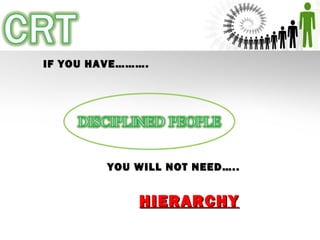
IF YOU HAVE……….IF YOU HAVE……….
YOU WILL NOT NEED…..YOU WILL NOT NEED…..
HIERARCHYHIERARCHY
IF YOU HAVE……….IF YOU HAVE……….
YOU WILL NOT NEED…..YOU WILL NOT NEED…..
BUREAUCRACYBUREAUCRACY
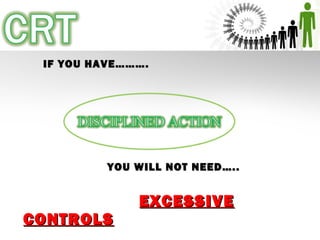
IF YOU HAVE……….IF YOU HAVE……….
YOU WILL NOT NEED…..YOU WILL NOT NEED…..
EXCESSIVEEXCESSIVE
CONTROLSCONTROLS
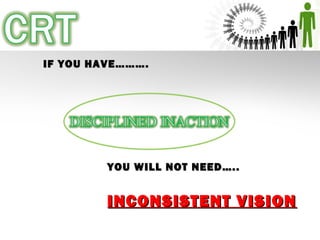
IF YOU HAVE……….IF YOU HAVE……….
YOU WILL NOT NEED…..YOU WILL NOT NEED…..
INCONSISTENT VISIONINCONSISTENT VISION
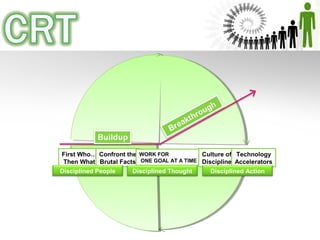
First Who…
Then What
Confront the
Brutal Facts
WORK FOR
ONE GOAL AT A TIME
Culture of
Discipline
Technology
Accelerators
Disciplined People Disciplined Thought Disciplined Action
 People who “rinse their cottage cheese”People who “rinse their cottage cheese”
 Not about a tyrant who disciplinesNot about a tyrant who disciplines
 Getting disciplined people who engage inGetting disciplined people who engage in
disciplined thought and who then takedisciplined thought and who then take
disciplined action, fanatically consistentdisciplined action, fanatically consistent
with three circleswith three circles
Involves a duality.Involves a duality.
 Requires people who adhere to aRequires people who adhere to a
consistent system.consistent system.
 Gives people freedom and responsibilityGives people freedom and responsibility
within framework of that system.within framework of that system.
 Budgeting is to decide which arenas fitBudgeting is to decide which arenas fit
Hedgehog Concept and should be fully fundedHedgehog Concept and should be fully funded
and which should not be funded at all.and which should not be funded at all.
 ““Stop doing” lists are more important thanStop doing” lists are more important than
“to do” lists.“to do” lists.
 ““Anything that does not fit with ourAnything that does not fit with our
Hedgehog Concept, we will not do.”Hedgehog Concept, we will not do.”
 Includes willingness to shun opportunitiesIncludes willingness to shun opportunities
that fall outside the three circles.that fall outside the three circles.
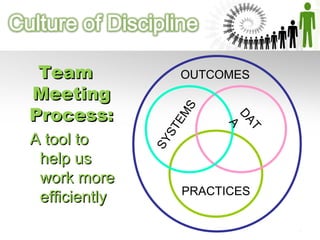
SYSTEMSPRACTICES
DAT
A
OUTCOMESTeamTeam
MeetingMeeting
Process:Process:
A tool toA tool to
help ushelp us
work morework more
efficientlyefficiently
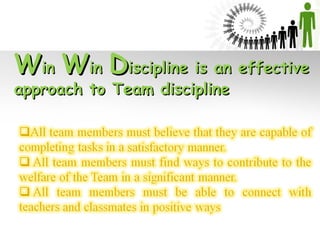
WWinin WWinin DDisciplineiscipline
WWinin WWinin DDiscipline is an effectiveiscipline is an effective
approach to Team disciplineapproach to Team discipline
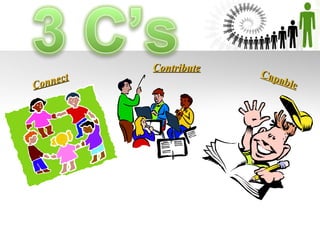
Connect
Connect
ContributeContribute
Capable
Capable
Win-Win Discipline
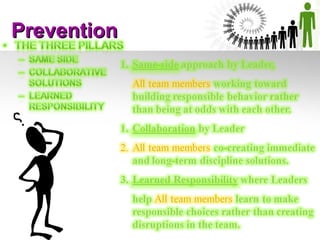
PreventionPrevention
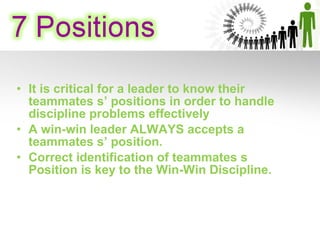
• It is critical for a leader to know their
teammates s’ positions in order to handle
discipline problems effectively
• A win-win leader ALWAYS accepts a
teammates s’ position.
• Correct identification of teammates s
Position is key to the Win-Win Discipline.
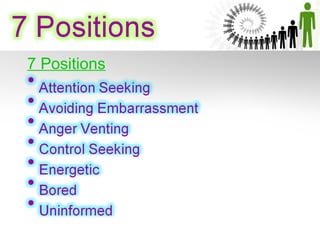
7 Positions
Key Lessons
Questions & Comments
Disciplined team

Disciplined team

  • 4.
    The purposes ofdisciplineThe purposes of discipline include:include: 1.1.Provide employees withProvide employees with adequate information aboutadequate information about how their current performance,how their current performance, attendance or behavior differsattendance or behavior differs from what’s expectedfrom what’s expected 2. Motivate and assist2. Motivate and assist employees in changing theiremployees in changing their
  • 5.
    3.3. Enhance employeemoraleEnhance employee morale and performance byand performance by “showing” that inadequate“showing” that inadequate performance by fellowperformance by fellow employees won’t just beemployees won’t just be toleratedtolerated
  • 6.
    Rule of thumb:Ruleof thumb: Similarly situatedSimilarly situated employees should receive similaremployees should receive similar penalties for similar offenses.penalties for similar offenses. (Employees do not have to receive(Employees do not have to receive identical penalties, but if all relevantidentical penalties, but if all relevant circumstances are similar, the penaltiescircumstances are similar, the penalties should be similar.)should be similar.) Rule of other thumbRule of other thumb: Major: Major differences in situation or circumstancesdifferences in situation or circumstances can justify very different penalties.can justify very different penalties. Adapted from HR on CampusAdapted from HR on Campus
  • 7.
  • 8.
    DISCIPLINE TEAMSDISCIPLINE TEAMS •Teamsare much more aboutTeams are much more about discipline than togetherness.discipline than togetherness. • Discipline Teams can beDiscipline Teams can be more quickly assembled,more quickly assembled, deployed, refocused anddeployed, refocused and disbanded, withoutdisbanded, without disrupting more permanentdisrupting more permanent structures and processesstructures and processes
  • 9.
    •A distinction alsoneeds to be madeA distinction also needs to be made between a performing team and a singlebetween a performing team and a single leader unit.leader unit. •In the single leader unit, someone takesIn the single leader unit, someone takes control, makes the key decisions,control, makes the key decisions, delegates and monitors individualdelegates and monitors individual assignments and chooses when and howassignments and chooses when and how to modify the working approach.to modify the working approach. •But teams are different. Members shareBut teams are different. Members share responsibilities and accountability andresponsibilities and accountability and complement each other. The team leadercomplement each other. The team leader is seldom the primary determinant of teamis seldom the primary determinant of team DISCIPLINE TEAMSDISCIPLINE TEAMS
  • 10.
    THE THREE LITMUSTESTSTHE THREE LITMUS TESTS The need for collective workThe need for collective work products to be delivered byproducts to be delivered by two or more people workingtwo or more people working together in real time.together in real time. Leadership roles that need toLeadership roles that need to shift among the members.shift among the members. The need for mutualThe need for mutual accountability in addition toaccountability in addition to individual accountabilityindividual accountability
  • 11.
    Katzenbach and SmithdiscussKatzenbach and Smith discuss the four elementsthe four elements •common commitment purpose.common commitment purpose. •performance goals.performance goals. •complementary skills.complementary skills. •mutual accountability. thatmutual accountability. that make teams function.make teams function. DISCIPLINE TEAMSDISCIPLINE TEAMS
  • 12.
    They also classifyteamsThey also classify teams into three varietiesinto three varieties • teams that recommendteams that recommend things,things, • teams that make or doteams that make or do things,things, • teams that run thingsteams that run things and describe how each typeand describe how each type DISCIPLINE TEAMSDISCIPLINE TEAMS
  • 14.
    IF YOU HAVE……….IFYOU HAVE………. YOU WILL NOT NEED…..YOU WILL NOT NEED….. HIERARCHYHIERARCHY
  • 15.
    IF YOU HAVE……….IFYOU HAVE………. YOU WILL NOT NEED…..YOU WILL NOT NEED….. BUREAUCRACYBUREAUCRACY
  • 16.
    IF YOU HAVE……….IFYOU HAVE………. YOU WILL NOT NEED…..YOU WILL NOT NEED….. EXCESSIVEEXCESSIVE CONTROLSCONTROLS
  • 17.
    IF YOU HAVE……….IFYOU HAVE………. YOU WILL NOT NEED…..YOU WILL NOT NEED….. INCONSISTENT VISIONINCONSISTENT VISION
  • 18.
    First Who… Then What Confrontthe Brutal Facts WORK FOR ONE GOAL AT A TIME Culture of Discipline Technology Accelerators Disciplined People Disciplined Thought Disciplined Action
  • 19.
     People who“rinse their cottage cheese”People who “rinse their cottage cheese”  Not about a tyrant who disciplinesNot about a tyrant who disciplines  Getting disciplined people who engage inGetting disciplined people who engage in disciplined thought and who then takedisciplined thought and who then take disciplined action, fanatically consistentdisciplined action, fanatically consistent with three circleswith three circles
  • 20.
    Involves a duality.Involvesa duality.  Requires people who adhere to aRequires people who adhere to a consistent system.consistent system.  Gives people freedom and responsibilityGives people freedom and responsibility within framework of that system.within framework of that system.
  • 21.
     Budgeting isto decide which arenas fitBudgeting is to decide which arenas fit Hedgehog Concept and should be fully fundedHedgehog Concept and should be fully funded and which should not be funded at all.and which should not be funded at all.  ““Stop doing” lists are more important thanStop doing” lists are more important than “to do” lists.“to do” lists.  ““Anything that does not fit with ourAnything that does not fit with our Hedgehog Concept, we will not do.”Hedgehog Concept, we will not do.”  Includes willingness to shun opportunitiesIncludes willingness to shun opportunities that fall outside the three circles.that fall outside the three circles.
  • 25.
    SYSTEMSPRACTICES DAT A OUTCOMESTeamTeam MeetingMeeting Process:Process: A tool toAtool to help ushelp us work morework more efficientlyefficiently
  • 26.
  • 27.
    WWinin WWinin DDisciplineis an effectiveiscipline is an effective approach to Team disciplineapproach to Team discipline
  • 28.
  • 29.
  • 30.
  • 32.
    • It iscritical for a leader to know their teammates s’ positions in order to handle discipline problems effectively • A win-win leader ALWAYS accepts a teammates s’ position. • Correct identification of teammates s Position is key to the Win-Win Discipline.
  • 33.
  • 34.
  • 40.