An Overview  By
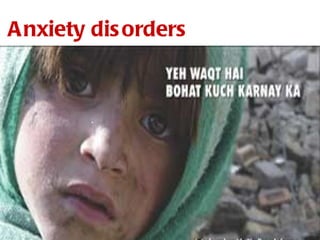
Anxiety disorders
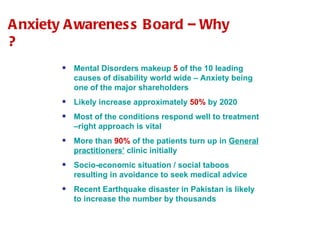
Anxiety Awareness Board – Why ? Mental Disorders makeup  5  of the 10 leading causes of disability world wide – Anxiety being one of the major shareholders Likely increase approximately  50%  by 2020 Most of the conditions respond well to treatment –right approach is vital More than  90%  of the patients turn up in  General practitioners’  clinic initially Socio-economic situation / social taboos resulting in avoidance to seek medical advice Recent Earthquake disaster in Pakistan is likely to increase the number by thousands
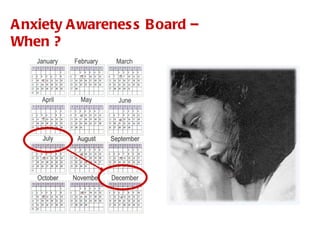
Anxiety Awareness Board – When ?
Anxiety Awareness Board – the logo ? AABP The Drop and ripples represent the concept of “ increasing awareness”
AAB Guidelines – Aims Increase awareness regarding anxiety Recognize anxiety as a treatable disorder Diffuse the influence of social taboos in order to make the patients seek medical advice Provide easy approaches in both psychotherapeutic and pharmacological areas to General Practitioners since most of the patients turn up in their clinics
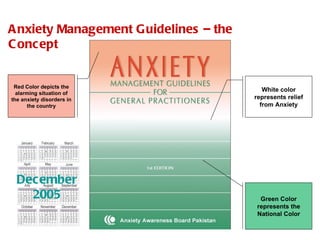
Red Color depicts the alarming situation of the anxiety disorders in the country Green Color represents the National Color December 2005 Anxiety Management Guidelines – the Concept White color represents relief from Anxiety
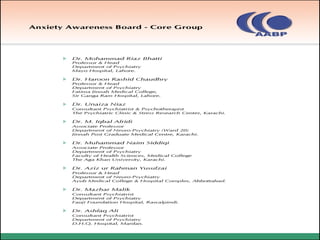
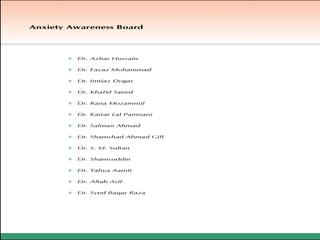
Anxiety Awareness Board – Core Members
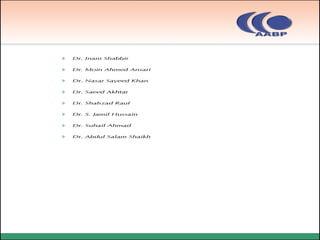
Anxiety Awareness Board – Members
 
AAB Guidelines   Highlights
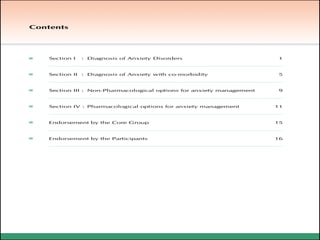
AAB Guidelines Contents - highlights
AAB Guidelines – Section I (Diagnosis) Anxiety Disorders Generalized Anxiety Disorder Panic Disorder Social Phobias Obsessive Compulsive Disorder Post Traumatic Stress Disorder
AAB Guidelines – Section II Anxiety Disorders with co-morbidities Psychiatric Disorders such as depression or Bipolar disorders Physical disorders such as hypertension, IHD, CVAs, Diabetes, gastritis  Drug induced AIDS Cancers In association with…
AAB Guidelines – Section III Non- Pharmacological Options for Anxiety Management Communication Skills (patient-doctor relationship) Advice on lifestyle changes  Relaxation techniques Religious therapy Other techniques such as sports and meditation
Pharmacological Options Benzodiazepines  Selective Serotinin Re-uptake Inhibitors (SSRIs)  Tricyclic Antidepressants (TCAs) Serotinin Noradrenaline Selective Serotinin Reuptake Inhibitor (SNRIs) Noradrenaline Selective Serotinin Agonist (NaSSA) Beta-Blockers AAB Guidelines – Section IV Long-acting Benzodiazepines Being the Recommended Choice
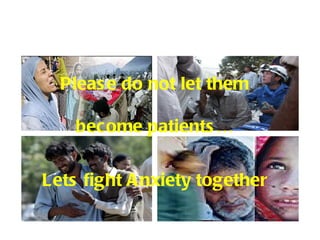
Please do not let them become patients… Lets fight Anxiety together

Aab guidelines overview_06a

  • 1.
  • 2.
  • 3.
    Anxiety Awareness Board– Why ? Mental Disorders makeup 5 of the 10 leading causes of disability world wide – Anxiety being one of the major shareholders Likely increase approximately 50% by 2020 Most of the conditions respond well to treatment –right approach is vital More than 90% of the patients turn up in General practitioners’ clinic initially Socio-economic situation / social taboos resulting in avoidance to seek medical advice Recent Earthquake disaster in Pakistan is likely to increase the number by thousands
  • 4.
  • 5.
    Anxiety Awareness Board– the logo ? AABP The Drop and ripples represent the concept of “ increasing awareness”
  • 6.
    AAB Guidelines –Aims Increase awareness regarding anxiety Recognize anxiety as a treatable disorder Diffuse the influence of social taboos in order to make the patients seek medical advice Provide easy approaches in both psychotherapeutic and pharmacological areas to General Practitioners since most of the patients turn up in their clinics
  • 7.
    Red Color depictsthe alarming situation of the anxiety disorders in the country Green Color represents the National Color December 2005 Anxiety Management Guidelines – the Concept White color represents relief from Anxiety
  • 8.
    Anxiety Awareness Board– Core Members
  • 9.
  • 10.
  • 11.
    AAB Guidelines Highlights
  • 12.
  • 13.
    AAB Guidelines –Section I (Diagnosis) Anxiety Disorders Generalized Anxiety Disorder Panic Disorder Social Phobias Obsessive Compulsive Disorder Post Traumatic Stress Disorder
  • 14.
    AAB Guidelines –Section II Anxiety Disorders with co-morbidities Psychiatric Disorders such as depression or Bipolar disorders Physical disorders such as hypertension, IHD, CVAs, Diabetes, gastritis Drug induced AIDS Cancers In association with…
  • 15.
    AAB Guidelines –Section III Non- Pharmacological Options for Anxiety Management Communication Skills (patient-doctor relationship) Advice on lifestyle changes Relaxation techniques Religious therapy Other techniques such as sports and meditation
  • 16.
    Pharmacological Options Benzodiazepines Selective Serotinin Re-uptake Inhibitors (SSRIs) Tricyclic Antidepressants (TCAs) Serotinin Noradrenaline Selective Serotinin Reuptake Inhibitor (SNRIs) Noradrenaline Selective Serotinin Agonist (NaSSA) Beta-Blockers AAB Guidelines – Section IV Long-acting Benzodiazepines Being the Recommended Choice
  • 17.
    Please do notlet them become patients… Lets fight Anxiety together