PEPTIC ULCER  & LIBRAX Presented by: IMRAN SHAFIQ MALIK
What is an ulcer? An ulcer is a sore in the lining of the stomach or duodenum (the first part of the small intestine). People of any age can acquire an ulcer.  Women are affected just as often as men.
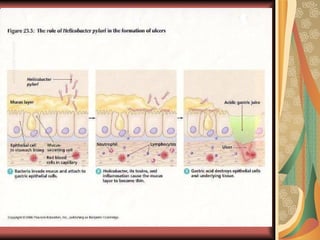
What causes Peptic ulcers?   Doctors used to think Peptic ulcers were caused  by stress or by eating food with too much acid in it.  We now know this isn’t true.  It is caused by an infection .  This infection is caused by a bacteria (germ) called  Helicobacter pylori  or H. pylori.
Helicobacter   pylori Bacteria That Cause Ulcers live organism   3D morphology   www.cellsalive.com
biology.kenyon.edu/.../ helicobacter/htm Helicobacter  is a Gram-negative, spiral shaped organism with flagella. It has a potent multisubunit urease enzyme that enables it to survive in acidic pH conditions and colonize the gastric environment (TIGR, 2004).  H. pylori  utilizes the enzyme urease to convert urea into bicarbonate and ammonia to combat the low acidity of the stomach. The mixing of the two extreme pH levels creates a neutralized protective cloud around the  H. pylori , allowing it to survive in the stomach (Helicobacter Foundation,  2004 )
HISTORY of Ulcer Early 20th Century  Ulcers are believed to be caused by stress and dietary factors. Treatment focuses on hospitalization, bed rest, and prescription of special bland foods. Later, gastric acid is blamed percent receive antibiotic therapy. Consumer for ulcer disease. Antacids and medications that block acid production become the standard of therapy. Despite this treatment, there is a high recurrence of ulcers.  1982  Australian physicians Robin Warren and Barry Marshall first identify the link between  Helicobacter pylori  ( H. pylori ) and ulcers, concluding that the bacterium, not stress or diet, causes ulcers. The medical community is slow to accept their findings. 1994  A National Institutes of Health Consensus Development Conference concludes that there is a strong association between  H. pylori  and ulcer disease, and recommends that ulcer patients with  H. pylori  infection be treated with antibiotics.  1995   Data show that about 75 percent of ulcer patients are still treated primarily with antisecretory medications, and only 5 research by the American Digestive Health Foundation finds that nearly 90 percent of ulcer sufferers are unaware that  H. pylori  causes ulcers. In fact, nearly 90 percent of those with ulcers blame their ulcers on stress or worry, and 60 percent point to diet.  1996 The Food and Drug Administration approves the first antibiotic for treatment of ulcer disease.  1997   (CDC), with other government agencies, academic institutions, and industry, launches a national education campaign to inform health care providers and consumers about the link between  H. pylori  and ulcers. This campaign reinforces the news that ulcers are a curable infection, and the fact that health can be greatly improved and money saved by disseminating information about  H. pylori.  Medical researchers sequence the  H. pylori  genome. This discovery can help scientists better understand the bacterium and design more effective drugs to fight it.
http:// www.faseb.org/opa/pylori/pylori.html Expected costs and days of treatment for ulcer therapy under three different protocols
http://www.safewater.org/facts/helicobacter.html  
Map showing percentages of population infected with H. pylori as determined by epidemiological studies.   http://www.faseb.org/opa/pylori/pylori.html
 
Symptoms   Abdominal pain Nausea Vomiting (with or without blood) Unintentional weight loss Chest pain Bloody stools Fatigue
Transmission Fecal-oral Cat feces on the hands Contaminated well water Infected object
Diagnosis Upper GI series of X-rays after injection of barium Endoscopy Specimen from stomach Laboratory technicians gram-stain smears of specimen Positive urease
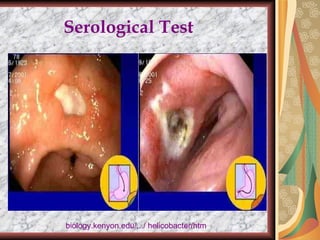
Serological Test  biology.kenyon.edu/.../ helicobacter/htm
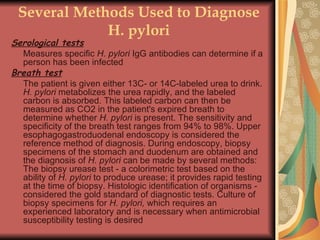
Several Methods Used to Diagnose H. pylori Serological tests   Measures specific  H. pylori  IgG antibodies can determine if a person has been infected  Breath test   The patient is given either 13C- or 14C-labeled urea to drink.  H. pylori  metabolizes the urea rapidly, and the labeled carbon is absorbed. This labeled carbon can then be measured as CO2 in the patient's expired breath to determine whether  H. pylori  is present. The sensitivity and specificity of the breath test ranges from 94% to 98%. Upper esophagogastroduodenal endoscopy is considered the reference method of diagnosis. During endoscopy, biopsy specimens of the stomach and duodenum are obtained and the diagnosis of  H. pylori  can be made by several methods: The biopsy urease test - a colorimetric test based on the ability of  H. pylori  to produce urease; it provides rapid testing at the time of biopsy. Histologic identification of organisms - considered the gold standard of diagnostic tests. Culture of biopsy specimens for  H. pylori,  which requires an experienced laboratory and is necessary when antimicrobial susceptibility testing is desired
Treatment Peptic ulcer are usually treated with a combination of antibiotics, acid suppressors and stomach protectors.  Drugs used to treat ulcers include: -antibiotics -antacids
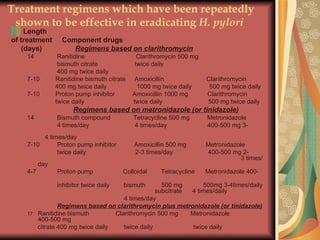
Treatment regimens which have been repeatedly shown to be effective in eradicating  H. pylori   Length  of treatment  Component drugs (days) Regimens based on clarithromycin 14  Ranitidine  Clarithromycin 500 mg bismuth citrate  twice daily 400 mg twice daily 7-10  Ranitidine bismuth citrate  Amoxicillin  Clarithromycin 400 mg twice daily  1000 mg twice daily  500 mg twice daily 7-10  Proton pump inhibitor  Amoxicillin 1000 mg  Clarithromycin twice daily  twice daily  500 mg twice daily Regimens based on metronidazole (or tinidazole) 14  Bismuth compound  Tetracycline 500 mg  Metronidazole 4 times/day  4 times/day  400-500 mg 3-    4 times/day 7-10  Proton pump inhibitor  Amoxicillin 500 mg  Metronidazole twice daily  2-3 times/day  400-500 mg 2-    3 times/day 4-7  Proton pump  Colloidal  Tetracycline  Metronidazole 400-  inhibitor twice daily  bismuth  500 mg  500mg 3-4times/daily      subcitrate  4 times/daily  4 times/day       Regimens based on clarithromycin plus metronidazole (or tinidazole) Ranitidine bismuth  Clarithromycin 500 mg  Metronidazole 400-500 mg  citrate 400 mg twice daily  twice daily  twice daily Proton pump inhibitor  Clarithromycin 500 mg  Metronidazole 400-500 mg  twice daily twice  daily twice daily  twice daily
References: http://bmj.bmjjournals.com/cgi/content/full/320/7226/31/T1   http://www.cdc.gov/ulcer http://digestive.niddk.nih.gov/ddiseases/pubs/hpylori http://www.cdc.gov/ulcer/history.htm http://www.familydoctor.org /271.xml Buaman, Robert W.  Microbiology  Alternate Edition with Disease by Body System

Ulcer

  • 1.
    PEPTIC ULCER & LIBRAX Presented by: IMRAN SHAFIQ MALIK
  • 2.
    What is anulcer? An ulcer is a sore in the lining of the stomach or duodenum (the first part of the small intestine). People of any age can acquire an ulcer. Women are affected just as often as men.
  • 3.
    What causes Pepticulcers? Doctors used to think Peptic ulcers were caused by stress or by eating food with too much acid in it. We now know this isn’t true. It is caused by an infection . This infection is caused by a bacteria (germ) called Helicobacter pylori or H. pylori.
  • 4.
    Helicobacter pylori Bacteria That Cause Ulcers live organism 3D morphology www.cellsalive.com
  • 5.
    biology.kenyon.edu/.../ helicobacter/htm Helicobacter is a Gram-negative, spiral shaped organism with flagella. It has a potent multisubunit urease enzyme that enables it to survive in acidic pH conditions and colonize the gastric environment (TIGR, 2004). H. pylori utilizes the enzyme urease to convert urea into bicarbonate and ammonia to combat the low acidity of the stomach. The mixing of the two extreme pH levels creates a neutralized protective cloud around the H. pylori , allowing it to survive in the stomach (Helicobacter Foundation, 2004 )
  • 6.
    HISTORY of UlcerEarly 20th Century Ulcers are believed to be caused by stress and dietary factors. Treatment focuses on hospitalization, bed rest, and prescription of special bland foods. Later, gastric acid is blamed percent receive antibiotic therapy. Consumer for ulcer disease. Antacids and medications that block acid production become the standard of therapy. Despite this treatment, there is a high recurrence of ulcers. 1982 Australian physicians Robin Warren and Barry Marshall first identify the link between Helicobacter pylori ( H. pylori ) and ulcers, concluding that the bacterium, not stress or diet, causes ulcers. The medical community is slow to accept their findings. 1994 A National Institutes of Health Consensus Development Conference concludes that there is a strong association between H. pylori and ulcer disease, and recommends that ulcer patients with H. pylori infection be treated with antibiotics. 1995 Data show that about 75 percent of ulcer patients are still treated primarily with antisecretory medications, and only 5 research by the American Digestive Health Foundation finds that nearly 90 percent of ulcer sufferers are unaware that H. pylori causes ulcers. In fact, nearly 90 percent of those with ulcers blame their ulcers on stress or worry, and 60 percent point to diet. 1996 The Food and Drug Administration approves the first antibiotic for treatment of ulcer disease. 1997 (CDC), with other government agencies, academic institutions, and industry, launches a national education campaign to inform health care providers and consumers about the link between H. pylori and ulcers. This campaign reinforces the news that ulcers are a curable infection, and the fact that health can be greatly improved and money saved by disseminating information about H. pylori. Medical researchers sequence the H. pylori genome. This discovery can help scientists better understand the bacterium and design more effective drugs to fight it.
  • 7.
    http:// www.faseb.org/opa/pylori/pylori.html Expectedcosts and days of treatment for ulcer therapy under three different protocols
  • 8.
  • 9.
    Map showing percentagesof population infected with H. pylori as determined by epidemiological studies. http://www.faseb.org/opa/pylori/pylori.html
  • 10.
  • 11.
    Symptoms Abdominal pain Nausea Vomiting (with or without blood) Unintentional weight loss Chest pain Bloody stools Fatigue
  • 12.
    Transmission Fecal-oral Catfeces on the hands Contaminated well water Infected object
  • 13.
    Diagnosis Upper GIseries of X-rays after injection of barium Endoscopy Specimen from stomach Laboratory technicians gram-stain smears of specimen Positive urease
  • 14.
    Serological Test biology.kenyon.edu/.../ helicobacter/htm
  • 15.
    Several Methods Usedto Diagnose H. pylori Serological tests Measures specific H. pylori IgG antibodies can determine if a person has been infected Breath test The patient is given either 13C- or 14C-labeled urea to drink. H. pylori metabolizes the urea rapidly, and the labeled carbon is absorbed. This labeled carbon can then be measured as CO2 in the patient's expired breath to determine whether H. pylori is present. The sensitivity and specificity of the breath test ranges from 94% to 98%. Upper esophagogastroduodenal endoscopy is considered the reference method of diagnosis. During endoscopy, biopsy specimens of the stomach and duodenum are obtained and the diagnosis of H. pylori can be made by several methods: The biopsy urease test - a colorimetric test based on the ability of H. pylori to produce urease; it provides rapid testing at the time of biopsy. Histologic identification of organisms - considered the gold standard of diagnostic tests. Culture of biopsy specimens for H. pylori, which requires an experienced laboratory and is necessary when antimicrobial susceptibility testing is desired
  • 16.
    Treatment Peptic ulcerare usually treated with a combination of antibiotics, acid suppressors and stomach protectors. Drugs used to treat ulcers include: -antibiotics -antacids
  • 17.
    Treatment regimens whichhave been repeatedly shown to be effective in eradicating H. pylori Length of treatment Component drugs (days) Regimens based on clarithromycin 14 Ranitidine Clarithromycin 500 mg bismuth citrate twice daily 400 mg twice daily 7-10 Ranitidine bismuth citrate Amoxicillin Clarithromycin 400 mg twice daily 1000 mg twice daily 500 mg twice daily 7-10 Proton pump inhibitor Amoxicillin 1000 mg Clarithromycin twice daily twice daily 500 mg twice daily Regimens based on metronidazole (or tinidazole) 14 Bismuth compound Tetracycline 500 mg Metronidazole 4 times/day 4 times/day 400-500 mg 3- 4 times/day 7-10 Proton pump inhibitor Amoxicillin 500 mg Metronidazole twice daily 2-3 times/day 400-500 mg 2- 3 times/day 4-7 Proton pump Colloidal Tetracycline Metronidazole 400- inhibitor twice daily bismuth 500 mg 500mg 3-4times/daily subcitrate 4 times/daily 4 times/day     Regimens based on clarithromycin plus metronidazole (or tinidazole) Ranitidine bismuth Clarithromycin 500 mg Metronidazole 400-500 mg citrate 400 mg twice daily twice daily twice daily Proton pump inhibitor Clarithromycin 500 mg Metronidazole 400-500 mg twice daily twice daily twice daily twice daily
  • 18.
    References: http://bmj.bmjjournals.com/cgi/content/full/320/7226/31/T1 http://www.cdc.gov/ulcer http://digestive.niddk.nih.gov/ddiseases/pubs/hpylori http://www.cdc.gov/ulcer/history.htm http://www.familydoctor.org /271.xml Buaman, Robert W. Microbiology Alternate Edition with Disease by Body System