



Glyburide
(Doanil tablet)
๏ฌ
๏ฌ
๏ฌ
๏ฌwww. Mmhennawy.co.nrwww. Mmhennawy.co.nr
๏ฌshows promise for women with
gestational diabetes and pregnant
women with type 2 diabetes
๏ฌWhat about women withWhat about women with
type 2 diabetes, who aretype 2 diabetes, who are
taking diabetes pills, ortaking diabetes pills, or
women who have hadwomen who have had
gestational diabetes in thegestational diabetes in the
past?past?
๏ฌWill they need insulin, orWill they need insulin, or
will diabetes pills be okay towill diabetes pills be okay to
use during pregnancyuse during pregnancy??
glyburideglyburide
Glyburide is a sulfonylurea drug used to lowerGlyburide is a sulfonylurea drug used to lower
blood sugar levels in people with type 2blood sugar levels in people with type 2
diabetes(non-insulin-dependentdiabetes(non-insulin-dependent((
Glyburide appears to lower the blood glucoseGlyburide appears to lower the blood glucose
acutely by stimulating the release of insulin fromacutely by stimulating the release of insulin from
the pancreas, an effect dependent uponthe pancreas, an effect dependent upon
functioning beta cells in the pancreatic isletsfunctioning beta cells in the pancreatic islets
glyburide, a type of sulfonylurea drug, does notglyburide, a type of sulfonylurea drug, does not
pass through the placentapass through the placenta
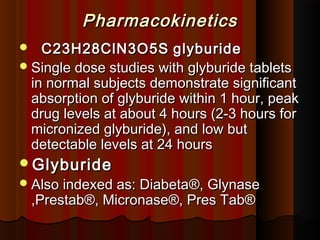
PharmacokineticsPharmacokinetics
๏ฌ C23H28ClN3O5SC23H28ClN3O5S glyburideglyburide
๏ฌSingle dose studies with glyburide tabletsSingle dose studies with glyburide tablets
in normal subjects demonstrate significantin normal subjects demonstrate significant
absorption of glyburide within 1 hour, peakabsorption of glyburide within 1 hour, peak
drug levels at about 4 hours (2-3 hours fordrug levels at about 4 hours (2-3 hours for
micronized glyburide), and low butmicronized glyburide), and low but
detectable levels at 24 hoursdetectable levels at 24 hours
๏ฌGlyburideGlyburide
๏ฌAlso indexed as: DiabetaAlso indexed as: Diabetaยฎยฎ, Glynase, Glynase
,Prestab,Prestabยฎยฎ, Micronase, Micronaseยฎยฎ, Pres Tab, Pres Tabยฎยฎ
SulfonylureasSulfonylureas๏ฌ First-Generation Agents:First-Generation Agents:
๏ฌ Generic Name: acetohexamideGeneric Name: acetohexamide
Brand Name: DymelorBrand Name: Dymelor
๏ฌ Generic Name: chloropropamideGeneric Name: chloropropamide
Brand Name: DiabineseBrand Name: Diabinese
๏ฌ Generic Name: tolazamideGeneric Name: tolazamide
Brand Name: TolinaseBrand Name: Tolinase
๏ฌ Generic Name: tolbutamideGeneric Name: tolbutamide
Brand Name: OrinaseBrand Name: Orinase
๏ฌ Second-Generation AgentsSecond-Generation Agents::
๏ฌ Generic Name: glimepirideGeneric Name: glimepiride
Brand Name:Brand Name: AmarylAmaryl
๏ฌ Generic Name: glipizideGeneric Name: glipizide
Brand Names: GlucotrolBrand Names: Glucotrol,, Glucotrol XLGlucotrol XL
๏ฌ Generic Name: glyburideGeneric Name: glyburide
Brand Names: DiaBeta, MicronaseBrand Names: DiaBeta, Micronase,, GlynaseGlynase
๏ฌ Combination AgentsCombination Agents::
๏ฌ Generic Name: glyburide plusGeneric Name: glyburide plus metforminmetformin
Brand Name:Brand Name: GlucoVanceGlucoVance
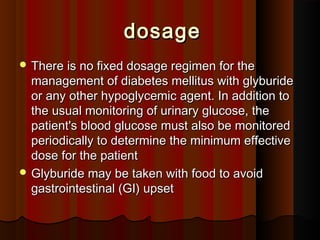
dosagedosage
๏ฌ There is no fixed dosage regimen for theThere is no fixed dosage regimen for the
management of diabetes mellitus with glyburidemanagement of diabetes mellitus with glyburide
or any other hypoglycemic agent. In addition toor any other hypoglycemic agent. In addition to
the usual monitoring of urinary glucose, thethe usual monitoring of urinary glucose, the
patient's blood glucose must also be monitoredpatient's blood glucose must also be monitored
periodically to determine the minimum effectiveperiodically to determine the minimum effective
dose for the patientdose for the patient
๏ฌ Glyburide may be taken with food to avoidGlyburide may be taken with food to avoid
gastrointestinal (GI) upsetgastrointestinal (GI) upset
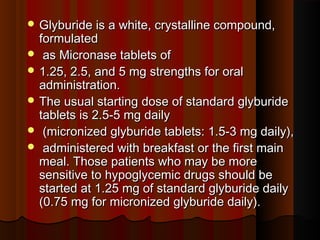
๏ฌ Glyburide is a white, crystalline compound,Glyburide is a white, crystalline compound,
formulatedformulated
๏ฌ as Micronase tablets ofas Micronase tablets of
๏ฌ 1.25, 2.5, and 5 mg strengths for oral1.25, 2.5, and 5 mg strengths for oral
administration.administration.
๏ฌ The usual starting dose of standard glyburideThe usual starting dose of standard glyburide
tablets is 2.5-5 mg dailytablets is 2.5-5 mg daily
๏ฌ (micronized glyburide tablets: 1.5-3 mg daily),(micronized glyburide tablets: 1.5-3 mg daily),
๏ฌ administered with breakfast or the first mainadministered with breakfast or the first main
meal. Those patients who may be moremeal. Those patients who may be more
sensitive to hypoglycemic drugs should besensitive to hypoglycemic drugs should be
started at 1.25 mg of standard glyburide dailystarted at 1.25 mg of standard glyburide daily
(0.75 mg for micronized glyburide daily).(0.75 mg for micronized glyburide daily).
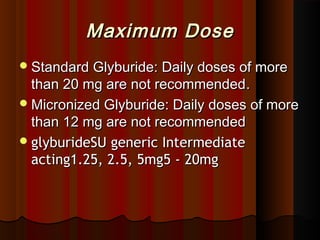
Maximum DoseMaximum Dose
๏ฌStandard Glyburide: Daily doses of moreStandard Glyburide: Daily doses of more
than 20 mg are not recommendedthan 20 mg are not recommended..
๏ฌMicronized Glyburide: Daily doses of moreMicronized Glyburide: Daily doses of more
than 12 mg are not recommendedthan 12 mg are not recommended
๏ฌglyburideSU generic IntermediateglyburideSU generic Intermediate
acting1.25, 2.5, 5mg5 - 20mgacting1.25, 2.5, 5mg5 - 20mg
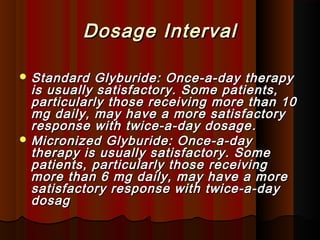
Dosage IntervalDosage Interval
๏ฌ Standard Glyburide: Once-a-day therapyStandard Glyburide: Once-a-day therapy
is usually satisfactory. Some patients,is usually satisfactory. Some patients,
particularly those receiving more than 10particularly those receiving more than 10
mg daily, may have a more satisfactorymg daily, may have a more satisfactory
response with twice-a-day dosageresponse with twice-a-day dosage ..
๏ฌ Micronized Glyburide: Once-a-dayMicronized Glyburide: Once-a-day
therapy is usually satisfactory. Sometherapy is usually satisfactory. Some
patients, particularly those receivingpatients, particularly those receiving
more than 6 mg daily, may have a moremore than 6 mg daily, may have a more
satisfactory response with twice-a-daysatisfactory response with twice-a-day
dosagdosag
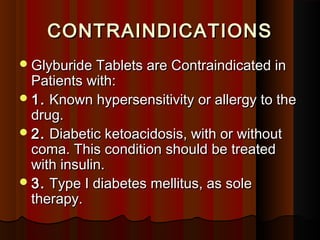
CONTRAINDICATIONSCONTRAINDICATIONS
๏ฌGlyburide Tablets are Contraindicated inGlyburide Tablets are Contraindicated in
Patients with:Patients with:
๏ฌ1.1. Known hypersensitivity or allergy to theKnown hypersensitivity or allergy to the
drug.drug.
๏ฌ2.2. Diabetic ketoacidosis, with or withoutDiabetic ketoacidosis, with or without
coma. This condition should be treatedcoma. This condition should be treated
with insulin.with insulin.
๏ฌ3.3. Type I diabetes mellitus, as soleType I diabetes mellitus, as sole
therapy.therapy.
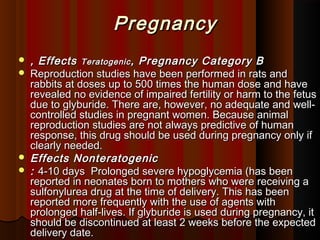
PregnancyPregnancy
๏ฌ , Effects, Effects TeratogenicTeratogenic , Pregnancy Category B, Pregnancy Category B
๏ฌ Reproduction studies have been performed in rats andReproduction studies have been performed in rats and
rabbits at doses up to 500 times the human dose and haverabbits at doses up to 500 times the human dose and have
revealed no evidence of impaired fertility or harm to the fetusrevealed no evidence of impaired fertility or harm to the fetus
due to glyburide. There are, however, no adequate and well-due to glyburide. There are, however, no adequate and well-
controlled studies in pregnant women. Because animalcontrolled studies in pregnant women. Because animal
reproduction studies are not always predictive of humanreproduction studies are not always predictive of human
response, this drug should be used during pregnancy only ifresponse, this drug should be used during pregnancy only if
clearly needed.clearly needed.
๏ฌ EffectsEffects NonteratogenicNonteratogenic
๏ฌ :: 4-10 days ย Prolonged severe hypoglycemia (has been4-10 days ย Prolonged severe hypoglycemia (has been
reported in neonates born to mothers who were receiving areported in neonates born to mothers who were receiving a
sulfonylurea drug at the time of delivery. This has beensulfonylurea drug at the time of delivery. This has been
reported more frequently with the use of agents withreported more frequently with the use of agents with
prolonged half-lives. If glyburide is used during pregnancy, itprolonged half-lives. If glyburide is used during pregnancy, it
should be discontinued at least 2 weeks before the expectedshould be discontinued at least 2 weeks before the expected
delivery date.delivery date.
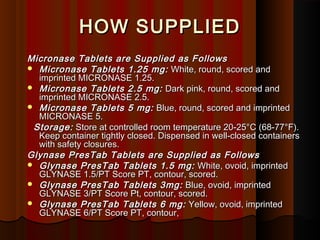
HOW SUPPLIEDHOW SUPPLIED
Micronase Tablets are Supplied as FollowsMicronase Tablets are Supplied as Follows
๏ฌ Micronase Tablets 1.25 mg:Micronase Tablets 1.25 mg: ย ย White, round, scored andWhite, round, scored and
imprinted MICRONASE 1.25.imprinted MICRONASE 1.25.
๏ฌ Micronase Tablets 2.5 mg:Micronase Tablets 2.5 mg: ย ย Dark pink, round, scored andDark pink, round, scored and
imprinted MICRONASE 2.5.imprinted MICRONASE 2.5.
๏ฌ Micronase Tablets 5 mg:Micronase Tablets 5 mg:ย ย Blue, round, scored and imprintedBlue, round, scored and imprinted
MICRONASE 5.MICRONASE 5.
Storage:Storage:ย ย Store at controlled room temperature 20-25ยฐC (68-77ยฐF).Store at controlled room temperature 20-25ยฐC (68-77ยฐF).
Keep container tightly closed. Dispensed in well-closed containersKeep container tightly closed. Dispensed in well-closed containers
with safety closures.with safety closures.
Glynase PresTab Tablets are Supplied as FollowsGlynase PresTab Tablets are Supplied as Follows
๏ฌ Glynase PresTab Tablets 1.5 mg:Glynase PresTab Tablets 1.5 mg: ย ย White, ovoid, imprintedWhite, ovoid, imprinted
GLYNASE 1.5/PT Score PT, contour, scored.GLYNASE 1.5/PT Score PT, contour, scored.
๏ฌ Glynase PresTab Tablets 3mg:Glynase PresTab Tablets 3mg:ย ย Blue, ovoid, imprintedBlue, ovoid, imprinted
GLYNASE 3/PT Score Pt, contour, scored.GLYNASE 3/PT Score Pt, contour, scored.
๏ฌ Glynase PresTab Tablets 6 mg:Glynase PresTab Tablets 6 mg: ย ย Yellow, ovoid, imprintedYellow, ovoid, imprinted
GLYNASE 6/PT Score PT, contour,GLYNASE 6/PT Score PT, contour,
๏ฌinsulin is considered the drug ofinsulin is considered the drug of
choice for the treatment ofchoice for the treatment of
gestational diabetes; however, it isgestational diabetes; however, it is
expensive and its administration isexpensive and its administration is
inconvenientinconvenient
๏ฌ""Women with gestational diabetesWomen with gestational diabetes
mellitus are rarely treated with amellitus are rarely treated with a
sulfonylurea drug, because ofsulfonylurea drug, because of
concern about teratogenicity andconcern about teratogenicity and
neonatal hypoglycemianeonatal hypoglycemia ..
๏ฌ. Gestational diabetes is rarely diagnosed. Gestational diabetes is rarely diagnosed
during the first trimester of pregnancy, theduring the first trimester of pregnancy, the
period when organogenesis and moreperiod when organogenesis and more
severe malformations occur. Therefore itsevere malformations occur. Therefore it
seems unlikely that a pregnant femaleseems unlikely that a pregnant female
would receive treatment for gestationalwould receive treatment for gestational
diabetes during this time period. Evendiabetes during this time period. Even
though the results of this study showthough the results of this study show
promise with regards to the use of second-promise with regards to the use of second-
generation sulfonylureas for the treatmentgeneration sulfonylureas for the treatment
of gestational diabetes, more studies needof gestational diabetes, more studies need
to be conducted before these medicationsto be conducted before these medications
can be considered safe in pregnancy.can be considered safe in pregnancy.
A Comparison of Glyburide andA Comparison of Glyburide and
Insulin in Women with GestationalInsulin in Women with Gestational
Diabetes MellitusDiabetes Mellitus..
๏ฌThe new sulphonylurea called glyburideThe new sulphonylurea called glyburide
does not cross the placental barrierdoes not cross the placental barrier
published in The New Englandpublished in The New England
Journal of MedicineJournal of Medicine
Volume 343Volume 343 October 19, 2000October 19, 2000
Number 16Number 16
๏ฌ Of the 404 womenwith singleton pregnancies andOf the 404 womenwith singleton pregnancies and
gestational diabetes that required treatmen , 201gestational diabetes that required treatmen , 201
received glyburide and 203 received human insulinreceived glyburide and 203 received human insulin
๏ฌ between 11 and 33 weeks of gestationbetween 11 and 33 weeks of gestation
๏ฌ The meanThe mean (ยฑ(ยฑ SD) serum glucose concentrationSD) serum glucose concentration
observed during routine visits to the clinic was 102observed during routine visits to the clinic was 102ยฑยฑ
2424 mg/dl in the glyburide group and 99mg/dl in the glyburide group and 99ยฑ 22ยฑ 22 mg/dl inmg/dl in
the insulin groupthe insulin group..
๏ฌ In addition, 82% of women in the glyburideIn addition, 82% of women in the glyburide
group and 88% of women in the insulin groupgroup and 88% of women in the insulin group
had home blood glucose measurements that fellhad home blood glucose measurements that fell
into the desired rangeinto the desired range
๏ฌ .. No significant differences existed between theNo significant differences existed between the
two groups with regards to perinatal outcometwo groups with regards to perinatal outcome ..
๏ฌThe incidence of macrosomia between theThe incidence of macrosomia between the
groups was similar; 11% in the glyburidegroups was similar; 11% in the glyburide
group and 10% in the insulin groupgroup and 10% in the insulin group
๏ฌ.. The cord serum of all infants wasThe cord serum of all infants was
measured for the presence of glyburide;measured for the presence of glyburide;
however, the drug was not detected in anyhowever, the drug was not detected in any
of the infantsof the infants ..
๏ฌ There were no significant differencesThere were no significant differences
between the glyburide and insulin groups inbetween the glyburide and insulin groups in
the percentage of infants who werethe percentage of infants who were large forlarge for
gestational agegestational age (12 percent and 13 percent,(12 percent and 13 percent,
respectivelyrespectively ))
๏ฌ who hadwho had macrosomiamacrosomia, defined as a birth, defined as a birth
weight of 4000 g or more (7 percent and 4weight of 4000 g or more (7 percent and 4
percentpercent
๏ฌ );); who hadwho had lung complicationslung complications (8 percent and(8 percent and
6 percent6 percent
๏ฌ );); who hadwho had hypoglycemiahypoglycemia (9 percent and 6(9 percent and 6
percentpercent
๏ฌ who were admitted to awho were admitted to a neonatal intensiveneonatal intensive
care unitcare unit (6 percent and 7 percent(6 percent and 7 percent
๏ฌ who hadwho had fetal anomaliesfetal anomalies (2 percent and 2(2 percent and 2
percent )percent )
๏ฌ TheThe cord-serum insulincord-serum insulin concentrations wereconcentrations were
similar in the two groups)similar in the two groups)
REFERENCESREFERENCES
๏ฌ Langer OD, Conway DL, Berkus MD, XenakisLanger OD, Conway DL, Berkus MD, Xenakis
EMJ, and Gonzales O. A comparison ofEMJ, and Gonzales O. A comparison of
glyburide and insulin in women with gestationalglyburide and insulin in women with gestational
diabetes. N Engl J Med 2000;343:1134-38.diabetes. N Engl J Med 2000;343:1134-38.
๏ฌ Greene MF. Oral hypoglycemic drugs forGreene MF. Oral hypoglycemic drugs for
gestational diabetes. N Engl J Medgestational diabetes. N Engl J Med
2000;343:1178-79.2000;343:1178-79.
๏ฌ Briggs GK, Freeman RK, Yaffe SJ, editors.Briggs GK, Freeman RK, Yaffe SJ, editors.
Drugs in Pregnancy and Lactation. 5th ed.Drugs in Pregnancy and Lactation. 5th ed.
Baltimore: Williams & Wilkins. 1998Baltimore: Williams & Wilkins. 1998
CONCLUSIONSCONCLUSIONS::
๏ฌ In women with gestational diabetes, glyburide isIn women with gestational diabetes, glyburide is
a clinically effective alternative to insulin therapya clinically effective alternative to insulin therapy
๏ฌ ."."The adverse reactions in the newborn areThe adverse reactions in the newborn are
therefore avoided and control of diabetes in thetherefore avoided and control of diabetes in the
mother is as good as with insulin. Both in termsmother is as good as with insulin. Both in terms
of efficacy and adverse reactions there is noof efficacy and adverse reactions there is no
statistical significant differencestatistical significant difference
๏ฌ that glyburide, a type of sulfonylurea drug, doesthat glyburide, a type of sulfonylurea drug, does
not pass through the placentanot pass through the placenta ..
๏ฌThe percentage of newborns who wereThe percentage of newborns who were
large for their gestational age was similarlarge for their gestational age was similar
in both groups of women. In addition,in both groups of women. In addition,
there were no statistically significantthere were no statistically significant
differences in the infants' rates of birthdifferences in the infants' rates of birth
defects, lung complications or low blooddefects, lung complications or low blood
sugar.sugar.
ButBut
๏ฌWe must still exercise caution inWe must still exercise caution in
applying these findings to clinicalapplying these findings to clinical
practice. Results need to bepractice. Results need to be
duplicated and the risk for fetalduplicated and the risk for fetal
malformations with the use ofmalformations with the use of
these agents during pregnancythese agents during pregnancy
remains a concern."remains a concern."

Glyburide doanil

  • 1.
  • 2.
    ๏ฌshows promise forwomen with gestational diabetes and pregnant women with type 2 diabetes
  • 3.
    ๏ฌWhat about womenwithWhat about women with type 2 diabetes, who aretype 2 diabetes, who are taking diabetes pills, ortaking diabetes pills, or women who have hadwomen who have had gestational diabetes in thegestational diabetes in the past?past? ๏ฌWill they need insulin, orWill they need insulin, or will diabetes pills be okay towill diabetes pills be okay to use during pregnancyuse during pregnancy??
  • 4.
    glyburideglyburide Glyburide is asulfonylurea drug used to lowerGlyburide is a sulfonylurea drug used to lower blood sugar levels in people with type 2blood sugar levels in people with type 2 diabetes(non-insulin-dependentdiabetes(non-insulin-dependent(( Glyburide appears to lower the blood glucoseGlyburide appears to lower the blood glucose acutely by stimulating the release of insulin fromacutely by stimulating the release of insulin from the pancreas, an effect dependent uponthe pancreas, an effect dependent upon functioning beta cells in the pancreatic isletsfunctioning beta cells in the pancreatic islets glyburide, a type of sulfonylurea drug, does notglyburide, a type of sulfonylurea drug, does not pass through the placentapass through the placenta
  • 5.
    PharmacokineticsPharmacokinetics ๏ฌ C23H28ClN3O5SC23H28ClN3O5S glyburideglyburide ๏ฌSingledose studies with glyburide tabletsSingle dose studies with glyburide tablets in normal subjects demonstrate significantin normal subjects demonstrate significant absorption of glyburide within 1 hour, peakabsorption of glyburide within 1 hour, peak drug levels at about 4 hours (2-3 hours fordrug levels at about 4 hours (2-3 hours for micronized glyburide), and low butmicronized glyburide), and low but detectable levels at 24 hoursdetectable levels at 24 hours ๏ฌGlyburideGlyburide ๏ฌAlso indexed as: DiabetaAlso indexed as: Diabetaยฎยฎ, Glynase, Glynase ,Prestab,Prestabยฎยฎ, Micronase, Micronaseยฎยฎ, Pres Tab, Pres Tabยฎยฎ
  • 6.
    SulfonylureasSulfonylureas๏ฌ First-Generation Agents:First-GenerationAgents: ๏ฌ Generic Name: acetohexamideGeneric Name: acetohexamide Brand Name: DymelorBrand Name: Dymelor ๏ฌ Generic Name: chloropropamideGeneric Name: chloropropamide Brand Name: DiabineseBrand Name: Diabinese ๏ฌ Generic Name: tolazamideGeneric Name: tolazamide Brand Name: TolinaseBrand Name: Tolinase ๏ฌ Generic Name: tolbutamideGeneric Name: tolbutamide Brand Name: OrinaseBrand Name: Orinase ๏ฌ Second-Generation AgentsSecond-Generation Agents:: ๏ฌ Generic Name: glimepirideGeneric Name: glimepiride Brand Name:Brand Name: AmarylAmaryl ๏ฌ Generic Name: glipizideGeneric Name: glipizide Brand Names: GlucotrolBrand Names: Glucotrol,, Glucotrol XLGlucotrol XL ๏ฌ Generic Name: glyburideGeneric Name: glyburide Brand Names: DiaBeta, MicronaseBrand Names: DiaBeta, Micronase,, GlynaseGlynase ๏ฌ Combination AgentsCombination Agents:: ๏ฌ Generic Name: glyburide plusGeneric Name: glyburide plus metforminmetformin Brand Name:Brand Name: GlucoVanceGlucoVance
  • 7.
    dosagedosage ๏ฌ There isno fixed dosage regimen for theThere is no fixed dosage regimen for the management of diabetes mellitus with glyburidemanagement of diabetes mellitus with glyburide or any other hypoglycemic agent. In addition toor any other hypoglycemic agent. In addition to the usual monitoring of urinary glucose, thethe usual monitoring of urinary glucose, the patient's blood glucose must also be monitoredpatient's blood glucose must also be monitored periodically to determine the minimum effectiveperiodically to determine the minimum effective dose for the patientdose for the patient ๏ฌ Glyburide may be taken with food to avoidGlyburide may be taken with food to avoid gastrointestinal (GI) upsetgastrointestinal (GI) upset
  • 8.
    ๏ฌ Glyburide isa white, crystalline compound,Glyburide is a white, crystalline compound, formulatedformulated ๏ฌ as Micronase tablets ofas Micronase tablets of ๏ฌ 1.25, 2.5, and 5 mg strengths for oral1.25, 2.5, and 5 mg strengths for oral administration.administration. ๏ฌ The usual starting dose of standard glyburideThe usual starting dose of standard glyburide tablets is 2.5-5 mg dailytablets is 2.5-5 mg daily ๏ฌ (micronized glyburide tablets: 1.5-3 mg daily),(micronized glyburide tablets: 1.5-3 mg daily), ๏ฌ administered with breakfast or the first mainadministered with breakfast or the first main meal. Those patients who may be moremeal. Those patients who may be more sensitive to hypoglycemic drugs should besensitive to hypoglycemic drugs should be started at 1.25 mg of standard glyburide dailystarted at 1.25 mg of standard glyburide daily (0.75 mg for micronized glyburide daily).(0.75 mg for micronized glyburide daily).
  • 9.
    Maximum DoseMaximum Dose ๏ฌStandardGlyburide: Daily doses of moreStandard Glyburide: Daily doses of more than 20 mg are not recommendedthan 20 mg are not recommended.. ๏ฌMicronized Glyburide: Daily doses of moreMicronized Glyburide: Daily doses of more than 12 mg are not recommendedthan 12 mg are not recommended ๏ฌglyburideSU generic IntermediateglyburideSU generic Intermediate acting1.25, 2.5, 5mg5 - 20mgacting1.25, 2.5, 5mg5 - 20mg
  • 10.
    Dosage IntervalDosage Interval ๏ฌStandard Glyburide: Once-a-day therapyStandard Glyburide: Once-a-day therapy is usually satisfactory. Some patients,is usually satisfactory. Some patients, particularly those receiving more than 10particularly those receiving more than 10 mg daily, may have a more satisfactorymg daily, may have a more satisfactory response with twice-a-day dosageresponse with twice-a-day dosage .. ๏ฌ Micronized Glyburide: Once-a-dayMicronized Glyburide: Once-a-day therapy is usually satisfactory. Sometherapy is usually satisfactory. Some patients, particularly those receivingpatients, particularly those receiving more than 6 mg daily, may have a moremore than 6 mg daily, may have a more satisfactory response with twice-a-daysatisfactory response with twice-a-day dosagdosag
  • 11.
    CONTRAINDICATIONSCONTRAINDICATIONS ๏ฌGlyburide Tablets areContraindicated inGlyburide Tablets are Contraindicated in Patients with:Patients with: ๏ฌ1.1. Known hypersensitivity or allergy to theKnown hypersensitivity or allergy to the drug.drug. ๏ฌ2.2. Diabetic ketoacidosis, with or withoutDiabetic ketoacidosis, with or without coma. This condition should be treatedcoma. This condition should be treated with insulin.with insulin. ๏ฌ3.3. Type I diabetes mellitus, as soleType I diabetes mellitus, as sole therapy.therapy.
  • 12.
    PregnancyPregnancy ๏ฌ , Effects,Effects TeratogenicTeratogenic , Pregnancy Category B, Pregnancy Category B ๏ฌ Reproduction studies have been performed in rats andReproduction studies have been performed in rats and rabbits at doses up to 500 times the human dose and haverabbits at doses up to 500 times the human dose and have revealed no evidence of impaired fertility or harm to the fetusrevealed no evidence of impaired fertility or harm to the fetus due to glyburide. There are, however, no adequate and well-due to glyburide. There are, however, no adequate and well- controlled studies in pregnant women. Because animalcontrolled studies in pregnant women. Because animal reproduction studies are not always predictive of humanreproduction studies are not always predictive of human response, this drug should be used during pregnancy only ifresponse, this drug should be used during pregnancy only if clearly needed.clearly needed. ๏ฌ EffectsEffects NonteratogenicNonteratogenic ๏ฌ :: 4-10 days ย Prolonged severe hypoglycemia (has been4-10 days ย Prolonged severe hypoglycemia (has been reported in neonates born to mothers who were receiving areported in neonates born to mothers who were receiving a sulfonylurea drug at the time of delivery. This has beensulfonylurea drug at the time of delivery. This has been reported more frequently with the use of agents withreported more frequently with the use of agents with prolonged half-lives. If glyburide is used during pregnancy, itprolonged half-lives. If glyburide is used during pregnancy, it should be discontinued at least 2 weeks before the expectedshould be discontinued at least 2 weeks before the expected delivery date.delivery date.
  • 13.
    HOW SUPPLIEDHOW SUPPLIED MicronaseTablets are Supplied as FollowsMicronase Tablets are Supplied as Follows ๏ฌ Micronase Tablets 1.25 mg:Micronase Tablets 1.25 mg: ย ย White, round, scored andWhite, round, scored and imprinted MICRONASE 1.25.imprinted MICRONASE 1.25. ๏ฌ Micronase Tablets 2.5 mg:Micronase Tablets 2.5 mg: ย ย Dark pink, round, scored andDark pink, round, scored and imprinted MICRONASE 2.5.imprinted MICRONASE 2.5. ๏ฌ Micronase Tablets 5 mg:Micronase Tablets 5 mg:ย ย Blue, round, scored and imprintedBlue, round, scored and imprinted MICRONASE 5.MICRONASE 5. Storage:Storage:ย ย Store at controlled room temperature 20-25ยฐC (68-77ยฐF).Store at controlled room temperature 20-25ยฐC (68-77ยฐF). Keep container tightly closed. Dispensed in well-closed containersKeep container tightly closed. Dispensed in well-closed containers with safety closures.with safety closures. Glynase PresTab Tablets are Supplied as FollowsGlynase PresTab Tablets are Supplied as Follows ๏ฌ Glynase PresTab Tablets 1.5 mg:Glynase PresTab Tablets 1.5 mg: ย ย White, ovoid, imprintedWhite, ovoid, imprinted GLYNASE 1.5/PT Score PT, contour, scored.GLYNASE 1.5/PT Score PT, contour, scored. ๏ฌ Glynase PresTab Tablets 3mg:Glynase PresTab Tablets 3mg:ย ย Blue, ovoid, imprintedBlue, ovoid, imprinted GLYNASE 3/PT Score Pt, contour, scored.GLYNASE 3/PT Score Pt, contour, scored. ๏ฌ Glynase PresTab Tablets 6 mg:Glynase PresTab Tablets 6 mg: ย ย Yellow, ovoid, imprintedYellow, ovoid, imprinted GLYNASE 6/PT Score PT, contour,GLYNASE 6/PT Score PT, contour,
  • 14.
    ๏ฌinsulin is consideredthe drug ofinsulin is considered the drug of choice for the treatment ofchoice for the treatment of gestational diabetes; however, it isgestational diabetes; however, it is expensive and its administration isexpensive and its administration is inconvenientinconvenient ๏ฌ""Women with gestational diabetesWomen with gestational diabetes mellitus are rarely treated with amellitus are rarely treated with a sulfonylurea drug, because ofsulfonylurea drug, because of concern about teratogenicity andconcern about teratogenicity and neonatal hypoglycemianeonatal hypoglycemia ..
  • 15.
    ๏ฌ. Gestational diabetesis rarely diagnosed. Gestational diabetes is rarely diagnosed during the first trimester of pregnancy, theduring the first trimester of pregnancy, the period when organogenesis and moreperiod when organogenesis and more severe malformations occur. Therefore itsevere malformations occur. Therefore it seems unlikely that a pregnant femaleseems unlikely that a pregnant female would receive treatment for gestationalwould receive treatment for gestational diabetes during this time period. Evendiabetes during this time period. Even though the results of this study showthough the results of this study show promise with regards to the use of second-promise with regards to the use of second- generation sulfonylureas for the treatmentgeneration sulfonylureas for the treatment of gestational diabetes, more studies needof gestational diabetes, more studies need to be conducted before these medicationsto be conducted before these medications can be considered safe in pregnancy.can be considered safe in pregnancy.
  • 16.
    A Comparison ofGlyburide andA Comparison of Glyburide and Insulin in Women with GestationalInsulin in Women with Gestational Diabetes MellitusDiabetes Mellitus.. ๏ฌThe new sulphonylurea called glyburideThe new sulphonylurea called glyburide does not cross the placental barrierdoes not cross the placental barrier
  • 17.
    published in TheNew Englandpublished in The New England Journal of MedicineJournal of Medicine Volume 343Volume 343 October 19, 2000October 19, 2000 Number 16Number 16 ๏ฌ Of the 404 womenwith singleton pregnancies andOf the 404 womenwith singleton pregnancies and gestational diabetes that required treatmen , 201gestational diabetes that required treatmen , 201 received glyburide and 203 received human insulinreceived glyburide and 203 received human insulin ๏ฌ between 11 and 33 weeks of gestationbetween 11 and 33 weeks of gestation ๏ฌ The meanThe mean (ยฑ(ยฑ SD) serum glucose concentrationSD) serum glucose concentration observed during routine visits to the clinic was 102observed during routine visits to the clinic was 102ยฑยฑ 2424 mg/dl in the glyburide group and 99mg/dl in the glyburide group and 99ยฑ 22ยฑ 22 mg/dl inmg/dl in the insulin groupthe insulin group..
  • 18.
    ๏ฌ In addition,82% of women in the glyburideIn addition, 82% of women in the glyburide group and 88% of women in the insulin groupgroup and 88% of women in the insulin group had home blood glucose measurements that fellhad home blood glucose measurements that fell into the desired rangeinto the desired range ๏ฌ .. No significant differences existed between theNo significant differences existed between the two groups with regards to perinatal outcometwo groups with regards to perinatal outcome ..
  • 19.
    ๏ฌThe incidence ofmacrosomia between theThe incidence of macrosomia between the groups was similar; 11% in the glyburidegroups was similar; 11% in the glyburide group and 10% in the insulin groupgroup and 10% in the insulin group ๏ฌ.. The cord serum of all infants wasThe cord serum of all infants was measured for the presence of glyburide;measured for the presence of glyburide; however, the drug was not detected in anyhowever, the drug was not detected in any of the infantsof the infants ..
  • 20.
    ๏ฌ There wereno significant differencesThere were no significant differences between the glyburide and insulin groups inbetween the glyburide and insulin groups in the percentage of infants who werethe percentage of infants who were large forlarge for gestational agegestational age (12 percent and 13 percent,(12 percent and 13 percent, respectivelyrespectively )) ๏ฌ who hadwho had macrosomiamacrosomia, defined as a birth, defined as a birth weight of 4000 g or more (7 percent and 4weight of 4000 g or more (7 percent and 4 percentpercent ๏ฌ );); who hadwho had lung complicationslung complications (8 percent and(8 percent and 6 percent6 percent ๏ฌ );); who hadwho had hypoglycemiahypoglycemia (9 percent and 6(9 percent and 6 percentpercent ๏ฌ who were admitted to awho were admitted to a neonatal intensiveneonatal intensive care unitcare unit (6 percent and 7 percent(6 percent and 7 percent ๏ฌ who hadwho had fetal anomaliesfetal anomalies (2 percent and 2(2 percent and 2 percent )percent ) ๏ฌ TheThe cord-serum insulincord-serum insulin concentrations wereconcentrations were similar in the two groups)similar in the two groups)
  • 21.
    REFERENCESREFERENCES ๏ฌ Langer OD,Conway DL, Berkus MD, XenakisLanger OD, Conway DL, Berkus MD, Xenakis EMJ, and Gonzales O. A comparison ofEMJ, and Gonzales O. A comparison of glyburide and insulin in women with gestationalglyburide and insulin in women with gestational diabetes. N Engl J Med 2000;343:1134-38.diabetes. N Engl J Med 2000;343:1134-38. ๏ฌ Greene MF. Oral hypoglycemic drugs forGreene MF. Oral hypoglycemic drugs for gestational diabetes. N Engl J Medgestational diabetes. N Engl J Med 2000;343:1178-79.2000;343:1178-79. ๏ฌ Briggs GK, Freeman RK, Yaffe SJ, editors.Briggs GK, Freeman RK, Yaffe SJ, editors. Drugs in Pregnancy and Lactation. 5th ed.Drugs in Pregnancy and Lactation. 5th ed. Baltimore: Williams & Wilkins. 1998Baltimore: Williams & Wilkins. 1998
  • 22.
    CONCLUSIONSCONCLUSIONS:: ๏ฌ In womenwith gestational diabetes, glyburide isIn women with gestational diabetes, glyburide is a clinically effective alternative to insulin therapya clinically effective alternative to insulin therapy ๏ฌ ."."The adverse reactions in the newborn areThe adverse reactions in the newborn are therefore avoided and control of diabetes in thetherefore avoided and control of diabetes in the mother is as good as with insulin. Both in termsmother is as good as with insulin. Both in terms of efficacy and adverse reactions there is noof efficacy and adverse reactions there is no statistical significant differencestatistical significant difference ๏ฌ that glyburide, a type of sulfonylurea drug, doesthat glyburide, a type of sulfonylurea drug, does not pass through the placentanot pass through the placenta ..
  • 23.
    ๏ฌThe percentage ofnewborns who wereThe percentage of newborns who were large for their gestational age was similarlarge for their gestational age was similar in both groups of women. In addition,in both groups of women. In addition, there were no statistically significantthere were no statistically significant differences in the infants' rates of birthdifferences in the infants' rates of birth defects, lung complications or low blooddefects, lung complications or low blood sugar.sugar.
  • 24.
    ButBut ๏ฌWe must stillexercise caution inWe must still exercise caution in applying these findings to clinicalapplying these findings to clinical practice. Results need to bepractice. Results need to be duplicated and the risk for fetalduplicated and the risk for fetal malformations with the use ofmalformations with the use of these agents during pregnancythese agents during pregnancy remains a concern."remains a concern."