DESCRIPTION
• GAZYVA (obinutuzumab) is a humanized anti-CD20
monoclonal antibody of the IgG1 subclass. It recognizes a
specific epitope of the CD20 molecule found on B-cells.
The molecular mass of the antibody is approximately 150
kDa.
• GAZYVA is produced by mammalian cell (CHO)
suspension culture. GAZYVA is a sterile, clear, colorless
to slightly brown, preservative free liquid concentrate for
intravenous administration. GAZYVA is supplied at a
concentration of 25 mg/mL in 1000 mg single use vials.
The product is formulated in 20 mM L-histidine/L-histidine
hydrochloride, 240 mM trehalose, 0.02% poloxamer 188.
The pH is 6.0.
GazyvaTM in Chronic
Lymphocytic Leukemia
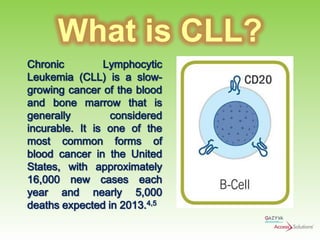
1. Gazyva is a medicine that works with the body’s own
immune system to attack blood cells called B-cells
that have a certain marker on their surface (CD20). Bcells are the cause of common blood cancers.1,2
2. Gazyva is FDA-approved for the treatment of people
with previously untreated chronic lymphocytic
leukemia (CLL) in combination with chlorambucil
chemotherapy.3
3. Phase III clinical data showed that Gazyva plus
chlorambucil chemotherapy helped people with CLL
live longer without the disease worsening than
chlorambucil chemotherapy alone.3
What is CLL?
Chronic
Lymphocytic
Leukemia (CLL) is a slowgrowing cancer of the blood
and bone marrow that is
generally
considered
incurable. It is one of the
most common forms of
blood cancer in the United
States, with approximately
16,000 new cases each
year and nearly 5,000
deaths expected in 2013.4,5
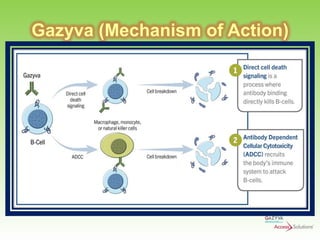
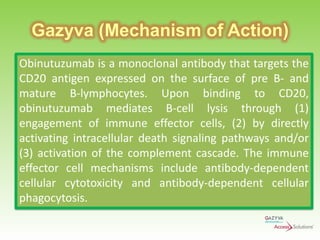
Gazyva (Mechanism of Action)
Obinutuzumab is a monoclonal antibody that targets the
CD20 antigen expressed on the surface of pre B- and
mature B-lymphocytes. Upon binding to CD20,
obinutuzumab mediates B-cell lysis through (1)
engagement of immune effector cells, (2) by directly
activating intracellular death signaling pathways and/or
(3) activation of the complement cascade. The immune
effector cell mechanisms include antibody-dependent
cellular cytotoxicity and antibody-dependent cellular
phagocytosis.
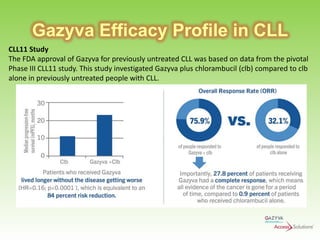
Gazyva Efficacy Profile in CLL
CLL11 Study
The FDA approval of Gazyva for previously untreated CLL was based on data from the pivotal
Phase III CLL11 study. This study investigated Gazyva plus chlorambucil (clb) compared to clb
alone in previously untreated people with CLL.
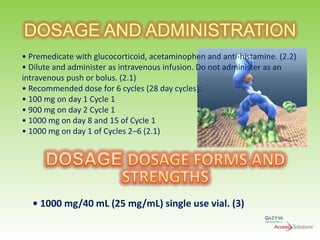
DOSAGE AND ADMINISTRATION
• Premedicate with glucocorticoid, acetaminophen and anti-histamine. (2.2)
• Dilute and administer as intravenous infusion. Do not administer as an
intravenous push or bolus. (2.1)
• Recommended dose for 6 cycles (28 day cycles):
• 100 mg on day 1 Cycle 1
• 900 mg on day 2 Cycle 1
• 1000 mg on day 8 and 15 of Cycle 1
• 1000 mg on day 1 of Cycles 2–6 (2.1)

• 1000 mg/40 mL (25 mg/mL) single use vial. (3)
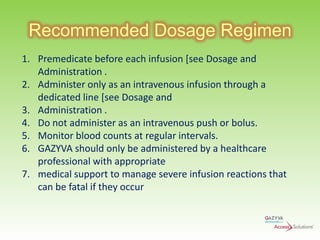
Recommended Dosage Regimen
1. Premedicate before each infusion [see Dosage and
Administration .
2. Administer only as an intravenous infusion through a
dedicated line [see Dosage and
3. Administration .
4. Do not administer as an intravenous push or bolus.
5. Monitor blood counts at regular intervals.
6. GAZYVA should only be administered by a healthcare
professional with appropriate
7. medical support to manage severe infusion reactions that
can be fatal if they occur
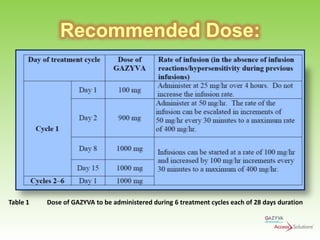
Recommended Dose:

Table 1

Dose of GAZYVA to be administered during 6 treatment cycles each of 28 days duration
Recommended Dose:
If a planned dose of GAZYVA is missed,
administer the missed dose as soon as
possible and adjust dosing schedule
accordingly. If appropriate, patients who
do not complete the Day 1 Cycle 1 dose
may proceed to the Day 2 Cycle 1 dose.
Recommended Dose:
If a patient experiences an infusion reaction of any grade during infusion, adjust
the infusion as follows
1. • Grade 4 (life threatening): Stop infusion immediately and permanently
discontinue GAZYVA therapy.
2. • Grade 3 (severe): Interrupt infusion and manage symptoms. Upon
resolution of symptoms, consider restarting GAZYVA infusion at no more
than half the previous rate (the rate being used at the time that the infusion
reaction occurred) and, if patient does not experience any further infusion
reaction symptoms, infusion rate escalation may resume at the increments
and intervals as appropriate for the treatment cycle dose. Permanently
discontinue treatment if patients experience a Grade 3 infusion related
symptom at re-challenge.
3. • Grade 1–2 (mild to moderate): Reduce infusion rate or interrupt infusion
and treat symptoms. Upon resolution of symptoms, continue or resume
infusion and, if patient does not experience any further infusion reaction
symptoms, infusion rate escalation may resume at the increments and
intervals as appropriate for the treatment cycle dose.
Recommended Premedication
Premedication is recommended to reduce the risk of infusion
reactions as outlined in Table 2. Hypotension may occur during
GAZYVA
intravenous
infusions.
Consider
withholding
antihypertensive treatments for 12 hours prior to and throughout
each GAZYVA infusion and for the first hour after administration.
For patients with high tumor burden and/or high circulating
absolute lymphocyte counts (greater than 25 x 109/L),
premedicate with anti-hyperuricemics (e.g., allopurinol)
beginning 12–24 hours prior to start of therapy and ensure
adequate hydration for prophylaxis of tumor lysis syndrome.
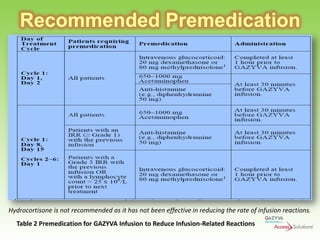
Recommended Premedication

Hydrocortisone is not recommended as it has not been effective in reducing the rate of infusion reactions.
Table 2 Premedication for GAZYVA Infusion to Reduce Infusion-Related Reactions
Pharmacodynamics
In clinical trials in patients with CLL, GAZYVA caused CD19 B-cell
depletion (defined as CD19 B-cell counts < 0.07 x 10⁹/L). Initial
CD19 B-cell recovery was observed in some patients
approximately 9 months after the last GAZYVA dose. At 18
months of follow up, some patients remain B-cell depleted.
Although the depletion of B-cells in the peripheral blood is a
measurable pharmacodynamic effect, it is not directly correlated
with the depletion of B-cells in solid organs or in malignant
deposits. B-cell depletion has not been shown to be directly
correlated to clinical response.
Cardiac Electrophysiology
The potential effects of GAZYVA on the QTc interval have not
been studied.
Pharmacokinetics
Based on a population pharmacokinetic (pop-PK) analysis, the geometric mean (CV%)
volume of distribution of obinutuzumab at steady state is approximately 3.8 (23) L.
The elimination of obinutuzumab is comprised of a linear clearance pathway and a timedependent non-linear clearance pathway. As GAZYVA treatment progresses, the impact of
the time-dependent pathway diminishes in a manner suggesting target mediated drug
disposition 13
(TMDD). Based on a pop-PK analysis, the geometric mean (CV%) terminal obinutuzumab
clearance and half-life are approximately 0.09 (46%) L/day and 28.4 (43%) days,
respectively.
Specific Populations:
Age: Age did not affect the pharmacokinetics of GAZYVA.
Body Weight: Volume of distribution and steady state clearance both increased with body
weight, however, the expected change in exposure does not warrant a dose modification.
Renal Impairment: Based on the population pharmacokinetic analysis, a baseline
creatinine clearance (CLcr) > 30 mL/min does not affect the pharmacokinetics of GAZYVA.
GAZYVA has not been studied in patients with a baseline CLcr < 30 mL/min.
Hepatic impairment: GAZYVA has not been studied in patients with hepatic impairment.
Infusion Reactions
 GAZYVA can cause severe and life-threatening infusion reactions. Two-thirds of
patients experienced a reaction to the first 1000 mg infused of GAZYVA. Infusion
reactions can also occur with subsequent infusions. Symptoms may include
hypotension, tachycardia, dyspnea, and respiratory symptoms (e.g., bronchospasm,
larynx and throat irritation, wheezing, laryngeal edema). Other common symptoms
include nausea, vomiting, diarrhea, hypertension, flushing, headache, pyrexia, and
chills

 Premedicate patients with acetaminophen, anti-histamine, and a
glucocorticoid. Institute medical management (e.g., glucocorticoids,
epinephrine, bronchodilators, and/or oxygen) for infusion 7 reactions as
needed. Closely monitor patients during the entire infusion. Infusion
reactions within 24 hours of receiving GAZYVA have occurred
Infusion Reactions
 For patients with any Grade 4 infusion reactions, including but not limited to
anaphylaxis, acute life-threatening respiratory symptoms, or other life-threatening infusion
reaction: Stop the GAZYVA infusion. Permanently discontinue GAZYVA therapy.
 For patients with Grade 1, 2, or 3 infusion reactions: Interrupt GAZYVA for Grade 3
reactions until resolution of symptoms. Interrupt or reduce the rate of the infusion for
Grade 1 or 2 reactions and manage symptoms.
 For patients with pre-existing cardiac or pulmonary conditions, monitor more frequently
throughout the infusion and the post-infusion period since they may be at greater risk of
experiencing more severe reactions. Hypotension may occur as part of the GAZYVA infusion
reaction. Consider withholding antihypertensive treatments for 12 hours prior to, during
each GAZYVA infusion, and for the first hour after administration until blood pressure is
stable. For patients at increased risk of hypertensive crisis, consider the benefits versus the
risks of withholding their hypertensive medication as is suggested here.
ADVERSE REACTIONS
The following adverse reactions are discussed in greater
detail in other sections of the label:
1.
2.
3.
4.
5.
6.

Hepatitis B reactivation
Progressive multifocal leukoencephalopathy
Infusion reactions
Tumor lysis syndrome
Neutropenia
Thrombocytopenia

The most common adverse reactions (incidence ≥ 10%) were: infusion
reactions, neutropenia, thrombocytopenia, anemia, pyrexia, cough,
and musculoskeletal disorders
Immunogenicity
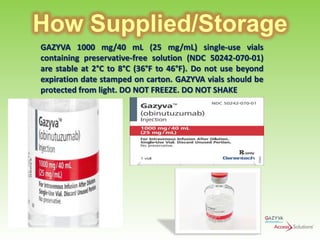
How Supplied/Storage
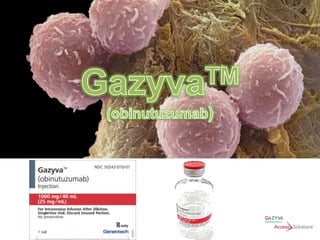
GAZYVA 1000 mg/40 mL (25 mg/mL) single-use vials
containing preservative-free solution (NDC 50242-070-01)
are stable at 2°C to 8°C (36°F to 46°F). Do not use beyond
expiration date stamped on carton. GAZYVA vials should be
protected from light. DO NOT FREEZE. DO NOT SHAKE

Gazyva

  • 2.
    DESCRIPTION • GAZYVA (obinutuzumab)is a humanized anti-CD20 monoclonal antibody of the IgG1 subclass. It recognizes a specific epitope of the CD20 molecule found on B-cells. The molecular mass of the antibody is approximately 150 kDa. • GAZYVA is produced by mammalian cell (CHO) suspension culture. GAZYVA is a sterile, clear, colorless to slightly brown, preservative free liquid concentrate for intravenous administration. GAZYVA is supplied at a concentration of 25 mg/mL in 1000 mg single use vials. The product is formulated in 20 mM L-histidine/L-histidine hydrochloride, 240 mM trehalose, 0.02% poloxamer 188. The pH is 6.0.
  • 3.
    GazyvaTM in Chronic LymphocyticLeukemia 1. Gazyva is a medicine that works with the body’s own immune system to attack blood cells called B-cells that have a certain marker on their surface (CD20). Bcells are the cause of common blood cancers.1,2 2. Gazyva is FDA-approved for the treatment of people with previously untreated chronic lymphocytic leukemia (CLL) in combination with chlorambucil chemotherapy.3 3. Phase III clinical data showed that Gazyva plus chlorambucil chemotherapy helped people with CLL live longer without the disease worsening than chlorambucil chemotherapy alone.3
  • 4.
    What is CLL? Chronic Lymphocytic Leukemia(CLL) is a slowgrowing cancer of the blood and bone marrow that is generally considered incurable. It is one of the most common forms of blood cancer in the United States, with approximately 16,000 new cases each year and nearly 5,000 deaths expected in 2013.4,5
  • 5.
  • 6.
    Gazyva (Mechanism ofAction) Obinutuzumab is a monoclonal antibody that targets the CD20 antigen expressed on the surface of pre B- and mature B-lymphocytes. Upon binding to CD20, obinutuzumab mediates B-cell lysis through (1) engagement of immune effector cells, (2) by directly activating intracellular death signaling pathways and/or (3) activation of the complement cascade. The immune effector cell mechanisms include antibody-dependent cellular cytotoxicity and antibody-dependent cellular phagocytosis.
  • 7.
    Gazyva Efficacy Profilein CLL CLL11 Study The FDA approval of Gazyva for previously untreated CLL was based on data from the pivotal Phase III CLL11 study. This study investigated Gazyva plus chlorambucil (clb) compared to clb alone in previously untreated people with CLL.
  • 8.
    DOSAGE AND ADMINISTRATION •Premedicate with glucocorticoid, acetaminophen and anti-histamine. (2.2) • Dilute and administer as intravenous infusion. Do not administer as an intravenous push or bolus. (2.1) • Recommended dose for 6 cycles (28 day cycles): • 100 mg on day 1 Cycle 1 • 900 mg on day 2 Cycle 1 • 1000 mg on day 8 and 15 of Cycle 1 • 1000 mg on day 1 of Cycles 2–6 (2.1) • 1000 mg/40 mL (25 mg/mL) single use vial. (3)
  • 9.
    Recommended Dosage Regimen 1.Premedicate before each infusion [see Dosage and Administration . 2. Administer only as an intravenous infusion through a dedicated line [see Dosage and 3. Administration . 4. Do not administer as an intravenous push or bolus. 5. Monitor blood counts at regular intervals. 6. GAZYVA should only be administered by a healthcare professional with appropriate 7. medical support to manage severe infusion reactions that can be fatal if they occur
  • 10.
    Recommended Dose: Table 1 Doseof GAZYVA to be administered during 6 treatment cycles each of 28 days duration
  • 11.
    Recommended Dose: If aplanned dose of GAZYVA is missed, administer the missed dose as soon as possible and adjust dosing schedule accordingly. If appropriate, patients who do not complete the Day 1 Cycle 1 dose may proceed to the Day 2 Cycle 1 dose.
  • 12.
    Recommended Dose: If apatient experiences an infusion reaction of any grade during infusion, adjust the infusion as follows 1. • Grade 4 (life threatening): Stop infusion immediately and permanently discontinue GAZYVA therapy. 2. • Grade 3 (severe): Interrupt infusion and manage symptoms. Upon resolution of symptoms, consider restarting GAZYVA infusion at no more than half the previous rate (the rate being used at the time that the infusion reaction occurred) and, if patient does not experience any further infusion reaction symptoms, infusion rate escalation may resume at the increments and intervals as appropriate for the treatment cycle dose. Permanently discontinue treatment if patients experience a Grade 3 infusion related symptom at re-challenge. 3. • Grade 1–2 (mild to moderate): Reduce infusion rate or interrupt infusion and treat symptoms. Upon resolution of symptoms, continue or resume infusion and, if patient does not experience any further infusion reaction symptoms, infusion rate escalation may resume at the increments and intervals as appropriate for the treatment cycle dose.
  • 13.
    Recommended Premedication Premedication isrecommended to reduce the risk of infusion reactions as outlined in Table 2. Hypotension may occur during GAZYVA intravenous infusions. Consider withholding antihypertensive treatments for 12 hours prior to and throughout each GAZYVA infusion and for the first hour after administration. For patients with high tumor burden and/or high circulating absolute lymphocyte counts (greater than 25 x 109/L), premedicate with anti-hyperuricemics (e.g., allopurinol) beginning 12–24 hours prior to start of therapy and ensure adequate hydration for prophylaxis of tumor lysis syndrome.
  • 14.
    Recommended Premedication Hydrocortisone isnot recommended as it has not been effective in reducing the rate of infusion reactions. Table 2 Premedication for GAZYVA Infusion to Reduce Infusion-Related Reactions
  • 15.
    Pharmacodynamics In clinical trialsin patients with CLL, GAZYVA caused CD19 B-cell depletion (defined as CD19 B-cell counts < 0.07 x 10⁹/L). Initial CD19 B-cell recovery was observed in some patients approximately 9 months after the last GAZYVA dose. At 18 months of follow up, some patients remain B-cell depleted. Although the depletion of B-cells in the peripheral blood is a measurable pharmacodynamic effect, it is not directly correlated with the depletion of B-cells in solid organs or in malignant deposits. B-cell depletion has not been shown to be directly correlated to clinical response. Cardiac Electrophysiology The potential effects of GAZYVA on the QTc interval have not been studied.
  • 16.
    Pharmacokinetics Based on apopulation pharmacokinetic (pop-PK) analysis, the geometric mean (CV%) volume of distribution of obinutuzumab at steady state is approximately 3.8 (23) L. The elimination of obinutuzumab is comprised of a linear clearance pathway and a timedependent non-linear clearance pathway. As GAZYVA treatment progresses, the impact of the time-dependent pathway diminishes in a manner suggesting target mediated drug disposition 13 (TMDD). Based on a pop-PK analysis, the geometric mean (CV%) terminal obinutuzumab clearance and half-life are approximately 0.09 (46%) L/day and 28.4 (43%) days, respectively. Specific Populations: Age: Age did not affect the pharmacokinetics of GAZYVA. Body Weight: Volume of distribution and steady state clearance both increased with body weight, however, the expected change in exposure does not warrant a dose modification. Renal Impairment: Based on the population pharmacokinetic analysis, a baseline creatinine clearance (CLcr) > 30 mL/min does not affect the pharmacokinetics of GAZYVA. GAZYVA has not been studied in patients with a baseline CLcr < 30 mL/min. Hepatic impairment: GAZYVA has not been studied in patients with hepatic impairment.
  • 17.
    Infusion Reactions  GAZYVAcan cause severe and life-threatening infusion reactions. Two-thirds of patients experienced a reaction to the first 1000 mg infused of GAZYVA. Infusion reactions can also occur with subsequent infusions. Symptoms may include hypotension, tachycardia, dyspnea, and respiratory symptoms (e.g., bronchospasm, larynx and throat irritation, wheezing, laryngeal edema). Other common symptoms include nausea, vomiting, diarrhea, hypertension, flushing, headache, pyrexia, and chills  Premedicate patients with acetaminophen, anti-histamine, and a glucocorticoid. Institute medical management (e.g., glucocorticoids, epinephrine, bronchodilators, and/or oxygen) for infusion 7 reactions as needed. Closely monitor patients during the entire infusion. Infusion reactions within 24 hours of receiving GAZYVA have occurred
  • 18.
    Infusion Reactions  Forpatients with any Grade 4 infusion reactions, including but not limited to anaphylaxis, acute life-threatening respiratory symptoms, or other life-threatening infusion reaction: Stop the GAZYVA infusion. Permanently discontinue GAZYVA therapy.  For patients with Grade 1, 2, or 3 infusion reactions: Interrupt GAZYVA for Grade 3 reactions until resolution of symptoms. Interrupt or reduce the rate of the infusion for Grade 1 or 2 reactions and manage symptoms.  For patients with pre-existing cardiac or pulmonary conditions, monitor more frequently throughout the infusion and the post-infusion period since they may be at greater risk of experiencing more severe reactions. Hypotension may occur as part of the GAZYVA infusion reaction. Consider withholding antihypertensive treatments for 12 hours prior to, during each GAZYVA infusion, and for the first hour after administration until blood pressure is stable. For patients at increased risk of hypertensive crisis, consider the benefits versus the risks of withholding their hypertensive medication as is suggested here.
  • 19.
    ADVERSE REACTIONS The followingadverse reactions are discussed in greater detail in other sections of the label: 1. 2. 3. 4. 5. 6. Hepatitis B reactivation Progressive multifocal leukoencephalopathy Infusion reactions Tumor lysis syndrome Neutropenia Thrombocytopenia The most common adverse reactions (incidence ≥ 10%) were: infusion reactions, neutropenia, thrombocytopenia, anemia, pyrexia, cough, and musculoskeletal disorders
  • 20.
  • 21.
    How Supplied/Storage GAZYVA 1000mg/40 mL (25 mg/mL) single-use vials containing preservative-free solution (NDC 50242-070-01) are stable at 2°C to 8°C (36°F to 46°F). Do not use beyond expiration date stamped on carton. GAZYVA vials should be protected from light. DO NOT FREEZE. DO NOT SHAKE