Decisions and Ethics
Northcentral University
Deborah Adams
Introduction
Leaders are expected to be both profitably effective while remaining within
ethical and legal guidelines. Some may feel that in current marketplaces this
requirement is like walking a tightrope without a circus net. There are
historical cases where leaders have either risen or fallen to the demands of
doing everything right and still make a profit. In the Information Age
demands are more expanded while the traditional expectations of doing
good, taking responsibility, and causing no harm to others seems blurred in
some situations.
Throughout this presentation terms, and case examples will be shown for an
understanding of how ethical decisions making may be easier to make by
some over others.
Information Technology Decision Support/MIS7003-2
2
Ethical Decisions
Information Technology Decision Support/MIS7003-2
3
The key to
ethics is good
behavior!
 The demonstration of proper conduct throughout all relationships is the
baseline for ethical leadership. Leaders who are ethical behave properly through
two-way communications, support, and comprehensive decision-making.
Through promotion and reinforcement leaders inform of both the benefits of
good behavior and the consequences of bad behavior. Clear expectations along
with balanced accountability elevates ethical leaders above marginal leaders.
Ethical leaders teach by doing setting examples by demonstrating good conduct
in their personal and professional affairs.
 There is not much noted by researchers on why some leaders behave ethically
while others behave unethically. There has been writings on the prediction of
likelihood for ethical behavior by leaders based upon personal characteristics.
Identifying traits, backgrounds is said to possibly assist in predicting, developing,
and reinforcing ethical leaders.
(Walumbwa & Schaubroeck, 2009)
Evaluate & Compare
Decisions
 Critical thinking/questions foster
decisions. Questioning made
through approaches:
(1) Dogmatic Absolutism - every
question has only one correct
answer.
(2) Subjective Relativism – all
questions are reduced to matters of
subjectiveness with no correct or
incorrect answer just differences of
opinions.
(Elder & Paul, 2006)
Decision-making
 Groupthink
Example: Kent State University Board
of Trustees refused to reconsider
their decision to build a physical
education and recreation facility on
part of the site where KSU students
and Ohio National Guardsmen had a
fatal confrontation over the
American involvement in the
Vietnam War. The trustees refused
to motion for a vote even after
involvement of political and legal
agencies and hundreds of thousands
of lost dollars by the University.
(Hensley & Griffin, 1986)
Information Technology Decision Support/MIS7003-2
4
Evaluate & Compare
Decision-making
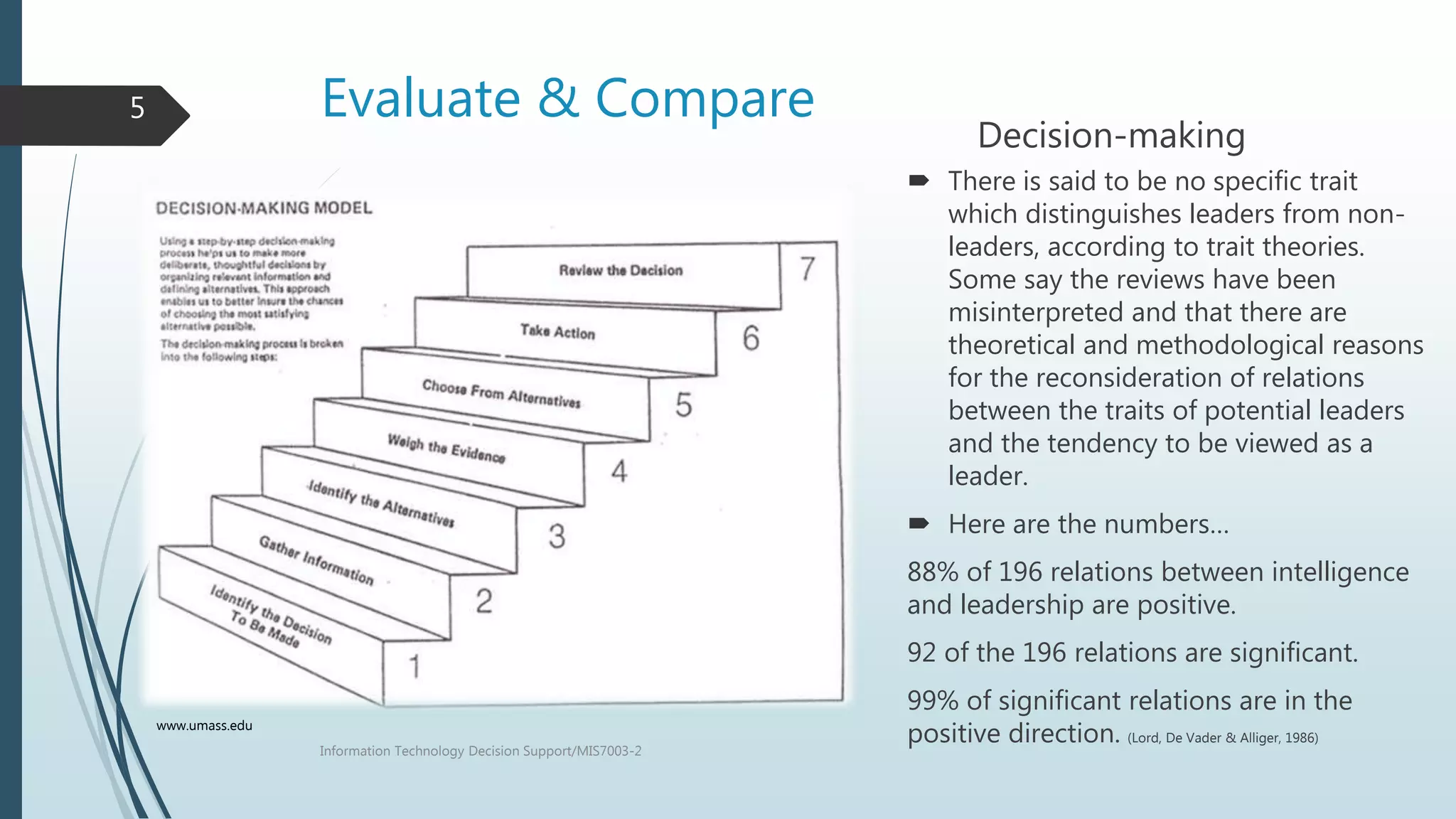
 There is said to be no specific trait
which distinguishes leaders from non-
leaders, according to trait theories.
Some say the reviews have been
misinterpreted and that there are
theoretical and methodological reasons
for the reconsideration of relations
between the traits of potential leaders
and the tendency to be viewed as a
leader.
 Here are the numbers…
88% of 196 relations between intelligence
and leadership are positive.
92 of the 196 relations are significant.
99% of significant relations are in the
positive direction. (Lord, De Vader & Alliger, 1986)
Information Technology Decision Support/MIS7003-2
5
www.umass.edu
Decisions
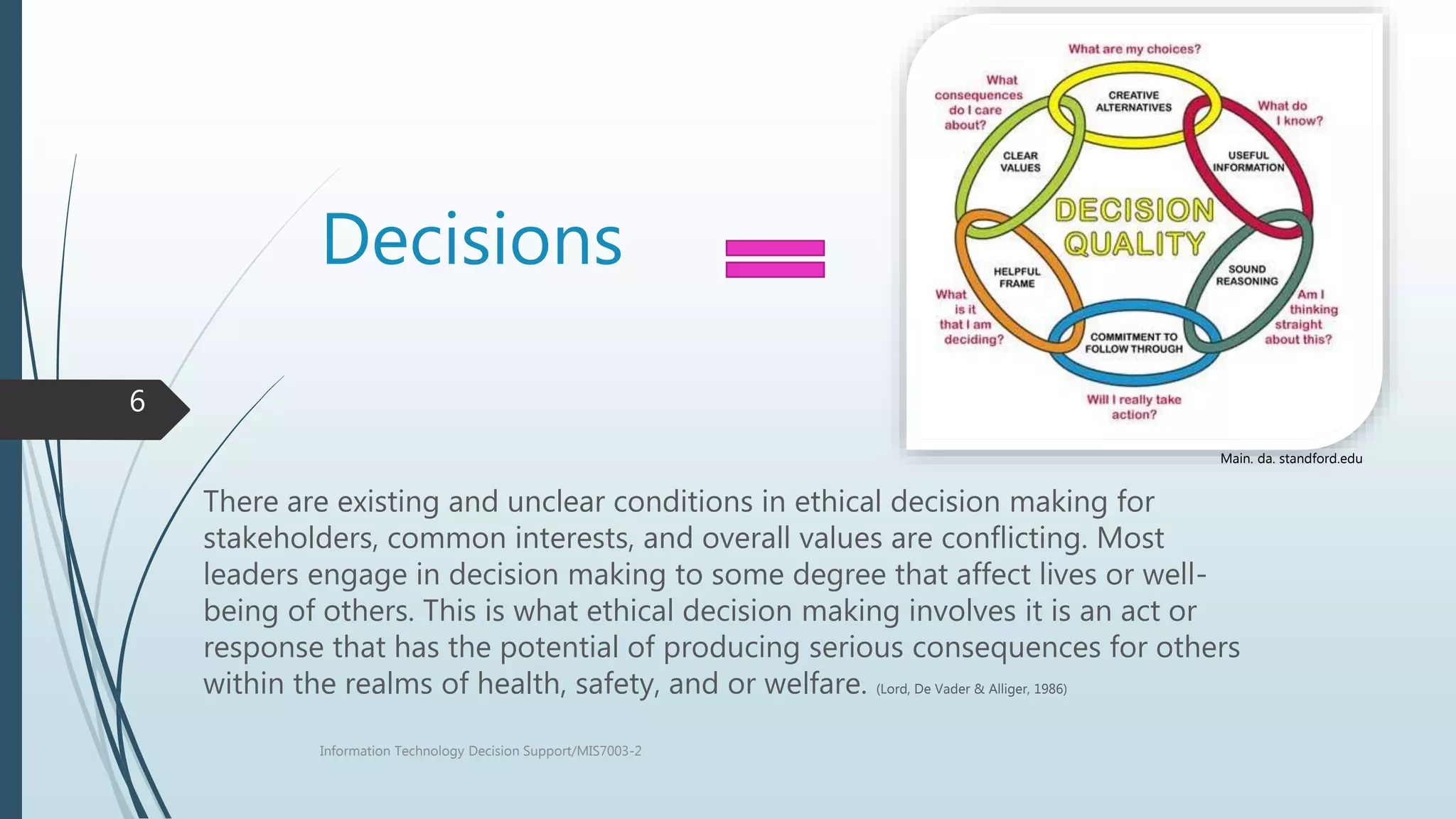
There are existing and unclear conditions in ethical decision making for
stakeholders, common interests, and overall values are conflicting. Most
leaders engage in decision making to some degree that affect lives or well-
being of others. This is what ethical decision making involves it is an act or
response that has the potential of producing serious consequences for others
within the realms of health, safety, and or welfare. (Lord, De Vader & Alliger, 1986)
Information Technology Decision Support/MIS7003-2
6
Main. da. standford.edu
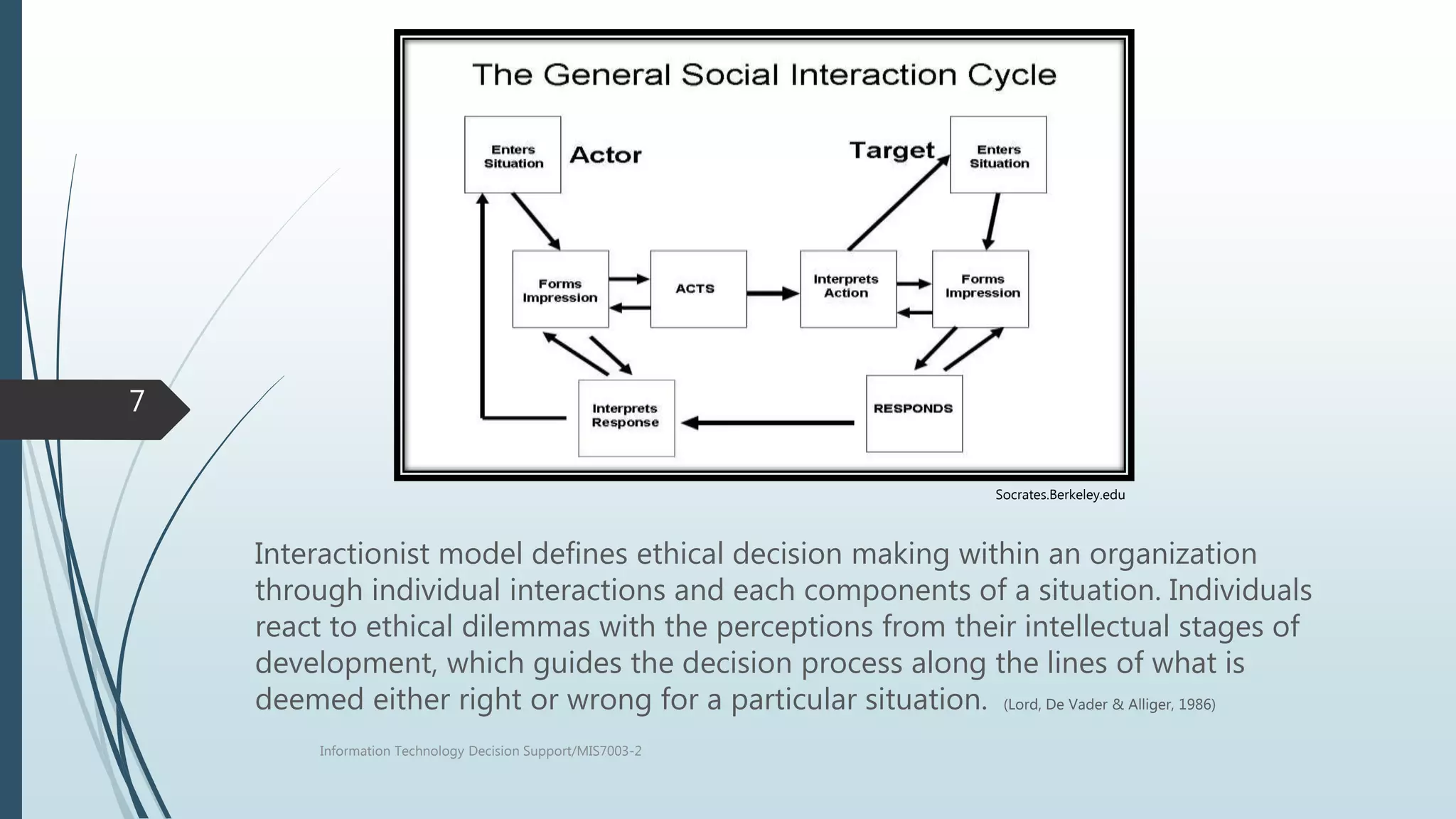
Interactionist model defines ethical decision making within an organization
through individual interactions and each components of a situation. Individuals
react to ethical dilemmas with the perceptions from their intellectual stages of
development, which guides the decision process along the lines of what is
deemed either right or wrong for a particular situation. (Lord, De Vader & Alliger, 1986)
Information Technology Decision Support/MIS7003-2
7
Socrates.Berkeley.edu
The Strategies…
 IT operates in survival mode with
agendas of the board and executive
officers increasingly plagued with
compliance, merger/acquisitions, and
business strategy issues.
 Today’s enterprises use wide IT systems
with demands to “think global and act
local”, which requires a combination of
knowledge by executives in areas of
organizational change and new
technology.
 Most strategic issues are linked to IT
directly or remotely. Behaving ethically is
on the same critical path as IT. (Earl & Feeny, 2000)
Information Technology Decision Support/MIS7003-2
8
www.springer.com
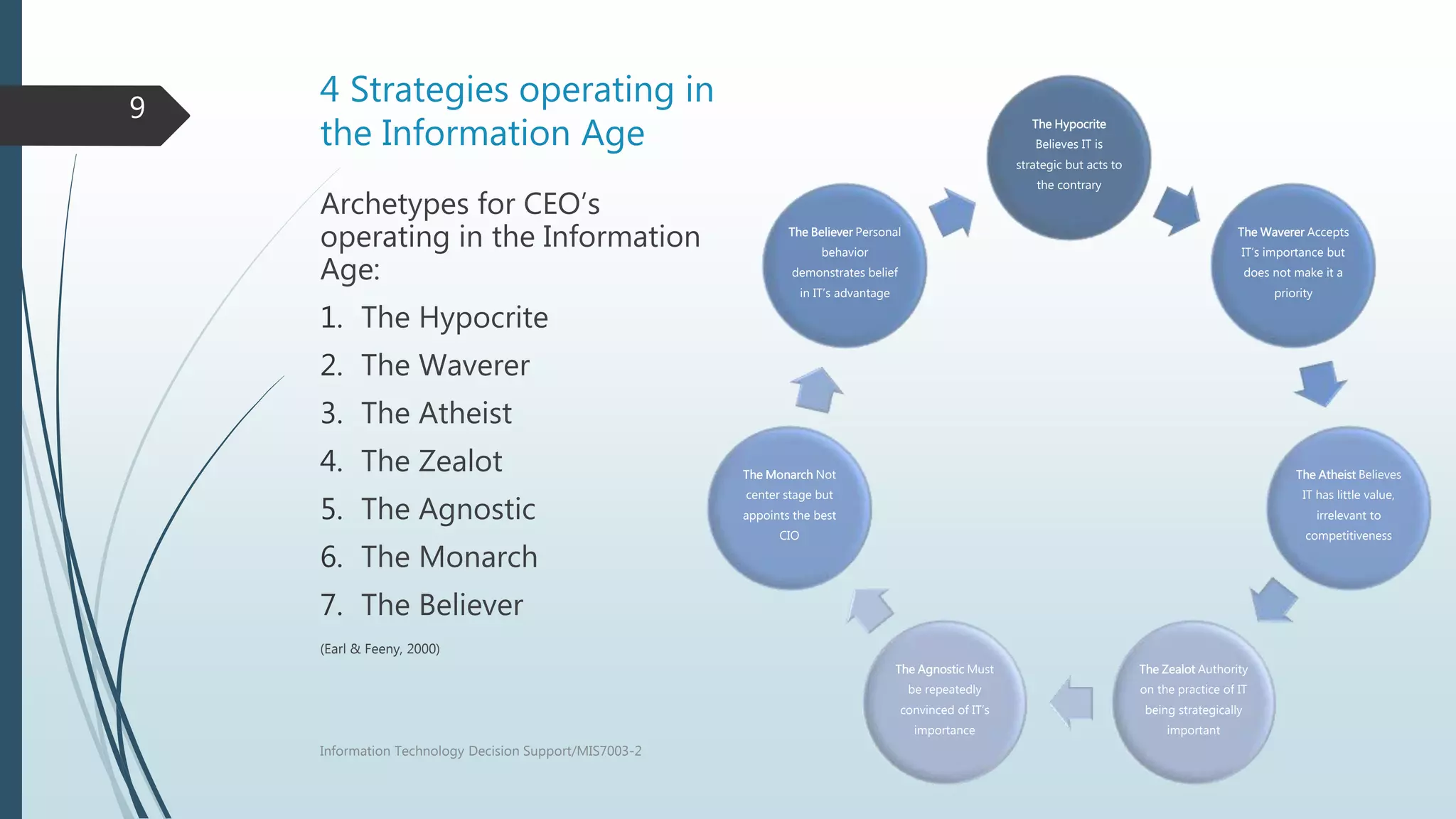
4 Strategies operating in
the Information Age The Hypocrite
Believes IT is
strategic but acts to
the contrary
The Waverer Accepts
IT’s importance but
does not make it a
priority
The Atheist Believes
IT has little value,
irrelevant to
competitiveness
The Zealot Authority
on the practice of IT
being strategically
important
The Agnostic Must
be repeatedly
convinced of IT’s
importance
The Monarch Not
center stage but
appoints the best
CIO
The Believer Personal
behavior
demonstrates belief
in IT’s advantage
Archetypes for CEO’s
operating in the Information
Age:
1. The Hypocrite
2. The Waverer
3. The Atheist
4. The Zealot
5. The Agnostic
6. The Monarch
7. The Believer
(Earl & Feeny, 2000)
Information Technology Decision Support/MIS7003-2
9
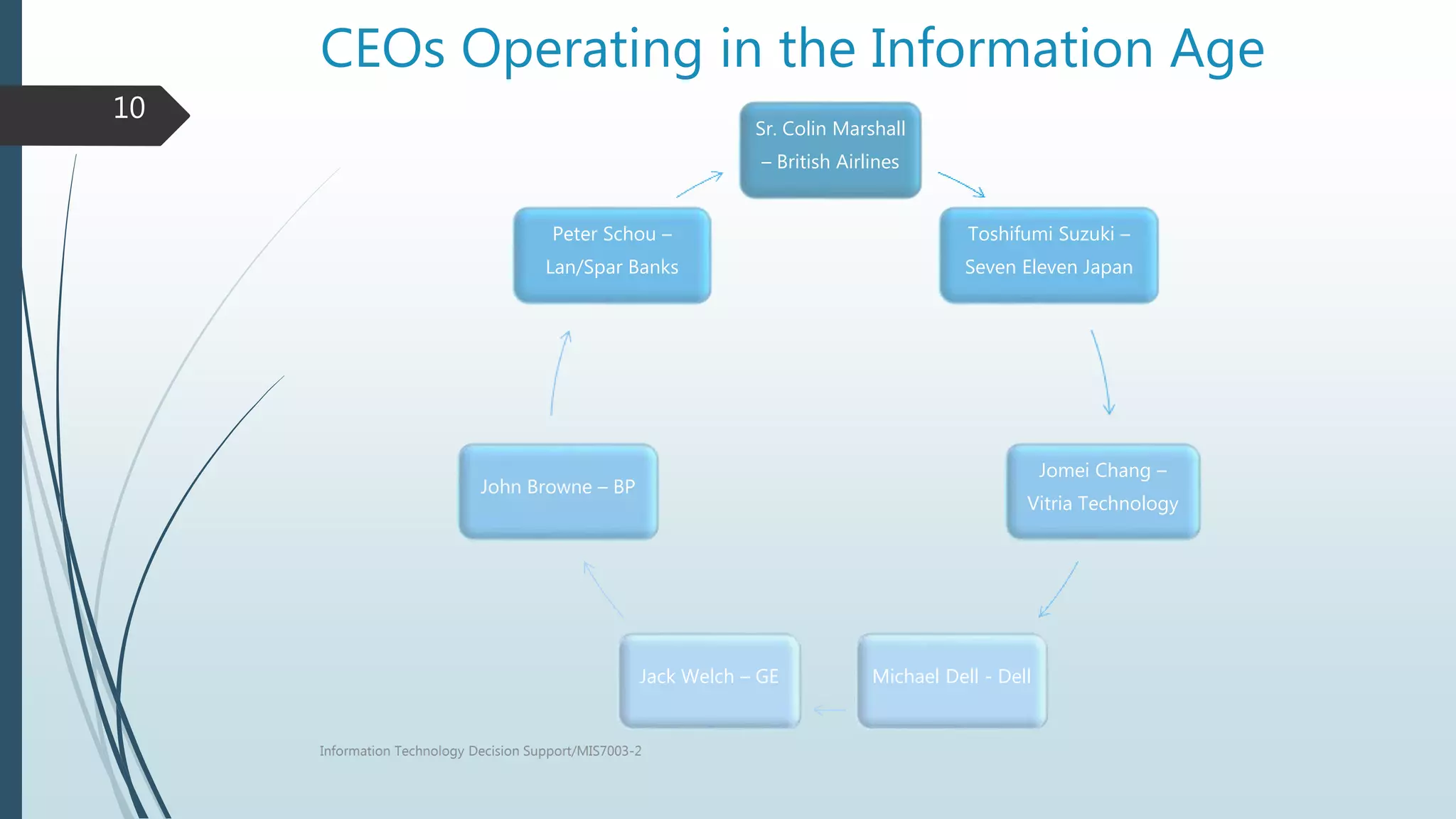
CEOs Operating in the Information Age
Sr. Colin Marshall
– British Airlines
Toshifumi Suzuki –
Seven Eleven Japan
Jomei Chang –
Vitria Technology
Michael Dell - DellJack Welch – GE
John Browne – BP
Peter Schou –
Lan/Spar Banks
Information Technology Decision Support/MIS7003-2
10
Microsoft Antitrust Court Case
Federal Appeals Microsoft Antitrust Case
Information Technology Decision Support/MIS7003-2
11
“
”
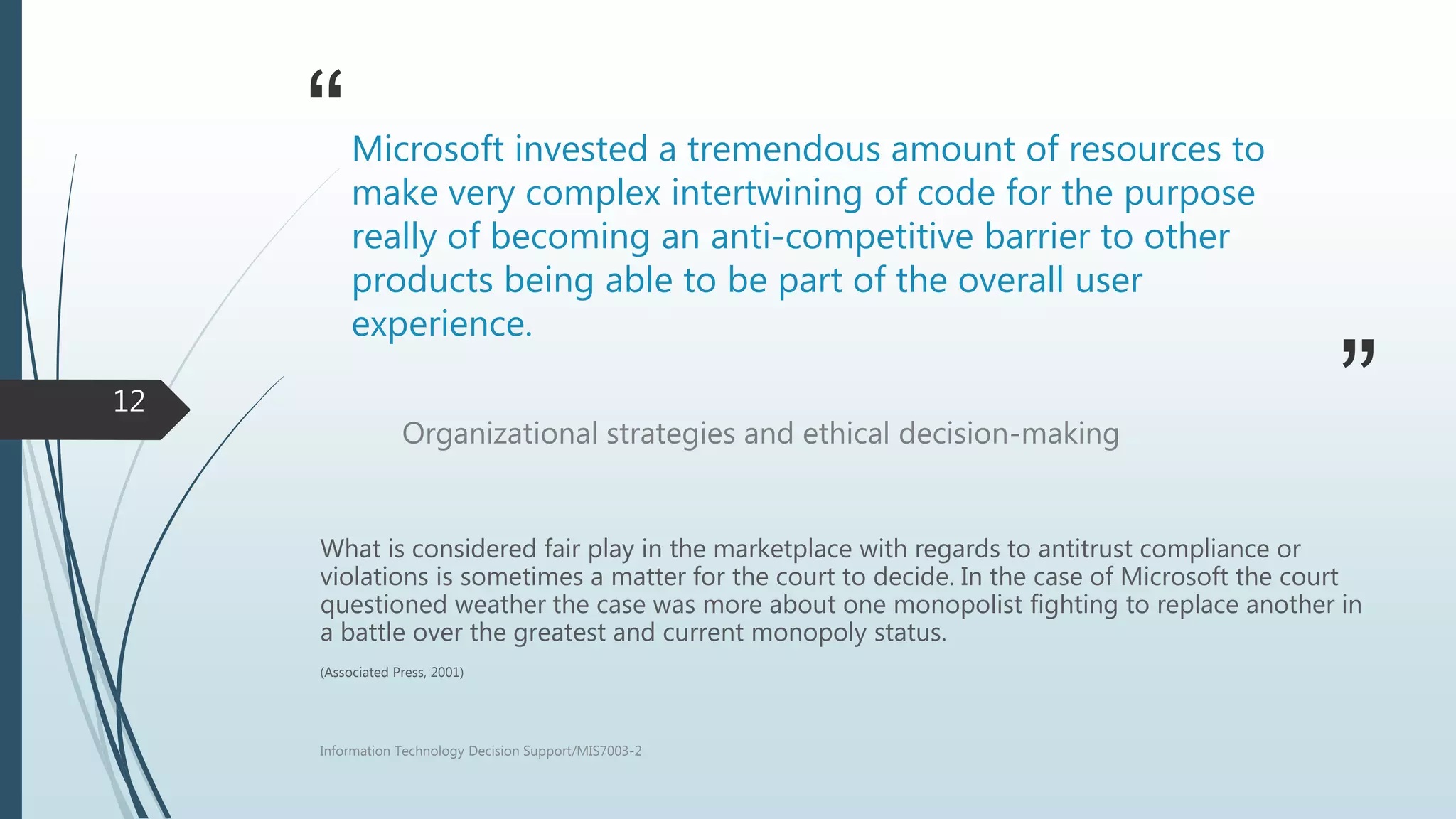
Microsoft invested a tremendous amount of resources to
make very complex intertwining of code for the purpose
really of becoming an anti-competitive barrier to other
products being able to be part of the overall user
experience.
Organizational strategies and ethical decision-making
What is considered fair play in the marketplace with regards to antitrust compliance or
violations is sometimes a matter for the court to decide. In the case of Microsoft the court
questioned weather the case was more about one monopolist fighting to replace another in
a battle over the greatest and current monopoly status.
(Associated Press, 2001)
Information Technology Decision Support/MIS7003-2
12
Conclusion
Executives are faces with balancing the best interests of the Board of
Directors they serve with equal attention to corporate governance of social
responsibility to society, and compliance of all regulations.
Most business strategies and missions are similar with regards to
managing/increasing profits and market share, expanding competitive edge
in the market, and keeping a positive corporate image.
Ethics and business strategies are not mutually exclusive. A CEO’s actions
must demonstrate ethical compliance across all areas of business and
incorporated throughout all strategies of business. The company’s leader is
its public figure who is charged with making positive and methodical
decisions that protect and expand the company and its relationships.
Information Technology Decision Support/MIS7003-2
13
References
Information Technology Decision Support/MIS7003-2
14
Associated Press. (2001). USA: Microsoft Anti trust Court Case Wrap. Retrieved from: http://ebscovideos.ebscohost.com/v/102364829/usa-microsoft-antitrust-
court-case-wrap.htm
Earl, M. & Feeny, D. (2000). How to be a CEO for the information age. Sloan Management Review. 41(2), Retrieved from
https://cb.hbsp.harvard.edu/cbmp/content/42841419
Elder, L., & Paul, R. (2006). The art of asking essential questions. The Foundation for Critical Thinking. www.criticalthinking.org.
Hensley, T. R., & Griffin, G. W. (1986). Victims of groupthink: The Kent State University board of trustees and the 1977 gymnasium controversy. The Journal of
Conflict Resolution (1986-1998), 30(3), 497. Retrieved from http://search.proquest.com.proxy1.ncu.edu/docview/236093532?accountid=28180
Lord, R. G., De Vader, C. L., & Alliger, G. M. (1986). A meta-analysis of the relation between personality traits and leadership perceptions: An application of
validity generalization procedures. Journal of Applied Psychology, 71(3), 402-410. doi:10.1037/0021-9010.71.3.402
Trevino, L. K. (1986). Ethical decision making in organizations: A person-situation interactionist model. Academy of Management Review, 11(3), 601-617.
doi:10.5465/AMR.1986.4306235
Walumbwa, F. O., & Schaubroeck, J. (2009). Leader personality traits and employee voice behavior: Mediating roles of ethical leadership and work group
psychological safety. Journal of Applied Psychology, 94(5), 1275-1286. doi:10.1037/a0015848

Ethics and Decision Making

  • 1.
    Decisions and Ethics NorthcentralUniversity Deborah Adams
  • 2.
    Introduction Leaders are expectedto be both profitably effective while remaining within ethical and legal guidelines. Some may feel that in current marketplaces this requirement is like walking a tightrope without a circus net. There are historical cases where leaders have either risen or fallen to the demands of doing everything right and still make a profit. In the Information Age demands are more expanded while the traditional expectations of doing good, taking responsibility, and causing no harm to others seems blurred in some situations. Throughout this presentation terms, and case examples will be shown for an understanding of how ethical decisions making may be easier to make by some over others. Information Technology Decision Support/MIS7003-2 2
  • 3.
    Ethical Decisions Information TechnologyDecision Support/MIS7003-2 3 The key to ethics is good behavior!  The demonstration of proper conduct throughout all relationships is the baseline for ethical leadership. Leaders who are ethical behave properly through two-way communications, support, and comprehensive decision-making. Through promotion and reinforcement leaders inform of both the benefits of good behavior and the consequences of bad behavior. Clear expectations along with balanced accountability elevates ethical leaders above marginal leaders. Ethical leaders teach by doing setting examples by demonstrating good conduct in their personal and professional affairs.  There is not much noted by researchers on why some leaders behave ethically while others behave unethically. There has been writings on the prediction of likelihood for ethical behavior by leaders based upon personal characteristics. Identifying traits, backgrounds is said to possibly assist in predicting, developing, and reinforcing ethical leaders. (Walumbwa & Schaubroeck, 2009)
  • 4.
    Evaluate & Compare Decisions Critical thinking/questions foster decisions. Questioning made through approaches: (1) Dogmatic Absolutism - every question has only one correct answer. (2) Subjective Relativism – all questions are reduced to matters of subjectiveness with no correct or incorrect answer just differences of opinions. (Elder & Paul, 2006) Decision-making  Groupthink Example: Kent State University Board of Trustees refused to reconsider their decision to build a physical education and recreation facility on part of the site where KSU students and Ohio National Guardsmen had a fatal confrontation over the American involvement in the Vietnam War. The trustees refused to motion for a vote even after involvement of political and legal agencies and hundreds of thousands of lost dollars by the University. (Hensley & Griffin, 1986) Information Technology Decision Support/MIS7003-2 4
  • 5.
    Evaluate & Compare Decision-making There is said to be no specific trait which distinguishes leaders from non- leaders, according to trait theories. Some say the reviews have been misinterpreted and that there are theoretical and methodological reasons for the reconsideration of relations between the traits of potential leaders and the tendency to be viewed as a leader.  Here are the numbers… 88% of 196 relations between intelligence and leadership are positive. 92 of the 196 relations are significant. 99% of significant relations are in the positive direction. (Lord, De Vader & Alliger, 1986) Information Technology Decision Support/MIS7003-2 5 www.umass.edu
  • 6.
    Decisions There are existingand unclear conditions in ethical decision making for stakeholders, common interests, and overall values are conflicting. Most leaders engage in decision making to some degree that affect lives or well- being of others. This is what ethical decision making involves it is an act or response that has the potential of producing serious consequences for others within the realms of health, safety, and or welfare. (Lord, De Vader & Alliger, 1986) Information Technology Decision Support/MIS7003-2 6 Main. da. standford.edu
  • 7.
    Interactionist model definesethical decision making within an organization through individual interactions and each components of a situation. Individuals react to ethical dilemmas with the perceptions from their intellectual stages of development, which guides the decision process along the lines of what is deemed either right or wrong for a particular situation. (Lord, De Vader & Alliger, 1986) Information Technology Decision Support/MIS7003-2 7 Socrates.Berkeley.edu
  • 8.
    The Strategies…  IToperates in survival mode with agendas of the board and executive officers increasingly plagued with compliance, merger/acquisitions, and business strategy issues.  Today’s enterprises use wide IT systems with demands to “think global and act local”, which requires a combination of knowledge by executives in areas of organizational change and new technology.  Most strategic issues are linked to IT directly or remotely. Behaving ethically is on the same critical path as IT. (Earl & Feeny, 2000) Information Technology Decision Support/MIS7003-2 8 www.springer.com
  • 9.
    4 Strategies operatingin the Information Age The Hypocrite Believes IT is strategic but acts to the contrary The Waverer Accepts IT’s importance but does not make it a priority The Atheist Believes IT has little value, irrelevant to competitiveness The Zealot Authority on the practice of IT being strategically important The Agnostic Must be repeatedly convinced of IT’s importance The Monarch Not center stage but appoints the best CIO The Believer Personal behavior demonstrates belief in IT’s advantage Archetypes for CEO’s operating in the Information Age: 1. The Hypocrite 2. The Waverer 3. The Atheist 4. The Zealot 5. The Agnostic 6. The Monarch 7. The Believer (Earl & Feeny, 2000) Information Technology Decision Support/MIS7003-2 9
  • 10.
    CEOs Operating inthe Information Age Sr. Colin Marshall – British Airlines Toshifumi Suzuki – Seven Eleven Japan Jomei Chang – Vitria Technology Michael Dell - DellJack Welch – GE John Browne – BP Peter Schou – Lan/Spar Banks Information Technology Decision Support/MIS7003-2 10
  • 11.
    Microsoft Antitrust CourtCase Federal Appeals Microsoft Antitrust Case Information Technology Decision Support/MIS7003-2 11
  • 12.
    “ ” Microsoft invested atremendous amount of resources to make very complex intertwining of code for the purpose really of becoming an anti-competitive barrier to other products being able to be part of the overall user experience. Organizational strategies and ethical decision-making What is considered fair play in the marketplace with regards to antitrust compliance or violations is sometimes a matter for the court to decide. In the case of Microsoft the court questioned weather the case was more about one monopolist fighting to replace another in a battle over the greatest and current monopoly status. (Associated Press, 2001) Information Technology Decision Support/MIS7003-2 12
  • 13.
    Conclusion Executives are faceswith balancing the best interests of the Board of Directors they serve with equal attention to corporate governance of social responsibility to society, and compliance of all regulations. Most business strategies and missions are similar with regards to managing/increasing profits and market share, expanding competitive edge in the market, and keeping a positive corporate image. Ethics and business strategies are not mutually exclusive. A CEO’s actions must demonstrate ethical compliance across all areas of business and incorporated throughout all strategies of business. The company’s leader is its public figure who is charged with making positive and methodical decisions that protect and expand the company and its relationships. Information Technology Decision Support/MIS7003-2 13
  • 14.
    References Information Technology DecisionSupport/MIS7003-2 14 Associated Press. (2001). USA: Microsoft Anti trust Court Case Wrap. Retrieved from: http://ebscovideos.ebscohost.com/v/102364829/usa-microsoft-antitrust- court-case-wrap.htm Earl, M. & Feeny, D. (2000). How to be a CEO for the information age. Sloan Management Review. 41(2), Retrieved from https://cb.hbsp.harvard.edu/cbmp/content/42841419 Elder, L., & Paul, R. (2006). The art of asking essential questions. The Foundation for Critical Thinking. www.criticalthinking.org. Hensley, T. R., & Griffin, G. W. (1986). Victims of groupthink: The Kent State University board of trustees and the 1977 gymnasium controversy. The Journal of Conflict Resolution (1986-1998), 30(3), 497. Retrieved from http://search.proquest.com.proxy1.ncu.edu/docview/236093532?accountid=28180 Lord, R. G., De Vader, C. L., & Alliger, G. M. (1986). A meta-analysis of the relation between personality traits and leadership perceptions: An application of validity generalization procedures. Journal of Applied Psychology, 71(3), 402-410. doi:10.1037/0021-9010.71.3.402 Trevino, L. K. (1986). Ethical decision making in organizations: A person-situation interactionist model. Academy of Management Review, 11(3), 601-617. doi:10.5465/AMR.1986.4306235 Walumbwa, F. O., & Schaubroeck, J. (2009). Leader personality traits and employee voice behavior: Mediating roles of ethical leadership and work group psychological safety. Journal of Applied Psychology, 94(5), 1275-1286. doi:10.1037/a0015848

Editor's Notes

  • #4 Focal leaders are most recognized for removing obstacles of discouragement which keeps at bay the sought after honest expression of concerns and ideas. Leaders who are ethical encourage active communication on all levels, not just from the top down. The value of open genuine relationships and communications that demonstrate the promise of no negative impact for ethical behaviors/communications is what sets ethical leaders above others. Leaders who are considered ethical typically act in direct alignment to their own values and or beliefs, while interacting truthfully and openly to gain trust and respect. They are unlikely to response to pressures from the outside or make decisions from narrow or temporary interest. (Walumbwa & Schaubroeck, 2009)
  • #5 Groupthink – decision makers become more concerned with retaining the approval of fellow members of the group over deciding upon good solutions for the task(s). Thinking involves the use of ideas which help develop conceptual questions that are either simple – settled through definitions or complex – settled through conflicting analysis of key concepts (Elder & Paul, 2006)
  • #6 Writings on applied psychology reports some negative perspectives on trait theory. Some authors states that between a leader’s effectiveness or personality traits there is either little or no relationship. It is stated that there has been an over generalization of the findings on leadership personality and how personalities are relevant to a leader’s success. (Lord, De Vader & Alliger, 1986)
  • #8 Symbolic interactionism (Mead 1934, Cooley 1902, and Thomas 1931) is where symbolic domains are lived by humans. The social objects and symbols that have connected meanings are created and maintained within social interactions. Reality is constructed through symbols, language and communication. Human (self, mind, society, and culture) is a social product of what is deemed reality. Reality is dependent upon symbols of interactions and it develops from this dependence. Human conduct and physical environments are relevant to the interpretations of symbolic systems.
  • #11 Sr. Colin Marshall – Stimulated development of new IT applications with criterion for selecting between investment opportunities. Toschifumi Suzuki – Stressed convenience, quality, and service in IT. Jomei Chang – Believes that business is real-time and nothing can wait until after lunch or until tomorrow. Michael Dell – Believes the company should be one or two steps ahead of change while creating and shaping it. Jack Welch – Believes IT must become the company’s central nervous system to become a winner in the next century. John Browne – IT makes rich exchanges possible without formal structures. Peter Schou – Knew that decisions about service levels, cost structures, and infrastructure design influence performance, profitability and bank growth.
  • #12 *** Select/Open hyperlink and allow time for browser to open*** In the appeal case of antitrust violations against Microsoft, questions from US Court of Appeals judges in the District of Columbia questioned Microsoft’s practices with competitors and the motives of the government for pursuing charges against Microsoft. Microsoft creator of Windows operating system, Word processing program, and Internet Explorer browser is seeking to reverse an order by the lower court to divide the company. The company’s attorney claims that Microsoft did nothing wrong and did not foreclose Netscape from the marketplace, and although it has pricing discretion it is not the same as monopoly power. Microsoft claims to have placed a tremendous amount of resources to purposely remove anti-competitive barriers so other products could be included in the user experience. Government prosecutors claimed that Microsoft’s conduct was coordinated and specifically directed to maintain monopoly power. (Associated Press, 2001)