Architectures of ERP Systems
Introduction
The design of enterprise network architectures (ENA) requires comprehensive research
and planning. Components of software, hardware, applications, and the network have to be
selected for the best match to the business objectives and future expansion. The team working on
this task can be comprised of both technical and non-technical individuals who possess knowledge
of the project’s objectives, desired results, and how to construct an enterprise resource planning
(ERP) system that will achieve the desired results. This presentation will provide information of how
organizations implement ERP systems, by providing system comparisons, implementation
solutions, and ERP limitations to provide viewers with an insight on how components and team
members in an ERP system project work together.
Deborah Adams - Northcentral University Enterprise Network Architecture 2
Implementing ERP Systems
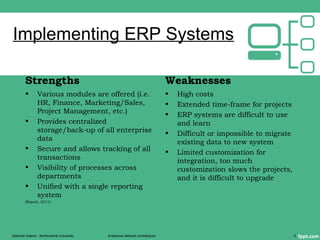
Strengths
• Various modules are offered (i.e.
HR, Finance, Marketing/Sales,
Project Management, etc.)
• Provides centralized
storage/back-up of all enterprise
data
• Secure and allows tracking of all
transactions
• Visibility of processes across
departments
• Unified with a single reporting
system
(Rajesh, 2011)
Weaknesses
• High costs
• Extended time-frame for projects
• ERP systems are difficult to use
and learn
• Difficult or impossible to migrate
existing data to new system
• Limited customization for
integration, too much
customization slows the projects,
and it is difficult to upgrade
Deborah Adams - Northcentral University Enterprise Network Architecture 3
Implementing ERP Systems
• ERP software is typically
standard
• Two main technical options
– Standard package
provided by supplier
– Bespoke adaptation to
suit specific requirements
• Critical Success Factors
(CSF) provide strategic and
tactical framework to guide
the implementation process
(Holland, & Light, 1999)
• Strategic, organization and
technical dimensions are
problems from management
perspectives
• Current business structure
and processes must be
properly aligned with ERP
systems
• ERP strategies need to be
evaluated against systems
and objectives to ensure
proper selection
Deborah Adams - Northcentral University Enterprise Network Architecture 4
Deborah Adams - Northcentral University Enterprise Network Architecture
5
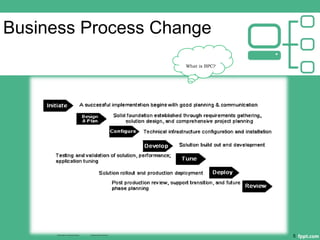
Business Process Change
What is BPC?
ERP Systems Comparison
Remember this…
• Get executive management
support
• Focus on specific business
process and systems
requirement when shopping
for vendors
• Look for accessibility from
smartphones, tablets, as well
as desktops
• Gauge the system by
evaluating all the options
(Lonoff Schiff, 2014)
Don’t forget…
• Request three verifiable
references from vendors (ask
what went right/wrong)
• Consider the amount of
customization required and
its impact on costs
• Consider control and
communicate change
management
• Appoint your ‘best’ people to
the ERP project team
Deborah Adams - Northcentral University Enterprise Network Architecture 6
Allocate
appropriate
time/resources
for ERP training
Solutions for ERP Systems
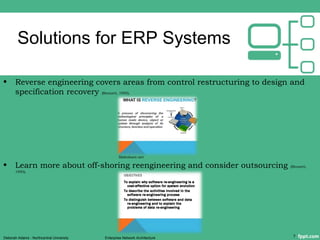
• Reverse engineering covers areas from control restructuring to design and
specification recovery (Bennett, 1995).
Slideshare.net
• Learn more about off-shoring reengineering and consider outsourcing (Bennett,
1995).
Deborah Adams - Northcentral University Enterprise Network Architecture 7
Limitations to ERP Systems
• Implementing ERP systems requires executive managers’
commitment/participation and organizational change from the
acquisition phase to the end
• To successfully implement an ERP system and avoid failure, the firm
should conduct preliminary analysis & develop a plan for ERP
acquisition and implementation
• Common reasons for failure:
– inadequate technology planning,
– user involvement and training,
– budget and schedule overruns, and
– availability of adequate skills
(Beheshti, 2006).
Deborah Adams - Northcentral University Enterprise Network Architecture 8
Components Work Together
• Replacing an IT system with one
robust company-wide system
that handles financials,
planning, distribution, tracking
functions, real-time updates,
and delivers data to decision
makers is an elegant concept
that is difficult to achieve.
(Stapleton, & Rezak,
2004).
• ERP implementations tracked
since 1994 have resulted in a
small fraction completed on
time, within budget, that met
original specifications with
over half exceeding the
budget, and/or sacrificing
functionality.
Deborah Adams - Northcentral University Enterprise Network Architecture 9
Aligning ERP with Expansion
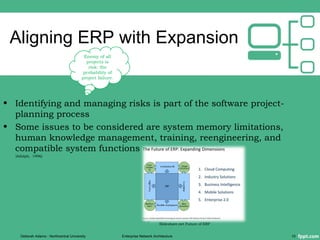
• Identifying and managing risks is part of the software project-
planning process
• Some issues to be considered are system memory limitations,
human knowledge management, training, reengineering, and
compatible system functions
(Adolph, 1996)
Deborah Adams - Northcentral University Enterprise Network Architecture 10
Enemy of all
projects is
risk: the
probability of
project failure.
Slideshare.net Future of ERP
Conclusion
In comparing ERP systems and planning to expand
existing systems the necessary requirements for success are
executive management support, knowledgeable team members,
detailed attention to CSFs, and foresight to future
upgrades/expansion.
Shopping for an ERP system may be one of the biggest
purchases a company will make in a fiscal period with long
lasting results, so ensuring the project’s proper planning is a
priority before its start. Planning is the first essential step in
this long complex process.
Deborah Adams - Northcentral University Enterprise Network Architecture 11
Reference
Adolph, W. S. (1996). Cash cow in the tar pit: Reengineering a legacy system. IEEE Software, 13(3), 41-47.
doi:http://dx.doi.org/10.1109/52.493019
Beheshti, H. (2006). What managers should know about ERP/ERP II. Management Resources News. Retrieved from:
file:///C:/Users/ddtadams/Documents/NCU/HIGHEREDUCATION/NCU%20Doctorate/COURSES/3Year
%202016-2017/MIS7005/WK%203/What%20managers%20should%20know%20about%20ERP.pdf
Bennett, K. (1995). Legacy systems: Coping with success. IEEE Software, 12(1), 19-23.
doi:http://dx.doi.org/10.1109/52.363157
Henderson, P. (2000). Systems engineering for business process change. London: Springer
Holland, C.P., & Light, B. (1999). A critical success factors model for enterprise resource planning implementation. Retrieved
from:
https://www.researchgate.net/publication/221407270_A_Critical_Success_Factors_Model_for_Enterprise_Resourc
e_Planning_Implementation
12
Reference
Lonoff Schiff, J. (2014). 9 Tips for selecting and implementing an ERP system. Retrieved from:
http://www.cio.com/article/2458889/enterprise-resource-planning/9-tips-for-selecting-and-implementing-an-erp-
system.html
Rajesh, K. (2011). Advantages & Disadvantages of ERP Systems. Retrieved from: http://www.excitingip.com/2010/advantages-
disadvantages-of-erp-enterprise-resource-planning-systems/
Shatat, A. S. (2015). Critical success factors in enterprise resource planning (ERP) system implementation: An exploratory study in
Oman. Electronic Journal of Information Systems Evaluation, 18(1), 36-45.
Stapleton, G., & Rezak, C. J. (2004). Change management underpins a successful ERP implementation at marathon oil. Journal of
Organizational Excellence, 23(4), 15-22. Retrieved from
http://search.proquest.com.proxy1.ncu.edu/docview/215050315?accountid=28180
13

architectures of erp systems

  • 1.
  • 2.
    Introduction The design ofenterprise network architectures (ENA) requires comprehensive research and planning. Components of software, hardware, applications, and the network have to be selected for the best match to the business objectives and future expansion. The team working on this task can be comprised of both technical and non-technical individuals who possess knowledge of the project’s objectives, desired results, and how to construct an enterprise resource planning (ERP) system that will achieve the desired results. This presentation will provide information of how organizations implement ERP systems, by providing system comparisons, implementation solutions, and ERP limitations to provide viewers with an insight on how components and team members in an ERP system project work together. Deborah Adams - Northcentral University Enterprise Network Architecture 2
  • 3.
    Implementing ERP Systems Strengths •Various modules are offered (i.e. HR, Finance, Marketing/Sales, Project Management, etc.) • Provides centralized storage/back-up of all enterprise data • Secure and allows tracking of all transactions • Visibility of processes across departments • Unified with a single reporting system (Rajesh, 2011) Weaknesses • High costs • Extended time-frame for projects • ERP systems are difficult to use and learn • Difficult or impossible to migrate existing data to new system • Limited customization for integration, too much customization slows the projects, and it is difficult to upgrade Deborah Adams - Northcentral University Enterprise Network Architecture 3
  • 4.
    Implementing ERP Systems •ERP software is typically standard • Two main technical options – Standard package provided by supplier – Bespoke adaptation to suit specific requirements • Critical Success Factors (CSF) provide strategic and tactical framework to guide the implementation process (Holland, & Light, 1999) • Strategic, organization and technical dimensions are problems from management perspectives • Current business structure and processes must be properly aligned with ERP systems • ERP strategies need to be evaluated against systems and objectives to ensure proper selection Deborah Adams - Northcentral University Enterprise Network Architecture 4
  • 5.
    Deborah Adams -Northcentral University Enterprise Network Architecture 5 Business Process Change What is BPC?
  • 6.
    ERP Systems Comparison Rememberthis… • Get executive management support • Focus on specific business process and systems requirement when shopping for vendors • Look for accessibility from smartphones, tablets, as well as desktops • Gauge the system by evaluating all the options (Lonoff Schiff, 2014) Don’t forget… • Request three verifiable references from vendors (ask what went right/wrong) • Consider the amount of customization required and its impact on costs • Consider control and communicate change management • Appoint your ‘best’ people to the ERP project team Deborah Adams - Northcentral University Enterprise Network Architecture 6 Allocate appropriate time/resources for ERP training
  • 7.
    Solutions for ERPSystems • Reverse engineering covers areas from control restructuring to design and specification recovery (Bennett, 1995). Slideshare.net • Learn more about off-shoring reengineering and consider outsourcing (Bennett, 1995). Deborah Adams - Northcentral University Enterprise Network Architecture 7
  • 8.
    Limitations to ERPSystems • Implementing ERP systems requires executive managers’ commitment/participation and organizational change from the acquisition phase to the end • To successfully implement an ERP system and avoid failure, the firm should conduct preliminary analysis & develop a plan for ERP acquisition and implementation • Common reasons for failure: – inadequate technology planning, – user involvement and training, – budget and schedule overruns, and – availability of adequate skills (Beheshti, 2006). Deborah Adams - Northcentral University Enterprise Network Architecture 8
  • 9.
    Components Work Together •Replacing an IT system with one robust company-wide system that handles financials, planning, distribution, tracking functions, real-time updates, and delivers data to decision makers is an elegant concept that is difficult to achieve. (Stapleton, & Rezak, 2004). • ERP implementations tracked since 1994 have resulted in a small fraction completed on time, within budget, that met original specifications with over half exceeding the budget, and/or sacrificing functionality. Deborah Adams - Northcentral University Enterprise Network Architecture 9
  • 10.
    Aligning ERP withExpansion • Identifying and managing risks is part of the software project- planning process • Some issues to be considered are system memory limitations, human knowledge management, training, reengineering, and compatible system functions (Adolph, 1996) Deborah Adams - Northcentral University Enterprise Network Architecture 10 Enemy of all projects is risk: the probability of project failure. Slideshare.net Future of ERP
  • 11.
    Conclusion In comparing ERPsystems and planning to expand existing systems the necessary requirements for success are executive management support, knowledgeable team members, detailed attention to CSFs, and foresight to future upgrades/expansion. Shopping for an ERP system may be one of the biggest purchases a company will make in a fiscal period with long lasting results, so ensuring the project’s proper planning is a priority before its start. Planning is the first essential step in this long complex process. Deborah Adams - Northcentral University Enterprise Network Architecture 11
  • 12.
    Reference Adolph, W. S.(1996). Cash cow in the tar pit: Reengineering a legacy system. IEEE Software, 13(3), 41-47. doi:http://dx.doi.org/10.1109/52.493019 Beheshti, H. (2006). What managers should know about ERP/ERP II. Management Resources News. Retrieved from: file:///C:/Users/ddtadams/Documents/NCU/HIGHEREDUCATION/NCU%20Doctorate/COURSES/3Year %202016-2017/MIS7005/WK%203/What%20managers%20should%20know%20about%20ERP.pdf Bennett, K. (1995). Legacy systems: Coping with success. IEEE Software, 12(1), 19-23. doi:http://dx.doi.org/10.1109/52.363157 Henderson, P. (2000). Systems engineering for business process change. London: Springer Holland, C.P., & Light, B. (1999). A critical success factors model for enterprise resource planning implementation. Retrieved from: https://www.researchgate.net/publication/221407270_A_Critical_Success_Factors_Model_for_Enterprise_Resourc e_Planning_Implementation 12
  • 13.
    Reference Lonoff Schiff, J.(2014). 9 Tips for selecting and implementing an ERP system. Retrieved from: http://www.cio.com/article/2458889/enterprise-resource-planning/9-tips-for-selecting-and-implementing-an-erp- system.html Rajesh, K. (2011). Advantages & Disadvantages of ERP Systems. Retrieved from: http://www.excitingip.com/2010/advantages- disadvantages-of-erp-enterprise-resource-planning-systems/ Shatat, A. S. (2015). Critical success factors in enterprise resource planning (ERP) system implementation: An exploratory study in Oman. Electronic Journal of Information Systems Evaluation, 18(1), 36-45. Stapleton, G., & Rezak, C. J. (2004). Change management underpins a successful ERP implementation at marathon oil. Journal of Organizational Excellence, 23(4), 15-22. Retrieved from http://search.proquest.com.proxy1.ncu.edu/docview/215050315?accountid=28180 13

Editor's Notes

  • #4 Explain advantages/disadvantages of ERP systems: It is important to remember that businesses use ERP systems to automate its core processes which need to be integrated company-wide through the use of information systems. ERP are blueprints that prescribes how the planning process should operate. ERP implementation involves a mix of BPC and software configuration to align the software with business processes (Holland, & Light, 1999)
  • #5 Important points to remember when implementing ERP systems: ERP strategy affects the business process change (BPC) and software configuration processes. ERP is a major component to a massive structure that is interconnected and dependent upon the steps that precede and/or follow. System software configuration is complex with integration and reengineering required for core business procedures at a company-wide scale. When using standard systems and ERP software the focus moves from systems design and analysis development to software configuration. ERP implementation is a complex and difficult process with the systems development effort focused upon enabling required functionality embedded into the ERP system’s business model. ERP can be thought of as a double-edge sword which can benefit companies if planning and implementation is performed correctly or be disastrous if the implementation process is not properly managed. (Holland, & Light, 1999; Rajesh, 2011)
  • #6 Discuss/Explain BPC relevant process/function in ERP systems: BPC - business process change is a defined step-by-step outline of specific business function(s) that includes manual and automated stages/phases. An organization’s activity is established to accomplish business goals and are designed systematic approaches. These processes make the workflow more effective, efficient, standardized, and adoptable to change. (Henderson, 2000)
  • #7 Discussion of how to shop for ERP systems: ERP systems have the benefit of increasing efficiency while gaining competitive advantage in the market. ERP systems can revolutionize the operations of the business, if implemented properly. One of the choices for selecting a ERP system should include analysis to reduce the likelihood of failure through CSFs. Choose a ERP system that is capable to re-engineer business processes through uniform information system. Understand whether the business is competent or capable to use the system, while taking advantage of its developmental and innovation opportunities. (Shatat, 2015).
  • #8 Possible solutions to system issues: Remember that evolving software requires remedial action or ITs structure will degrade Technical problems are accompanied by management problems (Bennett, 1995).
  • #9 Management should remember: Important success factors for ERP implementation require executives’ support, effective project management, extensive user training, and understanding/recognizing ERP as a business solution. ERP acquisition and implementation are hard to estimate the savings, and difficult to anticipate developments due to constant changes. The intangible benefits of an ERP system are difficult to put into monetary terms. (Beheshti, 2006).
  • #10 Point out that when discussing ERP systems and the people who manage, design, implement them it should be noted that historically the technology parts of ERP has been given all the attention with people side receiving the ‘short shrift’ to the detriment of implementation. (Stapleton, & Rezak, 2004).
  • #11 When planning to expand ERP systems remember: Uncontrolled change can increase project risk Know the short-comings of the existing system Purpose new features that are more elegant and powerful, with reduced cost and increase efficiency (Adolph, 1996).