BUSINESS ETHICS
1. AN INTRODUCTION

2013/2014

Ana Cláudia Campos

1º Semestre
1
1.1 Morality, Ethics, and Business Ethics

1.2 The Emergence of Business Ethics: Globalization,
Sustainability, and Competitiveness

1.3

Conceptual

Network:

Stakeholders,

Social

Responsibility and Corporate Governance
2
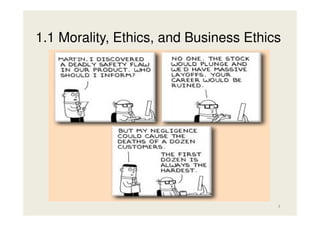
1.1 Morality, Ethics, and Business Ethics

3
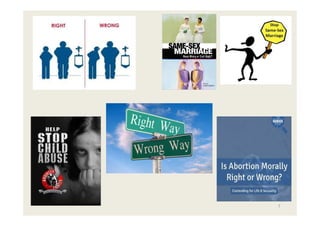
Morality
“… is concerned with the norms, values,
and beliefs embeded in social processes
which define right (√) and wrong (×) for an
individual or a community.”
(Crane & Matten, 2010)

4
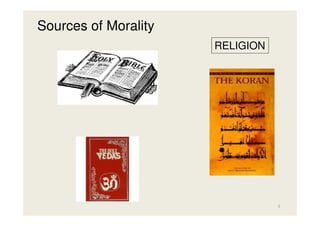
Sources of Morality
RELIGION

5
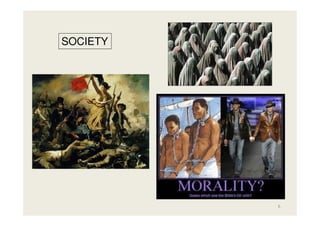
SOCIETY

6
7
8
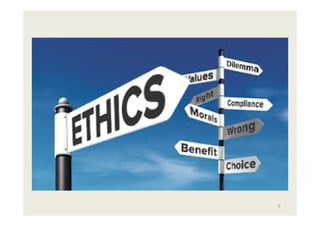
ETHICS
“… is concerned with the study of morality and
the application of reason to elucidate specific
rules and principles that determine right and
wrong for a given situation. These rules and
principles are called ethical theories.”
(Crane & Matten, 2010)

9
“… deals with individual character and the
moral rules that govern and limit our
conduct. It investigates questions of right
and wrong, duty and obligation, and moral
responsibility.”
(Shaw, 2011)

10
Theoretical/philosophical study that
analyses ethical theories
(Popkin & Stroll, 1956)

11
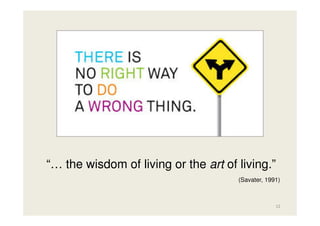
“… the wisdom of living or the art of living.”
(Savater, 1991)

12
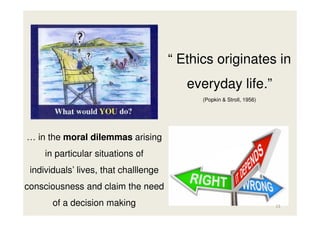
“ Ethics originates in
everyday life.”
(Popkin & Stroll, 1956)

… in the moral dilemmas arising
in particular situations of
individuals’ lives, that challlenge
consciousness and claim the need
of a decision making

13
“An ethical dilemma is a situation that requires a
choice regarding a possible course of action that,
although offering the potential for personal or
organizational benefit or both, may be considered
unethical. It is often a situation in which action must
be taken but for which there is no clear consensus
on what is «right» and «wrong»”.
(Schermerhorn, 2002)

14
The ethical reflection of everyday life becomes a
philosophical investigation when transcends the
individual’s particular issues and questions and
develops a general approach to them.

15
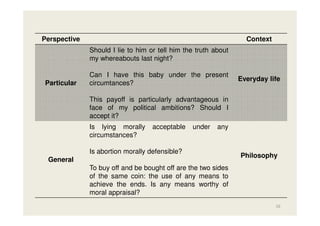
Perspective

Context
Should I lie to him or tell him the truth about
my whereabouts last night?

Particular

Can I have this baby under the present
circumtances?

Everyday life

This payoff is particularly advantageous in
face of my political ambitions? Should I
accept it?
Is lying morally
circumstances?

acceptable

under

any

Is abortion morally defensible?
General

Philosophy

To buy off and be bought off are the two sides
of the same coin: the use of any means to
achieve the ends. Is any means worthy of
moral appraisal?
16
BUSINESS ETHICS
“… is the study of what constitutes right and
wrong (or good and bad) human conduct in
a business context.”
(Shaw, 2011)

17
18
“… is the study of business situations,
activities, and decisions where issues of
right and wrong are addressed.”
(Crane & Matten, 2010)

19
20
Comments
•

By ‘right’ and ‘wrong’ it is meant ‘morally right’ and
‘morally wrong’, against ‘commercially’, ‘strategically’ or
‘finantially right or wrong’;

•

Business Ethics covers issues related to business
organizations but also other types of organizations
(governmental organizations, non-governmental/nonprofit, pressure groups, etc.)

21
•

Many people believe ‘ethics’ and ‘business’ don’t
match because businesses are either imoral
(against morality) ou non-moral (outside morality)

•

However Business Ethics is increasingly becoming
a topic of attention for both scholars

and

professionals in all fields

22
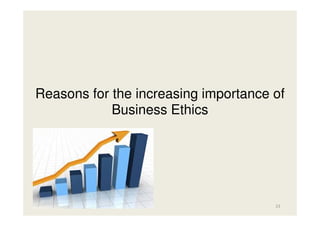
Reasons for the increasing importance of
Business Ethics

23
•

The power and influence of business and firms in
society is increasing everyday

•

Companies contribute to society (employment, taxes,
economic and personal development...) and it is
necessary to understand how this contribution occurs

•

Bad business practices have the potential to cause
harm to individuals, communities and the environment

24
•

Stakeholders

(consumers,

control

and

pressure

groups, the media, competition ...) increasingly require
businesses to behave responsibly and ethically

•

There is lack of formal training in the area of ethics,
and this training may contribute to problem analysis
and more informed decision making

25
•

Ethical violations (fraud, injustice at work, corruption,
abuse of trust ...) continue to happen in a daily basis
discipline and an ethical approach helps to understand
the reasons behind them

•

Studies show that companies with best ethical
performance are also those with improved financial
performance, increased productivity and quality, higher
sales and customer loyalty
26
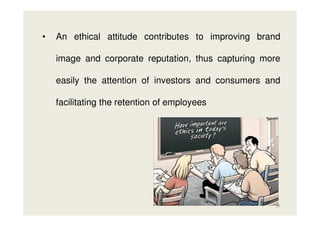
•

An ethical attitude contributes to improving brand
image and corporate reputation, thus capturing more
easily the attention of investors and consumers and
facilitating the retention of employees

27
“Business ethics can be said to begin when the law ends.
Business ethics is primarily concerned with those issues
not covered by the law, or where there is no definite
consensus on whether something is right or wrong. (…)
For this reason, it is often said that business ethics is
about the ‘grey areas’ of business, or where values are in
conflict.”
(Crane & Matten, 2010)
28
• It is expected that all legal conduct is also ethical, however much
of what has once been legal is nowadays seen as immoral, nonethical (slavery, political inequality and so forth)
• On the other hand, a non-illegal action is not necessarily ethical,
which means ethics transcends legality:

Is it ethical for an employee to take longer than the necessary to do a
job?
Is it ethical to make personal telephone calls during working time?
Is it ethical to call in sick to take a day off work?
Is it ethical not to report a co-worker misconduct?
…
29
1.2 The Emergence of Business Ethics:
Globalization,

Sustainability,

and

Competitiveness

30
“Globalization is a process which diminishes
the necessity of a common and shared
territorial basis for social, economic, and
political activities, processes, and relations.”
(Crane & Matten, 2010)

31
“… one of the most powerful and pervasive
influences on nations, businesses,
workplaces, communities and lives...”
(Kanter, 1995 )

32
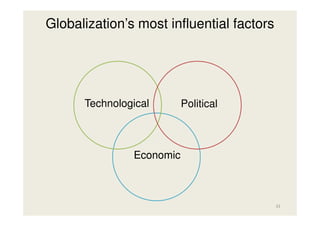
Globalization’s most influential factors

Technological

Political

Economic

33
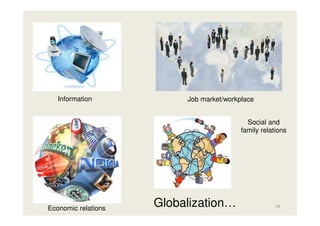
Information

Job market/workplace
Social and
family relations

Economic relations

Globalization…

34
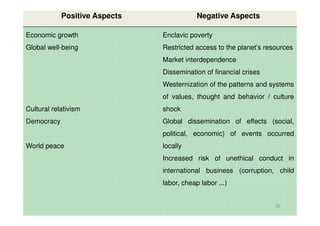
Positive Aspects

Negative Aspects

Economic growth

Enclavic poverty

Global well-being

Restricted access to the planet’s resources
Market interdependence
Dissemination of financial crises
Westernization of the patterns and systems
of values, thought and behavior / culture

Cultural relativism

shock

Democracy

Global dissemination of effects (social,
political, economic) of events occurred

World peace

locally
Increased risk of unethical conduct in
international business (corruption, child
labor, cheap labor ...)

35
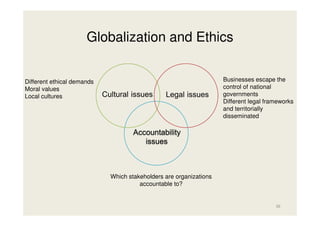
Globalization and Ethics
Businesses escape the
control of national
governments
Different legal frameworks
and territorially
disseminated

Different ethical demands
Moral values
Local cultures

Which stakeholders are organizations
accountable to?

36
“Sustainability refers to the long-term
maintenance of systems according to
environmental, economic, and social
considerations.”
(Crane & Matten, 2010)

37
“Competitiveness is the ability of a firm or a nation
to offer products and services that meet the quality
standards of the local and world markets at prices
that are competitive and provide adequate returns
on the resources employed or consumed in
producing them.”
(http://www.businessdictionary.com/definition/competitiveness.html#ixzz2eXJkFcHf)

38
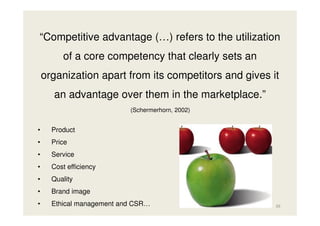
“Competitive advantage (…) refers to the utilization
of a core competency that clearly sets an
organization apart from its competitors and gives it
an advantage over them in the marketplace.”
(Schermerhorn, 2002)

•

Product

•

Price

•

Service

•

Cost efficiency

•

Quality

•

Brand image

•

Ethical management and CSR…

39
1.3.
Social

Conceptual

Network:

Responsibility,

and

Stakeholders,
Corporate

Governance

40
“Organizational stakeholders (are) those
persons, groups, and other organizations
directly affected by the behavior of the
organization and holding a stake in its
performance.”

(Schermerhorn, 2002)

41
“A stakeholder of a corporation is an
individual or a group which either: is harmed
by, or benefits from, the corporation; or
whose rights can be violated , or have to be
respected, by the corporation.”
(Crane & Matten, 2010)

42
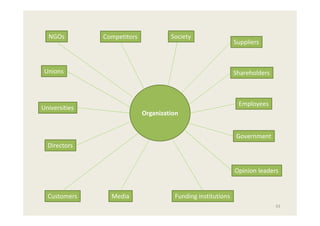
NGOs

Competitors

Society

Unions

Suppliers

Shareholders

Employees

Universities

Organization
Government

Directors

Opinion leaders

Customers

Media

Funding institutions
43
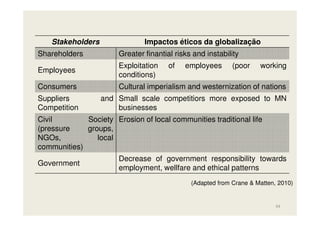
Stakeholders

Impactos éticos da globalização

Shareholders

Greater finantial risks and instability

Employees

Exploitation
conditions)

Consumers

Cultural imperialism and westernization of nations

Suppliers
Competition

and Small scale competitiors more exposed to MN
businesses

of

employees

(poor

working

Civil
Society Erosion of local communities traditional life
(pressure
groups,
NGOs,
local
communities)
Government

Decrease of government responsibility towards
employment, wellfare and ethical patterns
(Adapted from Crane & Matten, 2010)

44
“Corporate social responsibility is defined as
an obligation of the organization to act in
ways that serve both its own interests and
the interests of its many external
stakeholders.”

(Schermerhorn, 2002)

45
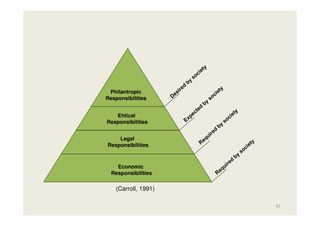
“Corporate social responsibility includes the
economic, legal, ethical, and philantropic
expectations placed on organizations by
society at a given point in time.”
(Crane and Matten, 2010)

46
Philantropic
Responsibilities
Ehtical
Responsibilities
Legal
Responsibilities

Economic
Responsibilities

(Carroll, 1991)
47
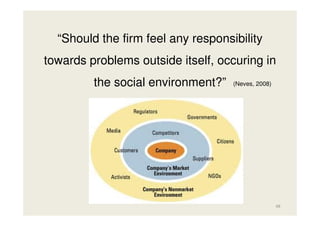
“Should the firm feel any responsibility
towards problems outside itself, occuring in
the social environment?”

(Neves, 2008)

48
The firm’s primary responsibility

To protect the owners’ /shareholders investment
and to act in their best interest…

49
M. Friedman’s (1970) arguments against
Corporate Social Responsibility

•

Only human beings have a moral responsibility for their
actions (he excludes organizations)

•

Managers’ responsibility is to act solely in the interests of
stakeholders (he excludes other stakeholders)

•

Social issues and problems are the province of the state
rather than corporate managers (he excludes social goals)
50
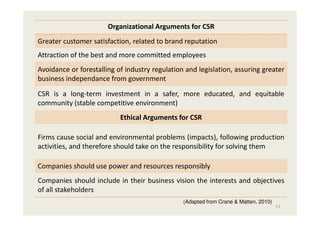
Organizational Arguments for CSR
Greater customer satisfaction, related to brand reputation
Attraction of the best and more committed employees
Avoidance or forestalling of industry regulation and legislation, assuring greater
business independance from government
CSR is a long-term investment in a safer, more educated, and equitable
community (stable competitive environment)
Ethical Arguments for CSR
Firms cause social and environmental problems (impacts), following production
activities, and therefore should take on the responsibility for solving them
Companies should use power and resources responsibly
Companies should include in their business vision the interests and objectives
of all stakeholders
(Adapted from Crane & Matten, 2010)

51
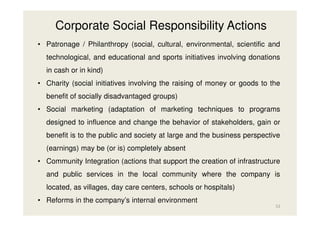
Corporate Social Responsibility Actions
• Patronage / Philanthropy (social, cultural, environmental, scientific and
technological, and educational and sports initiatives involving donations
in cash or in kind)
• Charity (social initiatives involving the raising of money or goods to the
benefit of socially disadvantaged groups)
• Social marketing (adaptation of marketing techniques to programs
designed to influence and change the behavior of stakeholders, gain or
benefit is to the public and society at large and the business perspective
(earnings) may be (or is) completely absent
• Community Integration (actions that support the creation of infrastructure
and public services in the local community where the company is
located, as villages, day care centers, schools or hospitals)
• Reforms in the company’s internal environment
52
“Corporate governance (…) is the system of
control and performance monitoring of top
management that is maintained by boards of
directors and other major stakeholders
representatives.”

(Schermerhorn, 2002)

53

Business ethics an introduction

  • 1.
    BUSINESS ETHICS 1. ANINTRODUCTION 2013/2014 Ana Cláudia Campos 1º Semestre 1
  • 2.
    1.1 Morality, Ethics,and Business Ethics 1.2 The Emergence of Business Ethics: Globalization, Sustainability, and Competitiveness 1.3 Conceptual Network: Stakeholders, Social Responsibility and Corporate Governance 2
  • 3.
    1.1 Morality, Ethics,and Business Ethics 3
  • 4.
    Morality “… is concernedwith the norms, values, and beliefs embeded in social processes which define right (√) and wrong (×) for an individual or a community.” (Crane & Matten, 2010) 4
  • 5.
  • 6.
  • 7.
  • 8.
  • 9.
    ETHICS “… is concernedwith the study of morality and the application of reason to elucidate specific rules and principles that determine right and wrong for a given situation. These rules and principles are called ethical theories.” (Crane & Matten, 2010) 9
  • 10.
    “… deals withindividual character and the moral rules that govern and limit our conduct. It investigates questions of right and wrong, duty and obligation, and moral responsibility.” (Shaw, 2011) 10
  • 11.
    Theoretical/philosophical study that analysesethical theories (Popkin & Stroll, 1956) 11
  • 12.
    “… the wisdomof living or the art of living.” (Savater, 1991) 12
  • 13.
    “ Ethics originatesin everyday life.” (Popkin & Stroll, 1956) … in the moral dilemmas arising in particular situations of individuals’ lives, that challlenge consciousness and claim the need of a decision making 13
  • 14.
    “An ethical dilemmais a situation that requires a choice regarding a possible course of action that, although offering the potential for personal or organizational benefit or both, may be considered unethical. It is often a situation in which action must be taken but for which there is no clear consensus on what is «right» and «wrong»”. (Schermerhorn, 2002) 14
  • 15.
    The ethical reflectionof everyday life becomes a philosophical investigation when transcends the individual’s particular issues and questions and develops a general approach to them. 15
  • 16.
    Perspective Context Should I lieto him or tell him the truth about my whereabouts last night? Particular Can I have this baby under the present circumtances? Everyday life This payoff is particularly advantageous in face of my political ambitions? Should I accept it? Is lying morally circumstances? acceptable under any Is abortion morally defensible? General Philosophy To buy off and be bought off are the two sides of the same coin: the use of any means to achieve the ends. Is any means worthy of moral appraisal? 16
  • 17.
    BUSINESS ETHICS “… isthe study of what constitutes right and wrong (or good and bad) human conduct in a business context.” (Shaw, 2011) 17
  • 18.
  • 19.
    “… is thestudy of business situations, activities, and decisions where issues of right and wrong are addressed.” (Crane & Matten, 2010) 19
  • 20.
  • 21.
    Comments • By ‘right’ and‘wrong’ it is meant ‘morally right’ and ‘morally wrong’, against ‘commercially’, ‘strategically’ or ‘finantially right or wrong’; • Business Ethics covers issues related to business organizations but also other types of organizations (governmental organizations, non-governmental/nonprofit, pressure groups, etc.) 21
  • 22.
    • Many people believe‘ethics’ and ‘business’ don’t match because businesses are either imoral (against morality) ou non-moral (outside morality) • However Business Ethics is increasingly becoming a topic of attention for both scholars and professionals in all fields 22
  • 23.
    Reasons for theincreasing importance of Business Ethics 23
  • 24.
    • The power andinfluence of business and firms in society is increasing everyday • Companies contribute to society (employment, taxes, economic and personal development...) and it is necessary to understand how this contribution occurs • Bad business practices have the potential to cause harm to individuals, communities and the environment 24
  • 25.
    • Stakeholders (consumers, control and pressure groups, the media,competition ...) increasingly require businesses to behave responsibly and ethically • There is lack of formal training in the area of ethics, and this training may contribute to problem analysis and more informed decision making 25
  • 26.
    • Ethical violations (fraud,injustice at work, corruption, abuse of trust ...) continue to happen in a daily basis discipline and an ethical approach helps to understand the reasons behind them • Studies show that companies with best ethical performance are also those with improved financial performance, increased productivity and quality, higher sales and customer loyalty 26
  • 27.
    • An ethical attitudecontributes to improving brand image and corporate reputation, thus capturing more easily the attention of investors and consumers and facilitating the retention of employees 27
  • 28.
    “Business ethics canbe said to begin when the law ends. Business ethics is primarily concerned with those issues not covered by the law, or where there is no definite consensus on whether something is right or wrong. (…) For this reason, it is often said that business ethics is about the ‘grey areas’ of business, or where values are in conflict.” (Crane & Matten, 2010) 28
  • 29.
    • It isexpected that all legal conduct is also ethical, however much of what has once been legal is nowadays seen as immoral, nonethical (slavery, political inequality and so forth) • On the other hand, a non-illegal action is not necessarily ethical, which means ethics transcends legality: Is it ethical for an employee to take longer than the necessary to do a job? Is it ethical to make personal telephone calls during working time? Is it ethical to call in sick to take a day off work? Is it ethical not to report a co-worker misconduct? … 29
  • 30.
    1.2 The Emergenceof Business Ethics: Globalization, Sustainability, and Competitiveness 30
  • 31.
    “Globalization is aprocess which diminishes the necessity of a common and shared territorial basis for social, economic, and political activities, processes, and relations.” (Crane & Matten, 2010) 31
  • 32.
    “… one ofthe most powerful and pervasive influences on nations, businesses, workplaces, communities and lives...” (Kanter, 1995 ) 32
  • 33.
    Globalization’s most influentialfactors Technological Political Economic 33
  • 34.
    Information Job market/workplace Social and familyrelations Economic relations Globalization… 34
  • 35.
    Positive Aspects Negative Aspects Economicgrowth Enclavic poverty Global well-being Restricted access to the planet’s resources Market interdependence Dissemination of financial crises Westernization of the patterns and systems of values, thought and behavior / culture Cultural relativism shock Democracy Global dissemination of effects (social, political, economic) of events occurred World peace locally Increased risk of unethical conduct in international business (corruption, child labor, cheap labor ...) 35
  • 36.
    Globalization and Ethics Businessesescape the control of national governments Different legal frameworks and territorially disseminated Different ethical demands Moral values Local cultures Which stakeholders are organizations accountable to? 36
  • 37.
    “Sustainability refers tothe long-term maintenance of systems according to environmental, economic, and social considerations.” (Crane & Matten, 2010) 37
  • 38.
    “Competitiveness is theability of a firm or a nation to offer products and services that meet the quality standards of the local and world markets at prices that are competitive and provide adequate returns on the resources employed or consumed in producing them.” (http://www.businessdictionary.com/definition/competitiveness.html#ixzz2eXJkFcHf) 38
  • 39.
    “Competitive advantage (…)refers to the utilization of a core competency that clearly sets an organization apart from its competitors and gives it an advantage over them in the marketplace.” (Schermerhorn, 2002) • Product • Price • Service • Cost efficiency • Quality • Brand image • Ethical management and CSR… 39
  • 40.
  • 41.
    “Organizational stakeholders (are)those persons, groups, and other organizations directly affected by the behavior of the organization and holding a stake in its performance.” (Schermerhorn, 2002) 41
  • 42.
    “A stakeholder ofa corporation is an individual or a group which either: is harmed by, or benefits from, the corporation; or whose rights can be violated , or have to be respected, by the corporation.” (Crane & Matten, 2010) 42
  • 43.
  • 44.
    Stakeholders Impactos éticos daglobalização Shareholders Greater finantial risks and instability Employees Exploitation conditions) Consumers Cultural imperialism and westernization of nations Suppliers Competition and Small scale competitiors more exposed to MN businesses of employees (poor working Civil Society Erosion of local communities traditional life (pressure groups, NGOs, local communities) Government Decrease of government responsibility towards employment, wellfare and ethical patterns (Adapted from Crane & Matten, 2010) 44
  • 45.
    “Corporate social responsibilityis defined as an obligation of the organization to act in ways that serve both its own interests and the interests of its many external stakeholders.” (Schermerhorn, 2002) 45
  • 46.
    “Corporate social responsibilityincludes the economic, legal, ethical, and philantropic expectations placed on organizations by society at a given point in time.” (Crane and Matten, 2010) 46
  • 47.
  • 48.
    “Should the firmfeel any responsibility towards problems outside itself, occuring in the social environment?” (Neves, 2008) 48
  • 49.
    The firm’s primaryresponsibility To protect the owners’ /shareholders investment and to act in their best interest… 49
  • 50.
    M. Friedman’s (1970)arguments against Corporate Social Responsibility • Only human beings have a moral responsibility for their actions (he excludes organizations) • Managers’ responsibility is to act solely in the interests of stakeholders (he excludes other stakeholders) • Social issues and problems are the province of the state rather than corporate managers (he excludes social goals) 50
  • 51.
    Organizational Arguments forCSR Greater customer satisfaction, related to brand reputation Attraction of the best and more committed employees Avoidance or forestalling of industry regulation and legislation, assuring greater business independance from government CSR is a long-term investment in a safer, more educated, and equitable community (stable competitive environment) Ethical Arguments for CSR Firms cause social and environmental problems (impacts), following production activities, and therefore should take on the responsibility for solving them Companies should use power and resources responsibly Companies should include in their business vision the interests and objectives of all stakeholders (Adapted from Crane & Matten, 2010) 51
  • 52.
    Corporate Social ResponsibilityActions • Patronage / Philanthropy (social, cultural, environmental, scientific and technological, and educational and sports initiatives involving donations in cash or in kind) • Charity (social initiatives involving the raising of money or goods to the benefit of socially disadvantaged groups) • Social marketing (adaptation of marketing techniques to programs designed to influence and change the behavior of stakeholders, gain or benefit is to the public and society at large and the business perspective (earnings) may be (or is) completely absent • Community Integration (actions that support the creation of infrastructure and public services in the local community where the company is located, as villages, day care centers, schools or hospitals) • Reforms in the company’s internal environment 52
  • 53.
    “Corporate governance (…)is the system of control and performance monitoring of top management that is maintained by boards of directors and other major stakeholders representatives.” (Schermerhorn, 2002) 53