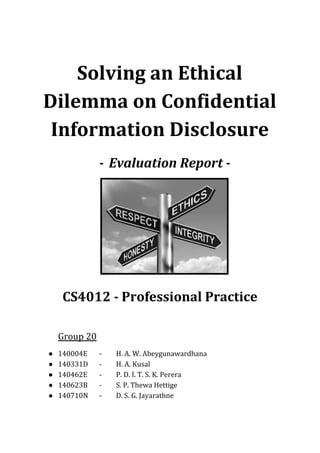
Solving an Ethical
Dilemma on Confidential
Information Disclosure
- Evaluation Report -
CS4012 - Professional Practice
Group 20
● 140004E - H. A. W. Abeygunawardhana
● 140331D - H. A. Kusal
● 140462E - P. D. I. T. S. K. Perera
● 140623B - S. P. Thewa Hettige
● 140710N - D. S. G. Jayarathne
Table of Contents
1. Professional Ethics 2
2. Ethical Dilemma 2
3. Case Study 3
4. How the Dilemma is Handled in the Video 4
a. Informal Approach 4
i. Tests Performed 4
b. Formal Approach 5
i. Kallman and Grillo’s Four Step Process 5
c. Code of Ethics/Conduct 9
5. Analysis of the Dilemma using The Virtue Framework 11
a. The Virtue Framework 12
i. Analysis of the Case Study Using The Virtue Framework 12
ii. Drawbacks of the Virtue Framework 14
1
Professional Ethics
The moral principles that govern the behavior of a person, are called ​Ethics​. The
field of ethics, also known as the ​Moral Philosophy​, includes ​systematizing, defending,
and recommending concepts of ​right ​and ​wrong ​behavior of a person. Usually ethics
are divided into three main categories:
● Metaethics ​- understands the nature of ​ethical properties, statements, attitudes,
and judgments
● Normative Ethics - i​nvestigates the set of questions that arise when considering
how one should act, morally speaking
● Applied Ethics​ - analyses ​particular moral issues in private and public life
However, ​Professional Ethics are the professionally accepted standards of
ethics, that might differ according to the field of study. These ethics are established by
professional bodies in different areas to support and guide the members to perform a
job role with professionality according to clear and ethical principles.
Ethical Dilemma
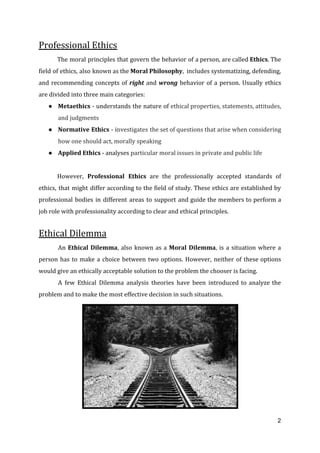
An ​Ethical Dilemma​, also known as a ​Moral Dilemma​, is a situation where a
person has to make a choice between two options. However, neither of these options
would give an ethically acceptable solution to the problem the chooser is facing.
A few Ethical Dilemma analysis theories have been introduced to analyze the
problem and to make the most effective decision in such situations.
2
Case Study
Kelum is working as a Business Analyst in a company for 4 years now. He finds
his job role and life boring for working in that company for too long and is deciding to
move to another company. He meets a friend who is working in the same industry, and
hears from him about a vacancy for a Business Analyst in his company. Therefore,
Kelum decides to apply for this position. He faces an interview with the HR Manager of
that company after sending applying for that job. The HR Manager is impressed by
Kelum’s experience as a Business Analyst in the industry, and also the work done in the
projects he has been engaged with, in his previous company. Therefore, the company
hires him and assigns him to a project similar to the previous project he has been
working on.
While Kelum is working in the new company, the HR Manager asks him to
provide confidential client information of the project he has been working on, in his
previous company. Since the current project he is working on is similar to the previous
one, the HR manager thinks it would be an opportunity for them to grab a tender to
their company without going into a fair competition. Further, this request is made in a
friendly manner where no evidence can be found if legal actions are to be taken. In this
situation, Kelum cannot give a straight answer to his HR Manager since it is not ethical
for him to distribute confidential information of his previous company. However, he
cannot refuse this offer at once, since it would lead him to lose his job.
Therefore, Kelum is facing a difficult situation, which is an ​ethical dilemma​,
where he must decide whether to reveal the confidential information or to refuse the
HR Manager’s request. 
3
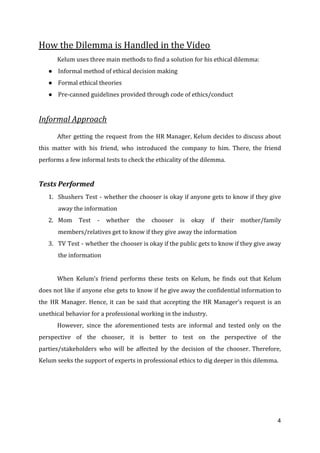
How the Dilemma is Handled in the Video
Kelum uses three main methods to find a solution for his ethical dilemma:
● Informal method of ethical decision making
● Formal ethical theories
● Pre-canned guidelines provided through code of ethics/conduct
Informal Approach
After getting the request from the HR Manager, Kelum decides to discuss about
this matter with his friend, who introduced the company to him. There, the friend
performs a few informal tests to check the ethicality of the dilemma.
Tests Performed
1. Shushers Test - whether the chooser is okay if anyone gets to know if they give
away the information
2. Mom Test - whether the chooser is okay if their mother/family
members/relatives get to know if they give away the information
3. TV Test - whether the chooser is okay if the public gets to know if they give away
the information
When Kelum’s friend performs these tests on Kelum, he finds out that Kelum
does not like if anyone else gets to know if he give away the confidential information to
the HR Manager. Hence, it can be said that accepting the HR Manager’s request is an
unethical behavior for a professional working in the industry.
However, since the aforementioned tests are informal and tested only on the
perspective of the chooser, it is better to test on the perspective of the
parties/stakeholders who will be affected by the decision of the chooser. Therefore,
Kelum seeks the support of experts in professional ethics to dig deeper in this dilemma.
4
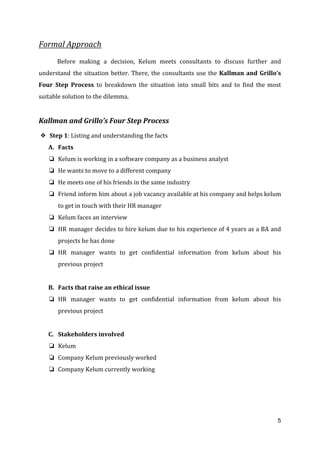
Formal Approach
Before making a decision, Kelum meets consultants to discuss further and
understand the situation better. There, the consultants use the ​Kallman and Grillo’s
Four Step Process ​to breakdown the situation into small bits and to find the most
suitable solution to the dilemma.
Kallman and Grillo’s Four Step Process
❖ Step 1​: Listing and understanding the facts
A. Facts
❏ Kelum is working in a software company as a business analyst
❏ He wants to move to a different company
❏ He meets one of his friends in the same industry
❏ Friend inform him about a job vacancy available at his company and helps kelum
to get in touch with their HR manager
❏ Kelum faces an interview
❏ HR manager decides to hire kelum due to his experience of 4 years as a BA and
projects he has done
❏ HR manager wants to get confidential information from kelum about his
previous project
B. Facts that raise an ethical issue
❏ HR manager wants to get confidential information from kelum about his
previous project
C. Stakeholders involved
❏ Kelum
❏ Company Kelum previously worked
❏ Company Kelum currently working
5
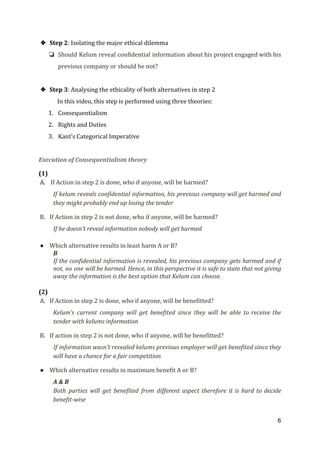
❖ Step 2​: Isolating the major ethical dilemma
❏ Should Kelum reveal confidential information about his project engaged with his
previous company or should he not?
❖ Step 3​: Analysing the ethicality of both alternatives in step 2
In this video, this step is performed using three theories:
1. Consequentialism
2. Rights and Duties
3. Kant’s Categorical Imperative
Execution of Consequentialism theory
(1)
A. ​If Action in step 2 is done, who if anyone, will be harmed?
If kelum reveals confidential information, his previous company will get harmed and
they might probably end up losing the tender
B. If Action in step 2 is not done, who if anyone, will be harmed?
If he doesn't reveal information nobody will get harmed
● Which alternative results in least harm A or B?
B
If the confidential information is revealed, his previous company gets harmed and if
not, no one will be harmed. Hence, in this perspective it is safe to state that not giving
away the information is the best option that Kelum can choose.
(2)
A. If Action in step 2 is done, who if anyone, will be benefitted?
Kelum’s current company will get benefited since they will be able to receive the
tender with kelums information
B. If action in step 2 is not done, who if anyone, will be benefitted?
If information wasn’t revealed kelums previous employer will get benefited since they
will have a chance for a fair competition
● Which alternative results in maximum benefit A or B?
A & B
Both parties will get benefited from different aspect therefore it is hard to decide
benefit-wise
6
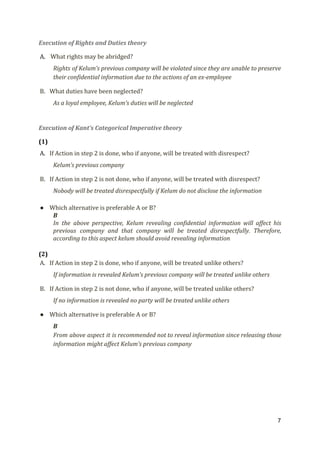
Execution of Rights and Duties theory
A. ​What rights may be abridged?
Rights of Kelum’s previous company will be violated since they are unable to preserve
their confidential information due to the actions of an ex-employee
B. What duties have been neglected?
As a loyal employee, Kelum’s duties will be neglected
Execution of Kant’s Categorical Imperative theory
(1)
A. If Action in step 2 is done, who if anyone, will be treated with disrespect?
Kelum’s previous company
B. If Action in step 2 is not done, who if anyone, will be treated with disrespect?
Nobody will be treated disrespectfully if Kelum do not disclose the information
● Which alternative is preferable A or B?
B
In the above perspective, Kelum revealing confidential information will affect his
previous company and that company will be treated disrespectfully. Therefore,
according to this aspect kelum should avoid revealing information
(2)
A. If Action in step 2 is done, who if anyone, will be treated unlike others?
If information is revealed Kelum’s previous company will be treated unlike others
B. If Action in step 2 is not done, who if anyone, will be treated unlike others?
If no information is revealed no party will be treated unlike others
● Which alternative is preferable A or B?
B
From above aspect it is recommended not to reveal information since releasing those
information might affect Kelum’s previous company
7
❖ Step 4​: Making decisions and planning the implementation
A. Make a defensible ethical decision
Considering all above evaluations kelum should not reveal confidential information to
his new company about his previous projects.
B. List the specific steps needed to implement your defensible ethical decision.
Kelum should talk to his HR manager and explain him about the ethical issue in
releasing information and justify Kelum’s decision not to reveal them.
C. Show how the major stakeholders are affected by these actions.
Rights of his previous company are not violated and they are treated with respect.
Duties of Kelum as a professional is not neglected.
D. What other long term changes (Political/ Legal/ Technical/ Societal/
Organizational) would help prevent such problems in the future?
Prohibiting an employee to disclose any information about his previous employer or
previous employer‘s intellectual property to his new employer through a code of
conduct.
Additionally passing it as a law and defining what actions to be taken in such a
situation where intellectual property rights are violated and encouraging employees
to avoid such practice.
build awareness on the fact that intellectual property rights should be preserved with
in the industry.
E. What should have been done or not done in the first place (at the pivot point) to
avoid this dilemma?
If kelum has had signed a NDA (non disclosure agreement) with his previous employer,
by law he will not be able to reveal confidential information about his previous work
to his current employer.
As the formal approach of the Four Step Process interprets, Kelum should not
reveal the confidential information of the project of his previous company to the HR
Manager of his new company, since by making such a decision may lead his previous
company to be disrespected and harmed. Further, by doing so, the reputation and image
Kelum has been maintaining for four years in the industry will be damaged and it would
leave a guilt in his mind.
8
Code of Ethics/Conduct
Code of Ethics is a document that outlines the mission and values of an
organization or a business, how the professionals are supposed to make decisions to the
problems or dilemmas, and the ethical principles of the organization’s core values and
standards. ​Code of Conduct is a set of rules that outlines the social norms and religious
rules and responsibilities for an individual or an organization, that includes ethical,
honor, moral codes and religious law concepts.
The consultants in the video refer to the ​Association for Computing Machinery
(ACM) ​Software Engineering Code of Ethics and Professional Practice guidelines to
solve Kelum’s dilemma further. According to this document, a software engineer should
adhere to the following principles, which are being analyzed in this video in accordance
to the ethical dilemma recognized.
1. Public: ​responsibility as an IT professional is neglected for the public
2. Client and Employer: ​cheating the previous employer and misleading the client
since the confidential information is given to the current employer and they use that
information to mislead the client
3. Product: ​when the confidential information of the product is being revealed, it
harms the product itself and lowers its value
4. Judgement: ​people will judge Kelum in a wrong perspective if he reveals
information that should be hidden, they might be mislead by the information given
5. Management: ​the management of the previous company has worked hard to get
the particular project up to the current level. Hence by revealing such information
would be a waste of their hard work.
6. Profession: ​a professional should be ethical and follow these guidelines to retain
the professionality in the industry. By making a wrong decision can harm that
professional image
7. Colleagues: ​colleagues of the previous company who worked hard to develop the
project will be disrespected and their work will be wasted if the information is
revealed
8. Self: ​a disrespect and a guilt will remain within if the information is revealed just
because he could not reject the HR Manager’s request
9
By analysing the above methods where Kelum’s dilemma is being questioned, it
can be concluded that revealing the confidential information of the project he has been
working on, in his previous company is the worst decision he can make. Further, as an
IT professional, Kelum should talk gently with his HR Manager about this matter openly
and make him understand about the unethical behavior of the request he has made.
However, though there is a probability for Kelum to lose his job due to rejecting the
management’s request, he would not have to work under fault pressure or disrespect
and guilt in himself by rejecting the request
10
Analysis of the Dilemma using The Virtue Framework
Once a professional is faced with an ethical dilemma, there are multiple
approaches he/she can select to help themselves with ethical decision making. These
approaches are fundamentally associated either with informal guidelines that are based
on quick tests and/or decision making frameworks that evolved from formal ethical
theories. Formal ethical theories can be broadly divided into three categories;
1. Consequentialist Theories
These theories are primarily concerned with the ethical consequences of a particular
action or a set of actions.
2. Non-consequentialist Theories
Theories in which it is more concerned about the intentions of the person making the
decision.
3. Agent-centered Theories
More concerned with the overall ethical status of individuals rather than identifying
the morality of a particular set of actions.
Meanwhile it is also important to notice that there are several approaches that
share the characteristics of multiple categories.
In addition to having a sensitivity to ethical issues, one should practice an
appropriate method for analysing the ethical aspects of a decision. These methods can
be derived from ethical decision making frameworks that are based on formal ethical
theories. In the case study, two of such frameworks are used in making the ethically
correct decision.
1. The Consequentialist Framework
2. The Duty Framework
In this chapter we hope to analyze this situation using ​“The Virtue
Framework” ​and derive an accurate decision with its help.
11
The Virtue Framework
When evaluating a decision using this framework, we are rather interested
about the question, ​“What kind of person should I be and what will my actions
show about my character?”​. Simply the decision making party is concerned with what
kind of personality he/she will depict through their course of actions. In essence, this
framework suggests to look into character traits that might be motivating the involving
parties to cause this ethical dilemma. Further it defines the ​ethical behaviour as
whatever a virtuous person would do in such a situation and directs out course of
actions under the assumption that we seek to develop similar positive virtues.
Analysis of the Case Study Using The Virtue Framework
In the case study, the ​ethical dilemma Kelum has to face is, whether to reveal
confidential information regarding to the project he was assigned at his previous
workplace or not. In order to derive a correct ethical decision in this scenario, we must
first define the virtuous person Kelum is determined to follow. In various contexts, good
virtues are defined differently. However as a whole, these virtues represent the same
set of good ethical qualities more or less. After defining a virtuous person, we can
predict his course of actions adhering to the morals he is determined to protect.
According to the framework itself, the ​ethical behaviour ​is the behaviour of the
virtuous person we define and thus the ethically accurate decision to solve the ethical
dilemma is revealed.
For an instance, let us define a virtuous person who is following the ​seven
heavenly virtues​. According to Pope Gregory, the set of virtues would be,
● Faith - the belief in right things.
● Hope - having positive future view, that good will prevail
● Charity - being concerned and actively helping others
● Fortitude - never giving up
● Justice - being fair and equitable with others
● Prudence - care of and moderation of money
● Temperance - moderation of needed things and abstinence of unwanted things
12
After defining the virtuous person, we have to relate the ethical dilemma to at
least one of these virtues. It is natural for a given ethical dilemma to fall under the
jurisdiction of multiple virtues, because the concept of virtues is very abstract and most
of them include overlapping ethical and moral values. Let us try to relate the ethical
dilemma to the virtues by evaluating the two options Kelum has, focusing on the
influence they have on the Kelums character respectively.
Let us assume that Kelum decides to reveal the confidential information. The
question we are trying to find the answers for is ​“If Kelum was to reveal the
confidential information, what are the virtues he had to jeopardize? Or what are
the virtues he continues to safeguard?”​.
The HR Manager asks Kelum to submit the confidential client information to
acquire the tender, causing this ethical dilemma. This incident is staged as an informal
meeting between two. Thus it is safe to assume that the HR manager was asking for a
personal favour to reduce the workload on him. By revealing this confidential
information Kelum might be able to help the colleague. But we have to identify the
virtues that are affected both positively and negatively by his action.
● A common misconception would be, that by agreeing to give away information
Kelum is acting according to the virtue ​charity. ​But a shallow analysis of the virtue
itself reveals that this action is not aligned with the definitions of the very virtue.
Although he is trying to help someone, the information he is giving away is not his
property in the first place. As this information is intellectual property of the
previous company he worked for, Kelum might as well be stealing from his previous
employer, which is definitely not a good virtue.
● Also it is quite obvious that by agreeing to provide those information, Kelum is
treating his previous employer in an unfair way. First of all, the information about
the clients and the project is ​not ​Kelums brain child. It is a result of a group of
hardworking employees in Kelums previous company. Though Kelum was a part of
this team, it does not necessarily provide him with authority to distribute this
knowledge according to his will. Secondly, by getting this information, Kelum’s
current employer might gain a significant progress in the process of acquiring the
13
tender. They will gain an advantage over Kelums former employer. It is obvious that
this advantage is based on the work done by Kelums previous employer. Thus, this
action deprives Kelums previous employer of having the chance for a fair
competition with the rivals to acquire the tender. Which leads to the conclusion that
Kelums action was not just. Kelums action is not aligned with the virtue ​justice​.
Further if Kelum has signed any ​non-disclosure agreement with his previous
employer, this action is not only ethically wrong, but also punishable by law.
In conclusion, if Kelum agrees to give away the confidential information, that
particular decision can not be considered as a ethically correct decision according to
this analysis. He has to jeopardise several virtues if he is to take that decision. Thus, we
can safely come to the conclusion that the ethically accurate decision will be to ​not
reveal the confidential information to Kelums current employer.
Drawbacks of the Virtue Framework
It is observable that a definition of a virtuous person is not available in this
framework. If a person intends to use this framework for evaluating a ethical decision,
they have to define the virtues themselves or use an existing definition. These existing
definitions of good virtues differ from each other quite often. Furthermore in most
communities, this virtues happen to be cultural norms that are inherent in that
particular community. Thus, there can be such events where there are conflicts between
defined sets of virtues.
Having a clear, global definition of a set of good virtues would solve these
conflicts.
14
References
[1] I. Staff, “Code of Ethics,” ​Investopedia​, 20-Jan-2018. [Online]. Available:
https://www.investopedia.com/terms/c/code-of-ethics.asp. [Accessed:
08-Feb-2018].
[2] J. Fieser, “Ethics,” ​Internet Encyclopedia of Philosophy​. [Online]. Available:
https://www.iep.utm.edu/ethics/. [Accessed: 08-Feb-2018].
[3] “Software Engineering Code,” ​ACM Ethics​, 18-Nov-2017. [Online]. Available:
https://ethics.acm.org/code-of-ethics/software-engineering-code/. [Accessed:
08-Feb-2018].
[4] “Brown University,”​ A Framework for Making Ethical Decisions | Science and
Technology Studies​. [Online]. Available:
https://www.brown.edu/academics/science-and-technology-studies/framework-
making-ethical-decisions. [Accessed: 08-Feb-2018].
[5] “The Seven Virtues - Changing minds,” ​Changing Minds​. [Online]. Available:
http://changingminds.org/explanations/values/seven_virtues.html. [Accessed:
09-Feb-2018].
15

solving an ethical dilemma

  • 1.
    Solving an Ethical Dilemmaon Confidential Information Disclosure - Evaluation Report - CS4012 - Professional Practice Group 20 ● 140004E - H. A. W. Abeygunawardhana ● 140331D - H. A. Kusal ● 140462E - P. D. I. T. S. K. Perera ● 140623B - S. P. Thewa Hettige ● 140710N - D. S. G. Jayarathne
  • 2.
    Table of Contents 1.Professional Ethics 2 2. Ethical Dilemma 2 3. Case Study 3 4. How the Dilemma is Handled in the Video 4 a. Informal Approach 4 i. Tests Performed 4 b. Formal Approach 5 i. Kallman and Grillo’s Four Step Process 5 c. Code of Ethics/Conduct 9 5. Analysis of the Dilemma using The Virtue Framework 11 a. The Virtue Framework 12 i. Analysis of the Case Study Using The Virtue Framework 12 ii. Drawbacks of the Virtue Framework 14 1
  • 3.
    Professional Ethics The moralprinciples that govern the behavior of a person, are called ​Ethics​. The field of ethics, also known as the ​Moral Philosophy​, includes ​systematizing, defending, and recommending concepts of ​right ​and ​wrong ​behavior of a person. Usually ethics are divided into three main categories: ● Metaethics ​- understands the nature of ​ethical properties, statements, attitudes, and judgments ● Normative Ethics - i​nvestigates the set of questions that arise when considering how one should act, morally speaking ● Applied Ethics​ - analyses ​particular moral issues in private and public life However, ​Professional Ethics are the professionally accepted standards of ethics, that might differ according to the field of study. These ethics are established by professional bodies in different areas to support and guide the members to perform a job role with professionality according to clear and ethical principles. Ethical Dilemma An ​Ethical Dilemma​, also known as a ​Moral Dilemma​, is a situation where a person has to make a choice between two options. However, neither of these options would give an ethically acceptable solution to the problem the chooser is facing. A few Ethical Dilemma analysis theories have been introduced to analyze the problem and to make the most effective decision in such situations. 2
  • 4.
    Case Study Kelum isworking as a Business Analyst in a company for 4 years now. He finds his job role and life boring for working in that company for too long and is deciding to move to another company. He meets a friend who is working in the same industry, and hears from him about a vacancy for a Business Analyst in his company. Therefore, Kelum decides to apply for this position. He faces an interview with the HR Manager of that company after sending applying for that job. The HR Manager is impressed by Kelum’s experience as a Business Analyst in the industry, and also the work done in the projects he has been engaged with, in his previous company. Therefore, the company hires him and assigns him to a project similar to the previous project he has been working on. While Kelum is working in the new company, the HR Manager asks him to provide confidential client information of the project he has been working on, in his previous company. Since the current project he is working on is similar to the previous one, the HR manager thinks it would be an opportunity for them to grab a tender to their company without going into a fair competition. Further, this request is made in a friendly manner where no evidence can be found if legal actions are to be taken. In this situation, Kelum cannot give a straight answer to his HR Manager since it is not ethical for him to distribute confidential information of his previous company. However, he cannot refuse this offer at once, since it would lead him to lose his job. Therefore, Kelum is facing a difficult situation, which is an ​ethical dilemma​, where he must decide whether to reveal the confidential information or to refuse the HR Manager’s request.  3
  • 5.
    How the Dilemmais Handled in the Video Kelum uses three main methods to find a solution for his ethical dilemma: ● Informal method of ethical decision making ● Formal ethical theories ● Pre-canned guidelines provided through code of ethics/conduct Informal Approach After getting the request from the HR Manager, Kelum decides to discuss about this matter with his friend, who introduced the company to him. There, the friend performs a few informal tests to check the ethicality of the dilemma. Tests Performed 1. Shushers Test - whether the chooser is okay if anyone gets to know if they give away the information 2. Mom Test - whether the chooser is okay if their mother/family members/relatives get to know if they give away the information 3. TV Test - whether the chooser is okay if the public gets to know if they give away the information When Kelum’s friend performs these tests on Kelum, he finds out that Kelum does not like if anyone else gets to know if he give away the confidential information to the HR Manager. Hence, it can be said that accepting the HR Manager’s request is an unethical behavior for a professional working in the industry. However, since the aforementioned tests are informal and tested only on the perspective of the chooser, it is better to test on the perspective of the parties/stakeholders who will be affected by the decision of the chooser. Therefore, Kelum seeks the support of experts in professional ethics to dig deeper in this dilemma. 4
  • 6.
    Formal Approach Before makinga decision, Kelum meets consultants to discuss further and understand the situation better. There, the consultants use the ​Kallman and Grillo’s Four Step Process ​to breakdown the situation into small bits and to find the most suitable solution to the dilemma. Kallman and Grillo’s Four Step Process ❖ Step 1​: Listing and understanding the facts A. Facts ❏ Kelum is working in a software company as a business analyst ❏ He wants to move to a different company ❏ He meets one of his friends in the same industry ❏ Friend inform him about a job vacancy available at his company and helps kelum to get in touch with their HR manager ❏ Kelum faces an interview ❏ HR manager decides to hire kelum due to his experience of 4 years as a BA and projects he has done ❏ HR manager wants to get confidential information from kelum about his previous project B. Facts that raise an ethical issue ❏ HR manager wants to get confidential information from kelum about his previous project C. Stakeholders involved ❏ Kelum ❏ Company Kelum previously worked ❏ Company Kelum currently working 5
  • 7.
    ❖ Step 2​:Isolating the major ethical dilemma ❏ Should Kelum reveal confidential information about his project engaged with his previous company or should he not? ❖ Step 3​: Analysing the ethicality of both alternatives in step 2 In this video, this step is performed using three theories: 1. Consequentialism 2. Rights and Duties 3. Kant’s Categorical Imperative Execution of Consequentialism theory (1) A. ​If Action in step 2 is done, who if anyone, will be harmed? If kelum reveals confidential information, his previous company will get harmed and they might probably end up losing the tender B. If Action in step 2 is not done, who if anyone, will be harmed? If he doesn't reveal information nobody will get harmed ● Which alternative results in least harm A or B? B If the confidential information is revealed, his previous company gets harmed and if not, no one will be harmed. Hence, in this perspective it is safe to state that not giving away the information is the best option that Kelum can choose. (2) A. If Action in step 2 is done, who if anyone, will be benefitted? Kelum’s current company will get benefited since they will be able to receive the tender with kelums information B. If action in step 2 is not done, who if anyone, will be benefitted? If information wasn’t revealed kelums previous employer will get benefited since they will have a chance for a fair competition ● Which alternative results in maximum benefit A or B? A & B Both parties will get benefited from different aspect therefore it is hard to decide benefit-wise 6
  • 8.
    Execution of Rightsand Duties theory A. ​What rights may be abridged? Rights of Kelum’s previous company will be violated since they are unable to preserve their confidential information due to the actions of an ex-employee B. What duties have been neglected? As a loyal employee, Kelum’s duties will be neglected Execution of Kant’s Categorical Imperative theory (1) A. If Action in step 2 is done, who if anyone, will be treated with disrespect? Kelum’s previous company B. If Action in step 2 is not done, who if anyone, will be treated with disrespect? Nobody will be treated disrespectfully if Kelum do not disclose the information ● Which alternative is preferable A or B? B In the above perspective, Kelum revealing confidential information will affect his previous company and that company will be treated disrespectfully. Therefore, according to this aspect kelum should avoid revealing information (2) A. If Action in step 2 is done, who if anyone, will be treated unlike others? If information is revealed Kelum’s previous company will be treated unlike others B. If Action in step 2 is not done, who if anyone, will be treated unlike others? If no information is revealed no party will be treated unlike others ● Which alternative is preferable A or B? B From above aspect it is recommended not to reveal information since releasing those information might affect Kelum’s previous company 7
  • 9.
    ❖ Step 4​:Making decisions and planning the implementation A. Make a defensible ethical decision Considering all above evaluations kelum should not reveal confidential information to his new company about his previous projects. B. List the specific steps needed to implement your defensible ethical decision. Kelum should talk to his HR manager and explain him about the ethical issue in releasing information and justify Kelum’s decision not to reveal them. C. Show how the major stakeholders are affected by these actions. Rights of his previous company are not violated and they are treated with respect. Duties of Kelum as a professional is not neglected. D. What other long term changes (Political/ Legal/ Technical/ Societal/ Organizational) would help prevent such problems in the future? Prohibiting an employee to disclose any information about his previous employer or previous employer‘s intellectual property to his new employer through a code of conduct. Additionally passing it as a law and defining what actions to be taken in such a situation where intellectual property rights are violated and encouraging employees to avoid such practice. build awareness on the fact that intellectual property rights should be preserved with in the industry. E. What should have been done or not done in the first place (at the pivot point) to avoid this dilemma? If kelum has had signed a NDA (non disclosure agreement) with his previous employer, by law he will not be able to reveal confidential information about his previous work to his current employer. As the formal approach of the Four Step Process interprets, Kelum should not reveal the confidential information of the project of his previous company to the HR Manager of his new company, since by making such a decision may lead his previous company to be disrespected and harmed. Further, by doing so, the reputation and image Kelum has been maintaining for four years in the industry will be damaged and it would leave a guilt in his mind. 8
  • 10.
    Code of Ethics/Conduct Codeof Ethics is a document that outlines the mission and values of an organization or a business, how the professionals are supposed to make decisions to the problems or dilemmas, and the ethical principles of the organization’s core values and standards. ​Code of Conduct is a set of rules that outlines the social norms and religious rules and responsibilities for an individual or an organization, that includes ethical, honor, moral codes and religious law concepts. The consultants in the video refer to the ​Association for Computing Machinery (ACM) ​Software Engineering Code of Ethics and Professional Practice guidelines to solve Kelum’s dilemma further. According to this document, a software engineer should adhere to the following principles, which are being analyzed in this video in accordance to the ethical dilemma recognized. 1. Public: ​responsibility as an IT professional is neglected for the public 2. Client and Employer: ​cheating the previous employer and misleading the client since the confidential information is given to the current employer and they use that information to mislead the client 3. Product: ​when the confidential information of the product is being revealed, it harms the product itself and lowers its value 4. Judgement: ​people will judge Kelum in a wrong perspective if he reveals information that should be hidden, they might be mislead by the information given 5. Management: ​the management of the previous company has worked hard to get the particular project up to the current level. Hence by revealing such information would be a waste of their hard work. 6. Profession: ​a professional should be ethical and follow these guidelines to retain the professionality in the industry. By making a wrong decision can harm that professional image 7. Colleagues: ​colleagues of the previous company who worked hard to develop the project will be disrespected and their work will be wasted if the information is revealed 8. Self: ​a disrespect and a guilt will remain within if the information is revealed just because he could not reject the HR Manager’s request 9
  • 11.
    By analysing theabove methods where Kelum’s dilemma is being questioned, it can be concluded that revealing the confidential information of the project he has been working on, in his previous company is the worst decision he can make. Further, as an IT professional, Kelum should talk gently with his HR Manager about this matter openly and make him understand about the unethical behavior of the request he has made. However, though there is a probability for Kelum to lose his job due to rejecting the management’s request, he would not have to work under fault pressure or disrespect and guilt in himself by rejecting the request 10
  • 12.
    Analysis of theDilemma using The Virtue Framework Once a professional is faced with an ethical dilemma, there are multiple approaches he/she can select to help themselves with ethical decision making. These approaches are fundamentally associated either with informal guidelines that are based on quick tests and/or decision making frameworks that evolved from formal ethical theories. Formal ethical theories can be broadly divided into three categories; 1. Consequentialist Theories These theories are primarily concerned with the ethical consequences of a particular action or a set of actions. 2. Non-consequentialist Theories Theories in which it is more concerned about the intentions of the person making the decision. 3. Agent-centered Theories More concerned with the overall ethical status of individuals rather than identifying the morality of a particular set of actions. Meanwhile it is also important to notice that there are several approaches that share the characteristics of multiple categories. In addition to having a sensitivity to ethical issues, one should practice an appropriate method for analysing the ethical aspects of a decision. These methods can be derived from ethical decision making frameworks that are based on formal ethical theories. In the case study, two of such frameworks are used in making the ethically correct decision. 1. The Consequentialist Framework 2. The Duty Framework In this chapter we hope to analyze this situation using ​“The Virtue Framework” ​and derive an accurate decision with its help. 11
  • 13.
    The Virtue Framework Whenevaluating a decision using this framework, we are rather interested about the question, ​“What kind of person should I be and what will my actions show about my character?”​. Simply the decision making party is concerned with what kind of personality he/she will depict through their course of actions. In essence, this framework suggests to look into character traits that might be motivating the involving parties to cause this ethical dilemma. Further it defines the ​ethical behaviour as whatever a virtuous person would do in such a situation and directs out course of actions under the assumption that we seek to develop similar positive virtues. Analysis of the Case Study Using The Virtue Framework In the case study, the ​ethical dilemma Kelum has to face is, whether to reveal confidential information regarding to the project he was assigned at his previous workplace or not. In order to derive a correct ethical decision in this scenario, we must first define the virtuous person Kelum is determined to follow. In various contexts, good virtues are defined differently. However as a whole, these virtues represent the same set of good ethical qualities more or less. After defining a virtuous person, we can predict his course of actions adhering to the morals he is determined to protect. According to the framework itself, the ​ethical behaviour ​is the behaviour of the virtuous person we define and thus the ethically accurate decision to solve the ethical dilemma is revealed. For an instance, let us define a virtuous person who is following the ​seven heavenly virtues​. According to Pope Gregory, the set of virtues would be, ● Faith - the belief in right things. ● Hope - having positive future view, that good will prevail ● Charity - being concerned and actively helping others ● Fortitude - never giving up ● Justice - being fair and equitable with others ● Prudence - care of and moderation of money ● Temperance - moderation of needed things and abstinence of unwanted things 12
  • 14.
    After defining thevirtuous person, we have to relate the ethical dilemma to at least one of these virtues. It is natural for a given ethical dilemma to fall under the jurisdiction of multiple virtues, because the concept of virtues is very abstract and most of them include overlapping ethical and moral values. Let us try to relate the ethical dilemma to the virtues by evaluating the two options Kelum has, focusing on the influence they have on the Kelums character respectively. Let us assume that Kelum decides to reveal the confidential information. The question we are trying to find the answers for is ​“If Kelum was to reveal the confidential information, what are the virtues he had to jeopardize? Or what are the virtues he continues to safeguard?”​. The HR Manager asks Kelum to submit the confidential client information to acquire the tender, causing this ethical dilemma. This incident is staged as an informal meeting between two. Thus it is safe to assume that the HR manager was asking for a personal favour to reduce the workload on him. By revealing this confidential information Kelum might be able to help the colleague. But we have to identify the virtues that are affected both positively and negatively by his action. ● A common misconception would be, that by agreeing to give away information Kelum is acting according to the virtue ​charity. ​But a shallow analysis of the virtue itself reveals that this action is not aligned with the definitions of the very virtue. Although he is trying to help someone, the information he is giving away is not his property in the first place. As this information is intellectual property of the previous company he worked for, Kelum might as well be stealing from his previous employer, which is definitely not a good virtue. ● Also it is quite obvious that by agreeing to provide those information, Kelum is treating his previous employer in an unfair way. First of all, the information about the clients and the project is ​not ​Kelums brain child. It is a result of a group of hardworking employees in Kelums previous company. Though Kelum was a part of this team, it does not necessarily provide him with authority to distribute this knowledge according to his will. Secondly, by getting this information, Kelum’s current employer might gain a significant progress in the process of acquiring the 13
  • 15.
    tender. They willgain an advantage over Kelums former employer. It is obvious that this advantage is based on the work done by Kelums previous employer. Thus, this action deprives Kelums previous employer of having the chance for a fair competition with the rivals to acquire the tender. Which leads to the conclusion that Kelums action was not just. Kelums action is not aligned with the virtue ​justice​. Further if Kelum has signed any ​non-disclosure agreement with his previous employer, this action is not only ethically wrong, but also punishable by law. In conclusion, if Kelum agrees to give away the confidential information, that particular decision can not be considered as a ethically correct decision according to this analysis. He has to jeopardise several virtues if he is to take that decision. Thus, we can safely come to the conclusion that the ethically accurate decision will be to ​not reveal the confidential information to Kelums current employer. Drawbacks of the Virtue Framework It is observable that a definition of a virtuous person is not available in this framework. If a person intends to use this framework for evaluating a ethical decision, they have to define the virtues themselves or use an existing definition. These existing definitions of good virtues differ from each other quite often. Furthermore in most communities, this virtues happen to be cultural norms that are inherent in that particular community. Thus, there can be such events where there are conflicts between defined sets of virtues. Having a clear, global definition of a set of good virtues would solve these conflicts. 14
  • 16.
    References [1] I. Staff,“Code of Ethics,” ​Investopedia​, 20-Jan-2018. [Online]. Available: https://www.investopedia.com/terms/c/code-of-ethics.asp. [Accessed: 08-Feb-2018]. [2] J. Fieser, “Ethics,” ​Internet Encyclopedia of Philosophy​. [Online]. Available: https://www.iep.utm.edu/ethics/. [Accessed: 08-Feb-2018]. [3] “Software Engineering Code,” ​ACM Ethics​, 18-Nov-2017. [Online]. Available: https://ethics.acm.org/code-of-ethics/software-engineering-code/. [Accessed: 08-Feb-2018]. [4] “Brown University,”​ A Framework for Making Ethical Decisions | Science and Technology Studies​. [Online]. Available: https://www.brown.edu/academics/science-and-technology-studies/framework- making-ethical-decisions. [Accessed: 08-Feb-2018]. [5] “The Seven Virtues - Changing minds,” ​Changing Minds​. [Online]. Available: http://changingminds.org/explanations/values/seven_virtues.html. [Accessed: 09-Feb-2018]. 15