Ethics in Information
Technology, Fourth Edition
Chapter 1
An Overview of Ethics
Objectives
• As you read this chapter, consider the following
questions:
– What is ethics, and why is it important to act
according to a code of ethics?
– Why is business ethics becoming increasingly
important?
– What are organizations doing to improve their
business ethics?
Ethics in Information Technology, Fourth Edition 2
Objectives (cont’d.)
– Why are organizations interested in fostering good
business ethics?
– What approach can you take to ensure ethical
decision making?
– What trends have increased the risk of using
information technology in an unethical manner?
Ethics in Information Technology, Fourth Edition 3
Ethics in Information Technology, Fourth Edition 4
What is Ethics?
• Moral code
– Set of rules
– Establishes boundaries of generally accepted
behavior
– Different rules often have contradictions
• Morality
– Social conventions about right and wrong
– Widely shared
– Form basis for an established consensus
Ethics in Information Technology, Fourth Edition 5
What is Ethics? (cont’d.)
• Morality may vary by:
– Age
– Cultural group
– Ethnic background
– Religion
– Life experiences
– Education
– Gender
Ethics in Information Technology, Fourth Edition 6
Definition of Ethics
• Ethics
– Set of beliefs about right and wrong behavior
• Virtues
– Habits that incline people to do what is acceptable
• Vices
– Habits of unacceptable behavior
• Virtues and vices define a personal value system
– Scheme of moral values
Ethics in Information Technology, Fourth Edition 7
The Importance of Integrity
• Integrity is a cornerstone of ethical behavior
• People with integrity:
– Act in accordance with a personal code of principles
– Extend to all the same respect and consideration
– Apply the same moral standards in all situations
• Lack of integrity emerges if you apply moral
standards differently according to situation or people
involved
• Many ethical dilemmas are not as simple as right
versus wrong
The Difference Between Morals,
Ethics, and Laws
• Morals: one’s personal beliefs about right and wrong
• Ethics: standards or codes of behavior expected of
an individual by a group
• Law: system of rules that tells us what we can and
cannot do
– Laws are enforced by a set of institutions
– Legal acts conform to the law
– Moral acts conform to what an individual believes is
the right belief of right and wrong
Ethics in Information Technology, Fourth Edition 8
Ethics in the Business World
• Both the likelihood and the negative impact of
inappropriate behavior have increased
• Several trends have increased the likelihood of
unethical behavior:
– Globalization creating complex work environments
– Organizations challenged to maintain profits / revenue
– Heightened vigilance by:
• Employees
• Shareholders
• Regulatory agencies
Ethics in Information Technology, Fourth Edition 9
Ethics in the Business World (cont’d.)
• Recent scandals in IT companies
– Satyam Computer Services (India)
– Hewlett Packard
– Computer Associates International
– IBM
• Not just executives, but even lower-level employees,
can find themselves in the middle of an ethical
dilemma
Ethics in Information Technology, Fourth Edition 10
Ethics in Information Technology, Fourth Edition 11
Why Fostering Good Business Ethics
Is Important
• To gain the good will of the community
• To create an organization that operates consistently
• To foster good business practices
• To protect organization/employees from legal action
• To avoid unfavorable publicity
Ethics in Information Technology, Fourth Edition 12
Gaining the Good Will
of the Community
• Organizations have fundamental responsibilities to
society
– Declared in formal statement of company’s principles
or beliefs
– Include:
• Making contributions to charitable organizations and
nonprofit institutions
• Providing benefits for employees in excess of legal
requirements
• Choosing economic opportunities that might be more
socially desirable than profitable
Ethics in Information Technology, Fourth Edition 13
Gaining the Good Will of the
Community (cont’d.)
• Socially responsible activities create good will
• Good will makes it easier for corporations to conduct
business
Creating an Organization That
Operates Consistently
• Consistency ensures that employees:
– Know what is expected of them
– Can employ the organization’s values to help them in
decision making
• Consistency also means that shareholders,
customers, suppliers, and community know what
they can expect of the organization
Ethics in Information Technology, Fourth Edition 14
Ethics in Information Technology, Fourth Edition 15
Creating an Organization That
Operates Consistently (cont’d.)
• Many companies share the following values:
– Operate with honesty and integrity, staying true to
organizational principles
– Operate according to standards of ethical conduct, in
words and action
– Treat colleagues, customers, and consumers with
respect
– Strive to be the best at what matters to the company
– Value diversity
– Make decisions based on facts and principles
Fostering Good Business Practices
• Good ethics means good business/improved profits
• Companies that:
– Produce safe and effective products
• Avoid costly recalls and lawsuits
– Provide excellent service that retains customers
– Develop and maintain strong employee relations
• Suffer lower turnover rates
• Enjoy better employee morale
Ethics in Information Technology, Fourth Edition 16
Ethics in Information Technology, Fourth Edition 17
Fostering Good Business Practices
(cont’d.)
• Suppliers/business partners place priority on
working with companies that operate in a fair and
ethical manner
• Bad ethics means bad business/waning profits
– Bad ethics can lead to bad business results
– Bad ethics can have a negative impact on employees
Protecting the Organization and Its
Employees from Legal Actions
• U.S. Supreme Court established that an employer
can be held responsible for the acts of its
employees
• This principle is called respondeat superior
• Coalition of several legal organizations argues
establishment of ethics and compliance programs
should reduce criminal liability of organization
• Others argue company officers should not be given
light sentences if their ethics programs are
ineffective
Ethics in Information Technology, Fourth Edition 18
Avoiding Unfavorable Publicity
• Public reputation of company strongly influences:
– Value of its stock
– How consumers regard products and services
– Degree of oversight received from government
– Amount of support and cooperation received
• Organizations are motivated to build strong ethics
programs to avoid negative publicity
Ethics in Information Technology, Fourth Edition 19
Improving Corporate Ethics
• Characteristics of a successful ethics program
– Employees willing to seek advice about ethical issues
– Employees feel prepared to handle situations that
could lead to misconduct
– Employees are rewarded for ethical behavior
– Employees are not rewarded for success obtained
through questionable means
– Employees feel positive about their company
Ethics in Information Technology, Fourth Edition 20
Ethics in Information Technology, Fourth Edition 21
Appointing a Corporate Ethics Officer
• Corporate ethics officer
– Provides vision and leadership in business conduct
– Should be well-respected, senior-level manager who
reports directly to the CEO
– Ensures ethical procedures are put in place
– Creates and maintains ethics culture
– Is responsible for key knowledge/contact person for
ethical issues
Ethical Standards Set by Board of
Directors
• Board oversees the organization’s business
activities and management
• Board members of company are expected to:
– Conduct themselves according to the highest
standards of personal and professional integrity
– Set standard for company-wide ethical conduct
– Ensure compliance with laws and regulations
– Create environment in which employees can seek
advice about business conduct, raise issues, and
report misconduct
Ethics in Information Technology, Fourth Edition 22
Ethics in Information Technology, Fourth Edition 23
Establishing a Corporate Code of
Ethics
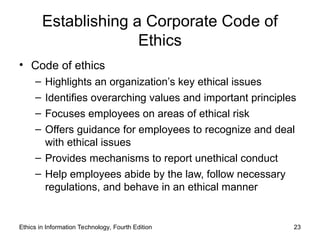
• Code of ethics
– Highlights an organization’s key ethical issues
– Identifies overarching values and important principles
– Focuses employees on areas of ethical risk
– Offers guidance for employees to recognize and deal
with ethical issues
– Provides mechanisms to report unethical conduct
– Help employees abide by the law, follow necessary
regulations, and behave in an ethical manner
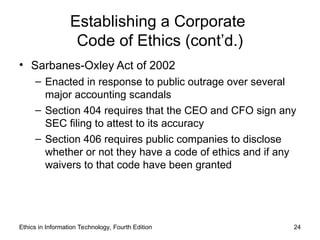
• Sarbanes-Oxley Act of 2002
– Enacted in response to public outrage over several
major accounting scandals
– Section 404 requires that the CEO and CFO sign any
SEC filing to attest to its accuracy
– Section 406 requires public companies to disclose
whether or not they have a code of ethics and if any
waivers to that code have been granted
Ethics in Information Technology, Fourth Edition 24
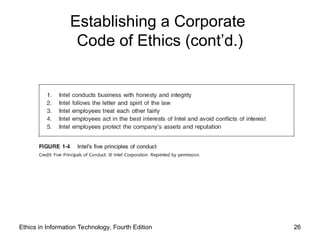
Establishing a Corporate
Code of Ethics (cont’d.)
Establishing a Corporate
Code of Ethics (cont’d.)
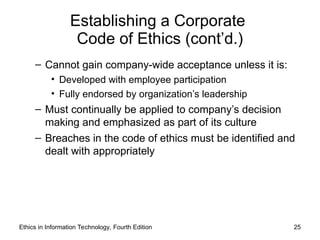
– Cannot gain company-wide acceptance unless it is:
• Developed with employee participation
• Fully endorsed by organization’s leadership
– Must continually be applied to company’s decision
making and emphasized as part of its culture
– Breaches in the code of ethics must be identified and
dealt with appropriately
Ethics in Information Technology, Fourth Edition 25
Ethics in Information Technology, Fourth Edition 26
Establishing a Corporate
Code of Ethics (cont’d.)
Ethics in Information Technology, Fourth Edition 27
Conducting Social Audits
• Social audit
– Reviews how well organization is meeting ethical and
social responsibility goals
– Communicates new goals for upcoming year
– Shared broadly with employees, shareholders,
investors, market analysts, customers, suppliers,
government agencies, and local communities
Ethics in Information Technology, Fourth Edition 28
Requiring Employees to
Take Ethics Training
• Personal convictions improved through education
• Comprehensive ethics education program
encourages employees to act responsibly and
ethically
– Often presented in small workshop formats
– Employees apply code of ethics to hypothetical but
realistic case studies
– Demonstration of recent company decisions based on
principles from the code of ethics
Requiring Employees to
Take Ethics Training (cont’d.)
• Critical that training increase the percentage of
employees who report incidents of misconduct
• Employees must:
– Learn effective ways of reporting incidents
– Be reassured their feedback will be acted on without
retaliation
Ethics in Information Technology, Fourth Edition 29
Ethics in Information Technology, Fourth Edition 30
Including Ethical Criteria in
Employee Appraisals
• Only 43% of companies include ethical conduct in
employee’s performance appraisal
• Ethical criteria include:
– Treating others fairly and with respect
– Operating effectively in a multicultural environment
– Accepting personal accountability
– Continually developing themselves and others
– Operating openly and honestly with all
Ethics in Information Technology, Fourth Edition 31
Creating an Ethical Work Environment
• Good employees may make bad ethical choices
• May be encouraged to do “whatever it takes” to get
the job done
• Employees need a knowledgeable resource to
discuss perceived unethical practices
– A manager
– Legal or Internal Audit Department
– Business Unit’s legal counsel
– Anonymously through internal Web site
Ethics in Information Technology, Fourth Edition 32
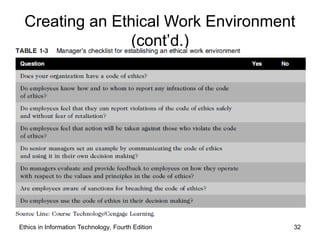
Creating an Ethical Work Environment
(cont’d.)
Including Ethical Considerations in
Decision Making
• Steps in a decision-making process
– Develop problem statement
– Identify alternatives
– Evaluate and choose alternative
– Implement decision
– Evaluate results
– Success
Ethics in Information Technology, Fourth Edition 33
Develop a Problem Statement
• Clear, concise description of the issue
• Answers these questions:
– What causes people to think there is a problem?
– Who is directly affected by the problem?
– Is there anyone else affected?
– How often does it occur?
– What is the impact of the problem?
– How serious is the problem?
• Most critical step in decision-making process
Ethics in Information Technology, Fourth Edition 34
Develop a Problem Statement (cont’d.)
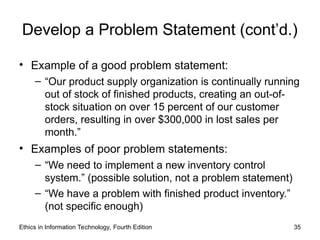
• Example of a good problem statement:
– “Our product supply organization is continually running
out of stock of finished products, creating an out-of-
stock situation on over 15 percent of our customer
orders, resulting in over $300,000 in lost sales per
month.”
• Examples of poor problem statements:
– “We need to implement a new inventory control
system.” (possible solution, not a problem statement)
– “We have a problem with finished product inventory.”
(not specific enough)
Ethics in Information Technology, Fourth Edition 35
Identify, Evaluate, and Choose an
Alternative
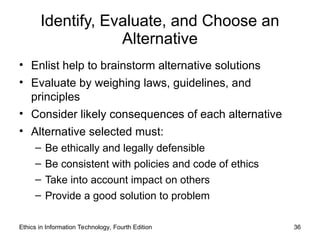
• Enlist help to brainstorm alternative solutions
• Evaluate by weighing laws, guidelines, and
principles
• Consider likely consequences of each alternative
• Alternative selected must:
– Be ethically and legally defensible
– Be consistent with policies and code of ethics
– Take into account impact on others
– Provide a good solution to problem
Ethics in Information Technology, Fourth Edition 36
Ethics in Information Technology, Fourth Edition 37
Common Approaches to Ethical
Decision Making
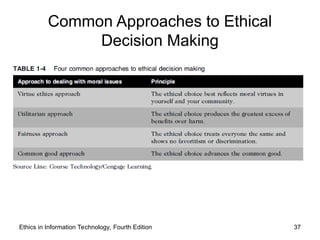
Table 1-5 Four common approaches to ethical decision making
Virtue Ethics Approach
• Virtue ethics approach
– Focuses on concern with daily life in a community
– People guided by virtues to reach “right” decision
– More effective than following set of principles/rules
• Problems
– Does not provide guide for action
– Virtue cannot be worked out objectively; depends on
circumstances
Ethics in Information Technology, Fourth Edition 38
Utilitarian Approach
• Utilitarian approach
– Chooses action that has best overall consequences
– Finds the greatest good by balancing all interests
– Fits concept of value in economics and the use of
cost-benefit analysis
• Problems
– Measuring and comparing values is often difficult
– Predicting resulting benefits and harm is difficult
Ethics in Information Technology, Fourth Edition 39
Fairness Approach
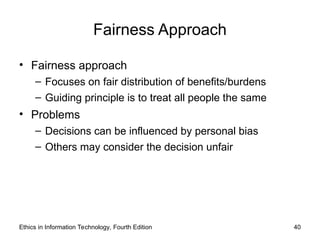
• Fairness approach
– Focuses on fair distribution of benefits/burdens
– Guiding principle is to treat all people the same
• Problems
– Decisions can be influenced by personal bias
– Others may consider the decision unfair
Ethics in Information Technology, Fourth Edition 40
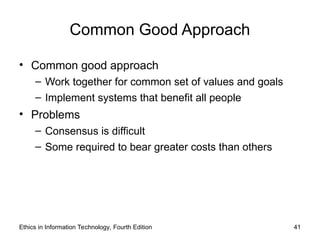
Common Good Approach
• Common good approach
– Work together for common set of values and goals
– Implement systems that benefit all people
• Problems
– Consensus is difficult
– Some required to bear greater costs than others
Ethics in Information Technology, Fourth Edition 41
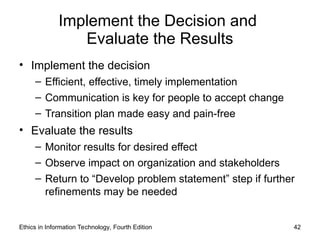
Implement the Decision and
Evaluate the Results
• Implement the decision
– Efficient, effective, timely implementation
– Communication is key for people to accept change
– Transition plan made easy and pain-free
• Evaluate the results
– Monitor results for desired effect
– Observe impact on organization and stakeholders
– Return to “Develop problem statement” step if further
refinements may be needed
Ethics in Information Technology, Fourth Edition 42
Ethics in Information Technology, Fourth Edition 43
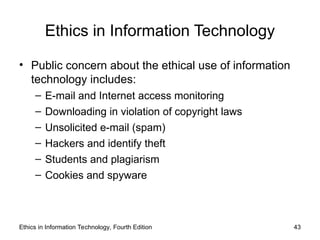
Ethics in Information Technology
• Public concern about the ethical use of information
technology includes:
– E-mail and Internet access monitoring
– Downloading in violation of copyright laws
– Unsolicited e-mail (spam)
– Hackers and identify theft
– Students and plagiarism
– Cookies and spyware
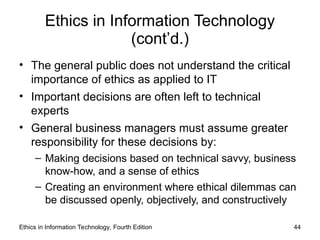
Ethics in Information Technology
(cont’d.)
• The general public does not understand the critical
importance of ethics as applied to IT
• Important decisions are often left to technical
experts
• General business managers must assume greater
responsibility for these decisions by:
– Making decisions based on technical savvy, business
know-how, and a sense of ethics
– Creating an environment where ethical dilemmas can
be discussed openly, objectively, and constructively
Ethics in Information Technology, Fourth Edition 44
Ethics in Information Technology
(cont’d.)
• Goals of this text
– To educate people about the tremendous impact of
ethical issues in the successful and secure use of
information technology
– To motivate people to recognize these issues when
making business decisions
– To provide tools, approaches, and useful insights for
making ethical decisions
Ethics in Information Technology, Fourth Edition 45
Summary
• Ethics is important because the risks associated
with inappropriate behavior have increased
• Organizations have at least five good reasons for
encouraging employees to act ethically
– To gain the good will of the community
– To create an organization that operates consistently
– To foster good business practices
– To protect the organization and its employees against
legal action
– To avoid unfavorable publicity
Ethics in Information Technology, Fourth Edition 46
Summary (cont’d.)
• Organizations require successful ethics programs
• The corporate ethics officer ensures that ethical
procedures are installed and followed
• Managers’ behaviors and expectations can strongly
influence employees’ ethical behavior
• Most of us have developed a simple decision-
making model that includes five steps
• Ethical considerations must be incorporated into
decision making
Ethics in Information Technology, Fourth Edition 47
Summary (cont’d.)
• Four common approaches to ethical decision
making
– Virtue ethics approach
– Utilitarian approach
– Fairness approach
– Common good approach
Ethics in Information Technology, Fourth Edition 48
Ethics in Information
Technology, Fourth Edition
Chapter 2
Ethics for IT Workers and IT Users
49
Objectives
• As you read this chapter, consider the following
questions:
– What key characteristics distinguish a professional
from other kinds of workers, and is an IT worker
considered a professional?
– What factors are transforming the professional
services industry?
– What relationships must an IT worker manage, and
what key ethical issues can arise in each?
Ethics in Information Technology, Fourth Edition 50
Objectives (cont’d.)
– How do codes of ethics, professional organizations,
certification, and licensing affect the ethical behavior
of IT professionals?
– What is meant by compliance, and how does it help
promote the right behaviors and discourage
undesirable ones?
Ethics in Information Technology, Fourth Edition 51
IT Professionals
• Profession is a calling that requires:
– Specialized knowledge
– Long and intensive academic preparation
• Professionals:
– Require advanced training and experience
– Must exercise discretion and judgment in their work
– Their work cannot be standardized
– Contribute to society, participate in lifelong training,
assist other professionals
– Carry special rights and responsibilities
Ethics in Information Technology, Fourth Edition 52
Are IT Workers Professionals?
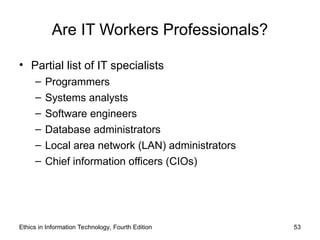
• Partial list of IT specialists
– Programmers
– Systems analysts
– Software engineers
– Database administrators
– Local area network (LAN) administrators
– Chief information officers (CIOs)
Ethics in Information Technology, Fourth Edition 53
Are IT Workers Professionals?
(cont’d.)
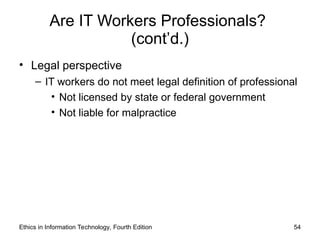
• Legal perspective
– IT workers do not meet legal definition of professional
• Not licensed by state or federal government
• Not liable for malpractice
Ethics in Information Technology, Fourth Edition 54
The Changing Professional Services
Industry
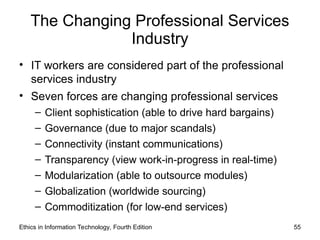
• IT workers are considered part of the professional
services industry
• Seven forces are changing professional services
– Client sophistication (able to drive hard bargains)
– Governance (due to major scandals)
– Connectivity (instant communications)
– Transparency (view work-in-progress in real-time)
– Modularization (able to outsource modules)
– Globalization (worldwide sourcing)
– Commoditization (for low-end services)
Ethics in Information Technology, Fourth Edition 55
Professional Relationships That Must
Be Managed
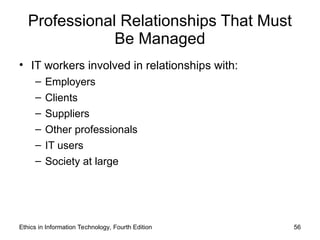
• IT workers involved in relationships with:
– Employers
– Clients
– Suppliers
– Other professionals
– IT users
– Society at large
Ethics in Information Technology, Fourth Edition 56
Relationships Between
IT Workers and Employers
• IT workers agree on many aspects of work
relationship before workers accept job offer
• Other aspects of work relationship defined in
company’s policy and procedure manual or code of
conduct
• Some aspects develop over time
• As steward of organization’s IT resources, IT
workers must set an example and enforce policies
regarding the ethical use of IT in:
Ethics in Information Technology, Fourth Edition 57
Relationships Between
IT Workers and Employers
• Software piracy
– Act of illegally making copies of software or enabling
access to software to which they are not entitled
– Area in which IT workers can be tempted to violate laws
and policies
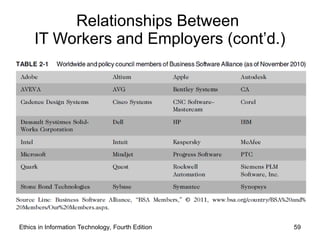
– The Business Software Alliance (BSA) is a trade group
representing the world’s largest software and hardware
manufacturers; mission is to stop the unauthorized
copying of software
– Thousands of cases prosecuted each year
Ethics in Information Technology, Fourth Edition 58
Ethics in Information Technology, Fourth Edition 59
Relationships Between
IT Workers and Employers (cont’d.)
Relationships Between
IT Workers and Employers (cont’d.)
• IT workers must set an example and enforce policies
regarding the ethical use of IT in: (cont’d.)
– Trade secrets
• Business information generally unknown to public
• Company takes actions to keep confidential
• Require cost or effort to develop
• Have some degree of uniqueness or novelty
– Whistle-blowing
• Employee attracts attention to a negligent, illegal,
unethical, abusive, or dangerous act that threatens
the public interest
Ethics in Information Technology, Fourth Edition 60
Relationships Between
IT Workers and Clients
• IT worker provides:
– Hardware, software, or services at a certain cost and
within a given time frame
• Client provides:
– Compensation
– Access to key contacts
– Work space
• Relationship is usually documented in contractual
terms
Ethics in Information Technology, Fourth Edition 61
Relationships Between
IT Workers and Clients (cont’d.)
• Client makes decisions about a project based on
information, alternatives, and recommendations
provided by the IT worker
• Client trusts IT worker to act in client’s best interests
• IT worker trusts that client will provide relevant
information, listen to and understand what the IT
worker says, ask questions to understand impact of
key decisions, and use the information to make wise
choices
Ethics in Information Technology, Fourth Edition 62
Relationships Between
IT Workers and Clients (cont’d.)
• Ethical problems arise if a company recommends its
own products and services to remedy problems they
have detected
– Creates a conflict of interest
• Problems arise during a project if IT workers are
unable to provide full and accurate reporting of a
project’s status
– Finger pointing and heated discussions can ensue
Ethics in Information Technology, Fourth Edition 63
Relationships Between
IT Workers and Clients (cont’d.)
• Fraud
– Crime of obtaining goods, services, or property
through deception or trickery
• Misrepresentation
– Misstatement or incomplete statement of material fact
– If misrepresentation causes a party to enter into a
contract, that party may have the right to cancel
contract or seek reimbursement for damages
Ethics in Information Technology, Fourth Edition 64
Relationships Between
IT Workers and Clients (cont’d.)
• Breach of contract
– One party fails to meet the terms of a contract
– When there is material breach of contract:
• The non-breaching party may rescind the contract,
seek restitution of any compensation paid to the
breaching party, and be discharged from any further
performance under the contract
• IT projects are joint efforts in which vendors and
customers work together
– When there are problems, it is difficult to assign who is
at fault
Ethics in Information Technology, Fourth Edition 65
Relationships Between
IT Workers and Suppliers
• Develop good working relationships with suppliers:
– To encourage flow of useful information and ideas to
develop innovative and cost-effective ways of using
the supplier in ways that the IT worker may not have
considered
– By dealing fairly with them
– By not making unreasonable demands
Ethics in Information Technology, Fourth Edition 66
Relationships Between
IT Workers and Suppliers (cont’d.)
• Bribery
– Providing money, property, or favors to obtain a
business advantage
– U.S. Foreign Corrupt Practices Act (FCPA): crime to
bribe a foreign official, a foreign political party official, or
a candidate for foreign political office
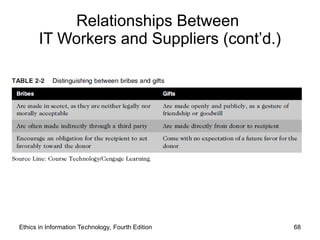
– At what point does a gift become a bribe?
– No gift should be hidden
– Perceptions of donor and recipient can differ
– United Nations Convention Against Corruption is a
global treaty to fight bribery and corruption
Ethics in Information Technology, Fourth Edition 67
Ethics in Information Technology, Fourth Edition 68
Relationships Between
IT Workers and Suppliers (cont’d.)
Relationships Between
IT Workers and Other Professionals
• Professionals feel a degree of loyalty to other
members of their profession
• Professionals owe each other adherence to their
profession’s code of conduct
• Ethical problems among the IT profession
– Résumé inflation on 30% of U.S. job applications
– Inappropriate sharing of corporate information
• Information might be sold intentionally or shared
informally with those who have no need to know
Ethics in Information Technology, Fourth Edition 69
Relationships Between
IT Workers and IT Users
• IT user: person using a hardware or software
product
• IT workers’ duties
– Understand users’ needs and capabilities
– Deliver products and services that meet those needs
– Establish environment that supports ethical behavior:
• To discourages software piracy
• To minimize inappropriate use of corporate
computing resources
• To avoid inappropriate sharing of information
Ethics in Information Technology, Fourth Edition 70
Relationships Between
IT Workers and Society
• Society expects members of a profession:
– To provide significant benefits
– To not cause harm through their actions
• Actions of an IT worker can affect society
• Professional organizations provide codes of ethics
to guide IT workers’ actions
Ethics in Information Technology, Fourth Edition 71
Professional Codes of Ethics
• State the principles and core values that are
essential to the work of an occupational group
• Most codes of ethics include:
– What the organization aspires to become
– Rules and principles by which members of the
organization are expected to abide
• Many codes also include commitment to continuing
education for those who practice the profession
Ethics in Information Technology, Fourth Edition 72
Professional Codes of Ethics
(cont’d.)
• Following a professional code of ethics can produce
benefits for the individual, the profession, and
society as a whole
– Ethical decision making
– High standards of practice and ethical behavior
– Trust and respect from general public
– Evaluation benchmark for self-assessment
Ethics in Information Technology, Fourth Edition 73
Professional Organizations
• No universal code of ethics for IT professionals
• No single, formal organization of IT professionals
has emerged as preeminent
• Five of the most prominent organizations include:
– Association for Computing Machinery (ACM)
– Institute of Electrical and Electronics Engineers
Computer Society (IEEE-CS)
– Association of IT Professionals (AITP)
– SysAdmin, Audit, Network, Security (SANS) Institute
Ethics in Information Technology, Fourth Edition 74
Certification
• Indicates that a professional possesses a particular
set of skills, knowledge, or abilities in the opinion of
the certifying organization
• Can also apply to products
• Generally voluntary
• May or may not require adherence to a code of
ethics
• Employers view as benchmark of knowledge
• Opinions are divided on value of certification
Ethics in Information Technology, Fourth Edition 75
Certification (cont’d.)
• Vendor certifications
– Some certifications substantially improve IT workers’
salaries and career prospects
– Relevant for narrowly defined roles or certain aspects
of broader roles
– Require passing a written exam, or in some cases, a
hands-on lab to demonstrate skills and knowledge
– Can take years to obtain necessary experience
– Training can be expensive
Ethics in Information Technology, Fourth Edition 76
Certification (cont’d.)
• Industry association certifications
– Require a higher level of experience and a broader
perspective than vendor certifications
– Must sit for and pass written exam
– May need to pay annual renewal fee, earn continuing
education credits, and/or pass renewal test
– Lag in developing tests that cover new technologies
– Are moving from purely technical content to a broader
mix of technical, business, and behavioral
competencies
Ethics in Information Technology, Fourth Edition 77
Government Licensing
• License is a government-issued permission to
engage in an activity or operate a business
• Generally administered at the state level in the
United States
• Often requires that recipient pass a test
• Some professionals must be licensed – doctors,
lawyers, CPAs, medical and day care providers,
engineers
• One goal: protect public safety
Ethics in Information Technology, Fourth Edition 78
Government Licensing (cont’d.)
• Case for licensing IT workers
– Encourages following highest standards of profession
– Encourages practicing a code of ethics
– Violators would be punished
• Without licensing, there are no requirements for
heightened care and no concept of professional
malpractice
Ethics in Information Technology, Fourth Edition 79
Government Licensing (cont’d.)
• Issues associated with government licensing of IT
workers
– There are few licensing programs for IT professionals
• No universally accepted core body of knowledge
• Unclear who should manage content and
administration of licensing exams
• No administrative body to accredit professional
education programs
• No administrative body to assess and ensure
competence of individual workers
Ethics in Information Technology, Fourth Edition 80
IT Professional Malpractice
• Negligence: not doing something that a reasonable
person would do, or doing something that a
reasonable person would not do
• Duty of care: obligation to protect people against
any unreasonable harm or risk
– Reasonable person standard
– Reasonable professional standard
• Professional malpractice: professionals who breach
the duty of care are liable for injuries that their
negligence causes
Ethics in Information Technology, Fourth Edition 81
IT Users
• Employees’ ethical use of IT is an area of growing
concern because of increased access to:
– Personal computers
– Corporate information systems and data
– The Internet
Ethics in Information Technology, Fourth Edition 82
Common Ethical Issues for IT Users
• Software piracy
• Inappropriate use of computing resources
– Erodes productivity and wastes time
– Could lead to lawsuits
• Inappropriate sharing of information, including:
– Every organization stores vast amounts of private or
confidential data
• Private data (employees and customers)
• Confidential information (company and operations)
Ethics in Information Technology, Fourth Edition 83
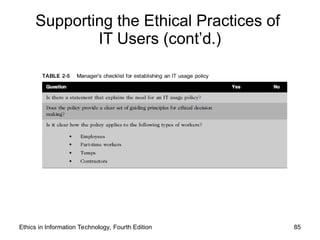
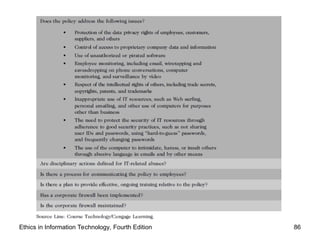
Supporting the Ethical Practices of
IT Users
• Policies that protect against abuses:
– Set forth general rights and responsibilities of users
– Create boundaries of acceptable behavior
– Enable management to punish violators
• Policy components include:
– Establishing guidelines for use of company software
– Defining appropriate use of IT resources
– Structuring information systems to protect data and
information
– Installing and maintaining a corporate firewall
Ethics in Information Technology, Fourth Edition 84
Supporting the Ethical Practices of
IT Users (cont’d.)
Ethics in Information Technology, Fourth Edition 85
Ethics in Information Technology, Fourth Edition 86
Compliance
• To be in accordance with established policies,
guidelines, specifications, and legislation
– Sarbanes-Oxley – established requirements for
internal controls
– HIPAA – ensures security and privacy of employee
healthcare data
– Failure to be in conformance can lead to criminal or
civil penalties and also lawsuits
Ethics in Information Technology, Fourth Edition 87
Compliance (cont’d.)
• Major challenge to comply with multiple government
and industry regulations that are sometimes in
conflict
• To meet this challenge:
– Implement software to track and record compliance
actions
– Hire management consultants for advice and training
– Create Chief Compliance Officer position
Ethics in Information Technology, Fourth Edition 88
Compliance (cont’d.)
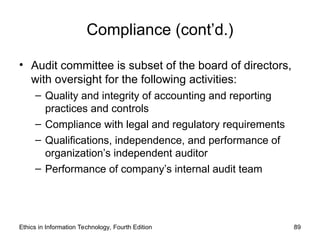
• Audit committee is subset of the board of directors,
with oversight for the following activities:
– Quality and integrity of accounting and reporting
practices and controls
– Compliance with legal and regulatory requirements
– Qualifications, independence, and performance of
organization’s independent auditor
– Performance of company’s internal audit team
Ethics in Information Technology, Fourth Edition 89
Compliance (cont’d.)
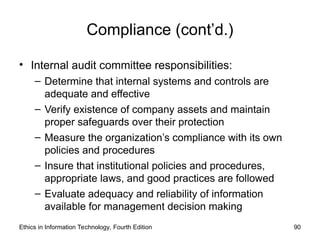
• Internal audit committee responsibilities:
– Determine that internal systems and controls are
adequate and effective
– Verify existence of company assets and maintain
proper safeguards over their protection
– Measure the organization’s compliance with its own
policies and procedures
– Insure that institutional policies and procedures,
appropriate laws, and good practices are followed
– Evaluate adequacy and reliability of information
available for management decision making
Ethics in Information Technology, Fourth Edition 90
Summary
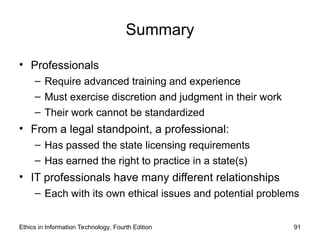
• Professionals
– Require advanced training and experience
– Must exercise discretion and judgment in their work
– Their work cannot be standardized
• From a legal standpoint, a professional:
– Has passed the state licensing requirements
– Has earned the right to practice in a state(s)
• IT professionals have many different relationships
– Each with its own ethical issues and potential problems
Ethics in Information Technology, Fourth Edition 91
Summary (cont’d.)
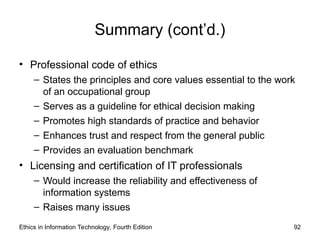
• Professional code of ethics
– States the principles and core values essential to the work
of an occupational group
– Serves as a guideline for ethical decision making
– Promotes high standards of practice and behavior
– Enhances trust and respect from the general public
– Provides an evaluation benchmark
• Licensing and certification of IT professionals
– Would increase the reliability and effectiveness of
information systems
– Raises many issues
Ethics in Information Technology, Fourth Edition 92
Summary (cont’d.)
• IT-related professional organizations have
developed their code of ethics that:
– Outlines what the organization aspires to become
– Lists rules and principles for members
– Includes a commitment to continuing education for
those who practice the profession
• Audit committee and internal audit team have a
major role in ensuring that both the IT organization
and IT users are in compliance with guidelines and
various legal and regulatory practices
Ethics in Information Technology, Fourth Edition 93
Ethics in Information Technology,
Fourth Edition
Chapter 3
Computer and Internet Crime
Objectives
• As you read this chapter, consider the following
questions:
– What key trade-offs and ethical issues are
associated with the safeguarding of data and
information systems?
– Why has there been a dramatic increase in the
number of computer-related security incidents in
recent years?
– What are the most common types of computer
security attacks?
Ethics in Information Technology, Fourth Edition
Objectives (cont’d.)
– Who are the primary perpetrators of computer crime,
and what are their objectives?
– What are the key elements of a multilayer process for
managing security vulnerabilities based on the
concept of reasonable assurance?
– What actions must be taken in response to a security
incident?
– What is computer forensics, and what role does it play
in responding to a computer incident?
Ethics in Information Technology, Fourth Edition
IT Security Incidents: A Major Concern
• Security of information technology is of utmost
importance
– Safeguard:
• Confidential business data
• Private customer and employee data
– Protect against malicious acts of theft or disruption
– Balance against other business needs and issues
• Number of IT-related security incidents is increasing
around the world
Ethics in Information Technology, Fourth Edition
Why Computer Incidents Are So
Prevalent
• Increasing complexity increases vulnerability
– Computing environment is enormously complex
• Continues to increase in complexity
• Number of entry points expands continuously
• Cloud computing and virtualization software
• Higher computer user expectations
– Computer help desks under intense pressure
• Forget to verify users’ IDs or check authorizations
• Computer users share login IDs and passwords
Ethics in Information Technology, Fourth Edition
Why Computer Incidents Are So
Prevalent (cont’d.)
• Expanding/changing systems equal new risks
– Network era
• Personal computers connect to networks with
millions of other computers
• All capable of sharing information
– Information technology
• Ubiquitous
• Necessary tool for organizations to achieve goals
• Increasingly difficult to match pace of technological
change
Ethics in Information Technology, Fourth Edition
Why Computer Incidents Are So
Prevalent (cont’d.)
• Increased reliance on commercial software with
known vulnerabilities
– Exploit
• Attack on information system
• Takes advantage of system vulnerability
• Due to poor system design or implementation
– Patch
• “Fix” to eliminate the problem
• Users are responsible for obtaining and installing
• Delays expose users to security breaches
Ethics in Information Technology, Fourth Edition
Why Computer Incidents Are So
Prevalent (cont’d.)
• Zero-day attack
– Before a vulnerability is discovered or fixed
• U.S. companies rely on commercial software with
known vulnerabilities
Ethics in Information Technology, Fourth Edition
Types of Exploits
• Computers as well as smartphones can be target
• Types of attacks
– Virus
– Worm
– Trojan horse
– Distributed denial of service
– Rootkit
– Spam
– Phishing (spear-phishing, smishing, and vishing)
Ethics in Information Technology, Fourth Edition
Viruses
• Pieces of programming code
• Usually disguised as something else
• Cause unexpected and undesirable behavior
• Often attached to files
• Deliver a “payload”
• Spread by actions of the “infected” computer user
• Infected e-mail document attachments
• Downloads of infected programs
• Visits to infected Web sites
Ethics in Information Technology, Fourth Edition
Worms
• Harmful programs
– Reside in active memory of a computer
– Duplicate themselves
• Can propagate without human intervention
• Negative impact of worm attack
– Lost data and programs
– Lost productivity
– Additional effort for IT workers
Ethics in Information Technology, Fourth Edition
Trojan Horses
• Malicious code hidden inside seemingly harmless
programs
• Users are tricked into installing them
• Delivered via email attachment, downloaded from a
Web site, or contracted via a removable media
device
• Logic bomb
– Executes when triggered by certain event
Distributed Denial-of-Service (DDoS)
Attacks
• Malicious hacker takes over computers on the
Internet and causes them to flood a target site with
demands for data and other small tasks
– The computers that are taken over are called zombies
– Botnet is a very large group of such computers
• Does not involve a break-in at the target computer
– Target machine is busy responding to a stream of
automated requests
– Legitimate users cannot access target machine
Ethics in Information Technology, Fourth Edition
Rootkits
• Set of programs that enables its user to gain
administrator-level access to a computer without the
end user’s consent or knowledge
• Attacker can gain full control of the system and even
obscure the presence of the rootkit
• Fundamental problem in detecting a rootkit is that
the operating system currently running cannot be
trusted to provide valid test results
Ethics in Information Technology, Fourth Edition
Spam
• Abuse of email systems to send unsolicited email to
large numbers of people
– Low-cost commercial advertising for questionable
products
– Method of marketing also used by many legitimate
organizations
• Controlling the Assault of Non-Solicited
Pornography and Marketing (CAN-SPAM) Act
– Legal to spam if basic requirements are met
Ethics in Information Technology, Fourth Edition
Spam (cont’d.)
• Completely Automated Public Turing Test to Tell
Computers and Humans Apart (CAPTCHA)
– Software generates tests that humans can pass but
computer programs cannot
Ethics in Information Technology, Fourth Edition
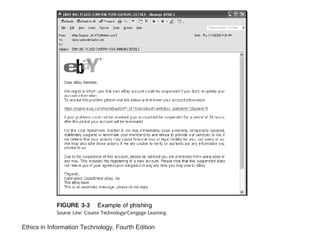
Phishing
• Act of using email fraudulently to try to get the
recipient to reveal personal data
• Legitimate-looking emails lead users to counterfeit
Web sites
• Spear-phishing
– Fraudulent emails to an organization’s employees
• Smishing
– Phishing via text messages
• Vishing
– Phishing via voice mail messages
Ethics in Information Technology, Fourth Edition
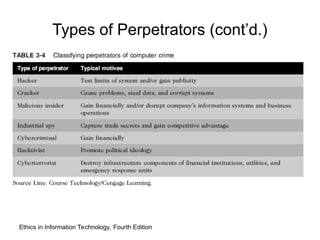
Types of Perpetrators
• Perpetrators include:
– Thrill seekers wanting a challenge
– Common criminals looking for financial gain
– Industrial spies trying to gain an advantage
– Terrorists seeking to cause destruction
• Different objectives and access to varying resources
• Willing to take different levels of risk to accomplish
an objective
Ethics in Information Technology, Fourth Edition
Types of Perpetrators (cont’d.)
Ethics in Information Technology, Fourth Edition
Hackers and Crackers
• Hackers
– Test limitations of systems out of intellectual curiosity
• Some smart and talented
• Others inept; termed “lamers” or “script kiddies”
• Crackers
– Cracking is a form of hacking
– Clearly criminal activity
Malicious Insiders
• Major security concern for companies
• Fraud within an organization is usually due to
weaknesses in internal control procedures
• Collusion
– Cooperation between an employee and an outsider
• Insiders are not necessarily employees
– Can also be consultants and contractors
• Extremely difficult to detect or stop
– Authorized to access the very systems they abuse
• Negligent insiders have potential to cause damage
Ethics in Information Technology, Fourth Edition
Industrial Spies
• Use illegal means to obtain trade secrets from
competitors
• Trade secrets are protected by the Economic
Espionage Act of 1996
• Competitive intelligence
– Uses legal techniques
– Gathers information available to the public
• Industrial espionage
– Uses illegal means
– Obtains information not available to the public
Ethics in Information Technology, Fourth Edition
Cybercriminals
• Hack into corporate computers to steal
• Engage in all forms of computer fraud
• Chargebacks are disputed transactions
• Loss of customer trust has more impact than fraud
• To reduce potential for online credit card fraud:
– Use encryption technology
– Verify the address submitted online against the issuing
bank
– Request a card verification value (CVV)
– Use transaction-risk scoring software
Ethics in Information Technology, Fourth Edition
Cybercriminals (cont’d.)
• Smart cards
– Contain a memory chip
– Updated with encrypted data each time card is used
– Used widely in Europe
– Not widely used in the U.S.
Ethics in Information Technology, Fourth Edition
Hacktivists and Cyberterrorists
• Hacktivism
– Hacking to achieve a political or social goal
• Cyberterrorist
– Attacks computers or networks in an attempt to
intimidate or coerce a government in order to advance
certain political or social objectives
– Seeks to cause harm rather than gather information
– Uses techniques that destroy or disrupt services
Ethics in Information Technology, Fourth Edition
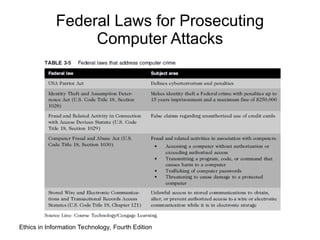
Federal Laws for Prosecuting
Computer Attacks
Ethics in Information Technology, Fourth Edition
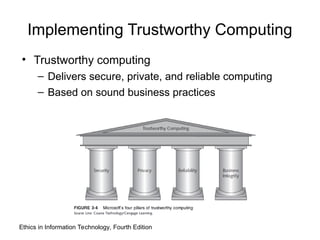
Implementing Trustworthy Computing
• Trustworthy computing
– Delivers secure, private, and reliable computing
– Based on sound business practices
Ethics in Information Technology, Fourth Edition
Implementing Trustworthy Computing
(cont’d.)
• Security of any system or network
– Combination of technology, policy, and people
– Requires a wide range of activities to be effective
• Systems must be monitored to detect possible
intrusion
• Clear reaction plan addresses:
– Notification, evidence protection, activity log
maintenance, containment, eradication, and recovery
Ethics in Information Technology, Fourth Edition
Risk Assessment
• Process of assessing security-related risks:
– To an organization’s computers and networks
– From both internal and external threats
• Identifies investments that best protect from most
likely and serious threats
• Focuses security efforts on areas of highest payoff
Ethics in Information Technology, Fourth Edition
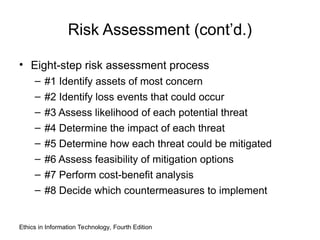
Risk Assessment (cont’d.)
• Eight-step risk assessment process
– #1 Identify assets of most concern
– #2 Identify loss events that could occur
– #3 Assess likelihood of each potential threat
– #4 Determine the impact of each threat
– #5 Determine how each threat could be mitigated
– #6 Assess feasibility of mitigation options
– #7 Perform cost-benefit analysis
– #8 Decide which countermeasures to implement
Ethics in Information Technology, Fourth Edition
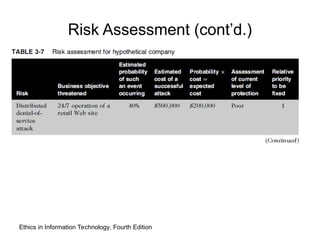
Risk Assessment (cont’d.)
Ethics in Information Technology, Fourth Edition
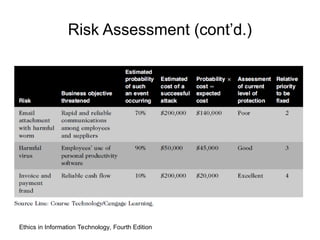
Risk Assessment (cont’d.)
Establishing a Security Policy
• A security policy defines:
– Organization’s security requirements
– Controls and sanctions needed to meet the
requirements
• Delineates responsibilities and expected behavior
• Outlines what needs to be done
– Not how to do it
• Automated system policies should mirror written
policies
Ethics in Information Technology, Fourth Edition
Establishing a Security Policy (cont’d.)
• Trade-off between:
– Ease of use
– Increased security
• Areas of concern
– Email attachments
– Wireless devices
• VPN uses the Internet to relay communications but
maintains privacy through security features
• Additional security includes encrypting originating and
receiving network addresses
Ethics in Information Technology, Fourth Edition
Educating Employees, Contractors,
and Part-Time Workers
• Educate and motivate users to understand and
follow policy
• Discuss recent security incidents
• Help protect information systems by:
– Guarding passwords
– Not allowing sharing of passwords
– Applying strict access controls to protect data
– Reporting all unusual activity
– Protecting portable computing and data storage
devices
Ethics in Information Technology, Fourth Edition
Prevention
• Implement a layered security solution
– Make computer break-ins harder
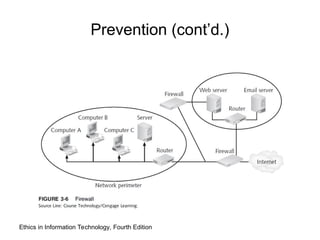
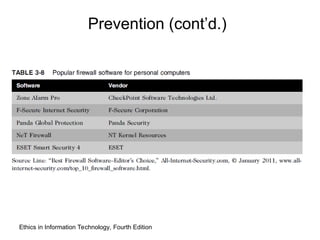
• Installing a corporate firewall
– Limits network access
• Intrusion prevention systems
– Block viruses, malformed packets, and other threats
• Installing antivirus software
– Scans for sequence of bytes or virus signature
– United States Computer Emergency Readiness Team
(US-CERT) serves as clearinghouse
Ethics in Information Technology, Fourth Edition
Prevention (cont’d.)
Ethics in Information Technology, Fourth Edition
Prevention (cont’d.)
• Safeguards against attacks by malicious insiders
• Departing employees and contractors
– Promptly delete computer accounts, login IDs, and
passwords
• Carefully define employee roles and separate key
responsibilities
• Create roles and user accounts to limit authority
Ethics in Information Technology, Fourth Edition
Prevention (cont’d.)
• Defending against cyberterrorism
– Department of Homeland Security and its National
Cyber Security Division (NCSD) is a resource
• Builds and maintains a national security
cyberspace response system
• Implements a cyber-risk management program for
protection of critical infrastructure, including
banking and finance, water, government
operations, and emergency services
Ethics in Information Technology, Fourth Edition
Prevention (cont’d.)
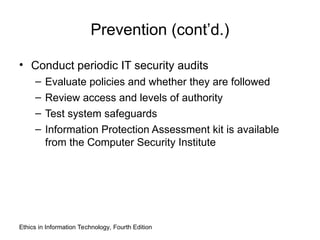
• Conduct periodic IT security audits
– Evaluate policies and whether they are followed
– Review access and levels of authority
– Test system safeguards
– Information Protection Assessment kit is available
from the Computer Security Institute
Ethics in Information Technology, Fourth Edition
Detection
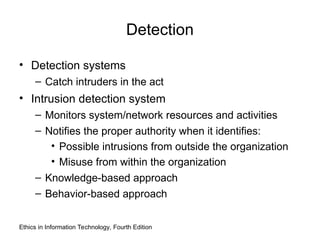
• Detection systems
– Catch intruders in the act
• Intrusion detection system
– Monitors system/network resources and activities
– Notifies the proper authority when it identifies:
• Possible intrusions from outside the organization
• Misuse from within the organization
– Knowledge-based approach
– Behavior-based approach
Ethics in Information Technology, Fourth Edition
Response
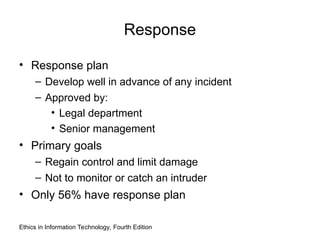
• Response plan
– Develop well in advance of any incident
– Approved by:
• Legal department
• Senior management
• Primary goals
– Regain control and limit damage
– Not to monitor or catch an intruder
• Only 56% have response plan
Ethics in Information Technology, Fourth Edition
Response (cont’d.)
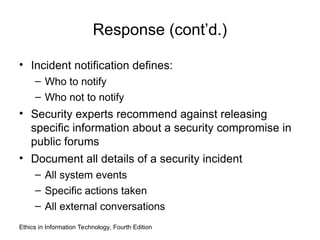
• Incident notification defines:
– Who to notify
– Who not to notify
• Security experts recommend against releasing
specific information about a security compromise in
public forums
• Document all details of a security incident
– All system events
– Specific actions taken
– All external conversations
Ethics in Information Technology, Fourth Edition
Response (cont’d.)
• Act quickly to contain an attack
• Eradication effort
– Collect and log all possible criminal evidence
– Verify necessary backups are current and complete
– Create new backups
• Follow-up
– Determine how security was compromised
• Prevent it from happening again
Ethics in Information Technology, Fourth Edition
Response (cont’d.)
• Review
– Determine exactly what happened
– Evaluate how the organization responded
• Weigh carefully the amount of effort required to
capture the perpetrator
• Consider the potential for negative publicity
• Legal precedent
– Hold organizations accountable for their own IT
security weaknesses
Ethics in Information Technology, Fourth Edition
Computer Forensics
• Combines elements of law and computer science to
identify, collect, examine, and preserve data and
preserve its integrity so it is admissible as evidence
• Computer forensics investigation requires extensive
training and certification and knowledge of laws that
apply to gathering of criminal evidence
Ethics in Information Technology, Fourth Edition
Summary
• Ethical decisions in determining which information
systems and data most need protection
• Most common computer exploits
– Viruses
– Worms
– Trojan horses
– Distributed denial-of-service attacks
– Rootkits
– Spam
– Phishing, spear-fishing, smishing, vishing
Ethics in Information Technology, Fourth Edition
Summary (cont’d.)
• Perpetrators include:
– Hackers
– Crackers
– Malicious insider
– Industrial spies
– Cybercriminals
– Hacktivist
– Cyberterrorists
Summary (cont’d.)
• Must implement multilayer process for managing
security vulnerabilities, including:
– Assessment of threats
– Identifying actions to address vulnerabilities
– User education
• IT must lead the effort to implement:
– Security policies and procedures
– Hardware and software to prevent security breaches
• Computer forensics is key to fighting computer crime
in a court of law
Ethics in Information Technology, Fourth Edition
Ethics in Information Technology,
Fourth Edition
Chapter 4
Privacy
Objectives
• As you read this chapter, consider the following
questions:
– What is the right of privacy, and what is the basis for
protecting personal privacy under the law?
– What are some of the laws that provide protection for
the privacy of personal data, and what are some of
the associated ethical issues?
– What is identity theft, and what techniques do identity
thieves use?
Ethics in Information Technology, Fourth Edition
Objectives (cont’d.)
– What are the various strategies for consumer
profiling, and what are the associated ethical issues?
– What must organizations do to treat consumer data
responsibly?
– Why and how are employers increasingly using
workplace monitoring?
– What are the capabilities of advanced surveillance
technologies, and what ethical issues do they raise?
Ethics in Information Technology, Fourth Edition
Privacy Protection and the Law
• Systems collect and store key data from every
interaction with customers to make better decisions
• Many object to data collection policies of
government and business
• Privacy
– Key concern of Internet users
– Top reason why nonusers still avoid the Internet
• Reasonable limits must be set
• Historical perspective on the right to privacy
– Fourth Amendment reasonable expectation of privacy
Ethics in Information Technology, Fourth Edition
Information Privacy
• Definition of privacy
– “The right to be left alone—the most comprehensive of
rights, and the right most valued by a free people”
• Information privacy is a combination of:
– Communications privacy
• Ability to communicate with others without being
monitored by other persons or organizations
– Data privacy
• Ability to limit access to one’s personal data by other
individuals and organizations in order to exercise a
substantial degree of control over that data and its use
Ethics in Information Technology, Fourth Edition
Privacy Laws, Applications,
and Court Rulings
• Legislative acts passed over the past 40 years
– Most address invasion of privacy by the government
– No protection of data privacy abuses by corporations
– No single, overarching national data privacy policy
Ethics in Information Technology, Fourth Edition
Privacy Laws, Applications,
and Court Rulings (cont’d.)
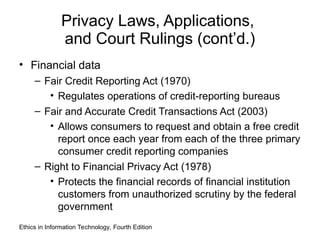
• Financial data
– Fair Credit Reporting Act (1970)
• Regulates operations of credit-reporting bureaus
– Fair and Accurate Credit Transactions Act (2003)
• Allows consumers to request and obtain a free credit
report once each year from each of the three primary
consumer credit reporting companies
– Right to Financial Privacy Act (1978)
• Protects the financial records of financial institution
customers from unauthorized scrutiny by the federal
government
Ethics in Information Technology, Fourth Edition
Privacy Laws, Applications,
and Court Rulings (cont’d.)
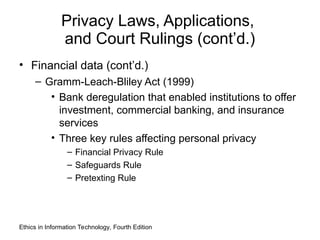
• Financial data (cont’d.)
– Gramm-Leach-Bliley Act (1999)
• Bank deregulation that enabled institutions to offer
investment, commercial banking, and insurance
services
• Three key rules affecting personal privacy
– Financial Privacy Rule
– Safeguards Rule
– Pretexting Rule
Ethics in Information Technology, Fourth Edition
Privacy Laws, Applications,
and Court Rulings (cont’d.)
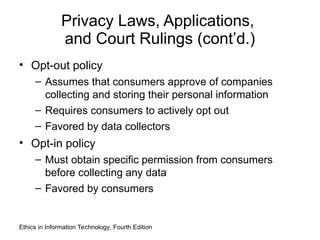
• Opt-out policy
– Assumes that consumers approve of companies
collecting and storing their personal information
– Requires consumers to actively opt out
– Favored by data collectors
• Opt-in policy
– Must obtain specific permission from consumers
before collecting any data
– Favored by consumers
Ethics in Information Technology, Fourth Edition
Privacy Laws, Applications,
and Court Rulings (cont’d.)
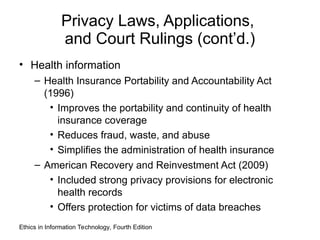
• Health information
– Health Insurance Portability and Accountability Act
(1996)
• Improves the portability and continuity of health
insurance coverage
• Reduces fraud, waste, and abuse
• Simplifies the administration of health insurance
– American Recovery and Reinvestment Act (2009)
• Included strong privacy provisions for electronic
health records
• Offers protection for victims of data breaches
Ethics in Information Technology, Fourth Edition
Privacy Laws, Applications,
and Court Rulings (cont’d.)
• State laws related to security breach notification
– Over 40 states have enacted legislation requiring
organizations to disclose security breaches
– For some states, these laws are quite stringent
Ethics in Information Technology, Fourth Edition
Privacy Laws, Applications,
and Court Rulings (cont’d.)
• Children’s personal data
– Children’s Online Privacy Protection Act (1998)
• Web sites catering to children must offer
comprehensive privacy policies, notify parents or
guardians about its data-collection practices, and
receive parental consent before collecting personal
information from children under 13
– Family Education Rights and Privacy Act (1974)
• Assigns rights to parents regarding their children’s
education records
• Rights transfer to student once student becomes 18
Ethics in Information Technology, Fourth Edition
Privacy Laws, Applications,
and Court Rulings (cont’d.)
• Electronic surveillance
– Communications Act of 1934
• Established the Federal Communications
Commission
• Regulates all non-federal-government use of radio
and television plus all interstate communications
– Title III of the Omnibus Crime Control and Safe Streets
Act (Wiretap Act)
• Regulates interception of telephone and oral
communications
• Has been amended by new laws
Ethics in Information Technology, Fourth Edition
Privacy Laws, Applications,
and Court Rulings (cont’d.)
– Electronic surveillance (cont’d.)
• Foreign Intelligence Surveillance Act (FISA) of
1978
– Describes procedures for electronic surveillance and
collection of foreign intelligence information in
communications between foreign powers and agents of
foreign powers
Ethics in Information Technology, Fourth Edition
Privacy Laws, Applications,
and Court Rulings (cont’d.)
• Electronic surveillance (cont’d.)
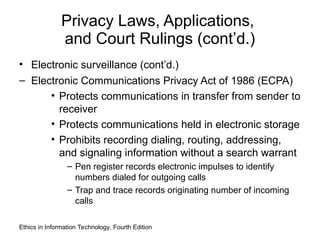
– Electronic Communications Privacy Act of 1986 (ECPA)
• Protects communications in transfer from sender to
receiver
• Protects communications held in electronic storage
• Prohibits recording dialing, routing, addressing,
and signaling information without a search warrant
– Pen register records electronic impulses to identify
numbers dialed for outgoing calls
– Trap and trace records originating number of incoming
calls
Ethics in Information Technology, Fourth Edition
Privacy Laws, Applications,
and Court Rulings (cont’d.)
• Electronic surveillance (cont’d.)
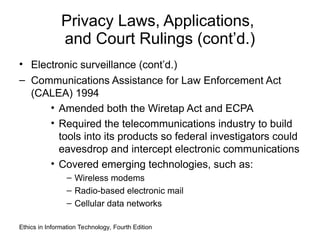
– Communications Assistance for Law Enforcement Act
(CALEA) 1994
• Amended both the Wiretap Act and ECPA
• Required the telecommunications industry to build
tools into its products so federal investigators could
eavesdrop and intercept electronic communications
• Covered emerging technologies, such as:
– Wireless modems
– Radio-based electronic mail
– Cellular data networks
Ethics in Information Technology, Fourth Edition
Privacy Laws, Applications,
and Court Rulings (cont’d.)
• Electronic surveillance (cont’d.)
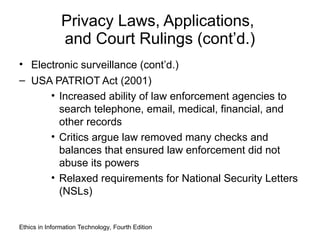
– USA PATRIOT Act (2001)
• Increased ability of law enforcement agencies to
search telephone, email, medical, financial, and
other records
• Critics argue law removed many checks and
balances that ensured law enforcement did not
abuse its powers
• Relaxed requirements for National Security Letters
(NSLs)
Ethics in Information Technology, Fourth Edition
Privacy Laws, Applications,
and Court Rulings (cont’d.)
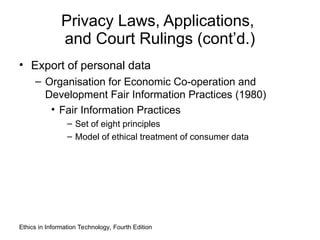
• Export of personal data
– Organisation for Economic Co-operation and
Development Fair Information Practices (1980)
• Fair Information Practices
– Set of eight principles
– Model of ethical treatment of consumer data
Ethics in Information Technology, Fourth Edition
Privacy Laws, Applications,
and Court Rulings (cont’d.)
• Export of personal data (cont’d.)
– European Union Data Protection Directive
• Requires companies doing business within the
borders of 15 European nations to implement a set
of privacy directives on the fair and appropriate use
of information
• Goal to ensure data transferred to non-European
countries is protected
• Based on set of seven principles for data privacy
• Concern that U.S. government can invoke USA
PATRIOT Act to access data
Ethics in Information Technology, Fourth Edition
Privacy Laws, Applications,
and Court Rulings (cont’d.)
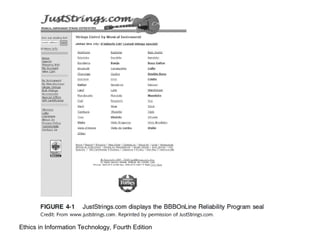
• BBBOnLine and TRUSTe
– Independent initiatives that favor an industry-
regulated approach to data privacy
– BBBOnLine reliability seal or a TRUSTe data privacy
seal demonstrates that Web site adheres to high level
of data privacy
– Seals
• Increase consumer confidence in site
• Help users make more informed decisions about
whether to release personal information
Ethics in Information Technology, Fourth Edition
Privacy Laws, Applications,
and Court Rulings (cont’d.)
• Access to government records
– Freedom of Information Act (1966 amended 1974)
• Grants citizens the right to access certain
information and records of the federal government
upon request
• Exemptions bar disclosure of information that
could:
– Compromise national security
– Interfere with active law enforcement investigation
– Invade someone’s privacy
Ethics in Information Technology, Fourth Edition
Privacy Laws, Applications,
and Court Rulings (cont’d.)
– Access to government records (cont’d.)
• The Privacy Act of 1974
– Prohibits government agencies from concealing the
existence of any personal data record-keeping system
– Outlines 12 requirements that each record-keeping
agency must meet
– CIA and law enforcement agencies are excluded from
this act
– Does not cover actions of private industry
Ethics in Information Technology, Fourth Edition
Key Privacy and Anonymity Issues
• Identity theft
• Electronic discovery
• Consumer profiling
• Treating customer data responsibly
• Workplace monitoring
• Advanced surveillance technology
Ethics in Information Technology, Fourth Edition
Identity Theft
• Theft of key pieces of personal information to
impersonate a person, including:
– Name
– Address
– Date of birth
– Social Security number
– Passport number
– Driver’s license number
– Mother’s maiden name
Ethics in Information Technology, Fourth Edition
Identity Theft (cont’d.)
• Fastest-growing form of fraud in the United States
• Consumers and organizations are becoming more
vigilant and proactive in fighting identity theft
• Four approaches used by identity thieves
– Create a data breach
– Purchase personal data
– Use phishing to entice users to give up data
– Install spyware to capture keystrokes of victims
Ethics in Information Technology, Fourth Edition
Identity Theft (cont’d.)
• Data breaches of large databases
– To gain personal identity information
– May be caused by:
• Hackers
• Failure to follow proper security procedures
• Purchase of personal data
– Black market for:
• Credit card numbers in bulk—$.40 each
• Logon name and PIN for bank account—$10
• Identity information—including DOB, address, SSN, and
telephone number—$1 to $15
Ethics in Information Technology, Fourth Edition
Identity Theft (cont’d.)
• Phishing
– Stealing personal identity data by tricking users into
entering information on a counterfeit Web site
• Spyware
– Keystroke-logging software
– Enables the capture of:
• Account usernames
• Passwords
• Credit card numbers
• Other sensitive information
– Operates even if infected computer is not online
Ethics in Information Technology, Fourth Edition
Identity Theft (cont’d.)
• Identity Theft and Assumption Deterrence Act of
1998 was passed to fight fraud
• Identity Theft Monitoring Services
– Monitor the three major credit reporting agencies
(TransUnion, Equifax, and Experian)
– Monitor additional databases (financial institutions,
utilities, and DMV)
Ethics in Information Technology, Fourth Edition
Electronic Discovery
• Collection, preparation, review, and production of
electronically stored information for use in criminal
and civil actions
• Quite likely that information of a private or personal
nature will be disclosed during e-discovery
• Federal Rules of Procedure define e-discovery
processes
• E-discovery is complicated and requires extensive
time to collect, prepare, and review data
Ethics in Information Technology, Fourth Edition
Electronic Discovery (cont’d.)
• Raises many ethical issues
– Should an organization attempt to destroy or conceal
incriminating evidence?
– To what degree must an organization be proactive
and thorough in providing evidence?
– Should an organization attempt to “bury” incriminating
evidence in a mountain of trivial, routine data?
Ethics in Information Technology, Fourth Edition
Consumer Profiling
• Companies openly collect personal information
about Internet users
• Cookies
– Text files that a Web site can download to visitors’
hard drives so that it can identify visitors later
• Tracking software analyzes browsing habits
• Similar controversial methods are used outside the
Web environment
Ethics in Information Technology, Fourth Edition
Consumer Profiling (cont’d.)
• Aggregating consumer data
– Databases contain a huge amount of consumer behavioral
data
– Affiliated Web sites are served by a single advertising
network
• Collecting data from Web site visits
– Goal: provide customized service for each consumer
– Types of data collected
• GET data
• POST data
• Click-stream data
Ethics in Information Technology, Fourth Edition
Consumer Profiling (cont’d.)
• Four ways to limit or stop the deposit of cookies on
hard drives
– Set the browser to limit or stop cookies
– Manually delete them from the hard drive
– Download and install a cookie-management program
– Use anonymous browsing programs that don’t accept
cookies
Ethics in Information Technology, Fourth Edition
Consumer Profiling (cont’d.)
• Personalization software
– Used by marketers to optimize the number, frequency, and
mixture of their ad placements
• Rules-based
• Collaborative filtering
• Demographic filtering
• Contextual commerce
• Consumer data privacy
– Platform for Privacy Preferences (P3P)
• Shields users from sites that don’t provide the level of
privacy protection desired
Ethics in Information Technology, Fourth Edition
Treating Consumer Data Responsibly
• Strong measures are required to avoid customer
relationship problems
• Companies should adopt:
– Fair Information Practices
– 1980 OECD privacy guidelines
• Federal Trade Commission responsible for
protecting privacy of U.S. consumers
• Chief privacy officer (CPO)
– Executive to oversee data privacy policies and
initiatives
Ethics in Information Technology, Fourth Edition
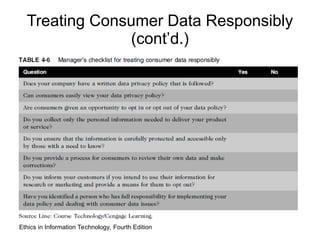
Treating Consumer Data Responsibly
(cont’d.)
Workplace Monitoring
• Employers monitor workers
– Protect against employee abuses that reduce worker
productivity or expose employer to harassment lawsuits
• Fourth Amendment cannot be used to limit how a
private employer treats its employees
– Public-sector employees have far greater privacy rights
than in the private industry
• Privacy advocates want federal legislation
– To keep employers from infringing upon privacy rights
of employees
Ethics in Information Technology, Fourth Edition
Advanced Surveillance Technology
• Camera surveillance
– Many cities plan to expand surveillance systems
– Advocates argue people have no expectation of
privacy in a public place
– Critics concerned about potential for abuse
• Global positioning system (GPS) chips
– Placed in many devices
– Precisely locate users
– Banks, retailers, airlines eager to launch new services
based on knowledge of consumer location
Ethics in Information Technology, Fourth Edition
Summary
• Laws, technical solutions, and privacy policies are
required to balance needs of business against rights
of consumers
• A number of laws have been enacted that affect a
person’s privacy particularly in the areas of financial
and health records, protection following a security
breach, children’s personal data, electronic
surveillance, export of personal data, and access to
government records
Ethics in Information Technology, Fourth Edition
Summary (cont’d.)
• Identity theft is fastest-growing form of fraud
• E-discovery can be expensive, can reveal data of a
private or personal data, and raises many ethical
issues
• Web sites collect personal data about visitors
• Consumer data privacy has become a major
marketing issue
• Code of Fair Information Practices and 1980 OECD
privacy guidelines provide an approach to treating
consumer data responsibly
Ethics in Information Technology, Fourth Edition
Summary (cont’d.)
• Employers monitor employees to maintain employee
productivity and limit exposure to harassment
lawsuits
• Advances in information technology provide new
data-gathering capabilities but also diminish
individual privacy
– Surveillance cameras
– GPS systems
Ethics in Information Technology, Fourth Edition
Ethics in Information Technology,
Fourth Edition
Chapter 5
Freedom of Expression
Objectives
• As you read this chapter, consider the following
questions:
– What is the basis for the protection of freedom of
expression in the United States, and what types of
expression are not protected under the law?
– What are some key federal laws that affect online
freedom of expression, and how do they impact
organizations?
– What important freedom of expression issues relate to
the use of information technology?
Ethics in Information Technology, Fourth Edition 188
First Amendment Rights
• Right to freedom of expression
– Important right for free people everywhere
– Guaranteed by the First Amendment
• Definition of free speech includes:
– Nonverbal, visual, and symbolic forms of
expression
– Right to speak anonymously
Ethics in Information Technology, Fourth Edition 189
First Amendment Rights (cont’d.)
• Not protected by the First Amendment
– Perjury
– Fraud
– Defamation
– Obscene speech
– Incitement of panic
– Incitement to crime
– “Fighting words”
– Sedition
Ethics in Information Technology, Fourth Edition 190
Obscene Speech
• Based on Miller v. California, speech is considered
obscene when:
– Average person finds the work appeals to the prurient
interest
– Work depicts or describes sexual conduct in an
offensive way
– Lacks serious literary, artistic, political, or scientific
value
Ethics in Information Technology, Fourth Edition 191
Defamation
• Oral or written statement of alleged fact that is:
– False
– Harms another person
• Harm is often of a financial nature
• Slander
– Oral defamatory statement
• Libel
– Written defamatory statement
Ethics in Information Technology, Fourth Edition 192
Freedom of Expression: Key Issues
• Controlling access to information on the Internet
• Anonymity on the Internet
• Defamation and hate speech
• Corporate blogging
• Pornography
Ethics in Information Technology, Fourth Edition 193
Controlling Access to Information on
the Internet
• Freedom of speech on the Internet is complicated
by ease by which children can access Internet
• Communications Decency Act (CDA)
– Aimed at protecting children from pornography
– Broad language and vague definition of indecency
– Found unconstitutional in 1997
Ethics in Information Technology, Fourth Edition 194
Controlling Access to Information on
the Internet (cont’d.)
• Child Online Protection Act (COPA)
– Applies to communication for commercial purposes
– Imposes penalties for exposing minors to harmful
material on the Web
– Found unconstitutional in 2004
• Internet filtering
– Software installed with a Web browser
– Blocks access to certain Web sites deemed to
contain inappropriate or offensive material
Ethics in Information Technology, Fourth Edition 195
Ethics in Information Technology, Third Edition 196
196
Ethics in Information Technology,
Controlling Access to Information on
the Internet (cont’d.)
• URL filtering
– Blocks objectionable URLs or domain names
• Keyword filtering
– Blocks keywords or phrases
• Dynamic content filtering
– Web site’s content is evaluated immediately before
being displayed
– Uses
• Object analysis
• Image recognition
Ethics in Information Technology, Fourth Edition 197
Controlling Access to Information on
the Internet (cont’d.)
• Top-rated Internet filters for home users
– NetNanny Parental Controls
– PureSight PC
– CYBERsitter
– SafeEyes
– CyberPatrol
Ethics in Information Technology, Fourth Edition 198
Controlling Access to Information on
the Internet (cont’d.)
• ICRA rating system
– Questionnaire for Web authors
– Generates a content label
• Platform for Internet Content Selection (PICS)
– Users configure browsers to read the label
– Relies on Web authors to rate their site
– Complement to other filtering techniques
Ethics in Information Technology, Fourth Edition 199
Controlling Access to Information on
the Internet (cont’d.)
• ISP blocking
– Blocking is performed on the ISP server
– ClearSail/Family.NET prevents access to certain Web
sites
Ethics in Information Technology, Fourth Edition 200
Children’s Internet Protection Act
(CIPA)
• Federally financed schools and libraries must block
computer access to:
– Obscene material
– Pornography
– Anything considered harmful to minors
Ethics in Information Technology, Fourth Edition 201
Children’s Internet Protection Act
(CIPA)
• Schools and libraries subject to CIPA do not receive
Internet access discounts unless they:
– Put in place measures to filter pictures that are
obscene, contain child pornography, or are harmful to
minors
– Adopt a policy to monitor the online activities of
minors
– Adopt a policy restricting minors’ access to materials
harmful to them
Ethics in Information Technology, Fourth Edition 202
Children’s Internet Protection Act
(CIPA) (cont’d.)
• CIPA does not require the tracking of Internet use by
minors or adults
• Acceptable use policy agreement is an essential
element of a successful program in schools
– Signed by:
• Students
• Parents
• Employees
Ethics in Information Technology, Fourth Edition 203
Children’s Internet Protection Act
(CIPA) (cont’d.)
• Difficulty implementing CIPA in libraries because
their services are open to people of all ages
– Including adults with First Amendment rights
• CIPA has been upheld as constitutional by U.S.
Supreme Court (U.S. v American Library
Association)
Ethics in Information Technology, Fourth Edition 204
Anonymity on the Internet
• Anonymous expression is expression of opinions by
people who do not reveal their identity
• Freedom to express an opinion without fear of
reprisal is an important right in democratic society
• Anonymity is even more important in countries that
do not allow free speech
• Played important role in early formation of U.S.
• In the wrong hands, it can be a tool to commit illegal
or unethical activities
Ethics in Information Technology, Fourth Edition 205
Anonymity on the Internet (cont’d.)
• Anonymous remailer service
– Computer program that strips the originating address
from the email message
– Forwards the message to the intended recipient
– Ensures no header information can identify the author
– Keeps what is communicated anonymous
– What is communicated and whether it is ethical or
unethical, legal or illegal, is up to the sender
Ethics in Information Technology, Fourth Edition 206
Anonymity on the Internet (cont’d.)
• John Doe lawsuit
– Defendant communicates using a pseudonym or
anonymously so identity of defendant is temporarily
unknown
– Common in Internet libel cases
– Once John Doe lawsuit is filed, the company may
request court permission to issue subpoenas
– ISPs frequently subpoenaed to provide the identity of
anonymous “John Does”
– Anonymity on the Internet cannot be guaranteed
Ethics in Information Technology, Fourth Edition 207
Defamation and Hate Speech
• Hate speech that can be prosecuted includes:
– Clear threats and intimidation against specific citizens
– Sending threatening private messages over the
Internet to a person
– Displaying public messages on a Web site describing
intent to commit acts of hate-motivated violence
against specific individuals
– Libel directed at a particular person
Ethics in Information Technology, Fourth Edition 208
Defamation and Hate Speech (cont’d.)
• Many ISPs reserve right to remove content that
does not meet their standards
• Such actions do not violate the subscriber’s First
Amendment rights because these prohibitions are in
the terms of service
– ISPs must monitor the use of their service
– Take action when terms are violated
Ethics in Information Technology, Fourth Edition 209
Defamation and Hate Speech (cont’d.)
• Public schools and universities are legally
considered agents of the government and must
follow the First Amendment prohibition against
speech restrictions
• Corporations, private schools, and private
universities not part of state or federal government
– May prohibit students, instructors, and employees
from engaging in offensive speech
Ethics in Information Technology, Fourth Edition 210
Corporate Blogging
• Some organizations allow employees to create their
own personal blogs to:
– Reach out to partners, customers, and employees
– Improve their corporate image
• Blogs can provide uncensored commentary and
interaction
– Criticism of corporate policies and decisions
• Could involve risk that employees might:
– Reveal company secrets
– Breach federal security disclosure laws
Ethics in Information Technology, Fourth Edition 211
Pornography
• The Internet has been a boon to the pornography
industry
– More than 4.2 million porn Web sites are accessible
– The sites generate an estimated $1 to $7 billion a year
in revenue
– 72 million estimated visitors to porn Web sites monthly
• Individuals free to produce and publish what they
want; however, if what they distribute is judged
obscene, they are subject to prosecute
– California v Miller set precedent for what is obscene
Ethics in Information Technology, Fourth Edition 212
Pornography (cont’d.)
• Many organizations take steps to stop access in the
workplace
– Establishing a computer usage policy that prohibits
access to pornography sites
– Identifying those who violate the policy
– Taking action against those users
– Failure to take action against pornography could
result in sexual harassment lawsuit
Ethics in Information Technology, Fourth Edition 213
Pornography (cont’d.)
• Numerous federal laws address child pornography
– Federal offense to produce or distribute
– Most states outlaw possession as well
• At least seven states require computer technicians
to report child pornography on clients’ computers
• Sexting is sending of sexual messages, nude or
seminude photos, or sexually explicit videos over a
cell phone
– Fast-growing trend
Ethics in Information Technology, Fourth Edition 214
Pornography (cont’d.)
• CAN-SPAM Act
– Specifies requirements that commercial retailers must
follow when sending messages
– Each violation can result in $250 - $750 fine
– Federal Trade Commission charged with enforcing
the act, but has not done so effectively
– Deterrent in fighting the dissemination of pornography
Ethics in Information Technology, Fourth Edition 215
Ethics in Information Technology, Fourth Edition 216
Ethics in Information Technology, Fourth Edition 217
Summary
• First Amendment protects the right to:
– Freedom of religion and expression
• Does not protect obscene speech, defamation
• Key issues
– Controlling access to Internet information, especially
for children
– Anonymous communication
– Spread of defamation and hate speech
– Access to pornography
– CAN-SPAM Act limitations on email messages
Ethics in Information Technology,
Fourth Edition
Chapter 6
Intellectual Property
Objectives
• As you read this chapter, consider the following
questions:
– What does the term intellectual property encompass,
and why are organizations so concerned about
protecting intellectual property?
– What are the strengths and limitations of using
copyrights, patents, and trade secret laws to protect
intellectual property?
– What is plagiarism, and what can be done to combat
it?
Ethics in Information Technology, Fourth Edition 219
Objectives (cont’d.)
– What is reverse engineering, and what issues are
associated with applying it to create a look-alike of a
competitor’s software program?
– What is open source code, and what is the
fundamental premise behind its use?
– What is the essential difference between competitive
intelligence and industrial espionage, and how is
competitive intelligence gathered?
– What is cybersquatting, and what strategy should be
used to protect an organization from it?
Ethics in Information Technology, Fourth Edition 220
What Is Intellectual Property?
• Term used to describe works of the mind
– Distinct and “owned” or created by a person or group
• Copyright law
– Protects authored works
• Patent law
– Protects inventions
• Trade secret law
– Helps safeguard information critical to an
organization’s success
Ethics in Information Technology, Fourth Edition 221
Copyrights
• Established in the U.S. Constitution
– Article I, Section 8, Clause 8
• Grants creators of original works the exclusive right
to:
– Distribute
– Display
– Perform
– Reproduce work
– Prepare derivative works based upon the work
• Author may grant exclusive right to others
Ethics in Information Technology, Fourth Edition 222
Copyrights (cont’d.)
• Copyright term
– Copyright law guarantees developers the rights to their
works for a certain amount of time
• Sonny Bono Copyright Term Extension Act
– Created after 1/1/78, life of the author plus 70 years
– Created but not published or registered before 1/1/78,
life of the author plus 70 years; no expiration before
12/31/2004
– Created before 1978 still in original or renewable term
of copyright, 95 years from the date the copyright was
originally secured
Ethics in Information Technology, Fourth Edition 223
Copyrights (cont’d.)
• Types of work that can be copyrighted
– Architecture
– Art
– Audiovisual works
– Choreography
– Drama
– Graphics
– Literature
– Motion pictures
Ethics in Information Technology, Fourth Edition 224
Ethics in Information Technology, Fourth Edition 225
Copyrights (cont’d.)
• Types of work that can be copyrighted (cont’d.)
– Music
– Pantomimes
– Pictures
– Sculptures
– Sound recordings
– Other intellectual works:
• As described in Title 17 of U.S. Code
Copyrights (cont’d.)
• Must fall within one of the preceding categories
• Must be original
– Evaluating originality can cause problems
• Fair use doctrine
– Allows portions of copyrighted materials to be used
without permission under certain circumstances
– Maintains balance between protecting an author’s
rights and enabling public access to copyrighted works
– Factors to consider when evaluating the use of
copyrighted material
Ethics in Information Technology, Fourth Edition 226
Copyrights (cont’d.)
• Fair use doctrine factors include:
– Purpose and character of the use
– Nature of the copyrighted work
– Portion of the copyrighted work used
– Effect of the use upon the value of the copyrighted
work
– Key concept: an idea cannot be copyrighted, but the
expression of an idea can be
Ethics in Information Technology, Fourth Edition 227
Copyrights (cont’d.)
• Copyright infringement
– Copy substantial and material part of another’s
copyrighted work
– Without permission
• Software copyright protection
– Raises many complicated issues of interpretation
– Copyright law should not be used to inhibit
interoperability between the products of rival vendors
Ethics in Information Technology, Fourth Edition 228
Copyrights (cont’d.)
• The Prioritizing Resources and Organization for
Intellectual Property (PRO-IP) Act of 2008
– Increased enforcement and substantially increased
penalties for infringement
• General Agreement on Tariffs and Trade (GATT)
– Trade agreement between 117 countries
– Created World Trade Organization (WTO) to enforce
– Despite GATT, copyright protection varies greatly from
country to country
Ethics in Information Technology, Fourth Edition 229
Copyrights (cont’d.)
• The WTO and the WTO TRIPS Agreement (1994)
– Many nations recognize that intellectual property has
become increasingly important in world trade
– Established minimum levels of protection that each
government must provide to the intellectual property
of members
– Covers copyright, patents, and trade secrets
Ethics in Information Technology, Fourth Edition 230
Copyrights (cont’d.)
• World Intellectual Property Organization (WIPO)
– Agency of the United Nations
– Advocates for the interests of intellectual property
owners
– WIPO Copyright Treaty provides additional copyright
protections for electronic media
Ethics in Information Technology, Fourth Edition 231
Ethics in Information Technology, Fourth Edition 232
Copyrights (cont’d.)
• Digital Millennium Copyright Act (DMCA)
– Civil and criminal penalties included
– Governs distribution of tools and software that can be
used to circumvent technological measures used to
protect copyrighted works
– Provides safe harbors for ISPs whose
customers/subscribers may be breaking copyright
laws
• ISP must comply with “notice and takedown
procedures” that grant copyright holders a process
to halt access to alleged infringing content
Ethics in Information Technology, Fourth Edition 233
Patents
• Grant of property right to inventors
• Issued by the U.S. Patent and Trademark Office
(USPTO)
• Permits an owner to exclude the public from making,
using, or selling the protected invention
• Allows legal action against violators
• Prevents independent creation as well as copying
• Extends only to the United States and its territories
and possessions
Ethics in Information Technology, Fourth Edition 234
Patents (cont’d.)
• Applicant must file with the USPTO
– USPTO searches prior art
– Takes an average of 35.3 months from filing an
application until application is issued as a patent or
abandoned
• Prior art
– Existing body of knowledge
– Available to a person of ordinary skill in the art
Ethics in Information Technology, Fourth Edition 235
Patents (cont’d.)
• An invention must pass four tests
– Must be in one of the five statutory classes of items
– Must be useful
– Must be novel
– Must not be obvious to a person having ordinary skill
in the same field
• Items cannot be patented if they are:
– Abstract ideas
– Laws of nature
– Natural phenomena
Ethics in Information Technology, Fourth Edition 236
Patents (cont’d.)
• Patent infringement
– Making unauthorized use of another’s patent
– No specified limit to the monetary penalty
• Software patent
– Protects feature, function, or process embodied in
instructions executed on a computer
• 20,000 software-related patents per year have been
issued since the early 1980s
• Some experts think the number of software patents
being granted inhibits new software development
Ethics in Information Technology, Fourth Edition 237
Patents (cont’d.)
• Before obtaining a software patent, do a patent
search
• Software Patent Institute is building a database of
information
• Software cross-licensing agreements
– Large software companies agree not to sue each
other over patent infringements
– Small businesses have no choice but to license
patents if they use them
• Average patent lawsuit costs $3 - $10 million
Ethics in Information Technology, Fourth Edition 238
Patents (cont’d.)
• Defensive publishing
– Alternative to filing for patents
– Company publishes a description of the innovation
– Establishes the idea’s legal existence as prior art
– Costs mere hundreds of dollars
– No lawyers
– Fast
• Patent troll firm
– Acquires patents with no intention of manufacturing
anything; instead, licensing the patents to others
Ethics in Information Technology, Fourth Edition 239
Patents (cont’d.)
• Standard is a definition or format
– Approved by recognized standards organization or
accepted as a de facto standard by the industry
– Enables hardware and software from different
manufacturers to work together
• Submarine patent
– Patented process/invention hidden within a standard
– Does not surface until standard is broadly adopted
Ethics in Information Technology, Fourth Edition 240
Patents (cont’d.)
• Patent farming involves:
– Influencing a standards organization to make use of a
patented item without revealing the existence of the
patent
– Demanding royalties from all parties that use the
standard
Ethics in Information Technology, Fourth Edition 241
Trade Secrets
• Trade secret
– Business information
– Represents something of economic value
– Requires an effort or cost to develop
– Some degree of uniqueness or novelty
– Generally unknown to the public
– Kept confidential
• Information is only considered a trade secret if the
company takes steps to protect it
Ethics in Information Technology, Fourth Edition 242
Trade Secrets (cont’d.)
• Trade secret law has a few key advantages over
patents and copyrights
– No time limitations
– No need to file an application
– Patents can be ruled invalid by courts
– No filing or application fees
• Law doesn’t prevent someone from using the same
idea if it is developed independently
• Trade secret law varies greatly from country to
country
Ethics in Information Technology, Fourth Edition 243
Trade Secret Laws
• Uniform Trade Secrets Act (UTSA)
– Established uniformity across the states in area of
trade secret law
– Computer hardware and software can qualify for trade
secret protection
• The Economic Espionage Act (EEA) of 1996
– Penalties of up to $10 million and 15 years in prison
for the theft of trade secrets
Ethics in Information Technology, Fourth Edition 244
Employees and Trade Secrets
• Employees are the greatest threat to trade secrets
• Unauthorized use of an employer’s customer list
– Customer list is not automatically considered a trade
secret
– Educate workers about the confidentiality of lists
• Nondisclosure clauses in employee’s contract
– Enforcement can be difficult
– Confidentiality issues are reviewed at the exit
interview
Ethics in Information Technology, Fourth Edition 245
Employees and Trade Secrets (cont’d.)
• Noncompete agreements
– Protect intellectual property from being used by
competitors when key employees leave
– Require employees not to work for competitors for a
period of time
– Wide range of treatment on noncompete agreements
among the various states
Ethics in Information Technology, Fourth Edition 246
Key Intellectual Property Issues
• Issues that apply to intellectual property and
information technology
– Plagiarism
– Reverse engineering
– Open source code
– Competitive intelligence
– Trademark infringement
– Cybersquatting
Ethics in Information Technology, Fourth Edition 247
Plagiarism
• Stealing someone’s ideas or words and passing
them off as one’s own
• Many students:
– Do not understand what constitutes plagiarism
– Believe that all electronic content is in the public
domain
• Plagiarism is also common outside academia
• Plagiarism detection systems
– Check submitted material against databases of
electronic content
Ethics in Information Technology, Fourth Edition 248
Ethics in Information Technology, Fourth Edition 249
Plagiarism (cont’d.)
• Steps to combat student plagiarism
– Help students understand what constitutes plagiarism
and why they need to cite sources
– Show students how to document Web pages
– Schedule major writing assignments in portions due
over the course of the term
– Tell students that instructors are aware of Internet
paper mills and plagiarism detection services
– Incorporate detection into an antiplagiarism program
Ethics in Information Technology, Fourth Edition 250
Reverse Engineering
• Process of taking something apart in order to:
– Understand it
– Build a copy of it
– Improve it
• Applied to computer:
– Hardware
– Software
• Convert a program code to a higher-level design
• Convert an application that ran on one vendor’s
database to run on another’s
Ethics in Information Technology, Fourth Edition 251
Reverse Engineering (cont’d.)
• Compiler
– Language translator
– Converts computer program statements expressed in
a source language to machine language
• Software manufacturer
– Provides software in machine language form
• Decompiler
– Reads machine language
– Produces source code
Ethics in Information Technology, Fourth Edition 252
Reverse Engineering (cont’d.)
• Courts have ruled in favor of reverse engineering:
– To enable interoperability
• Software license agreements forbid reverse
engineering
• Ethics of using reverse engineering are debated
– Fair use if it provides useful function/interoperability
– Can uncover designs that someone else has
developed at great cost and taken care to protect
Ethics in Information Technology, Fourth Edition 253
Open Source Code
• Program source code made available for use or
modification:
– As users or other developers see fit
• Basic premise
– Many programmers can help software improve
– Can be adapted to meet new needs
– Bugs rapidly identified and fixed
– High reliability
• GNU General Public License (GPL) was a precursor
to the Open Source Initiative (OSI)
Ethics in Information Technology, Fourth Edition 254
Competitive Intelligence
• Gathering of legally obtainable information
– To help a company gain an advantage over rivals
• Often integrated into a company’s strategic plans
and decision making
• Not the same as industrial espionage, which uses
illegal means to obtain business information not
available to the general public
• Without proper management safeguards, it can
cross over to industrial espionage
Ethics in Information Technology, Fourth Edition 255
Competitive Intelligence (cont’d.)
Ethics in Information Technology, Fourth Edition 256
Competitive Intelligence (cont’d.)
Ethics in Information Technology, Fourth Edition 257
Trademark Infringement
• Trademark is logo, package design, phrase, sound,
or word that enables consumer to differentiate one
company’s product from another’s
• Trademark owner can prevent others from using the
same mark or a confusingly similar mark on a
product’s label
• Organizations frequently sue one another over the
use of a trademark in a Web site or domain name
• Nominative fair use is defense often employed by
defendant in trademark infringement case
Ethics in Information Technology, Fourth Edition 258
Cybersquatting
• Cybersquatters
– Register domain names for famous trademarks or
company names
– Hope the trademark’s owner will buy the domain
name for a large sum of money
• To curb cybersquatting, register all possible domain
names
– .org, .com, .info
Ethics in Information Technology, Fourth Edition 259
Cybersquatting (cont’d.)
• Internet Corporation for Assigned Names and
Numbers (ICANN)
– Several top-level domains (.com, .edu, edu., .gov, .int,
.mil, .net, .org,
aero, .biz, .coop, .info, .museum, .name, .pro, .asis, .c
at, .mobi, .tel, and .travel)
– Current trademark holders are given time to assert
their rights in the new top-level domains before
registrations are opened to the general public
– Anticybersquatting Consumer Protection Act allows
trademark owners to challenge foreign cybersquatters
Ethics in Information Technology, Fourth Edition 260
Summary
• Intellectual property is protected by laws for:
– Copyrights
– Patents
– Trademarks
– Trade secrets
• Plagiarism is stealing and passing off the ideas and
words of another as one’s own
• Reverse engineering
– Process of breaking something down in order to
understand, build a copy of, or improve it
Ethics in Information Technology, Fourth Edition 261
Summary (cont’d.)
• Open source code
– Made available for use or modification as users or
other developers see fit
• Competitive intelligence
– Uses legal means and public information
• Trademark infringement
– Use of other’s trademark in a Web site can lead to
issues
• Cybersquatting
– Registration of a domain name by an unaffiliated party
Ethics in Information Technology, Fourth Edition 262
Ethics in Information Technology,
Fourth Edition
Chapter 7
Software Development
Objectives
• As you read this chapter, consider the following
questions:
– Why do companies require high-quality software in
business systems, industrial process control systems,
and consumer products?
– What potential ethical issues do software
manufacturers face in making trade-offs between
project schedules, project costs, and software quality?
– What are the four most common types of software
product liability claims?
Ethics in Information Technology, Fourth Edition 264
Objectives (cont’d.)
– What are the essential components of a software
development methodology, and what are the benefits
of using such a methodology?
– How can the Capability Maturity Model Integration
improve an organization’s software development
process?
– What is a safety-critical system, and what special
actions are required during its development?
Ethics in Information Technology, Fourth Edition 265
Strategies for Engineering
Quality Software
• High-quality software systems:
– Perform quickly and efficiently
– Operate safely and reliably
– Meet their users’ needs
– Are required to support the fields of:
• Air traffic control
• Nuclear power
• Automobile safety
• Health care
• Military and defense
• Space exploration
Ethics in Information Technology, Fourth Edition 266
Strategies for Engineering
Quality Software (cont’d.)
• Increased demand for high-quality software
• Software defect
– Could cause a system to fail to meet users’ needs
– Impact may be trivial or very serious
– Subtle and undetectable or glaringly obvious
• Software quality
– Degree to which software meets the needs of users
Ethics in Information Technology, Fourth Edition 267
Strategies for Engineering
Quality Software (cont’d.)
• Quality management
– Defines, measures, and refines the quality of the
development process and products developed
– Objective
• Help developers deliver high-quality systems that
meet the needs of users
• Deliverables are products such as:
– Statements of requirements
– Flowcharts
– User documentation
Ethics in Information Technology, Fourth Edition 268
Strategies for Engineering
Quality Software (cont’d.)
• Primary cause for poor software quality:
– Many developers do not know how to design quality
into software from the start
– Or do not take the time to do so
• Developers must:
– Define and follow rigorous engineering principles
– Learn from past mistakes
– Understand systems’ operating environment
– Design systems relatively immune to human error
Ethics in Information Technology, Fourth Edition 269
Strategies for Engineering
Quality Software (cont’d.)
• Programmers make mistakes in turning design
specifications into code
– About one defect for every 7-10 lines of code
• Extreme pressure to reduce time to market
– Driven by need to:
• Deliver new functionality
• Begin generating revenue to recover costs
• Meet quarterly earnings forecasts
– Resources and time to ensure quality are often cut
Ethics in Information Technology, Fourth Edition 270
Strategies for Engineering
Quality Software (cont’d.)
• Ethical dilemma: how much additional cost and
effort should be expended to ensure products and
services meet customers’ expectations?
• First release of software
– Organizations avoid buying the first release
– Or prohibit its use in critical systems
– Usually has many defects
• Established software products can also falter:
– When operating conditions change
Ethics in Information Technology, Fourth Edition 271
The Importance of Software Quality
• Business information systems
– Set of interrelated components including:
• Hardware
• Software
• Databases
• Networks
• People
• Procedures
– Collect and process data and disseminate the output
Ethics in Information Technology, Fourth Edition 272
The Importance of Software Quality
(cont’d.)
• Business information system examples
– Manufacturer’s order-processing system
– Bank’s electronic-funds transfer system
– Airline’s online ticket reservation system
• Decision support system (DSS)
– Used to improve decision making
• Software is used to control industrial processes
• Software controls the operation of many industrial
and consumer products
Ethics in Information Technology, Fourth Edition 273
The Importance of Software Quality
(cont’d.)
• Mismanaged software can be fatal to a business
• Ethical questions
– How much effort and money to invest to ensure high-
quality software
– Whether products could cause damage and what the
legal exposure would be if they did
Ethics in Information Technology, Fourth Edition 274
Software Product Liability
• Product liability
– Liability of manufacturers, sellers, lessors, and others
for injuries caused by defective products
– There is no federal product liability law
• Mainly state law
• Article 2 of the Uniform Commercial Code
• Strict liability
– Defendant held responsible for the injury
– Regardless of negligence or intent
Ethics in Information Technology, Fourth Edition 275
Software Product Liability (cont’d.)
• Strict liability
– Plaintiff must prove only that the software product is
defective or unreasonably dangerous and that the
defect caused the injury
– No requirement to prove that the manufacturer was
careless or negligent or to prove who caused the defect
– All parties in the chain of distribution are liable
• Manufacturer
• Subcontractors
• Distributors
Ethics in Information Technology, Fourth Edition 276
Software Product Liability (cont’d.)
• Legal defenses used against strict liability
– Doctrine of supervening event
– Government contractor defense
– Expired statute of limitations
• Negligence
– Failure to do what a reasonable person would do, or
doing something that a reasonable person would not do
– Responsibility is limited to defects that could have been
detected and corrected through “reasonable” software
development practices
Ethics in Information Technology, Fourth Edition 277
Software Product Liability (cont’d.)
• Negligence
– Area of great risk for software manufacturers
– Defense of negligence may include:
• Legal justification for the alleged misconduct
• Demonstration that the plaintiffs’ own actions
contributed to injuries (contributory negligence)
Ethics in Information Technology, Fourth Edition 278
Software Product Liability (cont’d.)
• Warranty
– Assures buyers or lessees that a product meets certain
standards of quality
– May be expressly stated or implied by law
• Breach of warranty claim
– When the product fails to meet the terms of its warranty
– Plaintiff must have a valid contract that the supplier did
not fulfill
– Can be extremely difficult to prove because the
software supplier writes the warranty to limit liability
Ethics in Information Technology, Fourth Edition 279
Software Product Liability (cont’d.)
• Intentional misrepresentation
– Seller or lessor either misrepresents the quality of a
product or conceals a defect in it
– Forms of representation
• Advertising
• Salespersons’ comments
• Invoices
• Shipping labels
Ethics in Information Technology, Fourth Edition 280
Software Development Process
• Large software project roles
– System analysts
– Programmers
– Architects
– Database specialists
– Project managers
– Documentation specialists
– Trainers
– Testers
Ethics in Information Technology, Fourth Edition 281
Software Development Process
(cont’d.)
• Software development methodology
– Standard, proven work process
– Controlled and orderly progress
– Defines activities in software development process
– Defines individual and group responsibilities
– Recommends specific techniques for activities
– Offers guidelines for managing the quality of software
during various stages of development
Ethics in Information Technology, Fourth Edition 282
Software Development Process
(cont’d.)
• Easier and cheaper to avoid software problems at
the beginning than to attempt to fix damages after
the fact
– Cost to identify and remove a defect in an early stage
can be up to 100 times less than removing a defect in
distributed software
– Identify and remove errors early in the development
process
• Cost-saving measure
• Most efficient way to improve software quality
Ethics in Information Technology, Fourth Edition 283
Software Development Process
(cont’d.)
• Effective methodology protects from legal liability
– Reduces the number of software errors
– If an organization follows widely accepted
development methods, negligence on its part is
harder to prove
• Software quality assurance (QA) refers to methods
within the development cycle
– Guarantee reliable operation of product
– Are applied at each stage in the development cycle
– Include testing before the product ships
Ethics in Information Technology, Fourth Edition 284
Software Development Process
(cont’d.)
• Dynamic testing
– Black-box testing
• Tester has no knowledge of code
– White-box testing
• Testing all possible logic paths in the software unit,
with thorough knowledge of the logic
• Makes each program statement execute at least
once
Ethics in Information Technology, Fourth Edition 285
Software Development Process
(cont’d.)
• Static testing
– Static analyzers are run against the new code
– Looks for suspicious patterns in programs that might
indicate a defect
• Integration testing
– Occurs after successful unit testing
– Software units are combined into an integrated
subsystem
– Ensures that all linkages among various subsystems
work successfully
Ethics in Information Technology, Fourth Edition 286
Software Development Process
(cont’d.)
• System testing
– Occurs after successful integration testing
– Various subsystems are combined
– Tests the entire system as a complete entity
• User acceptance testing
– Independent testing performed by trained end users
– Ensures that the system operates as they expect
Ethics in Information Technology, Fourth Edition 287
Capability Maturity Model Integration
• Process improvement approach
• Defined by the Software Engineering Institute
– At Carnegie Mellon University in Pittsburgh
• Defines essential elements of effective processes
• General enough to evaluate and improve almost any
process
• Frequently used to assess software development
practices
Ethics in Information Technology, Fourth Edition 288
Capability Maturity Model Integration
(cont’d.)
• Defines five levels of software development maturity
• Identifies issues most critical to software quality and
process improvement
• Organization conducts an assessment of its
software development practices
– Determines where they fit in the capability model
– Identifies areas for improvement
• Action plans defined to upgrade the development
process
Ethics in Information Technology, Fourth Edition 289
Capability Maturity Model Integration
(cont’d.)
• Maturity level increases
– Organization improves its ability to deliver good
software on time and on budget
• CMMI-Development
– Set of guidelines for 22 process areas related to
systems development
– Organizations that do these 22 things well will have
an outstanding software development and
maintenance process
Ethics in Information Technology, Fourth Edition 290
Ethics in Information Technology, Fourth Edition 291
Capability Maturity Model Integration
(cont’d.)
Key Issues in Software Development
• Consequences of software defects in certain
systems can be deadly
– Companies must take special precautions
• Ethical decisions involve a trade-off between quality
and cost, ease of use, and time to market
Ethics in Information Technology, Fourth Edition 292
Development of Safety-Critical
Systems
• Safety-critical system
– A system whose failure may cause injury or death
– Examples
• Automobile’s antilock brakes
• Nuclear power plant reactors
• Airplane navigation
• Roller coasters
• Elevators
• Medical devices
Ethics in Information Technology, Fourth Edition 293
Development of Safety-Critical
Systems (cont’d.)
• Key assumption
– Safety will not automatically result from following the
organization’s standard development methodology
• Requires a more rigorous and time-consuming
development process than other kinds of software
• All tasks require:
– Additional steps
– More thorough documentation
– Vigilant checking and rechecking
Ethics in Information Technology, Fourth Edition 294
Development of Safety-Critical
Systems (cont’d.)
• Project safety engineer
– Explicit responsibility for the system’s safety
– Uses a logging and monitoring system:
• To track hazards from the project’s start to finish
• Hazard log
– Used at each stage of the software development
process to assess how project team has accounted
for detected hazards
Ethics in Information Technology, Fourth Edition 295
Development of Safety-Critical
Systems (cont’d.)
• Safety reviews
– Held throughout the development process
• Robust configuration management system
– Tracks all safety-related documentation
• Formal documentation required
– Including verification reviews and signatures
• Key issues
– Ethical dilemmas re: increased time and expense
– Deciding when QA staff has performed enough testing
Ethics in Information Technology, Fourth Edition 296
Development of Safety-Critical
Systems (cont’d.)
• Risk
– Probability of an undesirable event occurring times
the magnitude of the event’s consequences
– Consequences include:
• Damage to property
• Loss of money
• Injury to people
• Death
Ethics in Information Technology, Fourth Edition 297
Development of Safety-Critical
Systems (cont’d.)
• Redundancy
– Provision of multiple interchangeable components to
perform a single function
– Used to cope with failures and errors
– During times of widespread disaster, lack of sufficient
redundant can lead to major problems
Ethics in Information Technology, Fourth Edition 298
Development of Safety-Critical
Systems (cont’d.)
• N-version programming
– Form of redundancy
– Involves the execution of a series of program
instructions simultaneously by two different systems
– Uses different algorithms to execute instructions that
accomplish the same result
Ethics in Information Technology, Fourth Edition 299
Development of Safety-Critical
Systems (cont’d.)
• N-version programming (cont’d.)
– Results from the two systems are compared
– If a difference is found, another algorithm is executed to
determine which system yielded the correct result
– Instructions for the two systems can be:
• Written by programmers from two different companies
• Run on different hardware devices
– Rationale
• Both systems are highly unlikely to fail at the same
time under the same conditions
Ethics in Information Technology, Fourth Edition 300
Development of Safety-Critical
Systems (cont’d.)
• Decide what level of risk is acceptable
– Difficult and controversial decision
– Make system modifications if level of risk is judged to
be too great
• Mitigate the consequences of failure
– Devise emergency procedures and evacuation plans
• Decide whether to recall a product:
– When data indicates a problem
Ethics in Information Technology, Fourth Edition 301
Development of Safety-Critical
Systems (cont’d.)
• Reliability
– Probability of a component or system performing
without failure over its product life
• Human interface
– Important and difficult area of safety-critical system
design
– Should leave the operator little room for erroneous
judgment
– Poor design of a system interface can greatly
increase risk
Ethics in Information Technology, Fourth Edition 302
Quality Management Standards
• ISO 9001 family of standards
– Guide to quality products, services, and management
– Organization must submit to an examination by an
external assessor
– Requirements
• Written procedures for everything it does
• Follow those procedures
• Prove to the auditor the organization fulfilled the
first two requirements
Ethics in Information Technology, Fourth Edition 303
Quality Management Standards
(cont’d.)
• Failure mode and effects analysis (FMEA)
– Technique used to evaluate reliability and determine the
effect of system and equipment failures
– Failures are classified by:
• Impact on a project’s success
• Personnel safety
• Equipment safety
• Customer satisfaction and safety
– Goal
• Identify potential design and process failures early in a
project
Ethics in Information Technology, Fourth Edition 304
Ethics in Information Technology, Fourth Edition 305
Summary
• Demand for high-quality software is increasing
• Developers are under extreme pressure to reduce
time to market of products
• Software product liability claims are frequently
based on:
– Strict liability
– Negligence
– Breach of warranty
– Misrepresentation
Ethics in Information Technology, Fourth Edition 306
Summary (cont’d.)
• Software development methodology
– Defines activities in the development process
– Defines individual and group responsibilities
– Recommends specific techniques
– Offers guidelines for managing product quality
• CMMI
– Defines five levels of software development maturity
• Safety-critical system
– Failure may cause injury or death
Ethics in Information Technology, Fourth Edition 307
Summary (cont’d.)
• ISO 9001 standard is a guide to quality products,
services, and management
• Failure mode and effects analysis (FMEA) is an
important technique used to develop ISO 9001-
compliant quality systems
Ethics in Information Technology, Fourth Edition 308
Ethics in Information Technology,
Fourth Edition
Chapter 8
The Impact of Information Technology on
Productivity and Quality of Life
Objectives
• As you read this chapter, consider the following
questions:
– What impact has IT had on the standard of living and
worker productivity?
– What is being done to reduce the negative influence
of the digital divide?
– What impact can IT have on improving the quality of
healthcare and reducing its costs?
Ethics in Information Technology, Fourth Edition 310
Objectives (cont’d.)
• What ethical issues are raised because some
entities can afford to make significant investments in
IT while others cannot and thus are blocked in their
efforts to raise productivity and quality?
Ethics in Information Technology, Fourth Edition 311
The Impact of IT on the Standard of
Living and Worker Productivity
• Gross domestic product (GDP)
– Measurement of the material standard of living
– Equals total annual output of a nation’s economy
• Standard of living in U.S. and developed countries
– Has improved for a long time
– Rate of change varies as a result of business cycles
• Productivity
– Amount of output produced per unit of input
– Measured in many different ways
Ethics in Information Technology, Fourth Edition 312
The Impact of IT on the Standard of
Living and Worker Productivity (cont’d.)
• United States
– Labor productivity growth 2% annually
– Living standards have doubled about every 36 years
– Modern management techniques and automated
technology increase productivity
• Innovation
– Key factor in productivity improvement
– IT has an important role
Ethics in Information Technology, Fourth Edition 313
IT Investment and Productivity
• Relationship between IT investment and productivity
growth is complex
– Rate of productivity from 1995 to 2005 is only slightly
higher than the long-term U.S. rate
– Possible lag time between:
• Application of innovative IT solutions
• Capture of significant productivity gains
• Other factors besides IT influence worker productivity
rates
• Difficult to quantify how much the use of IT has
contributed to worker productivity
Ethics in Information Technology, Fourth Edition 314
IT Investment and Productivity (cont’d.)
• Factors that affect national productivity rates
– Business cycles of expansion and contraction
– Outsourcing to contractors can skew productivity
– Regulations make it easier to hire and fire workers
– More competitive markets for goods and services
– Difficult to measure output of some services
– IT investments don’t always yield tangible results
Ethics in Information Technology, Fourth Edition 315
IT Investment and Productivity (cont’d.)
Ethics in Information Technology, Fourth Edition 316
IT Investment and Productivity (cont’d.)
• Telework/Telecommuting
– Employee works away from the office
– Advances in technology enable communications
– Highly skilled workers demand more flexibility
– Laws passed to encourage telework
– Organizations must prepare guidelines and policies
– Some positions are not suited to telework
– Some individuals are not suited to be teleworkers
Ethics in Information Technology, Fourth Edition 317
Ethics in Information Technology, Fourth Edition 318
IT Investment and Productivity (cont’d.)
Ethics in Information Technology, Fourth Edition 319
The Digital Divide
• Standard of living
– Level of material comfort measured by the goods,
services, and luxuries available
• Digital divide
– Gulf between those who do/don’t have access to:
• Cell phones
• Personal computers
• The Internet
– Gulf among age groups, economic classes, and
cities/rural areas
Ethics in Information Technology, Fourth Edition 320
The Digital Divide (cont’d.)
• Digital divide must be bridged to improve resolution
of:
– Health emergencies
– Crime emergencies
– Other emergencies
• Access to IT and communications technology:
– Enhances learning
– Provides educational and economic opportunities
– Influences cultural, social, and political conditions
Ethics in Information Technology, Fourth Edition 321
The Digital Divide (cont’d.)
• Education Rate (E-Rate) program
– Created by the Telecommunications Act of 1996
– Goal to help schools and libraries obtain:
• Access to state-of-the-art services and technologies
• Discounted rates
– Supported with up to $2.25 billion per year from fees
charged to telephone customers
– Administered by the Universal Service Administrative
Company (USAC)
– Has not gone well but continues today
Ethics in Information Technology, Fourth Edition 322
The Digital Divide (cont’d.)
• Low-cost computers for developing countries
– One Laptop per Child (OLPC)
• Provides low-cost laptop computers for education
– Classmate PC from Intel
– Eee notebook from Asus
• Mobile phone
– Tool to bridge the digital divide
– Costs less than PC and more broadly available
Ethics in Information Technology, Fourth Edition 323
The Impact of IT on Healthcare Costs
• Rapidly rising cost of healthcare is major challenge
– Spending increasing at 6.3% per year
– Grow from $2.6 trillion to $4.6 trillion by 2019
• Increase (above inflation) due to new medical
technology
– Diagnostic procedures and treatments
– Patients sometimes overuse medical resources
• Patient awareness must be raised
• Technology costs must be managed
• Improved use of IT can lead to cost reductions
Ethics in Information Technology, Fourth Edition 324
Electronic Health Records
• Electronic health record (EHR)
– Computer readable record of health-related
information on an individual: patient demographics,
medical history, family history, immunization records,
lab data, health problems, progress notes,
medications, vital signs, and radiology reports
– Summary of health information generated by each
patient encounter in any healthcare delivery setting
– Effective use of EHR improves patient care and
reduces costs
Ethics in Information Technology, Fourth Edition 325
Electronic Health Records (cont’d.)
• Lack of patient data transparency results in:
– Diagnostic and medication errors
– Ordering of duplicate tests
– Compromise of patient safety
– At least 98,000 people die in hospitals each year due
to preventable medical mistakes
Ethics in Information Technology, Fourth Edition 326
Electronic Health Records (cont’d)
• Health Information Technology for Economic and
Clinical Health Act (HITECH)
– Requires government to develop standards for
nationwide exchange and use of health information
– Provides $20 billion in incentives
– Saves $10 billion through improvements in quality of
care
– Strengthens protection of identifiable health
information
Ethics in Information Technology, Fourth Edition 327
Use of Mobile and Wireless Technology
in the Healthcare Industry
• Healthcare industry is a leader in adopting mobile
and wireless technology
– Means to access/update EHR at bedsides
– Scan barcodes to match patient with medications
– Communicate with healthcare employees
Ethics in Information Technology, Fourth Edition 328
Telemedicine
• Employs modern telecommunications and
information technologies
• Provides medical care to people who live far away
from healthcare providers
• Store-and-forward telemedicine
– Acquires data, sound, images, and video from patient
and transmits to medical specialist for evaluation at a
later time
– Does not require presence of patient
Ethics in Information Technology, Fourth Edition 329
Telemedicine (cont’d.)
• Live telemedicine
– Requires the presence of patient and healthcare
provider at the same time
– Involves a video conference link between the two
sites
Ethics in Information Technology, Fourth Edition 330
Telemedicine (cont’d.)
• Use of telemedicine raises new ethical issues:
– Must physicians providing advice to patients at
remote location be licensed at that location?
– Must healthcare system be required to possess a
license from a state in which it has a virtual facility?
– Must minimum set of technology standards be met?
– What sort of system certification and verification is
necessary?
– Does patient involvement with remote doctors have
negative impact on the local doctor’s relationship?
Ethics in Information Technology, Fourth Edition 331
Medical Information Web Sites for
Laypeople
• People need reliable information on a wide range of
medical topics to:
– Learn more about healthcare services
– Take more responsibility for their health
• Web sites are not substitutes for professional
medical advice, diagnosis, or treatment
• Some healthcare providers and employers offer
online tools that go beyond basic health information
Ethics in Information Technology, Fourth Edition 332
Ethics in Information Technology, Fourth Edition 333
Ethics in Information Technology, Fourth Edition 334
Summary
• Gross national product (GNP) measures material
standard of living
• Progressive management uses IT to innovate
products, processes, and services
• Telework opportunities can be used to:
– Reduce costs
– Increase productivity
– Reduce organization’s carbon footprint
– Prepare for potential local or widespread disasters
Summary (cont’d.)
• The digital divide exists:
– Between more and less developed countries
– Within countries, among:
• Age groups
• Economic classes
• People who live in cities versus those in rural
areas
• New information technologies can be used with little
capital cost to reduce the digital divide
Ethics in Information Technology, Fourth Edition 335
Summary (cont’d.)
• Healthcare costs are soaring out of control
– 6.3% annual growth rate
– Will reach $4.6 trillion by 2019
• Improved use of IT in the healthcare industry can
lead to significantly reduced costs
– Electronic health records (EHRs)
– Telemedicine
– Web-based health information
Ethics in Information Technology, Fourth Edition 336
Ethics in Information Technology,
Fourth Edition
Chapter 9
Social Networking
Objectives
• As you read this chapter, consider the following
questions:
– What are social networks, how do people use them,
and what are some of their practical business uses?
– What are some of the key ethical issues associated
with the use of social networking Web sites?
– What is a virtual life community, and what are some of
the ethical issues associated with such a community?
Ethics in Information Technology, Fourth Edition 338
What Is a Social Networking Web Site?
• Creates an online community of Internet users that
eliminates barriers created by time, distance, and
cultural differences
• Allows people to interact with others online by
sharing opinions, insights, information, interests,
and experiences
• Members may use the site to interact with friends,
family members, and colleagues they already know
• Members may also wish to develop new personal
and professional relationships
Ethics in Information Technology, Fourth Edition 339
Ethics in Information Technology, Fourth Edition 340
Ethics in Information Technology, Fourth Edition 341
What Is a Social Networking Web Site?
(cont’d.)
• Endless range of interests and a wide range of
social networking Web sites catering to those
interests
• Over 314.5 million social network users worldwide
• Average visitor spends almost six hours per month
• Popularity increasing mostly rapidly among those
aged 50 and older
Ethics in Information Technology, Fourth Edition 342
Business Applications of Online Social
Networking
• Social network advertising
– Uses social networks to communicate and promote the
benefits of products and services
• Social network advertising strategies
– Direct advertising
• Banner ads on social networking Web site
– Advertising using an individual’s network of friends
• People frequently make decisions based on input from
their close group of friends
• Ethical issues with exploiting an individual’s personal
relationships for the financial benefit of a company
Ethics in Information Technology, Fourth Edition 343
Business Applications of Online Social
Networking (cont’d.)
• Social network advertising strategies (cont’d.)
– Indirect advertising through groups
• Interested users can join by becoming “fans”
• Fans gained in this manner may not remain loyal
– Company-owned social networking Web site
• Users can talk about what new products, services,
or improvements they would like to see
– Viral marketing
• Users pass along marketing message to others,
creating the potential for exponential growth
Ethics in Information Technology, Fourth Edition 344
The Use of Social Networks in the
Hiring Process
• 89% of recruiters use some form of social media in
the recruiting process
• Employers can and do look at the social networking
profiles of job candidates when hiring
• Companies may reject candidates who post:
– Information about their drinking or drug use
– Provocative or inappropriate photos
– Discriminatory remarks relating to race, gender, or
religion
– Confidential information
Ethics in Information Technology, Fourth Edition 345
The Use of Social Networks in the
Hiring Process (cont’d.)
• Employer cannot legally screen applicants based on
race or ethnicity, but:
– Members of social networking Web sites frequently
provide sex, age, marital status, sexual orientation,
religion, and political affiliation data
– Personal photos may reveal a disability or user’s race
or ethnicity
– Individuals may reveal data that are protected by civil
rights legislation
Ethics in Information Technology, Fourth Edition 346
Use of Social Media to Improve
Customer Service
• Consumers use social networks to share their
experiences, both good and bad, with others
• Also seek help and advice on how to use products
more effectively and how to deal with special
situations
• Unless organizations monitor social networks,
customers are left to resolve questions and issues
on their own, risking loss of customers and future
sales
Ethics in Information Technology, Fourth Edition 347
Social Shopping Web Sites
• Combine two highly popular online activities:
shopping and social networking
• Shoppers and sellers can share information and
make recommendations while shopping online
• Revenue is generated through retailer advertising or
by sharing with retailers data about their members’
likes and dislikes
• Retailers can design product improvements based
on input and get ideas for new product lines
• Great way for small businesses to boost sales
Ethics in Information Technology, Fourth Edition 348
349
Ethics in Information Technology, Fourth Edition
Social Networking Ethical Issues
• Ethical issues for social networking Web sites are:
– Cyberbullying
– Cyberstalking
– Sexual predators
– Uploading inappropriate material
• Cyberbullying
– Harassment, torment, humiliation, or threatening of one
minor by another minor or group of minors via the Internet
or cell phone
– Cyberbullying can become so intense, child commits
suicide
Ethics in Information Technology, Fourth Edition 350
351
Ethics in Information Technology, Fourth Edition
Social Networking Ethical Issues
(cont’d.)
• Numerous forms of cyberbullying
– Sending mean-spirited or threatening messages
– Sending thousands of text messages to victim’s cell
phone and running up a huge cell phone bill
– Impersonating victim and sending inappropriate
messages to others
– Stealing victim’s password and modifying his or her
profile to include racist, homophobic, sexual, or other
inappropriate data that offends others or attracts the
attention of undesirable people
Ethics in Information Technology, Fourth Edition 352
Social Networking Ethical Issues
(cont’d.)
• Numerous forms of cyberbullying (cont’d.)
– Posting mean, personal, or false information about the
victim in the cyberbully’s blog
– Creating a Web site whose purpose is to humiliate or
threaten the victim
– Taking inappropriate photos of the victim and either
posting online or sending to others via cell phone
– Setting up an Internet poll to elicit responses to
embarrassing questions regarding victim
– Sending inappropriate messages while playing
interactive games
Ethics in Information Technology, Fourth Edition 353
Social Networking Ethical Issues
(cont’d.)
• Cyberstalking
– Threatening behavior or unwanted advances using the
Internet or online and electronic communications
– Adult version of cyberbullying
– Can escalate into:
• Abusive or excessive phone calls
• Threatening or obscene mail
• Trespassing
• Vandalism
• Physical stalking
• Physical assault
Ethics in Information Technology, Fourth Edition 354
Social Networking Ethical Issues
(cont’d.)
• Cyberstalking (cont’d.)
– Over three dozen states have laws prohibiting
cyberstalking
– Current federal statues address some forms of
cyberstalking, but there are large gaps in federal and
state law
Ethics in Information Technology, Fourth Edition 355
Social Networking Ethical Issues
(cont’d.)
• Encounters with sexual predators
– Some social networking Web sites are criticized for
not protecting minors from sexual predators
• MySpace banned 90,000 registered sex offenders
from its site
– Legislators are pushing social networking Web sites
to adopt stronger safety measures
Ethics in Information Technology, Fourth Edition 356
Social Networking Ethical Issues
(cont’d.)
• Uploading of inappropriate material
– Social networking Web sites have policies against
uploading videos depicting violence or obscenity
– Most social networking Web sites have terms of use
agreements that give the sites the right to delete
material and terminate users accounts that violate
their policy
– Most Web sites do not have sufficient resources to
review all material posted
Ethics in Information Technology, Fourth Edition 357
Online Virtual Worlds
• Virtual world is a shared multimedia, computer-
generated environment in which users represented by
avatars can act, communicate, create, retain ownership
of what they create, and exchange assets with each
other
– Massively multiplayer online game (MMOG) is multiplayer
video game capable of supporting hundreds or even
thousands of concurrent players
• Massively multiplayer online role playing game
(MMORPG) provides huge online world in which
players take on the role of a character and control that
character’s action
Ethics in Information Technology, Fourth Edition 358
Online Virtual Worlds (cont’d.)
• Avatars can do everything one can do in real life
– Shop, hold jobs, run for political office
– Develop relationships with other avatars
– Start up new businesses
– Engage in criminal activities
Ethics in Information Technology, Fourth Edition 359
Crime in Virtual Worlds
• Should law enforcement—real or virtual—get
involved in acts that occur in virtual worlds?
• Criminal acts in a virtual world:
– Can be clearly illegal, such as trafficking in actual
drugs or stolen credit cards
– May not be real-life crime, such as virtual muggings
and sex crimes that can cause real life anguish
– May be in the gray area, for example, unfair operation
of virtual casinos
Ethics in Information Technology, Fourth Edition 360
Crime in Virtual Worlds (cont’d)
• Virtual worlds have rules against offensive behavior
in public, such as using racial slurs or performing
overtly sexual actions, but:
– Consenting adults can travel to private areas and
engage in socially unacceptable behavior
– Bad deeds done online can often be mediated by
game administrators based on rules of the game
Ethics in Information Technology, Fourth Edition 361
Educational and Business Uses of
Virtual Worlds
• New Media Consortium (NMC)
– International consortium of hundreds of organizations
– Explores new media and technologies to improve
teaching, learning, and creative expression
– Also builds custom virtual learning worlds,
simulations, and learning games
Ethics in Information Technology, Fourth Edition 362
Educational and Business Uses of
Virtual Worlds
• Second Life Work Microsites
– Enable businesses and government agencies to use
Second Life for virtual meetings, events, training, and
simulations
– Stimulates engaged, collaborative learning to
augment their traditional curriculum
Ethics in Information Technology, Fourth Edition 363
Ethics in Information Technology, Fourth Edition 364
Summary
• Social networking Web sites
– Create an online community of Internet users
– Break down barriers created by time, distance, and
cultural differences
– Allow people to interact with others online by sharing
opinions, insights, information, interests, and
experiences
• Social network advertising uses social networks to
inform, promote, and communicate the benefits of
products and services
Summary (cont’d.)
• Social network advertising strategies
– Direct advertising
– Advertising using network of friends
– Indirect advertising through groups
– Advertising via company-owned Web sites
– Viral marketing
• Employers look at the social network profiles of job
candidates when hiring
Ethics in Information Technology, Fourth Edition 365
Summary (cont’d)
• Consumers use social networks to share their
experiences and seek help and advice
• Unless organizations monitor social networks,
customers are left to resolve questions and issues on
their own, risking loss of customers and future sales
• Ethical issues for social networking Web sites are:
– Cyberbullying
– Cyberstalking
– Sexual predators
– Uploading inappropriate material
Ethics in Information Technology, Fourth Edition 366
Summary (cont’d.)
• Online virtual world is a computer-simulated world
– Visitor can move in three-dimensional space
– Visitor can communicate and interact with other
visitors
– Visitor can manipulate elements of the simulated
world
Ethics in Information Technology, Fourth Edition 367
Ethics in Information Technology,
Fourth Edition
Chapter 10
Ethics of IT Organizations
Objectives
• As you read this chapter, consider the following
questions:
– What are contingent workers, and how are they
employed in the information technology industry?
– What key ethical issues are associated with the use of
contingent workers, including H-1B visa holders and
offshore outsourcing companies?
– What is whistle-blowing, and what ethical issues are
associated with it?
Ethics in Information Technology, Fourth Edition 369
Ethics in Information Technology, Fourth Edition 370
Objectives (cont’d.)
– What is an effective whistle-blowing process?
– What measures are members of the electronics
manufacturing industry taking to ensure the ethical
behavior of the many participants in their long and
complex supply chains?
– What is green computing, and what are organizations
doing to support this initiative?
Key Ethical Issues for Organizations
• Ethical topics are pertinent to organizations in the IT
industry and organizations that make use of IT
– Use of nontraditional workers
– Whistle-blowing
– Green computing
– ICT code of ethics
Ethics in Information Technology, Fourth Edition 371
The Need for Nontraditional Workers
• Bureau of Labor Statistics (BLS) forecast
– Network systems and data communications analysts
will be 2nd
fastest growing occupation from 2008-2018
– Employment of computer software engineers will grow
34%
• Concern about a shortfall in the number of U.S.
workers to fill these positions
• Several IT positions in the top-ten paid majors for
2010-2011 bachelor’s degree graduates
Ethics in Information Technology, Fourth Edition 372
The Need for Nontraditional Workers
(cont’d.)
• Long-term shortage of IT workers
– Employers turning to nontraditional sources
• Sources include:
– Contingent workers
– H-1B workers
– Outsourced offshore workers
• Ethical decisions about whether to:
– Recruit new/more workers from these sources
– Develop their own staff to meet their needs
Ethics in Information Technology, Fourth Edition 373
Ethics in Information Technology, Fourth Edition 374
Contingent Workers
• Contingent work is a job situation in which an
individual does not have an explicit or implicit contract
for long-term employment
• Contingent workers include:
– Independent contractors
– Temporary workers through employment agencies
– On-call or day laborers
– On-site workers provided by contract firms
• Needed for pronounced IT staffing fluctuations
• Workers hired for the life of the project only
Ethics in Information Technology, Fourth Edition 375
Contingent Workers (cont’d.)
• Sources
– Temporary agencies
– Employee leasing
– Consulting organizations
• Firms that provide temporary help:
– Recruit, train, and test their employees in a wide
range of job categories and skill levels
– Assign them to clients
376
Ethics in Information Technology, Fourth Edition
Ethics in Information Technology, Fourth Edition 377
Contingent Workers (cont’d.)
• Employee leasing
– Business outsources all or part of its workforce to a
professional employer organization
– Subject to special regulations regarding workers’
compensation and unemployment insurance
• Coemployment relationship
– Two employers have actual or potential legal rights
and duties with respect to the same employee or
group of employees
Contingent Workers (cont’d.)
• Advantages of using contingent workers
– Business does not pay for benefits
– Can continually adjust the number of contingent
workers to stay consistent with its business needs
– Does not customarily incur training costs
Ethics in Information Technology, Fourth Edition 378
Ethics in Information Technology, Fourth Edition 379
Contingent Workers (cont’d.)
• Disadvantages of using contingent workers
– Workers may lack a strong relationship with the firm
• Low commitment to the company and its projects
• High turnover rate
– Workers gain valuable practical experience working
within a company’s structure and culture
• Lost when workers depart at the project’s
completion
Ethics in Information Technology, Fourth Edition 380
Contingent Workers (cont’d.)
• When deciding to use contingent workers:
– Recognize the trade-off between:
• Completing a single project quickly and cheaply
• Developing people in the organization
– When staffing is truly temporary:
• Use of contingent workers is a good approach
– Think twice about using contingent workers:
• When they are likely to learn corporate processes
and strategies that are key to the company’s success
– Worker’s next assignment may be with major competitor
Ethics in Information Technology, Fourth Edition 381
Contingent Workers (cont’d.)
• Deciding when to use contingent workers
– Can raise ethical and legal issues
– Potential liability for:
• Withholding payroll taxes
• Payment of employee retirement benefits
• Payment of health insurance premiums
• Administration of workers’ compensation
Ethics in Information Technology, Fourth Edition 382
Contingent Workers (cont’d.)
• Deciding when to use contingent workers (cont’d.)
– Can be viewed as permanent employees by:
• Internal Revenue Service
• Labor Department
• State workers’ compensation agency
• State unemployment agencies
– Vizcaino v. Microsoft lawsuit
• Deciding factor is degree of control company
exercises over employees
• Employers must exercise care in the treatment of
contingent workers
Ethics in Information Technology, Fourth Edition 383
Ethics in Information Technology, Fourth Edition 384
H-1B Workers
• Temporary work visa
– U.S. Citizenship and Immigration Services (USCIS)
– For people who work in specialty occupations
• H-1B workers
– Meet critical business needs
– Have essential technical skills and knowledge not
readily found in the U.S.
– Employers must pay H-1B workers the prevailing
wage for the work being performed
Ethics in Information Technology, Fourth Edition 385
H-1B Workers (cont’d.)
• Maximum continuous period of six years
– After six years, the foreign worker must remain
outside the United States for one year before another
H-1B petition can be approved
• Continued use of H-1B workers
– Symptom of a larger, more fundamental problem
– U.S. not developing sufficient IT employees
Ethics in Information Technology, Fourth Edition 386
H-1B Workers (cont’d.)
• Top five outsourcing countries
– India
– China
– Canada
– Philippines
– Korea
• Federal cap of 65,000 for number of H-1B visas
– Applies only to certain IT professionals
– Large number of workers are exempt from cap
Ethics in Information Technology, Fourth Edition 387
H-1B Workers (cont’d.)
• English as a second language
– Workers who are not fluent in English:
• May find it difficult and uncomfortable to participate
• May create their own cliques
• May stop trying to acclimate
• Can hurt a project team’s morale and lead to division
• Managers and coworkers should:
– Strive to help improve H-1B workers’ English skills and
cultural understanding
– Be sensitive to workers’ heritage and needs
Ethics in Information Technology, Fourth Edition 388
H-1B Workers (cont’d.)
• H-1B application process
– Employer making job offer must also offer sponsorship
– Application has two stages
• Labor Condition Attestation (LCA)
• H-1B visa application
– If H-1B are more than 15% percent of company’s
workforce:
• Must prove that it first tried to find U.S. workers
• Must prove not hiring H-1B after laying off similar
U.S. worker
H-1B Workers (cont’d.)
• American Competitiveness in the Twenty-First Century
Act (2000)
– Allows current H-1B holders to start working for
employers as soon as their petitions are filed
• Using H-1B workers instead of U.S. workers
– Good for short-term hiring
– Long-term hiring
• Lessens incentive to educate and develop U.S.
workforces
• Does nothing to develop strong core of permanent
U.S. IT workers needed in future
Ethics in Information Technology, Fourth Edition 389
Ethics in Information Technology, Fourth Edition 390
H-1B Workers (cont’d.)
• Potential exploitation of H-1B workers
– Salary abuse by unethical companies
– Some H1-B workers are paid $10,000 to $30,000 less
than U.S. workers in the same job
– Visa Reform Act (2004)
• Defined a modified wage-rate system
– At end of the six-year visa term:
• If no green card, firm loses worker
• Suddenly unemployed worker must return home
B - 1 Visa Controversy
• B-1 visitor visa for people who wish to enter U.S.
temporarily:
– For pleasure or medical treatment
– To travel for short periods of time to consult with
business associates; attend convention or
conference; negotiate a contract; or install or maintain
machinery
• B-1 visa faster, easier, and cheaper to obtain
– Lot of gray area in the use of B-1 visas
Ethics in Information Technology, Fourth Edition 391
Outsourcing
• Outsourcing
– Approach to meeting staffing needs
– Long-term business arrangement
• Company contracts with an outside organization
that has expertise in providing a specific function
• Rationale
– Coemployment legal problems are minimal
– Lower costs
– Obtain strategic flexibility
– Keep staff focused on core competencies
Ethics in Information Technology, Fourth Edition 392
Ethics in Information Technology, Fourth Edition 393
Offshore Outsourcing
• Variation of outsourcing
– Services provided by an organization whose
employees are in a foreign country
• Companies reduce labor costs
• Increasing in IT industry
• As key processes move offshore, U.S. IT providers
are forced to lower prices
• Common to use offshore outsourcing for major
programming projects
Offshore Outsourcing (cont’d.)
Ethics in Information Technology, Fourth Edition 394
Offshore Outsourcing (cont’d.)
Ethics in Information Technology, Fourth Edition 395
Offshore Outsourcing (cont’d.)
Ethics in Information Technology, Fourth Edition 396
Ethics in Information Technology, Fourth Edition 397
Offshore Outsourcing (cont’d.)
• Pros and cons of offshore outsourcing
– Low wages
• Demand for offshoring driving up salaries
– Dramatically speeds up development efforts
• Make progress on a project around the clock
– Can also result in new expenses
• Additional time to select an offshore vendor
• Additional costs for travel and communications
– Same ethical issues as H1-B and contingent workers
– Difficulty of communications over long distances and
differences in culture and language
Ethics in Information Technology, Fourth Edition 398
Offshore Outsourcing (cont’d.)
• Strategies for successful offshore outsourcing
– Expertise in technologies involved in the project
– Project manager speaks native language of employer
– Large staff available
– State-of-the-art telecommunications setup
– High-quality on-site managers and supervisors
Ethics in Information Technology, Fourth Edition 399
Whistle-Blowing
• Effort to attract public attention to a negligent, illegal,
unethical, abusive, or dangerous act by a company
• Whistle-blower
– Usually has personal or special knowledge
– Risks own career
– Might even affect lives of friends and family
– Must choose between protecting society and
remaining silent
Ethics in Information Technology, Fourth Edition 400
Whistle-Blowing (cont’d.)
• Protection laws allow employees to alert authorities
to employer actions that are unethical, illegal, or
unsafe or that violate specific public policies
– No comprehensive federal law
– Each law has different:
• Filing provisions
• Administrative and judicial remedies
• Statutes of limitations
Ethics in Information Technology, Fourth Edition 401
Whistle-Blowing (cont’d.)
• False Claims Act (“Lincoln Law”)
– Enacted during the Civil War
– Enticed whistle-blowers to come forward
– Offered a share of the money recovered
• Qui tam provision allows private citizen to file in
name of government
• Violators are liable for three times the dollar amount
the government is defrauded
• Provides strong whistle-blower protection
• Complexity requires advice of an attorney
Whistle-Blowing (cont’d.)
• Whistle-blower protection for private-sector workers
– Many states, not all, have laws that prevent workers
from being fired because of an employee’s
participation in “protected” activities
• Whistle-blowers can file claims against their
employers for retaliatory termination
• Whistle-blowers are entitled to jury trials
• If successful at trial, can receive punitive damage
awards
Ethics in Information Technology, Fourth Edition 402
Whistle-Blowing (cont’d.)
• Dealing with a whistle-blowing situation
– Assess the seriousness of the situation
– Begin documentation
– Attempt to address the situation internally
– Consider escalating the situation within the company
– Assess implications of becoming a whistle-blower
– Use experienced resources to develop action plan
– Execute the action plan
– Live with the consequences
Ethics in Information Technology, Fourth Edition 403
Green Computing
• To manufacture truly “green” products, companies
must:
– Produce product that requires less electricity
– Reduce the amount of hazardous materials used
– Increase amount of reusable or recyclable materials
– Help consumers dispose of their products in an
environmentally safe manner at the end of the
product’s useful life
Ethics in Information Technology, Fourth Edition 404
Green Computing (cont’d.)
• Personal computers and cell phones contain
thousands of components composed of many
different materials
– Some harmful to humans and environment
– Workers along the entire supply chain at risk
– Users can also be exposed to these materials
Ethics in Information Technology, Fourth Edition 405
Green Computing (cont’d.)
• EPEAT (Electronic Product Environmental Assessment
Tool)
– Enables purchasers to evaluate, compare, and select
electronic products
• Based on a total of 51 environmental criteria
• Products are ranked in three tiers of environmental
performance
• European Restriction of Hazardous Substances
Directive
– Restricts use of many hazardous materials in computer
manufacturing
Ethics in Information Technology, Fourth Edition 406
Green Computing (cont’d.)
• How to safely dispose of obsolete computers
– Many states have recycling programs
– Some manufacturers have developed programs
• Greenpeace environmental activist organization
– Issues quarterly ratings of manufacturers according to
the manufacturers’ policies on toxic chemicals,
recycling, and climate change
• Manufacturers have long way to go to meet the
high standards
Ethics in Information Technology, Fourth Edition 407
ICT Industry Code of Conduct
• Electronic Industry Citizenship Coalition (EICC)
– Promotes common code of conduct for ICT industry
– Focuses on the areas of:
• Worker safety and fairness
• Environmental responsibility
• Business efficiency
– Coalition membership is voluntary
• Code of conduct defines performance, compliance,
auditing, and reporting guidelines across five areas
of social responsibility
Ethics in Information Technology, Fourth Edition 408
ICT Industry Code of Conduct (cont’d.)
• Guiding principles of social responsibility
– Labor
• Must uphold the human rights of workers
– Health and safety
• Must provide safe and healthy work environment
– Environment
• Adverse effects minimized
– Management system
• Ensures compliance with code
– Ethics
• Must uphold the highest standards of ethics
Ethics in Information Technology, Fourth Edition 409
Ethics in Information Technology, Fourth Edition 410
Summary
• Contingent workforce includes:
– Independent contractors
– Temporary workers through employment agencies
– On-call or day laborers
– On-site workers provided by contract firms
• Outsourcing
– Long-term business arrangement
– Contract for services with outside organization
– Expertise in providing a specific function
Summary (cont’d.)
• Whistle-blowing
– Effort to attract public attention to negligent, illegal,
unethical, abusive, or dangerous acts by company
– Whistle-blowing process
• Assess the seriousness of the situation
• Begin documentation
• Attempt to address the situation internally
• Consider escalating the situation within the company
• Assess the implications of becoming a whistle-blower
• Use experienced resources to develop an action plan
• Execute the action plan
• Live with the consequences
Ethics in Information Technology, Fourth Edition 411
Summary (cont’d.)
• Green computers
– Use less electricity
– Include fewer hazardous materials
– Contain reusable or recyclable material
• Manufacturers must help consumers:
– Dispose of products in an environmentally safe manner
at the end of the product’s useful life
• EPEAT (Electronic Product Assessment Tool)
– Purchasers can evaluate, compare, and select
– Based on 51 environmental criteria
Ethics in Information Technology, Fourth Edition 412
Chapter 1 - Ethics for Information Technology Professionals.ppt

  • 1.
    Ethics in Information Technology,Fourth Edition Chapter 1 An Overview of Ethics
  • 2.
    Objectives • As youread this chapter, consider the following questions: – What is ethics, and why is it important to act according to a code of ethics? – Why is business ethics becoming increasingly important? – What are organizations doing to improve their business ethics? Ethics in Information Technology, Fourth Edition 2
  • 3.
    Objectives (cont’d.) – Whyare organizations interested in fostering good business ethics? – What approach can you take to ensure ethical decision making? – What trends have increased the risk of using information technology in an unethical manner? Ethics in Information Technology, Fourth Edition 3
  • 4.
    Ethics in InformationTechnology, Fourth Edition 4 What is Ethics? • Moral code – Set of rules – Establishes boundaries of generally accepted behavior – Different rules often have contradictions • Morality – Social conventions about right and wrong – Widely shared – Form basis for an established consensus
  • 5.
    Ethics in InformationTechnology, Fourth Edition 5 What is Ethics? (cont’d.) • Morality may vary by: – Age – Cultural group – Ethnic background – Religion – Life experiences – Education – Gender
  • 6.
    Ethics in InformationTechnology, Fourth Edition 6 Definition of Ethics • Ethics – Set of beliefs about right and wrong behavior • Virtues – Habits that incline people to do what is acceptable • Vices – Habits of unacceptable behavior • Virtues and vices define a personal value system – Scheme of moral values
  • 7.
    Ethics in InformationTechnology, Fourth Edition 7 The Importance of Integrity • Integrity is a cornerstone of ethical behavior • People with integrity: – Act in accordance with a personal code of principles – Extend to all the same respect and consideration – Apply the same moral standards in all situations • Lack of integrity emerges if you apply moral standards differently according to situation or people involved • Many ethical dilemmas are not as simple as right versus wrong
  • 8.
    The Difference BetweenMorals, Ethics, and Laws • Morals: one’s personal beliefs about right and wrong • Ethics: standards or codes of behavior expected of an individual by a group • Law: system of rules that tells us what we can and cannot do – Laws are enforced by a set of institutions – Legal acts conform to the law – Moral acts conform to what an individual believes is the right belief of right and wrong Ethics in Information Technology, Fourth Edition 8
  • 9.
    Ethics in theBusiness World • Both the likelihood and the negative impact of inappropriate behavior have increased • Several trends have increased the likelihood of unethical behavior: – Globalization creating complex work environments – Organizations challenged to maintain profits / revenue – Heightened vigilance by: • Employees • Shareholders • Regulatory agencies Ethics in Information Technology, Fourth Edition 9
  • 10.
    Ethics in theBusiness World (cont’d.) • Recent scandals in IT companies – Satyam Computer Services (India) – Hewlett Packard – Computer Associates International – IBM • Not just executives, but even lower-level employees, can find themselves in the middle of an ethical dilemma Ethics in Information Technology, Fourth Edition 10
  • 11.
    Ethics in InformationTechnology, Fourth Edition 11 Why Fostering Good Business Ethics Is Important • To gain the good will of the community • To create an organization that operates consistently • To foster good business practices • To protect organization/employees from legal action • To avoid unfavorable publicity
  • 12.
    Ethics in InformationTechnology, Fourth Edition 12 Gaining the Good Will of the Community • Organizations have fundamental responsibilities to society – Declared in formal statement of company’s principles or beliefs – Include: • Making contributions to charitable organizations and nonprofit institutions • Providing benefits for employees in excess of legal requirements • Choosing economic opportunities that might be more socially desirable than profitable
  • 13.
    Ethics in InformationTechnology, Fourth Edition 13 Gaining the Good Will of the Community (cont’d.) • Socially responsible activities create good will • Good will makes it easier for corporations to conduct business
  • 14.
    Creating an OrganizationThat Operates Consistently • Consistency ensures that employees: – Know what is expected of them – Can employ the organization’s values to help them in decision making • Consistency also means that shareholders, customers, suppliers, and community know what they can expect of the organization Ethics in Information Technology, Fourth Edition 14
  • 15.
    Ethics in InformationTechnology, Fourth Edition 15 Creating an Organization That Operates Consistently (cont’d.) • Many companies share the following values: – Operate with honesty and integrity, staying true to organizational principles – Operate according to standards of ethical conduct, in words and action – Treat colleagues, customers, and consumers with respect – Strive to be the best at what matters to the company – Value diversity – Make decisions based on facts and principles
  • 16.
    Fostering Good BusinessPractices • Good ethics means good business/improved profits • Companies that: – Produce safe and effective products • Avoid costly recalls and lawsuits – Provide excellent service that retains customers – Develop and maintain strong employee relations • Suffer lower turnover rates • Enjoy better employee morale Ethics in Information Technology, Fourth Edition 16
  • 17.
    Ethics in InformationTechnology, Fourth Edition 17 Fostering Good Business Practices (cont’d.) • Suppliers/business partners place priority on working with companies that operate in a fair and ethical manner • Bad ethics means bad business/waning profits – Bad ethics can lead to bad business results – Bad ethics can have a negative impact on employees
  • 18.
    Protecting the Organizationand Its Employees from Legal Actions • U.S. Supreme Court established that an employer can be held responsible for the acts of its employees • This principle is called respondeat superior • Coalition of several legal organizations argues establishment of ethics and compliance programs should reduce criminal liability of organization • Others argue company officers should not be given light sentences if their ethics programs are ineffective Ethics in Information Technology, Fourth Edition 18
  • 19.
    Avoiding Unfavorable Publicity •Public reputation of company strongly influences: – Value of its stock – How consumers regard products and services – Degree of oversight received from government – Amount of support and cooperation received • Organizations are motivated to build strong ethics programs to avoid negative publicity Ethics in Information Technology, Fourth Edition 19
  • 20.
    Improving Corporate Ethics •Characteristics of a successful ethics program – Employees willing to seek advice about ethical issues – Employees feel prepared to handle situations that could lead to misconduct – Employees are rewarded for ethical behavior – Employees are not rewarded for success obtained through questionable means – Employees feel positive about their company Ethics in Information Technology, Fourth Edition 20
  • 21.
    Ethics in InformationTechnology, Fourth Edition 21 Appointing a Corporate Ethics Officer • Corporate ethics officer – Provides vision and leadership in business conduct – Should be well-respected, senior-level manager who reports directly to the CEO – Ensures ethical procedures are put in place – Creates and maintains ethics culture – Is responsible for key knowledge/contact person for ethical issues
  • 22.
    Ethical Standards Setby Board of Directors • Board oversees the organization’s business activities and management • Board members of company are expected to: – Conduct themselves according to the highest standards of personal and professional integrity – Set standard for company-wide ethical conduct – Ensure compliance with laws and regulations – Create environment in which employees can seek advice about business conduct, raise issues, and report misconduct Ethics in Information Technology, Fourth Edition 22
  • 23.
    Ethics in InformationTechnology, Fourth Edition 23 Establishing a Corporate Code of Ethics • Code of ethics – Highlights an organization’s key ethical issues – Identifies overarching values and important principles – Focuses employees on areas of ethical risk – Offers guidance for employees to recognize and deal with ethical issues – Provides mechanisms to report unethical conduct – Help employees abide by the law, follow necessary regulations, and behave in an ethical manner
  • 24.
    • Sarbanes-Oxley Actof 2002 – Enacted in response to public outrage over several major accounting scandals – Section 404 requires that the CEO and CFO sign any SEC filing to attest to its accuracy – Section 406 requires public companies to disclose whether or not they have a code of ethics and if any waivers to that code have been granted Ethics in Information Technology, Fourth Edition 24 Establishing a Corporate Code of Ethics (cont’d.)
  • 25.
    Establishing a Corporate Codeof Ethics (cont’d.) – Cannot gain company-wide acceptance unless it is: • Developed with employee participation • Fully endorsed by organization’s leadership – Must continually be applied to company’s decision making and emphasized as part of its culture – Breaches in the code of ethics must be identified and dealt with appropriately Ethics in Information Technology, Fourth Edition 25
  • 26.
    Ethics in InformationTechnology, Fourth Edition 26 Establishing a Corporate Code of Ethics (cont’d.)
  • 27.
    Ethics in InformationTechnology, Fourth Edition 27 Conducting Social Audits • Social audit – Reviews how well organization is meeting ethical and social responsibility goals – Communicates new goals for upcoming year – Shared broadly with employees, shareholders, investors, market analysts, customers, suppliers, government agencies, and local communities
  • 28.
    Ethics in InformationTechnology, Fourth Edition 28 Requiring Employees to Take Ethics Training • Personal convictions improved through education • Comprehensive ethics education program encourages employees to act responsibly and ethically – Often presented in small workshop formats – Employees apply code of ethics to hypothetical but realistic case studies – Demonstration of recent company decisions based on principles from the code of ethics
  • 29.
    Requiring Employees to TakeEthics Training (cont’d.) • Critical that training increase the percentage of employees who report incidents of misconduct • Employees must: – Learn effective ways of reporting incidents – Be reassured their feedback will be acted on without retaliation Ethics in Information Technology, Fourth Edition 29
  • 30.
    Ethics in InformationTechnology, Fourth Edition 30 Including Ethical Criteria in Employee Appraisals • Only 43% of companies include ethical conduct in employee’s performance appraisal • Ethical criteria include: – Treating others fairly and with respect – Operating effectively in a multicultural environment – Accepting personal accountability – Continually developing themselves and others – Operating openly and honestly with all
  • 31.
    Ethics in InformationTechnology, Fourth Edition 31 Creating an Ethical Work Environment • Good employees may make bad ethical choices • May be encouraged to do “whatever it takes” to get the job done • Employees need a knowledgeable resource to discuss perceived unethical practices – A manager – Legal or Internal Audit Department – Business Unit’s legal counsel – Anonymously through internal Web site
  • 32.
    Ethics in InformationTechnology, Fourth Edition 32 Creating an Ethical Work Environment (cont’d.)
  • 33.
    Including Ethical Considerationsin Decision Making • Steps in a decision-making process – Develop problem statement – Identify alternatives – Evaluate and choose alternative – Implement decision – Evaluate results – Success Ethics in Information Technology, Fourth Edition 33
  • 34.
    Develop a ProblemStatement • Clear, concise description of the issue • Answers these questions: – What causes people to think there is a problem? – Who is directly affected by the problem? – Is there anyone else affected? – How often does it occur? – What is the impact of the problem? – How serious is the problem? • Most critical step in decision-making process Ethics in Information Technology, Fourth Edition 34
  • 35.
    Develop a ProblemStatement (cont’d.) • Example of a good problem statement: – “Our product supply organization is continually running out of stock of finished products, creating an out-of- stock situation on over 15 percent of our customer orders, resulting in over $300,000 in lost sales per month.” • Examples of poor problem statements: – “We need to implement a new inventory control system.” (possible solution, not a problem statement) – “We have a problem with finished product inventory.” (not specific enough) Ethics in Information Technology, Fourth Edition 35
  • 36.
    Identify, Evaluate, andChoose an Alternative • Enlist help to brainstorm alternative solutions • Evaluate by weighing laws, guidelines, and principles • Consider likely consequences of each alternative • Alternative selected must: – Be ethically and legally defensible – Be consistent with policies and code of ethics – Take into account impact on others – Provide a good solution to problem Ethics in Information Technology, Fourth Edition 36
  • 37.
    Ethics in InformationTechnology, Fourth Edition 37 Common Approaches to Ethical Decision Making Table 1-5 Four common approaches to ethical decision making
  • 38.
    Virtue Ethics Approach •Virtue ethics approach – Focuses on concern with daily life in a community – People guided by virtues to reach “right” decision – More effective than following set of principles/rules • Problems – Does not provide guide for action – Virtue cannot be worked out objectively; depends on circumstances Ethics in Information Technology, Fourth Edition 38
  • 39.
    Utilitarian Approach • Utilitarianapproach – Chooses action that has best overall consequences – Finds the greatest good by balancing all interests – Fits concept of value in economics and the use of cost-benefit analysis • Problems – Measuring and comparing values is often difficult – Predicting resulting benefits and harm is difficult Ethics in Information Technology, Fourth Edition 39
  • 40.
    Fairness Approach • Fairnessapproach – Focuses on fair distribution of benefits/burdens – Guiding principle is to treat all people the same • Problems – Decisions can be influenced by personal bias – Others may consider the decision unfair Ethics in Information Technology, Fourth Edition 40
  • 41.
    Common Good Approach •Common good approach – Work together for common set of values and goals – Implement systems that benefit all people • Problems – Consensus is difficult – Some required to bear greater costs than others Ethics in Information Technology, Fourth Edition 41
  • 42.
    Implement the Decisionand Evaluate the Results • Implement the decision – Efficient, effective, timely implementation – Communication is key for people to accept change – Transition plan made easy and pain-free • Evaluate the results – Monitor results for desired effect – Observe impact on organization and stakeholders – Return to “Develop problem statement” step if further refinements may be needed Ethics in Information Technology, Fourth Edition 42
  • 43.
    Ethics in InformationTechnology, Fourth Edition 43 Ethics in Information Technology • Public concern about the ethical use of information technology includes: – E-mail and Internet access monitoring – Downloading in violation of copyright laws – Unsolicited e-mail (spam) – Hackers and identify theft – Students and plagiarism – Cookies and spyware
  • 44.
    Ethics in InformationTechnology (cont’d.) • The general public does not understand the critical importance of ethics as applied to IT • Important decisions are often left to technical experts • General business managers must assume greater responsibility for these decisions by: – Making decisions based on technical savvy, business know-how, and a sense of ethics – Creating an environment where ethical dilemmas can be discussed openly, objectively, and constructively Ethics in Information Technology, Fourth Edition 44
  • 45.
    Ethics in InformationTechnology (cont’d.) • Goals of this text – To educate people about the tremendous impact of ethical issues in the successful and secure use of information technology – To motivate people to recognize these issues when making business decisions – To provide tools, approaches, and useful insights for making ethical decisions Ethics in Information Technology, Fourth Edition 45
  • 46.
    Summary • Ethics isimportant because the risks associated with inappropriate behavior have increased • Organizations have at least five good reasons for encouraging employees to act ethically – To gain the good will of the community – To create an organization that operates consistently – To foster good business practices – To protect the organization and its employees against legal action – To avoid unfavorable publicity Ethics in Information Technology, Fourth Edition 46
  • 47.
    Summary (cont’d.) • Organizationsrequire successful ethics programs • The corporate ethics officer ensures that ethical procedures are installed and followed • Managers’ behaviors and expectations can strongly influence employees’ ethical behavior • Most of us have developed a simple decision- making model that includes five steps • Ethical considerations must be incorporated into decision making Ethics in Information Technology, Fourth Edition 47
  • 48.
    Summary (cont’d.) • Fourcommon approaches to ethical decision making – Virtue ethics approach – Utilitarian approach – Fairness approach – Common good approach Ethics in Information Technology, Fourth Edition 48
  • 49.
    Ethics in Information Technology,Fourth Edition Chapter 2 Ethics for IT Workers and IT Users 49
  • 50.
    Objectives • As youread this chapter, consider the following questions: – What key characteristics distinguish a professional from other kinds of workers, and is an IT worker considered a professional? – What factors are transforming the professional services industry? – What relationships must an IT worker manage, and what key ethical issues can arise in each? Ethics in Information Technology, Fourth Edition 50
  • 51.
    Objectives (cont’d.) – Howdo codes of ethics, professional organizations, certification, and licensing affect the ethical behavior of IT professionals? – What is meant by compliance, and how does it help promote the right behaviors and discourage undesirable ones? Ethics in Information Technology, Fourth Edition 51
  • 52.
    IT Professionals • Professionis a calling that requires: – Specialized knowledge – Long and intensive academic preparation • Professionals: – Require advanced training and experience – Must exercise discretion and judgment in their work – Their work cannot be standardized – Contribute to society, participate in lifelong training, assist other professionals – Carry special rights and responsibilities Ethics in Information Technology, Fourth Edition 52
  • 53.
    Are IT WorkersProfessionals? • Partial list of IT specialists – Programmers – Systems analysts – Software engineers – Database administrators – Local area network (LAN) administrators – Chief information officers (CIOs) Ethics in Information Technology, Fourth Edition 53
  • 54.
    Are IT WorkersProfessionals? (cont’d.) • Legal perspective – IT workers do not meet legal definition of professional • Not licensed by state or federal government • Not liable for malpractice Ethics in Information Technology, Fourth Edition 54
  • 55.
    The Changing ProfessionalServices Industry • IT workers are considered part of the professional services industry • Seven forces are changing professional services – Client sophistication (able to drive hard bargains) – Governance (due to major scandals) – Connectivity (instant communications) – Transparency (view work-in-progress in real-time) – Modularization (able to outsource modules) – Globalization (worldwide sourcing) – Commoditization (for low-end services) Ethics in Information Technology, Fourth Edition 55
  • 56.
    Professional Relationships ThatMust Be Managed • IT workers involved in relationships with: – Employers – Clients – Suppliers – Other professionals – IT users – Society at large Ethics in Information Technology, Fourth Edition 56
  • 57.
    Relationships Between IT Workersand Employers • IT workers agree on many aspects of work relationship before workers accept job offer • Other aspects of work relationship defined in company’s policy and procedure manual or code of conduct • Some aspects develop over time • As steward of organization’s IT resources, IT workers must set an example and enforce policies regarding the ethical use of IT in: Ethics in Information Technology, Fourth Edition 57
  • 58.
    Relationships Between IT Workersand Employers • Software piracy – Act of illegally making copies of software or enabling access to software to which they are not entitled – Area in which IT workers can be tempted to violate laws and policies – The Business Software Alliance (BSA) is a trade group representing the world’s largest software and hardware manufacturers; mission is to stop the unauthorized copying of software – Thousands of cases prosecuted each year Ethics in Information Technology, Fourth Edition 58
  • 59.
    Ethics in InformationTechnology, Fourth Edition 59 Relationships Between IT Workers and Employers (cont’d.)
  • 60.
    Relationships Between IT Workersand Employers (cont’d.) • IT workers must set an example and enforce policies regarding the ethical use of IT in: (cont’d.) – Trade secrets • Business information generally unknown to public • Company takes actions to keep confidential • Require cost or effort to develop • Have some degree of uniqueness or novelty – Whistle-blowing • Employee attracts attention to a negligent, illegal, unethical, abusive, or dangerous act that threatens the public interest Ethics in Information Technology, Fourth Edition 60
  • 61.
    Relationships Between IT Workersand Clients • IT worker provides: – Hardware, software, or services at a certain cost and within a given time frame • Client provides: – Compensation – Access to key contacts – Work space • Relationship is usually documented in contractual terms Ethics in Information Technology, Fourth Edition 61
  • 62.
    Relationships Between IT Workersand Clients (cont’d.) • Client makes decisions about a project based on information, alternatives, and recommendations provided by the IT worker • Client trusts IT worker to act in client’s best interests • IT worker trusts that client will provide relevant information, listen to and understand what the IT worker says, ask questions to understand impact of key decisions, and use the information to make wise choices Ethics in Information Technology, Fourth Edition 62
  • 63.
    Relationships Between IT Workersand Clients (cont’d.) • Ethical problems arise if a company recommends its own products and services to remedy problems they have detected – Creates a conflict of interest • Problems arise during a project if IT workers are unable to provide full and accurate reporting of a project’s status – Finger pointing and heated discussions can ensue Ethics in Information Technology, Fourth Edition 63
  • 64.
    Relationships Between IT Workersand Clients (cont’d.) • Fraud – Crime of obtaining goods, services, or property through deception or trickery • Misrepresentation – Misstatement or incomplete statement of material fact – If misrepresentation causes a party to enter into a contract, that party may have the right to cancel contract or seek reimbursement for damages Ethics in Information Technology, Fourth Edition 64
  • 65.
    Relationships Between IT Workersand Clients (cont’d.) • Breach of contract – One party fails to meet the terms of a contract – When there is material breach of contract: • The non-breaching party may rescind the contract, seek restitution of any compensation paid to the breaching party, and be discharged from any further performance under the contract • IT projects are joint efforts in which vendors and customers work together – When there are problems, it is difficult to assign who is at fault Ethics in Information Technology, Fourth Edition 65
  • 66.
    Relationships Between IT Workersand Suppliers • Develop good working relationships with suppliers: – To encourage flow of useful information and ideas to develop innovative and cost-effective ways of using the supplier in ways that the IT worker may not have considered – By dealing fairly with them – By not making unreasonable demands Ethics in Information Technology, Fourth Edition 66
  • 67.
    Relationships Between IT Workersand Suppliers (cont’d.) • Bribery – Providing money, property, or favors to obtain a business advantage – U.S. Foreign Corrupt Practices Act (FCPA): crime to bribe a foreign official, a foreign political party official, or a candidate for foreign political office – At what point does a gift become a bribe? – No gift should be hidden – Perceptions of donor and recipient can differ – United Nations Convention Against Corruption is a global treaty to fight bribery and corruption Ethics in Information Technology, Fourth Edition 67
  • 68.
    Ethics in InformationTechnology, Fourth Edition 68 Relationships Between IT Workers and Suppliers (cont’d.)
  • 69.
    Relationships Between IT Workersand Other Professionals • Professionals feel a degree of loyalty to other members of their profession • Professionals owe each other adherence to their profession’s code of conduct • Ethical problems among the IT profession – Résumé inflation on 30% of U.S. job applications – Inappropriate sharing of corporate information • Information might be sold intentionally or shared informally with those who have no need to know Ethics in Information Technology, Fourth Edition 69
  • 70.
    Relationships Between IT Workersand IT Users • IT user: person using a hardware or software product • IT workers’ duties – Understand users’ needs and capabilities – Deliver products and services that meet those needs – Establish environment that supports ethical behavior: • To discourages software piracy • To minimize inappropriate use of corporate computing resources • To avoid inappropriate sharing of information Ethics in Information Technology, Fourth Edition 70
  • 71.
    Relationships Between IT Workersand Society • Society expects members of a profession: – To provide significant benefits – To not cause harm through their actions • Actions of an IT worker can affect society • Professional organizations provide codes of ethics to guide IT workers’ actions Ethics in Information Technology, Fourth Edition 71
  • 72.
    Professional Codes ofEthics • State the principles and core values that are essential to the work of an occupational group • Most codes of ethics include: – What the organization aspires to become – Rules and principles by which members of the organization are expected to abide • Many codes also include commitment to continuing education for those who practice the profession Ethics in Information Technology, Fourth Edition 72
  • 73.
    Professional Codes ofEthics (cont’d.) • Following a professional code of ethics can produce benefits for the individual, the profession, and society as a whole – Ethical decision making – High standards of practice and ethical behavior – Trust and respect from general public – Evaluation benchmark for self-assessment Ethics in Information Technology, Fourth Edition 73
  • 74.
    Professional Organizations • Nouniversal code of ethics for IT professionals • No single, formal organization of IT professionals has emerged as preeminent • Five of the most prominent organizations include: – Association for Computing Machinery (ACM) – Institute of Electrical and Electronics Engineers Computer Society (IEEE-CS) – Association of IT Professionals (AITP) – SysAdmin, Audit, Network, Security (SANS) Institute Ethics in Information Technology, Fourth Edition 74
  • 75.
    Certification • Indicates thata professional possesses a particular set of skills, knowledge, or abilities in the opinion of the certifying organization • Can also apply to products • Generally voluntary • May or may not require adherence to a code of ethics • Employers view as benchmark of knowledge • Opinions are divided on value of certification Ethics in Information Technology, Fourth Edition 75
  • 76.
    Certification (cont’d.) • Vendorcertifications – Some certifications substantially improve IT workers’ salaries and career prospects – Relevant for narrowly defined roles or certain aspects of broader roles – Require passing a written exam, or in some cases, a hands-on lab to demonstrate skills and knowledge – Can take years to obtain necessary experience – Training can be expensive Ethics in Information Technology, Fourth Edition 76
  • 77.
    Certification (cont’d.) • Industryassociation certifications – Require a higher level of experience and a broader perspective than vendor certifications – Must sit for and pass written exam – May need to pay annual renewal fee, earn continuing education credits, and/or pass renewal test – Lag in developing tests that cover new technologies – Are moving from purely technical content to a broader mix of technical, business, and behavioral competencies Ethics in Information Technology, Fourth Edition 77
  • 78.
    Government Licensing • Licenseis a government-issued permission to engage in an activity or operate a business • Generally administered at the state level in the United States • Often requires that recipient pass a test • Some professionals must be licensed – doctors, lawyers, CPAs, medical and day care providers, engineers • One goal: protect public safety Ethics in Information Technology, Fourth Edition 78
  • 79.
    Government Licensing (cont’d.) •Case for licensing IT workers – Encourages following highest standards of profession – Encourages practicing a code of ethics – Violators would be punished • Without licensing, there are no requirements for heightened care and no concept of professional malpractice Ethics in Information Technology, Fourth Edition 79
  • 80.
    Government Licensing (cont’d.) •Issues associated with government licensing of IT workers – There are few licensing programs for IT professionals • No universally accepted core body of knowledge • Unclear who should manage content and administration of licensing exams • No administrative body to accredit professional education programs • No administrative body to assess and ensure competence of individual workers Ethics in Information Technology, Fourth Edition 80
  • 81.
    IT Professional Malpractice •Negligence: not doing something that a reasonable person would do, or doing something that a reasonable person would not do • Duty of care: obligation to protect people against any unreasonable harm or risk – Reasonable person standard – Reasonable professional standard • Professional malpractice: professionals who breach the duty of care are liable for injuries that their negligence causes Ethics in Information Technology, Fourth Edition 81
  • 82.
    IT Users • Employees’ethical use of IT is an area of growing concern because of increased access to: – Personal computers – Corporate information systems and data – The Internet Ethics in Information Technology, Fourth Edition 82
  • 83.
    Common Ethical Issuesfor IT Users • Software piracy • Inappropriate use of computing resources – Erodes productivity and wastes time – Could lead to lawsuits • Inappropriate sharing of information, including: – Every organization stores vast amounts of private or confidential data • Private data (employees and customers) • Confidential information (company and operations) Ethics in Information Technology, Fourth Edition 83
  • 84.
    Supporting the EthicalPractices of IT Users • Policies that protect against abuses: – Set forth general rights and responsibilities of users – Create boundaries of acceptable behavior – Enable management to punish violators • Policy components include: – Establishing guidelines for use of company software – Defining appropriate use of IT resources – Structuring information systems to protect data and information – Installing and maintaining a corporate firewall Ethics in Information Technology, Fourth Edition 84
  • 85.
    Supporting the EthicalPractices of IT Users (cont’d.) Ethics in Information Technology, Fourth Edition 85
  • 86.
    Ethics in InformationTechnology, Fourth Edition 86
  • 87.
    Compliance • To bein accordance with established policies, guidelines, specifications, and legislation – Sarbanes-Oxley – established requirements for internal controls – HIPAA – ensures security and privacy of employee healthcare data – Failure to be in conformance can lead to criminal or civil penalties and also lawsuits Ethics in Information Technology, Fourth Edition 87
  • 88.
    Compliance (cont’d.) • Majorchallenge to comply with multiple government and industry regulations that are sometimes in conflict • To meet this challenge: – Implement software to track and record compliance actions – Hire management consultants for advice and training – Create Chief Compliance Officer position Ethics in Information Technology, Fourth Edition 88
  • 89.
    Compliance (cont’d.) • Auditcommittee is subset of the board of directors, with oversight for the following activities: – Quality and integrity of accounting and reporting practices and controls – Compliance with legal and regulatory requirements – Qualifications, independence, and performance of organization’s independent auditor – Performance of company’s internal audit team Ethics in Information Technology, Fourth Edition 89
  • 90.
    Compliance (cont’d.) • Internalaudit committee responsibilities: – Determine that internal systems and controls are adequate and effective – Verify existence of company assets and maintain proper safeguards over their protection – Measure the organization’s compliance with its own policies and procedures – Insure that institutional policies and procedures, appropriate laws, and good practices are followed – Evaluate adequacy and reliability of information available for management decision making Ethics in Information Technology, Fourth Edition 90
  • 91.
    Summary • Professionals – Requireadvanced training and experience – Must exercise discretion and judgment in their work – Their work cannot be standardized • From a legal standpoint, a professional: – Has passed the state licensing requirements – Has earned the right to practice in a state(s) • IT professionals have many different relationships – Each with its own ethical issues and potential problems Ethics in Information Technology, Fourth Edition 91
  • 92.
    Summary (cont’d.) • Professionalcode of ethics – States the principles and core values essential to the work of an occupational group – Serves as a guideline for ethical decision making – Promotes high standards of practice and behavior – Enhances trust and respect from the general public – Provides an evaluation benchmark • Licensing and certification of IT professionals – Would increase the reliability and effectiveness of information systems – Raises many issues Ethics in Information Technology, Fourth Edition 92
  • 93.
    Summary (cont’d.) • IT-relatedprofessional organizations have developed their code of ethics that: – Outlines what the organization aspires to become – Lists rules and principles for members – Includes a commitment to continuing education for those who practice the profession • Audit committee and internal audit team have a major role in ensuring that both the IT organization and IT users are in compliance with guidelines and various legal and regulatory practices Ethics in Information Technology, Fourth Edition 93
  • 94.
    Ethics in InformationTechnology, Fourth Edition Chapter 3 Computer and Internet Crime
  • 95.
    Objectives • As youread this chapter, consider the following questions: – What key trade-offs and ethical issues are associated with the safeguarding of data and information systems? – Why has there been a dramatic increase in the number of computer-related security incidents in recent years? – What are the most common types of computer security attacks? Ethics in Information Technology, Fourth Edition
  • 96.
    Objectives (cont’d.) – Whoare the primary perpetrators of computer crime, and what are their objectives? – What are the key elements of a multilayer process for managing security vulnerabilities based on the concept of reasonable assurance? – What actions must be taken in response to a security incident? – What is computer forensics, and what role does it play in responding to a computer incident? Ethics in Information Technology, Fourth Edition
  • 97.
    IT Security Incidents:A Major Concern • Security of information technology is of utmost importance – Safeguard: • Confidential business data • Private customer and employee data – Protect against malicious acts of theft or disruption – Balance against other business needs and issues • Number of IT-related security incidents is increasing around the world Ethics in Information Technology, Fourth Edition
  • 98.
    Why Computer IncidentsAre So Prevalent • Increasing complexity increases vulnerability – Computing environment is enormously complex • Continues to increase in complexity • Number of entry points expands continuously • Cloud computing and virtualization software • Higher computer user expectations – Computer help desks under intense pressure • Forget to verify users’ IDs or check authorizations • Computer users share login IDs and passwords Ethics in Information Technology, Fourth Edition
  • 99.
    Why Computer IncidentsAre So Prevalent (cont’d.) • Expanding/changing systems equal new risks – Network era • Personal computers connect to networks with millions of other computers • All capable of sharing information – Information technology • Ubiquitous • Necessary tool for organizations to achieve goals • Increasingly difficult to match pace of technological change Ethics in Information Technology, Fourth Edition
  • 100.
    Why Computer IncidentsAre So Prevalent (cont’d.) • Increased reliance on commercial software with known vulnerabilities – Exploit • Attack on information system • Takes advantage of system vulnerability • Due to poor system design or implementation – Patch • “Fix” to eliminate the problem • Users are responsible for obtaining and installing • Delays expose users to security breaches Ethics in Information Technology, Fourth Edition
  • 101.
    Why Computer IncidentsAre So Prevalent (cont’d.) • Zero-day attack – Before a vulnerability is discovered or fixed • U.S. companies rely on commercial software with known vulnerabilities Ethics in Information Technology, Fourth Edition
  • 102.
    Types of Exploits •Computers as well as smartphones can be target • Types of attacks – Virus – Worm – Trojan horse – Distributed denial of service – Rootkit – Spam – Phishing (spear-phishing, smishing, and vishing) Ethics in Information Technology, Fourth Edition
  • 103.
    Viruses • Pieces ofprogramming code • Usually disguised as something else • Cause unexpected and undesirable behavior • Often attached to files • Deliver a “payload” • Spread by actions of the “infected” computer user • Infected e-mail document attachments • Downloads of infected programs • Visits to infected Web sites Ethics in Information Technology, Fourth Edition
  • 104.
    Worms • Harmful programs –Reside in active memory of a computer – Duplicate themselves • Can propagate without human intervention • Negative impact of worm attack – Lost data and programs – Lost productivity – Additional effort for IT workers Ethics in Information Technology, Fourth Edition
  • 105.
    Ethics in InformationTechnology, Fourth Edition Trojan Horses • Malicious code hidden inside seemingly harmless programs • Users are tricked into installing them • Delivered via email attachment, downloaded from a Web site, or contracted via a removable media device • Logic bomb – Executes when triggered by certain event
  • 106.
    Distributed Denial-of-Service (DDoS) Attacks •Malicious hacker takes over computers on the Internet and causes them to flood a target site with demands for data and other small tasks – The computers that are taken over are called zombies – Botnet is a very large group of such computers • Does not involve a break-in at the target computer – Target machine is busy responding to a stream of automated requests – Legitimate users cannot access target machine Ethics in Information Technology, Fourth Edition
  • 107.
    Rootkits • Set ofprograms that enables its user to gain administrator-level access to a computer without the end user’s consent or knowledge • Attacker can gain full control of the system and even obscure the presence of the rootkit • Fundamental problem in detecting a rootkit is that the operating system currently running cannot be trusted to provide valid test results Ethics in Information Technology, Fourth Edition
  • 108.
    Spam • Abuse ofemail systems to send unsolicited email to large numbers of people – Low-cost commercial advertising for questionable products – Method of marketing also used by many legitimate organizations • Controlling the Assault of Non-Solicited Pornography and Marketing (CAN-SPAM) Act – Legal to spam if basic requirements are met Ethics in Information Technology, Fourth Edition
  • 109.
    Spam (cont’d.) • CompletelyAutomated Public Turing Test to Tell Computers and Humans Apart (CAPTCHA) – Software generates tests that humans can pass but computer programs cannot Ethics in Information Technology, Fourth Edition
  • 110.
    Phishing • Act ofusing email fraudulently to try to get the recipient to reveal personal data • Legitimate-looking emails lead users to counterfeit Web sites • Spear-phishing – Fraudulent emails to an organization’s employees • Smishing – Phishing via text messages • Vishing – Phishing via voice mail messages Ethics in Information Technology, Fourth Edition
  • 111.
    Ethics in InformationTechnology, Fourth Edition
  • 112.
    Types of Perpetrators •Perpetrators include: – Thrill seekers wanting a challenge – Common criminals looking for financial gain – Industrial spies trying to gain an advantage – Terrorists seeking to cause destruction • Different objectives and access to varying resources • Willing to take different levels of risk to accomplish an objective Ethics in Information Technology, Fourth Edition
  • 113.
    Types of Perpetrators(cont’d.) Ethics in Information Technology, Fourth Edition
  • 114.
    Ethics in InformationTechnology, Fourth Edition Hackers and Crackers • Hackers – Test limitations of systems out of intellectual curiosity • Some smart and talented • Others inept; termed “lamers” or “script kiddies” • Crackers – Cracking is a form of hacking – Clearly criminal activity
  • 115.
    Malicious Insiders • Majorsecurity concern for companies • Fraud within an organization is usually due to weaknesses in internal control procedures • Collusion – Cooperation between an employee and an outsider • Insiders are not necessarily employees – Can also be consultants and contractors • Extremely difficult to detect or stop – Authorized to access the very systems they abuse • Negligent insiders have potential to cause damage Ethics in Information Technology, Fourth Edition
  • 116.
    Industrial Spies • Useillegal means to obtain trade secrets from competitors • Trade secrets are protected by the Economic Espionage Act of 1996 • Competitive intelligence – Uses legal techniques – Gathers information available to the public • Industrial espionage – Uses illegal means – Obtains information not available to the public Ethics in Information Technology, Fourth Edition
  • 117.
    Cybercriminals • Hack intocorporate computers to steal • Engage in all forms of computer fraud • Chargebacks are disputed transactions • Loss of customer trust has more impact than fraud • To reduce potential for online credit card fraud: – Use encryption technology – Verify the address submitted online against the issuing bank – Request a card verification value (CVV) – Use transaction-risk scoring software Ethics in Information Technology, Fourth Edition
  • 118.
    Cybercriminals (cont’d.) • Smartcards – Contain a memory chip – Updated with encrypted data each time card is used – Used widely in Europe – Not widely used in the U.S. Ethics in Information Technology, Fourth Edition
  • 119.
    Hacktivists and Cyberterrorists •Hacktivism – Hacking to achieve a political or social goal • Cyberterrorist – Attacks computers or networks in an attempt to intimidate or coerce a government in order to advance certain political or social objectives – Seeks to cause harm rather than gather information – Uses techniques that destroy or disrupt services Ethics in Information Technology, Fourth Edition
  • 120.
    Federal Laws forProsecuting Computer Attacks Ethics in Information Technology, Fourth Edition
  • 121.
    Implementing Trustworthy Computing •Trustworthy computing – Delivers secure, private, and reliable computing – Based on sound business practices Ethics in Information Technology, Fourth Edition
  • 122.
    Implementing Trustworthy Computing (cont’d.) •Security of any system or network – Combination of technology, policy, and people – Requires a wide range of activities to be effective • Systems must be monitored to detect possible intrusion • Clear reaction plan addresses: – Notification, evidence protection, activity log maintenance, containment, eradication, and recovery Ethics in Information Technology, Fourth Edition
  • 123.
    Risk Assessment • Processof assessing security-related risks: – To an organization’s computers and networks – From both internal and external threats • Identifies investments that best protect from most likely and serious threats • Focuses security efforts on areas of highest payoff Ethics in Information Technology, Fourth Edition
  • 124.
    Risk Assessment (cont’d.) •Eight-step risk assessment process – #1 Identify assets of most concern – #2 Identify loss events that could occur – #3 Assess likelihood of each potential threat – #4 Determine the impact of each threat – #5 Determine how each threat could be mitigated – #6 Assess feasibility of mitigation options – #7 Perform cost-benefit analysis – #8 Decide which countermeasures to implement Ethics in Information Technology, Fourth Edition
  • 125.
    Ethics in InformationTechnology, Fourth Edition Risk Assessment (cont’d.)
  • 126.
    Ethics in InformationTechnology, Fourth Edition Risk Assessment (cont’d.)
  • 127.
    Establishing a SecurityPolicy • A security policy defines: – Organization’s security requirements – Controls and sanctions needed to meet the requirements • Delineates responsibilities and expected behavior • Outlines what needs to be done – Not how to do it • Automated system policies should mirror written policies Ethics in Information Technology, Fourth Edition
  • 128.
    Establishing a SecurityPolicy (cont’d.) • Trade-off between: – Ease of use – Increased security • Areas of concern – Email attachments – Wireless devices • VPN uses the Internet to relay communications but maintains privacy through security features • Additional security includes encrypting originating and receiving network addresses Ethics in Information Technology, Fourth Edition
  • 129.
    Educating Employees, Contractors, andPart-Time Workers • Educate and motivate users to understand and follow policy • Discuss recent security incidents • Help protect information systems by: – Guarding passwords – Not allowing sharing of passwords – Applying strict access controls to protect data – Reporting all unusual activity – Protecting portable computing and data storage devices Ethics in Information Technology, Fourth Edition
  • 130.
    Prevention • Implement alayered security solution – Make computer break-ins harder • Installing a corporate firewall – Limits network access • Intrusion prevention systems – Block viruses, malformed packets, and other threats • Installing antivirus software – Scans for sequence of bytes or virus signature – United States Computer Emergency Readiness Team (US-CERT) serves as clearinghouse Ethics in Information Technology, Fourth Edition
  • 131.
    Ethics in InformationTechnology, Fourth Edition Prevention (cont’d.)
  • 132.
    Ethics in InformationTechnology, Fourth Edition Prevention (cont’d.)
  • 133.
    Prevention (cont’d.) • Safeguardsagainst attacks by malicious insiders • Departing employees and contractors – Promptly delete computer accounts, login IDs, and passwords • Carefully define employee roles and separate key responsibilities • Create roles and user accounts to limit authority Ethics in Information Technology, Fourth Edition
  • 134.
    Prevention (cont’d.) • Defendingagainst cyberterrorism – Department of Homeland Security and its National Cyber Security Division (NCSD) is a resource • Builds and maintains a national security cyberspace response system • Implements a cyber-risk management program for protection of critical infrastructure, including banking and finance, water, government operations, and emergency services Ethics in Information Technology, Fourth Edition
  • 135.
    Prevention (cont’d.) • Conductperiodic IT security audits – Evaluate policies and whether they are followed – Review access and levels of authority – Test system safeguards – Information Protection Assessment kit is available from the Computer Security Institute Ethics in Information Technology, Fourth Edition
  • 136.
    Detection • Detection systems –Catch intruders in the act • Intrusion detection system – Monitors system/network resources and activities – Notifies the proper authority when it identifies: • Possible intrusions from outside the organization • Misuse from within the organization – Knowledge-based approach – Behavior-based approach Ethics in Information Technology, Fourth Edition
  • 137.
    Response • Response plan –Develop well in advance of any incident – Approved by: • Legal department • Senior management • Primary goals – Regain control and limit damage – Not to monitor or catch an intruder • Only 56% have response plan Ethics in Information Technology, Fourth Edition
  • 138.
    Response (cont’d.) • Incidentnotification defines: – Who to notify – Who not to notify • Security experts recommend against releasing specific information about a security compromise in public forums • Document all details of a security incident – All system events – Specific actions taken – All external conversations Ethics in Information Technology, Fourth Edition
  • 139.
    Response (cont’d.) • Actquickly to contain an attack • Eradication effort – Collect and log all possible criminal evidence – Verify necessary backups are current and complete – Create new backups • Follow-up – Determine how security was compromised • Prevent it from happening again Ethics in Information Technology, Fourth Edition
  • 140.
    Response (cont’d.) • Review –Determine exactly what happened – Evaluate how the organization responded • Weigh carefully the amount of effort required to capture the perpetrator • Consider the potential for negative publicity • Legal precedent – Hold organizations accountable for their own IT security weaknesses Ethics in Information Technology, Fourth Edition
  • 141.
    Computer Forensics • Combineselements of law and computer science to identify, collect, examine, and preserve data and preserve its integrity so it is admissible as evidence • Computer forensics investigation requires extensive training and certification and knowledge of laws that apply to gathering of criminal evidence Ethics in Information Technology, Fourth Edition
  • 142.
    Summary • Ethical decisionsin determining which information systems and data most need protection • Most common computer exploits – Viruses – Worms – Trojan horses – Distributed denial-of-service attacks – Rootkits – Spam – Phishing, spear-fishing, smishing, vishing Ethics in Information Technology, Fourth Edition
  • 143.
    Ethics in InformationTechnology, Fourth Edition Summary (cont’d.) • Perpetrators include: – Hackers – Crackers – Malicious insider – Industrial spies – Cybercriminals – Hacktivist – Cyberterrorists
  • 144.
    Summary (cont’d.) • Mustimplement multilayer process for managing security vulnerabilities, including: – Assessment of threats – Identifying actions to address vulnerabilities – User education • IT must lead the effort to implement: – Security policies and procedures – Hardware and software to prevent security breaches • Computer forensics is key to fighting computer crime in a court of law Ethics in Information Technology, Fourth Edition
  • 145.
    Ethics in InformationTechnology, Fourth Edition Chapter 4 Privacy
  • 146.
    Objectives • As youread this chapter, consider the following questions: – What is the right of privacy, and what is the basis for protecting personal privacy under the law? – What are some of the laws that provide protection for the privacy of personal data, and what are some of the associated ethical issues? – What is identity theft, and what techniques do identity thieves use? Ethics in Information Technology, Fourth Edition
  • 147.
    Objectives (cont’d.) – Whatare the various strategies for consumer profiling, and what are the associated ethical issues? – What must organizations do to treat consumer data responsibly? – Why and how are employers increasingly using workplace monitoring? – What are the capabilities of advanced surveillance technologies, and what ethical issues do they raise? Ethics in Information Technology, Fourth Edition
  • 148.
    Privacy Protection andthe Law • Systems collect and store key data from every interaction with customers to make better decisions • Many object to data collection policies of government and business • Privacy – Key concern of Internet users – Top reason why nonusers still avoid the Internet • Reasonable limits must be set • Historical perspective on the right to privacy – Fourth Amendment reasonable expectation of privacy Ethics in Information Technology, Fourth Edition
  • 149.
    Information Privacy • Definitionof privacy – “The right to be left alone—the most comprehensive of rights, and the right most valued by a free people” • Information privacy is a combination of: – Communications privacy • Ability to communicate with others without being monitored by other persons or organizations – Data privacy • Ability to limit access to one’s personal data by other individuals and organizations in order to exercise a substantial degree of control over that data and its use Ethics in Information Technology, Fourth Edition
  • 150.
    Privacy Laws, Applications, andCourt Rulings • Legislative acts passed over the past 40 years – Most address invasion of privacy by the government – No protection of data privacy abuses by corporations – No single, overarching national data privacy policy Ethics in Information Technology, Fourth Edition
  • 151.
    Privacy Laws, Applications, andCourt Rulings (cont’d.) • Financial data – Fair Credit Reporting Act (1970) • Regulates operations of credit-reporting bureaus – Fair and Accurate Credit Transactions Act (2003) • Allows consumers to request and obtain a free credit report once each year from each of the three primary consumer credit reporting companies – Right to Financial Privacy Act (1978) • Protects the financial records of financial institution customers from unauthorized scrutiny by the federal government Ethics in Information Technology, Fourth Edition
  • 152.
    Privacy Laws, Applications, andCourt Rulings (cont’d.) • Financial data (cont’d.) – Gramm-Leach-Bliley Act (1999) • Bank deregulation that enabled institutions to offer investment, commercial banking, and insurance services • Three key rules affecting personal privacy – Financial Privacy Rule – Safeguards Rule – Pretexting Rule Ethics in Information Technology, Fourth Edition
  • 153.
    Privacy Laws, Applications, andCourt Rulings (cont’d.) • Opt-out policy – Assumes that consumers approve of companies collecting and storing their personal information – Requires consumers to actively opt out – Favored by data collectors • Opt-in policy – Must obtain specific permission from consumers before collecting any data – Favored by consumers Ethics in Information Technology, Fourth Edition
  • 154.
    Privacy Laws, Applications, andCourt Rulings (cont’d.) • Health information – Health Insurance Portability and Accountability Act (1996) • Improves the portability and continuity of health insurance coverage • Reduces fraud, waste, and abuse • Simplifies the administration of health insurance – American Recovery and Reinvestment Act (2009) • Included strong privacy provisions for electronic health records • Offers protection for victims of data breaches Ethics in Information Technology, Fourth Edition
  • 155.
    Privacy Laws, Applications, andCourt Rulings (cont’d.) • State laws related to security breach notification – Over 40 states have enacted legislation requiring organizations to disclose security breaches – For some states, these laws are quite stringent Ethics in Information Technology, Fourth Edition
  • 156.
    Privacy Laws, Applications, andCourt Rulings (cont’d.) • Children’s personal data – Children’s Online Privacy Protection Act (1998) • Web sites catering to children must offer comprehensive privacy policies, notify parents or guardians about its data-collection practices, and receive parental consent before collecting personal information from children under 13 – Family Education Rights and Privacy Act (1974) • Assigns rights to parents regarding their children’s education records • Rights transfer to student once student becomes 18 Ethics in Information Technology, Fourth Edition
  • 157.
    Privacy Laws, Applications, andCourt Rulings (cont’d.) • Electronic surveillance – Communications Act of 1934 • Established the Federal Communications Commission • Regulates all non-federal-government use of radio and television plus all interstate communications – Title III of the Omnibus Crime Control and Safe Streets Act (Wiretap Act) • Regulates interception of telephone and oral communications • Has been amended by new laws Ethics in Information Technology, Fourth Edition
  • 158.
    Privacy Laws, Applications, andCourt Rulings (cont’d.) – Electronic surveillance (cont’d.) • Foreign Intelligence Surveillance Act (FISA) of 1978 – Describes procedures for electronic surveillance and collection of foreign intelligence information in communications between foreign powers and agents of foreign powers Ethics in Information Technology, Fourth Edition
  • 159.
    Privacy Laws, Applications, andCourt Rulings (cont’d.) • Electronic surveillance (cont’d.) – Electronic Communications Privacy Act of 1986 (ECPA) • Protects communications in transfer from sender to receiver • Protects communications held in electronic storage • Prohibits recording dialing, routing, addressing, and signaling information without a search warrant – Pen register records electronic impulses to identify numbers dialed for outgoing calls – Trap and trace records originating number of incoming calls Ethics in Information Technology, Fourth Edition
  • 160.
    Privacy Laws, Applications, andCourt Rulings (cont’d.) • Electronic surveillance (cont’d.) – Communications Assistance for Law Enforcement Act (CALEA) 1994 • Amended both the Wiretap Act and ECPA • Required the telecommunications industry to build tools into its products so federal investigators could eavesdrop and intercept electronic communications • Covered emerging technologies, such as: – Wireless modems – Radio-based electronic mail – Cellular data networks Ethics in Information Technology, Fourth Edition
  • 161.
    Privacy Laws, Applications, andCourt Rulings (cont’d.) • Electronic surveillance (cont’d.) – USA PATRIOT Act (2001) • Increased ability of law enforcement agencies to search telephone, email, medical, financial, and other records • Critics argue law removed many checks and balances that ensured law enforcement did not abuse its powers • Relaxed requirements for National Security Letters (NSLs) Ethics in Information Technology, Fourth Edition
  • 162.
    Privacy Laws, Applications, andCourt Rulings (cont’d.) • Export of personal data – Organisation for Economic Co-operation and Development Fair Information Practices (1980) • Fair Information Practices – Set of eight principles – Model of ethical treatment of consumer data Ethics in Information Technology, Fourth Edition
  • 163.
    Privacy Laws, Applications, andCourt Rulings (cont’d.) • Export of personal data (cont’d.) – European Union Data Protection Directive • Requires companies doing business within the borders of 15 European nations to implement a set of privacy directives on the fair and appropriate use of information • Goal to ensure data transferred to non-European countries is protected • Based on set of seven principles for data privacy • Concern that U.S. government can invoke USA PATRIOT Act to access data Ethics in Information Technology, Fourth Edition
  • 164.
    Privacy Laws, Applications, andCourt Rulings (cont’d.) • BBBOnLine and TRUSTe – Independent initiatives that favor an industry- regulated approach to data privacy – BBBOnLine reliability seal or a TRUSTe data privacy seal demonstrates that Web site adheres to high level of data privacy – Seals • Increase consumer confidence in site • Help users make more informed decisions about whether to release personal information Ethics in Information Technology, Fourth Edition
  • 165.
    Ethics in InformationTechnology, Fourth Edition
  • 166.
    Privacy Laws, Applications, andCourt Rulings (cont’d.) • Access to government records – Freedom of Information Act (1966 amended 1974) • Grants citizens the right to access certain information and records of the federal government upon request • Exemptions bar disclosure of information that could: – Compromise national security – Interfere with active law enforcement investigation – Invade someone’s privacy Ethics in Information Technology, Fourth Edition
  • 167.
    Privacy Laws, Applications, andCourt Rulings (cont’d.) – Access to government records (cont’d.) • The Privacy Act of 1974 – Prohibits government agencies from concealing the existence of any personal data record-keeping system – Outlines 12 requirements that each record-keeping agency must meet – CIA and law enforcement agencies are excluded from this act – Does not cover actions of private industry Ethics in Information Technology, Fourth Edition
  • 168.
    Key Privacy andAnonymity Issues • Identity theft • Electronic discovery • Consumer profiling • Treating customer data responsibly • Workplace monitoring • Advanced surveillance technology Ethics in Information Technology, Fourth Edition
  • 169.
    Identity Theft • Theftof key pieces of personal information to impersonate a person, including: – Name – Address – Date of birth – Social Security number – Passport number – Driver’s license number – Mother’s maiden name Ethics in Information Technology, Fourth Edition
  • 170.
    Identity Theft (cont’d.) •Fastest-growing form of fraud in the United States • Consumers and organizations are becoming more vigilant and proactive in fighting identity theft • Four approaches used by identity thieves – Create a data breach – Purchase personal data – Use phishing to entice users to give up data – Install spyware to capture keystrokes of victims Ethics in Information Technology, Fourth Edition
  • 171.
    Identity Theft (cont’d.) •Data breaches of large databases – To gain personal identity information – May be caused by: • Hackers • Failure to follow proper security procedures • Purchase of personal data – Black market for: • Credit card numbers in bulk—$.40 each • Logon name and PIN for bank account—$10 • Identity information—including DOB, address, SSN, and telephone number—$1 to $15 Ethics in Information Technology, Fourth Edition
  • 172.
    Identity Theft (cont’d.) •Phishing – Stealing personal identity data by tricking users into entering information on a counterfeit Web site • Spyware – Keystroke-logging software – Enables the capture of: • Account usernames • Passwords • Credit card numbers • Other sensitive information – Operates even if infected computer is not online Ethics in Information Technology, Fourth Edition
  • 173.
    Identity Theft (cont’d.) •Identity Theft and Assumption Deterrence Act of 1998 was passed to fight fraud • Identity Theft Monitoring Services – Monitor the three major credit reporting agencies (TransUnion, Equifax, and Experian) – Monitor additional databases (financial institutions, utilities, and DMV) Ethics in Information Technology, Fourth Edition
  • 174.
    Electronic Discovery • Collection,preparation, review, and production of electronically stored information for use in criminal and civil actions • Quite likely that information of a private or personal nature will be disclosed during e-discovery • Federal Rules of Procedure define e-discovery processes • E-discovery is complicated and requires extensive time to collect, prepare, and review data Ethics in Information Technology, Fourth Edition
  • 175.
    Electronic Discovery (cont’d.) •Raises many ethical issues – Should an organization attempt to destroy or conceal incriminating evidence? – To what degree must an organization be proactive and thorough in providing evidence? – Should an organization attempt to “bury” incriminating evidence in a mountain of trivial, routine data? Ethics in Information Technology, Fourth Edition
  • 176.
    Consumer Profiling • Companiesopenly collect personal information about Internet users • Cookies – Text files that a Web site can download to visitors’ hard drives so that it can identify visitors later • Tracking software analyzes browsing habits • Similar controversial methods are used outside the Web environment Ethics in Information Technology, Fourth Edition
  • 177.
    Consumer Profiling (cont’d.) •Aggregating consumer data – Databases contain a huge amount of consumer behavioral data – Affiliated Web sites are served by a single advertising network • Collecting data from Web site visits – Goal: provide customized service for each consumer – Types of data collected • GET data • POST data • Click-stream data Ethics in Information Technology, Fourth Edition
  • 178.
    Consumer Profiling (cont’d.) •Four ways to limit or stop the deposit of cookies on hard drives – Set the browser to limit or stop cookies – Manually delete them from the hard drive – Download and install a cookie-management program – Use anonymous browsing programs that don’t accept cookies Ethics in Information Technology, Fourth Edition
  • 179.
    Consumer Profiling (cont’d.) •Personalization software – Used by marketers to optimize the number, frequency, and mixture of their ad placements • Rules-based • Collaborative filtering • Demographic filtering • Contextual commerce • Consumer data privacy – Platform for Privacy Preferences (P3P) • Shields users from sites that don’t provide the level of privacy protection desired Ethics in Information Technology, Fourth Edition
  • 180.
    Treating Consumer DataResponsibly • Strong measures are required to avoid customer relationship problems • Companies should adopt: – Fair Information Practices – 1980 OECD privacy guidelines • Federal Trade Commission responsible for protecting privacy of U.S. consumers • Chief privacy officer (CPO) – Executive to oversee data privacy policies and initiatives Ethics in Information Technology, Fourth Edition
  • 181.
    Ethics in InformationTechnology, Fourth Edition Treating Consumer Data Responsibly (cont’d.)
  • 182.
    Workplace Monitoring • Employersmonitor workers – Protect against employee abuses that reduce worker productivity or expose employer to harassment lawsuits • Fourth Amendment cannot be used to limit how a private employer treats its employees – Public-sector employees have far greater privacy rights than in the private industry • Privacy advocates want federal legislation – To keep employers from infringing upon privacy rights of employees Ethics in Information Technology, Fourth Edition
  • 183.
    Advanced Surveillance Technology •Camera surveillance – Many cities plan to expand surveillance systems – Advocates argue people have no expectation of privacy in a public place – Critics concerned about potential for abuse • Global positioning system (GPS) chips – Placed in many devices – Precisely locate users – Banks, retailers, airlines eager to launch new services based on knowledge of consumer location Ethics in Information Technology, Fourth Edition
  • 184.
    Summary • Laws, technicalsolutions, and privacy policies are required to balance needs of business against rights of consumers • A number of laws have been enacted that affect a person’s privacy particularly in the areas of financial and health records, protection following a security breach, children’s personal data, electronic surveillance, export of personal data, and access to government records Ethics in Information Technology, Fourth Edition
  • 185.
    Summary (cont’d.) • Identitytheft is fastest-growing form of fraud • E-discovery can be expensive, can reveal data of a private or personal data, and raises many ethical issues • Web sites collect personal data about visitors • Consumer data privacy has become a major marketing issue • Code of Fair Information Practices and 1980 OECD privacy guidelines provide an approach to treating consumer data responsibly Ethics in Information Technology, Fourth Edition
  • 186.
    Summary (cont’d.) • Employersmonitor employees to maintain employee productivity and limit exposure to harassment lawsuits • Advances in information technology provide new data-gathering capabilities but also diminish individual privacy – Surveillance cameras – GPS systems Ethics in Information Technology, Fourth Edition
  • 187.
    Ethics in InformationTechnology, Fourth Edition Chapter 5 Freedom of Expression
  • 188.
    Objectives • As youread this chapter, consider the following questions: – What is the basis for the protection of freedom of expression in the United States, and what types of expression are not protected under the law? – What are some key federal laws that affect online freedom of expression, and how do they impact organizations? – What important freedom of expression issues relate to the use of information technology? Ethics in Information Technology, Fourth Edition 188
  • 189.
    First Amendment Rights •Right to freedom of expression – Important right for free people everywhere – Guaranteed by the First Amendment • Definition of free speech includes: – Nonverbal, visual, and symbolic forms of expression – Right to speak anonymously Ethics in Information Technology, Fourth Edition 189
  • 190.
    First Amendment Rights(cont’d.) • Not protected by the First Amendment – Perjury – Fraud – Defamation – Obscene speech – Incitement of panic – Incitement to crime – “Fighting words” – Sedition Ethics in Information Technology, Fourth Edition 190
  • 191.
    Obscene Speech • Basedon Miller v. California, speech is considered obscene when: – Average person finds the work appeals to the prurient interest – Work depicts or describes sexual conduct in an offensive way – Lacks serious literary, artistic, political, or scientific value Ethics in Information Technology, Fourth Edition 191
  • 192.
    Defamation • Oral orwritten statement of alleged fact that is: – False – Harms another person • Harm is often of a financial nature • Slander – Oral defamatory statement • Libel – Written defamatory statement Ethics in Information Technology, Fourth Edition 192
  • 193.
    Freedom of Expression:Key Issues • Controlling access to information on the Internet • Anonymity on the Internet • Defamation and hate speech • Corporate blogging • Pornography Ethics in Information Technology, Fourth Edition 193
  • 194.
    Controlling Access toInformation on the Internet • Freedom of speech on the Internet is complicated by ease by which children can access Internet • Communications Decency Act (CDA) – Aimed at protecting children from pornography – Broad language and vague definition of indecency – Found unconstitutional in 1997 Ethics in Information Technology, Fourth Edition 194
  • 195.
    Controlling Access toInformation on the Internet (cont’d.) • Child Online Protection Act (COPA) – Applies to communication for commercial purposes – Imposes penalties for exposing minors to harmful material on the Web – Found unconstitutional in 2004 • Internet filtering – Software installed with a Web browser – Blocks access to certain Web sites deemed to contain inappropriate or offensive material Ethics in Information Technology, Fourth Edition 195
  • 196.
    Ethics in InformationTechnology, Third Edition 196 196 Ethics in Information Technology,
  • 197.
    Controlling Access toInformation on the Internet (cont’d.) • URL filtering – Blocks objectionable URLs or domain names • Keyword filtering – Blocks keywords or phrases • Dynamic content filtering – Web site’s content is evaluated immediately before being displayed – Uses • Object analysis • Image recognition Ethics in Information Technology, Fourth Edition 197
  • 198.
    Controlling Access toInformation on the Internet (cont’d.) • Top-rated Internet filters for home users – NetNanny Parental Controls – PureSight PC – CYBERsitter – SafeEyes – CyberPatrol Ethics in Information Technology, Fourth Edition 198
  • 199.
    Controlling Access toInformation on the Internet (cont’d.) • ICRA rating system – Questionnaire for Web authors – Generates a content label • Platform for Internet Content Selection (PICS) – Users configure browsers to read the label – Relies on Web authors to rate their site – Complement to other filtering techniques Ethics in Information Technology, Fourth Edition 199
  • 200.
    Controlling Access toInformation on the Internet (cont’d.) • ISP blocking – Blocking is performed on the ISP server – ClearSail/Family.NET prevents access to certain Web sites Ethics in Information Technology, Fourth Edition 200
  • 201.
    Children’s Internet ProtectionAct (CIPA) • Federally financed schools and libraries must block computer access to: – Obscene material – Pornography – Anything considered harmful to minors Ethics in Information Technology, Fourth Edition 201
  • 202.
    Children’s Internet ProtectionAct (CIPA) • Schools and libraries subject to CIPA do not receive Internet access discounts unless they: – Put in place measures to filter pictures that are obscene, contain child pornography, or are harmful to minors – Adopt a policy to monitor the online activities of minors – Adopt a policy restricting minors’ access to materials harmful to them Ethics in Information Technology, Fourth Edition 202
  • 203.
    Children’s Internet ProtectionAct (CIPA) (cont’d.) • CIPA does not require the tracking of Internet use by minors or adults • Acceptable use policy agreement is an essential element of a successful program in schools – Signed by: • Students • Parents • Employees Ethics in Information Technology, Fourth Edition 203
  • 204.
    Children’s Internet ProtectionAct (CIPA) (cont’d.) • Difficulty implementing CIPA in libraries because their services are open to people of all ages – Including adults with First Amendment rights • CIPA has been upheld as constitutional by U.S. Supreme Court (U.S. v American Library Association) Ethics in Information Technology, Fourth Edition 204
  • 205.
    Anonymity on theInternet • Anonymous expression is expression of opinions by people who do not reveal their identity • Freedom to express an opinion without fear of reprisal is an important right in democratic society • Anonymity is even more important in countries that do not allow free speech • Played important role in early formation of U.S. • In the wrong hands, it can be a tool to commit illegal or unethical activities Ethics in Information Technology, Fourth Edition 205
  • 206.
    Anonymity on theInternet (cont’d.) • Anonymous remailer service – Computer program that strips the originating address from the email message – Forwards the message to the intended recipient – Ensures no header information can identify the author – Keeps what is communicated anonymous – What is communicated and whether it is ethical or unethical, legal or illegal, is up to the sender Ethics in Information Technology, Fourth Edition 206
  • 207.
    Anonymity on theInternet (cont’d.) • John Doe lawsuit – Defendant communicates using a pseudonym or anonymously so identity of defendant is temporarily unknown – Common in Internet libel cases – Once John Doe lawsuit is filed, the company may request court permission to issue subpoenas – ISPs frequently subpoenaed to provide the identity of anonymous “John Does” – Anonymity on the Internet cannot be guaranteed Ethics in Information Technology, Fourth Edition 207
  • 208.
    Defamation and HateSpeech • Hate speech that can be prosecuted includes: – Clear threats and intimidation against specific citizens – Sending threatening private messages over the Internet to a person – Displaying public messages on a Web site describing intent to commit acts of hate-motivated violence against specific individuals – Libel directed at a particular person Ethics in Information Technology, Fourth Edition 208
  • 209.
    Defamation and HateSpeech (cont’d.) • Many ISPs reserve right to remove content that does not meet their standards • Such actions do not violate the subscriber’s First Amendment rights because these prohibitions are in the terms of service – ISPs must monitor the use of their service – Take action when terms are violated Ethics in Information Technology, Fourth Edition 209
  • 210.
    Defamation and HateSpeech (cont’d.) • Public schools and universities are legally considered agents of the government and must follow the First Amendment prohibition against speech restrictions • Corporations, private schools, and private universities not part of state or federal government – May prohibit students, instructors, and employees from engaging in offensive speech Ethics in Information Technology, Fourth Edition 210
  • 211.
    Corporate Blogging • Someorganizations allow employees to create their own personal blogs to: – Reach out to partners, customers, and employees – Improve their corporate image • Blogs can provide uncensored commentary and interaction – Criticism of corporate policies and decisions • Could involve risk that employees might: – Reveal company secrets – Breach federal security disclosure laws Ethics in Information Technology, Fourth Edition 211
  • 212.
    Pornography • The Internethas been a boon to the pornography industry – More than 4.2 million porn Web sites are accessible – The sites generate an estimated $1 to $7 billion a year in revenue – 72 million estimated visitors to porn Web sites monthly • Individuals free to produce and publish what they want; however, if what they distribute is judged obscene, they are subject to prosecute – California v Miller set precedent for what is obscene Ethics in Information Technology, Fourth Edition 212
  • 213.
    Pornography (cont’d.) • Manyorganizations take steps to stop access in the workplace – Establishing a computer usage policy that prohibits access to pornography sites – Identifying those who violate the policy – Taking action against those users – Failure to take action against pornography could result in sexual harassment lawsuit Ethics in Information Technology, Fourth Edition 213
  • 214.
    Pornography (cont’d.) • Numerousfederal laws address child pornography – Federal offense to produce or distribute – Most states outlaw possession as well • At least seven states require computer technicians to report child pornography on clients’ computers • Sexting is sending of sexual messages, nude or seminude photos, or sexually explicit videos over a cell phone – Fast-growing trend Ethics in Information Technology, Fourth Edition 214
  • 215.
    Pornography (cont’d.) • CAN-SPAMAct – Specifies requirements that commercial retailers must follow when sending messages – Each violation can result in $250 - $750 fine – Federal Trade Commission charged with enforcing the act, but has not done so effectively – Deterrent in fighting the dissemination of pornography Ethics in Information Technology, Fourth Edition 215
  • 216.
    Ethics in InformationTechnology, Fourth Edition 216
  • 217.
    Ethics in InformationTechnology, Fourth Edition 217 Summary • First Amendment protects the right to: – Freedom of religion and expression • Does not protect obscene speech, defamation • Key issues – Controlling access to Internet information, especially for children – Anonymous communication – Spread of defamation and hate speech – Access to pornography – CAN-SPAM Act limitations on email messages
  • 218.
    Ethics in InformationTechnology, Fourth Edition Chapter 6 Intellectual Property
  • 219.
    Objectives • As youread this chapter, consider the following questions: – What does the term intellectual property encompass, and why are organizations so concerned about protecting intellectual property? – What are the strengths and limitations of using copyrights, patents, and trade secret laws to protect intellectual property? – What is plagiarism, and what can be done to combat it? Ethics in Information Technology, Fourth Edition 219
  • 220.
    Objectives (cont’d.) – Whatis reverse engineering, and what issues are associated with applying it to create a look-alike of a competitor’s software program? – What is open source code, and what is the fundamental premise behind its use? – What is the essential difference between competitive intelligence and industrial espionage, and how is competitive intelligence gathered? – What is cybersquatting, and what strategy should be used to protect an organization from it? Ethics in Information Technology, Fourth Edition 220
  • 221.
    What Is IntellectualProperty? • Term used to describe works of the mind – Distinct and “owned” or created by a person or group • Copyright law – Protects authored works • Patent law – Protects inventions • Trade secret law – Helps safeguard information critical to an organization’s success Ethics in Information Technology, Fourth Edition 221
  • 222.
    Copyrights • Established inthe U.S. Constitution – Article I, Section 8, Clause 8 • Grants creators of original works the exclusive right to: – Distribute – Display – Perform – Reproduce work – Prepare derivative works based upon the work • Author may grant exclusive right to others Ethics in Information Technology, Fourth Edition 222
  • 223.
    Copyrights (cont’d.) • Copyrightterm – Copyright law guarantees developers the rights to their works for a certain amount of time • Sonny Bono Copyright Term Extension Act – Created after 1/1/78, life of the author plus 70 years – Created but not published or registered before 1/1/78, life of the author plus 70 years; no expiration before 12/31/2004 – Created before 1978 still in original or renewable term of copyright, 95 years from the date the copyright was originally secured Ethics in Information Technology, Fourth Edition 223
  • 224.
    Copyrights (cont’d.) • Typesof work that can be copyrighted – Architecture – Art – Audiovisual works – Choreography – Drama – Graphics – Literature – Motion pictures Ethics in Information Technology, Fourth Edition 224
  • 225.
    Ethics in InformationTechnology, Fourth Edition 225 Copyrights (cont’d.) • Types of work that can be copyrighted (cont’d.) – Music – Pantomimes – Pictures – Sculptures – Sound recordings – Other intellectual works: • As described in Title 17 of U.S. Code
  • 226.
    Copyrights (cont’d.) • Mustfall within one of the preceding categories • Must be original – Evaluating originality can cause problems • Fair use doctrine – Allows portions of copyrighted materials to be used without permission under certain circumstances – Maintains balance between protecting an author’s rights and enabling public access to copyrighted works – Factors to consider when evaluating the use of copyrighted material Ethics in Information Technology, Fourth Edition 226
  • 227.
    Copyrights (cont’d.) • Fairuse doctrine factors include: – Purpose and character of the use – Nature of the copyrighted work – Portion of the copyrighted work used – Effect of the use upon the value of the copyrighted work – Key concept: an idea cannot be copyrighted, but the expression of an idea can be Ethics in Information Technology, Fourth Edition 227
  • 228.
    Copyrights (cont’d.) • Copyrightinfringement – Copy substantial and material part of another’s copyrighted work – Without permission • Software copyright protection – Raises many complicated issues of interpretation – Copyright law should not be used to inhibit interoperability between the products of rival vendors Ethics in Information Technology, Fourth Edition 228
  • 229.
    Copyrights (cont’d.) • ThePrioritizing Resources and Organization for Intellectual Property (PRO-IP) Act of 2008 – Increased enforcement and substantially increased penalties for infringement • General Agreement on Tariffs and Trade (GATT) – Trade agreement between 117 countries – Created World Trade Organization (WTO) to enforce – Despite GATT, copyright protection varies greatly from country to country Ethics in Information Technology, Fourth Edition 229
  • 230.
    Copyrights (cont’d.) • TheWTO and the WTO TRIPS Agreement (1994) – Many nations recognize that intellectual property has become increasingly important in world trade – Established minimum levels of protection that each government must provide to the intellectual property of members – Covers copyright, patents, and trade secrets Ethics in Information Technology, Fourth Edition 230
  • 231.
    Copyrights (cont’d.) • WorldIntellectual Property Organization (WIPO) – Agency of the United Nations – Advocates for the interests of intellectual property owners – WIPO Copyright Treaty provides additional copyright protections for electronic media Ethics in Information Technology, Fourth Edition 231
  • 232.
    Ethics in InformationTechnology, Fourth Edition 232 Copyrights (cont’d.)
  • 233.
    Copyrights (cont’d.) • DigitalMillennium Copyright Act (DMCA) – Civil and criminal penalties included – Governs distribution of tools and software that can be used to circumvent technological measures used to protect copyrighted works – Provides safe harbors for ISPs whose customers/subscribers may be breaking copyright laws • ISP must comply with “notice and takedown procedures” that grant copyright holders a process to halt access to alleged infringing content Ethics in Information Technology, Fourth Edition 233
  • 234.
    Patents • Grant ofproperty right to inventors • Issued by the U.S. Patent and Trademark Office (USPTO) • Permits an owner to exclude the public from making, using, or selling the protected invention • Allows legal action against violators • Prevents independent creation as well as copying • Extends only to the United States and its territories and possessions Ethics in Information Technology, Fourth Edition 234
  • 235.
    Patents (cont’d.) • Applicantmust file with the USPTO – USPTO searches prior art – Takes an average of 35.3 months from filing an application until application is issued as a patent or abandoned • Prior art – Existing body of knowledge – Available to a person of ordinary skill in the art Ethics in Information Technology, Fourth Edition 235
  • 236.
    Patents (cont’d.) • Aninvention must pass four tests – Must be in one of the five statutory classes of items – Must be useful – Must be novel – Must not be obvious to a person having ordinary skill in the same field • Items cannot be patented if they are: – Abstract ideas – Laws of nature – Natural phenomena Ethics in Information Technology, Fourth Edition 236
  • 237.
    Patents (cont’d.) • Patentinfringement – Making unauthorized use of another’s patent – No specified limit to the monetary penalty • Software patent – Protects feature, function, or process embodied in instructions executed on a computer • 20,000 software-related patents per year have been issued since the early 1980s • Some experts think the number of software patents being granted inhibits new software development Ethics in Information Technology, Fourth Edition 237
  • 238.
    Patents (cont’d.) • Beforeobtaining a software patent, do a patent search • Software Patent Institute is building a database of information • Software cross-licensing agreements – Large software companies agree not to sue each other over patent infringements – Small businesses have no choice but to license patents if they use them • Average patent lawsuit costs $3 - $10 million Ethics in Information Technology, Fourth Edition 238
  • 239.
    Patents (cont’d.) • Defensivepublishing – Alternative to filing for patents – Company publishes a description of the innovation – Establishes the idea’s legal existence as prior art – Costs mere hundreds of dollars – No lawyers – Fast • Patent troll firm – Acquires patents with no intention of manufacturing anything; instead, licensing the patents to others Ethics in Information Technology, Fourth Edition 239
  • 240.
    Patents (cont’d.) • Standardis a definition or format – Approved by recognized standards organization or accepted as a de facto standard by the industry – Enables hardware and software from different manufacturers to work together • Submarine patent – Patented process/invention hidden within a standard – Does not surface until standard is broadly adopted Ethics in Information Technology, Fourth Edition 240
  • 241.
    Patents (cont’d.) • Patentfarming involves: – Influencing a standards organization to make use of a patented item without revealing the existence of the patent – Demanding royalties from all parties that use the standard Ethics in Information Technology, Fourth Edition 241
  • 242.
    Trade Secrets • Tradesecret – Business information – Represents something of economic value – Requires an effort or cost to develop – Some degree of uniqueness or novelty – Generally unknown to the public – Kept confidential • Information is only considered a trade secret if the company takes steps to protect it Ethics in Information Technology, Fourth Edition 242
  • 243.
    Trade Secrets (cont’d.) •Trade secret law has a few key advantages over patents and copyrights – No time limitations – No need to file an application – Patents can be ruled invalid by courts – No filing or application fees • Law doesn’t prevent someone from using the same idea if it is developed independently • Trade secret law varies greatly from country to country Ethics in Information Technology, Fourth Edition 243
  • 244.
    Trade Secret Laws •Uniform Trade Secrets Act (UTSA) – Established uniformity across the states in area of trade secret law – Computer hardware and software can qualify for trade secret protection • The Economic Espionage Act (EEA) of 1996 – Penalties of up to $10 million and 15 years in prison for the theft of trade secrets Ethics in Information Technology, Fourth Edition 244
  • 245.
    Employees and TradeSecrets • Employees are the greatest threat to trade secrets • Unauthorized use of an employer’s customer list – Customer list is not automatically considered a trade secret – Educate workers about the confidentiality of lists • Nondisclosure clauses in employee’s contract – Enforcement can be difficult – Confidentiality issues are reviewed at the exit interview Ethics in Information Technology, Fourth Edition 245
  • 246.
    Employees and TradeSecrets (cont’d.) • Noncompete agreements – Protect intellectual property from being used by competitors when key employees leave – Require employees not to work for competitors for a period of time – Wide range of treatment on noncompete agreements among the various states Ethics in Information Technology, Fourth Edition 246
  • 247.
    Key Intellectual PropertyIssues • Issues that apply to intellectual property and information technology – Plagiarism – Reverse engineering – Open source code – Competitive intelligence – Trademark infringement – Cybersquatting Ethics in Information Technology, Fourth Edition 247
  • 248.
    Plagiarism • Stealing someone’sideas or words and passing them off as one’s own • Many students: – Do not understand what constitutes plagiarism – Believe that all electronic content is in the public domain • Plagiarism is also common outside academia • Plagiarism detection systems – Check submitted material against databases of electronic content Ethics in Information Technology, Fourth Edition 248
  • 249.
    Ethics in InformationTechnology, Fourth Edition 249 Plagiarism (cont’d.)
  • 250.
    Plagiarism (cont’d.) • Stepsto combat student plagiarism – Help students understand what constitutes plagiarism and why they need to cite sources – Show students how to document Web pages – Schedule major writing assignments in portions due over the course of the term – Tell students that instructors are aware of Internet paper mills and plagiarism detection services – Incorporate detection into an antiplagiarism program Ethics in Information Technology, Fourth Edition 250
  • 251.
    Reverse Engineering • Processof taking something apart in order to: – Understand it – Build a copy of it – Improve it • Applied to computer: – Hardware – Software • Convert a program code to a higher-level design • Convert an application that ran on one vendor’s database to run on another’s Ethics in Information Technology, Fourth Edition 251
  • 252.
    Reverse Engineering (cont’d.) •Compiler – Language translator – Converts computer program statements expressed in a source language to machine language • Software manufacturer – Provides software in machine language form • Decompiler – Reads machine language – Produces source code Ethics in Information Technology, Fourth Edition 252
  • 253.
    Reverse Engineering (cont’d.) •Courts have ruled in favor of reverse engineering: – To enable interoperability • Software license agreements forbid reverse engineering • Ethics of using reverse engineering are debated – Fair use if it provides useful function/interoperability – Can uncover designs that someone else has developed at great cost and taken care to protect Ethics in Information Technology, Fourth Edition 253
  • 254.
    Open Source Code •Program source code made available for use or modification: – As users or other developers see fit • Basic premise – Many programmers can help software improve – Can be adapted to meet new needs – Bugs rapidly identified and fixed – High reliability • GNU General Public License (GPL) was a precursor to the Open Source Initiative (OSI) Ethics in Information Technology, Fourth Edition 254
  • 255.
    Competitive Intelligence • Gatheringof legally obtainable information – To help a company gain an advantage over rivals • Often integrated into a company’s strategic plans and decision making • Not the same as industrial espionage, which uses illegal means to obtain business information not available to the general public • Without proper management safeguards, it can cross over to industrial espionage Ethics in Information Technology, Fourth Edition 255
  • 256.
    Competitive Intelligence (cont’d.) Ethicsin Information Technology, Fourth Edition 256
  • 257.
    Competitive Intelligence (cont’d.) Ethicsin Information Technology, Fourth Edition 257
  • 258.
    Trademark Infringement • Trademarkis logo, package design, phrase, sound, or word that enables consumer to differentiate one company’s product from another’s • Trademark owner can prevent others from using the same mark or a confusingly similar mark on a product’s label • Organizations frequently sue one another over the use of a trademark in a Web site or domain name • Nominative fair use is defense often employed by defendant in trademark infringement case Ethics in Information Technology, Fourth Edition 258
  • 259.
    Cybersquatting • Cybersquatters – Registerdomain names for famous trademarks or company names – Hope the trademark’s owner will buy the domain name for a large sum of money • To curb cybersquatting, register all possible domain names – .org, .com, .info Ethics in Information Technology, Fourth Edition 259
  • 260.
    Cybersquatting (cont’d.) • InternetCorporation for Assigned Names and Numbers (ICANN) – Several top-level domains (.com, .edu, edu., .gov, .int, .mil, .net, .org, aero, .biz, .coop, .info, .museum, .name, .pro, .asis, .c at, .mobi, .tel, and .travel) – Current trademark holders are given time to assert their rights in the new top-level domains before registrations are opened to the general public – Anticybersquatting Consumer Protection Act allows trademark owners to challenge foreign cybersquatters Ethics in Information Technology, Fourth Edition 260
  • 261.
    Summary • Intellectual propertyis protected by laws for: – Copyrights – Patents – Trademarks – Trade secrets • Plagiarism is stealing and passing off the ideas and words of another as one’s own • Reverse engineering – Process of breaking something down in order to understand, build a copy of, or improve it Ethics in Information Technology, Fourth Edition 261
  • 262.
    Summary (cont’d.) • Opensource code – Made available for use or modification as users or other developers see fit • Competitive intelligence – Uses legal means and public information • Trademark infringement – Use of other’s trademark in a Web site can lead to issues • Cybersquatting – Registration of a domain name by an unaffiliated party Ethics in Information Technology, Fourth Edition 262
  • 263.
    Ethics in InformationTechnology, Fourth Edition Chapter 7 Software Development
  • 264.
    Objectives • As youread this chapter, consider the following questions: – Why do companies require high-quality software in business systems, industrial process control systems, and consumer products? – What potential ethical issues do software manufacturers face in making trade-offs between project schedules, project costs, and software quality? – What are the four most common types of software product liability claims? Ethics in Information Technology, Fourth Edition 264
  • 265.
    Objectives (cont’d.) – Whatare the essential components of a software development methodology, and what are the benefits of using such a methodology? – How can the Capability Maturity Model Integration improve an organization’s software development process? – What is a safety-critical system, and what special actions are required during its development? Ethics in Information Technology, Fourth Edition 265
  • 266.
    Strategies for Engineering QualitySoftware • High-quality software systems: – Perform quickly and efficiently – Operate safely and reliably – Meet their users’ needs – Are required to support the fields of: • Air traffic control • Nuclear power • Automobile safety • Health care • Military and defense • Space exploration Ethics in Information Technology, Fourth Edition 266
  • 267.
    Strategies for Engineering QualitySoftware (cont’d.) • Increased demand for high-quality software • Software defect – Could cause a system to fail to meet users’ needs – Impact may be trivial or very serious – Subtle and undetectable or glaringly obvious • Software quality – Degree to which software meets the needs of users Ethics in Information Technology, Fourth Edition 267
  • 268.
    Strategies for Engineering QualitySoftware (cont’d.) • Quality management – Defines, measures, and refines the quality of the development process and products developed – Objective • Help developers deliver high-quality systems that meet the needs of users • Deliverables are products such as: – Statements of requirements – Flowcharts – User documentation Ethics in Information Technology, Fourth Edition 268
  • 269.
    Strategies for Engineering QualitySoftware (cont’d.) • Primary cause for poor software quality: – Many developers do not know how to design quality into software from the start – Or do not take the time to do so • Developers must: – Define and follow rigorous engineering principles – Learn from past mistakes – Understand systems’ operating environment – Design systems relatively immune to human error Ethics in Information Technology, Fourth Edition 269
  • 270.
    Strategies for Engineering QualitySoftware (cont’d.) • Programmers make mistakes in turning design specifications into code – About one defect for every 7-10 lines of code • Extreme pressure to reduce time to market – Driven by need to: • Deliver new functionality • Begin generating revenue to recover costs • Meet quarterly earnings forecasts – Resources and time to ensure quality are often cut Ethics in Information Technology, Fourth Edition 270
  • 271.
    Strategies for Engineering QualitySoftware (cont’d.) • Ethical dilemma: how much additional cost and effort should be expended to ensure products and services meet customers’ expectations? • First release of software – Organizations avoid buying the first release – Or prohibit its use in critical systems – Usually has many defects • Established software products can also falter: – When operating conditions change Ethics in Information Technology, Fourth Edition 271
  • 272.
    The Importance ofSoftware Quality • Business information systems – Set of interrelated components including: • Hardware • Software • Databases • Networks • People • Procedures – Collect and process data and disseminate the output Ethics in Information Technology, Fourth Edition 272
  • 273.
    The Importance ofSoftware Quality (cont’d.) • Business information system examples – Manufacturer’s order-processing system – Bank’s electronic-funds transfer system – Airline’s online ticket reservation system • Decision support system (DSS) – Used to improve decision making • Software is used to control industrial processes • Software controls the operation of many industrial and consumer products Ethics in Information Technology, Fourth Edition 273
  • 274.
    The Importance ofSoftware Quality (cont’d.) • Mismanaged software can be fatal to a business • Ethical questions – How much effort and money to invest to ensure high- quality software – Whether products could cause damage and what the legal exposure would be if they did Ethics in Information Technology, Fourth Edition 274
  • 275.
    Software Product Liability •Product liability – Liability of manufacturers, sellers, lessors, and others for injuries caused by defective products – There is no federal product liability law • Mainly state law • Article 2 of the Uniform Commercial Code • Strict liability – Defendant held responsible for the injury – Regardless of negligence or intent Ethics in Information Technology, Fourth Edition 275
  • 276.
    Software Product Liability(cont’d.) • Strict liability – Plaintiff must prove only that the software product is defective or unreasonably dangerous and that the defect caused the injury – No requirement to prove that the manufacturer was careless or negligent or to prove who caused the defect – All parties in the chain of distribution are liable • Manufacturer • Subcontractors • Distributors Ethics in Information Technology, Fourth Edition 276
  • 277.
    Software Product Liability(cont’d.) • Legal defenses used against strict liability – Doctrine of supervening event – Government contractor defense – Expired statute of limitations • Negligence – Failure to do what a reasonable person would do, or doing something that a reasonable person would not do – Responsibility is limited to defects that could have been detected and corrected through “reasonable” software development practices Ethics in Information Technology, Fourth Edition 277
  • 278.
    Software Product Liability(cont’d.) • Negligence – Area of great risk for software manufacturers – Defense of negligence may include: • Legal justification for the alleged misconduct • Demonstration that the plaintiffs’ own actions contributed to injuries (contributory negligence) Ethics in Information Technology, Fourth Edition 278
  • 279.
    Software Product Liability(cont’d.) • Warranty – Assures buyers or lessees that a product meets certain standards of quality – May be expressly stated or implied by law • Breach of warranty claim – When the product fails to meet the terms of its warranty – Plaintiff must have a valid contract that the supplier did not fulfill – Can be extremely difficult to prove because the software supplier writes the warranty to limit liability Ethics in Information Technology, Fourth Edition 279
  • 280.
    Software Product Liability(cont’d.) • Intentional misrepresentation – Seller or lessor either misrepresents the quality of a product or conceals a defect in it – Forms of representation • Advertising • Salespersons’ comments • Invoices • Shipping labels Ethics in Information Technology, Fourth Edition 280
  • 281.
    Software Development Process •Large software project roles – System analysts – Programmers – Architects – Database specialists – Project managers – Documentation specialists – Trainers – Testers Ethics in Information Technology, Fourth Edition 281
  • 282.
    Software Development Process (cont’d.) •Software development methodology – Standard, proven work process – Controlled and orderly progress – Defines activities in software development process – Defines individual and group responsibilities – Recommends specific techniques for activities – Offers guidelines for managing the quality of software during various stages of development Ethics in Information Technology, Fourth Edition 282
  • 283.
    Software Development Process (cont’d.) •Easier and cheaper to avoid software problems at the beginning than to attempt to fix damages after the fact – Cost to identify and remove a defect in an early stage can be up to 100 times less than removing a defect in distributed software – Identify and remove errors early in the development process • Cost-saving measure • Most efficient way to improve software quality Ethics in Information Technology, Fourth Edition 283
  • 284.
    Software Development Process (cont’d.) •Effective methodology protects from legal liability – Reduces the number of software errors – If an organization follows widely accepted development methods, negligence on its part is harder to prove • Software quality assurance (QA) refers to methods within the development cycle – Guarantee reliable operation of product – Are applied at each stage in the development cycle – Include testing before the product ships Ethics in Information Technology, Fourth Edition 284
  • 285.
    Software Development Process (cont’d.) •Dynamic testing – Black-box testing • Tester has no knowledge of code – White-box testing • Testing all possible logic paths in the software unit, with thorough knowledge of the logic • Makes each program statement execute at least once Ethics in Information Technology, Fourth Edition 285
  • 286.
    Software Development Process (cont’d.) •Static testing – Static analyzers are run against the new code – Looks for suspicious patterns in programs that might indicate a defect • Integration testing – Occurs after successful unit testing – Software units are combined into an integrated subsystem – Ensures that all linkages among various subsystems work successfully Ethics in Information Technology, Fourth Edition 286
  • 287.
    Software Development Process (cont’d.) •System testing – Occurs after successful integration testing – Various subsystems are combined – Tests the entire system as a complete entity • User acceptance testing – Independent testing performed by trained end users – Ensures that the system operates as they expect Ethics in Information Technology, Fourth Edition 287
  • 288.
    Capability Maturity ModelIntegration • Process improvement approach • Defined by the Software Engineering Institute – At Carnegie Mellon University in Pittsburgh • Defines essential elements of effective processes • General enough to evaluate and improve almost any process • Frequently used to assess software development practices Ethics in Information Technology, Fourth Edition 288
  • 289.
    Capability Maturity ModelIntegration (cont’d.) • Defines five levels of software development maturity • Identifies issues most critical to software quality and process improvement • Organization conducts an assessment of its software development practices – Determines where they fit in the capability model – Identifies areas for improvement • Action plans defined to upgrade the development process Ethics in Information Technology, Fourth Edition 289
  • 290.
    Capability Maturity ModelIntegration (cont’d.) • Maturity level increases – Organization improves its ability to deliver good software on time and on budget • CMMI-Development – Set of guidelines for 22 process areas related to systems development – Organizations that do these 22 things well will have an outstanding software development and maintenance process Ethics in Information Technology, Fourth Edition 290
  • 291.
    Ethics in InformationTechnology, Fourth Edition 291 Capability Maturity Model Integration (cont’d.)
  • 292.
    Key Issues inSoftware Development • Consequences of software defects in certain systems can be deadly – Companies must take special precautions • Ethical decisions involve a trade-off between quality and cost, ease of use, and time to market Ethics in Information Technology, Fourth Edition 292
  • 293.
    Development of Safety-Critical Systems •Safety-critical system – A system whose failure may cause injury or death – Examples • Automobile’s antilock brakes • Nuclear power plant reactors • Airplane navigation • Roller coasters • Elevators • Medical devices Ethics in Information Technology, Fourth Edition 293
  • 294.
    Development of Safety-Critical Systems(cont’d.) • Key assumption – Safety will not automatically result from following the organization’s standard development methodology • Requires a more rigorous and time-consuming development process than other kinds of software • All tasks require: – Additional steps – More thorough documentation – Vigilant checking and rechecking Ethics in Information Technology, Fourth Edition 294
  • 295.
    Development of Safety-Critical Systems(cont’d.) • Project safety engineer – Explicit responsibility for the system’s safety – Uses a logging and monitoring system: • To track hazards from the project’s start to finish • Hazard log – Used at each stage of the software development process to assess how project team has accounted for detected hazards Ethics in Information Technology, Fourth Edition 295
  • 296.
    Development of Safety-Critical Systems(cont’d.) • Safety reviews – Held throughout the development process • Robust configuration management system – Tracks all safety-related documentation • Formal documentation required – Including verification reviews and signatures • Key issues – Ethical dilemmas re: increased time and expense – Deciding when QA staff has performed enough testing Ethics in Information Technology, Fourth Edition 296
  • 297.
    Development of Safety-Critical Systems(cont’d.) • Risk – Probability of an undesirable event occurring times the magnitude of the event’s consequences – Consequences include: • Damage to property • Loss of money • Injury to people • Death Ethics in Information Technology, Fourth Edition 297
  • 298.
    Development of Safety-Critical Systems(cont’d.) • Redundancy – Provision of multiple interchangeable components to perform a single function – Used to cope with failures and errors – During times of widespread disaster, lack of sufficient redundant can lead to major problems Ethics in Information Technology, Fourth Edition 298
  • 299.
    Development of Safety-Critical Systems(cont’d.) • N-version programming – Form of redundancy – Involves the execution of a series of program instructions simultaneously by two different systems – Uses different algorithms to execute instructions that accomplish the same result Ethics in Information Technology, Fourth Edition 299
  • 300.
    Development of Safety-Critical Systems(cont’d.) • N-version programming (cont’d.) – Results from the two systems are compared – If a difference is found, another algorithm is executed to determine which system yielded the correct result – Instructions for the two systems can be: • Written by programmers from two different companies • Run on different hardware devices – Rationale • Both systems are highly unlikely to fail at the same time under the same conditions Ethics in Information Technology, Fourth Edition 300
  • 301.
    Development of Safety-Critical Systems(cont’d.) • Decide what level of risk is acceptable – Difficult and controversial decision – Make system modifications if level of risk is judged to be too great • Mitigate the consequences of failure – Devise emergency procedures and evacuation plans • Decide whether to recall a product: – When data indicates a problem Ethics in Information Technology, Fourth Edition 301
  • 302.
    Development of Safety-Critical Systems(cont’d.) • Reliability – Probability of a component or system performing without failure over its product life • Human interface – Important and difficult area of safety-critical system design – Should leave the operator little room for erroneous judgment – Poor design of a system interface can greatly increase risk Ethics in Information Technology, Fourth Edition 302
  • 303.
    Quality Management Standards •ISO 9001 family of standards – Guide to quality products, services, and management – Organization must submit to an examination by an external assessor – Requirements • Written procedures for everything it does • Follow those procedures • Prove to the auditor the organization fulfilled the first two requirements Ethics in Information Technology, Fourth Edition 303
  • 304.
    Quality Management Standards (cont’d.) •Failure mode and effects analysis (FMEA) – Technique used to evaluate reliability and determine the effect of system and equipment failures – Failures are classified by: • Impact on a project’s success • Personnel safety • Equipment safety • Customer satisfaction and safety – Goal • Identify potential design and process failures early in a project Ethics in Information Technology, Fourth Edition 304
  • 305.
    Ethics in InformationTechnology, Fourth Edition 305
  • 306.
    Summary • Demand forhigh-quality software is increasing • Developers are under extreme pressure to reduce time to market of products • Software product liability claims are frequently based on: – Strict liability – Negligence – Breach of warranty – Misrepresentation Ethics in Information Technology, Fourth Edition 306
  • 307.
    Summary (cont’d.) • Softwaredevelopment methodology – Defines activities in the development process – Defines individual and group responsibilities – Recommends specific techniques – Offers guidelines for managing product quality • CMMI – Defines five levels of software development maturity • Safety-critical system – Failure may cause injury or death Ethics in Information Technology, Fourth Edition 307
  • 308.
    Summary (cont’d.) • ISO9001 standard is a guide to quality products, services, and management • Failure mode and effects analysis (FMEA) is an important technique used to develop ISO 9001- compliant quality systems Ethics in Information Technology, Fourth Edition 308
  • 309.
    Ethics in InformationTechnology, Fourth Edition Chapter 8 The Impact of Information Technology on Productivity and Quality of Life
  • 310.
    Objectives • As youread this chapter, consider the following questions: – What impact has IT had on the standard of living and worker productivity? – What is being done to reduce the negative influence of the digital divide? – What impact can IT have on improving the quality of healthcare and reducing its costs? Ethics in Information Technology, Fourth Edition 310
  • 311.
    Objectives (cont’d.) • Whatethical issues are raised because some entities can afford to make significant investments in IT while others cannot and thus are blocked in their efforts to raise productivity and quality? Ethics in Information Technology, Fourth Edition 311
  • 312.
    The Impact ofIT on the Standard of Living and Worker Productivity • Gross domestic product (GDP) – Measurement of the material standard of living – Equals total annual output of a nation’s economy • Standard of living in U.S. and developed countries – Has improved for a long time – Rate of change varies as a result of business cycles • Productivity – Amount of output produced per unit of input – Measured in many different ways Ethics in Information Technology, Fourth Edition 312
  • 313.
    The Impact ofIT on the Standard of Living and Worker Productivity (cont’d.) • United States – Labor productivity growth 2% annually – Living standards have doubled about every 36 years – Modern management techniques and automated technology increase productivity • Innovation – Key factor in productivity improvement – IT has an important role Ethics in Information Technology, Fourth Edition 313
  • 314.
    IT Investment andProductivity • Relationship between IT investment and productivity growth is complex – Rate of productivity from 1995 to 2005 is only slightly higher than the long-term U.S. rate – Possible lag time between: • Application of innovative IT solutions • Capture of significant productivity gains • Other factors besides IT influence worker productivity rates • Difficult to quantify how much the use of IT has contributed to worker productivity Ethics in Information Technology, Fourth Edition 314
  • 315.
    IT Investment andProductivity (cont’d.) • Factors that affect national productivity rates – Business cycles of expansion and contraction – Outsourcing to contractors can skew productivity – Regulations make it easier to hire and fire workers – More competitive markets for goods and services – Difficult to measure output of some services – IT investments don’t always yield tangible results Ethics in Information Technology, Fourth Edition 315
  • 316.
    IT Investment andProductivity (cont’d.) Ethics in Information Technology, Fourth Edition 316
  • 317.
    IT Investment andProductivity (cont’d.) • Telework/Telecommuting – Employee works away from the office – Advances in technology enable communications – Highly skilled workers demand more flexibility – Laws passed to encourage telework – Organizations must prepare guidelines and policies – Some positions are not suited to telework – Some individuals are not suited to be teleworkers Ethics in Information Technology, Fourth Edition 317
  • 318.
    Ethics in InformationTechnology, Fourth Edition 318
  • 319.
    IT Investment andProductivity (cont’d.) Ethics in Information Technology, Fourth Edition 319
  • 320.
    The Digital Divide •Standard of living – Level of material comfort measured by the goods, services, and luxuries available • Digital divide – Gulf between those who do/don’t have access to: • Cell phones • Personal computers • The Internet – Gulf among age groups, economic classes, and cities/rural areas Ethics in Information Technology, Fourth Edition 320
  • 321.
    The Digital Divide(cont’d.) • Digital divide must be bridged to improve resolution of: – Health emergencies – Crime emergencies – Other emergencies • Access to IT and communications technology: – Enhances learning – Provides educational and economic opportunities – Influences cultural, social, and political conditions Ethics in Information Technology, Fourth Edition 321
  • 322.
    The Digital Divide(cont’d.) • Education Rate (E-Rate) program – Created by the Telecommunications Act of 1996 – Goal to help schools and libraries obtain: • Access to state-of-the-art services and technologies • Discounted rates – Supported with up to $2.25 billion per year from fees charged to telephone customers – Administered by the Universal Service Administrative Company (USAC) – Has not gone well but continues today Ethics in Information Technology, Fourth Edition 322
  • 323.
    The Digital Divide(cont’d.) • Low-cost computers for developing countries – One Laptop per Child (OLPC) • Provides low-cost laptop computers for education – Classmate PC from Intel – Eee notebook from Asus • Mobile phone – Tool to bridge the digital divide – Costs less than PC and more broadly available Ethics in Information Technology, Fourth Edition 323
  • 324.
    The Impact ofIT on Healthcare Costs • Rapidly rising cost of healthcare is major challenge – Spending increasing at 6.3% per year – Grow from $2.6 trillion to $4.6 trillion by 2019 • Increase (above inflation) due to new medical technology – Diagnostic procedures and treatments – Patients sometimes overuse medical resources • Patient awareness must be raised • Technology costs must be managed • Improved use of IT can lead to cost reductions Ethics in Information Technology, Fourth Edition 324
  • 325.
    Electronic Health Records •Electronic health record (EHR) – Computer readable record of health-related information on an individual: patient demographics, medical history, family history, immunization records, lab data, health problems, progress notes, medications, vital signs, and radiology reports – Summary of health information generated by each patient encounter in any healthcare delivery setting – Effective use of EHR improves patient care and reduces costs Ethics in Information Technology, Fourth Edition 325
  • 326.
    Electronic Health Records(cont’d.) • Lack of patient data transparency results in: – Diagnostic and medication errors – Ordering of duplicate tests – Compromise of patient safety – At least 98,000 people die in hospitals each year due to preventable medical mistakes Ethics in Information Technology, Fourth Edition 326
  • 327.
    Electronic Health Records(cont’d) • Health Information Technology for Economic and Clinical Health Act (HITECH) – Requires government to develop standards for nationwide exchange and use of health information – Provides $20 billion in incentives – Saves $10 billion through improvements in quality of care – Strengthens protection of identifiable health information Ethics in Information Technology, Fourth Edition 327
  • 328.
    Use of Mobileand Wireless Technology in the Healthcare Industry • Healthcare industry is a leader in adopting mobile and wireless technology – Means to access/update EHR at bedsides – Scan barcodes to match patient with medications – Communicate with healthcare employees Ethics in Information Technology, Fourth Edition 328
  • 329.
    Telemedicine • Employs moderntelecommunications and information technologies • Provides medical care to people who live far away from healthcare providers • Store-and-forward telemedicine – Acquires data, sound, images, and video from patient and transmits to medical specialist for evaluation at a later time – Does not require presence of patient Ethics in Information Technology, Fourth Edition 329
  • 330.
    Telemedicine (cont’d.) • Livetelemedicine – Requires the presence of patient and healthcare provider at the same time – Involves a video conference link between the two sites Ethics in Information Technology, Fourth Edition 330
  • 331.
    Telemedicine (cont’d.) • Useof telemedicine raises new ethical issues: – Must physicians providing advice to patients at remote location be licensed at that location? – Must healthcare system be required to possess a license from a state in which it has a virtual facility? – Must minimum set of technology standards be met? – What sort of system certification and verification is necessary? – Does patient involvement with remote doctors have negative impact on the local doctor’s relationship? Ethics in Information Technology, Fourth Edition 331
  • 332.
    Medical Information WebSites for Laypeople • People need reliable information on a wide range of medical topics to: – Learn more about healthcare services – Take more responsibility for their health • Web sites are not substitutes for professional medical advice, diagnosis, or treatment • Some healthcare providers and employers offer online tools that go beyond basic health information Ethics in Information Technology, Fourth Edition 332
  • 333.
    Ethics in InformationTechnology, Fourth Edition 333
  • 334.
    Ethics in InformationTechnology, Fourth Edition 334 Summary • Gross national product (GNP) measures material standard of living • Progressive management uses IT to innovate products, processes, and services • Telework opportunities can be used to: – Reduce costs – Increase productivity – Reduce organization’s carbon footprint – Prepare for potential local or widespread disasters
  • 335.
    Summary (cont’d.) • Thedigital divide exists: – Between more and less developed countries – Within countries, among: • Age groups • Economic classes • People who live in cities versus those in rural areas • New information technologies can be used with little capital cost to reduce the digital divide Ethics in Information Technology, Fourth Edition 335
  • 336.
    Summary (cont’d.) • Healthcarecosts are soaring out of control – 6.3% annual growth rate – Will reach $4.6 trillion by 2019 • Improved use of IT in the healthcare industry can lead to significantly reduced costs – Electronic health records (EHRs) – Telemedicine – Web-based health information Ethics in Information Technology, Fourth Edition 336
  • 337.
    Ethics in InformationTechnology, Fourth Edition Chapter 9 Social Networking
  • 338.
    Objectives • As youread this chapter, consider the following questions: – What are social networks, how do people use them, and what are some of their practical business uses? – What are some of the key ethical issues associated with the use of social networking Web sites? – What is a virtual life community, and what are some of the ethical issues associated with such a community? Ethics in Information Technology, Fourth Edition 338
  • 339.
    What Is aSocial Networking Web Site? • Creates an online community of Internet users that eliminates barriers created by time, distance, and cultural differences • Allows people to interact with others online by sharing opinions, insights, information, interests, and experiences • Members may use the site to interact with friends, family members, and colleagues they already know • Members may also wish to develop new personal and professional relationships Ethics in Information Technology, Fourth Edition 339
  • 340.
    Ethics in InformationTechnology, Fourth Edition 340
  • 341.
    Ethics in InformationTechnology, Fourth Edition 341
  • 342.
    What Is aSocial Networking Web Site? (cont’d.) • Endless range of interests and a wide range of social networking Web sites catering to those interests • Over 314.5 million social network users worldwide • Average visitor spends almost six hours per month • Popularity increasing mostly rapidly among those aged 50 and older Ethics in Information Technology, Fourth Edition 342
  • 343.
    Business Applications ofOnline Social Networking • Social network advertising – Uses social networks to communicate and promote the benefits of products and services • Social network advertising strategies – Direct advertising • Banner ads on social networking Web site – Advertising using an individual’s network of friends • People frequently make decisions based on input from their close group of friends • Ethical issues with exploiting an individual’s personal relationships for the financial benefit of a company Ethics in Information Technology, Fourth Edition 343
  • 344.
    Business Applications ofOnline Social Networking (cont’d.) • Social network advertising strategies (cont’d.) – Indirect advertising through groups • Interested users can join by becoming “fans” • Fans gained in this manner may not remain loyal – Company-owned social networking Web site • Users can talk about what new products, services, or improvements they would like to see – Viral marketing • Users pass along marketing message to others, creating the potential for exponential growth Ethics in Information Technology, Fourth Edition 344
  • 345.
    The Use ofSocial Networks in the Hiring Process • 89% of recruiters use some form of social media in the recruiting process • Employers can and do look at the social networking profiles of job candidates when hiring • Companies may reject candidates who post: – Information about their drinking or drug use – Provocative or inappropriate photos – Discriminatory remarks relating to race, gender, or religion – Confidential information Ethics in Information Technology, Fourth Edition 345
  • 346.
    The Use ofSocial Networks in the Hiring Process (cont’d.) • Employer cannot legally screen applicants based on race or ethnicity, but: – Members of social networking Web sites frequently provide sex, age, marital status, sexual orientation, religion, and political affiliation data – Personal photos may reveal a disability or user’s race or ethnicity – Individuals may reveal data that are protected by civil rights legislation Ethics in Information Technology, Fourth Edition 346
  • 347.
    Use of SocialMedia to Improve Customer Service • Consumers use social networks to share their experiences, both good and bad, with others • Also seek help and advice on how to use products more effectively and how to deal with special situations • Unless organizations monitor social networks, customers are left to resolve questions and issues on their own, risking loss of customers and future sales Ethics in Information Technology, Fourth Edition 347
  • 348.
    Social Shopping WebSites • Combine two highly popular online activities: shopping and social networking • Shoppers and sellers can share information and make recommendations while shopping online • Revenue is generated through retailer advertising or by sharing with retailers data about their members’ likes and dislikes • Retailers can design product improvements based on input and get ideas for new product lines • Great way for small businesses to boost sales Ethics in Information Technology, Fourth Edition 348
  • 349.
    349 Ethics in InformationTechnology, Fourth Edition
  • 350.
    Social Networking EthicalIssues • Ethical issues for social networking Web sites are: – Cyberbullying – Cyberstalking – Sexual predators – Uploading inappropriate material • Cyberbullying – Harassment, torment, humiliation, or threatening of one minor by another minor or group of minors via the Internet or cell phone – Cyberbullying can become so intense, child commits suicide Ethics in Information Technology, Fourth Edition 350
  • 351.
    351 Ethics in InformationTechnology, Fourth Edition
  • 352.
    Social Networking EthicalIssues (cont’d.) • Numerous forms of cyberbullying – Sending mean-spirited or threatening messages – Sending thousands of text messages to victim’s cell phone and running up a huge cell phone bill – Impersonating victim and sending inappropriate messages to others – Stealing victim’s password and modifying his or her profile to include racist, homophobic, sexual, or other inappropriate data that offends others or attracts the attention of undesirable people Ethics in Information Technology, Fourth Edition 352
  • 353.
    Social Networking EthicalIssues (cont’d.) • Numerous forms of cyberbullying (cont’d.) – Posting mean, personal, or false information about the victim in the cyberbully’s blog – Creating a Web site whose purpose is to humiliate or threaten the victim – Taking inappropriate photos of the victim and either posting online or sending to others via cell phone – Setting up an Internet poll to elicit responses to embarrassing questions regarding victim – Sending inappropriate messages while playing interactive games Ethics in Information Technology, Fourth Edition 353
  • 354.
    Social Networking EthicalIssues (cont’d.) • Cyberstalking – Threatening behavior or unwanted advances using the Internet or online and electronic communications – Adult version of cyberbullying – Can escalate into: • Abusive or excessive phone calls • Threatening or obscene mail • Trespassing • Vandalism • Physical stalking • Physical assault Ethics in Information Technology, Fourth Edition 354
  • 355.
    Social Networking EthicalIssues (cont’d.) • Cyberstalking (cont’d.) – Over three dozen states have laws prohibiting cyberstalking – Current federal statues address some forms of cyberstalking, but there are large gaps in federal and state law Ethics in Information Technology, Fourth Edition 355
  • 356.
    Social Networking EthicalIssues (cont’d.) • Encounters with sexual predators – Some social networking Web sites are criticized for not protecting minors from sexual predators • MySpace banned 90,000 registered sex offenders from its site – Legislators are pushing social networking Web sites to adopt stronger safety measures Ethics in Information Technology, Fourth Edition 356
  • 357.
    Social Networking EthicalIssues (cont’d.) • Uploading of inappropriate material – Social networking Web sites have policies against uploading videos depicting violence or obscenity – Most social networking Web sites have terms of use agreements that give the sites the right to delete material and terminate users accounts that violate their policy – Most Web sites do not have sufficient resources to review all material posted Ethics in Information Technology, Fourth Edition 357
  • 358.
    Online Virtual Worlds •Virtual world is a shared multimedia, computer- generated environment in which users represented by avatars can act, communicate, create, retain ownership of what they create, and exchange assets with each other – Massively multiplayer online game (MMOG) is multiplayer video game capable of supporting hundreds or even thousands of concurrent players • Massively multiplayer online role playing game (MMORPG) provides huge online world in which players take on the role of a character and control that character’s action Ethics in Information Technology, Fourth Edition 358
  • 359.
    Online Virtual Worlds(cont’d.) • Avatars can do everything one can do in real life – Shop, hold jobs, run for political office – Develop relationships with other avatars – Start up new businesses – Engage in criminal activities Ethics in Information Technology, Fourth Edition 359
  • 360.
    Crime in VirtualWorlds • Should law enforcement—real or virtual—get involved in acts that occur in virtual worlds? • Criminal acts in a virtual world: – Can be clearly illegal, such as trafficking in actual drugs or stolen credit cards – May not be real-life crime, such as virtual muggings and sex crimes that can cause real life anguish – May be in the gray area, for example, unfair operation of virtual casinos Ethics in Information Technology, Fourth Edition 360
  • 361.
    Crime in VirtualWorlds (cont’d) • Virtual worlds have rules against offensive behavior in public, such as using racial slurs or performing overtly sexual actions, but: – Consenting adults can travel to private areas and engage in socially unacceptable behavior – Bad deeds done online can often be mediated by game administrators based on rules of the game Ethics in Information Technology, Fourth Edition 361
  • 362.
    Educational and BusinessUses of Virtual Worlds • New Media Consortium (NMC) – International consortium of hundreds of organizations – Explores new media and technologies to improve teaching, learning, and creative expression – Also builds custom virtual learning worlds, simulations, and learning games Ethics in Information Technology, Fourth Edition 362
  • 363.
    Educational and BusinessUses of Virtual Worlds • Second Life Work Microsites – Enable businesses and government agencies to use Second Life for virtual meetings, events, training, and simulations – Stimulates engaged, collaborative learning to augment their traditional curriculum Ethics in Information Technology, Fourth Edition 363
  • 364.
    Ethics in InformationTechnology, Fourth Edition 364 Summary • Social networking Web sites – Create an online community of Internet users – Break down barriers created by time, distance, and cultural differences – Allow people to interact with others online by sharing opinions, insights, information, interests, and experiences • Social network advertising uses social networks to inform, promote, and communicate the benefits of products and services
  • 365.
    Summary (cont’d.) • Socialnetwork advertising strategies – Direct advertising – Advertising using network of friends – Indirect advertising through groups – Advertising via company-owned Web sites – Viral marketing • Employers look at the social network profiles of job candidates when hiring Ethics in Information Technology, Fourth Edition 365
  • 366.
    Summary (cont’d) • Consumersuse social networks to share their experiences and seek help and advice • Unless organizations monitor social networks, customers are left to resolve questions and issues on their own, risking loss of customers and future sales • Ethical issues for social networking Web sites are: – Cyberbullying – Cyberstalking – Sexual predators – Uploading inappropriate material Ethics in Information Technology, Fourth Edition 366
  • 367.
    Summary (cont’d.) • Onlinevirtual world is a computer-simulated world – Visitor can move in three-dimensional space – Visitor can communicate and interact with other visitors – Visitor can manipulate elements of the simulated world Ethics in Information Technology, Fourth Edition 367
  • 368.
    Ethics in InformationTechnology, Fourth Edition Chapter 10 Ethics of IT Organizations
  • 369.
    Objectives • As youread this chapter, consider the following questions: – What are contingent workers, and how are they employed in the information technology industry? – What key ethical issues are associated with the use of contingent workers, including H-1B visa holders and offshore outsourcing companies? – What is whistle-blowing, and what ethical issues are associated with it? Ethics in Information Technology, Fourth Edition 369
  • 370.
    Ethics in InformationTechnology, Fourth Edition 370 Objectives (cont’d.) – What is an effective whistle-blowing process? – What measures are members of the electronics manufacturing industry taking to ensure the ethical behavior of the many participants in their long and complex supply chains? – What is green computing, and what are organizations doing to support this initiative?
  • 371.
    Key Ethical Issuesfor Organizations • Ethical topics are pertinent to organizations in the IT industry and organizations that make use of IT – Use of nontraditional workers – Whistle-blowing – Green computing – ICT code of ethics Ethics in Information Technology, Fourth Edition 371
  • 372.
    The Need forNontraditional Workers • Bureau of Labor Statistics (BLS) forecast – Network systems and data communications analysts will be 2nd fastest growing occupation from 2008-2018 – Employment of computer software engineers will grow 34% • Concern about a shortfall in the number of U.S. workers to fill these positions • Several IT positions in the top-ten paid majors for 2010-2011 bachelor’s degree graduates Ethics in Information Technology, Fourth Edition 372
  • 373.
    The Need forNontraditional Workers (cont’d.) • Long-term shortage of IT workers – Employers turning to nontraditional sources • Sources include: – Contingent workers – H-1B workers – Outsourced offshore workers • Ethical decisions about whether to: – Recruit new/more workers from these sources – Develop their own staff to meet their needs Ethics in Information Technology, Fourth Edition 373
  • 374.
    Ethics in InformationTechnology, Fourth Edition 374 Contingent Workers • Contingent work is a job situation in which an individual does not have an explicit or implicit contract for long-term employment • Contingent workers include: – Independent contractors – Temporary workers through employment agencies – On-call or day laborers – On-site workers provided by contract firms • Needed for pronounced IT staffing fluctuations • Workers hired for the life of the project only
  • 375.
    Ethics in InformationTechnology, Fourth Edition 375 Contingent Workers (cont’d.) • Sources – Temporary agencies – Employee leasing – Consulting organizations • Firms that provide temporary help: – Recruit, train, and test their employees in a wide range of job categories and skill levels – Assign them to clients
  • 376.
    376 Ethics in InformationTechnology, Fourth Edition
  • 377.
    Ethics in InformationTechnology, Fourth Edition 377 Contingent Workers (cont’d.) • Employee leasing – Business outsources all or part of its workforce to a professional employer organization – Subject to special regulations regarding workers’ compensation and unemployment insurance • Coemployment relationship – Two employers have actual or potential legal rights and duties with respect to the same employee or group of employees
  • 378.
    Contingent Workers (cont’d.) •Advantages of using contingent workers – Business does not pay for benefits – Can continually adjust the number of contingent workers to stay consistent with its business needs – Does not customarily incur training costs Ethics in Information Technology, Fourth Edition 378
  • 379.
    Ethics in InformationTechnology, Fourth Edition 379 Contingent Workers (cont’d.) • Disadvantages of using contingent workers – Workers may lack a strong relationship with the firm • Low commitment to the company and its projects • High turnover rate – Workers gain valuable practical experience working within a company’s structure and culture • Lost when workers depart at the project’s completion
  • 380.
    Ethics in InformationTechnology, Fourth Edition 380 Contingent Workers (cont’d.) • When deciding to use contingent workers: – Recognize the trade-off between: • Completing a single project quickly and cheaply • Developing people in the organization – When staffing is truly temporary: • Use of contingent workers is a good approach – Think twice about using contingent workers: • When they are likely to learn corporate processes and strategies that are key to the company’s success – Worker’s next assignment may be with major competitor
  • 381.
    Ethics in InformationTechnology, Fourth Edition 381 Contingent Workers (cont’d.) • Deciding when to use contingent workers – Can raise ethical and legal issues – Potential liability for: • Withholding payroll taxes • Payment of employee retirement benefits • Payment of health insurance premiums • Administration of workers’ compensation
  • 382.
    Ethics in InformationTechnology, Fourth Edition 382 Contingent Workers (cont’d.) • Deciding when to use contingent workers (cont’d.) – Can be viewed as permanent employees by: • Internal Revenue Service • Labor Department • State workers’ compensation agency • State unemployment agencies – Vizcaino v. Microsoft lawsuit • Deciding factor is degree of control company exercises over employees • Employers must exercise care in the treatment of contingent workers
  • 383.
    Ethics in InformationTechnology, Fourth Edition 383
  • 384.
    Ethics in InformationTechnology, Fourth Edition 384 H-1B Workers • Temporary work visa – U.S. Citizenship and Immigration Services (USCIS) – For people who work in specialty occupations • H-1B workers – Meet critical business needs – Have essential technical skills and knowledge not readily found in the U.S. – Employers must pay H-1B workers the prevailing wage for the work being performed
  • 385.
    Ethics in InformationTechnology, Fourth Edition 385 H-1B Workers (cont’d.) • Maximum continuous period of six years – After six years, the foreign worker must remain outside the United States for one year before another H-1B petition can be approved • Continued use of H-1B workers – Symptom of a larger, more fundamental problem – U.S. not developing sufficient IT employees
  • 386.
    Ethics in InformationTechnology, Fourth Edition 386 H-1B Workers (cont’d.) • Top five outsourcing countries – India – China – Canada – Philippines – Korea • Federal cap of 65,000 for number of H-1B visas – Applies only to certain IT professionals – Large number of workers are exempt from cap
  • 387.
    Ethics in InformationTechnology, Fourth Edition 387 H-1B Workers (cont’d.) • English as a second language – Workers who are not fluent in English: • May find it difficult and uncomfortable to participate • May create their own cliques • May stop trying to acclimate • Can hurt a project team’s morale and lead to division • Managers and coworkers should: – Strive to help improve H-1B workers’ English skills and cultural understanding – Be sensitive to workers’ heritage and needs
  • 388.
    Ethics in InformationTechnology, Fourth Edition 388 H-1B Workers (cont’d.) • H-1B application process – Employer making job offer must also offer sponsorship – Application has two stages • Labor Condition Attestation (LCA) • H-1B visa application – If H-1B are more than 15% percent of company’s workforce: • Must prove that it first tried to find U.S. workers • Must prove not hiring H-1B after laying off similar U.S. worker
  • 389.
    H-1B Workers (cont’d.) •American Competitiveness in the Twenty-First Century Act (2000) – Allows current H-1B holders to start working for employers as soon as their petitions are filed • Using H-1B workers instead of U.S. workers – Good for short-term hiring – Long-term hiring • Lessens incentive to educate and develop U.S. workforces • Does nothing to develop strong core of permanent U.S. IT workers needed in future Ethics in Information Technology, Fourth Edition 389
  • 390.
    Ethics in InformationTechnology, Fourth Edition 390 H-1B Workers (cont’d.) • Potential exploitation of H-1B workers – Salary abuse by unethical companies – Some H1-B workers are paid $10,000 to $30,000 less than U.S. workers in the same job – Visa Reform Act (2004) • Defined a modified wage-rate system – At end of the six-year visa term: • If no green card, firm loses worker • Suddenly unemployed worker must return home
  • 391.
    B - 1Visa Controversy • B-1 visitor visa for people who wish to enter U.S. temporarily: – For pleasure or medical treatment – To travel for short periods of time to consult with business associates; attend convention or conference; negotiate a contract; or install or maintain machinery • B-1 visa faster, easier, and cheaper to obtain – Lot of gray area in the use of B-1 visas Ethics in Information Technology, Fourth Edition 391
  • 392.
    Outsourcing • Outsourcing – Approachto meeting staffing needs – Long-term business arrangement • Company contracts with an outside organization that has expertise in providing a specific function • Rationale – Coemployment legal problems are minimal – Lower costs – Obtain strategic flexibility – Keep staff focused on core competencies Ethics in Information Technology, Fourth Edition 392
  • 393.
    Ethics in InformationTechnology, Fourth Edition 393 Offshore Outsourcing • Variation of outsourcing – Services provided by an organization whose employees are in a foreign country • Companies reduce labor costs • Increasing in IT industry • As key processes move offshore, U.S. IT providers are forced to lower prices • Common to use offshore outsourcing for major programming projects
  • 394.
    Offshore Outsourcing (cont’d.) Ethicsin Information Technology, Fourth Edition 394
  • 395.
    Offshore Outsourcing (cont’d.) Ethicsin Information Technology, Fourth Edition 395
  • 396.
    Offshore Outsourcing (cont’d.) Ethicsin Information Technology, Fourth Edition 396
  • 397.
    Ethics in InformationTechnology, Fourth Edition 397 Offshore Outsourcing (cont’d.) • Pros and cons of offshore outsourcing – Low wages • Demand for offshoring driving up salaries – Dramatically speeds up development efforts • Make progress on a project around the clock – Can also result in new expenses • Additional time to select an offshore vendor • Additional costs for travel and communications – Same ethical issues as H1-B and contingent workers – Difficulty of communications over long distances and differences in culture and language
  • 398.
    Ethics in InformationTechnology, Fourth Edition 398 Offshore Outsourcing (cont’d.) • Strategies for successful offshore outsourcing – Expertise in technologies involved in the project – Project manager speaks native language of employer – Large staff available – State-of-the-art telecommunications setup – High-quality on-site managers and supervisors
  • 399.
    Ethics in InformationTechnology, Fourth Edition 399 Whistle-Blowing • Effort to attract public attention to a negligent, illegal, unethical, abusive, or dangerous act by a company • Whistle-blower – Usually has personal or special knowledge – Risks own career – Might even affect lives of friends and family – Must choose between protecting society and remaining silent
  • 400.
    Ethics in InformationTechnology, Fourth Edition 400 Whistle-Blowing (cont’d.) • Protection laws allow employees to alert authorities to employer actions that are unethical, illegal, or unsafe or that violate specific public policies – No comprehensive federal law – Each law has different: • Filing provisions • Administrative and judicial remedies • Statutes of limitations
  • 401.
    Ethics in InformationTechnology, Fourth Edition 401 Whistle-Blowing (cont’d.) • False Claims Act (“Lincoln Law”) – Enacted during the Civil War – Enticed whistle-blowers to come forward – Offered a share of the money recovered • Qui tam provision allows private citizen to file in name of government • Violators are liable for three times the dollar amount the government is defrauded • Provides strong whistle-blower protection • Complexity requires advice of an attorney
  • 402.
    Whistle-Blowing (cont’d.) • Whistle-blowerprotection for private-sector workers – Many states, not all, have laws that prevent workers from being fired because of an employee’s participation in “protected” activities • Whistle-blowers can file claims against their employers for retaliatory termination • Whistle-blowers are entitled to jury trials • If successful at trial, can receive punitive damage awards Ethics in Information Technology, Fourth Edition 402
  • 403.
    Whistle-Blowing (cont’d.) • Dealingwith a whistle-blowing situation – Assess the seriousness of the situation – Begin documentation – Attempt to address the situation internally – Consider escalating the situation within the company – Assess implications of becoming a whistle-blower – Use experienced resources to develop action plan – Execute the action plan – Live with the consequences Ethics in Information Technology, Fourth Edition 403
  • 404.
    Green Computing • Tomanufacture truly “green” products, companies must: – Produce product that requires less electricity – Reduce the amount of hazardous materials used – Increase amount of reusable or recyclable materials – Help consumers dispose of their products in an environmentally safe manner at the end of the product’s useful life Ethics in Information Technology, Fourth Edition 404
  • 405.
    Green Computing (cont’d.) •Personal computers and cell phones contain thousands of components composed of many different materials – Some harmful to humans and environment – Workers along the entire supply chain at risk – Users can also be exposed to these materials Ethics in Information Technology, Fourth Edition 405
  • 406.
    Green Computing (cont’d.) •EPEAT (Electronic Product Environmental Assessment Tool) – Enables purchasers to evaluate, compare, and select electronic products • Based on a total of 51 environmental criteria • Products are ranked in three tiers of environmental performance • European Restriction of Hazardous Substances Directive – Restricts use of many hazardous materials in computer manufacturing Ethics in Information Technology, Fourth Edition 406
  • 407.
    Green Computing (cont’d.) •How to safely dispose of obsolete computers – Many states have recycling programs – Some manufacturers have developed programs • Greenpeace environmental activist organization – Issues quarterly ratings of manufacturers according to the manufacturers’ policies on toxic chemicals, recycling, and climate change • Manufacturers have long way to go to meet the high standards Ethics in Information Technology, Fourth Edition 407
  • 408.
    ICT Industry Codeof Conduct • Electronic Industry Citizenship Coalition (EICC) – Promotes common code of conduct for ICT industry – Focuses on the areas of: • Worker safety and fairness • Environmental responsibility • Business efficiency – Coalition membership is voluntary • Code of conduct defines performance, compliance, auditing, and reporting guidelines across five areas of social responsibility Ethics in Information Technology, Fourth Edition 408
  • 409.
    ICT Industry Codeof Conduct (cont’d.) • Guiding principles of social responsibility – Labor • Must uphold the human rights of workers – Health and safety • Must provide safe and healthy work environment – Environment • Adverse effects minimized – Management system • Ensures compliance with code – Ethics • Must uphold the highest standards of ethics Ethics in Information Technology, Fourth Edition 409
  • 410.
    Ethics in InformationTechnology, Fourth Edition 410 Summary • Contingent workforce includes: – Independent contractors – Temporary workers through employment agencies – On-call or day laborers – On-site workers provided by contract firms • Outsourcing – Long-term business arrangement – Contract for services with outside organization – Expertise in providing a specific function
  • 411.
    Summary (cont’d.) • Whistle-blowing –Effort to attract public attention to negligent, illegal, unethical, abusive, or dangerous acts by company – Whistle-blowing process • Assess the seriousness of the situation • Begin documentation • Attempt to address the situation internally • Consider escalating the situation within the company • Assess the implications of becoming a whistle-blower • Use experienced resources to develop an action plan • Execute the action plan • Live with the consequences Ethics in Information Technology, Fourth Edition 411
  • 412.
    Summary (cont’d.) • Greencomputers – Use less electricity – Include fewer hazardous materials – Contain reusable or recyclable material • Manufacturers must help consumers: – Dispose of products in an environmentally safe manner at the end of the product’s useful life • EPEAT (Electronic Product Assessment Tool) – Purchasers can evaluate, compare, and select – Based on 51 environmental criteria Ethics in Information Technology, Fourth Edition 412