UNIVERSITYOF EDUCATION
BANKROAD CAMPUS,LAHORE.
0 | P a g e
Business Ethics
“A man without ethics
is a wild beast loosed
upon this world”
Albert campus
UNIVERSITYOF EDUCATION
BANKROADCAMPUS, LAHORE.
1 | P a g e
SUBMITTED TO:
Mam Ezzah Batul
SUBMITTED BY:
Fariha Ijaz (1014)
Haleema Sadia (1057)
Shazmina Laiquat (1048)
Khadija Shafique (1025)
Nida Asghar (1033)
PROGRAMME :
BBA (Hons) 6th semester
TOPIC:
ETHICAL DECISION MAKING PROCESS
UNIVERSITYOF EDUCATION
BANKROADCAMPUS, LAHORE.
2 | P a g e
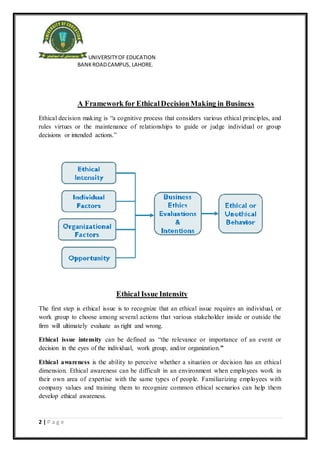
A Framework for EthicalDecisionMaking in Business
Ethical decision making is “a cognitive process that considers various ethical principles, and
rules virtues or the maintenance of relationships to guide or judge individual or group
decisions or intended actions.”
Ethical Issue Intensity
The first step is ethical issue is to recognize that an ethical issue requires an individual, or
work group to choose among several actions that various stakeholder inside or outside the
firm will ultimately evaluate as right and wrong.
Ethical issue intensity can be defined as “the relevance or importance of an event or
decision in the eyes of the individual, work group, and/or organization.”
Ethical awareness is the ability to perceive whether a situation or decision has an ethical
dimension. Ethical awareness can be difficult in an environment when employees work in
their own area of expertise with the same types of people. Familiarizing employees with
company values and training them to recognize common ethical scenarios can help them
develop ethical awareness.
UNIVERSITYOF EDUCATION
BANKROADCAMPUS, LAHORE.
3 | P a g e
Under current law, managers can be held liable for the unethical and illegal actions of
subordinates.
Ethical issue intensity reflects the ethical sensitivity of the individual or work group that faces
the ethical decision making process. Researcher suggest that individual are subject to face 6
sphere of influences when confronted with ethical choices the work , family , religion ,
place , legal system , community and profession and that the level of importance of each of
these influences will vary depending on how important the decision maker perceives the issue
to be .
Moral intensity relates to individuals' perceptions of social pressure and the harm they
believe their decisions will have on others.
Common concern regarding ethical issue in the organization is important. So managers need
to create a common concern to avoid ethical conflict.
Individual Factors
Individual factors such as gender, education, nationality, age and locus of control can affect
the ethical decision making process with some factors being more important than others.
When people need to resolve ethical issues in their daily lives, they often base their decision
on their own values and principles of right and wrong .They learn their values and principles
through the process of socialization with family members, social groups, and religion and
in their formal education. Good personal values have been found to decrease the unethical
practices and increase the positive work behavior. In other words those who believe that their
fate is in hands of others were more ethical than those who believed that they formed their
own destiny.
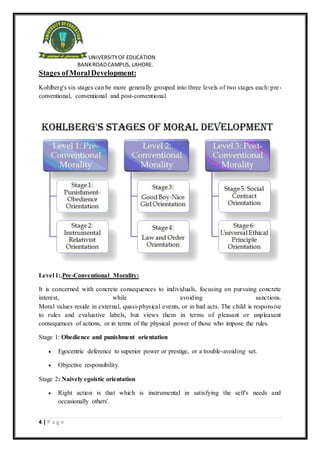
Moraldevelopment:
Moral development focuses on the emergence, change, and understanding of morality from
infancy through adulthood. In the field of moral development, morality is defined as
principles for how individuals ought to treat one another, with respect to justice, others'
welfare, and rights.
UNIVERSITYOF EDUCATION
BANKROADCAMPUS, LAHORE.
4 | P a g e
Stages ofMoralDevelopment:
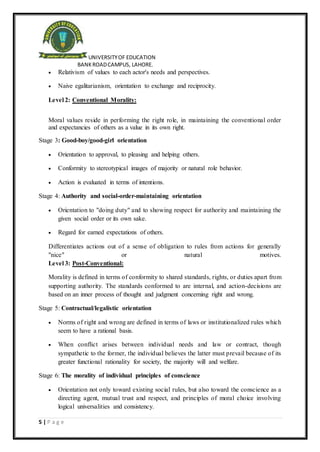
Kohlberg's six stages can be more generally grouped into three levels of two stages each: pre-
conventional, conventional and post-conventional.
Level 1:.Pre-Conventional Morality:
It is concerned with concrete consequences to individuals, focusing on pursuing concrete
interest, while avoiding sanctions.
Moral values reside in external, quasi-physical events, or in bad acts. The child is responsive
to rules and evaluative labels, but views them in terms of pleasant or unpleasant
consequences of actions, or in terms of the physical power of those who impose the rules.
Stage 1: Obedience and punishment orientation
 Egocentric deference to superior power or prestige, or a trouble-avoiding set.
 Objective responsibility.
Stage 2: Naively egoistic orientation
 Right action is that which is instrumental in satisfying the self's needs and
occasionally others'.
UNIVERSITYOF EDUCATION
BANKROADCAMPUS, LAHORE.
5 | P a g e
 Relativism of values to each actor's needs and perspectives.
 Naive egalitarianism, orientation to exchange and reciprocity.
Level 2: Conventional Morality:
Moral values reside in performing the right role, in maintaining the conventional order
and expectancies of others as a value in its own right.
Stage 3: Good-boy/good-girl orientation
 Orientation to approval, to pleasing and helping others.
 Conformity to stereotypical images of majority or natural role behavior.
 Action is evaluated in terms of intentions.
Stage 4: Authority and social-order-maintaining orientation
 Orientation to "doing duty" and to showing respect for authority and maintaining the
given social order or its own sake.
 Regard for earned expectations of others.
Differentiates actions out of a sense of obligation to rules from actions for generally
"nice" or natural motives.
Level 3: Post-Conventional:
Morality is defined in terms of conformity to shared standards, rights, or duties apart from
supporting authority. The standards conformed to are internal, and action-decisions are
based on an inner process of thought and judgment concerning right and wrong.
Stage 5: Contractual/legalistic orientation
 Norms of right and wrong are defined in terms of laws or institutionalized rules which
seem to have a rational basis.
 When conflict arises between individual needs and law or contract, though
sympathetic to the former, the individual believes the latter must prevail because of its
greater functional rationality for society, the majority will and welfare.
Stage 6: The morality of individual principles of conscience
 Orientation not only toward existing social rules, but also toward the conscience as a
directing agent, mutual trust and respect, and principles of moral choice involving
logical universalities and consistency.
UNIVERSITYOF EDUCATION
BANKROADCAMPUS, LAHORE.
6 | P a g e
Corporate
Culture
 Action is controlled by internalized ideals that exert a pressure to act accordingly
regardless of the reactions of others in the immediate environment.
 If one acts otherwise, self-condemnation and guilt result
Organizational Factors
Organizational factors such as organizations values
often have greater influences on an individual’s
decision than that persons own values. In addition
decision in business is most often made jointly, in
a work group and committees, or in convocations
and discussions with coworkers.
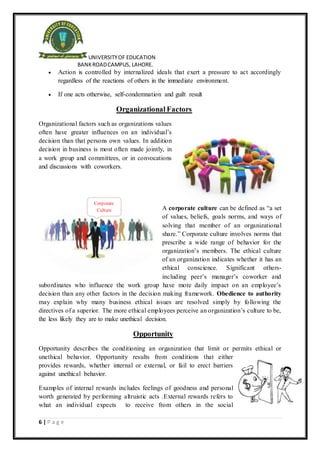
A corporate culture can be defined as “a set
of values, beliefs, goals norms, and ways of
solving that member of an organizational
share.” Corporate culture involves norms that
prescribe a wide range of behavior for the
organization’s members. The ethical culture
of an organization indicates whether it has an
ethical conscience. Significant others-
including peer’s manager’s coworker and
subordinates who influence the work group have more daily impact on an employee’s
decision than any other factors in the decision making framework. Obedience to authority
may explain why many business ethical issues are resolved simply by following the
directives of a superior. The more ethical employees perceive an organization’s culture to be,
the less likely they are to make unethical decision.
Opportunity
Opportunity describes the conditioning an organization that limit or permits ethical or
unethical behavior. Opportunity results from conditions that either
provides rewards, whether internal or external, or fail to erect barriers
against unethical behavior.
Examples of internal rewards includes feelings of goodness and personal
worth generated by performing altruistic acts .External rewards refers to
what an individual expects to receive from others in the social
UNIVERSITYOF EDUCATION
BANKROADCAMPUS, LAHORE.
7 | P a g e
environment in terms of social approvals, status, and esteem.
Opportunity relates to individual immediate jobs context
where they works, whom they works, with, and the nature of
the work. The immediate job context includes the
motivational superiors use to influence employees behavior.
Pay raises, bonuses, and public recognition are the positive
reinforcement, whereas demotions, firing, reprimands, and pay penalties are the negative
reinforcements
The opportunity for unethical behavior cannot be eliminated without aggressive enforcement
of codes and rules.
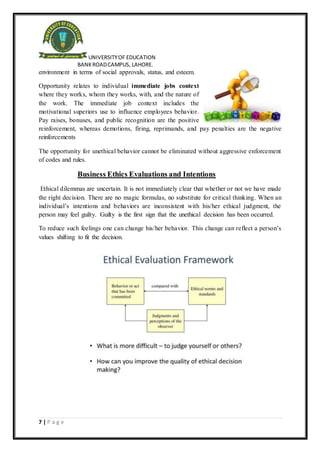
Business Ethics Evaluations and Intentions
Ethical dilemmas are uncertain. It is not immediately clear that whether or not we have made
the right decision. There are no magic formulas, no substitute for critical thinking. When an
individual’s intentions and behaviors are inconsistent with his/her ethical judgment, the
person may feel guilty. Guilty is the first sign that the unethical decision has been occurred.
To reduce such feelings one can change his/her behavior. This change can reflect a person’s
values shifting to fit the decision.
UNIVERSITYOF EDUCATION
BANKROADCAMPUS, LAHORE.
8 | P a g e
Using the Ethical DecisionMaking Framework to improve Ethical Decision
The ethical decision making framework is not a guide for making decision. It is intended to
provide insights and knowledge about typical ethical decision making processes in business
organizations. Ethical decision making within organization does not rely strictly on the
personal values and morals of employees. Organizations have culture of their own, which
when combined with corporate governance mechanisms may significantly influence business
ethics.
The more novel and difficult the ethical choice we face, the more we need to rely on
discussion and dialogue with others about the dilemma. Only by careful exploration of the
problem, aided by the insights and different perspectives of others, can we make good ethical
choices in such situations.

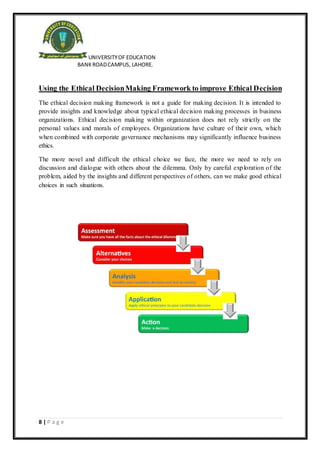
Framework of ethical decision making process

  • 1.
    UNIVERSITYOF EDUCATION BANKROAD CAMPUS,LAHORE. 0| P a g e Business Ethics “A man without ethics is a wild beast loosed upon this world” Albert campus
  • 2.
    UNIVERSITYOF EDUCATION BANKROADCAMPUS, LAHORE. 1| P a g e SUBMITTED TO: Mam Ezzah Batul SUBMITTED BY: Fariha Ijaz (1014) Haleema Sadia (1057) Shazmina Laiquat (1048) Khadija Shafique (1025) Nida Asghar (1033) PROGRAMME : BBA (Hons) 6th semester TOPIC: ETHICAL DECISION MAKING PROCESS
  • 3.
    UNIVERSITYOF EDUCATION BANKROADCAMPUS, LAHORE. 2| P a g e A Framework for EthicalDecisionMaking in Business Ethical decision making is “a cognitive process that considers various ethical principles, and rules virtues or the maintenance of relationships to guide or judge individual or group decisions or intended actions.” Ethical Issue Intensity The first step is ethical issue is to recognize that an ethical issue requires an individual, or work group to choose among several actions that various stakeholder inside or outside the firm will ultimately evaluate as right and wrong. Ethical issue intensity can be defined as “the relevance or importance of an event or decision in the eyes of the individual, work group, and/or organization.” Ethical awareness is the ability to perceive whether a situation or decision has an ethical dimension. Ethical awareness can be difficult in an environment when employees work in their own area of expertise with the same types of people. Familiarizing employees with company values and training them to recognize common ethical scenarios can help them develop ethical awareness.
  • 4.
    UNIVERSITYOF EDUCATION BANKROADCAMPUS, LAHORE. 3| P a g e Under current law, managers can be held liable for the unethical and illegal actions of subordinates. Ethical issue intensity reflects the ethical sensitivity of the individual or work group that faces the ethical decision making process. Researcher suggest that individual are subject to face 6 sphere of influences when confronted with ethical choices the work , family , religion , place , legal system , community and profession and that the level of importance of each of these influences will vary depending on how important the decision maker perceives the issue to be . Moral intensity relates to individuals' perceptions of social pressure and the harm they believe their decisions will have on others. Common concern regarding ethical issue in the organization is important. So managers need to create a common concern to avoid ethical conflict. Individual Factors Individual factors such as gender, education, nationality, age and locus of control can affect the ethical decision making process with some factors being more important than others. When people need to resolve ethical issues in their daily lives, they often base their decision on their own values and principles of right and wrong .They learn their values and principles through the process of socialization with family members, social groups, and religion and in their formal education. Good personal values have been found to decrease the unethical practices and increase the positive work behavior. In other words those who believe that their fate is in hands of others were more ethical than those who believed that they formed their own destiny. Moraldevelopment: Moral development focuses on the emergence, change, and understanding of morality from infancy through adulthood. In the field of moral development, morality is defined as principles for how individuals ought to treat one another, with respect to justice, others' welfare, and rights.
  • 5.
    UNIVERSITYOF EDUCATION BANKROADCAMPUS, LAHORE. 4| P a g e Stages ofMoralDevelopment: Kohlberg's six stages can be more generally grouped into three levels of two stages each: pre- conventional, conventional and post-conventional. Level 1:.Pre-Conventional Morality: It is concerned with concrete consequences to individuals, focusing on pursuing concrete interest, while avoiding sanctions. Moral values reside in external, quasi-physical events, or in bad acts. The child is responsive to rules and evaluative labels, but views them in terms of pleasant or unpleasant consequences of actions, or in terms of the physical power of those who impose the rules. Stage 1: Obedience and punishment orientation  Egocentric deference to superior power or prestige, or a trouble-avoiding set.  Objective responsibility. Stage 2: Naively egoistic orientation  Right action is that which is instrumental in satisfying the self's needs and occasionally others'.
  • 6.
    UNIVERSITYOF EDUCATION BANKROADCAMPUS, LAHORE. 5| P a g e  Relativism of values to each actor's needs and perspectives.  Naive egalitarianism, orientation to exchange and reciprocity. Level 2: Conventional Morality: Moral values reside in performing the right role, in maintaining the conventional order and expectancies of others as a value in its own right. Stage 3: Good-boy/good-girl orientation  Orientation to approval, to pleasing and helping others.  Conformity to stereotypical images of majority or natural role behavior.  Action is evaluated in terms of intentions. Stage 4: Authority and social-order-maintaining orientation  Orientation to "doing duty" and to showing respect for authority and maintaining the given social order or its own sake.  Regard for earned expectations of others. Differentiates actions out of a sense of obligation to rules from actions for generally "nice" or natural motives. Level 3: Post-Conventional: Morality is defined in terms of conformity to shared standards, rights, or duties apart from supporting authority. The standards conformed to are internal, and action-decisions are based on an inner process of thought and judgment concerning right and wrong. Stage 5: Contractual/legalistic orientation  Norms of right and wrong are defined in terms of laws or institutionalized rules which seem to have a rational basis.  When conflict arises between individual needs and law or contract, though sympathetic to the former, the individual believes the latter must prevail because of its greater functional rationality for society, the majority will and welfare. Stage 6: The morality of individual principles of conscience  Orientation not only toward existing social rules, but also toward the conscience as a directing agent, mutual trust and respect, and principles of moral choice involving logical universalities and consistency.
  • 7.
    UNIVERSITYOF EDUCATION BANKROADCAMPUS, LAHORE. 6| P a g e Corporate Culture  Action is controlled by internalized ideals that exert a pressure to act accordingly regardless of the reactions of others in the immediate environment.  If one acts otherwise, self-condemnation and guilt result Organizational Factors Organizational factors such as organizations values often have greater influences on an individual’s decision than that persons own values. In addition decision in business is most often made jointly, in a work group and committees, or in convocations and discussions with coworkers. A corporate culture can be defined as “a set of values, beliefs, goals norms, and ways of solving that member of an organizational share.” Corporate culture involves norms that prescribe a wide range of behavior for the organization’s members. The ethical culture of an organization indicates whether it has an ethical conscience. Significant others- including peer’s manager’s coworker and subordinates who influence the work group have more daily impact on an employee’s decision than any other factors in the decision making framework. Obedience to authority may explain why many business ethical issues are resolved simply by following the directives of a superior. The more ethical employees perceive an organization’s culture to be, the less likely they are to make unethical decision. Opportunity Opportunity describes the conditioning an organization that limit or permits ethical or unethical behavior. Opportunity results from conditions that either provides rewards, whether internal or external, or fail to erect barriers against unethical behavior. Examples of internal rewards includes feelings of goodness and personal worth generated by performing altruistic acts .External rewards refers to what an individual expects to receive from others in the social
  • 8.
    UNIVERSITYOF EDUCATION BANKROADCAMPUS, LAHORE. 7| P a g e environment in terms of social approvals, status, and esteem. Opportunity relates to individual immediate jobs context where they works, whom they works, with, and the nature of the work. The immediate job context includes the motivational superiors use to influence employees behavior. Pay raises, bonuses, and public recognition are the positive reinforcement, whereas demotions, firing, reprimands, and pay penalties are the negative reinforcements The opportunity for unethical behavior cannot be eliminated without aggressive enforcement of codes and rules. Business Ethics Evaluations and Intentions Ethical dilemmas are uncertain. It is not immediately clear that whether or not we have made the right decision. There are no magic formulas, no substitute for critical thinking. When an individual’s intentions and behaviors are inconsistent with his/her ethical judgment, the person may feel guilty. Guilty is the first sign that the unethical decision has been occurred. To reduce such feelings one can change his/her behavior. This change can reflect a person’s values shifting to fit the decision.
  • 9.
    UNIVERSITYOF EDUCATION BANKROADCAMPUS, LAHORE. 8| P a g e Using the Ethical DecisionMaking Framework to improve Ethical Decision The ethical decision making framework is not a guide for making decision. It is intended to provide insights and knowledge about typical ethical decision making processes in business organizations. Ethical decision making within organization does not rely strictly on the personal values and morals of employees. Organizations have culture of their own, which when combined with corporate governance mechanisms may significantly influence business ethics. The more novel and difficult the ethical choice we face, the more we need to rely on discussion and dialogue with others about the dilemma. Only by careful exploration of the problem, aided by the insights and different perspectives of others, can we make good ethical choices in such situations.