Is School Discipline a
Pathway to Incarceration?
       Deborah Adams
Introduction
          Throughout several years and as many
           courses I have recognized and become
           increasingly concerned about the relationship
           between school discipline and incarceration.
           My research is based on accumulated data
           acquired on the subject.


                                                           2
WEL440: Leadership in Practice
School Discipline
 30 % of students are low Income who
  receive 57 % of disciplinary removal from
  school.
 Special education students at 17%
  account for 40 % of removals.
 51% of students are males who account
  for 75% of removals.
 Black/African American students make
  up 8% but account for 16% of removals.
 Hispanic students are 14% and account
  for 16% of removals


                                                       3
Rennie Center: Act Out, Get Out?
Reasons for Discipline


       Lack of teacher preparation in classroom
        management

       Lack of training in cultural practices

       Racial stereotypes


                                                   4
Rennie Center: Act Out, Get Out?
Alternatives to Discipline
   School-wide positive behavioral supports (SWPBS)
          Develop integrated systems of student support
   Social Emotional Learning (SEL)
          Promotes social and emotional competence
   Restorative Practices
          Making students accountable for actions
    Safe and Responsive Schools (SRS)
          Improving behavior at school


Rennie Center: Act Out, Get Out?                          5
Incarceration


          Cycle of Discipline


                                        6
YouTube
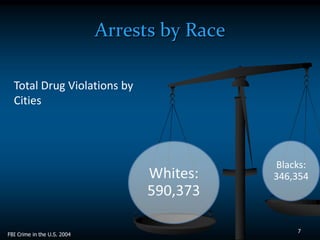
Arrests by Race

  Total Drug Violations by
  Cities


                                               Blacks:
                                               346,354


                                                   7
FBI Crime in the U.S. 2004
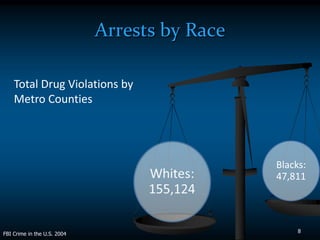
Arrests by Race

    Total Drug Violations by
    Metro Counties


                                               Blacks:
                                               47,811


FBI Crime in the U.S. 2004                          8
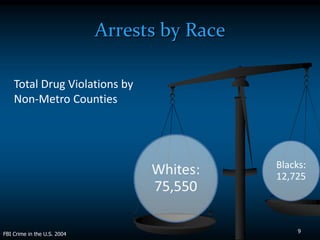
Arrests by Race

    Total Drug Violations by
    Non-Metro Counties


                                               Blacks:
                                               12,725


                                                    9
FBI Crime in the U.S. 2004
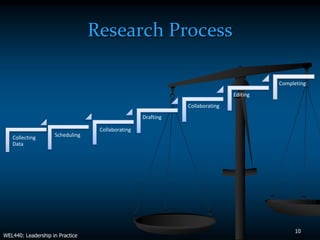
Research Process

                                                                                       Completing
                                                                             Editing
                                                             Collaborating
                                                  Drafting

                                  Collaborating
   Collecting       Scheduling
   Data


                                                                                            10
WEL440: Leadership in Practice
Conclusion
        This project has taught me
         how to use my strengths
         to drive results.
        Self-directed learning
         evolves similar to life
         experiences.
        My project has lead me to
         better appreciate a cause.


                                              11
WEL440: Leadership in Practice

Pathway to incarceration

  • 1.
    Is School Disciplinea Pathway to Incarceration? Deborah Adams
  • 2.
    Introduction  Throughout several years and as many courses I have recognized and become increasingly concerned about the relationship between school discipline and incarceration. My research is based on accumulated data acquired on the subject. 2 WEL440: Leadership in Practice
  • 3.
    School Discipline 30% of students are low Income who receive 57 % of disciplinary removal from school. Special education students at 17% account for 40 % of removals. 51% of students are males who account for 75% of removals. Black/African American students make up 8% but account for 16% of removals. Hispanic students are 14% and account for 16% of removals 3 Rennie Center: Act Out, Get Out?
  • 4.
    Reasons for Discipline Lack of teacher preparation in classroom management Lack of training in cultural practices Racial stereotypes 4 Rennie Center: Act Out, Get Out?
  • 5.
    Alternatives to Discipline School-wide positive behavioral supports (SWPBS) Develop integrated systems of student support Social Emotional Learning (SEL) Promotes social and emotional competence Restorative Practices Making students accountable for actions  Safe and Responsive Schools (SRS) Improving behavior at school Rennie Center: Act Out, Get Out? 5
  • 6.
    Incarceration Cycle of Discipline 6 YouTube
  • 7.
    Arrests by Race Total Drug Violations by Cities Blacks: 346,354 7 FBI Crime in the U.S. 2004
  • 8.
    Arrests by Race Total Drug Violations by Metro Counties Blacks: 47,811 FBI Crime in the U.S. 2004 8
  • 9.
    Arrests by Race Total Drug Violations by Non-Metro Counties Blacks: 12,725 9 FBI Crime in the U.S. 2004
  • 10.
    Research Process Completing Editing Collaborating Drafting Collaborating Collecting Scheduling Data 10 WEL440: Leadership in Practice
  • 11.
    Conclusion This project has taught me how to use my strengths to drive results. Self-directed learning evolves similar to life experiences. My project has lead me to better appreciate a cause. 11 WEL440: Leadership in Practice

Editor's Notes

  • #4 Massachusetts laws specify that disciplinary removal be used for serious behaviors that threaten school safety. 54% of removals reported for unassigned offenses did not threaten safety.
  • #5 According to professional opinion, research findings, and social psychology literature…the discipline of students of color may be attributed to the following…
  • #6 SWPBS – Aim to decrease problem behavior and develop integrated systems for students at school, classroom, and individual student levels. Teaching is by modeling, role playing and rewarding positive behaviors.SEL – Recognize and manage emotions, solve problems effectively and establish positive relationships with others.Restorative Practices – Based on theory that human beings are happier, more cooperative and productive, and more likely to make positive changes when those in authority do things with them rather than to them.SRS – School team-based approach (1) Create a positive school climate, (2) Early identification and intervention, (3) Effective responses
  • #8 Data found on website Crime in the U.S. 2004 Department of Justice-FBI