Leadership & Ethics
Ethical Behavior


Trustworthiness    Respect         Responsibility


                                            James Crawford
                                            James Crawford
                                        jcrawford71@cox.net
                                    jamescrawford10@skype
                         www.linkedin.com/in/jamesacrawford
What, then, is Ethics?

Ethics is two things. First, ethics refers to well-founded standards of right and wrong that
prescribe what humans ought to do, usually in terms of rights, obligations, benefits to
society, fairness, or specific virtues. Ethics, for example, refers to those standards that
impose the reasonable obligations to refrain from rape, stealing, murder, assault,
slander, and fraud. Ethical standards also include those that enjoin virtues of honesty,
compassion, and loyalty. And, ethical standards include standards relating to rights, such
as the right to life, the right to freedom from injury, and the right to privacy. Such
standards are adequate standards of ethics because they are supported by consistent
and well-founded reasons.


Secondly, ethics refers to the study and development of one's ethical standards. As
mentioned above, feelings, laws, and social norms can deviate from what is ethical. So it
is necessary to constantly examine one's standards to ensure that they are reasonable
and well-founded. Ethics also means, then, the continuous effort of studying our own
moral beliefs and our moral conduct, and striving to ensure that we, and the institutions
we help to shape, live up to standards that are reasonable and solidly-based.


Source: http://www.scu.edu/ethics/practicing/decision/whatisethics.html
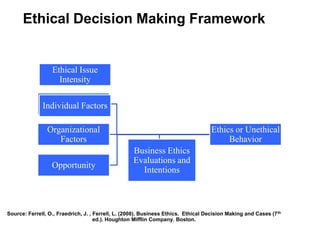
Ethical Decision Making Framework


                  Ethical Issue
                    Intensity
                   Factors
              Individual Factors
                Organizational

                Organizational                                                      Ethics or Unethical
                   Factors                                                               Behavior
                                                    Business Ethics
                                                    Evaluations and
                  Opportunity
                                                      Intentions


Source: Ferrell, O., Fraedrich, J. , Ferrell, L. (2008). Business Ethics. Ethical Decision Making and Cases (7 th
                                     ed.). Houghton Mifflin Company. Boston.
Ethical Decision Making


     Individual                            Organizational
                                                                                        Opportunity
      Factors                                 Factors
•   Education                             • Corporate                                • Immediate
•   Nationality                             Culture                                    Job Context
•   Age                                   • Ethical
•   Locus of                                Culture
    Control                               • Obedience to
                                            Authority


Source: Ferrell, O., Fraedrich, J. , Ferrell, L. (2008). Business Ethics. Ethical Decision Making and Cases (7th
ed.). Houghton Mifflin Company. Boston.
Leadership in a Corporate Culture


  “Leadership, the ability or
  authority to guide or direct
others toward achievement of
   a goal, has a significant
  impact on ethical decision
           making.”
Source: Ferrell, O., Fraedrich, J. , Ferrell, L. (2008). Business Ethics. Ethical Decision Making and Cases (7th
ed.). Houghton Mifflin Company. Boston.
Leadership Traits for Ethical Decision Making


  Trustworthiness

  Respect

  Responsibility

  Fairness

  Caring

  Citizenship


Critical Thinking:
Can a leader make ethical decisions
without these traits? Explain.

   Source: http://josephsoninstitute.org/MED/index.html
http://www.1000ventures.com/business_guide/crosscuttings/leadership_values-based.html
Leadership Styles


Critical Thinking: Which style is most effective?
Least effective? Why?
Source: http://www.gp-training.net/training/leadership/results.htm
Source: http://www.1000ventures.com/business_guide/crosscuttings/shared_values.html#GE%20Values%20Guide
Transactional Leadership vs. Transformational Leadership


                   Spark Question:
     Can transformational leadership be unethical?
               Source: http://www.theahriproshop.com/ss.html
7 Habits of Strong Ethical Leaders

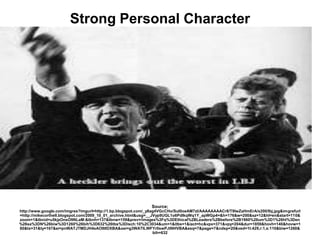
1.Ethical leaders have strong personal character.
2. Ethical leaders have a passion to do right.
3.Ethical leaders are proactive.
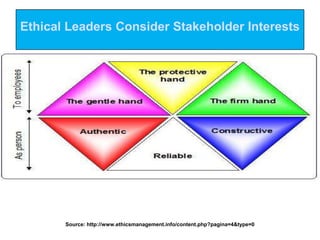
4.Ethical leaders consider stakeholders' interests.
5.Ethical leaders are role models for the organization's
values.
6.Ethical leaders are transparent and actively involved in
organizational decision making.
7.Ethical leaders are competent managers who take a
holistic view of the film's ethical culture.
Source: http://www.ar.cc.mn.us/gallop/S08%20Chapter%20Summaries/Chapter%205.pdf
Strong Personal Character


                                                              Source;
http://www.google.com/imgres?imgurl=http://1.bp.blogspot.com/_y8ag4VGcCHo/Sul0oeAM7zI/AAAAAAAACr8/T9lwZaHmErA/s200/lbj.jpg&imgrefurl
=http://mikecorthell.blogspot.com/2009_10_01_archive.html&usg=__JVyp9UGL1o6PdlkqWq1Y_apWGp4=&h=176&w=200&sz=12&hl=en&start=110&
zoom=1&tbnid=u5kjzOnsO9NLaM:&tbnh=137&tbnw=159&prev=/images%3Fq%3DEthical%2BLeaders%2Bbefore%2B1960%26um%3D1%26hl%3Den
%26sa%3DN%26biw%3D1260%26bih%3D632%26tbs%3Disch:10%2C3034&um=1&itbs=1&iact=hc&vpx=371&vpy=204&dur=1859&hovh=140&hovw=1
60&tx=31&ty=167&ei=pnWATJTMDJH4sAO9tIDXBA&oei=g3WATILWFYr0swPJtNHVBA&esq=7&page=7&ndsp=20&ved=1t:429,r:1,s:110&biw=1260&
                                                                 bih=632
Ethical Leaders Passion to do What's Right


Source: http://ethisphere.com/?s=questionnaire
Ethical Leaders are Proactive


Source: http://www.pacrao.org/docs/resources/writersteam/EthicalBehaviorforTodaysWorkplace.pdf
http://www.emeraldinsight.com/journals.htm?articleid=839319&show=html
Ethical Leaders Consider Stakeholder Interests


       Source: http://www.ethicsmanagement.info/content.php?pagina=4&type=0
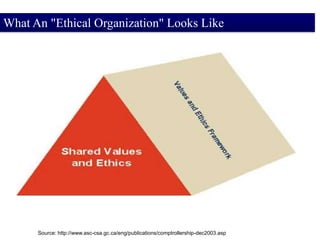
What An "Ethical Organization" Looks Like


      Source: http://www.asc-csa.gc.ca/eng/publications/comptrollership-dec2003.asp
Challenges Facing Ethical Leaders
 Corporate Culture
 Communication Style
 Organization Direction
 Decision Making
 Feedback Mechanisms


      Source: http://ezinearticles.com/?How-Are-You-Handling-The-Five-Biggest-
      Challenges-Facing-Managers-and-Business-Owners-Today?&id=285712
Spark Question: How much emphasis
              does your firm place on CSR?


Source: http://www.research-live.com/talk-normal/4001001.bloglead
The world has been utterly transformed in recent years by a
phenomenon affecting us all, what we call globalization.
Although there was a time when it was possible for citizens of
one country to think of themselves as owing no obligation to
the people of other nations, admittedly that was long ago.
Today national borders have less meaning as issues of trade,
environment, and health, along with incredible technological
advances of the last century, have left us with a legacy of
connectedness we cannot ignore.


      Spark Question:
      Assume you’re the leader of a
      Transnational Corp. What is your
      organizations policy for global ethics?
      Source: http://www.cceia.org/resources/transcripts/164.html
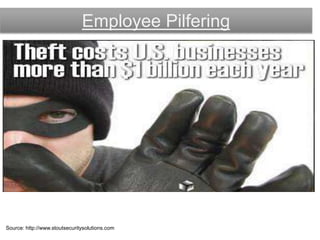
Employee Pilfering


Source: http://www.stoutsecuritysolutions.com
“Spark” Questions
The following practice questions are designed to spark your thinking
about leadership and ethics. They are intended to inspire you to think
creatively about the topic. The goal is that your insights with these
questions will lead to greater discussions and written papers.

1. What is the most significant influence on ethical behavior in your
   organization?
2. Describe the conditions that prohibit or encourage ethical behavior in
   a firm.
3. How does obedience to authority hinder ethical development?
4. Are transactional or transformational leaders more equipped to lead
   an ethical organization?

James Crawford Ethics presentation

  • 1.
    Leadership & Ethics EthicalBehavior Trustworthiness Respect Responsibility James Crawford James Crawford jcrawford71@cox.net jamescrawford10@skype www.linkedin.com/in/jamesacrawford
  • 3.
    What, then, isEthics? Ethics is two things. First, ethics refers to well-founded standards of right and wrong that prescribe what humans ought to do, usually in terms of rights, obligations, benefits to society, fairness, or specific virtues. Ethics, for example, refers to those standards that impose the reasonable obligations to refrain from rape, stealing, murder, assault, slander, and fraud. Ethical standards also include those that enjoin virtues of honesty, compassion, and loyalty. And, ethical standards include standards relating to rights, such as the right to life, the right to freedom from injury, and the right to privacy. Such standards are adequate standards of ethics because they are supported by consistent and well-founded reasons. Secondly, ethics refers to the study and development of one's ethical standards. As mentioned above, feelings, laws, and social norms can deviate from what is ethical. So it is necessary to constantly examine one's standards to ensure that they are reasonable and well-founded. Ethics also means, then, the continuous effort of studying our own moral beliefs and our moral conduct, and striving to ensure that we, and the institutions we help to shape, live up to standards that are reasonable and solidly-based. Source: http://www.scu.edu/ethics/practicing/decision/whatisethics.html
  • 4.
    Ethical Decision MakingFramework Ethical Issue Intensity Factors Individual Factors Organizational Organizational Ethics or Unethical Factors Behavior Business Ethics Evaluations and Opportunity Intentions Source: Ferrell, O., Fraedrich, J. , Ferrell, L. (2008). Business Ethics. Ethical Decision Making and Cases (7 th ed.). Houghton Mifflin Company. Boston.
  • 5.
    Ethical Decision Making Individual Organizational Opportunity Factors Factors • Education • Corporate • Immediate • Nationality Culture Job Context • Age • Ethical • Locus of Culture Control • Obedience to Authority Source: Ferrell, O., Fraedrich, J. , Ferrell, L. (2008). Business Ethics. Ethical Decision Making and Cases (7th ed.). Houghton Mifflin Company. Boston.
  • 6.
    Leadership in aCorporate Culture “Leadership, the ability or authority to guide or direct others toward achievement of a goal, has a significant impact on ethical decision making.” Source: Ferrell, O., Fraedrich, J. , Ferrell, L. (2008). Business Ethics. Ethical Decision Making and Cases (7th ed.). Houghton Mifflin Company. Boston.
  • 7.
    Leadership Traits forEthical Decision Making Trustworthiness Respect Responsibility Fairness Caring Citizenship Critical Thinking: Can a leader make ethical decisions without these traits? Explain. Source: http://josephsoninstitute.org/MED/index.html
  • 8.
  • 9.
    Leadership Styles Critical Thinking:Which style is most effective? Least effective? Why? Source: http://www.gp-training.net/training/leadership/results.htm
  • 10.
  • 11.
    Transactional Leadership vs.Transformational Leadership Spark Question: Can transformational leadership be unethical? Source: http://www.theahriproshop.com/ss.html
  • 12.
    7 Habits ofStrong Ethical Leaders 1.Ethical leaders have strong personal character. 2. Ethical leaders have a passion to do right. 3.Ethical leaders are proactive. 4.Ethical leaders consider stakeholders' interests. 5.Ethical leaders are role models for the organization's values. 6.Ethical leaders are transparent and actively involved in organizational decision making. 7.Ethical leaders are competent managers who take a holistic view of the film's ethical culture. Source: http://www.ar.cc.mn.us/gallop/S08%20Chapter%20Summaries/Chapter%205.pdf
  • 13.
    Strong Personal Character Source; http://www.google.com/imgres?imgurl=http://1.bp.blogspot.com/_y8ag4VGcCHo/Sul0oeAM7zI/AAAAAAAACr8/T9lwZaHmErA/s200/lbj.jpg&imgrefurl =http://mikecorthell.blogspot.com/2009_10_01_archive.html&usg=__JVyp9UGL1o6PdlkqWq1Y_apWGp4=&h=176&w=200&sz=12&hl=en&start=110& zoom=1&tbnid=u5kjzOnsO9NLaM:&tbnh=137&tbnw=159&prev=/images%3Fq%3DEthical%2BLeaders%2Bbefore%2B1960%26um%3D1%26hl%3Den %26sa%3DN%26biw%3D1260%26bih%3D632%26tbs%3Disch:10%2C3034&um=1&itbs=1&iact=hc&vpx=371&vpy=204&dur=1859&hovh=140&hovw=1 60&tx=31&ty=167&ei=pnWATJTMDJH4sAO9tIDXBA&oei=g3WATILWFYr0swPJtNHVBA&esq=7&page=7&ndsp=20&ved=1t:429,r:1,s:110&biw=1260& bih=632
  • 14.
    Ethical Leaders Passionto do What's Right Source: http://ethisphere.com/?s=questionnaire
  • 15.
    Ethical Leaders areProactive Source: http://www.pacrao.org/docs/resources/writersteam/EthicalBehaviorforTodaysWorkplace.pdf http://www.emeraldinsight.com/journals.htm?articleid=839319&show=html
  • 16.
    Ethical Leaders ConsiderStakeholder Interests Source: http://www.ethicsmanagement.info/content.php?pagina=4&type=0
  • 17.
    What An "EthicalOrganization" Looks Like Source: http://www.asc-csa.gc.ca/eng/publications/comptrollership-dec2003.asp
  • 18.
    Challenges Facing EthicalLeaders  Corporate Culture  Communication Style  Organization Direction  Decision Making  Feedback Mechanisms Source: http://ezinearticles.com/?How-Are-You-Handling-The-Five-Biggest- Challenges-Facing-Managers-and-Business-Owners-Today?&id=285712
  • 19.
    Spark Question: Howmuch emphasis does your firm place on CSR? Source: http://www.research-live.com/talk-normal/4001001.bloglead
  • 20.
    The world hasbeen utterly transformed in recent years by a phenomenon affecting us all, what we call globalization. Although there was a time when it was possible for citizens of one country to think of themselves as owing no obligation to the people of other nations, admittedly that was long ago. Today national borders have less meaning as issues of trade, environment, and health, along with incredible technological advances of the last century, have left us with a legacy of connectedness we cannot ignore. Spark Question: Assume you’re the leader of a Transnational Corp. What is your organizations policy for global ethics? Source: http://www.cceia.org/resources/transcripts/164.html
  • 21.
  • 22.
    “Spark” Questions The followingpractice questions are designed to spark your thinking about leadership and ethics. They are intended to inspire you to think creatively about the topic. The goal is that your insights with these questions will lead to greater discussions and written papers. 1. What is the most significant influence on ethical behavior in your organization? 2. Describe the conditions that prohibit or encourage ethical behavior in a firm. 3. How does obedience to authority hinder ethical development? 4. Are transactional or transformational leaders more equipped to lead an ethical organization?