INTRODUCTION
Now more than ever, leaders are challenged to make timely and precise decisions in
capricious situations. Data and information is so numerous it can boggle the mind
when mining for facts to enhance decision-making. Having a “good mind” is more
than just a saying it is considered a highly desirable trait of top leaders across all
industries. Possessing knowledge and knowing how and when to use it is essential to
organizational intelligence. Distinguishing how to access pertinent information, while
using it successfully for comprehensive benefits is sought after tangible knowledge.
Interactions, assessments, and case studies are presented to provide answers to
difficult questions on how the intelligence of an organization is used for making
decisions.
AdamsDMIS7003-4 2
Zofiaconsulting.com
DECISION-MAKING
STRATEGIC DECISIONS
• Numerous processes are deliberated in
making a decision
• Identifying integral results and the
anticipated outcome measured against the
variables are essential to the decision
process.
• A decision maker uses his or her character
traits of focus, motivation, self-awareness
during a mental process to choose a
conclusion.
• Market place decisions usually entail
retrieving and maintaining proper
knowledge.
DECISION MAKING PROCESS
• Identification of knowledge using established
principles.
• Spiraling dynamics of decision making uses human
influences affecting values and decisions.
• Focal point for decision makers is what retains or
increases profitability.
AdamsDMIS7003-4 3
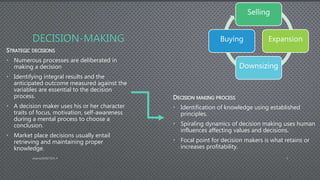
Selling
Expansion
Downsizing
Buying
HOW COMPETITION AFFECTS DECISIONS…
• There are challenges in the creation of value. Advantages in
competition may erode due to the undermining that imitation creates
to the resources uniqueness. Additionally, valuation of distinct
differences by consumers may decline. The differences between a
company’s resources, consumer heterogeneity and the environment
for demand are the roots of strategic heterogeneity.
(Adner, & Zemsky, 2006)
AdamsDMIS7003-4 4
ACCUMULATION OF
KNOWLEDGE
How knowledge is accumulated?
 Information/data at its essence is knowledge. It
can be extracted from experiences, research
findings, mathematical results, etc.
What is the knowledge used for making decisions?
 Decision making calls upon all forms of
knowledge relevant to the situation. Knowledge
in any form or fashion may be effective when
making choices. One size does not fit all.
How is knowledge best stored for later retrieval?
 Knowledge is typically stored in databases, on the
‘cloud’, contained in
policies/procedures/principles, historical records,
or paper files.
• Knowledge is fashioned into principles
for efficient/timely retrieval to make
decisions.
• It focuses on abstracts or tangibles.
• It uses objective over subjective
thinking.
• Rational decision making uses logical
analysis of all the evidence available at
the time.
AdamsDMIS7003-4 5
What is
knowledge?
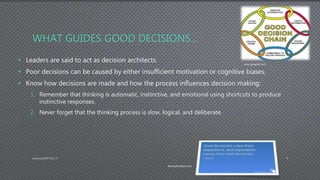
WHAT GUIDES GOOD DECISIONS…
• Leaders are said to act as decision architects.
• Poor decisions can be caused by either insufficient motivation or cognitive biases.
• Know how decisions are made and how the process influences decision making:
1. Remember that thinking is automatic, instinctive, and emotional using shortcuts to produce
instinctive responses.
2. Never forget that the thinking process is slow, logical, and deliberate.
AdamsDMIS7003-4 6
www.glogster.com
Boardofwisdom.com
HOW DECISIONS ARE MISGUIDED…
• Lack of compromise – My way or no way at all
• Judgement based on feelings – Personal agendas may conflict with business objectives
• Methodological issues – Not possessing structured reasoning for making decisions
• Lacking rationale for choices – Actions have consequences
• Discriminating criteria – Restricting information flow limits good choices
AdamsDMIS7003-4 7
www.pinterest.com
WHO’S AT FAULT INDIVIDUALS OR BUSINESSES
INDIVIDUAL DECISIONS
• Although decisions are made by individuals
the process of decision-making is not in a
vacuum. Whether it be ethical or unethical,
decisions are not made without influence
from the organizational culture or
environment in which is served. The
contextual ‘bubble’ in which decisions are
made influence the decision-making
process.
CORPORATE CULTURE
• The contextual organizational culture
shapes, while influencing individual
decision-making processes within the
structure over which it has control internally
or externally. Individuals are commissioned
to make-decisions that full-fill the
company’s objectives and follow well-
defined company principles that shape
decisions.
AdamsDMIS7003-4 8
(Jackson, Wood, & Zboja, 2013).
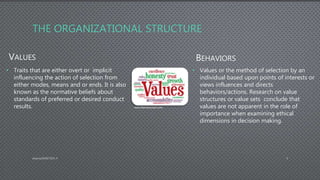
THE ORGANIZATIONAL STRUCTURE
VALUES
• Traits that are either overt or implicit
influencing the action of selection from
either modes, means and or ends. It is also
known as the normative beliefs about
standards of preferred or desired conduct
results.
BEHAVIORS
• Values or the method of selection by an
individual based upon points of interests or
views influences and directs
behaviors/actions. Research on value
structures or value sets conclude that
values are not apparent in the role of
importance when examining ethical
dimensions in decision making.
AdamsDMIS7003-4 9
www.thecrewcoach.com
INTERVIEWS
• Interviews were fashioned by creating a series of questions then sending them to
associates/connections via LinkedIn for response via the messaging connections feature.
Participants were senior vice presidents, owners, CEO, HR Executive Talent Acquisition
Consultant, and Financial Services Management Consultant of various companies (GE, Tech
Wave Group, Swiss RE, Attack Your Day, and Talent Acquisition). The questions were composed
as a survey in Survey Monkey.com with a brief message summarizing the survey process, reason
for the survey and how the information from the survey would be used explained in the
message body including the survey link (https://www.surveymonkey.com/r/8Q8CPT7), and my
contact information for feedback or questions. The designed questions were a combination of
multiple choice and explanation text. Exploring areas of organizational/departmental decision
making processes, training provided to decision makers, how knowledge is transferred and
managed, how decisions are based, and the type of research used to support decisions, etc.
AdamsDMIS7003-4 10
CONCLUSION
• As previously stated, data and information is so numerous it can boggle the mind
when mining for facts to enhance decision-making. The presentation reviewed how
various individual and business aspects play influential roles in decision-making.
Responses from the survey concluded that leaders are shaped either explicitly or
intrinsically to consider the weight of decisions against the consequences to the
company and its clients/customers. In short, the presentation/survey concludes
that ethical decisions are and should be made because it is the best thing to do for
everyone.
AdamsDMIS7003-4 11
AdamsDMIS7003-4 12
References
Adner, R., & Zemsky, P. (2006). A demand-based perspective on sustainable competitive advantage. Strategic
Management Journal, 27(3), 215-239. doi:10.1002/smj.513
Beshears, J., & Gino, F. (2015). Leaders as decision architects. (cover story). Harvard Business Review, 93(5), 51-62.
Ding, X., & Huang, R. (n.d). Effects of knowledge spillover on inter- organizational resource sharing decision in
collaborative knowledge creation. European Journal of Operational Research, 201(3), 949-959.
Fritzsche, D., & Oz, E. (2007). Personal values’ influence on the ethical dimension of decision making. Journal of Business
Ethics, 75(4), 335-343. doi:10.1007/s10551-006-9256-5
Jackson, R., Wood, C., & Zboja, J. (2013). The dissolution of ethical decision-making in organizations: A comprehensive
review and model. Journal of Business Ethics, 116(2), 233-250.
Woiceshyn, J. (2009). Lessons from “Good Minds”: How CEOs use intuition, analysis and guiding principles to make
strategic decisions. Long Range Planning, 42298-319. doi:10.1016/j.lrp.2009.05.002

Organizational intelligence

  • 2.
    INTRODUCTION Now more thanever, leaders are challenged to make timely and precise decisions in capricious situations. Data and information is so numerous it can boggle the mind when mining for facts to enhance decision-making. Having a “good mind” is more than just a saying it is considered a highly desirable trait of top leaders across all industries. Possessing knowledge and knowing how and when to use it is essential to organizational intelligence. Distinguishing how to access pertinent information, while using it successfully for comprehensive benefits is sought after tangible knowledge. Interactions, assessments, and case studies are presented to provide answers to difficult questions on how the intelligence of an organization is used for making decisions. AdamsDMIS7003-4 2 Zofiaconsulting.com
  • 3.
    DECISION-MAKING STRATEGIC DECISIONS • Numerousprocesses are deliberated in making a decision • Identifying integral results and the anticipated outcome measured against the variables are essential to the decision process. • A decision maker uses his or her character traits of focus, motivation, self-awareness during a mental process to choose a conclusion. • Market place decisions usually entail retrieving and maintaining proper knowledge. DECISION MAKING PROCESS • Identification of knowledge using established principles. • Spiraling dynamics of decision making uses human influences affecting values and decisions. • Focal point for decision makers is what retains or increases profitability. AdamsDMIS7003-4 3 Selling Expansion Downsizing Buying
  • 4.
    HOW COMPETITION AFFECTSDECISIONS… • There are challenges in the creation of value. Advantages in competition may erode due to the undermining that imitation creates to the resources uniqueness. Additionally, valuation of distinct differences by consumers may decline. The differences between a company’s resources, consumer heterogeneity and the environment for demand are the roots of strategic heterogeneity. (Adner, & Zemsky, 2006) AdamsDMIS7003-4 4
  • 5.
    ACCUMULATION OF KNOWLEDGE How knowledgeis accumulated?  Information/data at its essence is knowledge. It can be extracted from experiences, research findings, mathematical results, etc. What is the knowledge used for making decisions?  Decision making calls upon all forms of knowledge relevant to the situation. Knowledge in any form or fashion may be effective when making choices. One size does not fit all. How is knowledge best stored for later retrieval?  Knowledge is typically stored in databases, on the ‘cloud’, contained in policies/procedures/principles, historical records, or paper files. • Knowledge is fashioned into principles for efficient/timely retrieval to make decisions. • It focuses on abstracts or tangibles. • It uses objective over subjective thinking. • Rational decision making uses logical analysis of all the evidence available at the time. AdamsDMIS7003-4 5 What is knowledge?
  • 6.
    WHAT GUIDES GOODDECISIONS… • Leaders are said to act as decision architects. • Poor decisions can be caused by either insufficient motivation or cognitive biases. • Know how decisions are made and how the process influences decision making: 1. Remember that thinking is automatic, instinctive, and emotional using shortcuts to produce instinctive responses. 2. Never forget that the thinking process is slow, logical, and deliberate. AdamsDMIS7003-4 6 www.glogster.com Boardofwisdom.com
  • 7.
    HOW DECISIONS AREMISGUIDED… • Lack of compromise – My way or no way at all • Judgement based on feelings – Personal agendas may conflict with business objectives • Methodological issues – Not possessing structured reasoning for making decisions • Lacking rationale for choices – Actions have consequences • Discriminating criteria – Restricting information flow limits good choices AdamsDMIS7003-4 7 www.pinterest.com
  • 8.
    WHO’S AT FAULTINDIVIDUALS OR BUSINESSES INDIVIDUAL DECISIONS • Although decisions are made by individuals the process of decision-making is not in a vacuum. Whether it be ethical or unethical, decisions are not made without influence from the organizational culture or environment in which is served. The contextual ‘bubble’ in which decisions are made influence the decision-making process. CORPORATE CULTURE • The contextual organizational culture shapes, while influencing individual decision-making processes within the structure over which it has control internally or externally. Individuals are commissioned to make-decisions that full-fill the company’s objectives and follow well- defined company principles that shape decisions. AdamsDMIS7003-4 8 (Jackson, Wood, & Zboja, 2013).
  • 9.
    THE ORGANIZATIONAL STRUCTURE VALUES •Traits that are either overt or implicit influencing the action of selection from either modes, means and or ends. It is also known as the normative beliefs about standards of preferred or desired conduct results. BEHAVIORS • Values or the method of selection by an individual based upon points of interests or views influences and directs behaviors/actions. Research on value structures or value sets conclude that values are not apparent in the role of importance when examining ethical dimensions in decision making. AdamsDMIS7003-4 9 www.thecrewcoach.com
  • 10.
    INTERVIEWS • Interviews werefashioned by creating a series of questions then sending them to associates/connections via LinkedIn for response via the messaging connections feature. Participants were senior vice presidents, owners, CEO, HR Executive Talent Acquisition Consultant, and Financial Services Management Consultant of various companies (GE, Tech Wave Group, Swiss RE, Attack Your Day, and Talent Acquisition). The questions were composed as a survey in Survey Monkey.com with a brief message summarizing the survey process, reason for the survey and how the information from the survey would be used explained in the message body including the survey link (https://www.surveymonkey.com/r/8Q8CPT7), and my contact information for feedback or questions. The designed questions were a combination of multiple choice and explanation text. Exploring areas of organizational/departmental decision making processes, training provided to decision makers, how knowledge is transferred and managed, how decisions are based, and the type of research used to support decisions, etc. AdamsDMIS7003-4 10
  • 11.
    CONCLUSION • As previouslystated, data and information is so numerous it can boggle the mind when mining for facts to enhance decision-making. The presentation reviewed how various individual and business aspects play influential roles in decision-making. Responses from the survey concluded that leaders are shaped either explicitly or intrinsically to consider the weight of decisions against the consequences to the company and its clients/customers. In short, the presentation/survey concludes that ethical decisions are and should be made because it is the best thing to do for everyone. AdamsDMIS7003-4 11
  • 12.
    AdamsDMIS7003-4 12 References Adner, R.,& Zemsky, P. (2006). A demand-based perspective on sustainable competitive advantage. Strategic Management Journal, 27(3), 215-239. doi:10.1002/smj.513 Beshears, J., & Gino, F. (2015). Leaders as decision architects. (cover story). Harvard Business Review, 93(5), 51-62. Ding, X., & Huang, R. (n.d). Effects of knowledge spillover on inter- organizational resource sharing decision in collaborative knowledge creation. European Journal of Operational Research, 201(3), 949-959. Fritzsche, D., & Oz, E. (2007). Personal values’ influence on the ethical dimension of decision making. Journal of Business Ethics, 75(4), 335-343. doi:10.1007/s10551-006-9256-5 Jackson, R., Wood, C., & Zboja, J. (2013). The dissolution of ethical decision-making in organizations: A comprehensive review and model. Journal of Business Ethics, 116(2), 233-250. Woiceshyn, J. (2009). Lessons from “Good Minds”: How CEOs use intuition, analysis and guiding principles to make strategic decisions. Long Range Planning, 42298-319. doi:10.1016/j.lrp.2009.05.002

Editor's Notes

  • #4 Measurement between risks and desired results is an essential consideration of strategic decisions. Relevant to the market position(s), decision makers must be knowledgeable of the market place and the business position within the market while accessing the optimal climate for buying, selling, expanding, or downsizing. Transactions (buying, selling, expanding, downsizing, etc.) within the marketplace are cyclical processes and an integral part of decision making in business. Using the integration of knowledge yielded by structured principles ensures efficiency for the retrieval of data/knowledge. (Woiceshyn, 2009; Ding & Huang, n.d.)
  • #5 Main point to remember is that the strategies of the business and context of demand does propose new dimensions for which to consider new strategies. Demands features and the environment in which it is presented is influenced by both businesses and consumers. (Adner, & Zemsky, 2006)
  • #6 An individual cannot retain all of his or her experiences, so businesses create principles, best practices, procedures, etc. to guide the decision making process along the lines of proven results. Objective verses subjective decision making: Objectivity uses analysis based upon facts or evidence on which to base decisions. Subjectivity uses personal emotions, opinions or perspectives on which to base decisions. Identification of principles and essentials are the baseline focus for effective decision making. Intuition, according to cognitive science, may be prone to errors due to differing viewpoints. (Woiceshyn, 2009)
  • #7 There are two hands in decision making: On one hand, the problem can be as simple as overconfidence, underestimating, delayed responses or poor time management. On the other hand, the solution can be as simple as understanding the factors which affect one’s motivation to make a decision. Creating a method that will diminish the impact of biases, while frequently testing solutions to ensure that what once worked is still working. Exam the causes and consequences of previous poor decisions. Emotions and biases cause havoc in decision making, design principles that will divert focus to company objectives away from personalities. (Beshears, & Gino, 2015)
  • #8 Lack of compromise – leads to discord which leads to indecisiveness. There must be give and take in any exchange of ideas before a choice is made. Not willing to concede in some areas of non-consequential aspects inevitably leads to indecision, which in some situations may be more damaging than a bad decision. Judgement based on feelings – Asserting emotions over rationale analysis of the criteria is one ingredient that will spoil a decision. Methodological issues – Methodology is the logic of methods. It is the rationale and appropriateness for comprising research structure, choices, or making decisions. The easiest way to understand methodological issues is an understanding why you are doing something. Issues of methodology are often related to reliability or validity consequences. Lacking rationale for choices – Choices have consequences. All decisions should reflect aforethought as to the logical/rational reason for making or not making a choice. Knowledge of the reasons for selecting or not selecting, demonstrates a disciplined process. Discriminating criteria – Biased thinking about any subject matter restricts decisions/choices to incomplete information. Limiting the information used for making decisions has the potential of using poor data. It is essential to have complete unfiltered criteria for optimal decision making.
  • #9 The is that ethics is a progressive process taking place over time especially when there are an alignment of certain elements. Cases for reference: Viewers witnessed the consequences of poor ethical decisions on television when Morton-Thiakol and NASA, after the decision of leaders the space shuttle explored ignoring the efforts by an engineer who tried to stop the launch. In another case there were also deaths and injuries from the Ford Pinto automobile which could have been avoided if investment were the priority. Throughout the headlines then and even now Numerous disasters are witnesses as the result of corporate influenced unethical decision-making by individuals. It can be concluded that corporations are the persuasive instruments under which individual learn and make unethical decision making traditions. (Jackson, Wood, & Zboja, 2013).
  • #10 Authors/research claim that specific acts or sequential acts are directed by the various changing sets of values. These sets or clusters of values are formed by individual value systems, which are structured in a hierarchy fashion and based upon importance to relative personal values. Organized set of preferential standards which when used make objects, actions, conflict resolution selections to cope or invoke sanctions is known as a “value system”. Altruistic values – Desires world peace, no war or conflict, social justice, eliminating injustice, caring for the weak, and equal opportunity for all Self-enhancement values - Desires authority, the right to lead or command, influence, impacting people/events, wealth, and material possessions. A study found that in hiring the preference for employment candidates was for those with altruistic values over those with self-enhanced values. One may infer that individuals possess altruistic values will be more prone to make ethical decisions and conduct themselves with the best interest of others over themselves. (Fritzsche, & Oz, 2007).
  • #11 Introduction to the survey invited participants to complete the survey informing them that the survey was for educational purposes. It was disclosed that responses and data/information contained within the survey was solely for educational purposes. The closing remarks page of the survey thanked participants for their time to contribute to the educational experience and provided the name of the course with my email address. As stated, most participants are close connections personally or professionally and within LinkedIn, which offer the perfect venue for contacting a variety of professional with busy schedules, who may otherwise be unavailable to participate in a personal meeting with the strict timeframe of one week. I find the conducting interviews in this fashion expedites responses, while eliminating the anxiety of scheduling and preparing for an in-person interview. The electronic survey was welcomed by professionals who use technology in their daily business/personal affairs and would much prefer to participate in an electronic survey than a in-person meeting where more time would have to slated for preparation, doubling the time of the interview.