1
Mr.M.RAGU
Assistant Professor of
Chemistry
Vivekananda College
Tiruvedakam West –
Classification and
Synthesis of Dyes
 Introduction
 Theory of color and constitution
 Chromophore and Auxochrome
 Nitro dyes and Naphthol yellow
 Azo dyes
 Methyl orange
 T-Chloramine
OutlineOutline
THEORY OF COLOR AND CONSTITUTION
CHROMOPHORE
A chromophore is the part of a molecule responsible for its color
It arises when a molecule absorbs certain wavelengths of visible light and
transmits or reflects others
The energy difference between two different molecular orbitals falls within
the range of the visible spectrum.
Visible light that hits the chromophore can thus be absorbed by exciting
an electron from its ground state into an excited state.
White light is a continuum of different colours.
If white light is passed through clouds or a prism, then it can be split up
into its constituent colours, each of which has a different wavelength.
Examples of Chromophores
If there is only conjugation, a long chain of conjugated bonds is needed to
reduce the HOMO/LUMO gap to energies that correspond to visible light.
Realize that it is continuous, extended conjugation that is important (i.e. the size
of the molecular orbital), not the total number of double bonds.
If we continue to increase the number of conjugated C=C bonds, then eventually
we reach a point where the compound will absorb visible light (β-carotene ~475
nm).
Keto group, Nitroso group, Quinonoid group, Ethylenic group, Nitro
group, azo group.
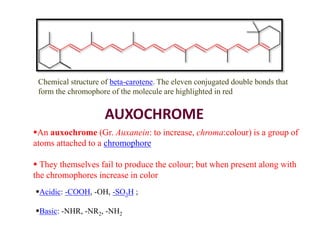
Chemical structure of beta-carotene. The eleven conjugated double bonds that
form the chromophore of the molecule are highlighted in red
An auxochrome (Gr. Auxanein: to increase, chroma:colour) is a group of
atoms attached to a chromophore
 They themselves fail to produce the colour; but when present along with
the chromophores increase in color
Acidic: -COOH, -OH, -SO3H ;
Basic: -NHR, -NR2, -NH2
AUXOCHROME
NITRO DYES
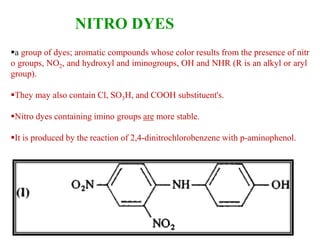
a group of dyes; aromatic compounds whose color results from the presence of nitr
o groups, NO2, and hydroxyl and iminogroups, OH and NHR (R is an alkyl or aryl
group).
They may also contain Cl, SO3H, and COOH substituent's.
Nitro dyes containing imino groups are more stable.
It is produced by the reaction of 2,4-dinitrochlorobenzene with p-aminophenol.
NAPHTHOL YELLOW
It is used in a number of countries as a food dye.
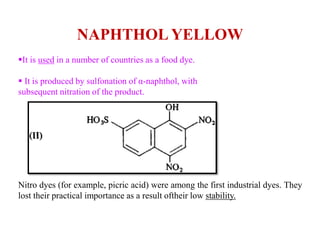
 It is produced by sulfonation of α-naphthol, with
subsequent nitration of the product.
Nitro dyes (for example, picric acid) were among the first industrial dyes. They
lost their practical importance as a result oftheir low stability.
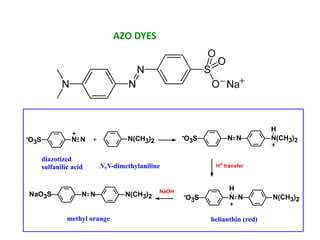
diazotized
sulfanilic acid
+-O3S N N N(CH3)2
N,N-dimethylaniline
-O3S N N N(CH3)2
H
H+ transfer
-O3S N N N(CH3)2
HNaOH
helianthin (red)
NaO3S N N N(CH3)2
methyl orange
AZO DYES
It is a pH indicator frequently used in titrations because of its clear and
distinct colour change.
Its not an universal indicator
Colourless solid is soluble in nonpolar organic solvents and not in water.
METHYL ORANGE
i) It can be synthesized by Friedel-Crafts
reaction from benzene and chloroform with aluminium
chloridecatalyst:
3 C6H6 + CHCl3 → Ph3CH + 3 HCl
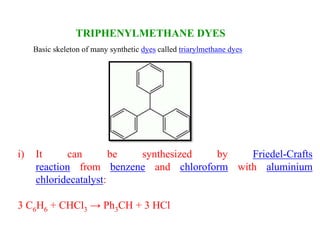
TRIPHENYLMETHANE DYES
Basic skeleton of many synthetic dyes called triarylmethane dyes
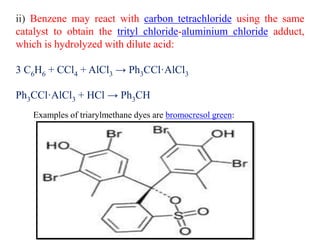
Examples of triarylmethane dyes are bromocresol green:
ii) Benzene may react with carbon tetrachloride using the same
catalyst to obtain the trityl chloride-aluminium chloride adduct,
which is hydrolyzed with dilute acid:
3 C6H6 + CCl4 + AlCl3 → Ph3CCl·AlCl3
Ph3CCl·AlCl3 + HCl → Ph3CH
It is prepared by condensing benzaldehyde and dimethylaniline in the
molecular ratio 1:2 in the presence of sulfuric acid
MALACHITE GREEN DYES
N-phenylglycine is treated with a molten mixture of sodium
hydroxide, potassium hydroxide, and sodamide. This highly sensitive melt
produces indoxyl, which is subsequently oxidized in air to form indigo.
INDIGO DYES
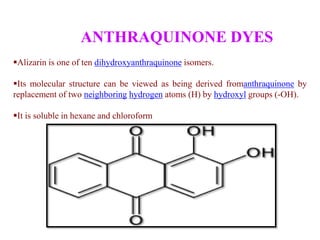
Alizarin is one of ten dihydroxyanthraquinone isomers.
Its molecular structure can be viewed as being derived fromanthraquinone by
replacement of two neighboring hydrogen atoms (H) by hydroxyl groups (-OH).
It is soluble in hexane and chloroform
ANTHRAQUINONE DYES
Derivatives of 9,10-anthraquinone include many important drugs
(collectively called anthracenediones).
Antimalarials such as rufigallol Antineoplastics used in the treatment
of cancer, such as mitoxantrone, pixantrone
Aloe emodin mitoxantrone
pixantrone
It can be prepared from phthalic anhydride and resorcinol in the presence
of zinc chloride via theFriedel-Crafts reaction.
FLUORESCEIN DYES
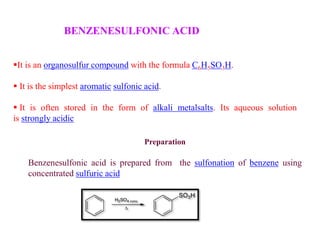
It is an organosulfur compound with the formula C6H5SO3H.
 It is the simplest aromatic sulfonic acid.
 It is often stored in the form of alkali metalsalts. Its aqueous solution
is strongly acidic
Preparation
Benzenesulfonic acid is prepared from the sulfonation of benzene using
concentrated sulfuric acid
BENZENESULFONIC ACID
of other aromatic sulfonic acids, forming sulfonamides, sulfonyl chloride, and
esters.
The sulfonation is reversed above 220 °C. Dehydration with phosphorus
pentoxide gives benzenesulfonic acid anhydride ((C6H5SO2)2O).
Conversion to the corresponding benzenesulfonyl chloride (C6H5SO2Cl) is
effected with phosphorus pentachloride.
It is a strong acid, being dissociated in water.
The alkali metal salt of benzenesulfonic acid was once widely used in the
production of phenol:
 C6H5SO3Na + 2 NaOH → C6H5ONa + Na2SO3
 C6H5ONa + HCl → C6H5OH + NaCl
It is an artificial sweetener with effectively no food energy which is about 300–
400 times as sweet as sucrose.
It starts with toluene; Sulfonation by chlorosulfonic acid gives
the ortho and para substituted sulfonyl chlorides. The ortho isomer is separated
and converted to the sulfonamide with ammonia. Oxidation of the methyl
substituent gives the carboxylic acid, which cyclicizes to give saccharin free acid
SACCHARIN
Anthranilic acid successively reacts with nitrous acid (from sodium
nitrite and hydrochloric acid), sulfur dioxide, chlorine, and then ammonia to
yield saccharin
CHLORAMINE-T
Chloramine-T is slightly basic (pH typically 8.5).
In water, it breaks down to the disinfectant hypochlorite.
It can be used as a source of electrophilic chlorine in organic synthesis.
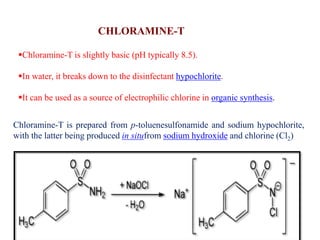
Chloramine-T is prepared from p-toluenesulfonamide and sodium hypochlorite,
with the latter being produced in situfrom sodium hydroxide and chlorine (Cl2)
Applications
It is widely used for the incorporation of iodine to peptides and proteins.
Chloramine-T together with iodogen or lactoperoxidase is commonly used
for labeling peptides and proteins withradioiodine isotopes
Chloramine-T is available in tablet or powder form and has to be dissolved before
use.
The substance is also used for parasitecontrol and for drinking water
disinfection.
It reacts readily with mustard gas to yield a harmless crystalline sulfimide;
chloramine-T derivatives are being studied as protective agents againstpoison gas
SULFONAMIDE OR SULPHONAMIDE
 It is the basis of several groups of drugs.
The original antibacterial sulfonamides (sometimes called sulfa drugs or sulpha
drugs) are synthetic antimicrobial agents that contain the sulfonamide group.
Some sulfonamides are also devoid of antibacterial activity
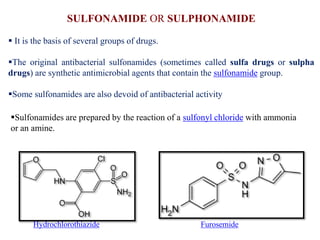
Sulfonamides are prepared by the reaction of a sulfonyl chloride with ammonia
or an amine.
Hydrochlorothiazide Furosemide
27
Mr.M.RAGU
Assistant Professor of
Chemistry
Vivekananda College
Tiruvedakam West –
Thank you

Dyes classification

  • 1.
    1 Mr.M.RAGU Assistant Professor of Chemistry VivekanandaCollege Tiruvedakam West – Classification and Synthesis of Dyes
  • 2.
     Introduction  Theoryof color and constitution  Chromophore and Auxochrome  Nitro dyes and Naphthol yellow  Azo dyes  Methyl orange  T-Chloramine OutlineOutline
  • 5.
    THEORY OF COLORAND CONSTITUTION CHROMOPHORE A chromophore is the part of a molecule responsible for its color It arises when a molecule absorbs certain wavelengths of visible light and transmits or reflects others The energy difference between two different molecular orbitals falls within the range of the visible spectrum. Visible light that hits the chromophore can thus be absorbed by exciting an electron from its ground state into an excited state. White light is a continuum of different colours. If white light is passed through clouds or a prism, then it can be split up into its constituent colours, each of which has a different wavelength.
  • 7.
    Examples of Chromophores Ifthere is only conjugation, a long chain of conjugated bonds is needed to reduce the HOMO/LUMO gap to energies that correspond to visible light. Realize that it is continuous, extended conjugation that is important (i.e. the size of the molecular orbital), not the total number of double bonds. If we continue to increase the number of conjugated C=C bonds, then eventually we reach a point where the compound will absorb visible light (β-carotene ~475 nm). Keto group, Nitroso group, Quinonoid group, Ethylenic group, Nitro group, azo group.
  • 8.
    Chemical structure ofbeta-carotene. The eleven conjugated double bonds that form the chromophore of the molecule are highlighted in red An auxochrome (Gr. Auxanein: to increase, chroma:colour) is a group of atoms attached to a chromophore  They themselves fail to produce the colour; but when present along with the chromophores increase in color Acidic: -COOH, -OH, -SO3H ; Basic: -NHR, -NR2, -NH2 AUXOCHROME
  • 9.
    NITRO DYES a groupof dyes; aromatic compounds whose color results from the presence of nitr o groups, NO2, and hydroxyl and iminogroups, OH and NHR (R is an alkyl or aryl group). They may also contain Cl, SO3H, and COOH substituent's. Nitro dyes containing imino groups are more stable. It is produced by the reaction of 2,4-dinitrochlorobenzene with p-aminophenol.
  • 10.
    NAPHTHOL YELLOW It isused in a number of countries as a food dye.  It is produced by sulfonation of α-naphthol, with subsequent nitration of the product. Nitro dyes (for example, picric acid) were among the first industrial dyes. They lost their practical importance as a result oftheir low stability.
  • 11.
    diazotized sulfanilic acid +-O3S NN N(CH3)2 N,N-dimethylaniline -O3S N N N(CH3)2 H H+ transfer -O3S N N N(CH3)2 HNaOH helianthin (red) NaO3S N N N(CH3)2 methyl orange AZO DYES
  • 12.
    It is apH indicator frequently used in titrations because of its clear and distinct colour change. Its not an universal indicator Colourless solid is soluble in nonpolar organic solvents and not in water. METHYL ORANGE
  • 13.
    i) It canbe synthesized by Friedel-Crafts reaction from benzene and chloroform with aluminium chloridecatalyst: 3 C6H6 + CHCl3 → Ph3CH + 3 HCl TRIPHENYLMETHANE DYES Basic skeleton of many synthetic dyes called triarylmethane dyes
  • 14.
    Examples of triarylmethanedyes are bromocresol green: ii) Benzene may react with carbon tetrachloride using the same catalyst to obtain the trityl chloride-aluminium chloride adduct, which is hydrolyzed with dilute acid: 3 C6H6 + CCl4 + AlCl3 → Ph3CCl·AlCl3 Ph3CCl·AlCl3 + HCl → Ph3CH
  • 15.
    It is preparedby condensing benzaldehyde and dimethylaniline in the molecular ratio 1:2 in the presence of sulfuric acid MALACHITE GREEN DYES
  • 16.
    N-phenylglycine is treatedwith a molten mixture of sodium hydroxide, potassium hydroxide, and sodamide. This highly sensitive melt produces indoxyl, which is subsequently oxidized in air to form indigo. INDIGO DYES
  • 17.
    Alizarin is oneof ten dihydroxyanthraquinone isomers. Its molecular structure can be viewed as being derived fromanthraquinone by replacement of two neighboring hydrogen atoms (H) by hydroxyl groups (-OH). It is soluble in hexane and chloroform ANTHRAQUINONE DYES
  • 18.
    Derivatives of 9,10-anthraquinoneinclude many important drugs (collectively called anthracenediones). Antimalarials such as rufigallol Antineoplastics used in the treatment of cancer, such as mitoxantrone, pixantrone Aloe emodin mitoxantrone pixantrone
  • 19.
    It can beprepared from phthalic anhydride and resorcinol in the presence of zinc chloride via theFriedel-Crafts reaction. FLUORESCEIN DYES
  • 20.
    It is anorganosulfur compound with the formula C6H5SO3H.  It is the simplest aromatic sulfonic acid.  It is often stored in the form of alkali metalsalts. Its aqueous solution is strongly acidic Preparation Benzenesulfonic acid is prepared from the sulfonation of benzene using concentrated sulfuric acid BENZENESULFONIC ACID
  • 21.
    of other aromaticsulfonic acids, forming sulfonamides, sulfonyl chloride, and esters. The sulfonation is reversed above 220 °C. Dehydration with phosphorus pentoxide gives benzenesulfonic acid anhydride ((C6H5SO2)2O). Conversion to the corresponding benzenesulfonyl chloride (C6H5SO2Cl) is effected with phosphorus pentachloride. It is a strong acid, being dissociated in water. The alkali metal salt of benzenesulfonic acid was once widely used in the production of phenol:  C6H5SO3Na + 2 NaOH → C6H5ONa + Na2SO3  C6H5ONa + HCl → C6H5OH + NaCl
  • 22.
    It is anartificial sweetener with effectively no food energy which is about 300– 400 times as sweet as sucrose. It starts with toluene; Sulfonation by chlorosulfonic acid gives the ortho and para substituted sulfonyl chlorides. The ortho isomer is separated and converted to the sulfonamide with ammonia. Oxidation of the methyl substituent gives the carboxylic acid, which cyclicizes to give saccharin free acid SACCHARIN
  • 23.
    Anthranilic acid successivelyreacts with nitrous acid (from sodium nitrite and hydrochloric acid), sulfur dioxide, chlorine, and then ammonia to yield saccharin
  • 24.
    CHLORAMINE-T Chloramine-T is slightlybasic (pH typically 8.5). In water, it breaks down to the disinfectant hypochlorite. It can be used as a source of electrophilic chlorine in organic synthesis. Chloramine-T is prepared from p-toluenesulfonamide and sodium hypochlorite, with the latter being produced in situfrom sodium hydroxide and chlorine (Cl2)
  • 25.
    Applications It is widelyused for the incorporation of iodine to peptides and proteins. Chloramine-T together with iodogen or lactoperoxidase is commonly used for labeling peptides and proteins withradioiodine isotopes Chloramine-T is available in tablet or powder form and has to be dissolved before use. The substance is also used for parasitecontrol and for drinking water disinfection. It reacts readily with mustard gas to yield a harmless crystalline sulfimide; chloramine-T derivatives are being studied as protective agents againstpoison gas
  • 26.
    SULFONAMIDE OR SULPHONAMIDE It is the basis of several groups of drugs. The original antibacterial sulfonamides (sometimes called sulfa drugs or sulpha drugs) are synthetic antimicrobial agents that contain the sulfonamide group. Some sulfonamides are also devoid of antibacterial activity Sulfonamides are prepared by the reaction of a sulfonyl chloride with ammonia or an amine. Hydrochlorothiazide Furosemide
  • 27.
    27 Mr.M.RAGU Assistant Professor of Chemistry VivekanandaCollege Tiruvedakam West – Thank you