PRACTICAL
Name- Saloni Singhal
M.Sc. (Statistics) II-Sem.
Roll No: 2046398
Course- MATH-409 L
Numerical Analysis Lab
Submitted To: Dr. S.C. Pandey
1.3
OBJECTIVE
Error Analysis in Computation: Round Off
and Truncation Errors
Problem Statement
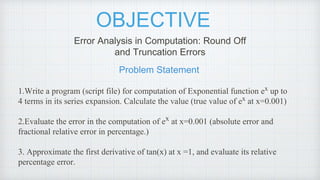
1.Write a program (script file) for computation of Exponential function ex up to
4 terms in its series expansion. Calculate the value (true value of ex at x=0.001)
2.Evaluate the error in the computation of ex at x=0.001 (absolute error and
fractional relative error in percentage.)
3. Approximate the first derivative of tan(x) at x =1, and evaluate its relative
percentage error.
Theory
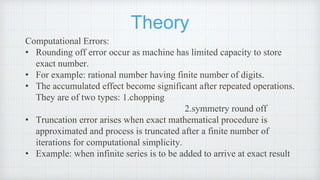
Computational Errors:
• Rounding off error occur as machine has limited capacity to store
exact number.
• For example: rational number having finite number of digits.
• The accumulated effect become significant after repeated operations.
They are of two types: 1.chopping
2.symmetry round off
• Truncation error arises when exact mathematical procedure is
approximated and process is truncated after a finite number of
iterations for computational simplicity.
• Example: when infinite series is to be added to arrive at exact result
Program
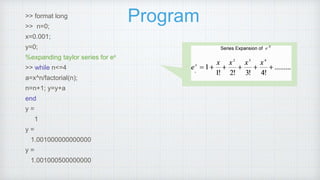
>> format long
>> n=0;
x=0.001;
y=0;
%expanding taylor series for ex
>> while n<=4
a=x^n/factorial(n);
n=n+1; y=y+a
end
y =
1
y =
1.001000000000000
y =
1.001000500000000
Program
Contd.
y =
1.001000500166667
y =
1.001000500166708
>> truevav=exp(0.001)
truevav =
1.001000500166708
>> err=abs(truevav-y)
err =
0
Error Analysis
As h grows smaller and smaller, f[x + h, x − h]
becomes a better and better approximation to
f(x) .If we plot the truncation error against h on a
log- scale (for linearity), we expect to see a
straight line. For small h values, the error is
dominated by roundoff rather than by truncation
error. An advantage of the higher order of
accuracy is that we can get very small truncation
errors even when h is not very small, and so we
tend to be able to reach a better optimal error
before cancellation effects start to dominate.
2. Program Contd.
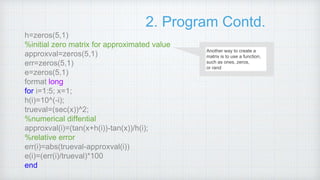
h=zeros(5,1)
%initial zero matrix for approximated value
approxval=zeros(5,1)
err=zeros(5,1)
e=zeros(5,1)
format long
for i=1:5; x=1;
h(i)=10^(-i);
trueval=(sec(x))^2;
%numerical diffential
approxval(i)=(tan(x+h(i))-tan(x))/h(i);
%relative error
err(i)=abs(trueval-approxval(i))
e(i)=(err(i)/trueval)*100
end
Another way to create a
matrix is to use a function,
such as ones, zeros,
or rand.
Conclusion
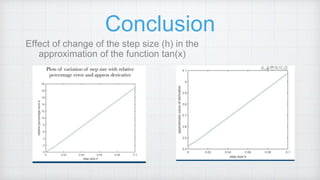
Effect of change of the step size (h) in the
approximation of the function tan(x)
Error Analysis
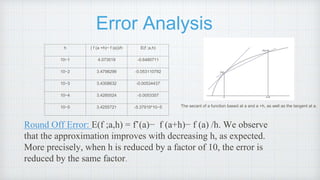
The secant of a function based at a and a +h, as well as the tangent at a.
h ( f (a +h)− f (a))/h E(f ;a,h)
10−1 4.073519 -0.6480711
10−2 3.4798299 -0.053110792
10−3 3.4308632 -0.00534437
10−4 3.4260524 -0.0053357
10−5 3.4255721 -5.37919*10−5
Round Off Error: E(f ;a,h) = f’(a)− f (a+h)− f (a) /h. We observe
that the approximation improves with decreasing h, as expected.
More precisely, when h is reduced by a factor of 10, the error is
reduced by the same factor.
Truncation Error
Expansion of f (a +h) about x = a using Taylor expansion, where ξh lies
in the interval (a,a+h). The formula may be rearranged to give an
expression for the error often referred to as the truncation error of the
approximation. It is bounded as:
Optimum step size(h)
Total error is given by:
To find the value of h which minimizes this expression, we differentiate with
respect to h and set the derivative to zero. We find 0 (h) = 0, we obtain the
approximate optimal value of h
References
• Class Codes by Prof. S.C. Pandey Sir
• MATLAB documentation
• Numerical Differentiation e-notes
• Introduction to Scientific Computing (CS 3220)
Bindel, Spring. 2012

Error analysis

  • 1.
    PRACTICAL Name- Saloni Singhal M.Sc.(Statistics) II-Sem. Roll No: 2046398 Course- MATH-409 L Numerical Analysis Lab Submitted To: Dr. S.C. Pandey 1.3
  • 2.
    OBJECTIVE Error Analysis inComputation: Round Off and Truncation Errors Problem Statement 1.Write a program (script file) for computation of Exponential function ex up to 4 terms in its series expansion. Calculate the value (true value of ex at x=0.001) 2.Evaluate the error in the computation of ex at x=0.001 (absolute error and fractional relative error in percentage.) 3. Approximate the first derivative of tan(x) at x =1, and evaluate its relative percentage error.
  • 3.
    Theory Computational Errors: • Roundingoff error occur as machine has limited capacity to store exact number. • For example: rational number having finite number of digits. • The accumulated effect become significant after repeated operations. They are of two types: 1.chopping 2.symmetry round off • Truncation error arises when exact mathematical procedure is approximated and process is truncated after a finite number of iterations for computational simplicity. • Example: when infinite series is to be added to arrive at exact result
  • 4.
    Program >> format long >>n=0; x=0.001; y=0; %expanding taylor series for ex >> while n<=4 a=x^n/factorial(n); n=n+1; y=y+a end y = 1 y = 1.001000000000000 y = 1.001000500000000
  • 5.
    Program Contd. y = 1.001000500166667 y = 1.001000500166708 >>truevav=exp(0.001) truevav = 1.001000500166708 >> err=abs(truevav-y) err = 0
  • 6.
    Error Analysis As hgrows smaller and smaller, f[x + h, x − h] becomes a better and better approximation to f(x) .If we plot the truncation error against h on a log- scale (for linearity), we expect to see a straight line. For small h values, the error is dominated by roundoff rather than by truncation error. An advantage of the higher order of accuracy is that we can get very small truncation errors even when h is not very small, and so we tend to be able to reach a better optimal error before cancellation effects start to dominate.
  • 7.
    2. Program Contd. h=zeros(5,1) %initialzero matrix for approximated value approxval=zeros(5,1) err=zeros(5,1) e=zeros(5,1) format long for i=1:5; x=1; h(i)=10^(-i); trueval=(sec(x))^2; %numerical diffential approxval(i)=(tan(x+h(i))-tan(x))/h(i); %relative error err(i)=abs(trueval-approxval(i)) e(i)=(err(i)/trueval)*100 end Another way to create a matrix is to use a function, such as ones, zeros, or rand.
  • 8.
    Conclusion Effect of changeof the step size (h) in the approximation of the function tan(x)
  • 9.
    Error Analysis The secantof a function based at a and a +h, as well as the tangent at a. h ( f (a +h)− f (a))/h E(f ;a,h) 10−1 4.073519 -0.6480711 10−2 3.4798299 -0.053110792 10−3 3.4308632 -0.00534437 10−4 3.4260524 -0.0053357 10−5 3.4255721 -5.37919*10−5 Round Off Error: E(f ;a,h) = f’(a)− f (a+h)− f (a) /h. We observe that the approximation improves with decreasing h, as expected. More precisely, when h is reduced by a factor of 10, the error is reduced by the same factor.
  • 10.
    Truncation Error Expansion off (a +h) about x = a using Taylor expansion, where ξh lies in the interval (a,a+h). The formula may be rearranged to give an expression for the error often referred to as the truncation error of the approximation. It is bounded as: Optimum step size(h) Total error is given by: To find the value of h which minimizes this expression, we differentiate with respect to h and set the derivative to zero. We find 0 (h) = 0, we obtain the approximate optimal value of h
  • 11.
    References • Class Codesby Prof. S.C. Pandey Sir • MATLAB documentation • Numerical Differentiation e-notes • Introduction to Scientific Computing (CS 3220) Bindel, Spring. 2012