PRACTICAL
Name- Saloni Singhal
M.Sc. (Statistics) II-Sem.
Roll No: 2046398
Course- MATH-409 L
Numerical Analysis Lab
Submitted To: Dr. S.C. Pandey
OBJECTIVE
• To write an m-file to implement L-U
Decomposition (without pivoting) for solving
system of linear equations.
• To write both script and function files for the
same program.
Theory
• The system of equation is based on the
observation that system of linear equation
involving triangular Coefficient Matrix are
easier to deal with.
• The composition is the product of lower
triangular Matrix and an upper triangular
matrix
Script File
% defines matrix A
A = [2 1 5; 3 5 2;2 1 4]
[m,n]=size(A);
if m~=n
fprintf("not square matrix")
exit
end
L=eye(n);
U=A;
ref=[U L];
%decomposition
for i=1:m-1
for j=i+1:m
a=ref(j,i)/ref(i,i); %back substitution
ref(j,:)=ref(j,:)-a*ref(i,:);
end
end
%representation
U=ref(1:n,1:n)
L=ref(1:n,n+1:2*n);
L=inv(L)
%verification
[c]=L*U
Function
File
function [L,U] =decomposition(A)
[m,n]=size(A);
if m~=n
fprintf("not square matrix")
exit
end
L=eye(n); U=A;
ref=[U L];
%decomposition
for i=1:m-1
for j=i+1:m
a=ref(j,i)/ref(i,i); %back substitution
ref(j,:)=ref(j,:)-a*ref(i,:);
end
end
%representation
U=ref(1:n,1:n)
L=ref(1:n,n+1:2*n);
L=inv(L)
%verification
[c]=L*U
end
Cases/Example
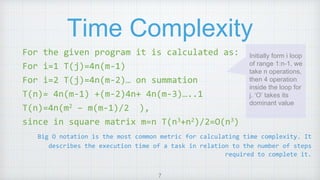
Time Complexity
7
For the given program it is calculated as:
For i=1 T(j)=4n(m-1)
For i=2 T(j)=4n(m-2)… on summation
T(n)= 4n(m-1) +(m-2)4n+ 4n(m-3)…..1
T(n)=4n(m2 – m(m-1)/2 ),
since in square matrix m=n T(n3+n2)/2=O(n3)
Big O notation is the most common metric for calculating time complexity. It
describes the execution time of a task in relation to the number of steps
required to complete it.
Initially form i loop
of range 1:n-1, we
take n operations,
then 4 operation
inside the loop for
j. ‘O’ takes its
dominant value
Conclusion
• It is more efficient as it requires gaussian elimination to be
performed once
• It is better for solving repeatedly and number of equation with
same on the left hand side.
• It does not require augmented matrix.
• Cholesky decomposition is faster by a factor of 2 and take
lesser memory and space
Caveats
• Using L-U Decomposition can be
unstable in algorithm, we may run
into blown up errors with poorly
managed flops and operations.
• The original matrix is lost
• Sometimes it is impossible to write
a matrix in the form of L-U
composition if the leading matrix
don't have a non-zero determinant
References
• https://learn.lboro.ac.uk/archive/olmp/olmp_resourc
es/pages/workbooks_1_50_jan2008/Workbook30/3
0_3_lu_decmp.pdf
• Lecture Notes of Prof. S.C. Pandey Sir
• MATLAB Documetation

L-U Decomposition

  • 1.
    PRACTICAL Name- Saloni Singhal M.Sc.(Statistics) II-Sem. Roll No: 2046398 Course- MATH-409 L Numerical Analysis Lab Submitted To: Dr. S.C. Pandey
  • 2.
    OBJECTIVE • To writean m-file to implement L-U Decomposition (without pivoting) for solving system of linear equations. • To write both script and function files for the same program.
  • 3.
    Theory • The systemof equation is based on the observation that system of linear equation involving triangular Coefficient Matrix are easier to deal with. • The composition is the product of lower triangular Matrix and an upper triangular matrix
  • 4.
    Script File % definesmatrix A A = [2 1 5; 3 5 2;2 1 4] [m,n]=size(A); if m~=n fprintf("not square matrix") exit end L=eye(n); U=A; ref=[U L]; %decomposition for i=1:m-1 for j=i+1:m a=ref(j,i)/ref(i,i); %back substitution ref(j,:)=ref(j,:)-a*ref(i,:); end end %representation U=ref(1:n,1:n) L=ref(1:n,n+1:2*n); L=inv(L) %verification [c]=L*U
  • 5.
    Function File function [L,U] =decomposition(A) [m,n]=size(A); ifm~=n fprintf("not square matrix") exit end L=eye(n); U=A; ref=[U L]; %decomposition for i=1:m-1 for j=i+1:m a=ref(j,i)/ref(i,i); %back substitution ref(j,:)=ref(j,:)-a*ref(i,:); end end %representation U=ref(1:n,1:n) L=ref(1:n,n+1:2*n); L=inv(L) %verification [c]=L*U end
  • 6.
  • 7.
    Time Complexity 7 For thegiven program it is calculated as: For i=1 T(j)=4n(m-1) For i=2 T(j)=4n(m-2)… on summation T(n)= 4n(m-1) +(m-2)4n+ 4n(m-3)…..1 T(n)=4n(m2 – m(m-1)/2 ), since in square matrix m=n T(n3+n2)/2=O(n3) Big O notation is the most common metric for calculating time complexity. It describes the execution time of a task in relation to the number of steps required to complete it. Initially form i loop of range 1:n-1, we take n operations, then 4 operation inside the loop for j. ‘O’ takes its dominant value
  • 8.
    Conclusion • It ismore efficient as it requires gaussian elimination to be performed once • It is better for solving repeatedly and number of equation with same on the left hand side. • It does not require augmented matrix. • Cholesky decomposition is faster by a factor of 2 and take lesser memory and space
  • 9.
    Caveats • Using L-UDecomposition can be unstable in algorithm, we may run into blown up errors with poorly managed flops and operations. • The original matrix is lost • Sometimes it is impossible to write a matrix in the form of L-U composition if the leading matrix don't have a non-zero determinant
  • 10.