Lesson Objectives
This lesson we will be looking at the process of
  erosion and how it shapes our coastline.

By the end of the lesson you should be able to:
• Name the four processes of coastal erosion
• Describe what each of these processes is
• Explain what landforms result from erosion and
  why
Hydraulic Action


The force of the water hitting the
 cliffs, often forcing air pockets
      into cracks in the rocks
Abrasion


Caused by waves picking up
stones and hurling them at the
  cliff face, wearing it away.
Attrition


Any material, but usually rocks
    and pebbles will become
 rounder and smaller over time
  as it collides with other rocks
            and pebbles.
Corrosion


The dissolving of rocks and
  minerals by sea water.
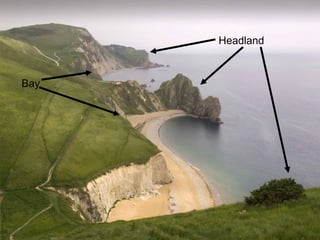
Headland


Bay
Headlands and Bays
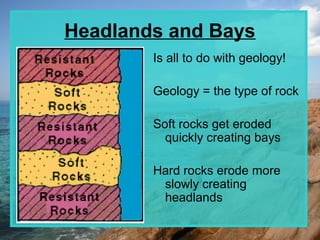
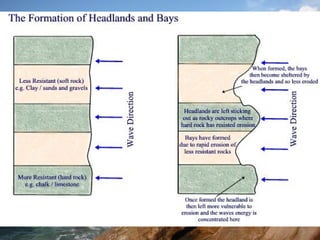
Is all to do with geology!
Geology = the type of rock
Soft rocks get eroded quickly creating bays
Hard rocks erode more slowly creating
  headlands
Headlands and Bays
        Is all to do with geology!

        Geology = the type of rock

        Soft rocks get eroded
          quickly creating bays

        Hard rocks erode more
         slowly creating
         headlands
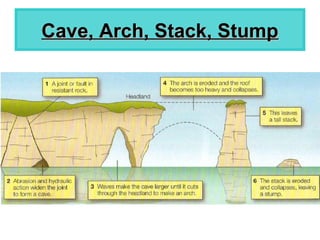
Cave, Arch, Stack, Stump
Key Words
Hydraulic Action - The force of the water hitting the cliffs,
  often forcing air pockets into cracks in the rocks

Abrasion - Caused by waves picking up stones and hurling
  them at the cliff face, wearing it away.

Attrition - Any material, but usually rocks and pebbles will
   become rounder and smaller over time as it collides with
   other rocks and pebbles.

Corrosion - The dissolving of rocks and minerals by sea
  water.
Key Words
Cave – a fracture in the rock that has been widened to form a deep
  hole in the cliff

Arch – when two caves meet in the middle a gap is formed in the cliff

Stack – a pillar of rock that is left over when the arch collapses due to
   gravity

Stump – A small piece of rock that just sticks up out of the ocean; what
   is left once the stack falls over

Geology – the type of rock

Erosion and Landforms

  • 1.
    Lesson Objectives This lessonwe will be looking at the process of erosion and how it shapes our coastline. By the end of the lesson you should be able to: • Name the four processes of coastal erosion • Describe what each of these processes is • Explain what landforms result from erosion and why
  • 2.
    Hydraulic Action The forceof the water hitting the cliffs, often forcing air pockets into cracks in the rocks
  • 3.
    Abrasion Caused by wavespicking up stones and hurling them at the cliff face, wearing it away.
  • 4.
    Attrition Any material, butusually rocks and pebbles will become rounder and smaller over time as it collides with other rocks and pebbles.
  • 5.
    Corrosion The dissolving ofrocks and minerals by sea water.
  • 6.
  • 7.
    Headlands and Bays Isall to do with geology! Geology = the type of rock Soft rocks get eroded quickly creating bays Hard rocks erode more slowly creating headlands
  • 8.
    Headlands and Bays Is all to do with geology! Geology = the type of rock Soft rocks get eroded quickly creating bays Hard rocks erode more slowly creating headlands
  • 10.
  • 11.
    Key Words Hydraulic Action- The force of the water hitting the cliffs, often forcing air pockets into cracks in the rocks Abrasion - Caused by waves picking up stones and hurling them at the cliff face, wearing it away. Attrition - Any material, but usually rocks and pebbles will become rounder and smaller over time as it collides with other rocks and pebbles. Corrosion - The dissolving of rocks and minerals by sea water.
  • 12.
    Key Words Cave –a fracture in the rock that has been widened to form a deep hole in the cliff Arch – when two caves meet in the middle a gap is formed in the cliff Stack – a pillar of rock that is left over when the arch collapses due to gravity Stump – A small piece of rock that just sticks up out of the ocean; what is left once the stack falls over Geology – the type of rock

Editor's Notes

  • #7 http://www.wiley.com/college/strahler/0471480533/animations/ch19_animations/animation2.html http://www.wiley.com/college/strahler/0471480533/animations/ch19_animations/animation2.html