Geography (year 8) Card switching task 
Erosional Landform Erosion process Deposition process Deposition Landform 
1
Abrasion: Material transported by waves hits a cliff and slowly wears it away. 
Hydraulic action: Air is trapped as waves approach, weakening the rock base 
of a cliff. 
Attrition: Waves smash the rocks against each other, making the rocks smaller. 
Corrosion: Chemicals in the sea dissolve the cliff face over thousands of years. 
2 
Caves: Waves cause little cracks in the cliff making a cave.
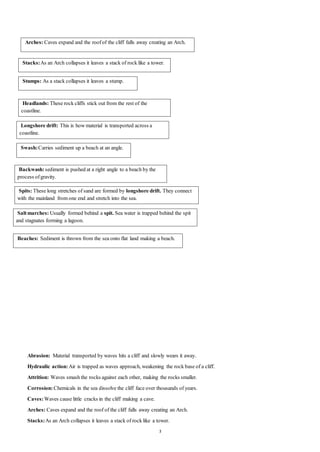
Arches: Caves expand and the roof of the cliff falls away creating an Arch. 
S tacks: As an Arch collapses it leaves a stack of rock like a tower. 
Stumps: As a stack collapses it leaves a stump. 
Headlands: These rock cliffs stick out from the rest of the 
coastline. 
Longshore drift: This is how material is transported across a 
coastline. 
Swash: Carries sediment up a beach at an angle. 
Backwash: sediment is pushed at a right angle to a beach by the 
process of gravity. 
Spits: These long stretches of sand are formed by longshore drift. They connect 
with the mainland from one end and stretch into the sea. 
Salt marches: Usually formed behind a spit. Sea water is trapped behind the spit 
and stagnates forming a lagoon. 
Beaches: Sediment is thrown from the sea onto flat land making a beach. 
Abrasion: Material transported by waves hits a cliff and slowly wears it away. 
Hydraulic action: Air is trapped as waves approach, weakening the rock base of a cliff. 
Attrition: Waves smash the rocks against each other, making the rocks smaller. 
Corrosion: Chemicals in the sea dissolve the cliff face over thousands of years. 
3 
Caves: Waves cause little cracks in the cliff making a cave. 
Arches: Caves expand and the roof of the cliff falls away creating an Arch. 
Stacks: As an Arch collapses it leaves a stack of rock like a tower.
4 
Stumps: As a stack collapses it leaves a stump. 
Headlands: These rock cliffs stick out from the rest of the coastline. 
Longshore drift: This is how material is transported across a coastline. 
Swash: Carries sediment up a beach at an angle. 
Backwash: sediment is pushed at a right angle to a beach by the process of gravity. 
Spits: These long stretches of sand are formed by longshore drift. They connect with the mainland from one end and 
stretch into the sea. 
Salt marches: Usually formed behind a spit. Sea water is trapped behind the spit and stagnates forming a lagoon. 
Beaches: Sediment is thrown from the sea onto flat land making a beach.

Geography year 8 card switching task

  • 1.
    Geography (year 8)Card switching task Erosional Landform Erosion process Deposition process Deposition Landform 1
  • 2.
    Abrasion: Material transportedby waves hits a cliff and slowly wears it away. Hydraulic action: Air is trapped as waves approach, weakening the rock base of a cliff. Attrition: Waves smash the rocks against each other, making the rocks smaller. Corrosion: Chemicals in the sea dissolve the cliff face over thousands of years. 2 Caves: Waves cause little cracks in the cliff making a cave.
  • 3.
    Arches: Caves expandand the roof of the cliff falls away creating an Arch. S tacks: As an Arch collapses it leaves a stack of rock like a tower. Stumps: As a stack collapses it leaves a stump. Headlands: These rock cliffs stick out from the rest of the coastline. Longshore drift: This is how material is transported across a coastline. Swash: Carries sediment up a beach at an angle. Backwash: sediment is pushed at a right angle to a beach by the process of gravity. Spits: These long stretches of sand are formed by longshore drift. They connect with the mainland from one end and stretch into the sea. Salt marches: Usually formed behind a spit. Sea water is trapped behind the spit and stagnates forming a lagoon. Beaches: Sediment is thrown from the sea onto flat land making a beach. Abrasion: Material transported by waves hits a cliff and slowly wears it away. Hydraulic action: Air is trapped as waves approach, weakening the rock base of a cliff. Attrition: Waves smash the rocks against each other, making the rocks smaller. Corrosion: Chemicals in the sea dissolve the cliff face over thousands of years. 3 Caves: Waves cause little cracks in the cliff making a cave. Arches: Caves expand and the roof of the cliff falls away creating an Arch. Stacks: As an Arch collapses it leaves a stack of rock like a tower.
  • 4.
    4 Stumps: Asa stack collapses it leaves a stump. Headlands: These rock cliffs stick out from the rest of the coastline. Longshore drift: This is how material is transported across a coastline. Swash: Carries sediment up a beach at an angle. Backwash: sediment is pushed at a right angle to a beach by the process of gravity. Spits: These long stretches of sand are formed by longshore drift. They connect with the mainland from one end and stretch into the sea. Salt marches: Usually formed behind a spit. Sea water is trapped behind the spit and stagnates forming a lagoon. Beaches: Sediment is thrown from the sea onto flat land making a beach.