1 | P a g e
UNIVERSITTY OF EDUCATION,
WINNEBA.
DEPARTMENT OF GEOGRAPHY.
COURSE CODE : GEOG 231
COURSE TITLE : GEOMORPHOLOGICAL PROCESSES AND
LANDFORMS
LECTURERS : MR. ADU K BOAHEN,
DR. I Y DADSON
NAME : FRANCIS, OPPONG
INDEX NUMBER :5150220204
ASSIGNMENT
WRITE A REPORT ON WHAT HAPPENED ON THE 11TH
DAY
OF OCTOBER, 2016
2 | P a g e
AS GEOGRAPHY LEVEL 200 STUDENTS EMBARKED ON A
TRIP TO TAKORADI IN THE WESTERN REGION.
A REPORT ON AN EDUCATIONAL TRIP
TO TAKORADI
On the 11th day of october,2016, the first batch of the level 200 geography student in
University Of Education, Winneba embarked on educational trip to Takoradi in the
western region of Ghana. It was organized by two lecturers and accompanied by a
lecturer from the department with the aim of giving pictorial evidences to back the
theoretical topics in geomorphological processes and landforms thus coastal
geomorphology. These lecturers were Mr. Kofi Adu Boahene , Dr. Ismael Yaw Dadson
and Dr. Adwoa Poku. We were at the bus joint thus the Simpa roundabout at the north
campus of U.E.W exactly 6:00am but due to delay in bus releasement, we waited till
8:31am before commencing from winneba. We were numbering about three hundred to
four hundred students so we occupied three 67 seatedbuses and two mini buses. I
particularly was in one big bus with Mr Kofi Adu Boahene. A prayer was said by one
student for the journey to start. On our way we sang with a joyful heart to praise our
lord.
We were at Komenda beach around 10:42am. We were then grouped into two. Thus in
respective to the two lecturers named. I was in Dr. Ismael Yaw Dadson’s group. He
started from wave actions. According to him, he said the most powerful agent of
marine erosion are waves. He defined waveas one of a series of ridges that moves
across the surface of a liquid especially across a large body of water. Is also the up and
down or back and forth movement of water. Their origin is due to the sweeping of
winds over the water surface, which sets a series of undulating swells surging forward.
These become higher and swifter. He made it clear that the highest point of the wave is
called the wave crest. And the lowest point of the wave is called the wave trough. The
wave is the key factor that causes changes to the landform along the coast. Along the
coast, different landform are form due to swash and backwash of the wave. The water
that rushes up the beach and hurls rock debris against the land is termed as swash. The
water is sucked back and retreats as backwash.
From this we have two types of wave namely constructive wave and destructive wave.
The constructive wavecause materials to be deposited at the beach while the
destructive wavecarries materials from the beach back to the sea. The wave is able to
perform this activities through erosion, transportation and deposition. When we talk of
erosion here is when materials are been remove as a result of wave. Wave
transportation is in the form of longshore drift. Longshore drift is the zigzag movements
of waves with materials from the sea to the beach by swash and deposition by
3 | P a g e
backwash. Swash brings the materials obliquely while backwash deposit then
perpendicular or at right angle to the shore. Through these beach materials are
deposited parallel to the coast. He also made it clear that, for transportation materials
are already embedded at the bottom of the sea or at the ocean floor and through the
erosive activities is able to shape and bring materials from the sea to the coast. It
happens in two ways thus the high tides and the low tides. At low tides, there are two
watermark thus the high watermark and the low watermark. At high watermark the
wave comes towards the farthest point of the land but at low tides just at the mouth of
the land and the sea. From him, Wave erosion has four main processes namely hydraulic
action, corrasion/abrasion, corrosion/solution and attrition.
Hydraulicaction is caused by water thrown against a cliff by breaking waves. The
force of the waves hitting a cliff compresses water and air into cracks and joints. This
can be equivalent to 30,000 kg/m2. This increase in pressure may lead to cracks
widening and pieces of rocks breaking.
Abrasion on the other hand is caused by pebbles, boulders and sand being hurled
against the base of cliff by breaking wave and resulting in undercutting and rock break
up. Rock fragments may be picked up by waves and thrown against the rock face by
subsequent waves. The effectiveness of the corrasion depends on the strength of the
wave, the nature of its “load” and the resistance of the rock in the cliff face. Corrasion
is most effective at the base of cliffs.
Corrosion involves the wearing away of rocks by chemical process especially the
solvent of sea water action. Salts and acids in sea water can react with rocks, slowly
dissolving them. The photo shows this process on a cliff of limestone which has been
chemically attacked by carbonic acid and other chemicals in sea water.
Attrition is the breakup of boulders and rocks as they are clashed against the shore and
against each other by braking wave. Rock fragments which have become detached by
hydraulic action and corrasion are worn down into smaller and smaller pieces.
Currents and tidal movements cause the fragments to be swirled around and to grind
against each other and the cliff face. This type of erosion produces pebble beaches and
leads to potholes in rocky coast
Due to the various wave erosion, different landform such as cliffs, stack,
cave, blowhole, geo, arch bays, headlands, stumps and so more are formed.
A cliff
Dr. Dadson said that, the present day landform which we observed at Komenda was
once a large cliff which has been reduced to its current state. This he said, was so as a
result of the continuous erosional activities caused by the waves. A cliff is a vertical or
near vertical rock exposure. They are very steepto vertical bedrock; they range from
only a few meters high to hundreds of metres above sea level. Their vertical nature is
4 | P a g e
the result of wave-induced erosion near sea level and the subsequent collapse of rocks at
higher elevation. Cliffs that extend to the shoreline commonly have a notch cut into
them where waves have battered the bedrock surface.
A NOTCH
A notch is relatively a v-shaped hole found at a lower point of a sea cliff. It is an
undercut part of a cliff base where wave attack concentrates erosion. It is an
indentation cut into a sea cliff at water level by wave action. It is formed after
destructive wave’s hits against the cliff face or when water from low and high tides get
thrown into the base of a cliff, thereby weakening it and causing undercutting of the sea
cliff to create a small pass. This notch enlarges as a result of a continuous wave actions
to form a cave. Below is a pictorial view of myself in a notch at komenda.
5 | P a g e
A CAVE
Cavesform where rock runs in bands horizontal to the direction of wave attack. There
is a band of resistant rock closest to the sea and a band of less resistant rock inland. The
waves seek out faults in the hard rock and erodes using the processes of
abrasion/corrasion and hydraulic action through to the soft rock behind. Wave
processes erode the softer rock faster and this leaves a circular cave with a narrow
entrance where the sea enters.
Blow Hole
6 | P a g e
A blow hole is a cavity due to erosion, located at the end of a sea cave that exists above
the cave, such that one could see the sky while standing in the cave. When a wave enters
the mouth of the cave, it will be funneled up towards the blow hole, which in return
causes water to be blasted out of the hole. It occurs during high tides. It may however be
formed as a result of sub-aerial processes, which may act to cause a collapse on a line of
weakness on top of a cave thereby creating a hole.
ARCH
A sea arch forms when sea caves merge from opposite sides of a headland. If a cave is
formed in a headland, it may eventually break through to the other side to form an
arch. It is formed when there is an opening underneath. Most arches form as a narrow
bridge walled by cliffs, beam narrower from erosion, with a softer rock stratum
gradually eroding out. When a natural arch collapses the remaining upright sections
form stacks, isolated rocks sticking up out of the sea.
GEO
Geo is a tidal inlet which occurs as a result of a collapse of the roof of a cave. They are
created by the wave driven erosion of cliffs along faults and bedding planes in the rock.
It may have sea caves at their heads, which may collapse extending the geo, or leaving
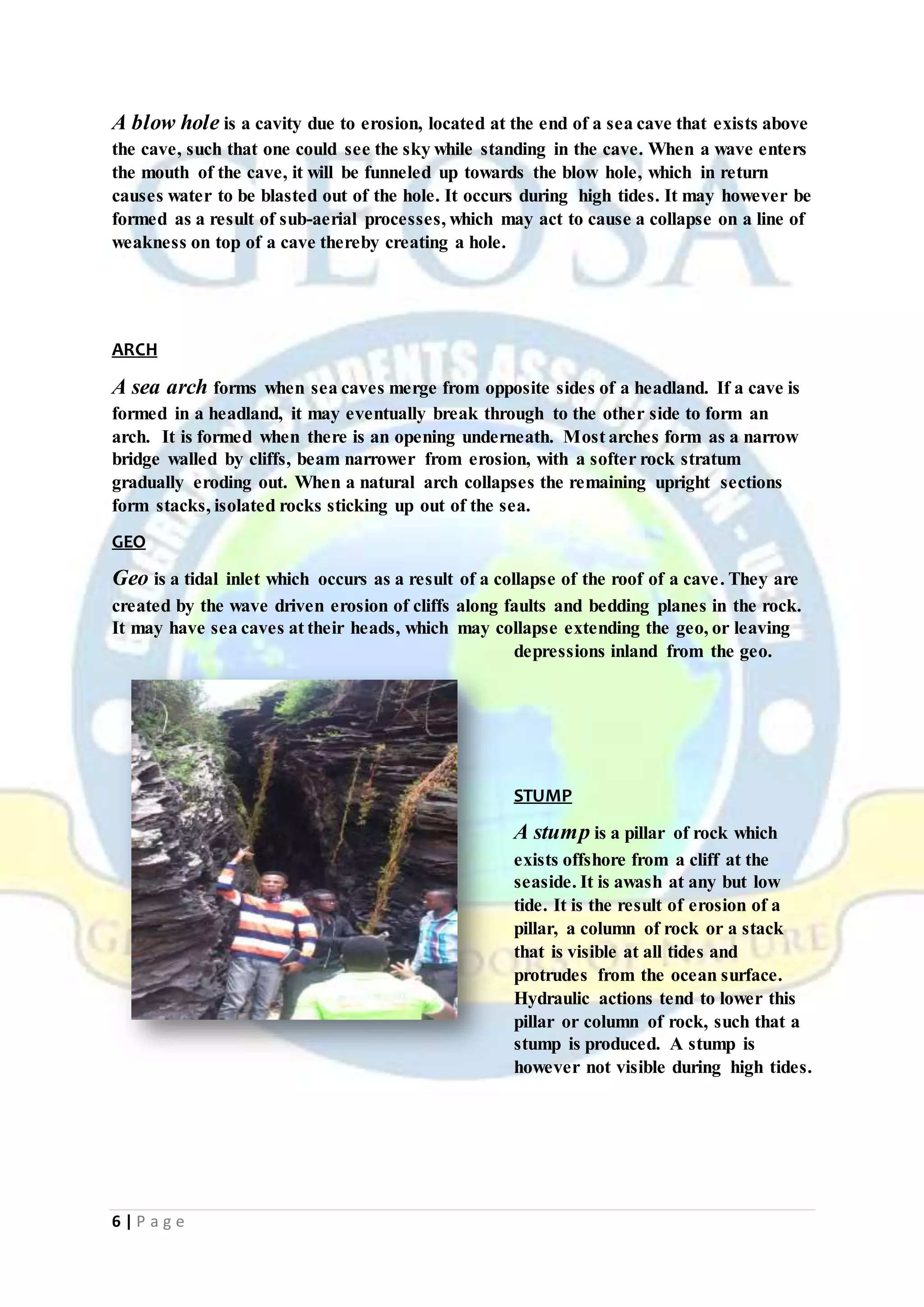
depressions inland from the geo.
STUMP
A stump is a pillar of rock which
exists offshore from a cliff at the
seaside. It is awash at any but low
tide. It is the result of erosion of a
pillar, a column of rock or a stack
that is visible at all tides and
protrudes from the ocean surface.
Hydraulic actions tend to lower this
pillar or column of rock, such that a
stump is produced. A stump is
however not visible during high tides.
7 | P a g e
BAYS AND HEADLANDS
Headlandsand Bays are
two related features often
found on the same
coastline. Headlands and
bays are formed when
there are parallel sections
of softer and harder rocks
perpendicular to the coast.
The sea erodes the softer
rock faster than the harder
rock, thereby causing an
indentation known as a
bay. The harder rock that is left sticks out further than the softer rock to form a
headland. A headland that projects into a sea is referred to as a promontory.
BEACH
A beach is a deposit of loose sediment adjacent to a body of water. It refers to the
entire land bordering the sea. The beach extends from the low-tide line to the distinct
change in slope and/or material landward of the unvegetated and active zone of
sediment accumulation. It may consist of sand, gravel, or evenmud, though sand is the
most common beach material. An area of coastal sediment accumulation at the land-sea
boundary. The beach is the first line of defense for coastal protection. A shoreline is
where a large body of water or the sea meets the land
8 | P a g e
From Komenda we moved on to
the shama beach . After about an
hour at Komenda where the
above features were observed, the
bus finally took off and headed
towards Shama in the Western
region. The bus passed through
places like, Aburansa, Daboase,
and Beposo among several towns.
One noticeable thing was the
change in vegetation as we moved
into Western region. After about
thirty five minutes ride from
Komenda, we arrived at Shama.
At shama beach we were again
grouped into two in respective of Mr. Adu Boahene and Dr. Dadson . I was still in Mr.
Dadsons group. He started describing the various features seenthere to us. He started
from
SAND SPIT
A sand spit is a linear accumulation of sediment that is attached to land at one end
with the other end terminating in the sea. It is made up of sand and shingles, narrowed
has one end joined to the land the other joined to the sea. Sand carried parallel to shore
by longshore drift which may eventually extend across a bay or between headlands
especially where water is relatively calm. Spits are typically elongated, narrow features
built to several dozen feet by wind and waves.
9 | P a g e
SAND BAR
Though we did not identify a sand bar at Shama, Dr. Dadson explained how it occurs.
He explained that it occurs when a sand spit is detached from the sea by wave actions
causing a sand deposit in the sea. Or when the energy of motion in water tires out, the
water deposits sediments mostly sand which it carries. The continuous deposition of
these sediments can also leads to the formation of a sand bar.
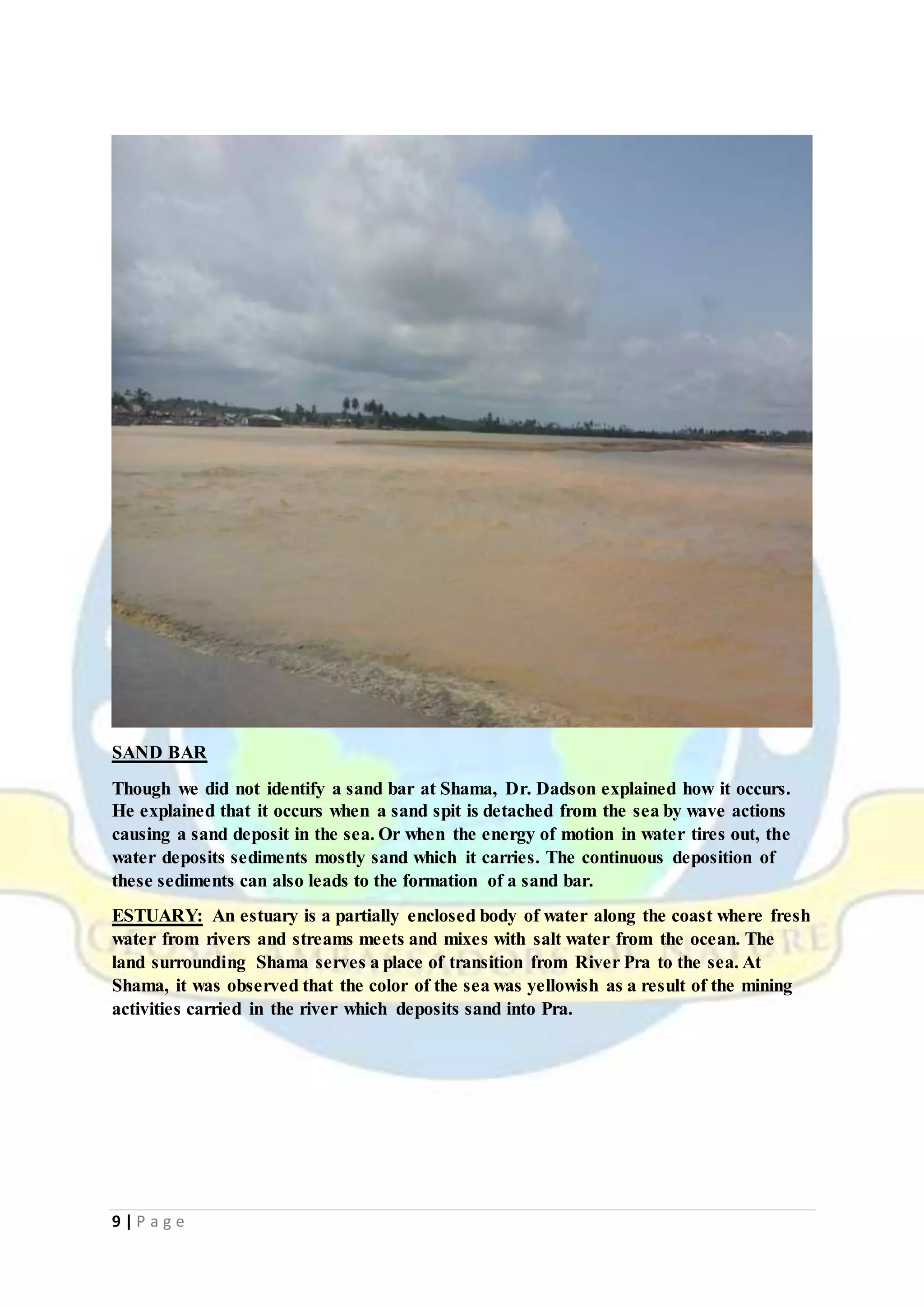
ESTUARY: An estuary is a partially enclosed body of water along the coast where fresh
water from rivers and streams meets and mixes with salt water from the ocean. The
land surrounding Shama serves a place of transition from River Pra to the sea. At
Shama, it was observed that the color of the sea was yellowish as a result of the mining
activities carried in the river which deposits sand into Pra.
10 | P a g e
DELTA
Though there was no delta at Shama, Dr. Dadson made mention of it and described how
it also occurs. A river delta is a landform that is formed at the mouth of a river, where
the river flows into an ocean, sea, estuary or a lake. They are formed from the
deposition of sediments carried by the river as the flow leaves the mouth of the river.
Over long period of time, this deposition builds a geographic pattern of a river delta.
From Shama, we commenced to Nkontompo. Esipong, Esikado were places the bus
passedbefore getting to Nkontompo. At this place not much were observed. Some of the
features observed include the sea defense and the stack
STACK
When an arch is eroded and as such part of the land is detached and left in the sea it
forms a stack. It is an isolated pillar of rock that has become separated from a headland
by coastal erosion. It is usually formed by the collapse of an arch. Further erosion will
reduce it to a stump.
11 | P a g e
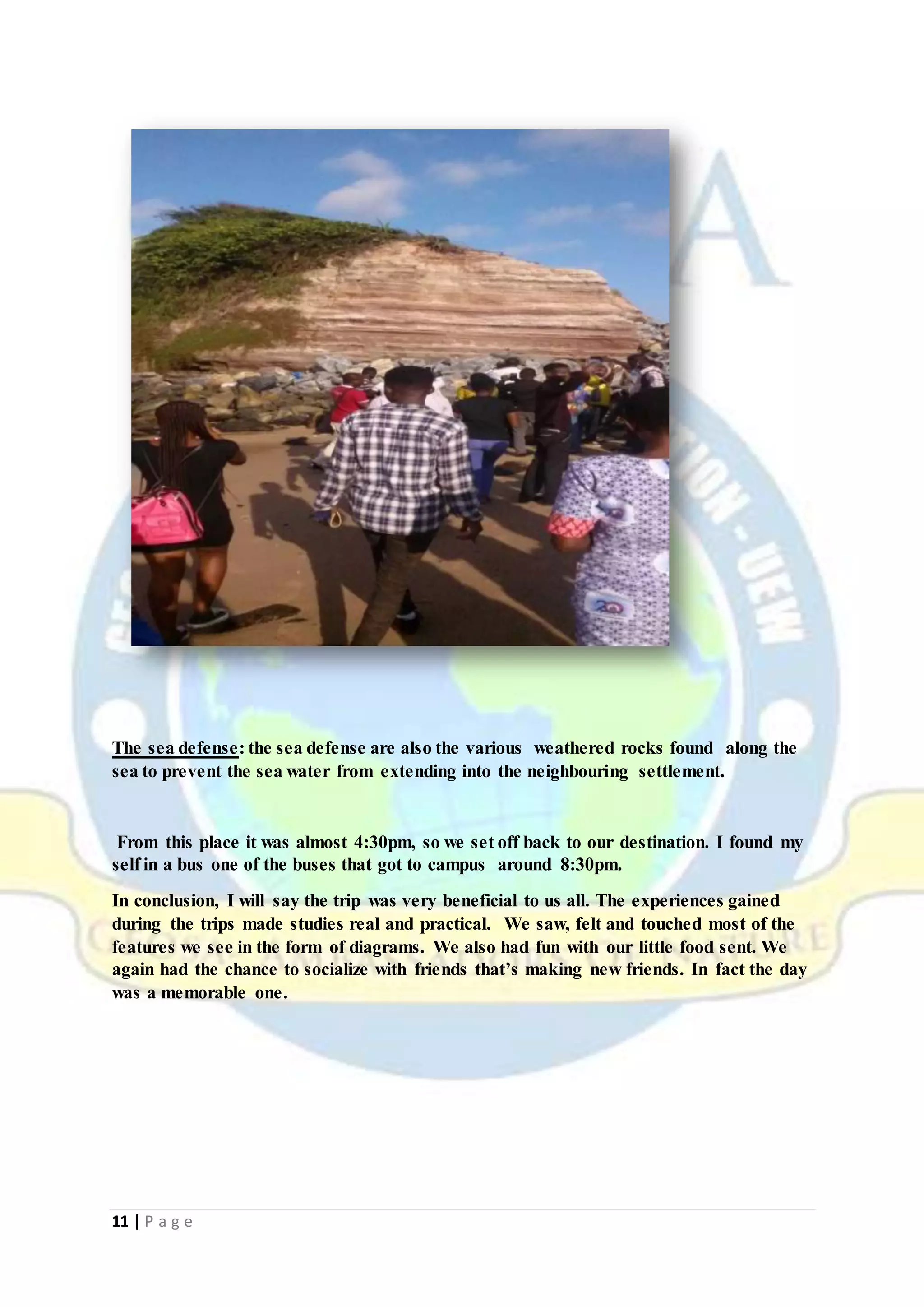
The sea defense: the sea defense are also the various weathered rocks found along the
sea to prevent the sea water from extending into the neighbouring settlement.
From this place it was almost 4:30pm, so we set off back to our destination. I found my
self in a bus one of the buses that got to campus around 8:30pm.
In conclusion, I will say the trip was very beneficial to us all. The experiences gained
during the trips made studies real and practical. We saw, felt and touched most of the
features we see in the form of diagrams. We also had fun with our little food sent. We
again had the chance to socialize with friends that’s making new friends. In fact the day
was a memorable one.
12 | P a g e

A report on a field trip

  • 1.
    1 | Pa g e UNIVERSITTY OF EDUCATION, WINNEBA. DEPARTMENT OF GEOGRAPHY. COURSE CODE : GEOG 231 COURSE TITLE : GEOMORPHOLOGICAL PROCESSES AND LANDFORMS LECTURERS : MR. ADU K BOAHEN, DR. I Y DADSON NAME : FRANCIS, OPPONG INDEX NUMBER :5150220204 ASSIGNMENT WRITE A REPORT ON WHAT HAPPENED ON THE 11TH DAY OF OCTOBER, 2016
  • 2.
    2 | Pa g e AS GEOGRAPHY LEVEL 200 STUDENTS EMBARKED ON A TRIP TO TAKORADI IN THE WESTERN REGION. A REPORT ON AN EDUCATIONAL TRIP TO TAKORADI On the 11th day of october,2016, the first batch of the level 200 geography student in University Of Education, Winneba embarked on educational trip to Takoradi in the western region of Ghana. It was organized by two lecturers and accompanied by a lecturer from the department with the aim of giving pictorial evidences to back the theoretical topics in geomorphological processes and landforms thus coastal geomorphology. These lecturers were Mr. Kofi Adu Boahene , Dr. Ismael Yaw Dadson and Dr. Adwoa Poku. We were at the bus joint thus the Simpa roundabout at the north campus of U.E.W exactly 6:00am but due to delay in bus releasement, we waited till 8:31am before commencing from winneba. We were numbering about three hundred to four hundred students so we occupied three 67 seatedbuses and two mini buses. I particularly was in one big bus with Mr Kofi Adu Boahene. A prayer was said by one student for the journey to start. On our way we sang with a joyful heart to praise our lord. We were at Komenda beach around 10:42am. We were then grouped into two. Thus in respective to the two lecturers named. I was in Dr. Ismael Yaw Dadson’s group. He started from wave actions. According to him, he said the most powerful agent of marine erosion are waves. He defined waveas one of a series of ridges that moves across the surface of a liquid especially across a large body of water. Is also the up and down or back and forth movement of water. Their origin is due to the sweeping of winds over the water surface, which sets a series of undulating swells surging forward. These become higher and swifter. He made it clear that the highest point of the wave is called the wave crest. And the lowest point of the wave is called the wave trough. The wave is the key factor that causes changes to the landform along the coast. Along the coast, different landform are form due to swash and backwash of the wave. The water that rushes up the beach and hurls rock debris against the land is termed as swash. The water is sucked back and retreats as backwash. From this we have two types of wave namely constructive wave and destructive wave. The constructive wavecause materials to be deposited at the beach while the destructive wavecarries materials from the beach back to the sea. The wave is able to perform this activities through erosion, transportation and deposition. When we talk of erosion here is when materials are been remove as a result of wave. Wave transportation is in the form of longshore drift. Longshore drift is the zigzag movements of waves with materials from the sea to the beach by swash and deposition by
  • 3.
    3 | Pa g e backwash. Swash brings the materials obliquely while backwash deposit then perpendicular or at right angle to the shore. Through these beach materials are deposited parallel to the coast. He also made it clear that, for transportation materials are already embedded at the bottom of the sea or at the ocean floor and through the erosive activities is able to shape and bring materials from the sea to the coast. It happens in two ways thus the high tides and the low tides. At low tides, there are two watermark thus the high watermark and the low watermark. At high watermark the wave comes towards the farthest point of the land but at low tides just at the mouth of the land and the sea. From him, Wave erosion has four main processes namely hydraulic action, corrasion/abrasion, corrosion/solution and attrition. Hydraulicaction is caused by water thrown against a cliff by breaking waves. The force of the waves hitting a cliff compresses water and air into cracks and joints. This can be equivalent to 30,000 kg/m2. This increase in pressure may lead to cracks widening and pieces of rocks breaking. Abrasion on the other hand is caused by pebbles, boulders and sand being hurled against the base of cliff by breaking wave and resulting in undercutting and rock break up. Rock fragments may be picked up by waves and thrown against the rock face by subsequent waves. The effectiveness of the corrasion depends on the strength of the wave, the nature of its “load” and the resistance of the rock in the cliff face. Corrasion is most effective at the base of cliffs. Corrosion involves the wearing away of rocks by chemical process especially the solvent of sea water action. Salts and acids in sea water can react with rocks, slowly dissolving them. The photo shows this process on a cliff of limestone which has been chemically attacked by carbonic acid and other chemicals in sea water. Attrition is the breakup of boulders and rocks as they are clashed against the shore and against each other by braking wave. Rock fragments which have become detached by hydraulic action and corrasion are worn down into smaller and smaller pieces. Currents and tidal movements cause the fragments to be swirled around and to grind against each other and the cliff face. This type of erosion produces pebble beaches and leads to potholes in rocky coast Due to the various wave erosion, different landform such as cliffs, stack, cave, blowhole, geo, arch bays, headlands, stumps and so more are formed. A cliff Dr. Dadson said that, the present day landform which we observed at Komenda was once a large cliff which has been reduced to its current state. This he said, was so as a result of the continuous erosional activities caused by the waves. A cliff is a vertical or near vertical rock exposure. They are very steepto vertical bedrock; they range from only a few meters high to hundreds of metres above sea level. Their vertical nature is
  • 4.
    4 | Pa g e the result of wave-induced erosion near sea level and the subsequent collapse of rocks at higher elevation. Cliffs that extend to the shoreline commonly have a notch cut into them where waves have battered the bedrock surface. A NOTCH A notch is relatively a v-shaped hole found at a lower point of a sea cliff. It is an undercut part of a cliff base where wave attack concentrates erosion. It is an indentation cut into a sea cliff at water level by wave action. It is formed after destructive wave’s hits against the cliff face or when water from low and high tides get thrown into the base of a cliff, thereby weakening it and causing undercutting of the sea cliff to create a small pass. This notch enlarges as a result of a continuous wave actions to form a cave. Below is a pictorial view of myself in a notch at komenda.
  • 5.
    5 | Pa g e A CAVE Cavesform where rock runs in bands horizontal to the direction of wave attack. There is a band of resistant rock closest to the sea and a band of less resistant rock inland. The waves seek out faults in the hard rock and erodes using the processes of abrasion/corrasion and hydraulic action through to the soft rock behind. Wave processes erode the softer rock faster and this leaves a circular cave with a narrow entrance where the sea enters. Blow Hole
  • 6.
    6 | Pa g e A blow hole is a cavity due to erosion, located at the end of a sea cave that exists above the cave, such that one could see the sky while standing in the cave. When a wave enters the mouth of the cave, it will be funneled up towards the blow hole, which in return causes water to be blasted out of the hole. It occurs during high tides. It may however be formed as a result of sub-aerial processes, which may act to cause a collapse on a line of weakness on top of a cave thereby creating a hole. ARCH A sea arch forms when sea caves merge from opposite sides of a headland. If a cave is formed in a headland, it may eventually break through to the other side to form an arch. It is formed when there is an opening underneath. Most arches form as a narrow bridge walled by cliffs, beam narrower from erosion, with a softer rock stratum gradually eroding out. When a natural arch collapses the remaining upright sections form stacks, isolated rocks sticking up out of the sea. GEO Geo is a tidal inlet which occurs as a result of a collapse of the roof of a cave. They are created by the wave driven erosion of cliffs along faults and bedding planes in the rock. It may have sea caves at their heads, which may collapse extending the geo, or leaving depressions inland from the geo. STUMP A stump is a pillar of rock which exists offshore from a cliff at the seaside. It is awash at any but low tide. It is the result of erosion of a pillar, a column of rock or a stack that is visible at all tides and protrudes from the ocean surface. Hydraulic actions tend to lower this pillar or column of rock, such that a stump is produced. A stump is however not visible during high tides.
  • 7.
    7 | Pa g e BAYS AND HEADLANDS Headlandsand Bays are two related features often found on the same coastline. Headlands and bays are formed when there are parallel sections of softer and harder rocks perpendicular to the coast. The sea erodes the softer rock faster than the harder rock, thereby causing an indentation known as a bay. The harder rock that is left sticks out further than the softer rock to form a headland. A headland that projects into a sea is referred to as a promontory. BEACH A beach is a deposit of loose sediment adjacent to a body of water. It refers to the entire land bordering the sea. The beach extends from the low-tide line to the distinct change in slope and/or material landward of the unvegetated and active zone of sediment accumulation. It may consist of sand, gravel, or evenmud, though sand is the most common beach material. An area of coastal sediment accumulation at the land-sea boundary. The beach is the first line of defense for coastal protection. A shoreline is where a large body of water or the sea meets the land
  • 8.
    8 | Pa g e From Komenda we moved on to the shama beach . After about an hour at Komenda where the above features were observed, the bus finally took off and headed towards Shama in the Western region. The bus passed through places like, Aburansa, Daboase, and Beposo among several towns. One noticeable thing was the change in vegetation as we moved into Western region. After about thirty five minutes ride from Komenda, we arrived at Shama. At shama beach we were again grouped into two in respective of Mr. Adu Boahene and Dr. Dadson . I was still in Mr. Dadsons group. He started describing the various features seenthere to us. He started from SAND SPIT A sand spit is a linear accumulation of sediment that is attached to land at one end with the other end terminating in the sea. It is made up of sand and shingles, narrowed has one end joined to the land the other joined to the sea. Sand carried parallel to shore by longshore drift which may eventually extend across a bay or between headlands especially where water is relatively calm. Spits are typically elongated, narrow features built to several dozen feet by wind and waves.
  • 9.
    9 | Pa g e SAND BAR Though we did not identify a sand bar at Shama, Dr. Dadson explained how it occurs. He explained that it occurs when a sand spit is detached from the sea by wave actions causing a sand deposit in the sea. Or when the energy of motion in water tires out, the water deposits sediments mostly sand which it carries. The continuous deposition of these sediments can also leads to the formation of a sand bar. ESTUARY: An estuary is a partially enclosed body of water along the coast where fresh water from rivers and streams meets and mixes with salt water from the ocean. The land surrounding Shama serves a place of transition from River Pra to the sea. At Shama, it was observed that the color of the sea was yellowish as a result of the mining activities carried in the river which deposits sand into Pra.
  • 10.
    10 | Pa g e DELTA Though there was no delta at Shama, Dr. Dadson made mention of it and described how it also occurs. A river delta is a landform that is formed at the mouth of a river, where the river flows into an ocean, sea, estuary or a lake. They are formed from the deposition of sediments carried by the river as the flow leaves the mouth of the river. Over long period of time, this deposition builds a geographic pattern of a river delta. From Shama, we commenced to Nkontompo. Esipong, Esikado were places the bus passedbefore getting to Nkontompo. At this place not much were observed. Some of the features observed include the sea defense and the stack STACK When an arch is eroded and as such part of the land is detached and left in the sea it forms a stack. It is an isolated pillar of rock that has become separated from a headland by coastal erosion. It is usually formed by the collapse of an arch. Further erosion will reduce it to a stump.
  • 11.
    11 | Pa g e The sea defense: the sea defense are also the various weathered rocks found along the sea to prevent the sea water from extending into the neighbouring settlement. From this place it was almost 4:30pm, so we set off back to our destination. I found my self in a bus one of the buses that got to campus around 8:30pm. In conclusion, I will say the trip was very beneficial to us all. The experiences gained during the trips made studies real and practical. We saw, felt and touched most of the features we see in the form of diagrams. We also had fun with our little food sent. We again had the chance to socialize with friends that’s making new friends. In fact the day was a memorable one.
  • 12.
    12 | Pa g e