YEAR 10 GEOGRAPHY
COASTS
10. COASTAL LANDFORMS
Coastal landforms can be either depositional or erosional.
Beaches, spits and tombolos are examples of depositional
landforms.
Cliffs and caves are examples of erosional landforms.
Beaches are a common feature of a coastline.
Beaches are made up of eroded material that has been
transported from elsewhere and deposited by the sea.
Constructive waves help to build up beaches.
A cross-section of a beach is called a beach profile.
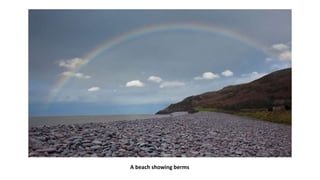
The shingle ridges often found towards the back of a beach are
called berms.
A beach showing berms
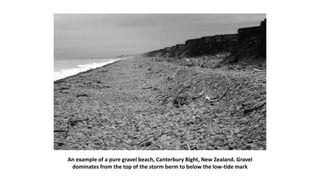
An example of a pure gravel beach, Canterbury Bight, New Zealand. Gravel
dominates from the top of the storm berm to below the low-tide mark
Most waves break near the shoreline, so sediment near the
water is more effectively broken down by attrition.
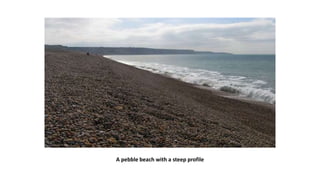
Sandy beaches have gently sloping profiles and shingle and
pebble beaches are steeper.
A pebble beach with a steep profile
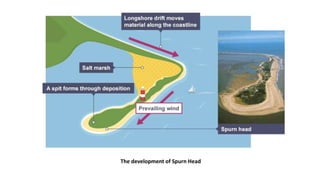
Spits are also created by deposition.
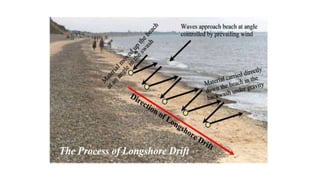
Spits are formed where the prevailing wind blows at an angle
to the coastline, resulting in longshore drift.
The development of Spurn Head
Longshore drift moves material along the coastline.
A spit forms when the material is deposited.
Over time, the spit grows and develops a hook if wind direction
changes further out.
Waves cannot get past a spit, which creates a sheltered area
where silt is deposited and mud flats or salt marshes form.
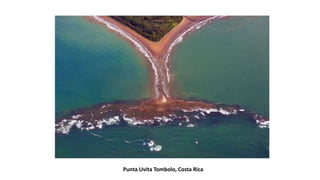
A tombolo is a spit connecting an island to the mainland.
Lagoons have formed behind the stretch of beach material.
Punta Uvita Tombolo, Costa Rica
One of the most common features of a coastline is a cliff.
Cliffs are shaped through a combination of erosion and
weathering - the breakdown of rocks caused by weather
conditions.
Soft rock, eg sand and clay, erodes easily to create gently
sloping cliffs.
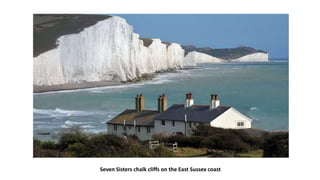
Hard rock, eg chalk, is more resistant and erodes slowly to
create steep cliffs.
Seven Sisters chalk cliffs on the East Sussex coast
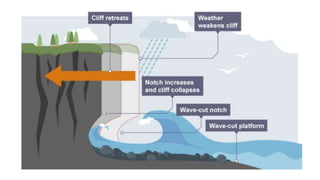
Weather weakens the top of the cliff.
The sea attacks the base of the cliff forming a wave-cut notch.
The notch increases in size causing the cliff to collapse.
The backwash carries the rubble towards the sea forming a
wave-cut platform.
The process repeats and the cliff continues to retreat.
Headlands are formed when the sea attacks a section of coast
with alternating bands of hard and soft rock.
The bands of soft rock, such as sand and clay, erode more
quickly than those of more resistant rock, such as chalk.
This leaves a section of land jutting out into the sea called a
headland.
The areas where the soft rock has eroded away, next to the
headland, are called bays.
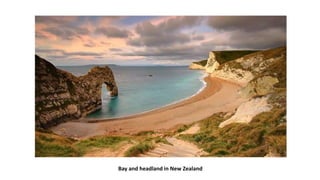
Bay and headland in New Zealand
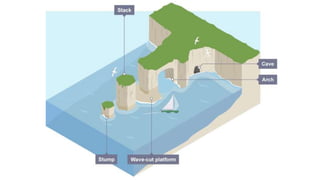
Weathering and erosion can create caves, arches, stacks and
stumps along a headland.
Caves occur when waves force their way into cracks in the cliff
face.
The water contains sand and other materials that grind away at
the rock until the cracks become a cave.
Hydraulic action is the predominant process.
If the cave is formed in a headland, it may eventually break
through to the other side forming an arch.
The arch will gradually become bigger until it can no longer
support the top of the arch.
When the arch collapses, it leaves the headland on one side and
a stack (a tall column of rock) on the other.
The stack will be attacked at the base in the same way that a
wave-cut notch is formed.
This weakens the structure and it will eventually collapse to
form a stump.
One of the best examples in Britain is Old Harry Rocks, a stack
found off a headland in the Isle of Purbeck.

GEOGRAPHY YEAR 10: COASTAL LANDFORMS

  • 1.
  • 2.
    Coastal landforms canbe either depositional or erosional. Beaches, spits and tombolos are examples of depositional landforms. Cliffs and caves are examples of erosional landforms.
  • 3.
    Beaches are acommon feature of a coastline. Beaches are made up of eroded material that has been transported from elsewhere and deposited by the sea. Constructive waves help to build up beaches. A cross-section of a beach is called a beach profile. The shingle ridges often found towards the back of a beach are called berms.
  • 4.
  • 5.
    An example ofa pure gravel beach, Canterbury Bight, New Zealand. Gravel dominates from the top of the storm berm to below the low-tide mark
  • 6.
    Most waves breaknear the shoreline, so sediment near the water is more effectively broken down by attrition. Sandy beaches have gently sloping profiles and shingle and pebble beaches are steeper.
  • 7.
    A pebble beachwith a steep profile
  • 8.
    Spits are alsocreated by deposition. Spits are formed where the prevailing wind blows at an angle to the coastline, resulting in longshore drift.
  • 9.
  • 10.
    Longshore drift movesmaterial along the coastline. A spit forms when the material is deposited. Over time, the spit grows and develops a hook if wind direction changes further out. Waves cannot get past a spit, which creates a sheltered area where silt is deposited and mud flats or salt marshes form.
  • 12.
    A tombolo isa spit connecting an island to the mainland. Lagoons have formed behind the stretch of beach material.
  • 13.
  • 14.
    One of themost common features of a coastline is a cliff. Cliffs are shaped through a combination of erosion and weathering - the breakdown of rocks caused by weather conditions. Soft rock, eg sand and clay, erodes easily to create gently sloping cliffs. Hard rock, eg chalk, is more resistant and erodes slowly to create steep cliffs.
  • 15.
    Seven Sisters chalkcliffs on the East Sussex coast
  • 17.
    Weather weakens thetop of the cliff. The sea attacks the base of the cliff forming a wave-cut notch. The notch increases in size causing the cliff to collapse. The backwash carries the rubble towards the sea forming a wave-cut platform. The process repeats and the cliff continues to retreat.
  • 18.
    Headlands are formedwhen the sea attacks a section of coast with alternating bands of hard and soft rock. The bands of soft rock, such as sand and clay, erode more quickly than those of more resistant rock, such as chalk. This leaves a section of land jutting out into the sea called a headland. The areas where the soft rock has eroded away, next to the headland, are called bays.
  • 19.
    Bay and headlandin New Zealand
  • 20.
    Weathering and erosioncan create caves, arches, stacks and stumps along a headland.
  • 22.
    Caves occur whenwaves force their way into cracks in the cliff face. The water contains sand and other materials that grind away at the rock until the cracks become a cave. Hydraulic action is the predominant process. If the cave is formed in a headland, it may eventually break through to the other side forming an arch.
  • 23.
    The arch willgradually become bigger until it can no longer support the top of the arch. When the arch collapses, it leaves the headland on one side and a stack (a tall column of rock) on the other. The stack will be attacked at the base in the same way that a wave-cut notch is formed. This weakens the structure and it will eventually collapse to form a stump. One of the best examples in Britain is Old Harry Rocks, a stack found off a headland in the Isle of Purbeck.