Distinctive landforms result from different processes. NT page 150 – 153 CGP pg 65
Lesson objectives: Landforms resulting from erosion To describe and explain the characteristics and formation of:-  headlands and bays cliffs and wave cut platforms caves, arches and stacks
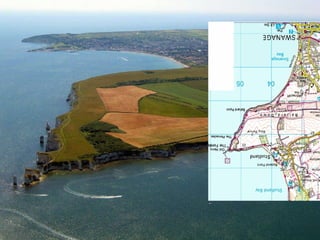
Headlands and bays
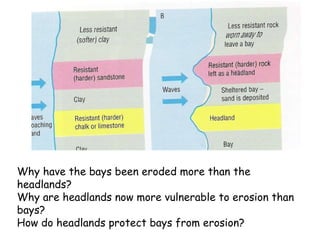
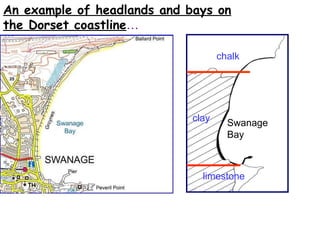
Why have the bays been eroded more than the headlands? Why are headlands now more vulnerable to erosion than bays? How do headlands protect bays from erosion?
 
Bay and Headland
 
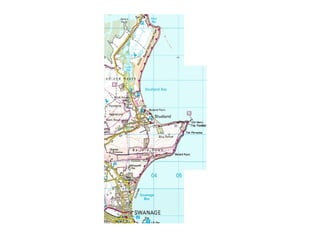
An example of headlands and bays on the Dorset coastline … chalk clay limestone Swanage Bay
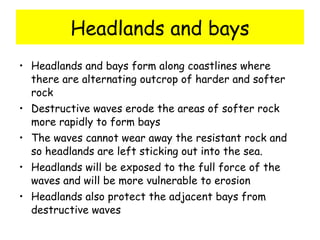
Headlands and bays Headlands and bays form along coastlines where there are alternating outcrop of harder and softer rock Destructive waves erode the areas of softer rock more rapidly to form bays The waves cannot wear away the resistant rock and so headlands are left sticking out into the sea. Headlands will be exposed to the full force of the waves and will be more vulnerable to erosion Headlands also protect the adjacent bays from destructive waves
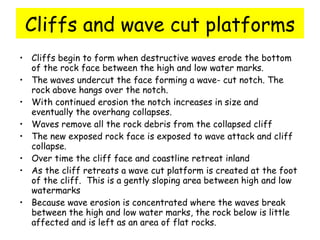
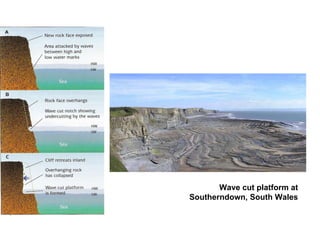
Cliffs and wave cut platforms Cliffs begin to form when destructive waves erode the bottom of the rock face between the high and low water marks. The waves undercut the face forming a wave- cut notch. The rock above hangs over the notch. With continued erosion the notch increases in size and eventually the overhang collapses. Waves remove all the rock debris from the collapsed cliff The new exposed rock face is exposed to wave attack and cliff collapse.  Over time the cliff face and coastline retreat inland As the cliff retreats a wave cut platform is created at the foot of the cliff.  This is a gently sloping area between high and low watermarks Because wave erosion is concentrated where the waves break between the high and low water marks, the rock below is little affected and is left as an area of flat rocks.
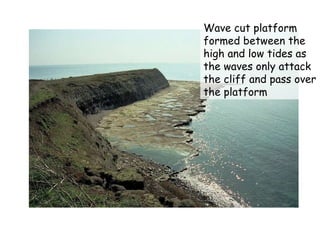
Wave cut platform formed between the high and low tides as the waves only attack the cliff and pass over the platform
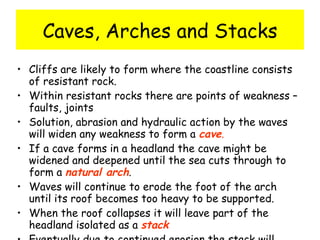
Wave cut platform at Southerndown, South Wales
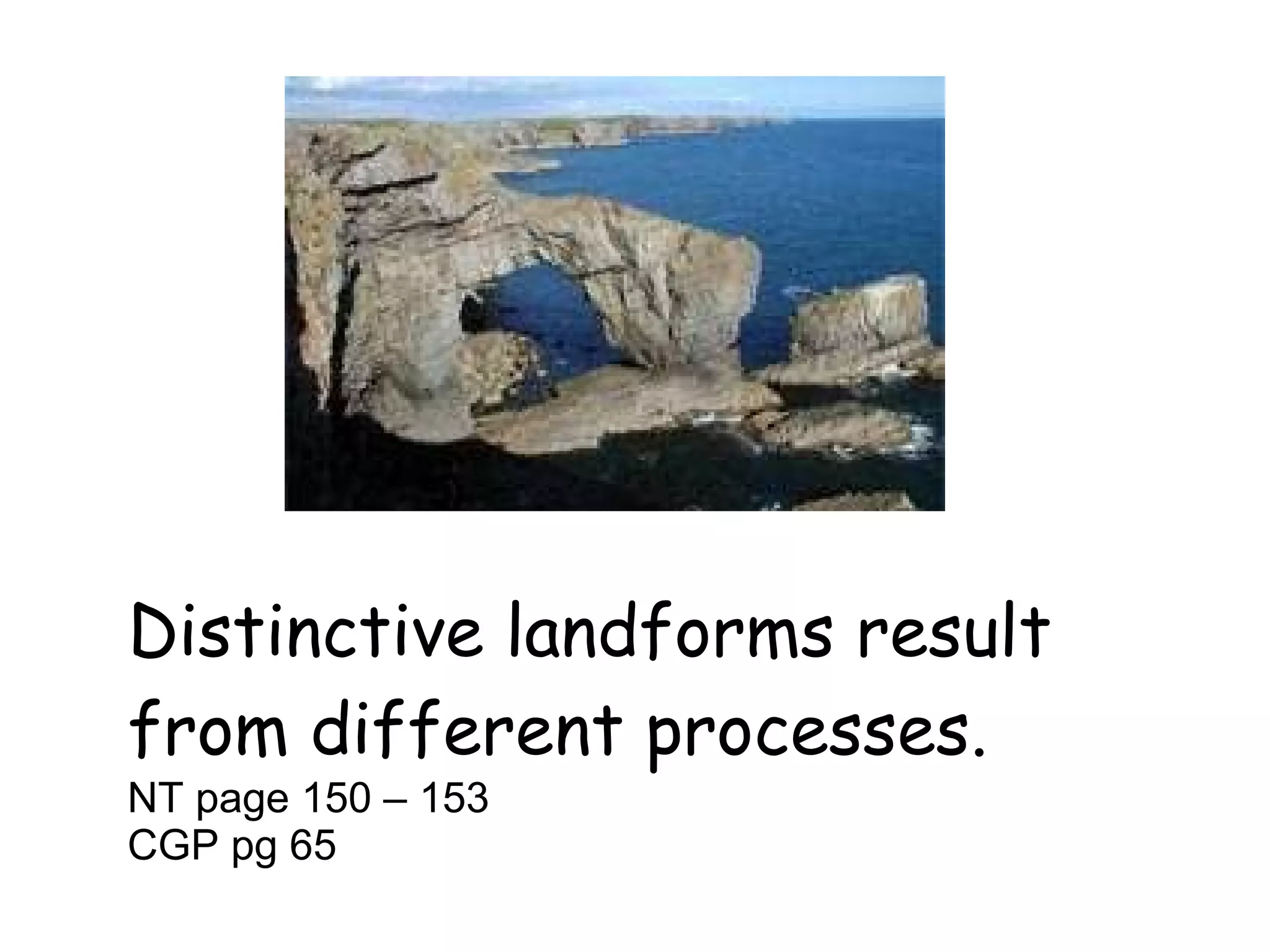
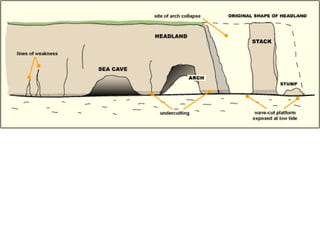
Caves, Arches and Stacks Cliffs are likely to form where the coastline consists of resistant rock. Within resistant rocks there are points of weakness – faults, joints Solution, abrasion and hydraulic action by the waves will widen any weakness to form a  cave . If a cave forms in a headland the cave might be widened and deepened until the sea cuts through to form a  natural arch . Waves will continue to erode the foot of the arch until its roof becomes too heavy to be supported. When the roof collapses it will leave part of the headland isolated as a  stack Eventually due to continued erosion the stack will collapse to leave a  stump
 
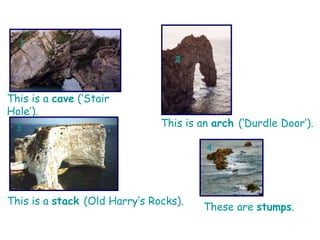
1 2 3 4 This is a  cave  (‘Stair Hole’). This is an  arch  (‘Durdle Door’). This is a  stack  (Old Harry’s Rocks). These are  stumps .
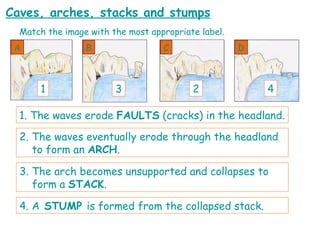
Caves, arches, stacks and stumps 1. The waves erode  FAULTS  (cracks) in the headland. 2. The waves eventually erode through the headland to form an  ARCH . 3. The arch becomes unsupported and collapses to form a  STACK . 4. A  STUMP  is formed from the collapsed stack. C D B A Match the image with the most appropriate label. 1 2 3 4
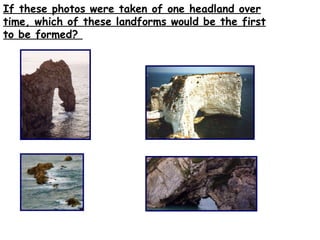
If these photos were taken of one headland over time, which of these landforms would be the first to be formed?
 
Exposed lines of weakness in ______ allow Hydraulic Action to form _____small along the base of the cliff. Over time the cave will continue to grow through _______  ______ and meet another cave on the other side of the headland forming a small ______. ______ will continue and undercut the base of the arch until it eventually falls due to lack of support and _______. This leaves behind a stack which will eventually collapse due to ___________and gravity to leave a _____.  erosion  stump  undercutting   gravity caves  Hydraulic Action  arch  cliffs
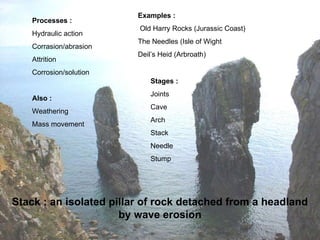
Stack : an isolated pillar of rock detached from a headland by wave erosion Stages : Joints Cave Arch Stack Needle Stump Processes : Hydraulic action Corrasion/abrasion Attrition Corrosion/solution Also : Weathering Mass movement Examples : Needles (Isle of Wight) Examples : Old Harry Rocks (Jurassic Coast) The Needles (Isle of Wight Deil’s Heid (Arbroath)
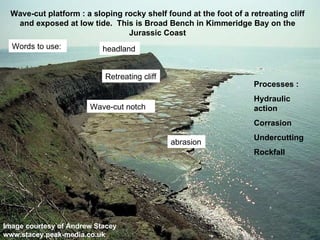
Image courtesy of Andrew Stacey  www.stacey.peak-media.co.uk  Wave-cut platform : a sloping rocky shelf found at the foot of a retreating cliff and exposed at low tide.  This is Broad Bench in Kimmeridge Bay on the Jurassic Coast Processes : Hydraulic action Corrasion Undercutting Rockfall headland Words to use: Wave-cut notch abrasion Retreating cliff

Distinctive Coastal Erosional Landforms

  • 1.
    Distinctive landforms resultfrom different processes. NT page 150 – 153 CGP pg 65
  • 2.
    Lesson objectives: Landformsresulting from erosion To describe and explain the characteristics and formation of:- headlands and bays cliffs and wave cut platforms caves, arches and stacks
  • 3.
  • 4.
    Why have thebays been eroded more than the headlands? Why are headlands now more vulnerable to erosion than bays? How do headlands protect bays from erosion?
  • 5.
  • 6.
  • 7.
  • 8.
    An example ofheadlands and bays on the Dorset coastline … chalk clay limestone Swanage Bay
  • 9.
    Headlands and baysHeadlands and bays form along coastlines where there are alternating outcrop of harder and softer rock Destructive waves erode the areas of softer rock more rapidly to form bays The waves cannot wear away the resistant rock and so headlands are left sticking out into the sea. Headlands will be exposed to the full force of the waves and will be more vulnerable to erosion Headlands also protect the adjacent bays from destructive waves
  • 10.
    Cliffs and wavecut platforms Cliffs begin to form when destructive waves erode the bottom of the rock face between the high and low water marks. The waves undercut the face forming a wave- cut notch. The rock above hangs over the notch. With continued erosion the notch increases in size and eventually the overhang collapses. Waves remove all the rock debris from the collapsed cliff The new exposed rock face is exposed to wave attack and cliff collapse. Over time the cliff face and coastline retreat inland As the cliff retreats a wave cut platform is created at the foot of the cliff. This is a gently sloping area between high and low watermarks Because wave erosion is concentrated where the waves break between the high and low water marks, the rock below is little affected and is left as an area of flat rocks.
  • 11.
    Wave cut platformformed between the high and low tides as the waves only attack the cliff and pass over the platform
  • 12.
    Wave cut platformat Southerndown, South Wales
  • 13.
    Caves, Arches andStacks Cliffs are likely to form where the coastline consists of resistant rock. Within resistant rocks there are points of weakness – faults, joints Solution, abrasion and hydraulic action by the waves will widen any weakness to form a cave . If a cave forms in a headland the cave might be widened and deepened until the sea cuts through to form a natural arch . Waves will continue to erode the foot of the arch until its roof becomes too heavy to be supported. When the roof collapses it will leave part of the headland isolated as a stack Eventually due to continued erosion the stack will collapse to leave a stump
  • 14.
  • 15.
    1 2 34 This is a cave (‘Stair Hole’). This is an arch (‘Durdle Door’). This is a stack (Old Harry’s Rocks). These are stumps .
  • 16.
    Caves, arches, stacksand stumps 1. The waves erode FAULTS (cracks) in the headland. 2. The waves eventually erode through the headland to form an ARCH . 3. The arch becomes unsupported and collapses to form a STACK . 4. A STUMP is formed from the collapsed stack. C D B A Match the image with the most appropriate label. 1 2 3 4
  • 17.
    If these photoswere taken of one headland over time, which of these landforms would be the first to be formed?
  • 18.
  • 19.
    Exposed lines ofweakness in ______ allow Hydraulic Action to form _____small along the base of the cliff. Over time the cave will continue to grow through _______ ______ and meet another cave on the other side of the headland forming a small ______. ______ will continue and undercut the base of the arch until it eventually falls due to lack of support and _______. This leaves behind a stack which will eventually collapse due to ___________and gravity to leave a _____. erosion stump undercutting gravity caves Hydraulic Action arch cliffs
  • 20.
    Stack : anisolated pillar of rock detached from a headland by wave erosion Stages : Joints Cave Arch Stack Needle Stump Processes : Hydraulic action Corrasion/abrasion Attrition Corrosion/solution Also : Weathering Mass movement Examples : Needles (Isle of Wight) Examples : Old Harry Rocks (Jurassic Coast) The Needles (Isle of Wight Deil’s Heid (Arbroath)
  • 21.
    Image courtesy ofAndrew Stacey www.stacey.peak-media.co.uk Wave-cut platform : a sloping rocky shelf found at the foot of a retreating cliff and exposed at low tide. This is Broad Bench in Kimmeridge Bay on the Jurassic Coast Processes : Hydraulic action Corrasion Undercutting Rockfall headland Words to use: Wave-cut notch abrasion Retreating cliff

Editor's Notes

  • #5 Get pupils to copy the diagram from WW, and add notes to explain how formed, then answer these questions on this slide.
  • #7 Annotate Rock types – clay in foreground, chalk in background