EXOGENIC PROCESSES
Are processes that
take place at or
near the earth’s
surface that
makes the surface
wear away.
These are very destructive.
They are responsible for
degradation and sculpting of
the earth’s surface.
TYPES OF EXOGENIC
PROCESSES
1. Weathering
2. Mass Wasting
3. Soil Erosion
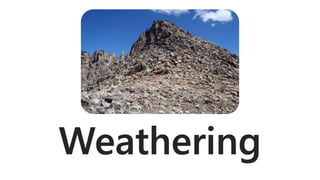
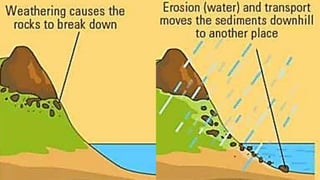
WEATHERING
A process that cause rocks to
disintegrate physically or
decompose chemically
because of exposure to
elements of weather such as
temperature, rainfall, frost,
fog and ice.
In addition, the weathered
material lies at its original
position.
There is no transportation
or movement other than
gravity.
1. PHYSICAL WEATHERING
Happens whenever rocks
are broken into smaller
fragments without any
chemical change in their
composition.
1. PHYSICAL WEATHERING
a. Block disintegration
b. Exfoliation
c. Frost action
d. Abrasion
A successive heating and
cooling which causes the
expansion and contraction
of rocks.
A. BLOCK DISINTEGRATION
In hot desert regions, day
temperatures are very high
while nights are very cold.
Because of these two
extremes, the rocks
disintegrate into smaller
blocks.
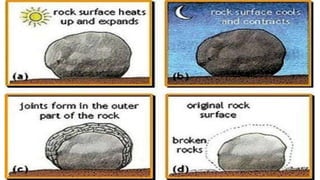
B. EXFOLIATION
This results because of the
intense heating of the
rock’s outer layers. Since
rocks are poor conductors
of heat, the inner layer
remain unaffected by heat.
Due to successive
expansion and
contraction, the outer
layers if the rock
subsequently peel off.
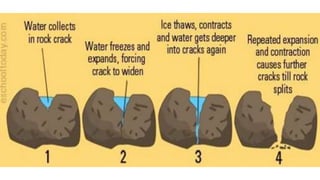
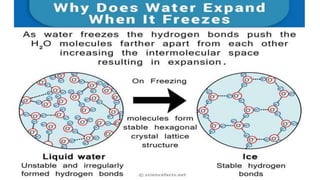
C. FROST ACTION
The alternate freezing
and melting of water
inside the joins of the
rocks, split them into
fragments.
C. FROST ACTION
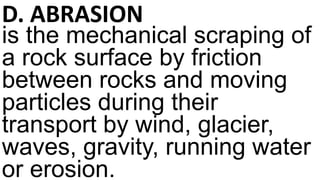
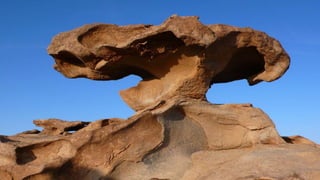
D. ABRASION
is the mechanical scraping of
a rock surface by friction
between rocks and moving
particles during their
transport by wind, glacier,
waves, gravity, running water
or erosion.
Abrasion is the mechanical
scraping of a rock surface by
friction between rocks and moving
particles during their transport by
wind, glacier, waves, gravity,
running water or erosion.
2. CHEMICAL WEATHERING
Gives way to formation of
new compounds or
formation of new
substances. Involves
chemical change.
TYPES OF CHEMICAL W.
2. Chemical Weathering
a. Oxidation
b. Carbonation
c. Hydration
d. Solution
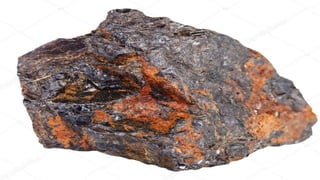
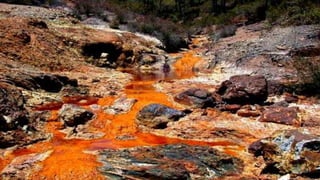
A. OXIDATION
The process in which
atmospheric oxygen reacts
with the rock to produce
oxides. The greatest impacts
of this process is observed
on ferrous (iron) minerals.
B. CARBONATION
The process by which
various types of carbonates
are formed. Some of the
carbonates are soluble in
water.
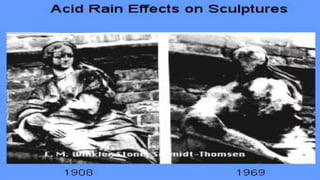
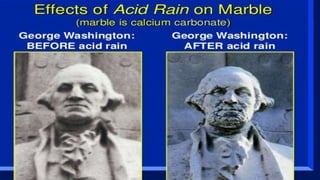
3.Carbonation – When pollutants like
Carbon Dioxide, Nitrogen & Sulfuric
Oxides mix with rain water creating
acid rain, which can dissolve limestone
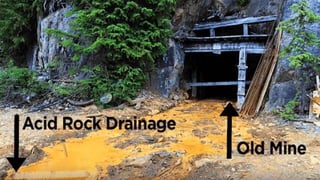
and harm the living environment.
- Coal Burning For Electricity
- Fossil Fuel Consumption for Cars
When pollutants like CO2 &
SO2 mix with rain water
creating acid rain, which
can dissolve limestone and
harm the living environment.
C. HYDRATION
The process by which
water is absorbed by the
minerals of the rocks and
its volume increases and
the grains lose their shape.
C. HYDRATION
D. SOLUTION
The process in
which some of the
minerals
get dissolved in
water
3. BIOTIC WEATHERING
a. Plants
b. Burrowing of Animals
c. Human Activity
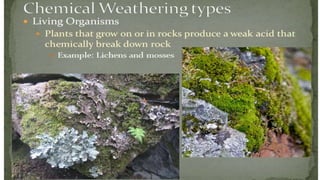
A. PLANTS
The roots of the plants grow
longer and thicker. In this
manner they exert pressure
on rocks & the rock joins are
thereby enlarged & broken
into smaller fragments.
2. BURROWING OF ANIMALS
Animals like earthworms,
rats, rabbits, termites & ants
breakdown the rocks. These
disintegrated rocks can
easily be eroded by wind,
etc.
2. BURROWING OF ANIMALS
Animals like earthworms,
rats, rabbits, termites & ants
breakdown the rocks. These
disintegrated rocks can
easily be eroded by wind,
etc.
2. BURROWING OF ANIMALS
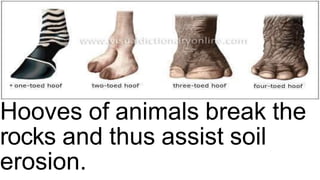
Hooves of animals break the
rocks and thus assist soil
erosion.
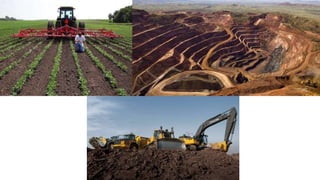
3. HUMAN ACTIVITIES
Man breaks a large amount
of rocks in the course of his
activities like agriculture,
construction and mining.
3. HUMAN ACTIVITIES
Man breaks a large amount
of rocks in the course of his
activities like agriculture,
construction and mining.
WEATHERING FACTORS
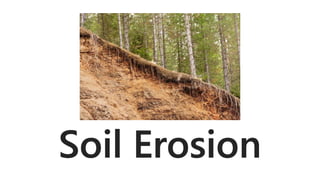
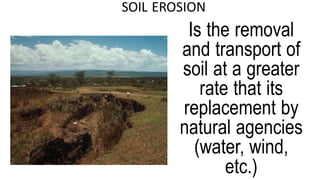
SOIL EROSION
Is the removal
and transport of
soil at a greater
rate that its
replacement by
natural agencies
(water, wind,
etc.)
Carries dust, sand and volcanic
ash from one place to another.
Wind can sometimes blow
sand into towering domes.
Can erode the land in frigid areas
and on some mountaintops. As
the ice moves or melts, it pick up
everything in their path from tiny
grains of sand to boulders.
Gravity pulls any loose bits
down the side of a hill or
mountain.
Gravity erosion is also known as
Mass Movement.
Erosion by Water
Changes the shape of
coastlines.
Waves constantly crush against
shores. They pound rocks into
pebbles and reduce them to
sand.
Can erode the land in frigid areas
and on some mountaintops. As
the ice moves or melts, it pick up
everything in their path from tiny
grains of sand to boulders.
Gravity pulls any loose bits
down the side of a hill or
mountain.
Gravity erosion is also known as
Mass Movement.
Erosion by Wind
Carries dust, sand and
volcanic ash from one place to
another. Wind can sometimes
blow sand into towering
domes.
Gravity pulls any loose bits
down the side of a hill or
mountain.
Gravity erosion is also known as
Mass Movement.
Erosion by Ice
Can erode the land in frigid
areas and on some
mountaintops. As the ice
moves or melts, it pick up
everything in their path from
tiny grains of sand to
boulders.
Can erode the land in frigid areas
and on some mountaintops. As
the ice moves or melts, it pick up
everything in their path from tiny
grains of sand to boulders.
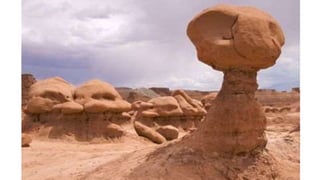
Erosion by Gravity
Gravity pulls any loose
bits down the side of a hill
or mountain.
Gravity erosion is also
known as
Mass Movement.
MASS MOVEMENT VIDEO (YouTube)
MASS WASTING
4
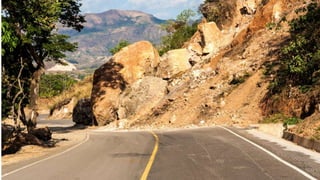
Mass Wasting refers to the
downslope movement of
rock and soil under the
influence of gravity.
This is a result of
Earth’s surface not
being flat but instead
consisting of slopes.
Mass Wasting is a natural
process and is considered
a natural hazard.
This process becomes
natural disaster when it
leads to loss of life &
property.
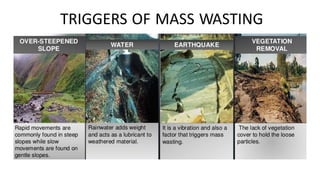
Controlled and triggered by
moisture (water) and
speed (rate).
The saturation of water
destroys the cohesion of
rock particles causing them
to loose.
TRIGGERS OF MASS WASTING
TYPES OF MASS WASTING
Based on the type of
motion, mass wasting could
be generally classified as
the following:
-Fall
-Slides
-Flow
1.Fall – the free-fall
movement of detached
individual pieces of rocks.
2.Slides – occur whenever
rock materials remain fairly
2.Slides – occur whenever
rock materials remain fairly
coherent and move along a
well-defined surface.
3. Flow – when rock
materials are saturated with
water to move downslope
as a viscous fluid.

exogenic-191201155250.pdf

  • 2.
    EXOGENIC PROCESSES Are processesthat take place at or near the earth’s surface that makes the surface wear away.
  • 3.
    These are verydestructive. They are responsible for degradation and sculpting of the earth’s surface.
  • 4.
    TYPES OF EXOGENIC PROCESSES 1.Weathering 2. Mass Wasting 3. Soil Erosion
  • 6.
    WEATHERING A process thatcause rocks to disintegrate physically or decompose chemically because of exposure to elements of weather such as temperature, rainfall, frost, fog and ice.
  • 7.
    In addition, theweathered material lies at its original position. There is no transportation or movement other than gravity.
  • 9.
    1. PHYSICAL WEATHERING Happenswhenever rocks are broken into smaller fragments without any chemical change in their composition.
  • 10.
    1. PHYSICAL WEATHERING a.Block disintegration b. Exfoliation c. Frost action d. Abrasion
  • 11.
    A successive heatingand cooling which causes the expansion and contraction of rocks. A. BLOCK DISINTEGRATION
  • 12.
    A. BLOCK DISINTEGRATION Inhot desert regions, day temperatures are very high while nights are very cold. Because of these two extremes, the rocks disintegrate into smaller blocks.
  • 15.
    B. EXFOLIATION This resultsbecause of the intense heating of the rock’s outer layers. Since rocks are poor conductors of heat, the inner layer remain unaffected by heat.
  • 16.
    Due to successive expansionand contraction, the outer layers if the rock subsequently peel off.
  • 20.
    C. FROST ACTION Thealternate freezing and melting of water inside the joins of the rocks, split them into fragments.
  • 21.
  • 25.
    D. ABRASION is themechanical scraping of a rock surface by friction between rocks and moving particles during their transport by wind, glacier, waves, gravity, running water or erosion.
  • 27.
    Abrasion is themechanical scraping of a rock surface by friction between rocks and moving particles during their transport by wind, glacier, waves, gravity, running water or erosion.
  • 33.
    2. CHEMICAL WEATHERING Givesway to formation of new compounds or formation of new substances. Involves chemical change.
  • 34.
    TYPES OF CHEMICALW. 2. Chemical Weathering a. Oxidation b. Carbonation c. Hydration d. Solution
  • 35.
    A. OXIDATION The processin which atmospheric oxygen reacts with the rock to produce oxides. The greatest impacts of this process is observed on ferrous (iron) minerals.
  • 39.
    B. CARBONATION The processby which various types of carbonates are formed. Some of the carbonates are soluble in water.
  • 40.
    3.Carbonation – Whenpollutants like Carbon Dioxide, Nitrogen & Sulfuric Oxides mix with rain water creating acid rain, which can dissolve limestone and harm the living environment. - Coal Burning For Electricity - Fossil Fuel Consumption for Cars
  • 44.
    When pollutants likeCO2 & SO2 mix with rain water creating acid rain, which can dissolve limestone and harm the living environment.
  • 45.
    C. HYDRATION The processby which water is absorbed by the minerals of the rocks and its volume increases and the grains lose their shape.
  • 46.
  • 49.
    D. SOLUTION The processin which some of the minerals get dissolved in water
  • 51.
    3. BIOTIC WEATHERING a.Plants b. Burrowing of Animals c. Human Activity
  • 52.
    A. PLANTS The rootsof the plants grow longer and thicker. In this manner they exert pressure on rocks & the rock joins are thereby enlarged & broken into smaller fragments.
  • 55.
    2. BURROWING OFANIMALS Animals like earthworms, rats, rabbits, termites & ants breakdown the rocks. These disintegrated rocks can easily be eroded by wind, etc.
  • 56.
    2. BURROWING OFANIMALS Animals like earthworms, rats, rabbits, termites & ants breakdown the rocks. These disintegrated rocks can easily be eroded by wind, etc.
  • 57.
    2. BURROWING OFANIMALS Hooves of animals break the rocks and thus assist soil erosion.
  • 58.
    3. HUMAN ACTIVITIES Manbreaks a large amount of rocks in the course of his activities like agriculture, construction and mining.
  • 59.
    3. HUMAN ACTIVITIES Manbreaks a large amount of rocks in the course of his activities like agriculture, construction and mining.
  • 61.
  • 63.
    SOIL EROSION Is theremoval and transport of soil at a greater rate that its replacement by natural agencies (water, wind, etc.)
  • 65.
    Carries dust, sandand volcanic ash from one place to another. Wind can sometimes blow sand into towering domes. Can erode the land in frigid areas and on some mountaintops. As the ice moves or melts, it pick up everything in their path from tiny grains of sand to boulders. Gravity pulls any loose bits down the side of a hill or mountain. Gravity erosion is also known as Mass Movement. Erosion by Water Changes the shape of coastlines. Waves constantly crush against shores. They pound rocks into pebbles and reduce them to sand.
  • 67.
    Can erode theland in frigid areas and on some mountaintops. As the ice moves or melts, it pick up everything in their path from tiny grains of sand to boulders. Gravity pulls any loose bits down the side of a hill or mountain. Gravity erosion is also known as Mass Movement. Erosion by Wind Carries dust, sand and volcanic ash from one place to another. Wind can sometimes blow sand into towering domes.
  • 69.
    Gravity pulls anyloose bits down the side of a hill or mountain. Gravity erosion is also known as Mass Movement. Erosion by Ice Can erode the land in frigid areas and on some mountaintops. As the ice moves or melts, it pick up everything in their path from tiny grains of sand to boulders.
  • 71.
    Can erode theland in frigid areas and on some mountaintops. As the ice moves or melts, it pick up everything in their path from tiny grains of sand to boulders. Erosion by Gravity Gravity pulls any loose bits down the side of a hill or mountain. Gravity erosion is also known as Mass Movement.
  • 73.
  • 75.
    MASS WASTING 4 Mass Wastingrefers to the downslope movement of rock and soil under the influence of gravity.
  • 76.
    This is aresult of Earth’s surface not being flat but instead consisting of slopes.
  • 78.
    Mass Wasting isa natural process and is considered a natural hazard. This process becomes natural disaster when it leads to loss of life & property.
  • 79.
    Controlled and triggeredby moisture (water) and speed (rate). The saturation of water destroys the cohesion of rock particles causing them to loose.
  • 80.
  • 81.
    TYPES OF MASSWASTING Based on the type of motion, mass wasting could be generally classified as the following:
  • 82.
  • 83.
    1.Fall – thefree-fall movement of detached individual pieces of rocks. 2.Slides – occur whenever rock materials remain fairly
  • 84.
    2.Slides – occurwhenever rock materials remain fairly coherent and move along a well-defined surface.
  • 85.
    3. Flow –when rock materials are saturated with water to move downslope as a viscous fluid.