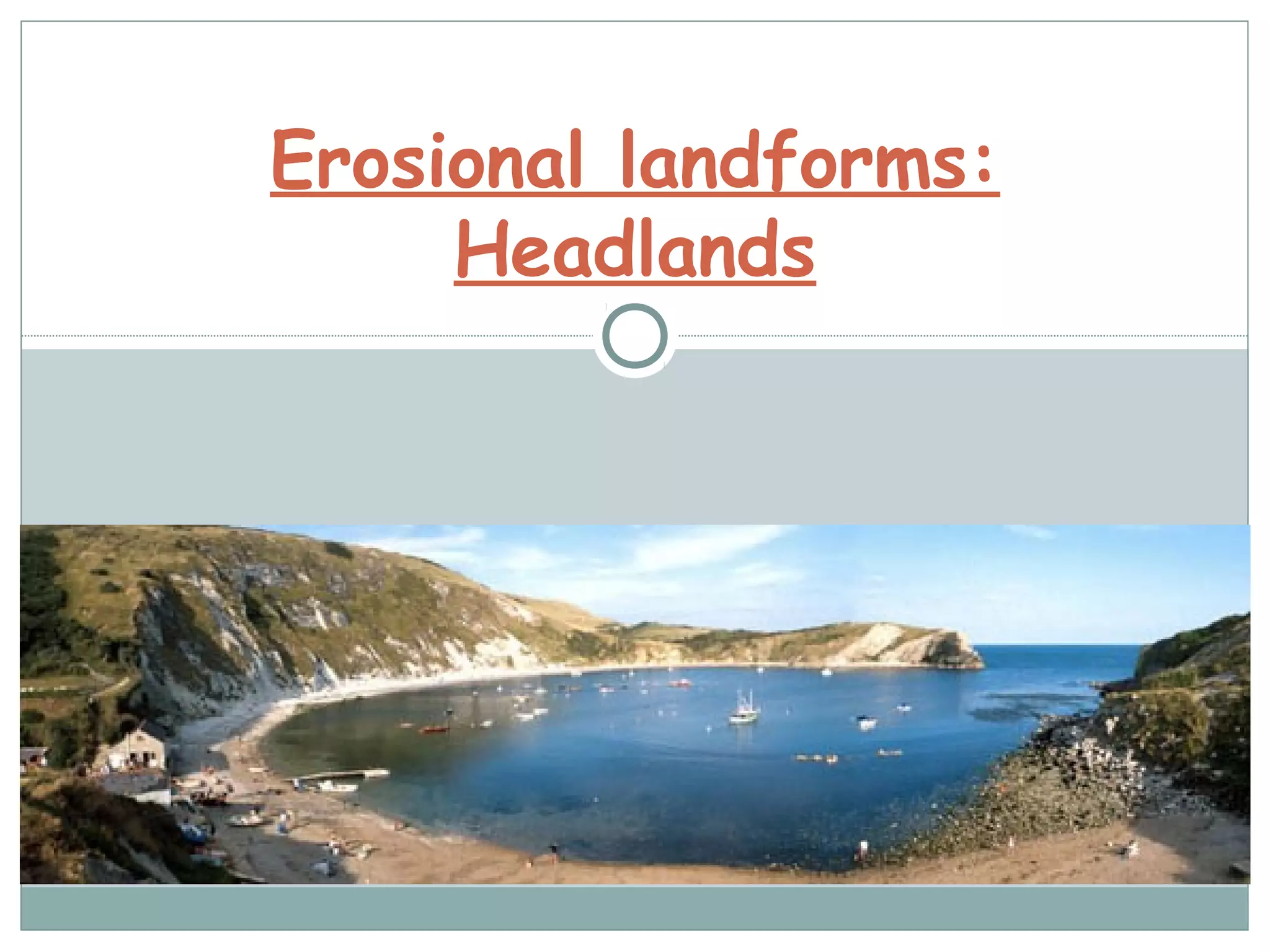
Erosional landforms:
Headlands
Coast The maximum distance over which waves can travel is known as the…
Fetch One of the erosion processes that involves large waves hurtling beach
material at a cliff is called……..
Corrasion The landform created along stretches of less resistant coastlines (i.e.
areas made of clay) are known as…….
Bays The name given to waves with a weak swash but strong backwash is……
Destructive The process that involves beach material being dropped is more
technically known as….
Deposition What is the name given to the predominant force affecting the coastal
landscape of the UK…….
Prevailing Winds The process that carries material up and down the beach is known
as…….
Longshore Drift What is the name of the process that carries / returns wave energy back
down the beach
Backswash The erosion process that breaks up large boulders into small particles by
bumping them against each other is known as…..
Attrition The areas of land left protruding into the sea as they are more resistant
to wave erosion are called…..
Headlands The force of waves compressing air into cracks in a cliff is an erosion
process called…
Hydraulic Action Coastlines can dissolved by salts and acids in seawater. This is also
known as….
Corrosion The narrow contact zone between land and sea is more commonly called
the…
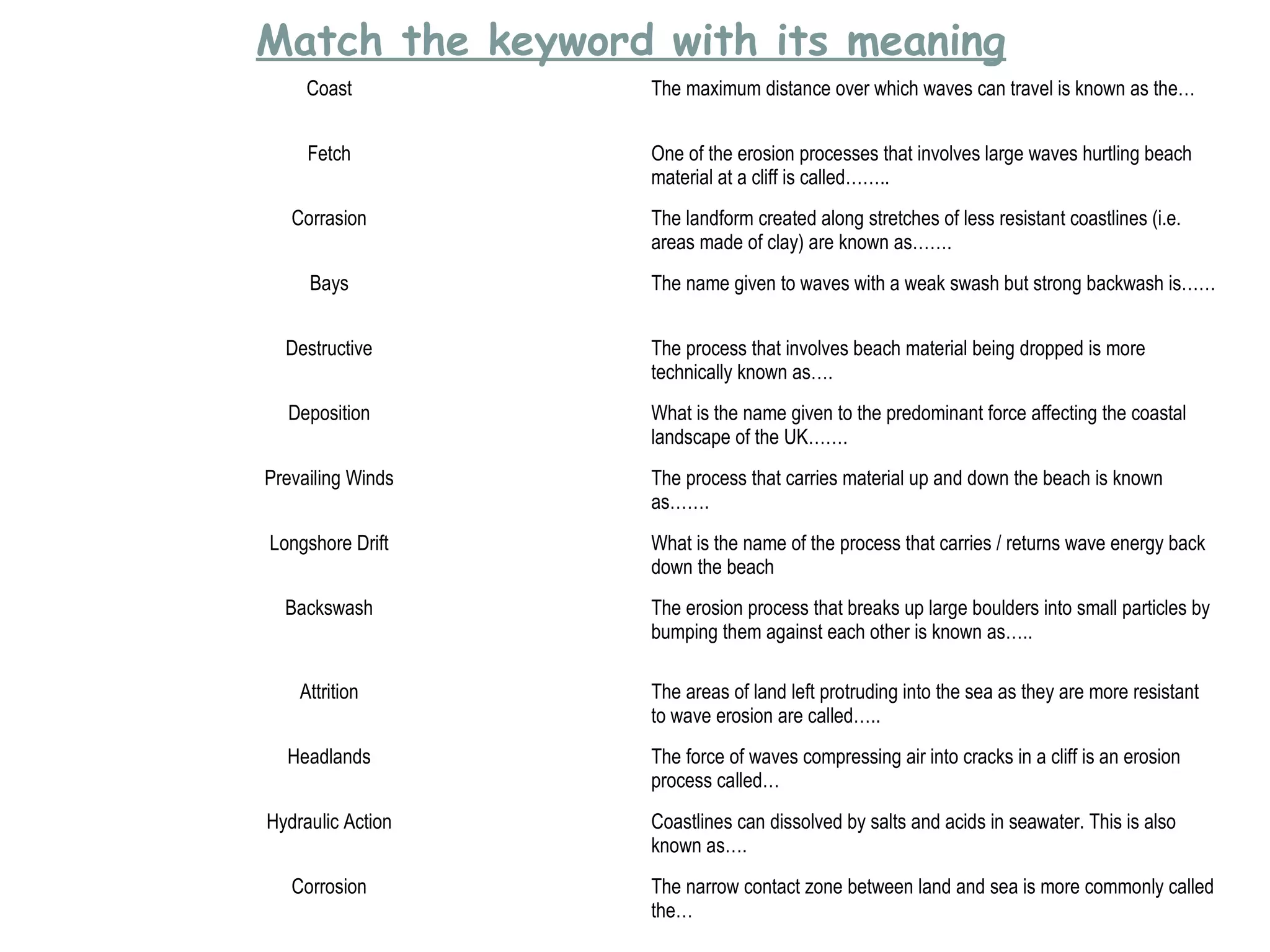
Match the keyword with its meaning
Headland landforms
The different properties of rocks means they are
more or less resistant to erosion.
This means they will change shape in different
ways.
Watch the animation of headland landforms being
created. headland animation
Pop-up headlands
Follow the instructions to make a pop-up headland
that shows caves, arches, stacks, etc.
http://www.flickr.com/photos/sacherfire/21711
3480/
1
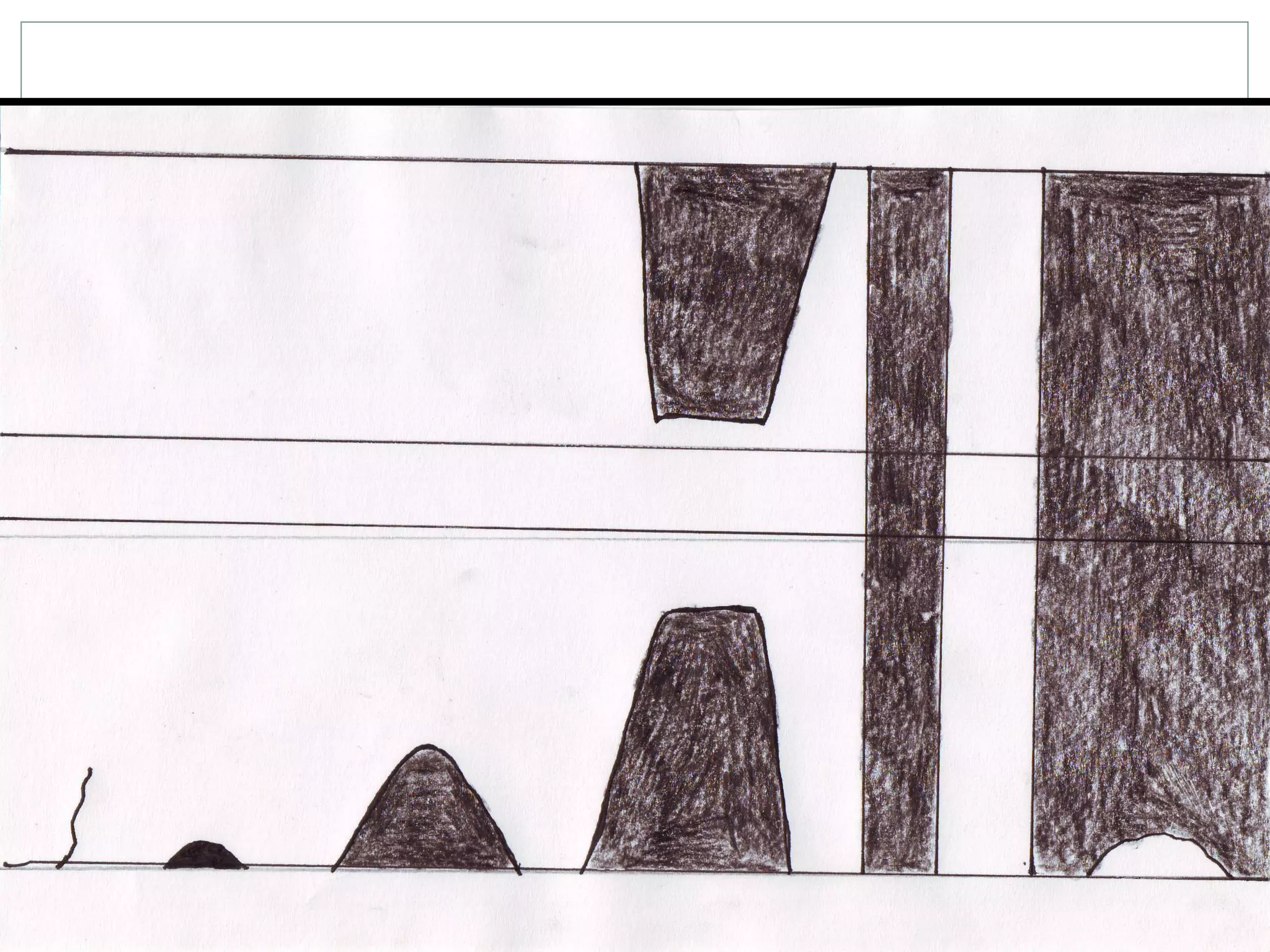
You need your template.
This will represent a
chalk headland.
2
Using a blue crayon -colour the outsidehorizontal strips- theserepresent the sea.
3
Using a green crayon-
colour the middle
horizontal strip- this
represents the top of
the headland- exposed
to weathering.
4 Just above the
horizontal blue lines-
shade a grey line- make
sure it reaches the top
of the wave-cut notch.
This represents wave
action between high and
low tide.
5
Carefully cut out all the
black areas on the
template- with the
exception of the wave-
cut notch.
Don’t cut off your stump!
6
It should look like this...
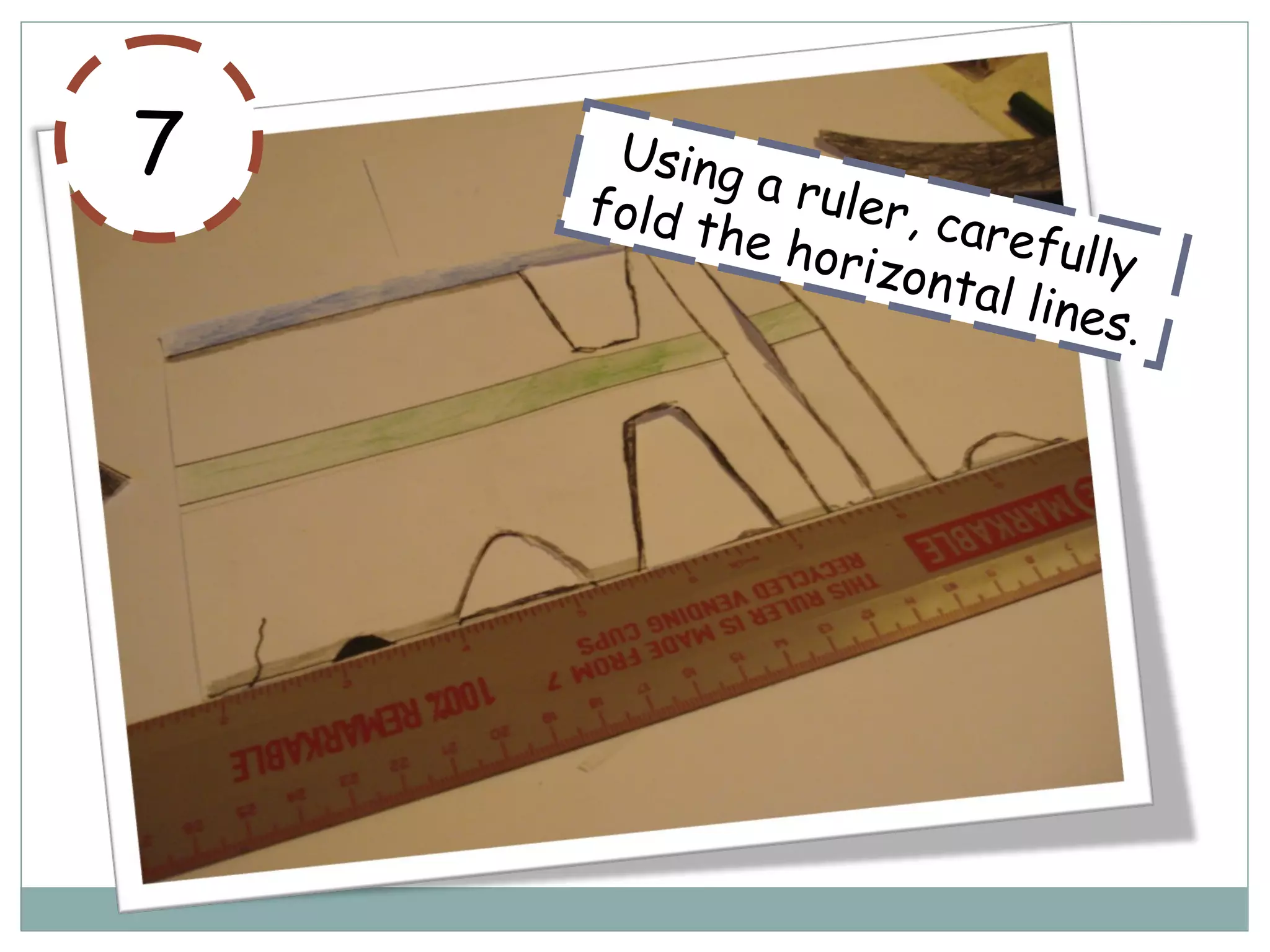
7 Using a ruler, carefully
fold the horizontal lines.
8
Like this...
9 Glue along the two blue
horizontal strips- on thereverse!
10
Position the green strip overthe centre fold of your book.Gently glue down the bluehorizontal strip- the one withthe stump.- Practice yourpositioning first.
11
Carefully practice folding
the model... are the folds
the right way?
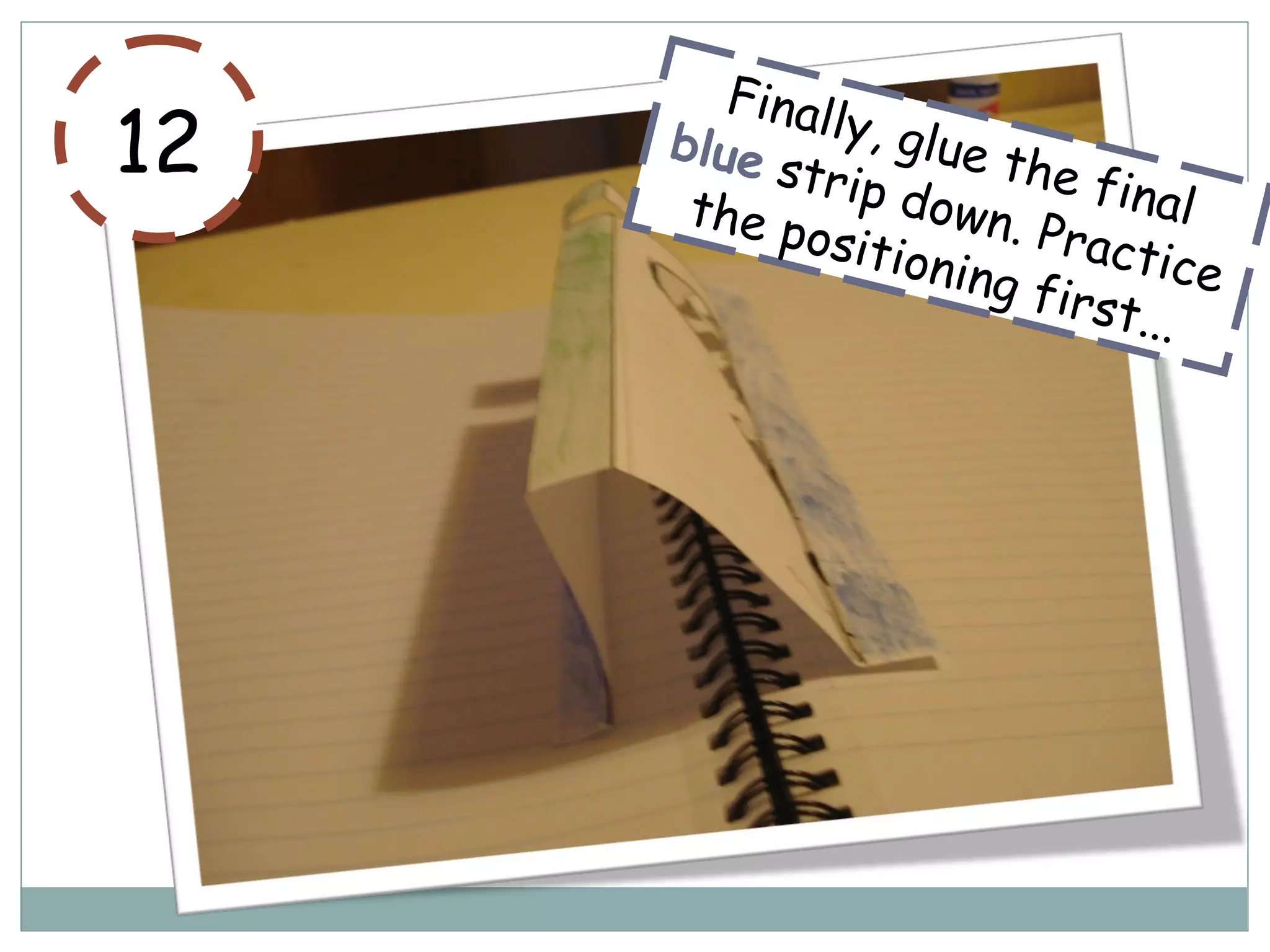
12
Finally, glue the final
blue strip down. Practice
the positioning first...
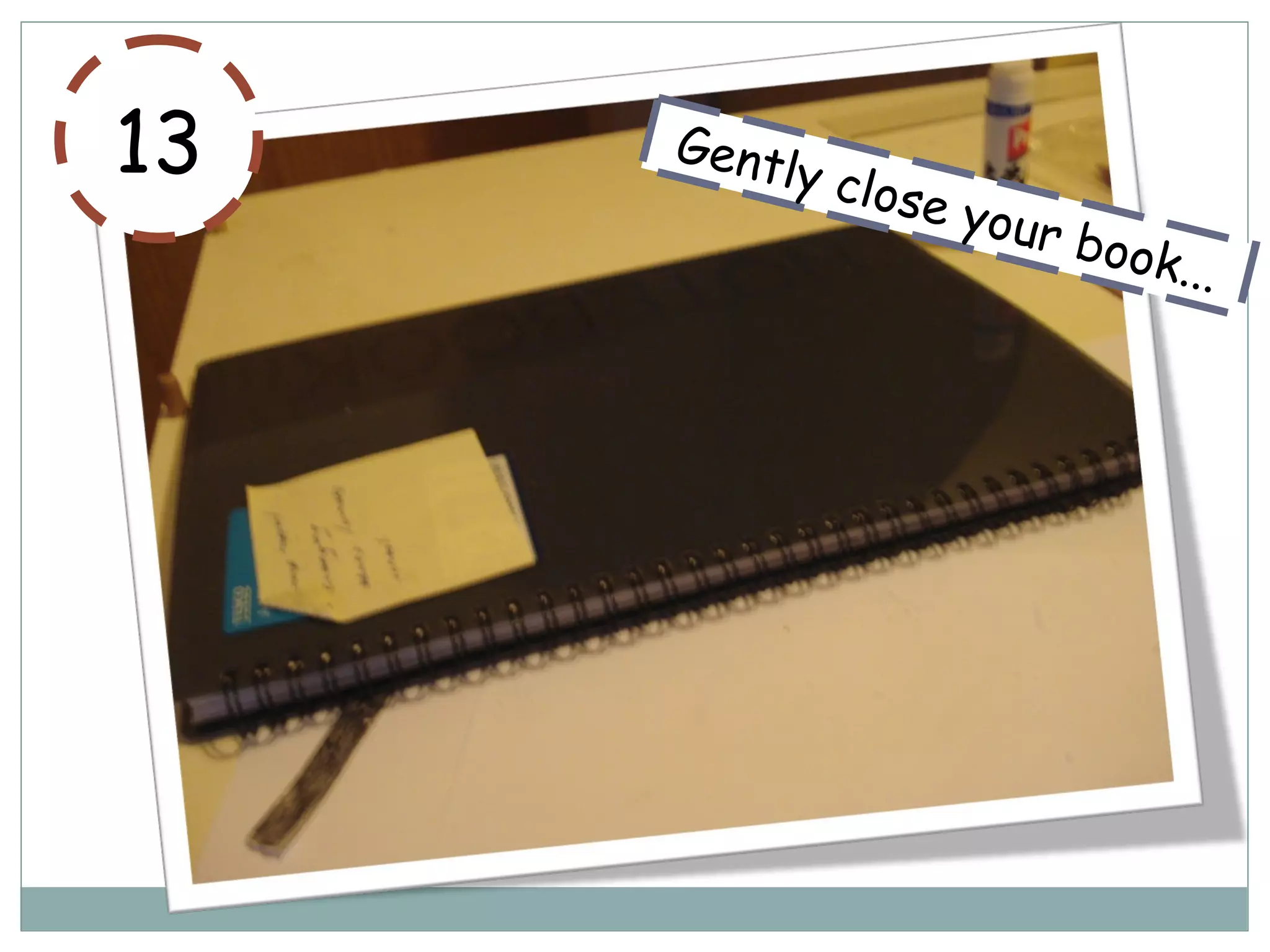
13 Gently close your book...
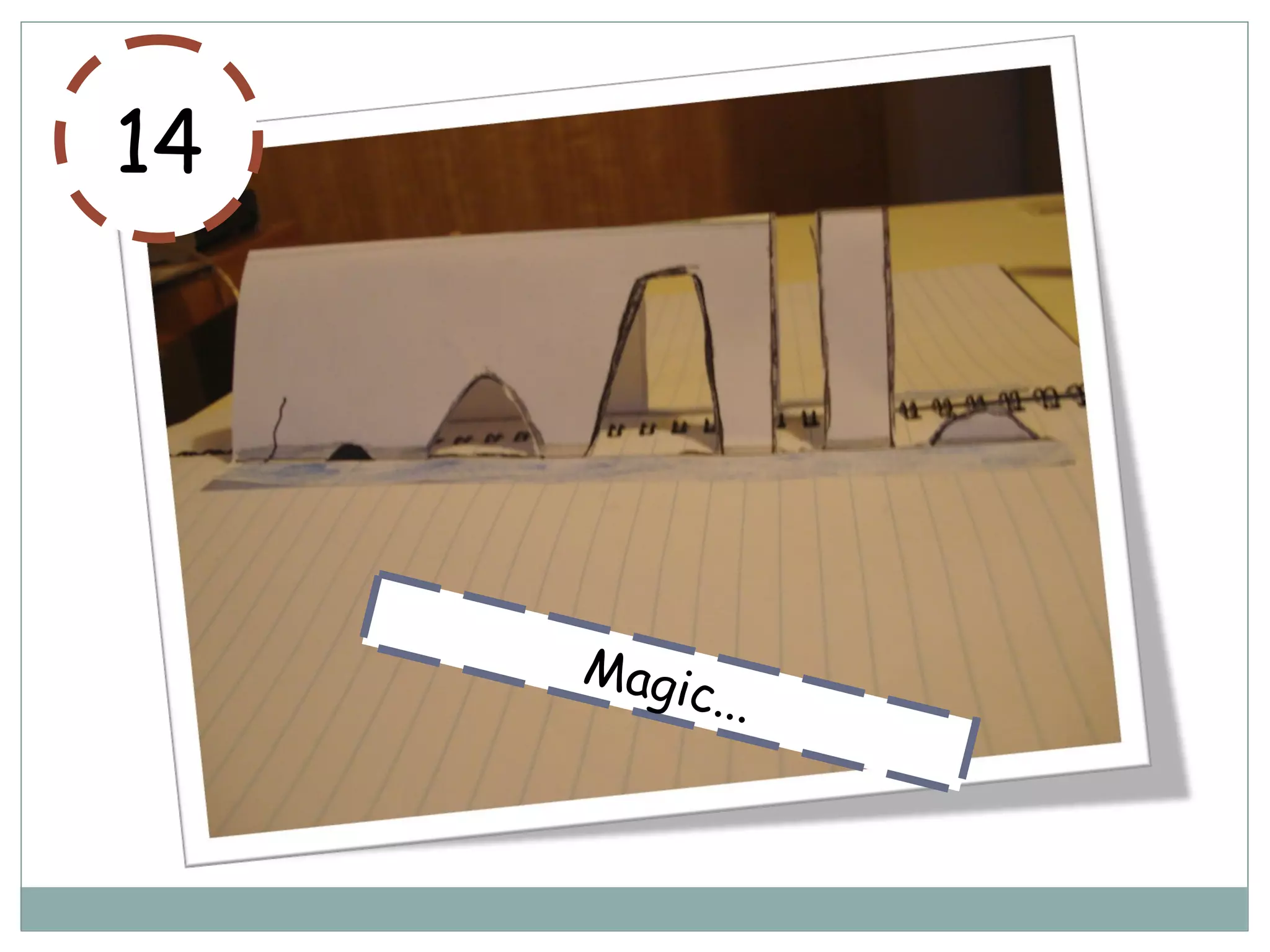
14
Magic...
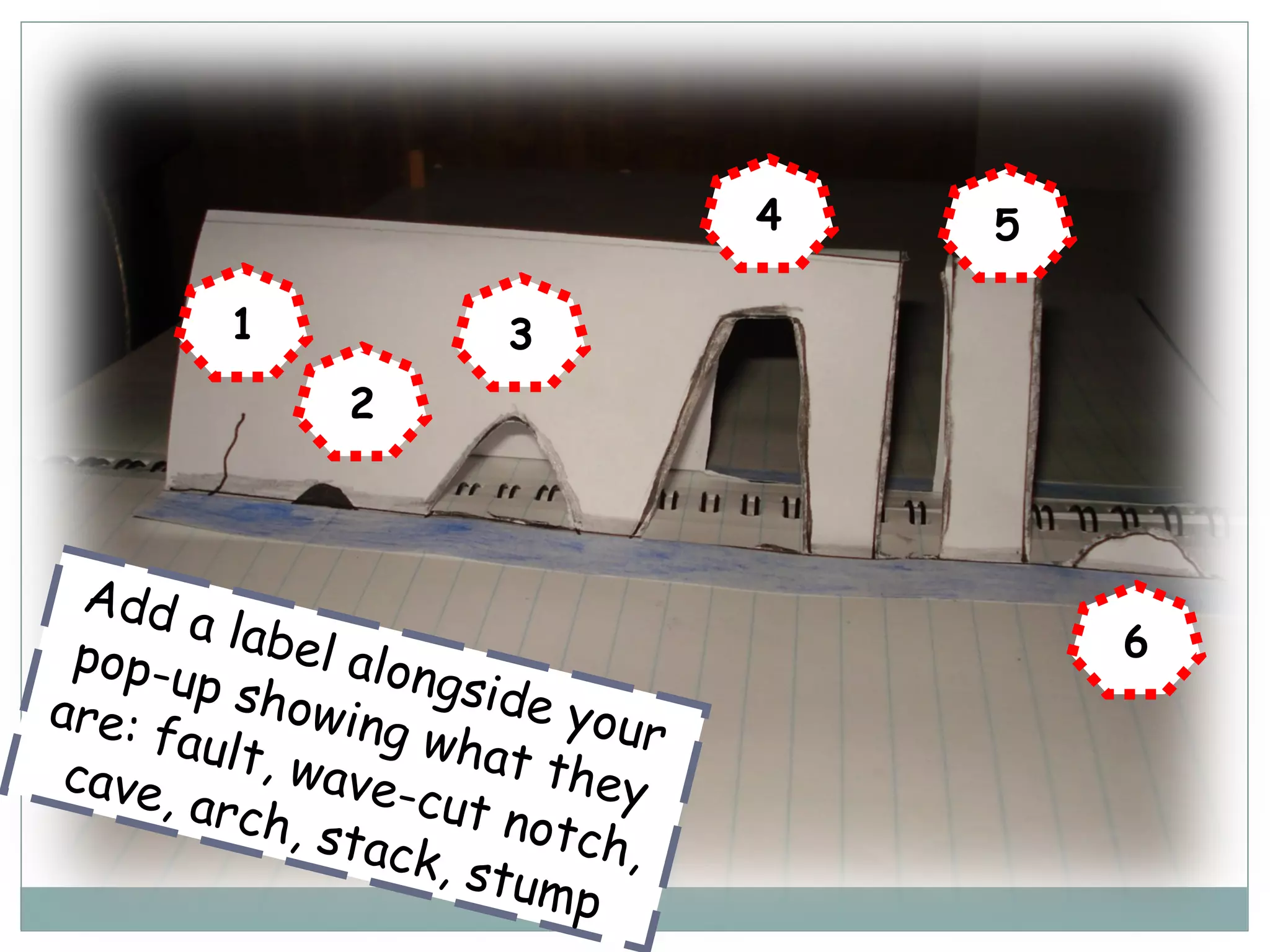
1
2
3
4 5
6
Add a label alongside your
pop-up showing what they
are: fault, wave-cut notch,
cave, arch, stack, stump
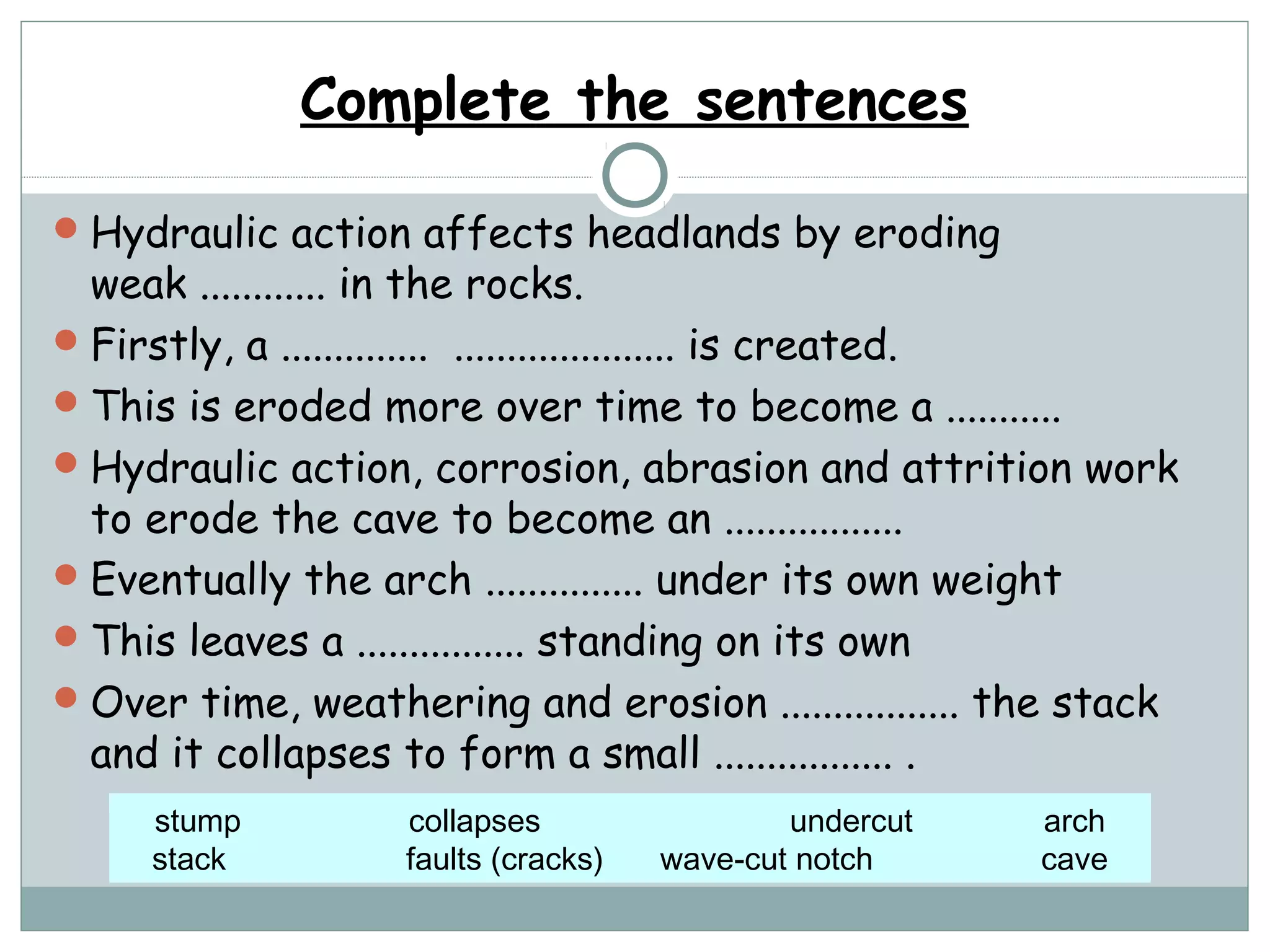
Complete the sentences
Hydraulic action affects headlands by eroding
weak ............ in the rocks.
Firstly, a .............. ..................... is created.
This is eroded more over time to become a ...........
Hydraulic action, corrosion, abrasion and attrition work
to erode the cave to become an .................
Eventually the arch ............... under its own weight
This leaves a ................ standing on its own
Over time, weathering and erosion ................. the stack
and it collapses to form a small ................. .
stump collapses undercut arch
stack faults (cracks) wave-cut notch cave
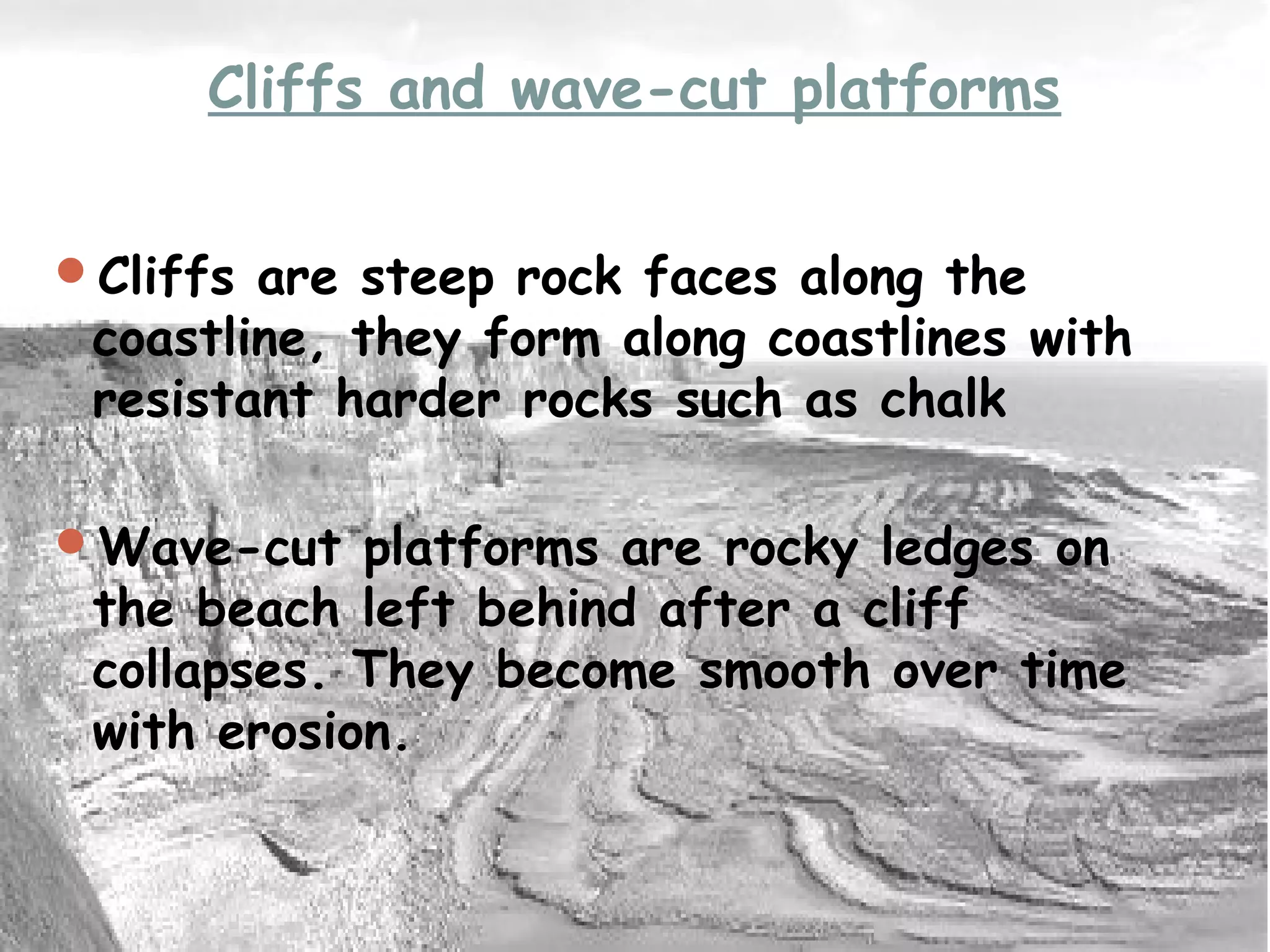
Cliffs and wave-cut platforms
Cliffs are steep rock faces along the
coastline, they form along coastlines with
resistant harder rocks such as chalk
Wave-cut platforms are rocky ledges on
the beach left behind after a cliff
collapses. They become smooth over time
with erosion.
CLIFFS AND WAVE-CUT PLATFORMS
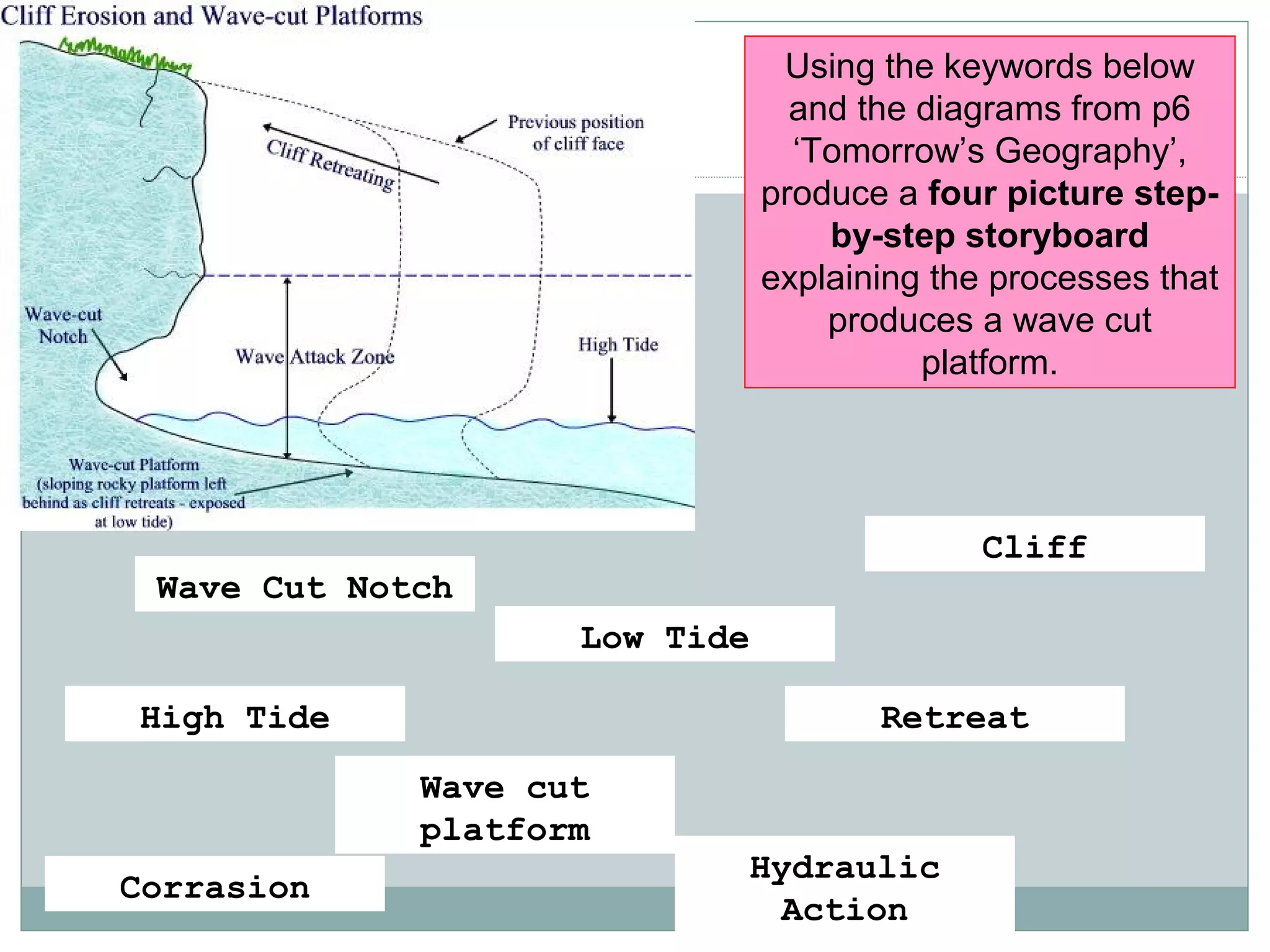
So how do cliffs and wave-cut platforms form?
 The erosion of a cliff is greatest at its base where large waves
break - hydraulic action, abrasion and attrition constantly
undercut the foot of the cliff
 This forms a dent called a wave-cut notch
 The cliff face is also affected by abrasion as rock fragments
are hurled against the cliff by the breaking waves.
 The undercutting continues and eventually the overhanging cliff
becomes so heavy it collapses downwards - this process

continues over time and the cliff gradually retreats inland and
becomes steeper.
 As the cliff retreats, a gently-sloping rocky platform is left at
the base, this is known as a wave-cut platform which is exposed
at low tide.
Using the keywords below
and the diagrams from p6
‘Tomorrow’s Geography’,
produce a four picture step-
by-step storyboard
explaining the processes that
produces a wave cut
platform.
High Tide
Low Tide
Wave Cut Notch
Corrasion
Retreat
Wave cut
platform
Cliff
Hydraulic
Action
Wave cut platforms
Copy the exam question into your books, then
answer it:
“With reference to erosion processes, explain how
wave-cut platforms are formed” {4marks}
How does geology influence landforms?
The different properties of rocks means they are
more or less resistant to erosion.
This means they will change shape in different
ways.
Watch the animation of a headland being formed.
animation.html
Jurassic Coast:
Swanage Bay
 Differing rock hardness is
picked out and
exaggerated by wave
action.
 The hard rocks form
headlands and the softer
rocks form bays.
 Currents are weaker in the
bays so beach sediments
are deposited.
What can you tell from the map?
The map above shows the stretch of coastline to the west of
Lulworth Cove. The features along this stretch provide
excellent examples of landforms forming on destructive
coastlines. What features can you identify?
What can you tell from the map?
What feature
is
this? ...................
....
What feature
is
this? ...................
........
What feature
is
this? ...................
........
YOUR CASE STUDY: Erosion landform
Old Harry Rocks
The Old Harry Rocks are two chalk stacks located at on
the Dorset coast in England
About 4 km NE of Swanage
The rocks are part of the Jurassic Coast
The cliff is chalk, with some bands of flint, which have
been gradually eroded over the centuries, Some of the
earlier stacks have fallen away
(Old Harry's original wife fell
in 1896), while new ones have
been formed.
Old Harry and his Wife
Old Harry Rocks
Watch the animation
Old Harry Rocks story cards
Read the information cards you have been given
Cut them up, and stick them in to your books in an
order that tells the story of what created Old
Harry and his wife.
Order:
1)Introduction to Old Harry Rocks (background
info, location)
2)What created Old Harry, step-by-step
The headland is to the
north of Swanage Bay.
Hydraulic action and
abrasion takes place.
The area is known as the
Isle of Purbeck. It is on
the Jurassic Coast.
Chalk is a more resistant
rock than clay.
The wave-cut notch
undercuts the cliff above,
making it unstable.
The stack is still eroded
and will eventually collapse
and become a stump.
A column of rock is left
standing on its own. This is
a stack.
Most of this area is clay.
Most wave erosion happens
at the base of the cliff.
Wave erosion takes place
between the high tide
mark and low tide mark.
The arch eventually
collapses under it’s own
weight.
A wave-cut notch is eroded
along the cliff base
between high and low tides.
Because the headland juts
out in to the sea, it takes
the full force of wave
erosion.
When chalk is formed, it
contains joints which
means it has areas of
weakness.
Wave erosion picks out the
areas of weakness in the
chalk cliffs and splits
rocks apart in to cracks.
Caves develop on both
sides of the headland.
Old Harry already lost one
‘wife’ in 1896 when she
collapsed.
Small cracks are formed. Small caves are formed.
Wave erosion enlarges the
caves.
Old Harry Rocks are in
Dorset.
Several lines of weakness
go right through the
headland cliff, wave action
can erode these.
Caves are eroded so far
back in to the headland
that they meet in the
middle and a hole is
created that goes through.
This creates an arch.
Further erosion causes the
arch to enlarge and become
unstable.
The headland is made of
chalk.
Chalk does not crumble
away as easily as clay.
This stack is called ‘Old
Harry’.
Caves, arches and stacks
cannot be formed in clay.
Old Harry’s wife is a
stump. She was created
when a stack collapsed a
long time ago.
Homework reminder
Extended homework sheet
This does not mean leave it to the last minute
Each week I want an update on what you have
found out so far.
This should be a detailed project
Due:
See www.priorygcse.wordpress.com for help
Keyword bingo
Match up the keyword with my description
5 in a row
You must also be able to explain the keyword in
your own words to win

L5 headlands

  • 1.
  • 2.
    Coast The maximumdistance over which waves can travel is known as the… Fetch One of the erosion processes that involves large waves hurtling beach material at a cliff is called…….. Corrasion The landform created along stretches of less resistant coastlines (i.e. areas made of clay) are known as……. Bays The name given to waves with a weak swash but strong backwash is…… Destructive The process that involves beach material being dropped is more technically known as…. Deposition What is the name given to the predominant force affecting the coastal landscape of the UK……. Prevailing Winds The process that carries material up and down the beach is known as……. Longshore Drift What is the name of the process that carries / returns wave energy back down the beach Backswash The erosion process that breaks up large boulders into small particles by bumping them against each other is known as….. Attrition The areas of land left protruding into the sea as they are more resistant to wave erosion are called….. Headlands The force of waves compressing air into cracks in a cliff is an erosion process called… Hydraulic Action Coastlines can dissolved by salts and acids in seawater. This is also known as…. Corrosion The narrow contact zone between land and sea is more commonly called the… Match the keyword with its meaning
  • 3.
    Headland landforms The differentproperties of rocks means they are more or less resistant to erosion. This means they will change shape in different ways. Watch the animation of headland landforms being created. headland animation
  • 4.
    Pop-up headlands Follow theinstructions to make a pop-up headland that shows caves, arches, stacks, etc.
  • 5.
  • 6.
    1 You need yourtemplate. This will represent a chalk headland.
  • 8.
    2 Using a bluecrayon -colour the outsidehorizontal strips- theserepresent the sea.
  • 9.
    3 Using a greencrayon- colour the middle horizontal strip- this represents the top of the headland- exposed to weathering.
  • 10.
    4 Just abovethe horizontal blue lines- shade a grey line- make sure it reaches the top of the wave-cut notch. This represents wave action between high and low tide.
  • 11.
    5 Carefully cut outall the black areas on the template- with the exception of the wave- cut notch. Don’t cut off your stump!
  • 12.
    6 It should looklike this...
  • 13.
    7 Using aruler, carefully fold the horizontal lines.
  • 14.
  • 15.
    9 Glue alongthe two blue horizontal strips- on thereverse!
  • 16.
    10 Position the greenstrip overthe centre fold of your book.Gently glue down the bluehorizontal strip- the one withthe stump.- Practice yourpositioning first.
  • 17.
    11 Carefully practice folding themodel... are the folds the right way?
  • 18.
    12 Finally, glue thefinal blue strip down. Practice the positioning first...
  • 19.
    13 Gently closeyour book...
  • 20.
  • 21.
    1 2 3 4 5 6 Add alabel alongside your pop-up showing what they are: fault, wave-cut notch, cave, arch, stack, stump
  • 22.
    Complete the sentences Hydraulicaction affects headlands by eroding weak ............ in the rocks. Firstly, a .............. ..................... is created. This is eroded more over time to become a ........... Hydraulic action, corrosion, abrasion and attrition work to erode the cave to become an ................. Eventually the arch ............... under its own weight This leaves a ................ standing on its own Over time, weathering and erosion ................. the stack and it collapses to form a small ................. . stump collapses undercut arch stack faults (cracks) wave-cut notch cave
  • 23.
    Cliffs and wave-cutplatforms Cliffs are steep rock faces along the coastline, they form along coastlines with resistant harder rocks such as chalk Wave-cut platforms are rocky ledges on the beach left behind after a cliff collapses. They become smooth over time with erosion.
  • 24.
    CLIFFS AND WAVE-CUTPLATFORMS So how do cliffs and wave-cut platforms form?  The erosion of a cliff is greatest at its base where large waves break - hydraulic action, abrasion and attrition constantly undercut the foot of the cliff  This forms a dent called a wave-cut notch  The cliff face is also affected by abrasion as rock fragments are hurled against the cliff by the breaking waves.  The undercutting continues and eventually the overhanging cliff becomes so heavy it collapses downwards - this process continues over time and the cliff gradually retreats inland and becomes steeper.  As the cliff retreats, a gently-sloping rocky platform is left at the base, this is known as a wave-cut platform which is exposed at low tide.
  • 26.
    Using the keywordsbelow and the diagrams from p6 ‘Tomorrow’s Geography’, produce a four picture step- by-step storyboard explaining the processes that produces a wave cut platform. High Tide Low Tide Wave Cut Notch Corrasion Retreat Wave cut platform Cliff Hydraulic Action
  • 27.
    Wave cut platforms Copythe exam question into your books, then answer it: “With reference to erosion processes, explain how wave-cut platforms are formed” {4marks}
  • 28.
    How does geologyinfluence landforms? The different properties of rocks means they are more or less resistant to erosion. This means they will change shape in different ways. Watch the animation of a headland being formed. animation.html
  • 29.
    Jurassic Coast: Swanage Bay Differing rock hardness is picked out and exaggerated by wave action.  The hard rocks form headlands and the softer rocks form bays.  Currents are weaker in the bays so beach sediments are deposited.
  • 30.
    What can youtell from the map? The map above shows the stretch of coastline to the west of Lulworth Cove. The features along this stretch provide excellent examples of landforms forming on destructive coastlines. What features can you identify?
  • 31.
    What can youtell from the map? What feature is this? ................... .... What feature is this? ................... ........ What feature is this? ................... ........
  • 32.
    YOUR CASE STUDY:Erosion landform Old Harry Rocks The Old Harry Rocks are two chalk stacks located at on the Dorset coast in England About 4 km NE of Swanage The rocks are part of the Jurassic Coast The cliff is chalk, with some bands of flint, which have been gradually eroded over the centuries, Some of the earlier stacks have fallen away (Old Harry's original wife fell in 1896), while new ones have been formed. Old Harry and his Wife
  • 33.
  • 34.
    Old Harry Rocksstory cards Read the information cards you have been given Cut them up, and stick them in to your books in an order that tells the story of what created Old Harry and his wife. Order: 1)Introduction to Old Harry Rocks (background info, location) 2)What created Old Harry, step-by-step
  • 35.
    The headland isto the north of Swanage Bay. Hydraulic action and abrasion takes place. The area is known as the Isle of Purbeck. It is on the Jurassic Coast. Chalk is a more resistant rock than clay. The wave-cut notch undercuts the cliff above, making it unstable. The stack is still eroded and will eventually collapse and become a stump. A column of rock is left standing on its own. This is a stack. Most of this area is clay. Most wave erosion happens at the base of the cliff. Wave erosion takes place between the high tide mark and low tide mark. The arch eventually collapses under it’s own weight. A wave-cut notch is eroded along the cliff base between high and low tides. Because the headland juts out in to the sea, it takes the full force of wave erosion. When chalk is formed, it contains joints which means it has areas of weakness. Wave erosion picks out the areas of weakness in the chalk cliffs and splits rocks apart in to cracks. Caves develop on both sides of the headland. Old Harry already lost one ‘wife’ in 1896 when she collapsed. Small cracks are formed. Small caves are formed. Wave erosion enlarges the caves. Old Harry Rocks are in Dorset. Several lines of weakness go right through the headland cliff, wave action can erode these. Caves are eroded so far back in to the headland that they meet in the middle and a hole is created that goes through. This creates an arch. Further erosion causes the arch to enlarge and become unstable. The headland is made of chalk. Chalk does not crumble away as easily as clay. This stack is called ‘Old Harry’. Caves, arches and stacks cannot be formed in clay. Old Harry’s wife is a stump. She was created when a stack collapsed a long time ago.
  • 36.
    Homework reminder Extended homeworksheet This does not mean leave it to the last minute Each week I want an update on what you have found out so far. This should be a detailed project Due: See www.priorygcse.wordpress.com for help
  • 37.
    Keyword bingo Match upthe keyword with my description 5 in a row You must also be able to explain the keyword in your own words to win