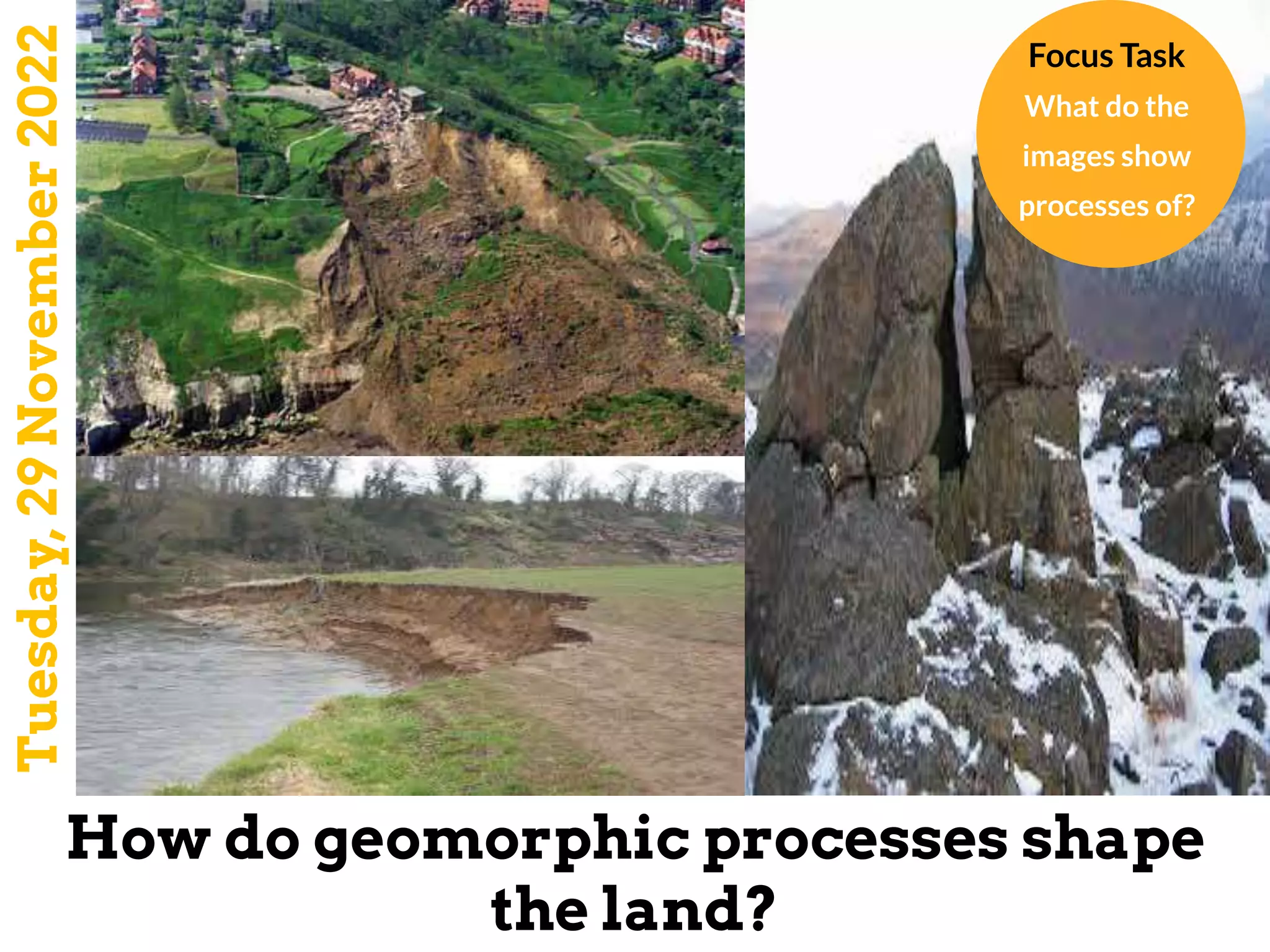
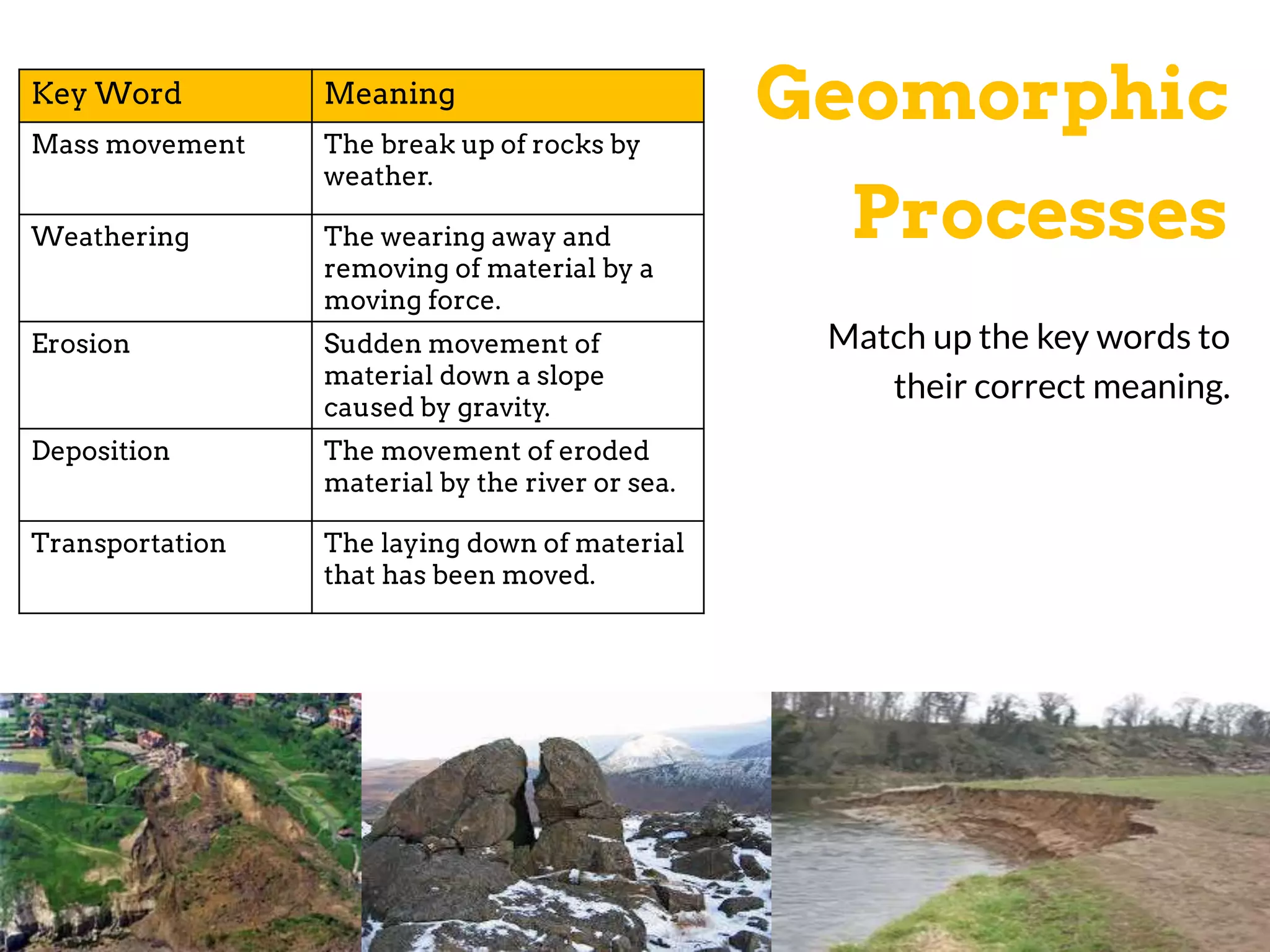
Focus Task
What do the
images show
processes of?
Tuesday,
29
November
2022
How do geomorphic processes shape
the land?
Starter
Practice exam question.
Geomorphic
Processes
What does the term
‘geomorphic processes’
mean?
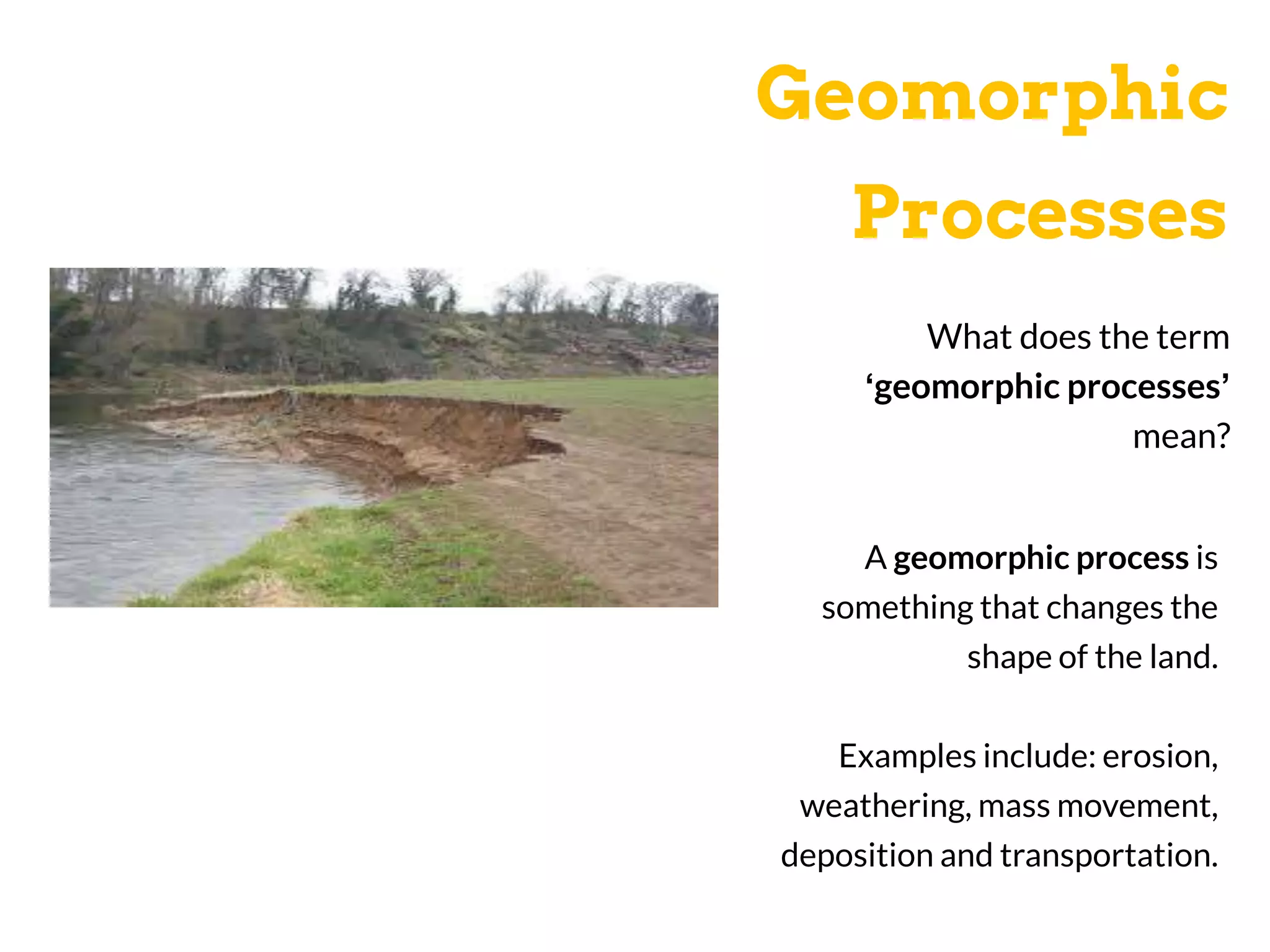
A geomorphic process is
something that changes the
shape of the land.
Examples include: erosion,
weathering, mass movement,
deposition and transportation.
Geomorphic
Processes
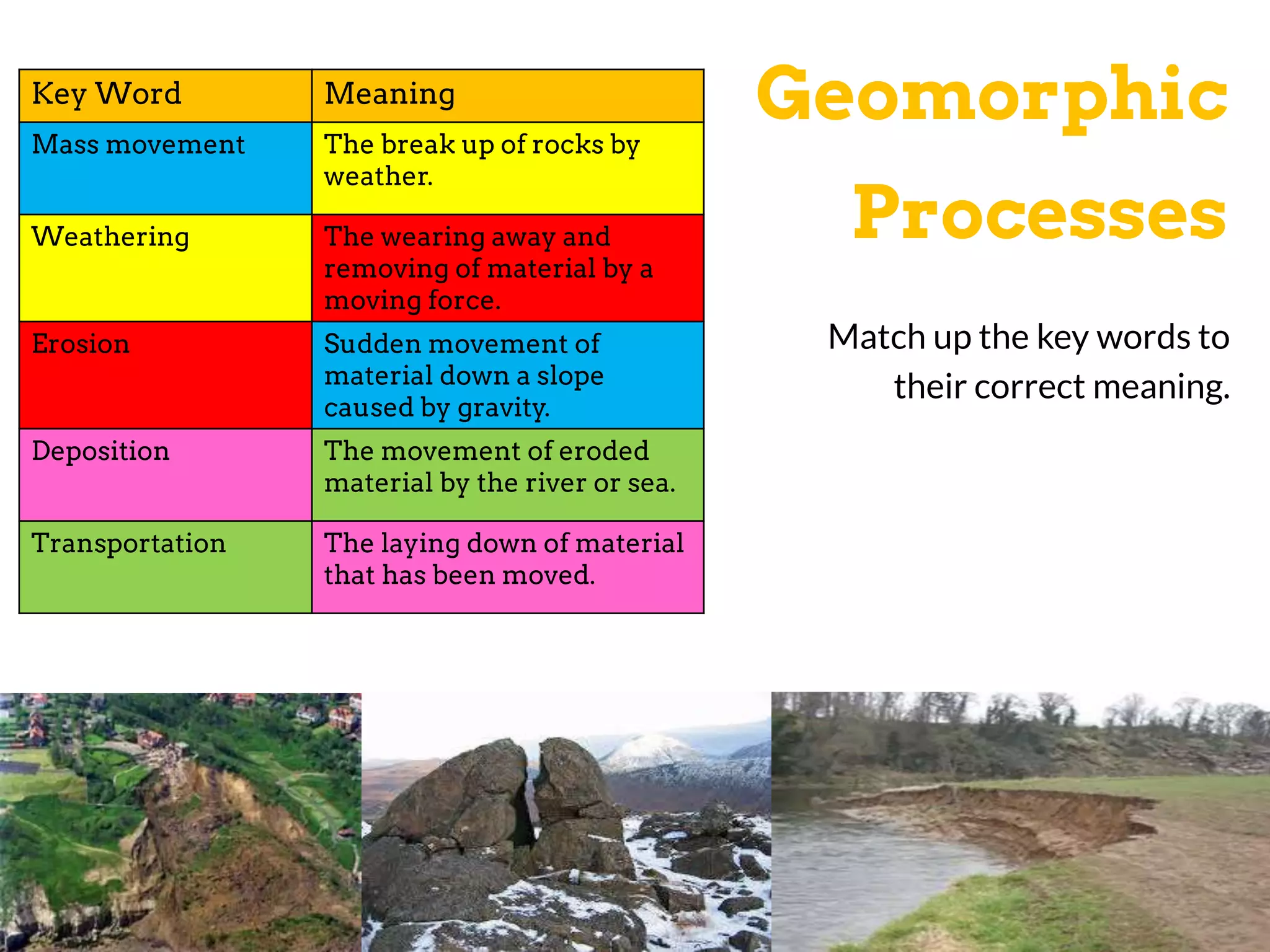
Match up the key words to
their correct meaning.
Key Word Meaning
Mass movement The break up of rocks by
weather.
Weathering The wearing away and
removing of material by a
moving force.
Erosion Sudden movement of
material down a slope
caused by gravity.
Deposition The movement of eroded
material by the river or sea.
Transportation The laying down of material
that has been moved.
Geomorphic
Processes
Match up the key words to
their correct meaning.
Key Word Meaning
Mass movement The break up of rocks by
weather.
Weathering The wearing away and
removing of material by a
moving force.
Erosion Sudden movement of
material down a slope
caused by gravity.
Deposition The movement of eroded
material by the river or sea.
Transportation The laying down of material
that has been moved.
Mass
Movement
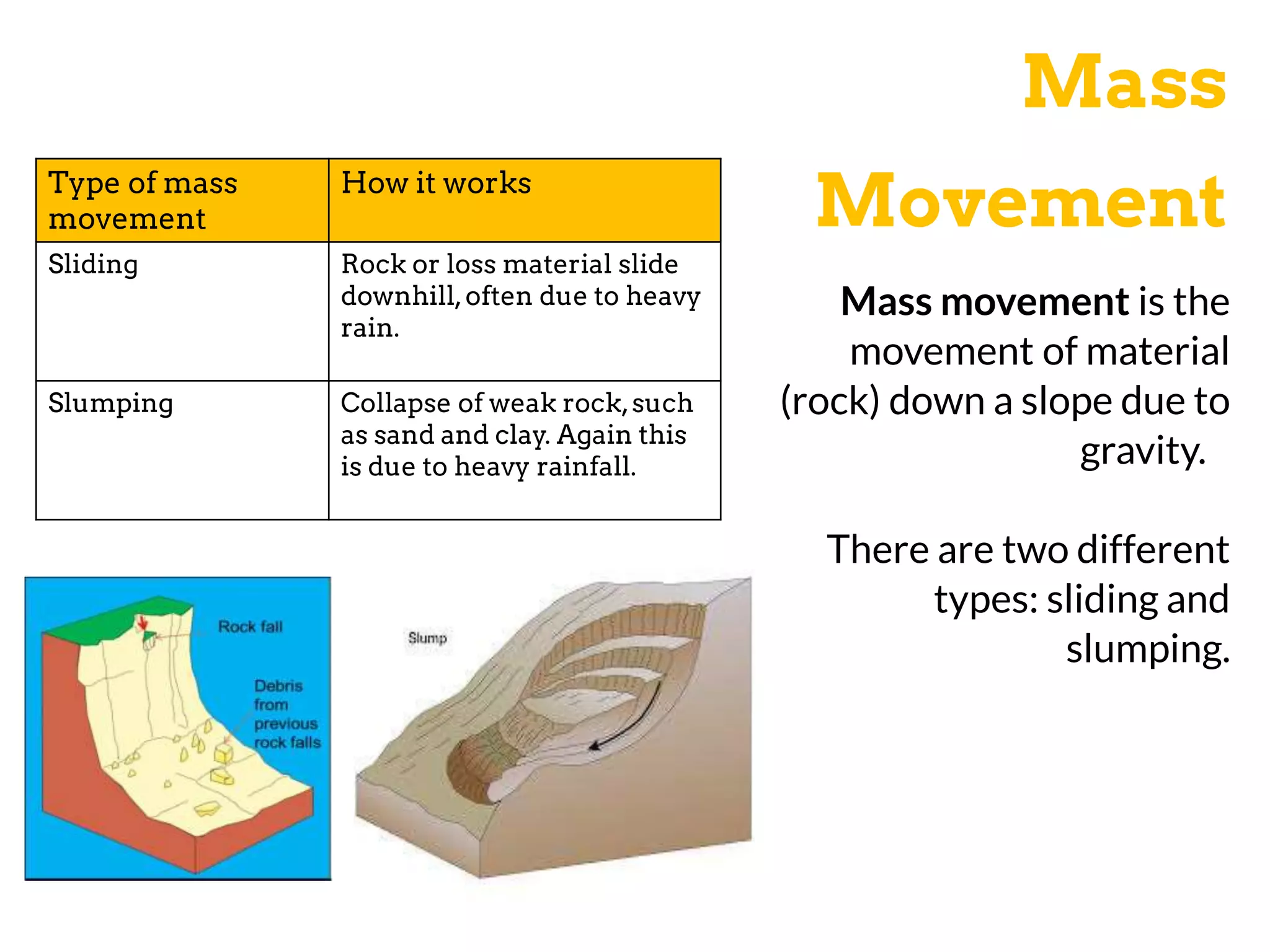
Mass movement is the
movement of material
(rock) down a slope due to
gravity.
There are two different
types: sliding and
slumping.
Type of mass
movement
How it works
Sliding Rock or loss material slide
downhill,often due to heavy
rain.
Slumping Collapse of weak rock,such
as sand and clay. Again this
is due to heavy rainfall.
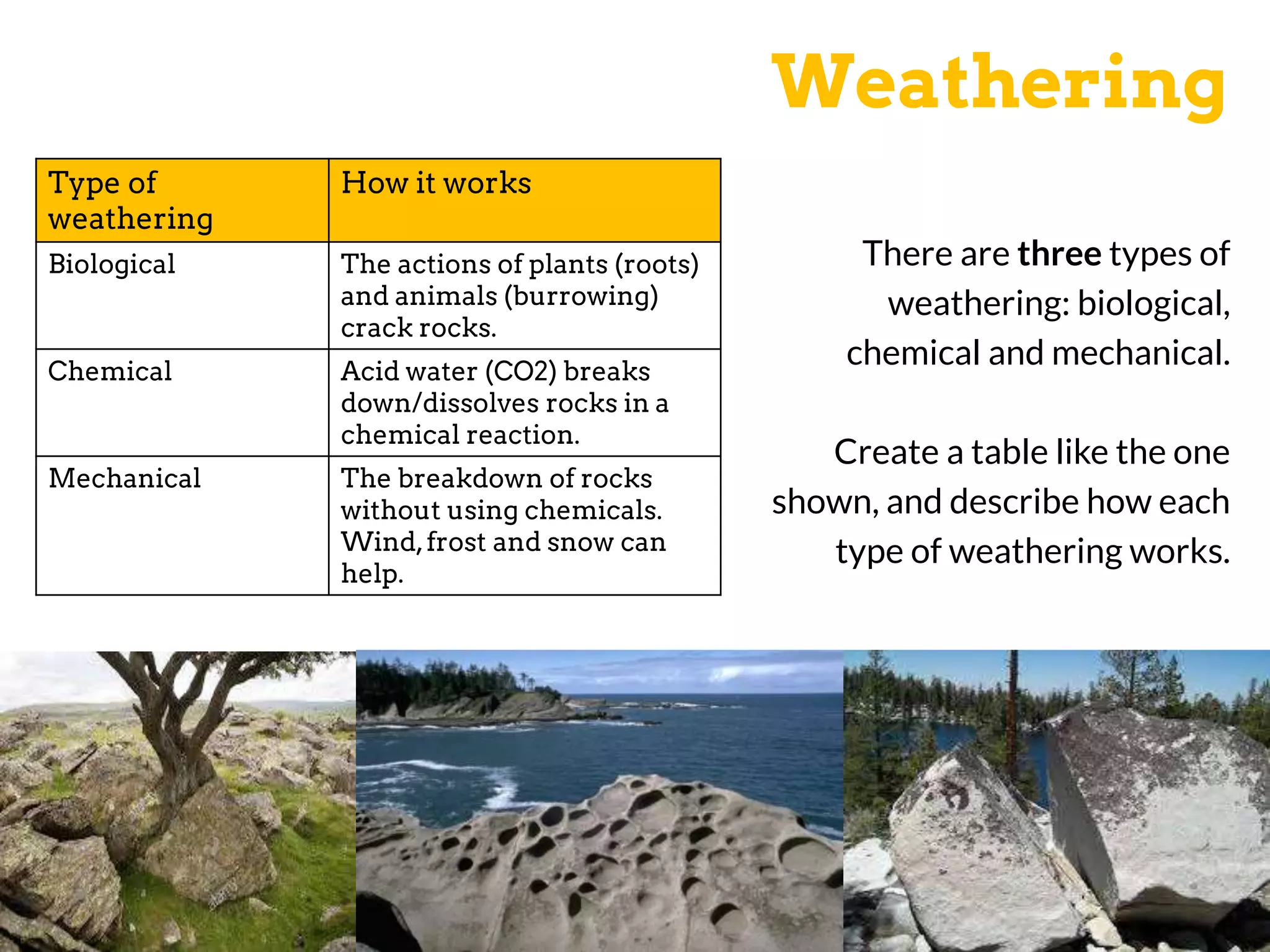
Weathering
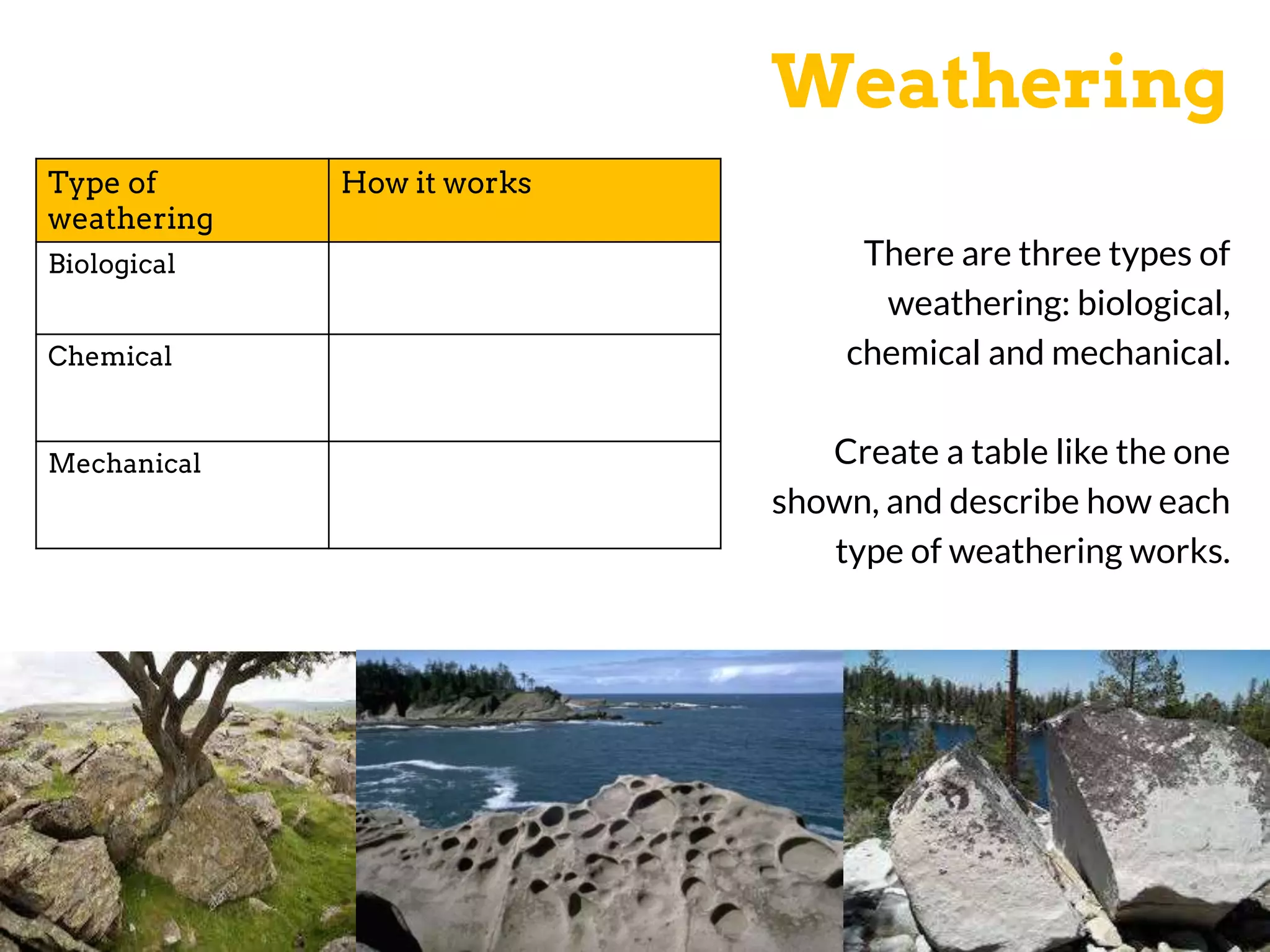
There are three types of
weathering: biological,
chemical and mechanical.
Create a table like the one
shown, and describe how each
type of weathering works.
Type of
weathering
How it works
Biological
Chemical
Mechanical
Weathering
There are three types of
weathering: biological,
chemical and mechanical.
Create a table like the one
shown, and describe how each
type of weathering works.
Type of
weathering
How it works
Biological The actions of plants (roots)
and animals (burrowing)
crack rocks.
Chemical Acid water (CO2) breaks
down/dissolves rocks in a
chemical reaction.
Mechanical The breakdown of rocks
without using chemicals.
Wind,frost and snow can
help.
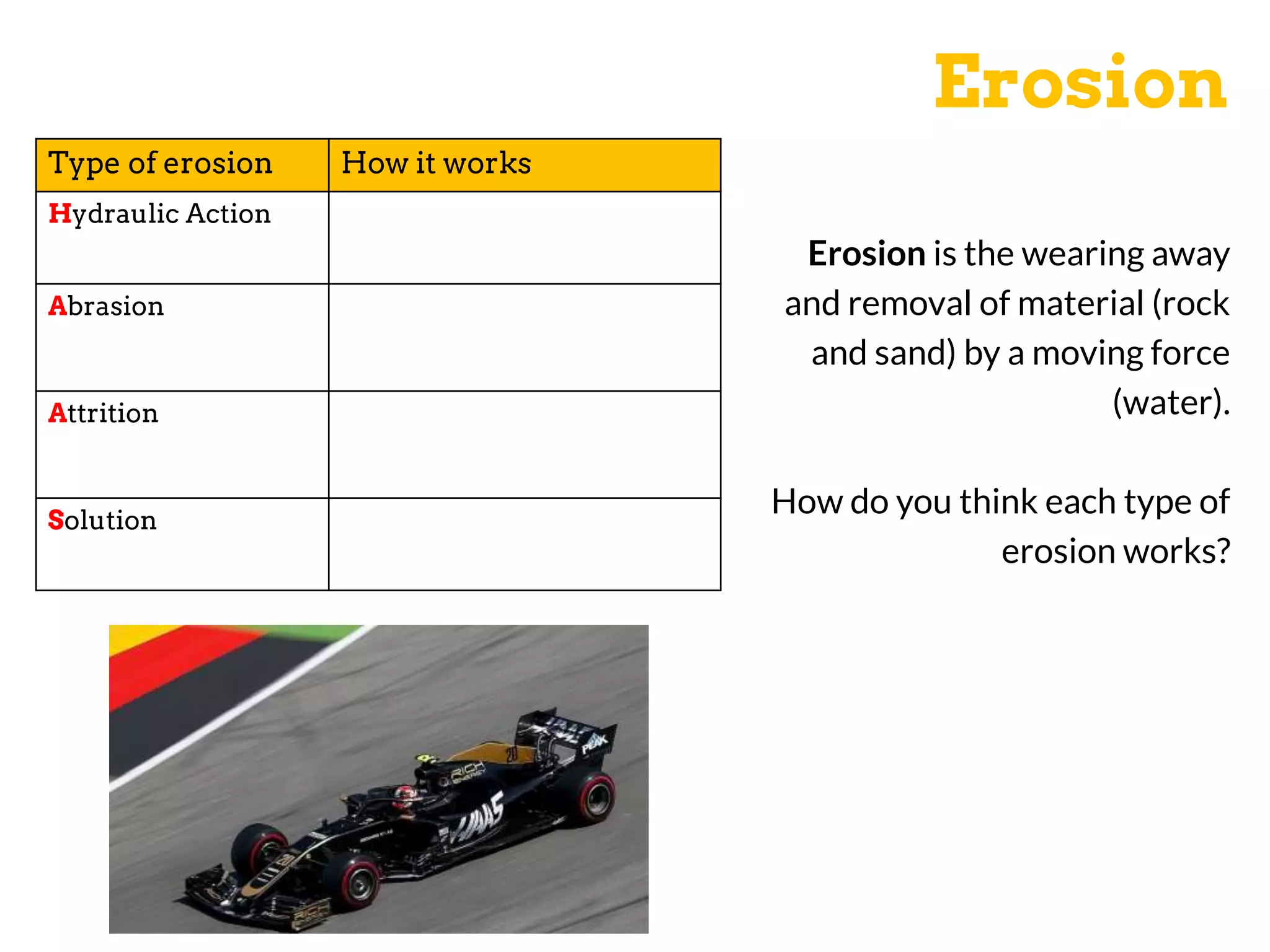
Erosion
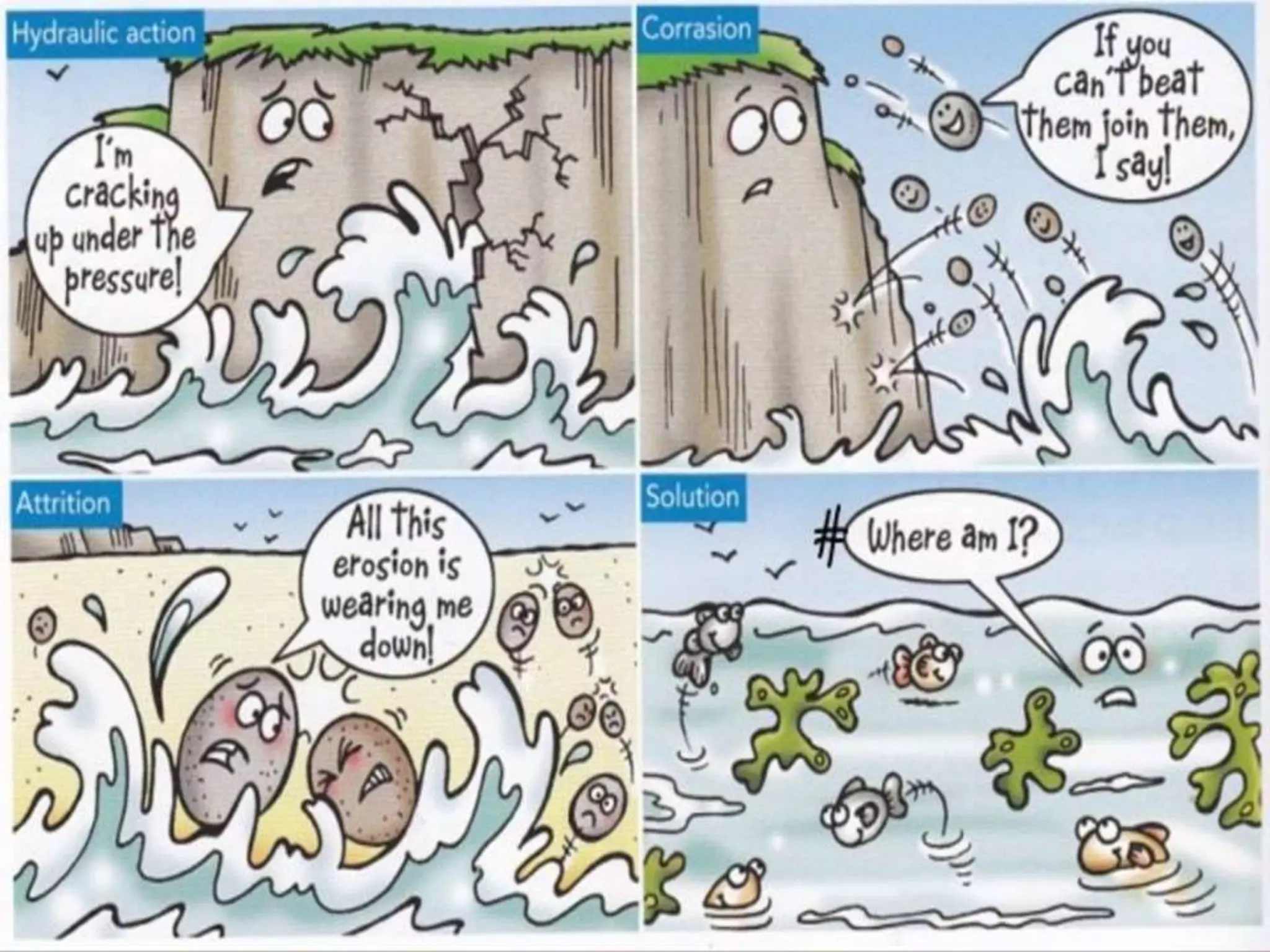
Erosion is the wearing away
and removal of material (rock
and sand) by a moving force
(water).
How do you think each type of
erosion works?
Type of erosion How it works
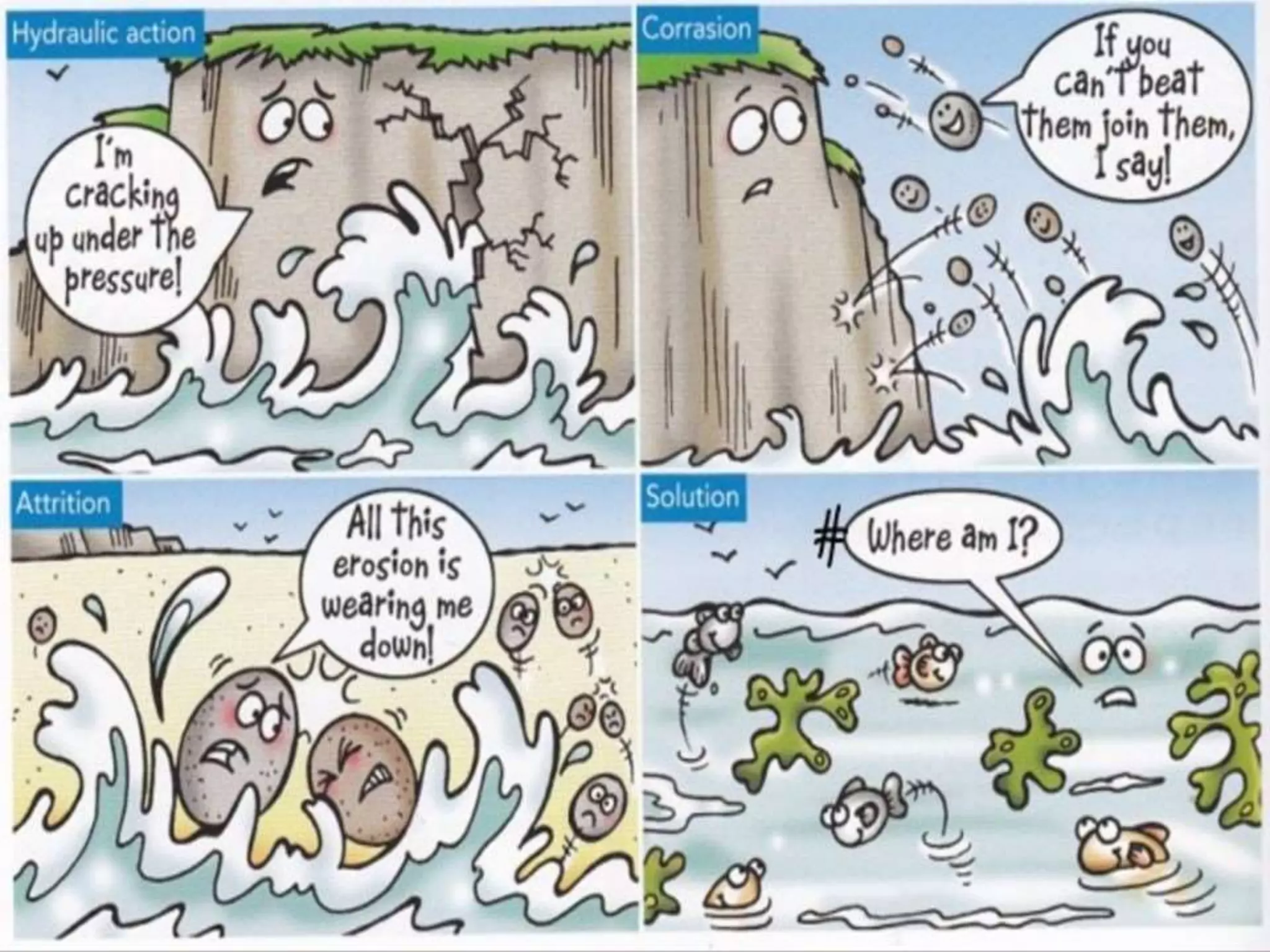
Hydraulic Action
Abrasion
Attrition
Solution
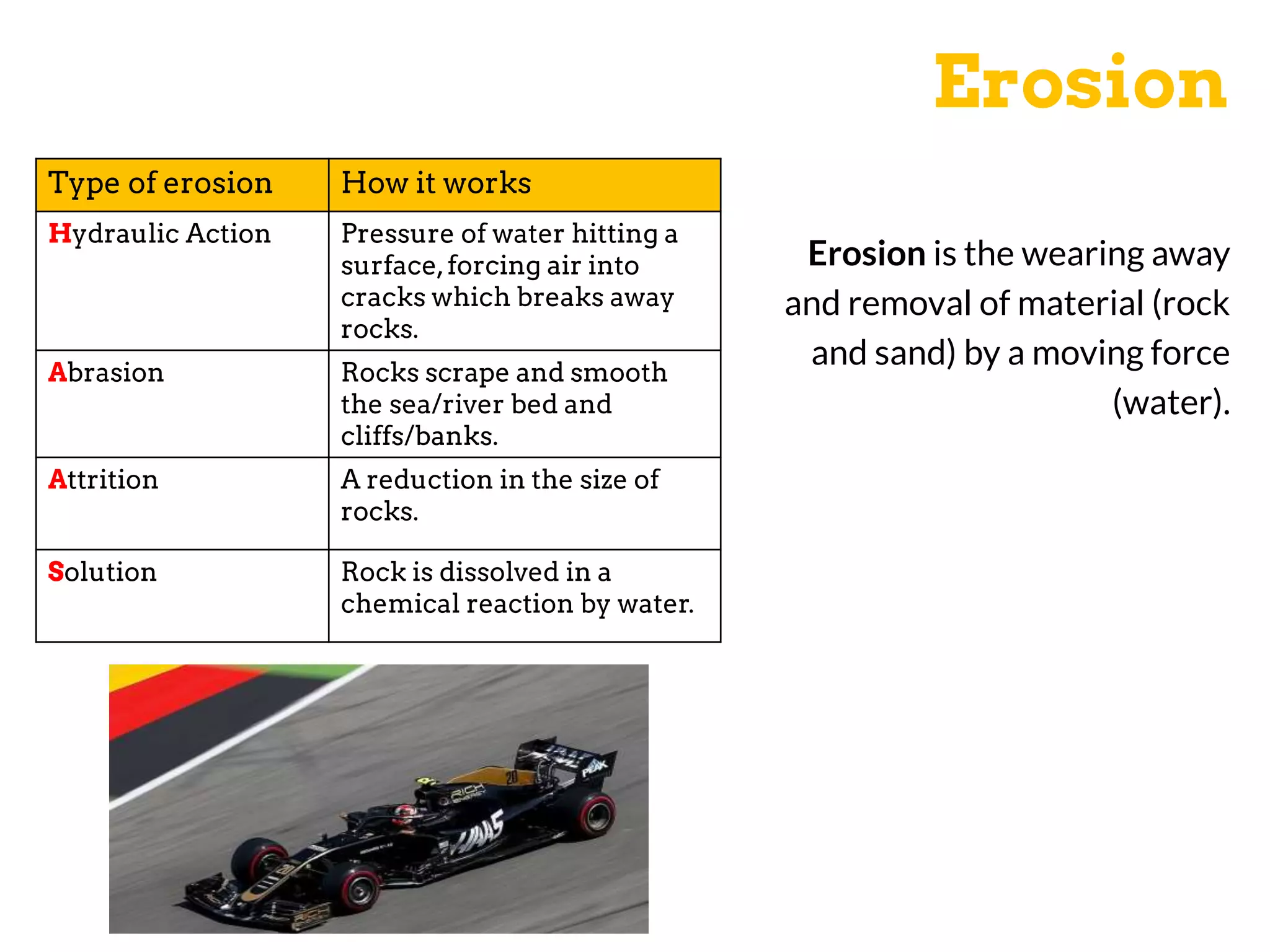
Erosion
Erosion is the wearing away
and removal of material (rock
and sand) by a moving force
(water).
Type of erosion How it works
Hydraulic Action Pressure of water hitting a
surface,forcing air into
cracks which breaks away
rocks.
Abrasion Rocks scrape and smooth
the sea/river bed and
cliffs/banks.
Attrition A reduction in the size of
rocks.
Solution Rock is dissolved in a
chemical reaction by water.
Deposition
Deposition is when material
being transported (moved) is
dropped due to a loss of
energy.
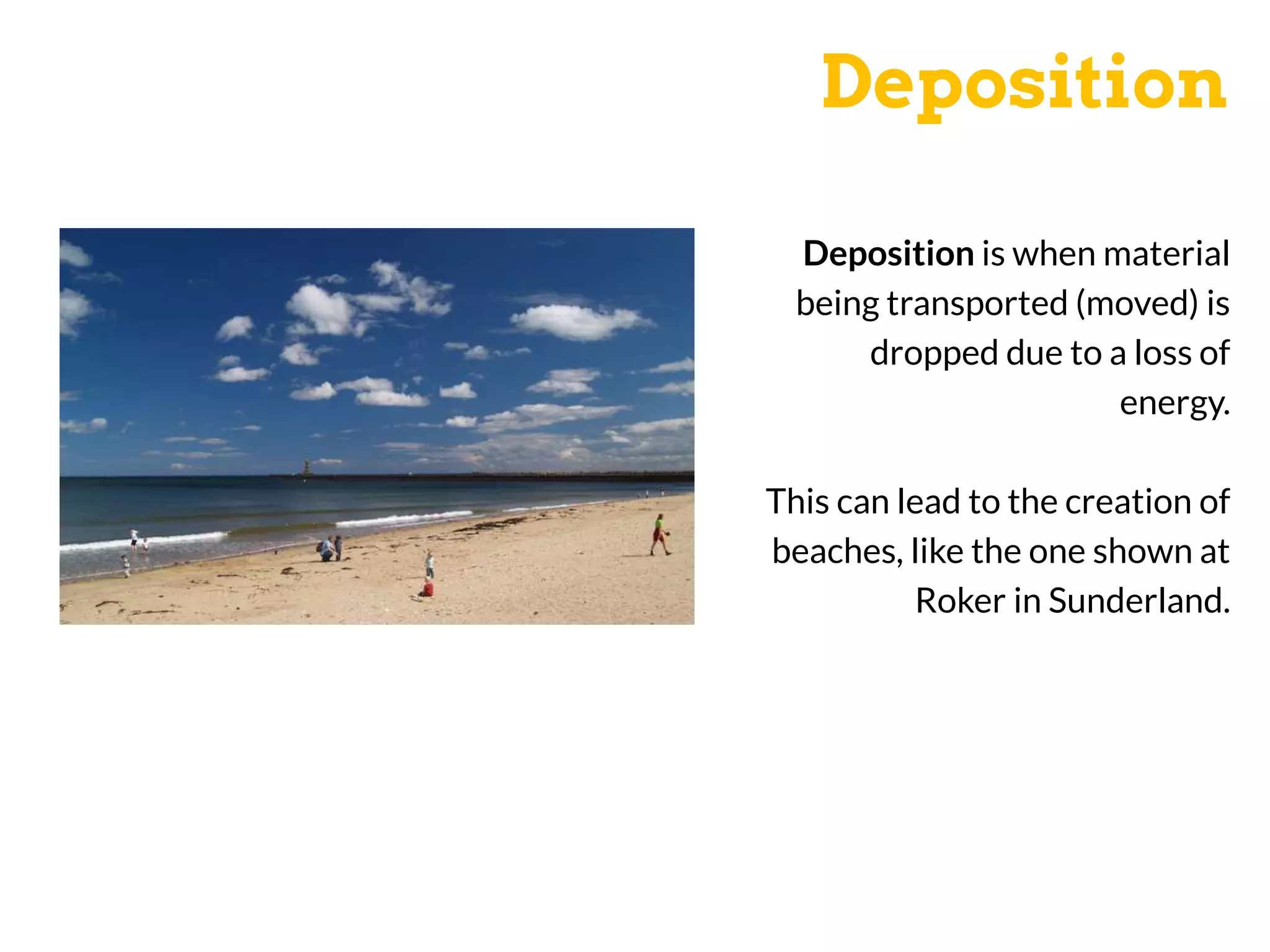
This can lead to the creation of
beaches, like the one shown at
Roker in Sunderland.
Transportation
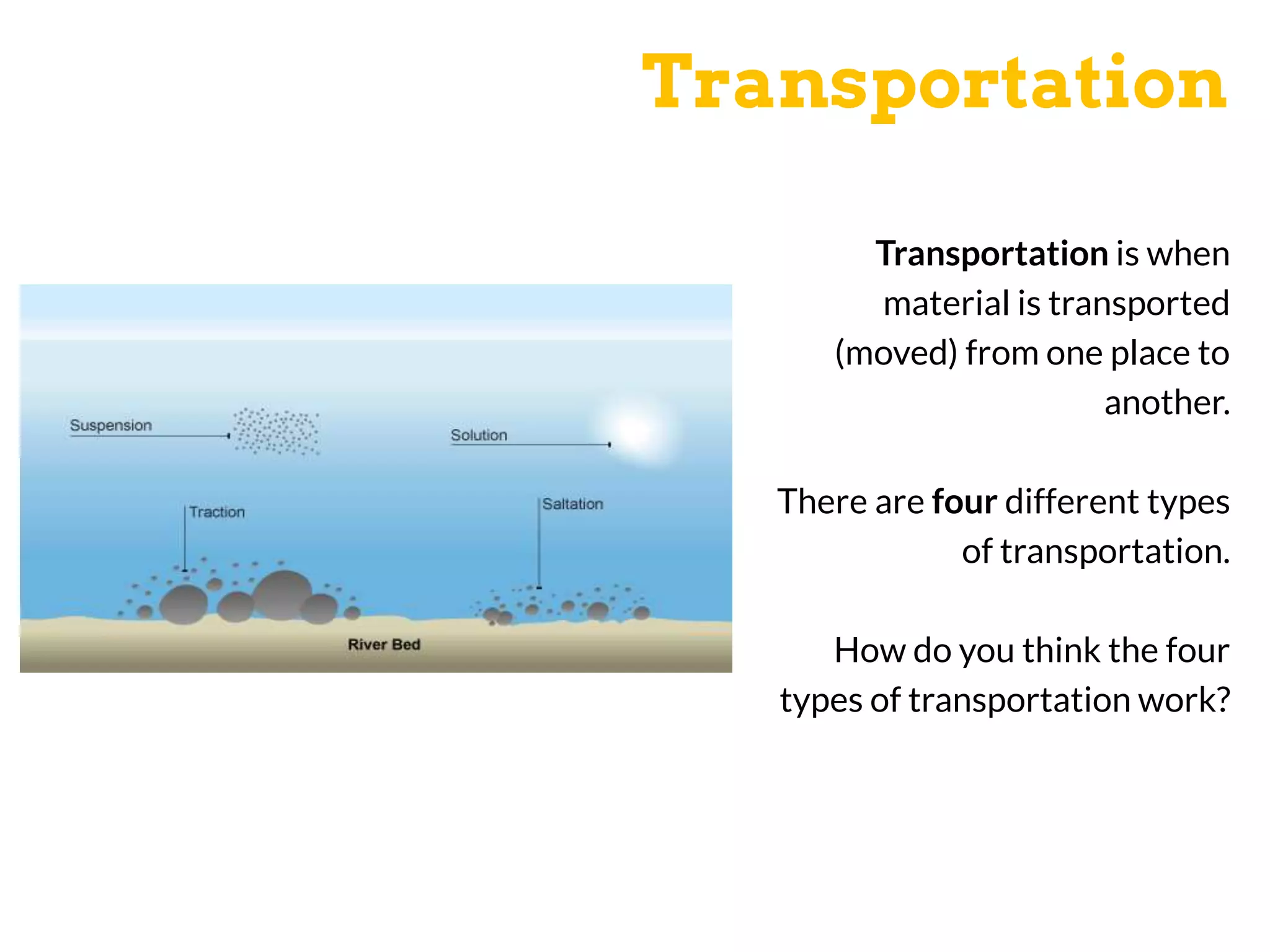
Transportation is when
material is transported
(moved) from one place to
another.
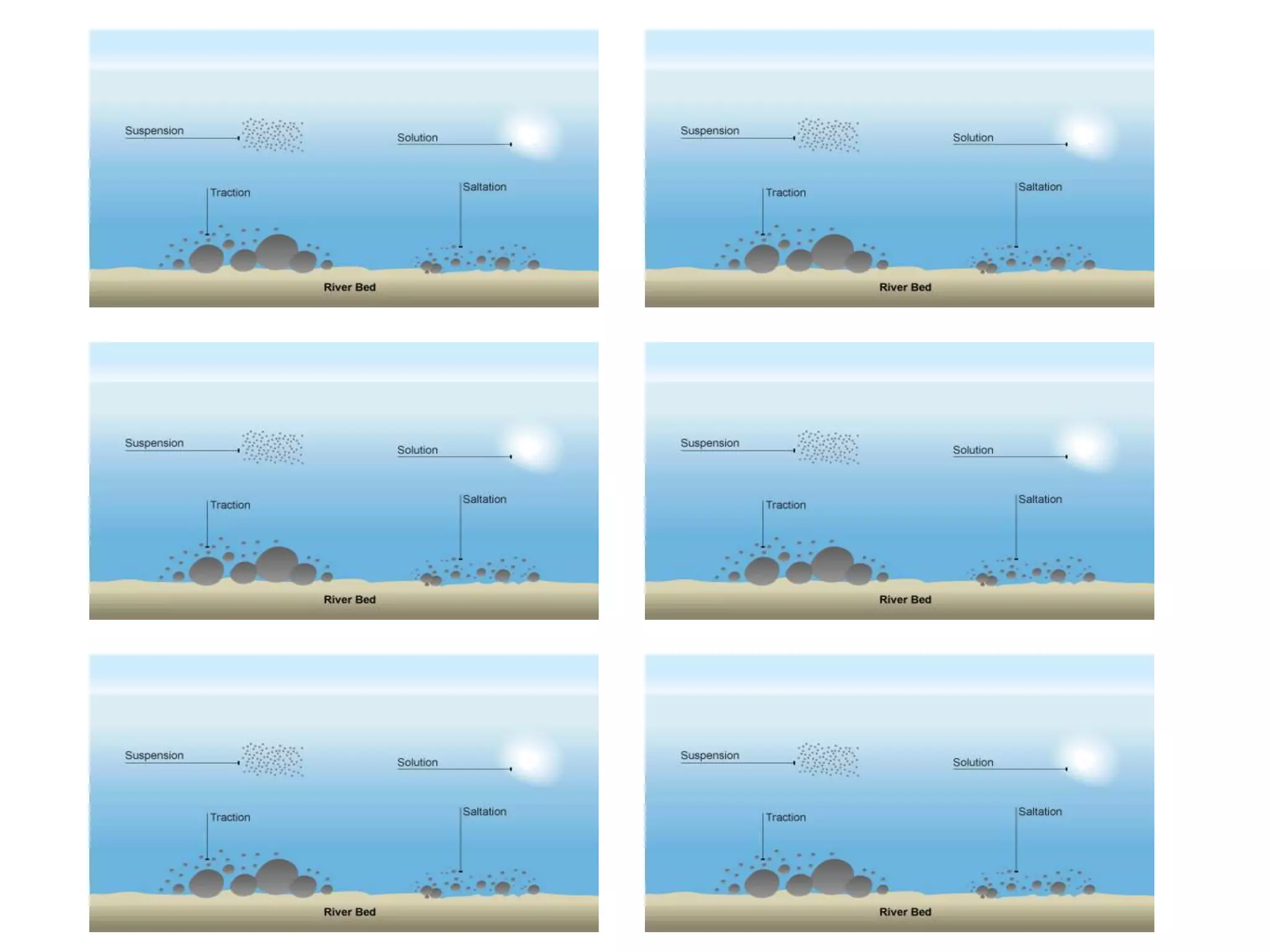
There are four different types
of transportation.
How do you think the four
types of transportation work?
Transportation
Type of erosion How it works
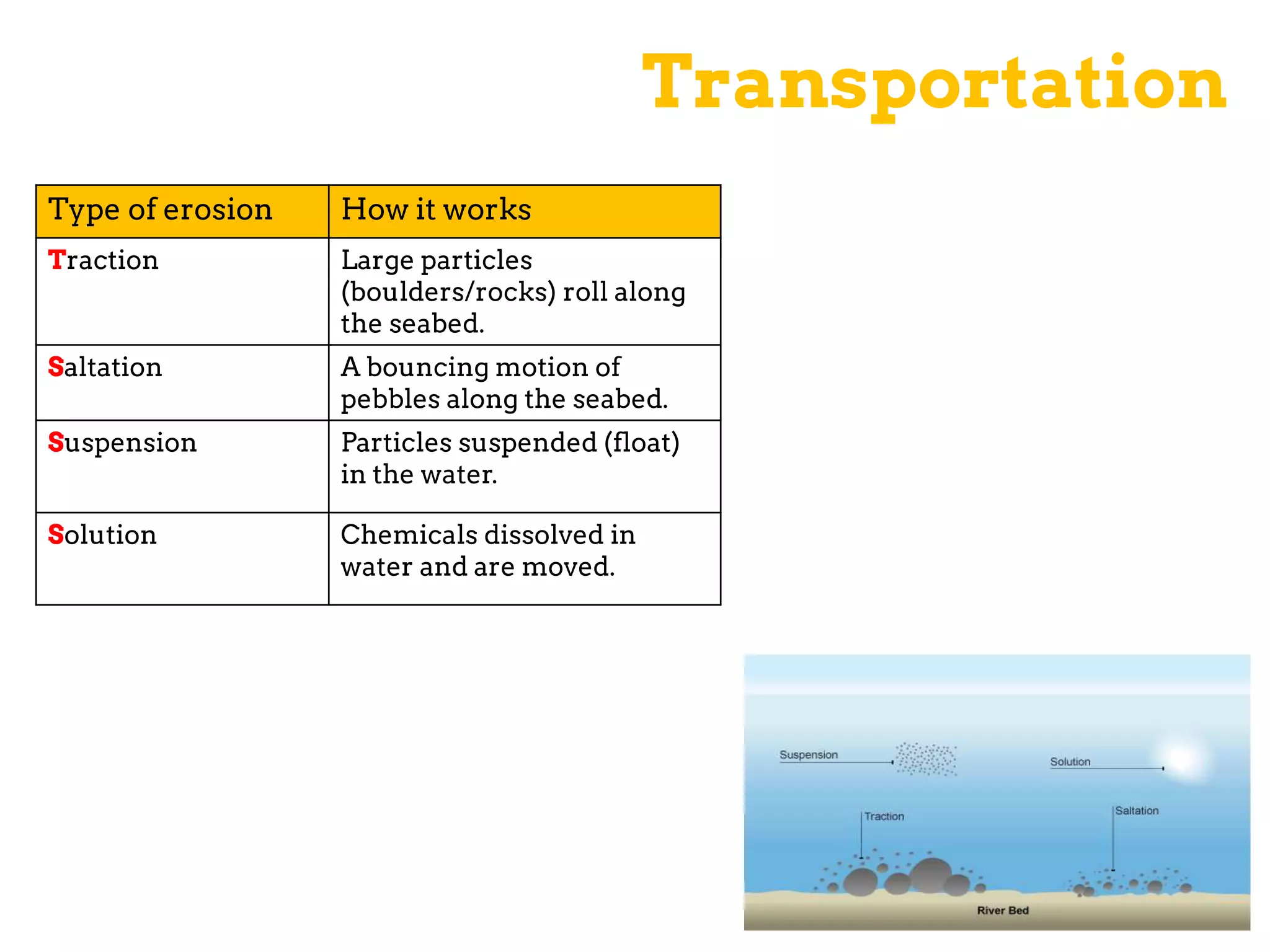
Traction Large particles
(boulders/rocks) roll along
the seabed.
Saltation A bouncing motion of
pebbles along the seabed.
Suspension Particles suspended (float)
in the water.
Solution Chemicals dissolved in
water and are moved.
Steps to
Success
Examine the impact of
geomorphic processes on river
landscapes.
Step What to include
1: Opening sentence Geomorphic processes such as
……… impact river landscapes.
2: Erosion Explain how at least two types of
erosion work and what landforms
they can create.
3: Mass Movement Explain how mass movement
(sliding and slumping) work.
4: Transportation Explain how at least two types of
transportation work,and the impact
this has.
5. Judgement- do
geomorphic processes
impact river landscapes?
Geomorphic processes do/do not
impact river landscapes. This is
because…
Resources
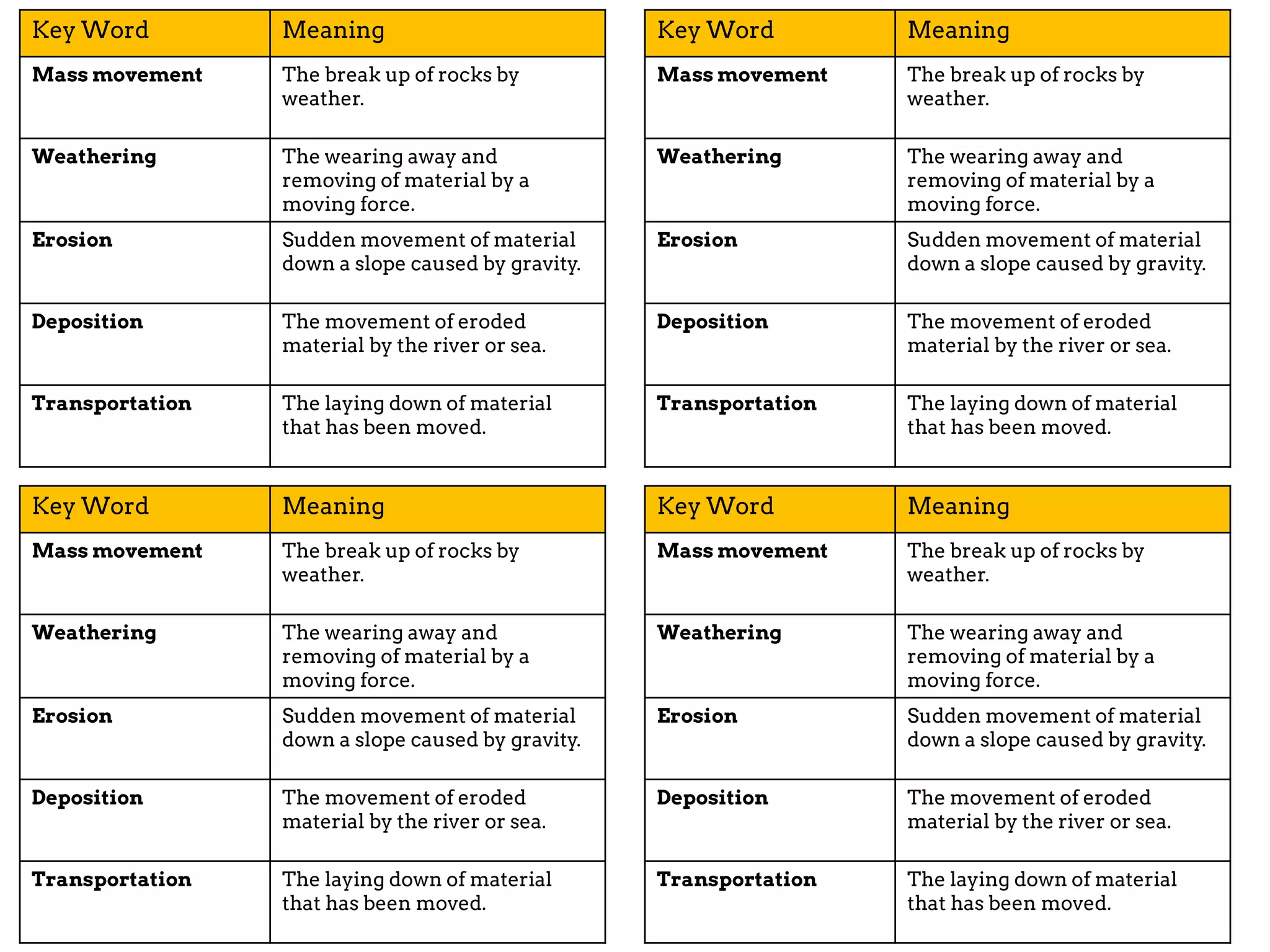
Key Word Meaning
Mass movement The break up of rocks by
weather.
Weathering The wearing away and
removing of material by a
moving force.
Erosion Sudden movement of material
down a slope caused by gravity.
Deposition The movement of eroded
material by the river or sea.
Transportation The laying down of material
that has been moved.
Key Word Meaning
Mass movement The break up of rocks by
weather.
Weathering The wearing away and
removing of material by a
moving force.
Erosion Sudden movement of material
down a slope caused by gravity.
Deposition The movement of eroded
material by the river or sea.
Transportation The laying down of material
that has been moved.
Key Word Meaning
Mass movement The break up of rocks by
weather.
Weathering The wearing away and
removing of material by a
moving force.
Erosion Sudden movement of material
down a slope caused by gravity.
Deposition The movement of eroded
material by the river or sea.
Transportation The laying down of material
that has been moved.
Key Word Meaning
Mass movement The break up of rocks by
weather.
Weathering The wearing away and
removing of material by a
moving force.
Erosion Sudden movement of material
down a slope caused by gravity.
Deposition The movement of eroded
material by the river or sea.
Transportation The laying down of material
that has been moved.
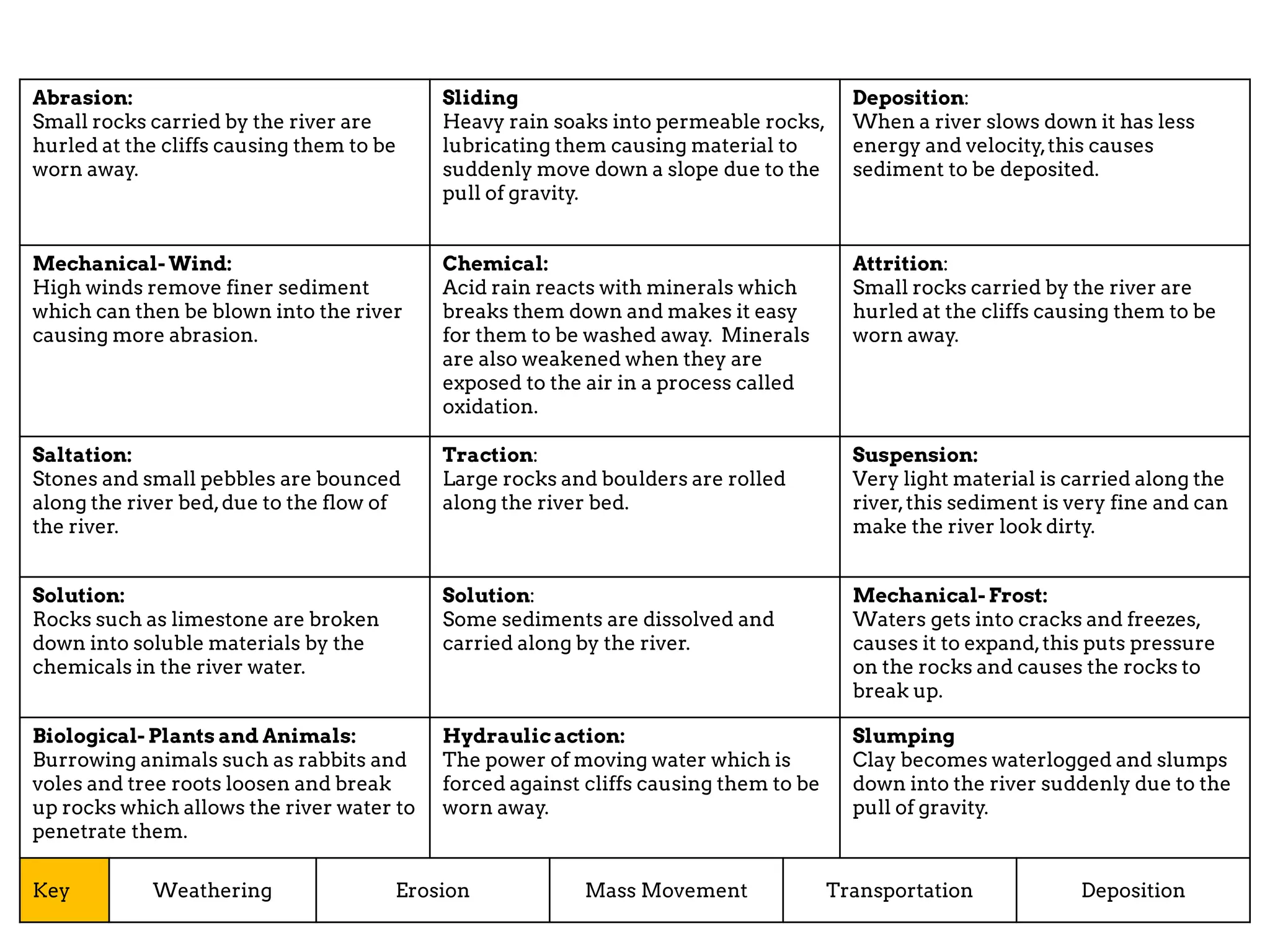
Abrasion:
Small rocks carried by the river are
hurled at the cliffs causing them to be
worn away.
Sliding
Heavy rain soaks into permeable rocks,
lubricating them causing material to
suddenly move down a slope due to the
pull of gravity.
Deposition:
When a river slows down it has less
energy and velocity,this causes
sediment to be deposited.
Mechanical- Wind:
High winds remove finer sediment
which can then be blown into the river
causing more abrasion.
Chemical:
Acid rain reacts with minerals which
breaks them down and makes it easy
for them to be washed away. Minerals
are also weakened when they are
exposed to the air in a process called
oxidation.
Attrition:
Small rocks carried by the river are
hurled at the cliffs causing them to be
worn away.
Saltation:
Stones and small pebbles are bounced
along the river bed,due to the flow of
the river.
Traction:
Large rocks and boulders are rolled
along the river bed.
Suspension:
Very light material is carried along the
river,this sediment is very fine and can
make the river look dirty.
Solution:
Rocks such as limestone are broken
down into soluble materials by the
chemicals in the river water.
Solution:
Some sediments are dissolved and
carried along by the river.
Mechanical- Frost:
Waters gets into cracks and freezes,
causes it to expand,this puts pressure
on the rocks and causes the rocks to
break up.
Biological- Plants and Animals:
Burrowing animals such as rabbits and
voles and tree roots loosen and break
up rocks which allows the river water to
penetrate them.
Hydraulic action:
The power of moving water which is
forced against cliffs causing them to be
worn away.
Slumping
Clay becomes waterlogged and slumps
down into the river suddenly due to the
pull of gravity.
Key Weathering Erosion Mass Movement Transportation Deposition

3.-Geomorphic-Processes.pptx

  • 2.
    Focus Task What dothe images show processes of? Tuesday, 29 November 2022 How do geomorphic processes shape the land?
  • 3.
  • 4.
    Geomorphic Processes What does theterm ‘geomorphic processes’ mean? A geomorphic process is something that changes the shape of the land. Examples include: erosion, weathering, mass movement, deposition and transportation.
  • 5.
    Geomorphic Processes Match up thekey words to their correct meaning. Key Word Meaning Mass movement The break up of rocks by weather. Weathering The wearing away and removing of material by a moving force. Erosion Sudden movement of material down a slope caused by gravity. Deposition The movement of eroded material by the river or sea. Transportation The laying down of material that has been moved.
  • 6.
    Geomorphic Processes Match up thekey words to their correct meaning. Key Word Meaning Mass movement The break up of rocks by weather. Weathering The wearing away and removing of material by a moving force. Erosion Sudden movement of material down a slope caused by gravity. Deposition The movement of eroded material by the river or sea. Transportation The laying down of material that has been moved.
  • 7.
    Mass Movement Mass movement isthe movement of material (rock) down a slope due to gravity. There are two different types: sliding and slumping. Type of mass movement How it works Sliding Rock or loss material slide downhill,often due to heavy rain. Slumping Collapse of weak rock,such as sand and clay. Again this is due to heavy rainfall.
  • 8.
    Weathering There are threetypes of weathering: biological, chemical and mechanical. Create a table like the one shown, and describe how each type of weathering works. Type of weathering How it works Biological Chemical Mechanical
  • 9.
    Weathering There are threetypes of weathering: biological, chemical and mechanical. Create a table like the one shown, and describe how each type of weathering works. Type of weathering How it works Biological The actions of plants (roots) and animals (burrowing) crack rocks. Chemical Acid water (CO2) breaks down/dissolves rocks in a chemical reaction. Mechanical The breakdown of rocks without using chemicals. Wind,frost and snow can help.
  • 10.
    Erosion Erosion is thewearing away and removal of material (rock and sand) by a moving force (water). How do you think each type of erosion works? Type of erosion How it works Hydraulic Action Abrasion Attrition Solution
  • 11.
    Erosion Erosion is thewearing away and removal of material (rock and sand) by a moving force (water). Type of erosion How it works Hydraulic Action Pressure of water hitting a surface,forcing air into cracks which breaks away rocks. Abrasion Rocks scrape and smooth the sea/river bed and cliffs/banks. Attrition A reduction in the size of rocks. Solution Rock is dissolved in a chemical reaction by water.
  • 13.
    Deposition Deposition is whenmaterial being transported (moved) is dropped due to a loss of energy. This can lead to the creation of beaches, like the one shown at Roker in Sunderland.
  • 14.
    Transportation Transportation is when materialis transported (moved) from one place to another. There are four different types of transportation. How do you think the four types of transportation work?
  • 15.
    Transportation Type of erosionHow it works Traction Large particles (boulders/rocks) roll along the seabed. Saltation A bouncing motion of pebbles along the seabed. Suspension Particles suspended (float) in the water. Solution Chemicals dissolved in water and are moved.
  • 16.
    Steps to Success Examine theimpact of geomorphic processes on river landscapes. Step What to include 1: Opening sentence Geomorphic processes such as ……… impact river landscapes. 2: Erosion Explain how at least two types of erosion work and what landforms they can create. 3: Mass Movement Explain how mass movement (sliding and slumping) work. 4: Transportation Explain how at least two types of transportation work,and the impact this has. 5. Judgement- do geomorphic processes impact river landscapes? Geomorphic processes do/do not impact river landscapes. This is because…
  • 17.
  • 18.
    Key Word Meaning Massmovement The break up of rocks by weather. Weathering The wearing away and removing of material by a moving force. Erosion Sudden movement of material down a slope caused by gravity. Deposition The movement of eroded material by the river or sea. Transportation The laying down of material that has been moved. Key Word Meaning Mass movement The break up of rocks by weather. Weathering The wearing away and removing of material by a moving force. Erosion Sudden movement of material down a slope caused by gravity. Deposition The movement of eroded material by the river or sea. Transportation The laying down of material that has been moved. Key Word Meaning Mass movement The break up of rocks by weather. Weathering The wearing away and removing of material by a moving force. Erosion Sudden movement of material down a slope caused by gravity. Deposition The movement of eroded material by the river or sea. Transportation The laying down of material that has been moved. Key Word Meaning Mass movement The break up of rocks by weather. Weathering The wearing away and removing of material by a moving force. Erosion Sudden movement of material down a slope caused by gravity. Deposition The movement of eroded material by the river or sea. Transportation The laying down of material that has been moved.
  • 20.
    Abrasion: Small rocks carriedby the river are hurled at the cliffs causing them to be worn away. Sliding Heavy rain soaks into permeable rocks, lubricating them causing material to suddenly move down a slope due to the pull of gravity. Deposition: When a river slows down it has less energy and velocity,this causes sediment to be deposited. Mechanical- Wind: High winds remove finer sediment which can then be blown into the river causing more abrasion. Chemical: Acid rain reacts with minerals which breaks them down and makes it easy for them to be washed away. Minerals are also weakened when they are exposed to the air in a process called oxidation. Attrition: Small rocks carried by the river are hurled at the cliffs causing them to be worn away. Saltation: Stones and small pebbles are bounced along the river bed,due to the flow of the river. Traction: Large rocks and boulders are rolled along the river bed. Suspension: Very light material is carried along the river,this sediment is very fine and can make the river look dirty. Solution: Rocks such as limestone are broken down into soluble materials by the chemicals in the river water. Solution: Some sediments are dissolved and carried along by the river. Mechanical- Frost: Waters gets into cracks and freezes, causes it to expand,this puts pressure on the rocks and causes the rocks to break up. Biological- Plants and Animals: Burrowing animals such as rabbits and voles and tree roots loosen and break up rocks which allows the river water to penetrate them. Hydraulic action: The power of moving water which is forced against cliffs causing them to be worn away. Slumping Clay becomes waterlogged and slumps down into the river suddenly due to the pull of gravity. Key Weathering Erosion Mass Movement Transportation Deposition

Editor's Notes