Settlement Change
Unit 3 – June 6th 2014
Functions of a Settlement
A function simply means what a settlement is used for.
Historically most settlements where for defence or to control
a piece of land, or for agriculture and trade.
However, most settlements now rely on the tertiary sector
and provide services such as shops, schools, hospitals and
entertainment
One function that is common to all settlements is to provide
housing. Some settlements have become dormitory
settlements where people commute to work but are only at
home in the evenings and weekends.
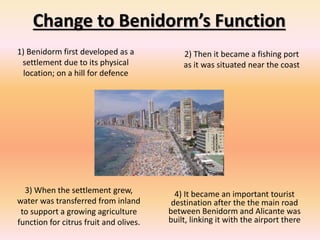
Change to Benidorm’s Function
1) Benidorm first developed as a
settlement due to its physical
location; on a hill for defence
2) Then it became a fishing port
as it was situated near the coast
3) When the settlement grew,
water was transferred from inland
to support a growing agriculture
function for citrus fruit and olives.
4) It became an important tourist
destination after the the main road
between Benidorm and Alicante was
built, linking it with the airport there
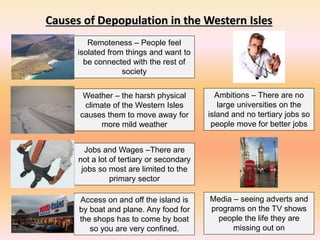
Causes of Depopulation in the Western Isles
Access on and off the island is
by boat and plane. Any food for
the shops has to come by boat
so you are very confined.
Remoteness – People feel
isolated from things and want to
be connected with the rest of
society
Jobs and Wages –There are
not a lot of tertiary or secondary
jobs so most are limited to the
primary sector
Weather – the harsh physical
climate of the Western Isles
causes them to move away for
more mild weather
Ambitions – There are no
large universities on the
island and no tertiary jobs so
people move for better jobs
Media – seeing adverts and
programs on the TV shows
people the life they are
missing out on
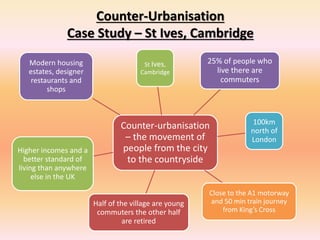
Counter-Urbanisation
Case Study – St Ives, Cambridge
Counter-urbanisation
– the movement of
people from the city
to the countryside
St Ives,
Cambridge
25% of people who
live there are
commuters
100km
north of
London
Close to the A1 motorway
and 50 min train journey
from King’s Cross
Half of the village are young
commuters the other half
are retired
Higher incomes and a
better standard of
living than anywhere
else in the UK
Modern housing
estates, designer
restaurants and
shops
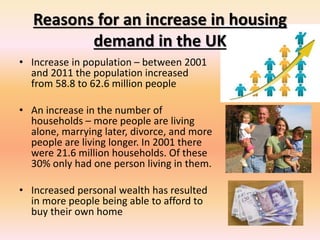
Reasons for an increase in housing
demand in the UK
• Increase in population – between 2001
and 2011 the population increased
from 58.8 to 62.6 million people
• An increase in the number of
households – more people are living
alone, marrying later, divorce, and more
people are living longer. In 2001 there
were 21.6 million households. Of these
30% only had one person living in them.
• Increased personal wealth has resulted
in more people being able to afford to
buy their own home
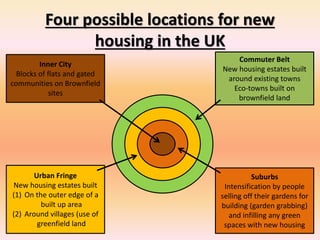
Four possible locations for new
housing in the UK
Commuter Belt
New housing estates built
around existing towns
Eco-towns built on
brownfield land
Suburbs
Intensification by people
selling off their gardens for
building (garden grabbing)
and infilling any green
spaces with new housing
Inner City
Blocks of flats and gated
communities on Brownfield
sites
Urban Fringe
New housing estates built
(1) On the outer edge of a
built up area
(2) Around villages (use of
greenfield land
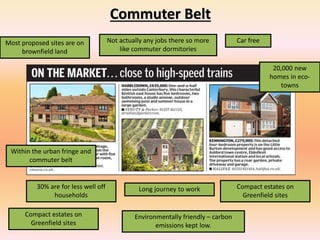
Commuter Belt
Compact estates on
Greenfield sites
Long journey to work
Car freeMost proposed sites are on
brownfield land
Not actually any jobs there so more
like commuter dormitories
Within the urban fringe and
commuter belt
Environmentally friendly – carbon
emissions kept low.
30% are for less well off
households
Compact estates on
Greenfield sites
20,000 new
homes in eco-
towns
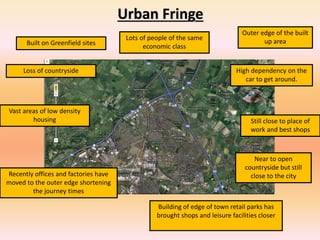
Urban Fringe
Outer edge of the built
up area
Near to open
countryside but still
close to the city
Built on Greenfield sites
Loss of countryside High dependency on the
car to get around.
Lots of people of the same
economic class
Vast areas of low density
housing Still close to place of
work and best shops
Building of edge of town retail parks has
brought shops and leisure facilities closer
Recently offices and factories have
moved to the outer edge shortening
the journey times
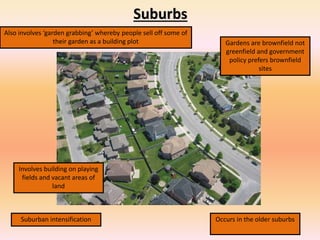
Suburbs
Also involves ‘garden grabbing’ whereby people sell off some of
their garden as a building plot Gardens are brownfield not
greenfield and government
policy prefers brownfield
sites
Suburban intensification Occurs in the older suburbs
Involves building on playing
fields and vacant areas of
land
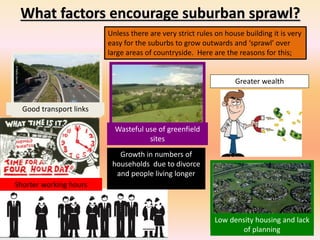
What factors encourage suburban sprawl?
Good transport links
Wasteful use of greenfield
sites
Greater wealth
Low density housing and lack
of planning
Growth in numbers of
households due to divorce
and people living longer
Shorter working hours
Unless there are very strict rules on house building it is very
easy for the suburbs to grow outwards and ‘sprawl’ over
large areas of countryside. Here are the reasons for this;
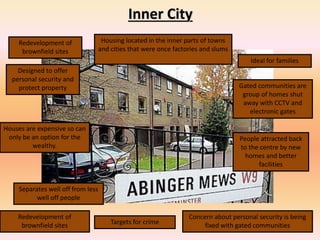
Inner City
Redevelopment of
brownfield sites
Housing located in the inner parts of towns
and cities that were once factories and slums
Concern about personal security is being
fixed with gated communities
Gated communities are
group of homes shut
away with CCTV and
electronic gates
Designed to offer
personal security and
protect property
Ideal for families
Redevelopment of
brownfield sites
Separates well off from less
well off people
Houses are expensive so can
only be an option for the
wealthy.
Targets for crime
People attracted back
to the centre by new
homes and better
facilities
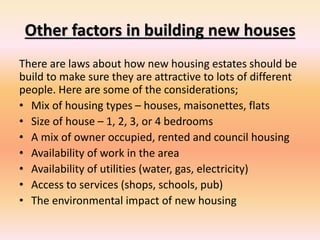
Other factors in building new houses
There are laws about how new housing estates should be
build to make sure they are attractive to lots of different
people. Here are some of the considerations;
• Mix of housing types – houses, maisonettes, flats
• Size of house – 1, 2, 3, or 4 bedrooms
• A mix of owner occupied, rented and council housing
• Availability of work in the area
• Availability of utilities (water, gas, electricity)
• Access to services (shops, schools, pub)
• The environmental impact of new housing
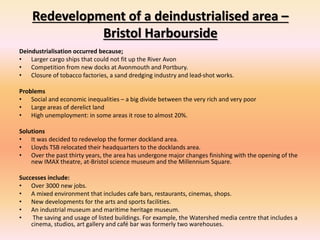
Redevelopment of a deindustrialised area –
Bristol Harbourside
Deindustrialisation occurred because;
• Larger cargo ships that could not fit up the River Avon
• Competition from new docks at Avonmouth and Portbury.
• Closure of tobacco factories, a sand dredging industry and lead-shot works.
Problems
• Social and economic inequalities – a big divide between the very rich and very poor
• Large areas of derelict land
• High unemployment: in some areas it rose to almost 20%.
Solutions
• It was decided to redevelop the former dockland area.
• Lloyds TSB relocated their headquarters to the docklands area.
• Over the past thirty years, the area has undergone major changes finishing with the opening of the
new IMAX theatre, at-Bristol science museum and the Millennium Square.
Successes include:
• Over 3000 new jobs.
• A mixed environment that includes cafe bars, restaurants, cinemas, shops.
• New developments for the arts and sports facilities.
• An industrial museum and maritime heritage museum.
• The saving and usage of listed buildings. For example, the Watershed media centre that includes a
cinema, studios, art gallery and café bar was formerly two warehouses.
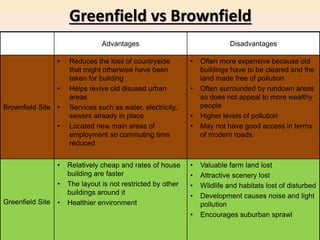
Advantages Disadvantages
Brownfield Site
• Reduces the loss of countryside
that might otherwise have been
taken for building
• Helps revive old disused urban
areas
• Services such as water, electricity,
sewers already in place
• Located new main areas of
employment so commuting time
reduced
• Often more expensive because old
buildings have to be cleared and the
land made free of pollution
• Often surrounded by rundown areas
so does not appeal to more wealthy
people
• Higher levels of pollution
• May not have good access in terms
of modern roads.
Greenfield Site
• Relatively cheap and rates of house
building are faster
• The layout is not restricted by other
buildings around it
• Healthier environment
• Valuable farm land lost
• Attractive scenery lost
• Wildlife and habitats lost of disturbed
• Development causes noise and light
pollution
• Encourages suburban sprawl
Greenfield vs Brownfield
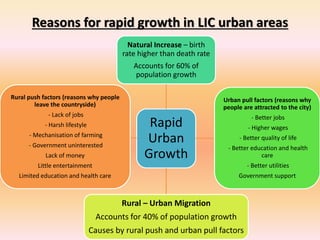
Reasons for rapid growth in LIC urban areas
Rapid
Urban
Growth
Natural Increase – birth
rate higher than death rate
Accounts for 60% of
population growth
Urban pull factors (reasons why
people are attracted to the city)
- Better jobs
- Higher wages
- Better quality of life
- Better education and health
care
- Better utilities
Government support
Rural – Urban Migration
Accounts for 40% of population growth
Causes by rural push and urban pull factors
Rural push factors (reasons why people
leave the countryside)
- Lack of jobs
- Harsh lifestyle
- Mechanisation of farming
- Government uninterested
Lack of money
Little entertainment
Limited education and health care
Case Study of an LIC urban area - Dhaka, Bangladesh
• Dhaka is the capital city of Bangladesh
• One of the poorest countries in the world
• Cities population is an estimated 12 million but forecast to increase to 21 million by 2050
• Dhaka is hemmed in by large river channels that thread their way through the city
• It is these low-lying areas that suffer widespread flooding during the monsoon season
• It is in these places that the ‘bostis’ are built; Illegal shanty towns and squatter settlements that have been
built by rural to urban migrants that have come to the city looking for work.
• The authorities have not provided any other form of housing and they cannot afford to live elsewhere
• Overcrowding and disease are major problems
• Water pollution and rotting piles of waste are a real health hazard
• So too is the smoke from domestic fires and air pollution from the factories and traffic
• The most common diseases are diarrhoea, tuberculosis, measles, and malaria
• The growth of the population is outstripping the creation of jobs
• Most people work in the informal economy e.g. working for themselves
• Common jobs are; selling the street, shoe shining, rubbish collection, scavenging and recycling waste
• Begging crime and prostitution are also less legal ways of making a living.
• In Dhaka, the driving of rickshaws is the most common form of informal activity
• No public transport means the rickshaws are an important factor in keeping the city moving
• Half a million children are also estimated to be involved in the informal economy
• Most of them work from dawn til dusk and earn about 12p per day

Settlement Change

  • 1.
    Settlement Change Unit 3– June 6th 2014
  • 2.
    Functions of aSettlement A function simply means what a settlement is used for. Historically most settlements where for defence or to control a piece of land, or for agriculture and trade. However, most settlements now rely on the tertiary sector and provide services such as shops, schools, hospitals and entertainment One function that is common to all settlements is to provide housing. Some settlements have become dormitory settlements where people commute to work but are only at home in the evenings and weekends.
  • 3.
    Change to Benidorm’sFunction 1) Benidorm first developed as a settlement due to its physical location; on a hill for defence 2) Then it became a fishing port as it was situated near the coast 3) When the settlement grew, water was transferred from inland to support a growing agriculture function for citrus fruit and olives. 4) It became an important tourist destination after the the main road between Benidorm and Alicante was built, linking it with the airport there
  • 4.
    Causes of Depopulationin the Western Isles Access on and off the island is by boat and plane. Any food for the shops has to come by boat so you are very confined. Remoteness – People feel isolated from things and want to be connected with the rest of society Jobs and Wages –There are not a lot of tertiary or secondary jobs so most are limited to the primary sector Weather – the harsh physical climate of the Western Isles causes them to move away for more mild weather Ambitions – There are no large universities on the island and no tertiary jobs so people move for better jobs Media – seeing adverts and programs on the TV shows people the life they are missing out on
  • 5.
    Counter-Urbanisation Case Study –St Ives, Cambridge Counter-urbanisation – the movement of people from the city to the countryside St Ives, Cambridge 25% of people who live there are commuters 100km north of London Close to the A1 motorway and 50 min train journey from King’s Cross Half of the village are young commuters the other half are retired Higher incomes and a better standard of living than anywhere else in the UK Modern housing estates, designer restaurants and shops
  • 6.
    Reasons for anincrease in housing demand in the UK • Increase in population – between 2001 and 2011 the population increased from 58.8 to 62.6 million people • An increase in the number of households – more people are living alone, marrying later, divorce, and more people are living longer. In 2001 there were 21.6 million households. Of these 30% only had one person living in them. • Increased personal wealth has resulted in more people being able to afford to buy their own home
  • 7.
    Four possible locationsfor new housing in the UK Commuter Belt New housing estates built around existing towns Eco-towns built on brownfield land Suburbs Intensification by people selling off their gardens for building (garden grabbing) and infilling any green spaces with new housing Inner City Blocks of flats and gated communities on Brownfield sites Urban Fringe New housing estates built (1) On the outer edge of a built up area (2) Around villages (use of greenfield land
  • 8.
    Commuter Belt Compact estateson Greenfield sites Long journey to work Car freeMost proposed sites are on brownfield land Not actually any jobs there so more like commuter dormitories Within the urban fringe and commuter belt Environmentally friendly – carbon emissions kept low. 30% are for less well off households Compact estates on Greenfield sites 20,000 new homes in eco- towns
  • 9.
    Urban Fringe Outer edgeof the built up area Near to open countryside but still close to the city Built on Greenfield sites Loss of countryside High dependency on the car to get around. Lots of people of the same economic class Vast areas of low density housing Still close to place of work and best shops Building of edge of town retail parks has brought shops and leisure facilities closer Recently offices and factories have moved to the outer edge shortening the journey times
  • 10.
    Suburbs Also involves ‘gardengrabbing’ whereby people sell off some of their garden as a building plot Gardens are brownfield not greenfield and government policy prefers brownfield sites Suburban intensification Occurs in the older suburbs Involves building on playing fields and vacant areas of land
  • 11.
    What factors encouragesuburban sprawl? Good transport links Wasteful use of greenfield sites Greater wealth Low density housing and lack of planning Growth in numbers of households due to divorce and people living longer Shorter working hours Unless there are very strict rules on house building it is very easy for the suburbs to grow outwards and ‘sprawl’ over large areas of countryside. Here are the reasons for this;
  • 12.
    Inner City Redevelopment of brownfieldsites Housing located in the inner parts of towns and cities that were once factories and slums Concern about personal security is being fixed with gated communities Gated communities are group of homes shut away with CCTV and electronic gates Designed to offer personal security and protect property Ideal for families Redevelopment of brownfield sites Separates well off from less well off people Houses are expensive so can only be an option for the wealthy. Targets for crime People attracted back to the centre by new homes and better facilities
  • 13.
    Other factors inbuilding new houses There are laws about how new housing estates should be build to make sure they are attractive to lots of different people. Here are some of the considerations; • Mix of housing types – houses, maisonettes, flats • Size of house – 1, 2, 3, or 4 bedrooms • A mix of owner occupied, rented and council housing • Availability of work in the area • Availability of utilities (water, gas, electricity) • Access to services (shops, schools, pub) • The environmental impact of new housing
  • 14.
    Redevelopment of adeindustrialised area – Bristol Harbourside Deindustrialisation occurred because; • Larger cargo ships that could not fit up the River Avon • Competition from new docks at Avonmouth and Portbury. • Closure of tobacco factories, a sand dredging industry and lead-shot works. Problems • Social and economic inequalities – a big divide between the very rich and very poor • Large areas of derelict land • High unemployment: in some areas it rose to almost 20%. Solutions • It was decided to redevelop the former dockland area. • Lloyds TSB relocated their headquarters to the docklands area. • Over the past thirty years, the area has undergone major changes finishing with the opening of the new IMAX theatre, at-Bristol science museum and the Millennium Square. Successes include: • Over 3000 new jobs. • A mixed environment that includes cafe bars, restaurants, cinemas, shops. • New developments for the arts and sports facilities. • An industrial museum and maritime heritage museum. • The saving and usage of listed buildings. For example, the Watershed media centre that includes a cinema, studios, art gallery and café bar was formerly two warehouses.
  • 15.
    Advantages Disadvantages Brownfield Site •Reduces the loss of countryside that might otherwise have been taken for building • Helps revive old disused urban areas • Services such as water, electricity, sewers already in place • Located new main areas of employment so commuting time reduced • Often more expensive because old buildings have to be cleared and the land made free of pollution • Often surrounded by rundown areas so does not appeal to more wealthy people • Higher levels of pollution • May not have good access in terms of modern roads. Greenfield Site • Relatively cheap and rates of house building are faster • The layout is not restricted by other buildings around it • Healthier environment • Valuable farm land lost • Attractive scenery lost • Wildlife and habitats lost of disturbed • Development causes noise and light pollution • Encourages suburban sprawl Greenfield vs Brownfield
  • 16.
    Reasons for rapidgrowth in LIC urban areas Rapid Urban Growth Natural Increase – birth rate higher than death rate Accounts for 60% of population growth Urban pull factors (reasons why people are attracted to the city) - Better jobs - Higher wages - Better quality of life - Better education and health care - Better utilities Government support Rural – Urban Migration Accounts for 40% of population growth Causes by rural push and urban pull factors Rural push factors (reasons why people leave the countryside) - Lack of jobs - Harsh lifestyle - Mechanisation of farming - Government uninterested Lack of money Little entertainment Limited education and health care
  • 17.
    Case Study ofan LIC urban area - Dhaka, Bangladesh • Dhaka is the capital city of Bangladesh • One of the poorest countries in the world • Cities population is an estimated 12 million but forecast to increase to 21 million by 2050 • Dhaka is hemmed in by large river channels that thread their way through the city • It is these low-lying areas that suffer widespread flooding during the monsoon season • It is in these places that the ‘bostis’ are built; Illegal shanty towns and squatter settlements that have been built by rural to urban migrants that have come to the city looking for work. • The authorities have not provided any other form of housing and they cannot afford to live elsewhere • Overcrowding and disease are major problems • Water pollution and rotting piles of waste are a real health hazard • So too is the smoke from domestic fires and air pollution from the factories and traffic • The most common diseases are diarrhoea, tuberculosis, measles, and malaria • The growth of the population is outstripping the creation of jobs • Most people work in the informal economy e.g. working for themselves • Common jobs are; selling the street, shoe shining, rubbish collection, scavenging and recycling waste • Begging crime and prostitution are also less legal ways of making a living. • In Dhaka, the driving of rickshaws is the most common form of informal activity • No public transport means the rickshaws are an important factor in keeping the city moving • Half a million children are also estimated to be involved in the informal economy • Most of them work from dawn til dusk and earn about 12p per day

Editor's Notes

  • #5 http://www.teachers-direct.co.uk/resources/wordsearches/ws-print.aspx?puzzle=1225241