Presentation on
Equation of Second Degree
Group: D
Department: Civil Engineering
Dhaka University of Engineering &
Technology, DUET, Gazipur.
CONTENTS
 Definition of General Equation of Second Degree
 Conic
 General Equation of Second Degree Represents a Conic
 Applications
BACKGROUND
Applications of Ellipse
Applications of Parabola
Applications of Hyperbola
General Equation of Second Degree:
Second-degree equation involves at least one variable that is squared or raised to a polar of two. One of the most well-
known second-degree equations is the quadric where a, b, & c are constants and a is not equal to zero. It is represented by
ax2+2hxy+by2+2gx+2fy+c=0
This second-degree equation defines all kinds of figure of Conic.
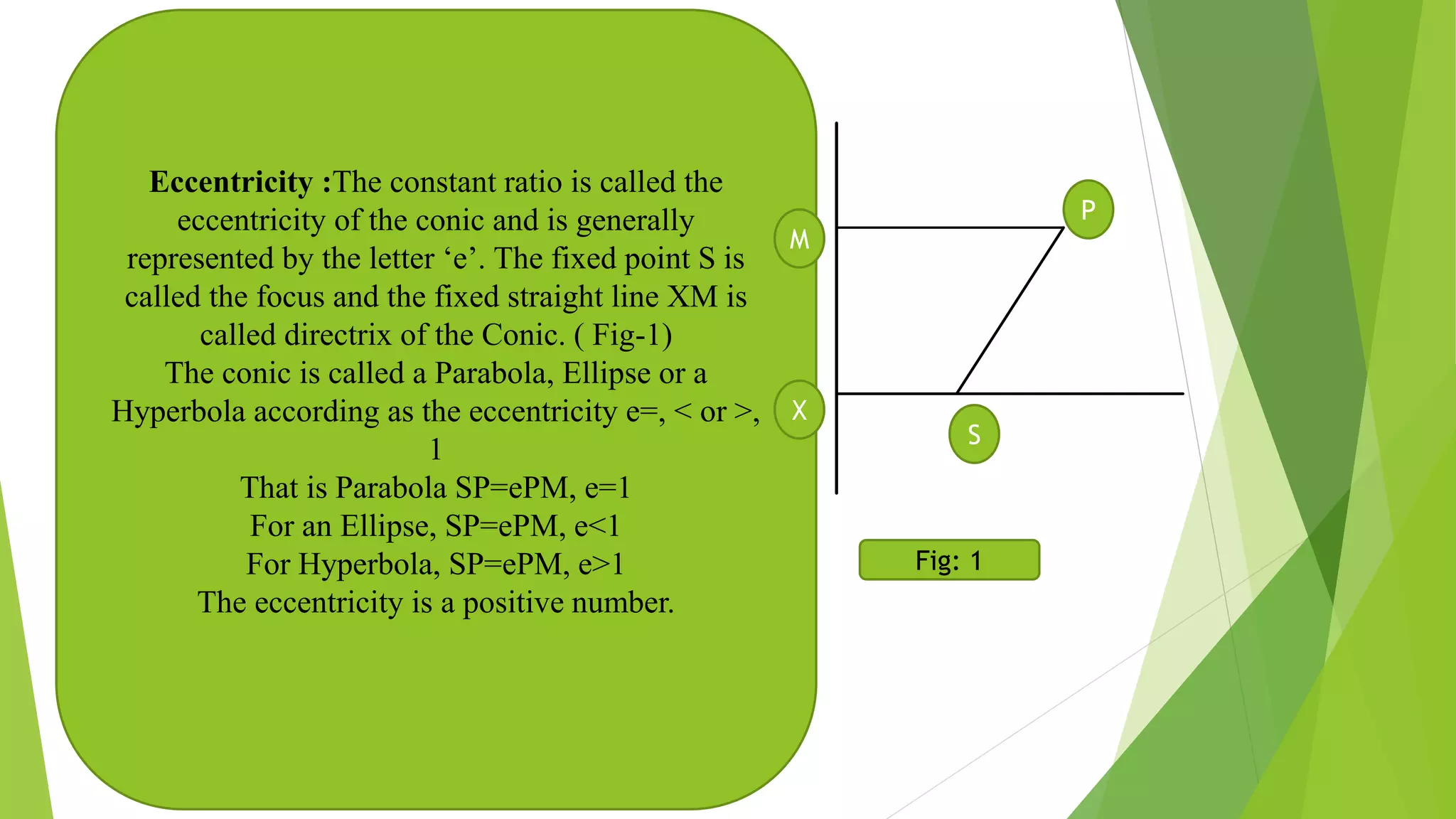
Conic: If a point P moves in a plane such a way that the ratio of its distance PS from a fixed point S in the plane to its
perpendicular distance PM from a fixed straight line XM in it, is always a constant, the locus of the point P is called a
Conic section or briefly conic.
Eccentricity :The constant ratio is called the
eccentricity of the conic and is generally
represented by the letter ‘e’. The fixed point S is
called the focus and the fixed straight line XM is
called directrix of the Conic. ( Fig-1)
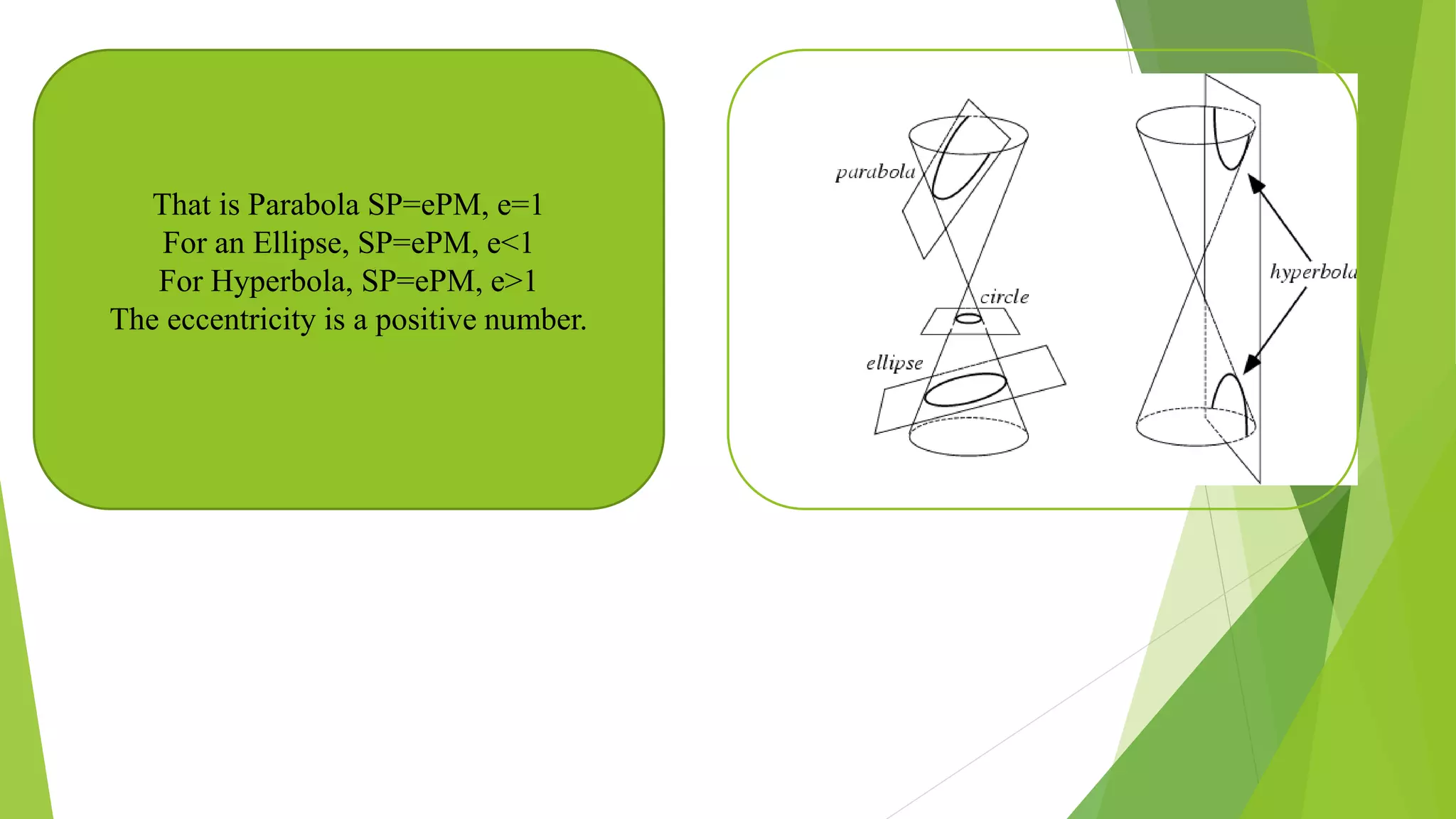
The conic is called a Parabola, Ellipse or a
Hyperbola according as the eccentricity e=, < or >,
1
That is Parabola SP=ePM, e=1
For an Ellipse, SP=ePM, e<1
For Hyperbola, SP=ePM, e>1
The eccentricity is a positive number.
M
X
S
P
Fig: 1
That is Parabola SP=ePM, e=1
For an Ellipse, SP=ePM, e<1
For Hyperbola, SP=ePM, e>1
The eccentricity is a positive number.
The general equation of second degree in x and y represents a conic:
Let the general equation of second degree
ax2+2hxy+by2+2gx+c=0 … … …… …… ..(1)
Let the axes be turned through an angle α, then eq. (1) takes from by putting
xcosα – ysinα for x
and sinα+ycosα for y,
x2(acos2α+2hcosα sinα+bsin2α)+2xy[h(cos2α+sin2α)-(a-b)sinα cosα]+y2(asin2α-2hsinα
cosα+bcos2α)+2x(gcosα+fsinα)+2y(fcosα-gsinα)+c=0 …………..(2)
Now if α be chosen that
h(cos2α-sin2α)-(a-b)sinα cosα=0
or, tan2α=
2ℎ
𝑎−𝑏
then in eq.(2) term containing xy vanishes and it takes the form by putting the value of α
Ax2+By2+2Gx+2Fy+C=0 …………(3)
Where by the principle of invariant
A+B=a+b and AB=ab-h2 ………………(4)
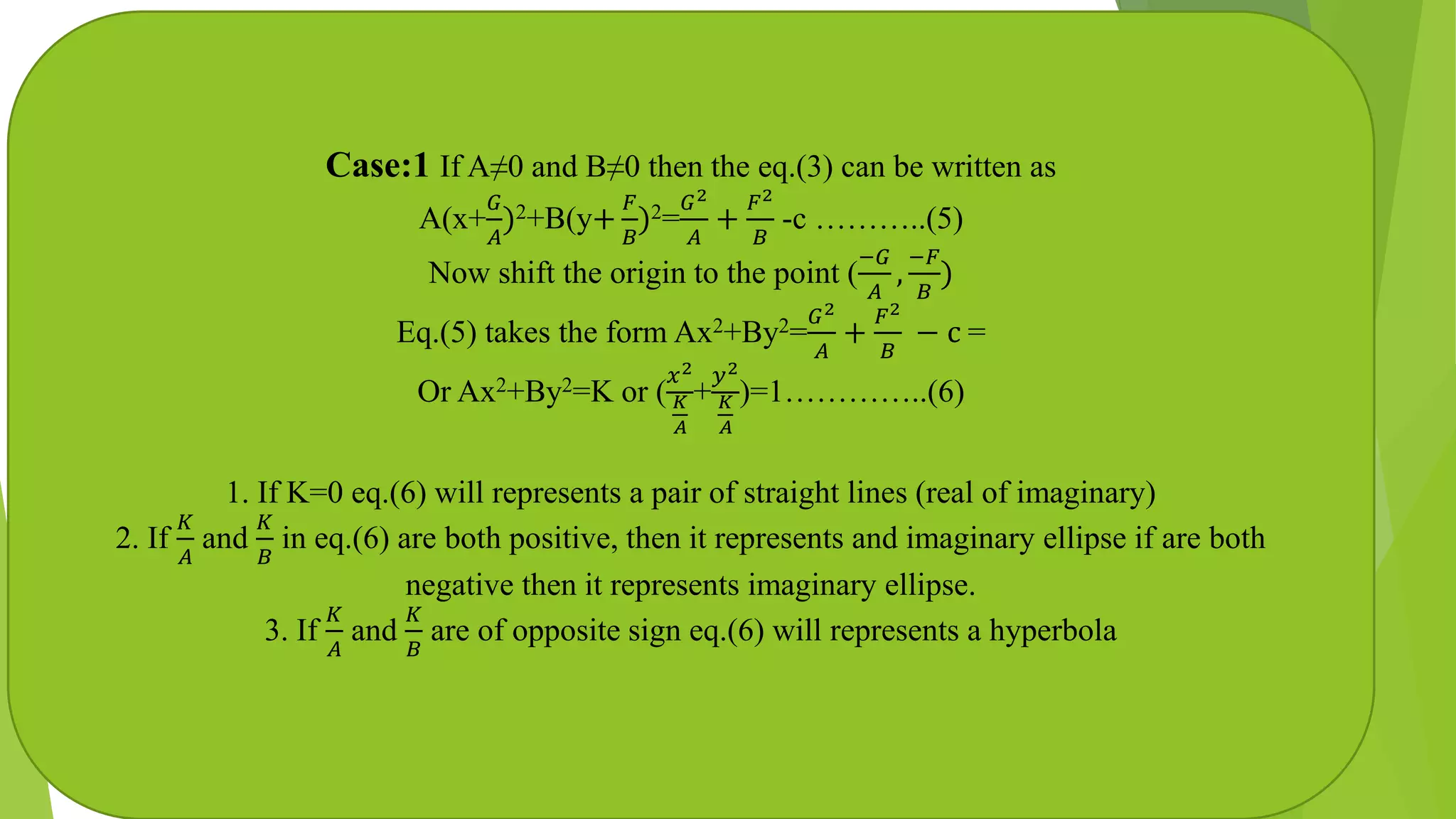
Case:1 If A≠0 and B≠0 then the eq.(3) can be written as
A(x+
𝐺
𝐴
)2+B(y+
𝐹
𝐵
)2=
𝐺2
𝐴
+
𝐹2
𝐵
-c ………..(5)
Now shift the origin to the point (
−𝐺
𝐴
,
−𝐹
𝐵
)
Eq.(5) takes the form Ax2+By2=
𝐺2
𝐴
+
𝐹2
𝐵
− c =
Or Ax2+By2=K or (
𝑥2
𝐾
𝐴
+
𝑦2
𝐾
𝐴
)=1…………..(6)
1. If K=0 eq.(6) will represents a pair of straight lines (real of imaginary)
2. If
𝐾
𝐴
and
𝐾
𝐵
in eq.(6) are both positive, then it represents and imaginary ellipse if are both
negative then it represents imaginary ellipse.
3. If
𝐾
𝐴
and
𝐾
𝐵
are of opposite sign eq.(6) will represents a hyperbola
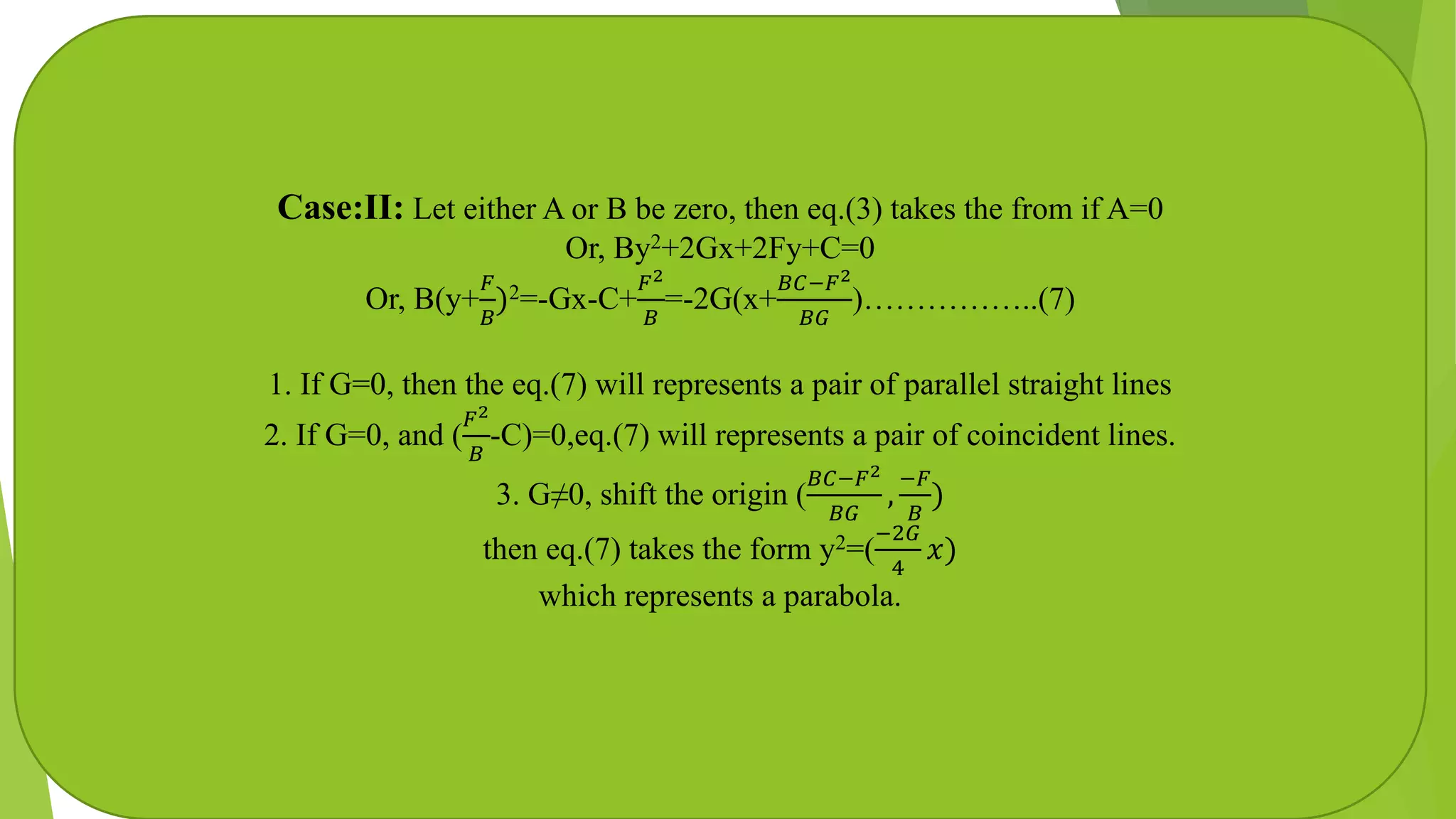
Case:II: Let either A or B be zero, then eq.(3) takes the from if A=0
Or, By2+2Gx+2Fy+C=0
Or, B(y+
𝐹
𝐵
)2=-Gx-C+
𝐹2
𝐵
=-2G(x+
𝐵𝐶−𝐹2
𝐵𝐺
)……………..(7)
1. If G=0, then the eq.(7) will represents a pair of parallel straight lines
2. If G=0, and (
𝐹2
𝐵
-C)=0,eq.(7) will represents a pair of coincident lines.
3. G≠0, shift the origin (
𝐵𝐶−𝐹2
𝐵𝐺
,
−𝐹
𝐵
)
then eq.(7) takes the form y2=(
−2𝐺
4
𝑥)
which represents a parabola.
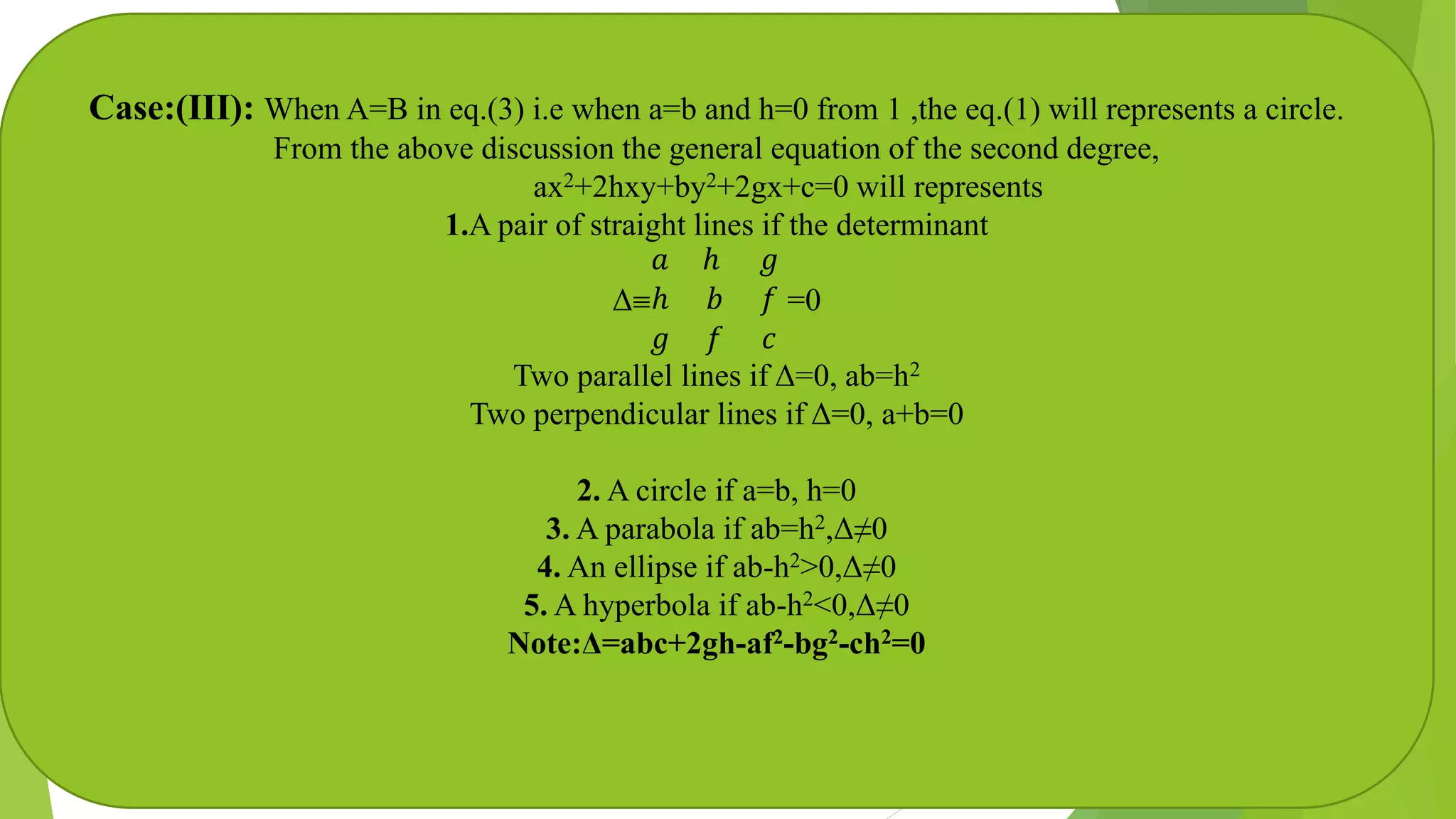
Case:(III): When A=B in eq.(3) i.e when a=b and h=0 from 1 ,the eq.(1) will represents a circle.
From the above discussion the general equation of the second degree,
ax2+2hxy+by2+2gx+c=0 will represents
1.A pair of straight lines if the determinant
Δ
𝑎 ℎ 𝑔
ℎ 𝑏 𝑓
𝑔 𝑓 𝑐
=0
Two parallel lines if Δ=0, ab=h2
Two perpendicular lines if Δ=0, a+b=0
2. A circle if a=b, h=0
3. A parabola if ab=h2,Δ≠0
4. An ellipse if ab-h2>0,Δ≠0
5. A hyperbola if ab-h2<0,Δ≠0
Note:Δ=abc+2gh-af2-bg2-ch2=0
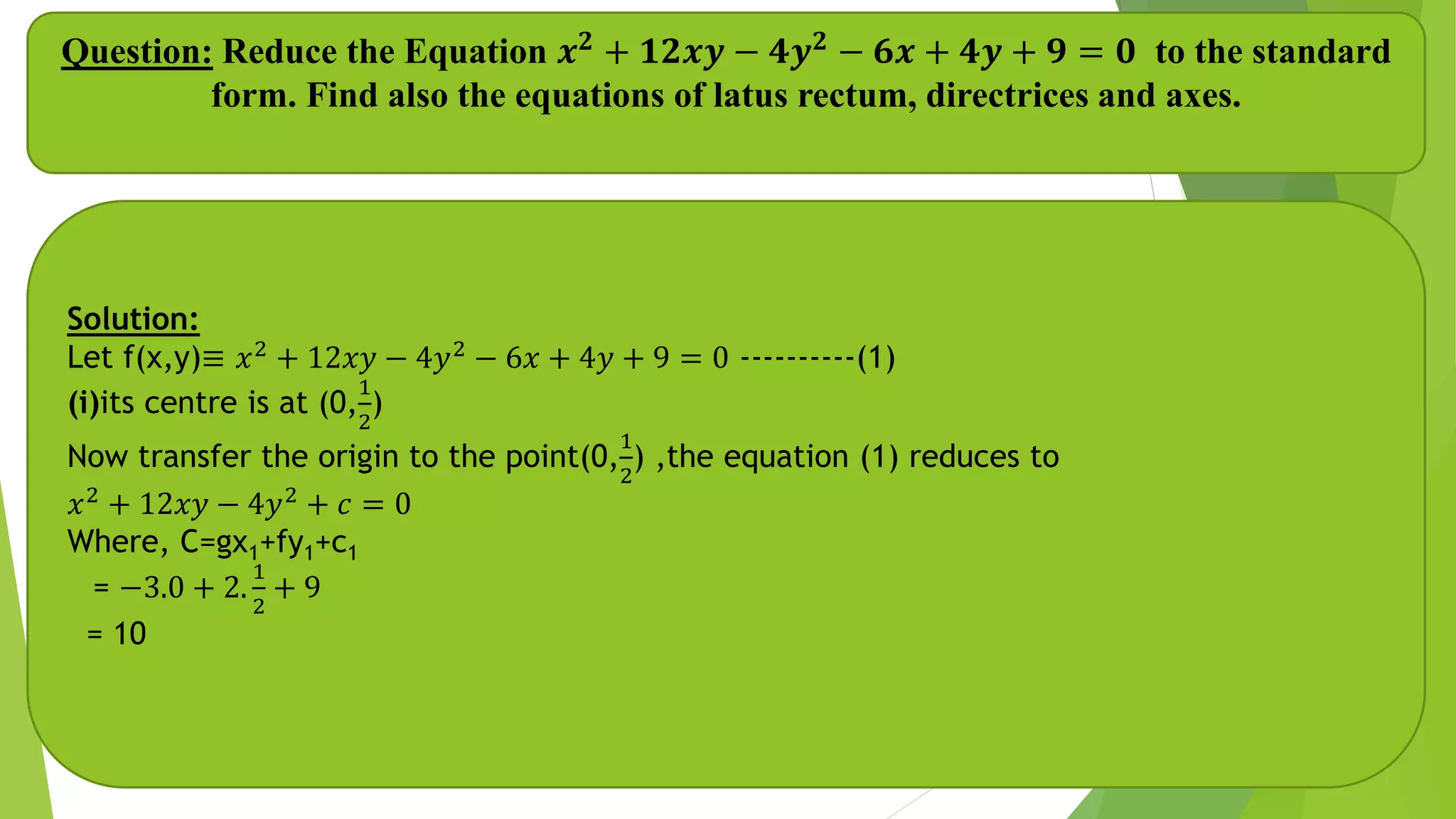
Question: Reduce the Equation 𝒙 𝟐 + 𝟏𝟐𝒙𝒚 − 𝟒𝒚 𝟐 − 𝟔𝒙 + 𝟒𝒚 + 𝟗 = 𝟎 to the standard
form. Find also the equations of latus rectum, directrices and axes.
Solution:
Let f(x,y)≡ 𝑥2
+ 12𝑥𝑦 − 4𝑦2
− 6𝑥 + 4𝑦 + 9 = 0 ----------(1)
(i)its centre is at (0,
1
2
)
Now transfer the origin to the point(0,
1
2
) ,the equation (1) reduces to
𝑥2
+ 12𝑥𝑦 − 4𝑦2
+ 𝑐 = 0
Where, C=gx1+fy1+c1
= −3.0 + 2.
1
2
+ 9
= 10
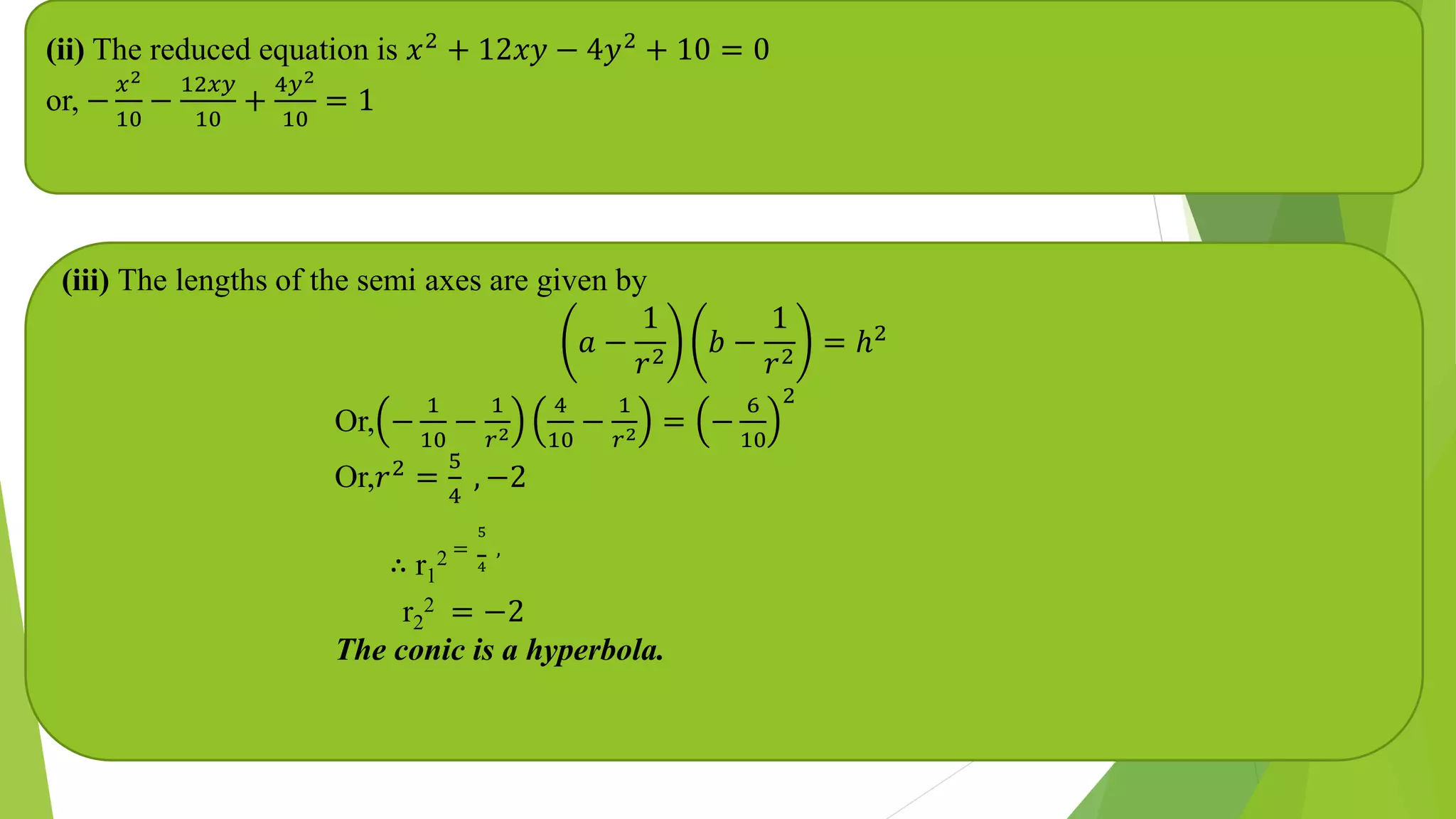
(ii) The reduced equation is 𝑥2
+ 12𝑥𝑦 − 4𝑦2
+ 10 = 0
or, −
𝑥2
10
−
12𝑥𝑦
10
+
4𝑦2
10
= 1
(iii) The lengths of the semi axes are given by
𝑎 −
1
𝑟2
𝑏 −
1
𝑟2
= ℎ2
Or, −
1
10
−
1
𝑟2
4
10
−
1
𝑟2 = −
6
10
2
Or,𝑟2 =
5
4
, −2
∴ r1
2 =
5
4
,
r2
2 = −2
The conic is a hyperbola.
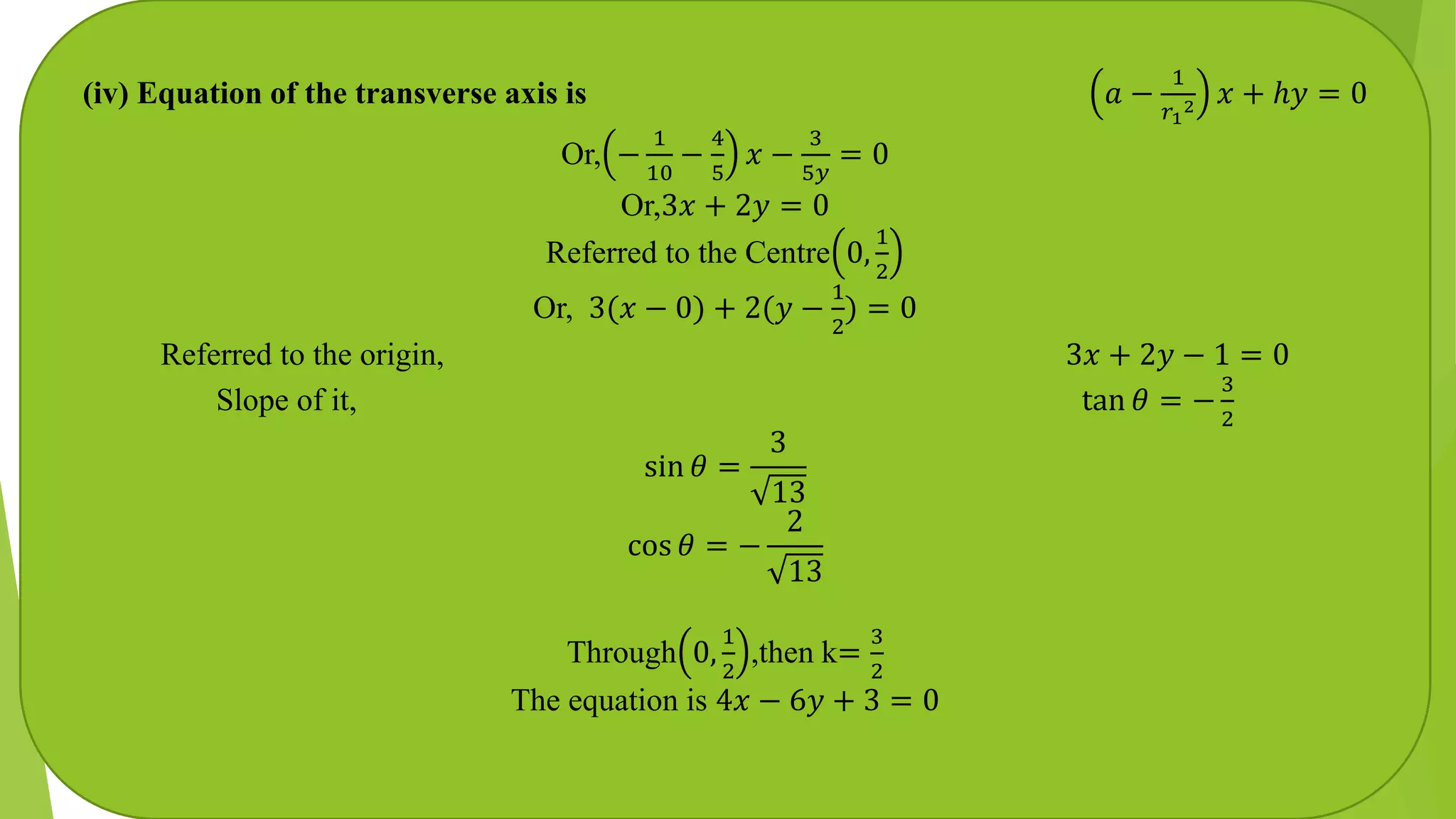
(iv) Equation of the transverse axis is 𝑎 −
1
𝑟1
2 𝑥 + ℎ𝑦 = 0
Or, −
1
10
−
4
5
𝑥 −
3
5𝑦
= 0
Or,3𝑥 + 2𝑦 = 0
Referred to the Centre 0,
1
2
Or, 3(𝑥 − 0) + 2(𝑦 −
1
2
) = 0
Referred to the origin, 3𝑥 + 2𝑦 − 1 = 0
Slope of it, tan 𝜃 = −
3
2
sin 𝜃 =
3
13
cos 𝜃 = −
2
13
Through 0,
1
2
,then k=
3
2
The equation is 4𝑥 − 6𝑦 + 3 = 0
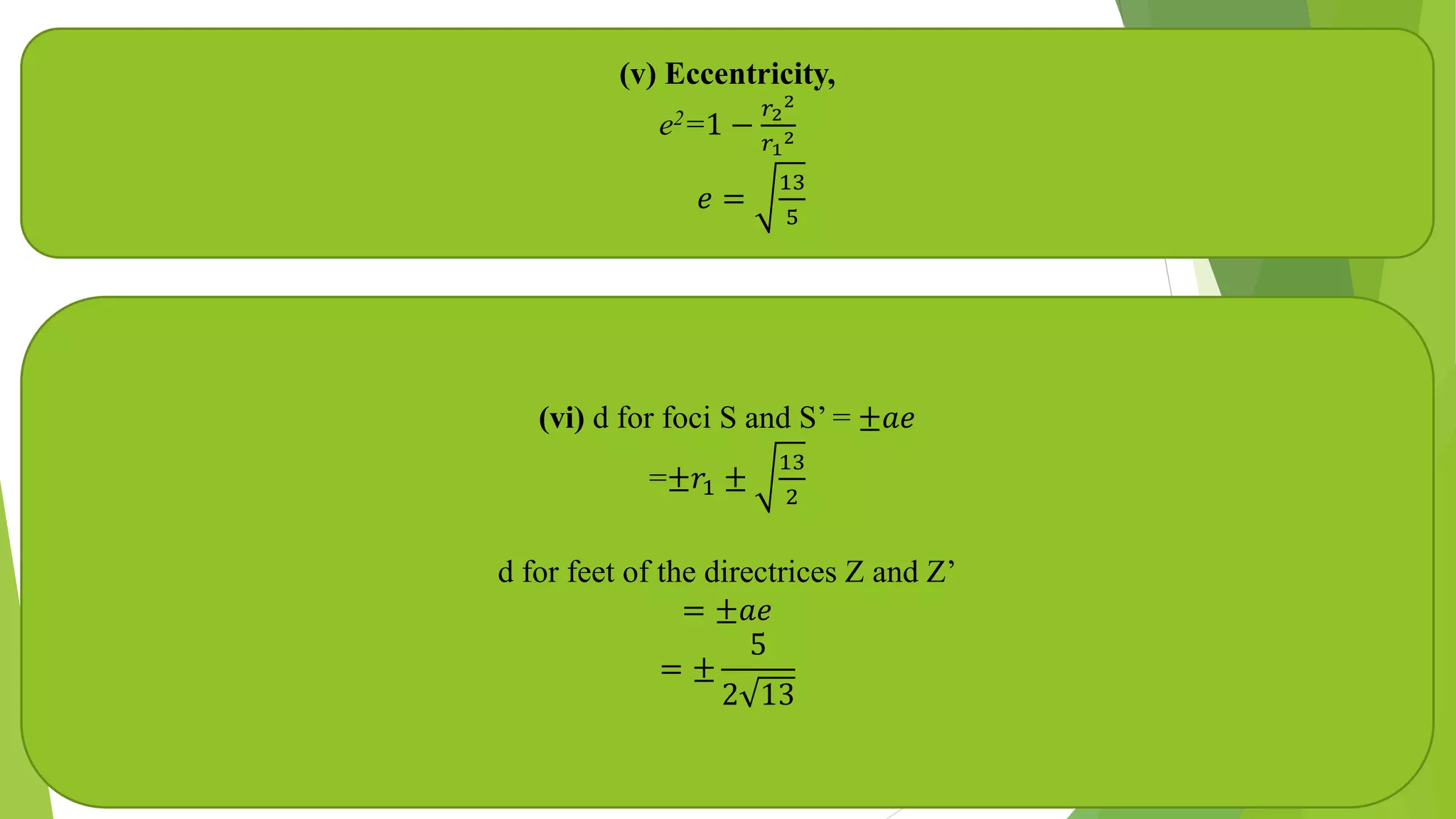
(v) Eccentricity,
e2=1 −
𝑟2
2
𝑟1
2
𝑒 =
13
5
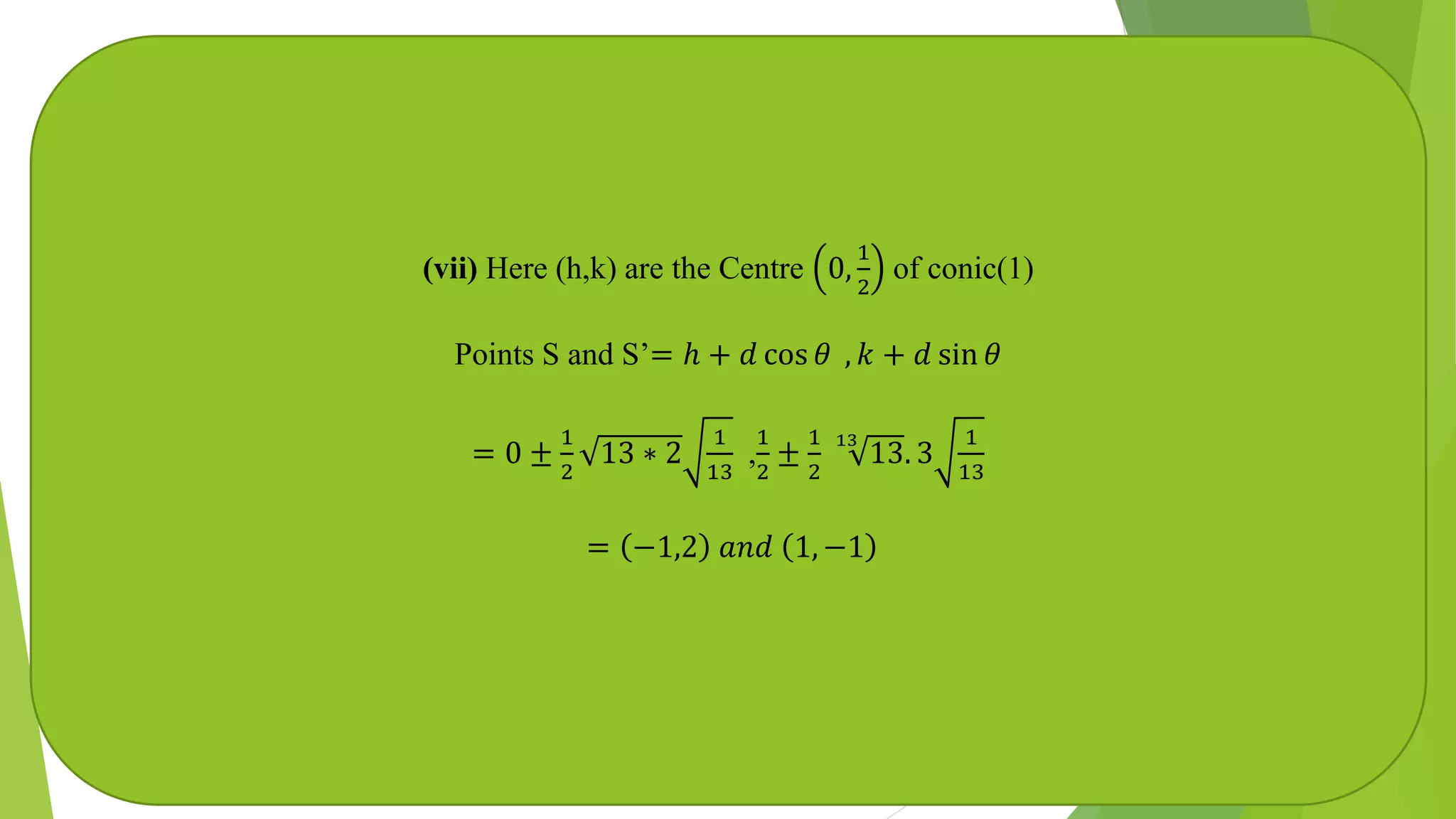
(vi) d for foci S and S’ = ±𝑎𝑒
=±𝑟1 ±
13
2
d for feet of the directrices Z and Z’
= ±𝑎𝑒
= ±
5
2 13
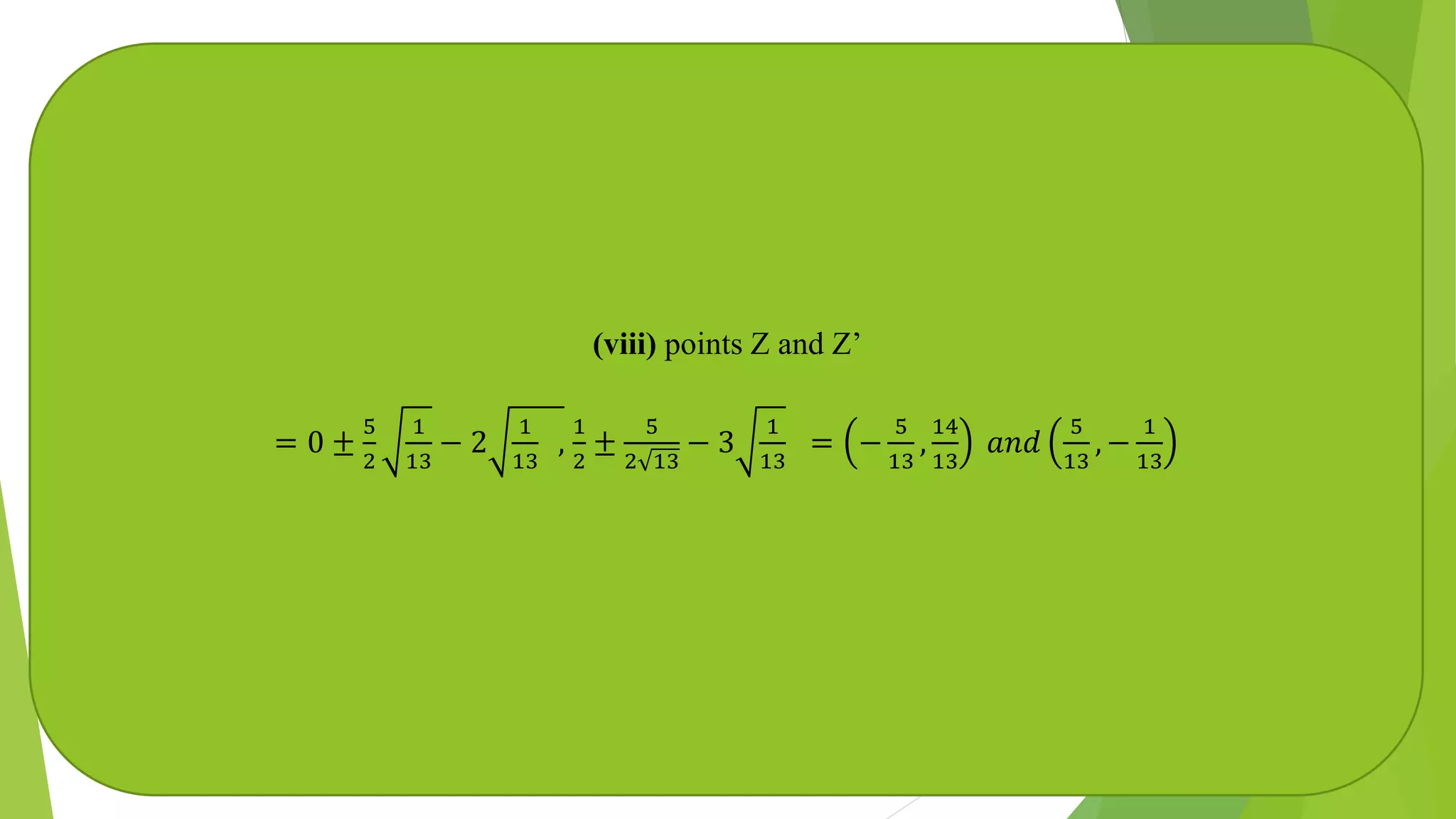
(vii) Here (h,k) are the Centre 0,
1
2
of conic(1)
Points S and S’= ℎ + 𝑑 cos 𝜃 , 𝑘 + 𝑑 sin 𝜃
= 0 ±
1
2
13 ∗ 2
1
13
,
1
2
±
1
2
13
13. 3
1
13
= −1,2 𝑎𝑛𝑑 1, −1
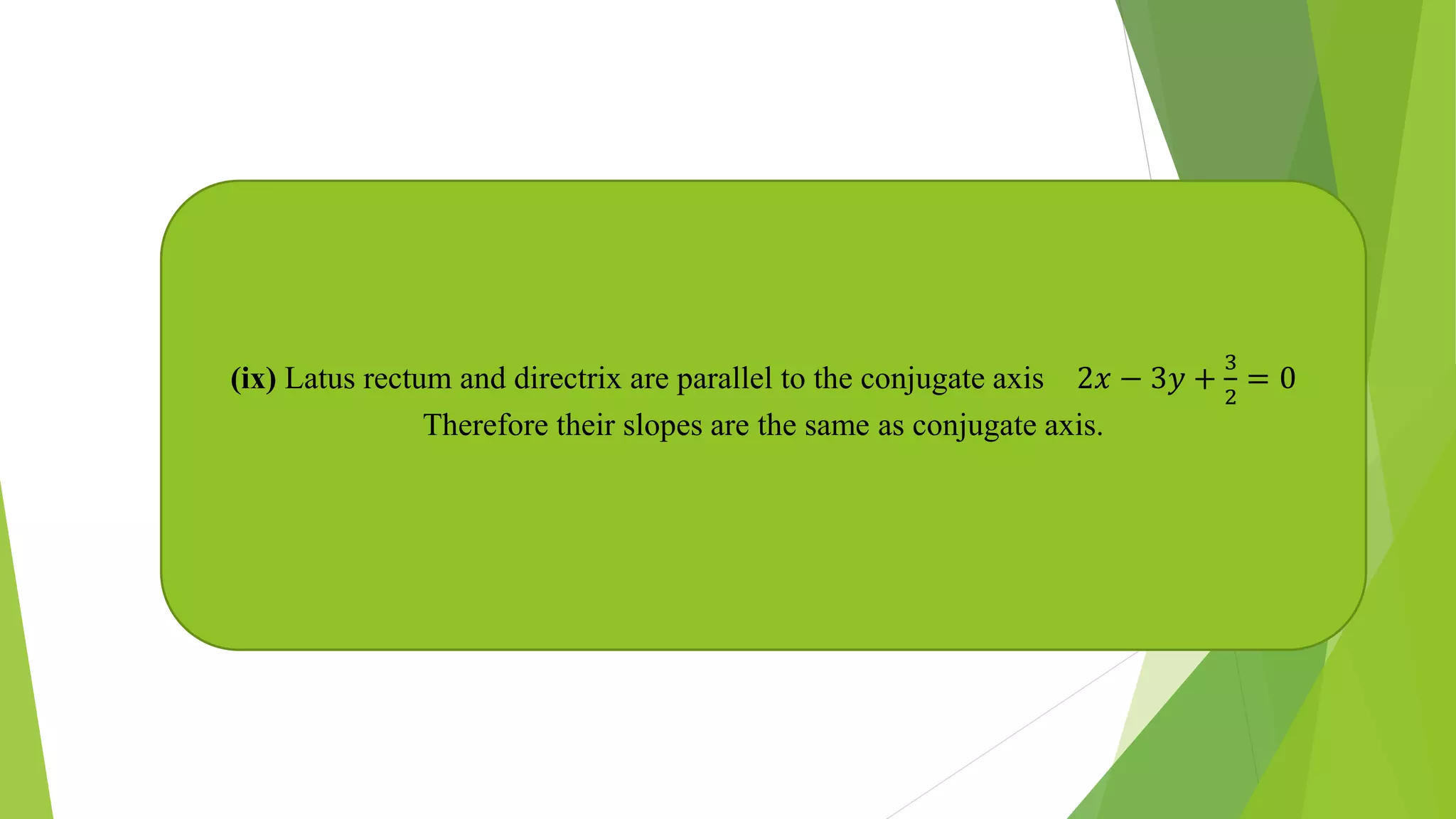
(viii) points Z and Z’
= 0 ±
5
2
1
13
− 2
1
13
,
1
2
±
5
2 13
− 3
1
13
= −
5
13
,
14
13
𝑎𝑛𝑑
5
13
, −
1
13
(ix) Latus rectum and directrix are parallel to the conjugate axis 2𝑥 − 3𝑦 +
3
2
= 0
Therefore their slopes are the same as conjugate axis.
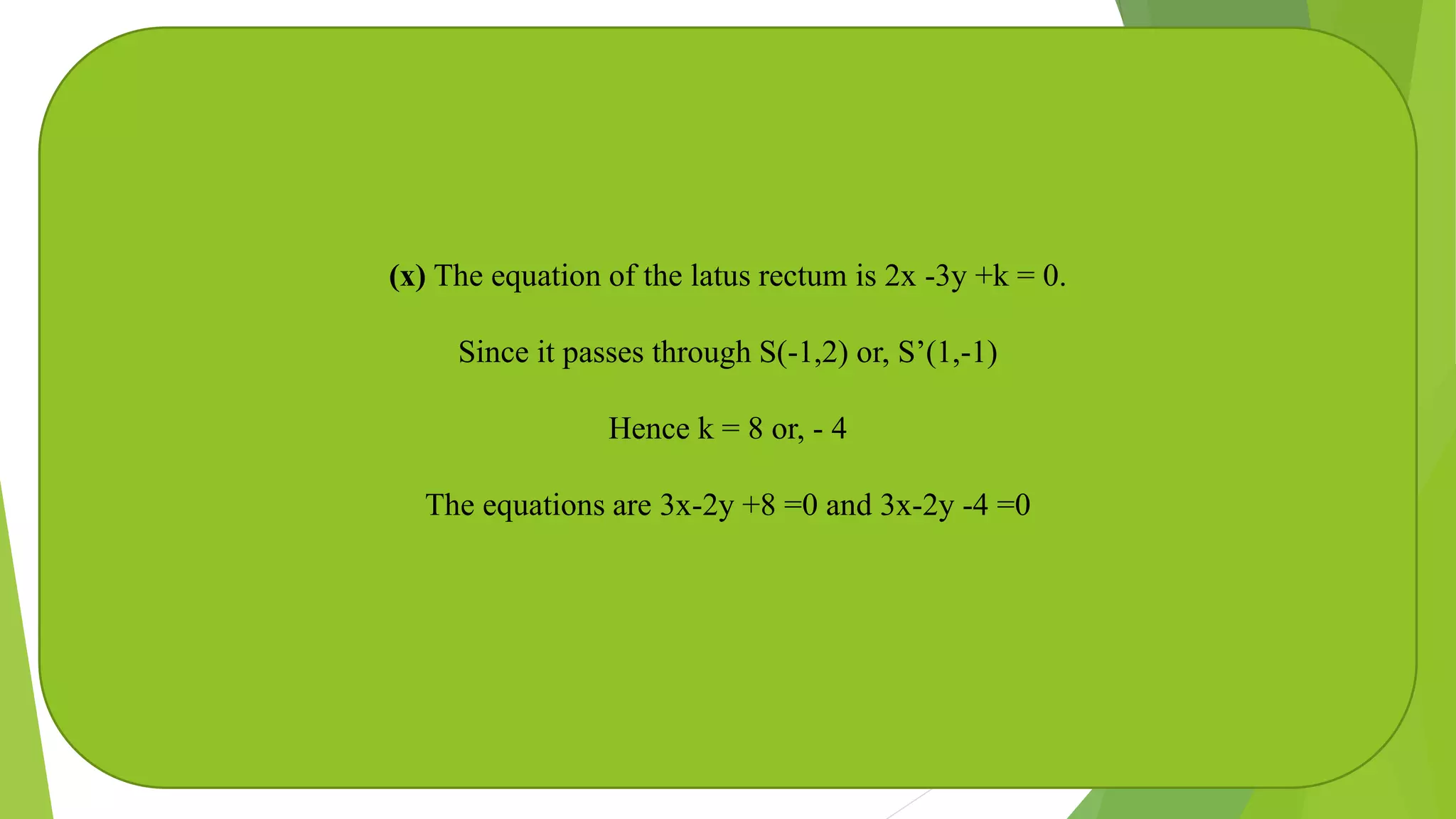
(x) The equation of the latus rectum is 2x -3y +k = 0.
Since it passes through S(-1,2) or, S’(1,-1)
Hence k = 8 or, - 4
The equations are 3x-2y +8 =0 and 3x-2y -4 =0
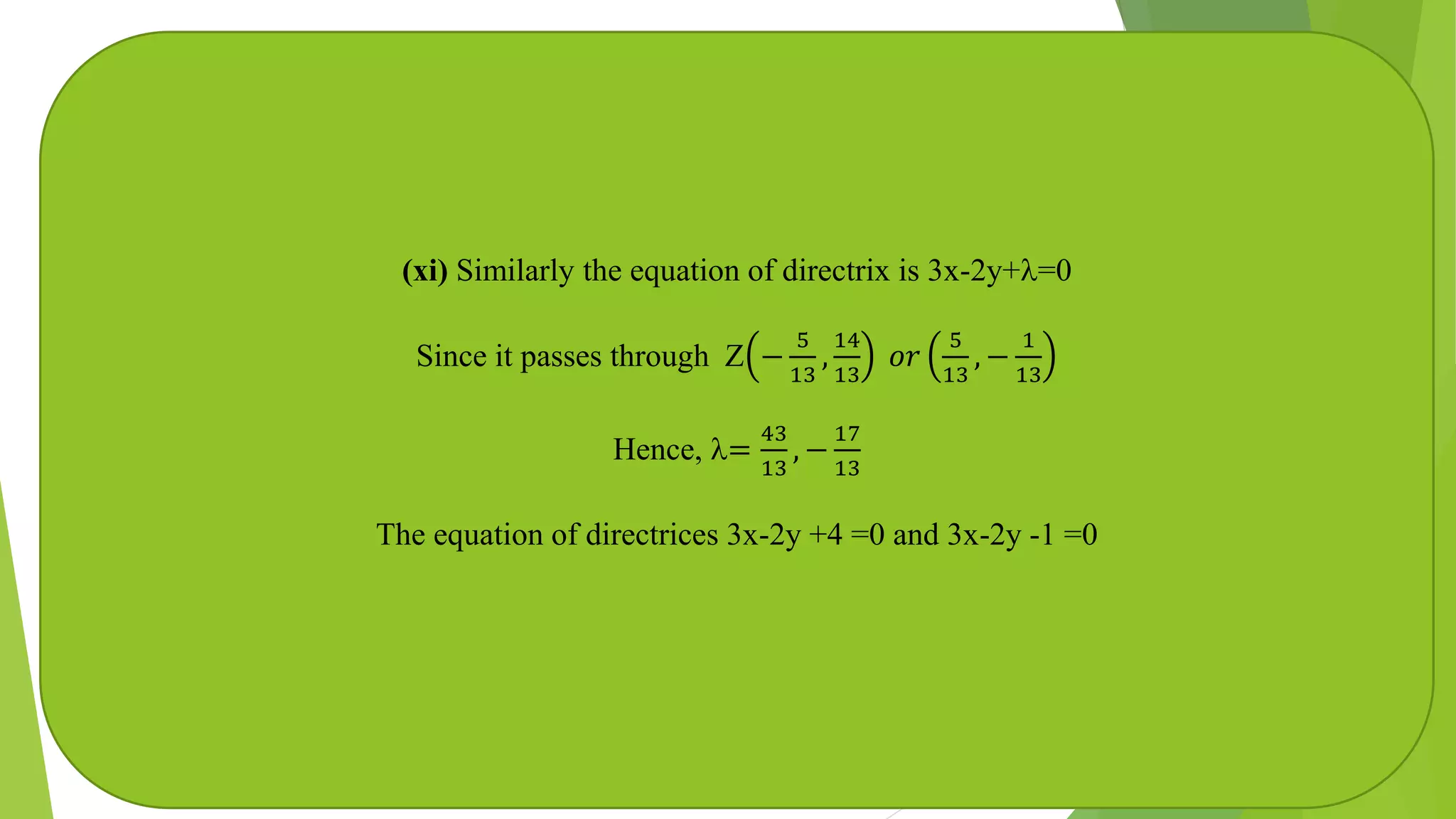
(xi) Similarly the equation of directrix is 3x-2y+=0
Since it passes through Z −
5
13
,
14
13
𝑜𝑟
5
13
, −
1
13
Hence, =
43
13
, −
17
13
The equation of directrices 3x-2y +4 =0 and 3x-2y -1 =0
REFERENCE
 A Text Book On Co-ordinate Geometry With Vector Analysis
By Rahman & Bhattacharjee
 Online Sources
Thank You to all
Any Questions?

Equation of second degree

  • 1.
    Presentation on Equation ofSecond Degree Group: D Department: Civil Engineering Dhaka University of Engineering & Technology, DUET, Gazipur.
  • 2.
    CONTENTS  Definition ofGeneral Equation of Second Degree  Conic  General Equation of Second Degree Represents a Conic  Applications
  • 3.
    BACKGROUND Applications of Ellipse Applicationsof Parabola Applications of Hyperbola
  • 4.
    General Equation ofSecond Degree: Second-degree equation involves at least one variable that is squared or raised to a polar of two. One of the most well- known second-degree equations is the quadric where a, b, & c are constants and a is not equal to zero. It is represented by ax2+2hxy+by2+2gx+2fy+c=0 This second-degree equation defines all kinds of figure of Conic. Conic: If a point P moves in a plane such a way that the ratio of its distance PS from a fixed point S in the plane to its perpendicular distance PM from a fixed straight line XM in it, is always a constant, the locus of the point P is called a Conic section or briefly conic.
  • 5.
    Eccentricity :The constantratio is called the eccentricity of the conic and is generally represented by the letter ‘e’. The fixed point S is called the focus and the fixed straight line XM is called directrix of the Conic. ( Fig-1) The conic is called a Parabola, Ellipse or a Hyperbola according as the eccentricity e=, < or >, 1 That is Parabola SP=ePM, e=1 For an Ellipse, SP=ePM, e<1 For Hyperbola, SP=ePM, e>1 The eccentricity is a positive number. M X S P Fig: 1
  • 6.
    That is ParabolaSP=ePM, e=1 For an Ellipse, SP=ePM, e<1 For Hyperbola, SP=ePM, e>1 The eccentricity is a positive number.
  • 7.
    The general equationof second degree in x and y represents a conic: Let the general equation of second degree ax2+2hxy+by2+2gx+c=0 … … …… …… ..(1) Let the axes be turned through an angle α, then eq. (1) takes from by putting xcosα – ysinα for x and sinα+ycosα for y, x2(acos2α+2hcosα sinα+bsin2α)+2xy[h(cos2α+sin2α)-(a-b)sinα cosα]+y2(asin2α-2hsinα cosα+bcos2α)+2x(gcosα+fsinα)+2y(fcosα-gsinα)+c=0 …………..(2) Now if α be chosen that h(cos2α-sin2α)-(a-b)sinα cosα=0 or, tan2α= 2ℎ 𝑎−𝑏 then in eq.(2) term containing xy vanishes and it takes the form by putting the value of α Ax2+By2+2Gx+2Fy+C=0 …………(3) Where by the principle of invariant A+B=a+b and AB=ab-h2 ………………(4)
  • 8.
    Case:1 If A≠0and B≠0 then the eq.(3) can be written as A(x+ 𝐺 𝐴 )2+B(y+ 𝐹 𝐵 )2= 𝐺2 𝐴 + 𝐹2 𝐵 -c ………..(5) Now shift the origin to the point ( −𝐺 𝐴 , −𝐹 𝐵 ) Eq.(5) takes the form Ax2+By2= 𝐺2 𝐴 + 𝐹2 𝐵 − c = Or Ax2+By2=K or ( 𝑥2 𝐾 𝐴 + 𝑦2 𝐾 𝐴 )=1…………..(6) 1. If K=0 eq.(6) will represents a pair of straight lines (real of imaginary) 2. If 𝐾 𝐴 and 𝐾 𝐵 in eq.(6) are both positive, then it represents and imaginary ellipse if are both negative then it represents imaginary ellipse. 3. If 𝐾 𝐴 and 𝐾 𝐵 are of opposite sign eq.(6) will represents a hyperbola
  • 9.
    Case:II: Let eitherA or B be zero, then eq.(3) takes the from if A=0 Or, By2+2Gx+2Fy+C=0 Or, B(y+ 𝐹 𝐵 )2=-Gx-C+ 𝐹2 𝐵 =-2G(x+ 𝐵𝐶−𝐹2 𝐵𝐺 )……………..(7) 1. If G=0, then the eq.(7) will represents a pair of parallel straight lines 2. If G=0, and ( 𝐹2 𝐵 -C)=0,eq.(7) will represents a pair of coincident lines. 3. G≠0, shift the origin ( 𝐵𝐶−𝐹2 𝐵𝐺 , −𝐹 𝐵 ) then eq.(7) takes the form y2=( −2𝐺 4 𝑥) which represents a parabola.
  • 10.
    Case:(III): When A=Bin eq.(3) i.e when a=b and h=0 from 1 ,the eq.(1) will represents a circle. From the above discussion the general equation of the second degree, ax2+2hxy+by2+2gx+c=0 will represents 1.A pair of straight lines if the determinant Δ 𝑎 ℎ 𝑔 ℎ 𝑏 𝑓 𝑔 𝑓 𝑐 =0 Two parallel lines if Δ=0, ab=h2 Two perpendicular lines if Δ=0, a+b=0 2. A circle if a=b, h=0 3. A parabola if ab=h2,Δ≠0 4. An ellipse if ab-h2>0,Δ≠0 5. A hyperbola if ab-h2<0,Δ≠0 Note:Δ=abc+2gh-af2-bg2-ch2=0
  • 11.
    Question: Reduce theEquation 𝒙 𝟐 + 𝟏𝟐𝒙𝒚 − 𝟒𝒚 𝟐 − 𝟔𝒙 + 𝟒𝒚 + 𝟗 = 𝟎 to the standard form. Find also the equations of latus rectum, directrices and axes. Solution: Let f(x,y)≡ 𝑥2 + 12𝑥𝑦 − 4𝑦2 − 6𝑥 + 4𝑦 + 9 = 0 ----------(1) (i)its centre is at (0, 1 2 ) Now transfer the origin to the point(0, 1 2 ) ,the equation (1) reduces to 𝑥2 + 12𝑥𝑦 − 4𝑦2 + 𝑐 = 0 Where, C=gx1+fy1+c1 = −3.0 + 2. 1 2 + 9 = 10
  • 12.
    (ii) The reducedequation is 𝑥2 + 12𝑥𝑦 − 4𝑦2 + 10 = 0 or, − 𝑥2 10 − 12𝑥𝑦 10 + 4𝑦2 10 = 1 (iii) The lengths of the semi axes are given by 𝑎 − 1 𝑟2 𝑏 − 1 𝑟2 = ℎ2 Or, − 1 10 − 1 𝑟2 4 10 − 1 𝑟2 = − 6 10 2 Or,𝑟2 = 5 4 , −2 ∴ r1 2 = 5 4 , r2 2 = −2 The conic is a hyperbola.
  • 13.
    (iv) Equation ofthe transverse axis is 𝑎 − 1 𝑟1 2 𝑥 + ℎ𝑦 = 0 Or, − 1 10 − 4 5 𝑥 − 3 5𝑦 = 0 Or,3𝑥 + 2𝑦 = 0 Referred to the Centre 0, 1 2 Or, 3(𝑥 − 0) + 2(𝑦 − 1 2 ) = 0 Referred to the origin, 3𝑥 + 2𝑦 − 1 = 0 Slope of it, tan 𝜃 = − 3 2 sin 𝜃 = 3 13 cos 𝜃 = − 2 13 Through 0, 1 2 ,then k= 3 2 The equation is 4𝑥 − 6𝑦 + 3 = 0
  • 14.
    (v) Eccentricity, e2=1 − 𝑟2 2 𝑟1 2 𝑒= 13 5 (vi) d for foci S and S’ = ±𝑎𝑒 =±𝑟1 ± 13 2 d for feet of the directrices Z and Z’ = ±𝑎𝑒 = ± 5 2 13
  • 15.
    (vii) Here (h,k)are the Centre 0, 1 2 of conic(1) Points S and S’= ℎ + 𝑑 cos 𝜃 , 𝑘 + 𝑑 sin 𝜃 = 0 ± 1 2 13 ∗ 2 1 13 , 1 2 ± 1 2 13 13. 3 1 13 = −1,2 𝑎𝑛𝑑 1, −1
  • 16.
    (viii) points Zand Z’ = 0 ± 5 2 1 13 − 2 1 13 , 1 2 ± 5 2 13 − 3 1 13 = − 5 13 , 14 13 𝑎𝑛𝑑 5 13 , − 1 13
  • 17.
    (ix) Latus rectumand directrix are parallel to the conjugate axis 2𝑥 − 3𝑦 + 3 2 = 0 Therefore their slopes are the same as conjugate axis.
  • 18.
    (x) The equationof the latus rectum is 2x -3y +k = 0. Since it passes through S(-1,2) or, S’(1,-1) Hence k = 8 or, - 4 The equations are 3x-2y +8 =0 and 3x-2y -4 =0
  • 19.
    (xi) Similarly theequation of directrix is 3x-2y+=0 Since it passes through Z − 5 13 , 14 13 𝑜𝑟 5 13 , − 1 13 Hence, = 43 13 , − 17 13 The equation of directrices 3x-2y +4 =0 and 3x-2y -1 =0
  • 20.
    REFERENCE  A TextBook On Co-ordinate Geometry With Vector Analysis By Rahman & Bhattacharjee  Online Sources
  • 21.
  • 22.