Hyperbola
1
2
hyperbola
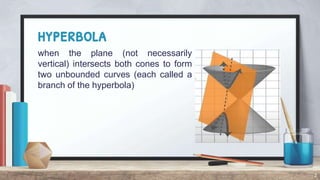
when the plane (not necessarily
vertical) intersects both cones to form
two unbounded curves (each called a
branch of the hyperbola)
hyperbola
3
is a set of all points in a place such the difference
of the distances of each point of the set from the fixed
points is constant. The fixed point are called foci.
Since c>a, the number 𝒄𝟐
− 𝒂𝟐
is a positive; we let 𝒃𝟐
= 𝒄𝟐
−
𝒂𝟐
. Then we can write the equation of the Ellipse
𝑥2
𝑎2
−
𝑦2
𝑏2
= 1
hyperbola
4
Figure 1.1
Part of the hyperbola
5
Horizontal Hyperbola
Figure 1.3
𝑥2
𝑎2
−
𝑦2
𝑏2
= 1
𝑦2
𝑎2
−
𝑥2
𝑏2
= 1
Vertical Hyperbola
Figure 1.2
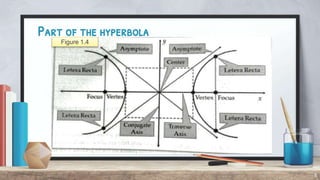
Definition of terms:
6
Focus- is called eccentricity of the hyperbola.
Vertices- the points of the hyperbola with the traverse axis.
Directrix (fixed line)- is a line such that the ratio of distance
of the points on the hyperbola from the focus to its
distance from the directrix is constant.
Latera Recta- the line segment passing through the foci
and perpendicular to the transverse axis.
Transverse axis- the line segment joining the vertices.
Conjugate axis- the segment which is perpendicular
bisector of the transverse axis with the length of 2b.
Definition of terms:
7
Focal length- is the line segment joining the foci with the
length of 2c.
Asymptote- the lines that pass to the center of the
hyperbola and are asymptotic to the curves.
Center- is the center where the two asymptotes intersect,
or it can be defined as the intersection of the traverse and
conjugate.
Part of the hyperbola
8
Figure 1.4
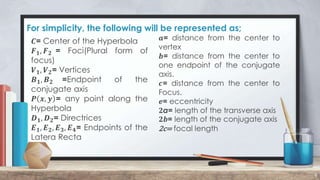
For simplicity, the following will be represented as;
9
𝑪= Center of the Hyperbola
𝑭𝟏, 𝑭𝟐 = Foci(Plural form of
focus)
𝑽𝟏, 𝑽𝟐= Vertices
𝑩𝟏, 𝑩𝟐 =Endpoint of the
conjugate axis
𝑷 𝒙, 𝒚 = any point along the
Hyperbola
𝑫𝟏, 𝑫𝟐= Directrices
𝑬𝟏, 𝑬𝟐, 𝑬𝟑, 𝑬𝟒= Endpoints of the
Latera Recta
𝒂= distance from the center to
vertex
𝒃= distance from the center to
one endpoint of the conjugate
axis.
𝒄= distance from the center to
Focus.
𝒆= eccentricity
𝟐a= length of the transverse axis
𝟐𝒃= length of the conjugate axis
2c= focal length
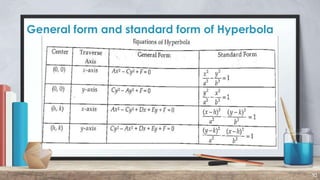
General form and standard form of Hyperbola
10
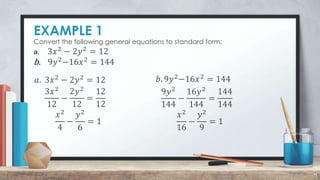
EXAMPLE 1
11
Convert the following general equations to standard form:
a. 3𝑥2 − 2𝑦2 = 12
b. 9𝑦2−16𝑥2 = 144
𝑎. 3𝑥2
− 2𝑦2
= 12
3𝑥2
12
−
2𝑦2
12
=
12
12
𝑥2
4
−
𝑦2
6
= 1
𝑏. 9𝑦2−16𝑥2 = 144
9𝑦2
144
−
16𝑦2
144
=
144
144
𝑥2
16
−
𝑦2
9
= 1
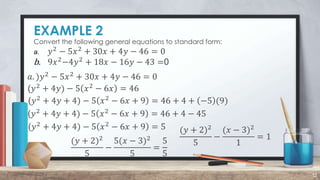
EXAMPLE 2
12
Convert the following general equations to standard form:
a. 𝑦2 − 5𝑥2 + 30𝑥 + 4𝑦 − 46 = 0
b. 9𝑥2−4𝑦2 + 18𝑥 − 16𝑦 − 43 =0
𝑎. )𝑦2
− 5𝑥2
+ 30𝑥 + 4𝑦 − 46 = 0
(𝑦 + 2)2
5
−
5(𝑥 − 3)2
5
=
5
5
(𝑦2
+ 4𝑦) − 5 𝑥2
− 6𝑥 = 46
(𝑦2
+ 4𝑦 + 4) − 5 𝑥2
− 6𝑥 + 9 = 46 + 4 + −5 (9)
(𝑦2
+ 4𝑦 + 4) − 5 𝑥2
− 6𝑥 + 9 = 46 + 4 − 45
(𝑦2
+ 4𝑦 + 4) − 5 𝑥2
− 6𝑥 + 9 = 5 (𝑦 + 2)2
5
−
(𝑥 − 3)2
1
= 1
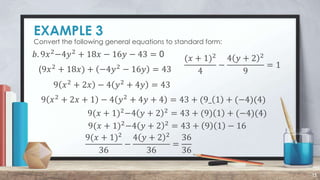
EXAMPLE 3
13
Convert the following general equations to standard form:
9(𝑥 + 1)2
36
−
4 𝑦 + 2 2
36
=
36
36
𝑏. 9𝑥2
−4𝑦2
+ 18𝑥 − 16𝑦 − 43 = 0
(9𝑥2 + 18𝑥) + −4𝑦2 − 16𝑦 = 43
9 𝑥2 + 2𝑥 − 4 𝑦2 + 4𝑦 = 43
9 𝑥2 + 2𝑥 + 1 − 4 𝑦2 + 4𝑦 + 4 = 43 + (9_ 1 + (−4)(4)
9(𝑥 + 1)2−4 𝑦 + 2 2 = 43 + (9) 1 + (−4)(4)
9(𝑥 + 1)2−4 𝑦 + 2 2 = 43 + 9 1 − 16
(𝑥 + 1)2
4
−
4 𝑦 + 2 2
9
= 1
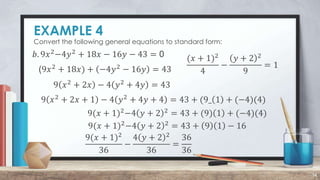
EXAMPLE 4
14
Convert the following general equations to standard form:
9(𝑥 + 1)2
36
−
4 𝑦 + 2 2
36
=
36
36
𝑏. 9𝑥2
−4𝑦2
+ 18𝑥 − 16𝑦 − 43 = 0
(9𝑥2 + 18𝑥) + −4𝑦2 − 16𝑦 = 43
9 𝑥2 + 2𝑥 − 4 𝑦2 + 4𝑦 = 43
9 𝑥2 + 2𝑥 + 1 − 4 𝑦2 + 4𝑦 + 4 = 43 + (9_ 1 + (−4)(4)
9(𝑥 + 1)2−4 𝑦 + 2 2 = 43 + (9) 1 + (−4)(4)
9(𝑥 + 1)2−4 𝑦 + 2 2 = 43 + 9 1 − 16
(𝑥 + 1)2
4
−
𝑦 + 2 2
9
= 1
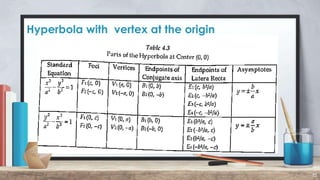
Hyperbola with vertex at the origin
15
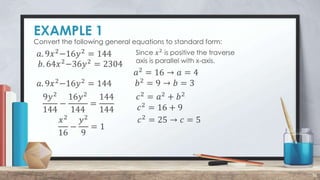
EXAMPLE 1
16
Convert the following general equations to standard form:
𝑎. 9𝑥2−16𝑦2 = 144
𝑏. 64𝑥2
−36𝑦2
= 2304
𝑎. 9𝑥2−16𝑦2 = 144
9𝑦2
144
−
16𝑦2
144
=
144
144
𝑥2
16
−
𝑦2
9
= 1
Since 𝑥2
is positive the traverse
axis is parallel with x-axis.
𝑎2
= 16 → 𝑎 = 4
𝑏2 = 9 → 𝑏 = 3
𝑐2
= 𝑎2
+ 𝑏2
𝑐2 = 16 + 9
𝑐2 = 25 → 𝑐 = 5
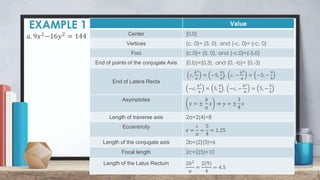
EXAMPLE 1
17
Value
Center (0,0)
Vertices (c, 0)= (5, 0), and (-c, 0)= (-c, 0)
Foci (c,0)= (5, 0), and (-c,0)=(-5,0)
End of points of the conjugate Axis (0,b)=(0,3), and (0, -b)= (0,-3)
End of Latera Recta
𝑐,
𝑏2
𝑎
= −5,
9
4
, 𝑐, −
𝑏2
𝑎
= −5, −
9
4
−𝑐,
𝑏2
𝑎
= 5,
9
4
, −𝑐, −
𝑏2
𝑎
= 5, −
9
4
Asymptotes
𝑦 = ±
𝑏
𝑎
𝑥 ⇒ 𝑦 = ±
3
4
𝑥
Length of traverse axis 2a=2(4)=8
Eccentricity
𝑒 =
𝑐
𝑎
=
5
4
= 1.25
Length of the conjugate axis 2b=(2)(3)=6
Focal length 2c=2(5)=10
Length of the Latus Rectum 2𝑏2
𝑎
=
2(9)
4
= 4.5
𝑎. 9𝑥2
−16𝑦2
= 144
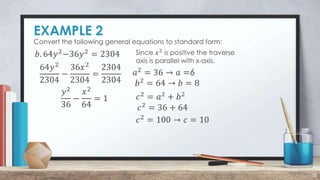
EXAMPLE 2
18
Convert the following general equations to standard form:
𝑏. 64𝑦2
−36𝑦2
= 2304
64𝑦2
2304
−
36𝑥2
2304
=
2304
2304
𝑦2
36
−
𝑥2
64
= 1
Since 𝑥2
is positive the traverse
axis is parallel with x-axis.
𝑎2
= 36 → 𝑎 =6
𝑏2 = 64 → 𝑏 = 8
𝑐2
= 𝑎2
+ 𝑏2
𝑐2 = 36 + 64
𝑐2 = 100 → 𝑐 = 10
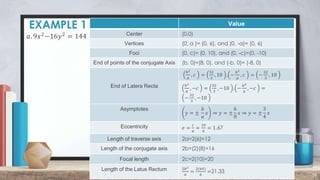
EXAMPLE 1
19
Value
Center (0,0)
Vertices (0, a )= (0, 6), and (0, -a)= (0, 6)
Foci (0, c)= (0, 10), and (0, -c)=(0, -10)
End of points of the conjugate Axis (b, 0)=(8, 0), and (-b, 0)= (-8, 0)
End of Latera Recta
𝑏2
𝑎
, 𝑐 =
32
3
, 10 , −
𝑏2
𝑎
, 𝑐 = −
32
3
, 10
𝑏2
𝑎
, −𝑐 =
32
3
, −10 , −
𝑏2
𝑎
, −𝑐 =
−
32
3
, −10
Asymptotes
𝑦 = ±
𝑏
𝑎
𝑥 ⇒ 𝑦 = ±
6
8
𝑥 ⇒ 𝑦 = ±
3
4
𝑥
Eccentricity 𝑒 =
𝑐
𝑎
=
10
6
= 1.67
Length of traverse axis 2a=2(6)=12
Length of the conjugate axis 2b=(2)(8)=16
Focal length 2c=2(10)=20
Length of the Latus Rectum 2𝑏2
𝑎
=
2(64)
6
=21.33
𝑎. 9𝑥2
−16𝑦2
= 144
Hyperbola with vertex at (h,k)
20
EXAMPLE 1
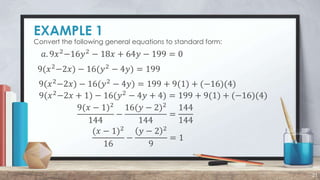
21
Convert the following general equations to standard form:
𝑎. 9𝑥2
−16𝑦2
− 18𝑥 + 64𝑦 − 199 = 0
9(𝑥 − 1)2
144
−
16(𝑦 − 2)2
144
=
144
144
9(𝑥2−2𝑥) − 16(𝑦2 − 4𝑦) = 199
9(𝑥2−2𝑥) − 16(𝑦2 − 4𝑦) = 199 + 9(1) + (−16)(4)
9(𝑥2−2𝑥 + 1) − 16(𝑦2 − 4𝑦 + 4) = 199 + 9(1) + (−16)(4)
(𝑥 − 1)2
16
−
𝑦 − 2 2
9
= 1
EXAMPLE 1
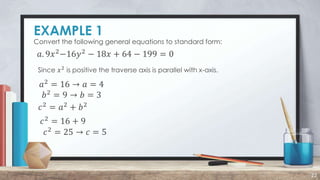
22
Convert the following general equations to standard form:
𝑎. 9𝑥2
−16𝑦2
− 18𝑥 + 64 − 199 = 0
Since 𝑥2
is positive the traverse axis is parallel with x-axis.
𝑎2
= 16 → 𝑎 = 4
𝑏2 = 9 → 𝑏 = 3
𝑐2
= 𝑎2
+ 𝑏2
𝑐2 = 16 + 9
𝑐2
= 25 → 𝑐 = 5
EXAMPLE 1
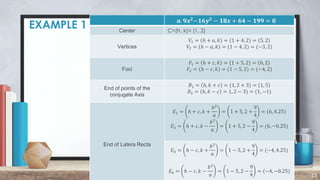
23
Center C=(h, k)= (1, 2)
Vertices
𝑉1 = ℎ + 𝑎, 𝑘 = (1 + 4, 2) = 5, 2
𝑉2 = ℎ − 𝑎, 𝑘 = (1 − 4, 2) = (−3, 2)
Foci
𝐹1 = ℎ + 𝑐, 𝑘 = (1 + 5, 2) = 6, 2
𝐹2 = ℎ − 𝑐, 𝑘 = (1 − 5, 2) = (−4, 2)
End of points of the
conjugate Axis
𝐵1 = ℎ, 𝑘 + 𝑐 = (1, 2 + 3) = 1, 5
𝐵2 = ℎ, 𝑘 − 𝑐 = 1, 2 − 3) = (1, −1)
End of Latera Recta
𝐸1 = ℎ + 𝑐, 𝑘 +
𝑏2
𝑎
= 1 + 5, 2 +
9
4
= (6, 4.25)
𝐸2 = ℎ + 𝑐, 𝑘 −
𝑏2
𝑎
= 1 + 5, 2 −
9
4
= (6, −0.25)
𝐸3 = ℎ − 𝑐, 𝑘 +
𝑏2
𝑎
= 1 − 5, 2 +
9
4
= (−4, 4.25)
𝐸4 = ℎ − 𝑐, 𝑘 −
𝑏2
𝑎
= 1 − 5, 2 −
9
4
= (−4, −0.25)
𝒂. 𝟗𝒙𝟐
−𝟏𝟔𝒚𝟐
− 𝟏𝟖𝒙 + 𝟔𝟒 − 𝟏𝟗𝟗 = 𝟎
EXAMPLE 1
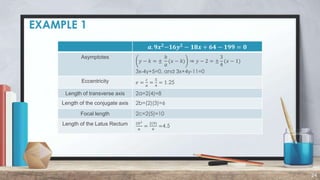
24
𝒂. 𝟗𝒙𝟐
−𝟏𝟔𝒚𝟐
− 𝟏𝟖𝒙 + 𝟔𝟒 − 𝟏𝟗𝟗 = 𝟎
Asymptotes
𝑦 − 𝑘 = ±
𝑏
𝑎
(𝑥 − ℎ) ⇒ 𝑦 − 2 = ±
3
4
(𝑥 − 1)
3x-4y+5=0, and 3x+4y-11=0
Eccentricity 𝑒 =
𝑐
𝑎
=
5
4
= 1.25
Length of transverse axis 2a=2(4)=8
Length of the conjugate axis 2b=(2)(3)=6
Focal length 2c=2(5)=10
Length of the Latus Rectum 2𝑏2
𝑎
=
2(9)
6
=4.5
GENERALIZATION
25
26
EVALUATION
Exercises
27
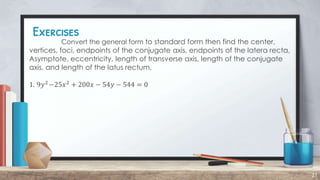
Convert the general form to standard form then find the center,
vertices, foci, endpoints of the conjugate axis, endpoints of the latera recta,
Asymptote, eccentricity, length of transverse axis, length of the conjugate
axis, and length of the latus rectum.
1. 9𝑦2
−25𝑥2
+ 200𝑥 − 54𝑦 − 544 = 0
28
ASSIGNMENT

Grade 11 STEM (2023~2024) Hyperbolas.pptx

  • 1.
  • 2.
    2 hyperbola when the plane(not necessarily vertical) intersects both cones to form two unbounded curves (each called a branch of the hyperbola)
  • 3.
    hyperbola 3 is a setof all points in a place such the difference of the distances of each point of the set from the fixed points is constant. The fixed point are called foci. Since c>a, the number 𝒄𝟐 − 𝒂𝟐 is a positive; we let 𝒃𝟐 = 𝒄𝟐 − 𝒂𝟐 . Then we can write the equation of the Ellipse 𝑥2 𝑎2 − 𝑦2 𝑏2 = 1
  • 4.
  • 5.
    Part of thehyperbola 5 Horizontal Hyperbola Figure 1.3 𝑥2 𝑎2 − 𝑦2 𝑏2 = 1 𝑦2 𝑎2 − 𝑥2 𝑏2 = 1 Vertical Hyperbola Figure 1.2
  • 6.
    Definition of terms: 6 Focus-is called eccentricity of the hyperbola. Vertices- the points of the hyperbola with the traverse axis. Directrix (fixed line)- is a line such that the ratio of distance of the points on the hyperbola from the focus to its distance from the directrix is constant. Latera Recta- the line segment passing through the foci and perpendicular to the transverse axis. Transverse axis- the line segment joining the vertices. Conjugate axis- the segment which is perpendicular bisector of the transverse axis with the length of 2b.
  • 7.
    Definition of terms: 7 Focallength- is the line segment joining the foci with the length of 2c. Asymptote- the lines that pass to the center of the hyperbola and are asymptotic to the curves. Center- is the center where the two asymptotes intersect, or it can be defined as the intersection of the traverse and conjugate.
  • 8.
    Part of thehyperbola 8 Figure 1.4
  • 9.
    For simplicity, thefollowing will be represented as; 9 𝑪= Center of the Hyperbola 𝑭𝟏, 𝑭𝟐 = Foci(Plural form of focus) 𝑽𝟏, 𝑽𝟐= Vertices 𝑩𝟏, 𝑩𝟐 =Endpoint of the conjugate axis 𝑷 𝒙, 𝒚 = any point along the Hyperbola 𝑫𝟏, 𝑫𝟐= Directrices 𝑬𝟏, 𝑬𝟐, 𝑬𝟑, 𝑬𝟒= Endpoints of the Latera Recta 𝒂= distance from the center to vertex 𝒃= distance from the center to one endpoint of the conjugate axis. 𝒄= distance from the center to Focus. 𝒆= eccentricity 𝟐a= length of the transverse axis 𝟐𝒃= length of the conjugate axis 2c= focal length
  • 10.
    General form andstandard form of Hyperbola 10
  • 11.
    EXAMPLE 1 11 Convert thefollowing general equations to standard form: a. 3𝑥2 − 2𝑦2 = 12 b. 9𝑦2−16𝑥2 = 144 𝑎. 3𝑥2 − 2𝑦2 = 12 3𝑥2 12 − 2𝑦2 12 = 12 12 𝑥2 4 − 𝑦2 6 = 1 𝑏. 9𝑦2−16𝑥2 = 144 9𝑦2 144 − 16𝑦2 144 = 144 144 𝑥2 16 − 𝑦2 9 = 1
  • 12.
    EXAMPLE 2 12 Convert thefollowing general equations to standard form: a. 𝑦2 − 5𝑥2 + 30𝑥 + 4𝑦 − 46 = 0 b. 9𝑥2−4𝑦2 + 18𝑥 − 16𝑦 − 43 =0 𝑎. )𝑦2 − 5𝑥2 + 30𝑥 + 4𝑦 − 46 = 0 (𝑦 + 2)2 5 − 5(𝑥 − 3)2 5 = 5 5 (𝑦2 + 4𝑦) − 5 𝑥2 − 6𝑥 = 46 (𝑦2 + 4𝑦 + 4) − 5 𝑥2 − 6𝑥 + 9 = 46 + 4 + −5 (9) (𝑦2 + 4𝑦 + 4) − 5 𝑥2 − 6𝑥 + 9 = 46 + 4 − 45 (𝑦2 + 4𝑦 + 4) − 5 𝑥2 − 6𝑥 + 9 = 5 (𝑦 + 2)2 5 − (𝑥 − 3)2 1 = 1
  • 13.
    EXAMPLE 3 13 Convert thefollowing general equations to standard form: 9(𝑥 + 1)2 36 − 4 𝑦 + 2 2 36 = 36 36 𝑏. 9𝑥2 −4𝑦2 + 18𝑥 − 16𝑦 − 43 = 0 (9𝑥2 + 18𝑥) + −4𝑦2 − 16𝑦 = 43 9 𝑥2 + 2𝑥 − 4 𝑦2 + 4𝑦 = 43 9 𝑥2 + 2𝑥 + 1 − 4 𝑦2 + 4𝑦 + 4 = 43 + (9_ 1 + (−4)(4) 9(𝑥 + 1)2−4 𝑦 + 2 2 = 43 + (9) 1 + (−4)(4) 9(𝑥 + 1)2−4 𝑦 + 2 2 = 43 + 9 1 − 16 (𝑥 + 1)2 4 − 4 𝑦 + 2 2 9 = 1
  • 14.
    EXAMPLE 4 14 Convert thefollowing general equations to standard form: 9(𝑥 + 1)2 36 − 4 𝑦 + 2 2 36 = 36 36 𝑏. 9𝑥2 −4𝑦2 + 18𝑥 − 16𝑦 − 43 = 0 (9𝑥2 + 18𝑥) + −4𝑦2 − 16𝑦 = 43 9 𝑥2 + 2𝑥 − 4 𝑦2 + 4𝑦 = 43 9 𝑥2 + 2𝑥 + 1 − 4 𝑦2 + 4𝑦 + 4 = 43 + (9_ 1 + (−4)(4) 9(𝑥 + 1)2−4 𝑦 + 2 2 = 43 + (9) 1 + (−4)(4) 9(𝑥 + 1)2−4 𝑦 + 2 2 = 43 + 9 1 − 16 (𝑥 + 1)2 4 − 𝑦 + 2 2 9 = 1
  • 15.
    Hyperbola with vertexat the origin 15
  • 16.
    EXAMPLE 1 16 Convert thefollowing general equations to standard form: 𝑎. 9𝑥2−16𝑦2 = 144 𝑏. 64𝑥2 −36𝑦2 = 2304 𝑎. 9𝑥2−16𝑦2 = 144 9𝑦2 144 − 16𝑦2 144 = 144 144 𝑥2 16 − 𝑦2 9 = 1 Since 𝑥2 is positive the traverse axis is parallel with x-axis. 𝑎2 = 16 → 𝑎 = 4 𝑏2 = 9 → 𝑏 = 3 𝑐2 = 𝑎2 + 𝑏2 𝑐2 = 16 + 9 𝑐2 = 25 → 𝑐 = 5
  • 17.
    EXAMPLE 1 17 Value Center (0,0) Vertices(c, 0)= (5, 0), and (-c, 0)= (-c, 0) Foci (c,0)= (5, 0), and (-c,0)=(-5,0) End of points of the conjugate Axis (0,b)=(0,3), and (0, -b)= (0,-3) End of Latera Recta 𝑐, 𝑏2 𝑎 = −5, 9 4 , 𝑐, − 𝑏2 𝑎 = −5, − 9 4 −𝑐, 𝑏2 𝑎 = 5, 9 4 , −𝑐, − 𝑏2 𝑎 = 5, − 9 4 Asymptotes 𝑦 = ± 𝑏 𝑎 𝑥 ⇒ 𝑦 = ± 3 4 𝑥 Length of traverse axis 2a=2(4)=8 Eccentricity 𝑒 = 𝑐 𝑎 = 5 4 = 1.25 Length of the conjugate axis 2b=(2)(3)=6 Focal length 2c=2(5)=10 Length of the Latus Rectum 2𝑏2 𝑎 = 2(9) 4 = 4.5 𝑎. 9𝑥2 −16𝑦2 = 144
  • 18.
    EXAMPLE 2 18 Convert thefollowing general equations to standard form: 𝑏. 64𝑦2 −36𝑦2 = 2304 64𝑦2 2304 − 36𝑥2 2304 = 2304 2304 𝑦2 36 − 𝑥2 64 = 1 Since 𝑥2 is positive the traverse axis is parallel with x-axis. 𝑎2 = 36 → 𝑎 =6 𝑏2 = 64 → 𝑏 = 8 𝑐2 = 𝑎2 + 𝑏2 𝑐2 = 36 + 64 𝑐2 = 100 → 𝑐 = 10
  • 19.
    EXAMPLE 1 19 Value Center (0,0) Vertices(0, a )= (0, 6), and (0, -a)= (0, 6) Foci (0, c)= (0, 10), and (0, -c)=(0, -10) End of points of the conjugate Axis (b, 0)=(8, 0), and (-b, 0)= (-8, 0) End of Latera Recta 𝑏2 𝑎 , 𝑐 = 32 3 , 10 , − 𝑏2 𝑎 , 𝑐 = − 32 3 , 10 𝑏2 𝑎 , −𝑐 = 32 3 , −10 , − 𝑏2 𝑎 , −𝑐 = − 32 3 , −10 Asymptotes 𝑦 = ± 𝑏 𝑎 𝑥 ⇒ 𝑦 = ± 6 8 𝑥 ⇒ 𝑦 = ± 3 4 𝑥 Eccentricity 𝑒 = 𝑐 𝑎 = 10 6 = 1.67 Length of traverse axis 2a=2(6)=12 Length of the conjugate axis 2b=(2)(8)=16 Focal length 2c=2(10)=20 Length of the Latus Rectum 2𝑏2 𝑎 = 2(64) 6 =21.33 𝑎. 9𝑥2 −16𝑦2 = 144
  • 20.
  • 21.
    EXAMPLE 1 21 Convert thefollowing general equations to standard form: 𝑎. 9𝑥2 −16𝑦2 − 18𝑥 + 64𝑦 − 199 = 0 9(𝑥 − 1)2 144 − 16(𝑦 − 2)2 144 = 144 144 9(𝑥2−2𝑥) − 16(𝑦2 − 4𝑦) = 199 9(𝑥2−2𝑥) − 16(𝑦2 − 4𝑦) = 199 + 9(1) + (−16)(4) 9(𝑥2−2𝑥 + 1) − 16(𝑦2 − 4𝑦 + 4) = 199 + 9(1) + (−16)(4) (𝑥 − 1)2 16 − 𝑦 − 2 2 9 = 1
  • 22.
    EXAMPLE 1 22 Convert thefollowing general equations to standard form: 𝑎. 9𝑥2 −16𝑦2 − 18𝑥 + 64 − 199 = 0 Since 𝑥2 is positive the traverse axis is parallel with x-axis. 𝑎2 = 16 → 𝑎 = 4 𝑏2 = 9 → 𝑏 = 3 𝑐2 = 𝑎2 + 𝑏2 𝑐2 = 16 + 9 𝑐2 = 25 → 𝑐 = 5
  • 23.
    EXAMPLE 1 23 Center C=(h,k)= (1, 2) Vertices 𝑉1 = ℎ + 𝑎, 𝑘 = (1 + 4, 2) = 5, 2 𝑉2 = ℎ − 𝑎, 𝑘 = (1 − 4, 2) = (−3, 2) Foci 𝐹1 = ℎ + 𝑐, 𝑘 = (1 + 5, 2) = 6, 2 𝐹2 = ℎ − 𝑐, 𝑘 = (1 − 5, 2) = (−4, 2) End of points of the conjugate Axis 𝐵1 = ℎ, 𝑘 + 𝑐 = (1, 2 + 3) = 1, 5 𝐵2 = ℎ, 𝑘 − 𝑐 = 1, 2 − 3) = (1, −1) End of Latera Recta 𝐸1 = ℎ + 𝑐, 𝑘 + 𝑏2 𝑎 = 1 + 5, 2 + 9 4 = (6, 4.25) 𝐸2 = ℎ + 𝑐, 𝑘 − 𝑏2 𝑎 = 1 + 5, 2 − 9 4 = (6, −0.25) 𝐸3 = ℎ − 𝑐, 𝑘 + 𝑏2 𝑎 = 1 − 5, 2 + 9 4 = (−4, 4.25) 𝐸4 = ℎ − 𝑐, 𝑘 − 𝑏2 𝑎 = 1 − 5, 2 − 9 4 = (−4, −0.25) 𝒂. 𝟗𝒙𝟐 −𝟏𝟔𝒚𝟐 − 𝟏𝟖𝒙 + 𝟔𝟒 − 𝟏𝟗𝟗 = 𝟎
  • 24.
    EXAMPLE 1 24 𝒂. 𝟗𝒙𝟐 −𝟏𝟔𝒚𝟐 −𝟏𝟖𝒙 + 𝟔𝟒 − 𝟏𝟗𝟗 = 𝟎 Asymptotes 𝑦 − 𝑘 = ± 𝑏 𝑎 (𝑥 − ℎ) ⇒ 𝑦 − 2 = ± 3 4 (𝑥 − 1) 3x-4y+5=0, and 3x+4y-11=0 Eccentricity 𝑒 = 𝑐 𝑎 = 5 4 = 1.25 Length of transverse axis 2a=2(4)=8 Length of the conjugate axis 2b=(2)(3)=6 Focal length 2c=2(5)=10 Length of the Latus Rectum 2𝑏2 𝑎 = 2(9) 6 =4.5
  • 25.
  • 26.
  • 27.
    Exercises 27 Convert the generalform to standard form then find the center, vertices, foci, endpoints of the conjugate axis, endpoints of the latera recta, Asymptote, eccentricity, length of transverse axis, length of the conjugate axis, and length of the latus rectum. 1. 9𝑦2 −25𝑥2 + 200𝑥 − 54𝑦 − 544 = 0
  • 28.