• Course No.: CE-2202 Credit: 1.5
Course Title: Fluid Mechanics Sessional
TOPIC: Centre of Pressure
DHAKA UNIVERSITY OF ENGINEERING AND
TECHNOLOGY, GAZIPUR
Presented By: Group: 01
1. Md. Mehedi Hasan - 161065
2. Md. Tayeb Hasan - 161066
3. Md. Momin Ali - 161067
4. Md. Robuil Awal - 161068
5. Md. Mehedi Hasan Shamim - 161069
6. Md. Helal Sarker - 161071
7. Md. Alomgir - 161072
8. Md. Faysal - 161073
9. Md. Morshed - 161074
10. Md. Ekramul - 161075
Department of Civil Engineering,
Dhaka University of Engineering & Technology, Gazipur
Presented To:
• Dr. Md. Khasro Mia
• Professor
• Department of Civil Engineering
• Zakir Hossen
• Assistant Professor
• Department of Civil Engineering
• Department of Civil Engineering,
Dhaka University of Engineering & Technology,
Gazipur
WELCOME
TO MY PRESENTATION
BACKGROUND
The center of pressureis that point where the total
some of pressure field acts one a body, causing a
force to act through that point. The resultant force
and Centre of pressure location produce equivalent
force and moment on the body as the original
pressure field
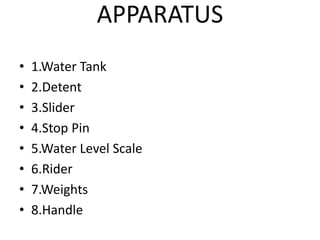
APPARATUS
• 1.Water Tank
• 2.Detent
• 3.Slider
• 4.Stop Pin
• 5.Water Level Scale
• 6.Rider
• 7.Weights
• 8.Handle
PROCEDURE
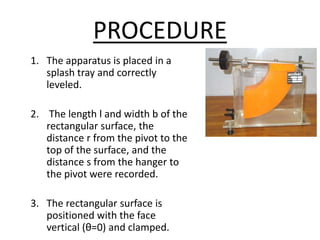
1. The apparatus is placed in a
splash tray and correctly
leveled.
2. The length l and width b of the
rectangular surface, the
distance r from the pivot to the
top of the surface, and the
distance s from the hanger to
the pivot were recorded.
3. The rectangular surface is
positioned with the face
vertical (θ=0) and clamped.
• 4. The position of the moveable jockey weight
is adjusted to give equilibrium, i.e. when the
balance pin is removed there is no movement
of the apparatus. The balance pin is replaced
• 5. Water is added to the storage chamber. This
created an out-of-balance clockwise moment
in the apparatus. A mass M is added to the
hanger and water is slowly removed from the
chamber via drain hole such that the system is
brought almost to equilibrium, but now
clockwisw moment is marginally greater.
Water is slowlynadded to the storage chamber
by a dropper until equilibrium is attained. At
this condition the drain hole is closed and the
balance pin again removed to cheek
equilibrium.
6. The balance pin is replaced and the values of
y1, y2 and M were recorded.
7. The above procedure is repeated for various
combinations of depth.
MAJOR EQUATION
The magnitude of the total hydrostatic force F
will be given by
F = ρgȳA
Where, ρ = Density of fluid
g = Acceleration due to gravity
ȳ = Depth to centroid of immersed
A = Area of immersed surface
This force will act through the centre of pressure
C.P. at a distance (Measured vertically)from
point O
Theory shows that
y = ȳ +
Where
ȳ = distance from O to the centroid CG of the
immersed surface.
ICG = 2nd moment of area of the immersed surface
about the horizontal axis through CG
ICG
Ay
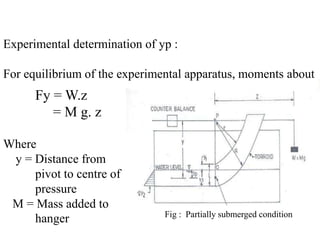
Experimental determination of yp :
For equilibrium of the experimental apparatus, moments about
the pivot P give
Fy = W.z
= M g. z
Where
y = Distance from
pivot to centre of
pressure
M = Mass added to
hanger Fig : Partially submerged condition
z = Distance from pivot to hanger
Therefore
y =
But y = yp + r - y1 [ full submerged ]
y = yp = r + y1 [ partially submerged ]
Therefore
yp = y - (r - y1) [ fully submerged ]
yp = y - (r - y1) [ partially submerged ]
Where
r = Distance from pivot to top of rectangular surface
y1 = Distance from water surface to top of rectangular
surface
In Fig
y2 = Distance from water surface to bottom of rectangular
surface
Mgz
F
PRACTICAL APPLICATION
• In engineering field,centre of pressure in most
used topics.In our practical iife we used many
things which make on based of centre of
pressure.Centre of pressure is also used in
Aircraft aerodynamics, Missile aerodynamics
etc.
• One very important application is for pitch
stability of an airplane. This is stability in the nose
up, nose down Direction. I use this when
designing paper airplanes.
• We look at the location between tail and nose of
both the center of gravity and the center of
pressure on the wing. The center of gravity is the
point where it appears that gravity is pulling
down on the aircraft.
• The center of pressure is a point along that line
where the lift is pulling up on the airplane.
Fluid mechanics

Fluid mechanics

  • 1.
    • Course No.:CE-2202 Credit: 1.5 Course Title: Fluid Mechanics Sessional TOPIC: Centre of Pressure DHAKA UNIVERSITY OF ENGINEERING AND TECHNOLOGY, GAZIPUR
  • 2.
    Presented By: Group:01 1. Md. Mehedi Hasan - 161065 2. Md. Tayeb Hasan - 161066 3. Md. Momin Ali - 161067 4. Md. Robuil Awal - 161068 5. Md. Mehedi Hasan Shamim - 161069 6. Md. Helal Sarker - 161071 7. Md. Alomgir - 161072 8. Md. Faysal - 161073 9. Md. Morshed - 161074 10. Md. Ekramul - 161075 Department of Civil Engineering, Dhaka University of Engineering & Technology, Gazipur
  • 3.
    Presented To: • Dr.Md. Khasro Mia • Professor • Department of Civil Engineering • Zakir Hossen • Assistant Professor • Department of Civil Engineering • Department of Civil Engineering, Dhaka University of Engineering & Technology, Gazipur
  • 4.
  • 5.
    BACKGROUND The center ofpressureis that point where the total some of pressure field acts one a body, causing a force to act through that point. The resultant force and Centre of pressure location produce equivalent force and moment on the body as the original pressure field
  • 6.
    APPARATUS • 1.Water Tank •2.Detent • 3.Slider • 4.Stop Pin • 5.Water Level Scale • 6.Rider • 7.Weights • 8.Handle
  • 7.
    PROCEDURE 1. The apparatusis placed in a splash tray and correctly leveled. 2. The length l and width b of the rectangular surface, the distance r from the pivot to the top of the surface, and the distance s from the hanger to the pivot were recorded. 3. The rectangular surface is positioned with the face vertical (θ=0) and clamped.
  • 8.
    • 4. Theposition of the moveable jockey weight is adjusted to give equilibrium, i.e. when the balance pin is removed there is no movement of the apparatus. The balance pin is replaced
  • 9.
    • 5. Wateris added to the storage chamber. This created an out-of-balance clockwise moment in the apparatus. A mass M is added to the hanger and water is slowly removed from the chamber via drain hole such that the system is brought almost to equilibrium, but now clockwisw moment is marginally greater. Water is slowlynadded to the storage chamber by a dropper until equilibrium is attained. At this condition the drain hole is closed and the balance pin again removed to cheek equilibrium.
  • 10.
    6. The balancepin is replaced and the values of y1, y2 and M were recorded. 7. The above procedure is repeated for various combinations of depth.
  • 11.
    MAJOR EQUATION The magnitudeof the total hydrostatic force F will be given by F = ρgȳA Where, ρ = Density of fluid g = Acceleration due to gravity ȳ = Depth to centroid of immersed A = Area of immersed surface This force will act through the centre of pressure C.P. at a distance (Measured vertically)from point O
  • 12.
    Theory shows that y= ȳ + Where ȳ = distance from O to the centroid CG of the immersed surface. ICG = 2nd moment of area of the immersed surface about the horizontal axis through CG ICG Ay
  • 13.
    Experimental determination ofyp : For equilibrium of the experimental apparatus, moments about the pivot P give Fy = W.z = M g. z Where y = Distance from pivot to centre of pressure M = Mass added to hanger Fig : Partially submerged condition
  • 14.
    z = Distancefrom pivot to hanger Therefore y = But y = yp + r - y1 [ full submerged ] y = yp = r + y1 [ partially submerged ] Therefore yp = y - (r - y1) [ fully submerged ] yp = y - (r - y1) [ partially submerged ] Where r = Distance from pivot to top of rectangular surface y1 = Distance from water surface to top of rectangular surface In Fig y2 = Distance from water surface to bottom of rectangular surface Mgz F
  • 15.
    PRACTICAL APPLICATION • Inengineering field,centre of pressure in most used topics.In our practical iife we used many things which make on based of centre of pressure.Centre of pressure is also used in Aircraft aerodynamics, Missile aerodynamics etc.
  • 16.
    • One veryimportant application is for pitch stability of an airplane. This is stability in the nose up, nose down Direction. I use this when designing paper airplanes. • We look at the location between tail and nose of both the center of gravity and the center of pressure on the wing. The center of gravity is the point where it appears that gravity is pulling down on the aircraft. • The center of pressure is a point along that line where the lift is pulling up on the airplane.