Introduction to Conic
Sections and Circles
Quarter 1  Week 1
Learning Outcomes
Upon completion of the lessons, you
should be able to:
Learning Outcomes
Upon completion of the lessons, you
should be able to:
1. illustrate the different types of
conic sections: parabola, ellipse,
circle, hyperbola, and degenerate
cases; (STEM_PC11AG-Ia-1)
Learning Outcomes
Upon completion of the lessons, you
should be able to:
1. illustrate the different types of
conic sections: parabola, ellipse,
circle, hyperbola, and degenerate
cases; (STEM_PC11AG-Ia-1)
2. define a circle; (STEM_PC11AG-Ia-2)
Learning Outcomes
Upon completion of the lessons, you
should be able to:
1. illustrate the different types of
conic sections: parabola, ellipse,
circle, hyperbola, and degenerate
cases; (STEM_PC11AG-Ia-1)
2. define a circle; (STEM_PC11AG-Ia-2)
3. determine the standard form of
equation of a circle. (STEM_PC11AG-Ia-
3)
Definition
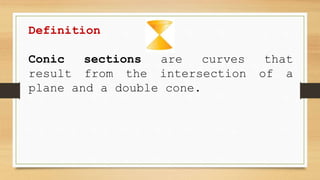
Conic sections are curves that
result from the intersection of a
plane and a double cone.
Definition
Conic sections are curves that
result from the intersection of a
plane and a double cone. The four
conic sections are
Definition
Conic sections are curves that
result from the intersection of a
plane and a double cone. The four
conic sections are a circle,
Definition
Conic sections are curves that
result from the intersection of a
plane and a double cone. The four
conic sections are a circle, an
ellipse,
Definition
Conic sections are curves that
result from the intersection of a
plane and a double cone. The four
conic sections are a circle, an
ellipse, a parabola,
Definition
Conic sections are curves that
result from the intersection of a
plane and a double cone. The four
conic sections are a circle, an
ellipse, a parabola, and a
hyperbola.
Definition
Conic sections are curves that
result from the intersection of a
plane and a double cone. The four
conic sections are a circle, an
ellipse, a parabola, and a
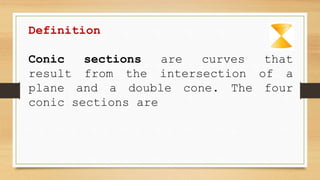
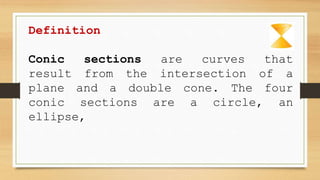
hyperbola. Conics is an abbreviation
for conic sections.
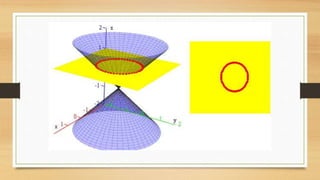
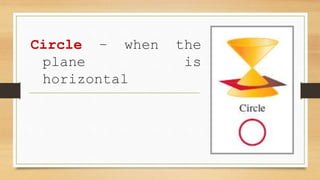
Circle – when the
plane is
horizontal
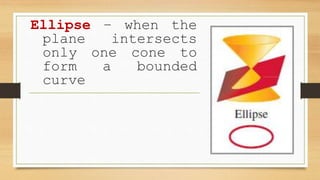
Ellipse – when the
plane intersects
only one cone to
form a bounded
curve
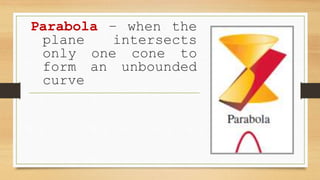
Parabola – when the
plane intersects
only one cone to
form an unbounded
curve
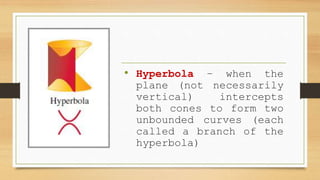
• Hyperbola – when the
plane (not necessarily
vertical) intercepts
both cones to form two
unbounded curves (each
called a branch of the
hyperbola)
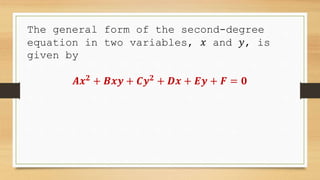
The general form of the second-degree
equation in two variables, 𝑥 and 𝑦, is
given by
The general form of the second-degree
equation in two variables, 𝑥 and 𝑦, is
given by
𝑨𝒙𝟐
+ 𝑩𝒙𝒚 + 𝑪𝒚𝟐
+ 𝑫𝒙 + 𝑬𝒚 + 𝑭 = 𝟎
The general form of the second-degree
equation in two variables, 𝑥 and 𝑦, is
given by
𝑨𝒙𝟐
+ 𝑩𝒙𝒚 + 𝑪𝒚𝟐
+ 𝑫𝒙 + 𝑬𝒚 + 𝑭 = 𝟎
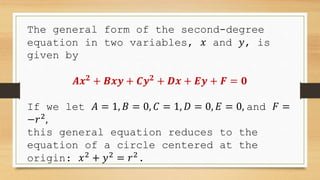
If we let 𝐴 = 1, 𝐵 = 0, 𝐶 = 1, 𝐷 = 0, 𝐸 = 0, and 𝐹 =
−𝑟2
,
this general equation reduces to the
equation of a circle centered at the
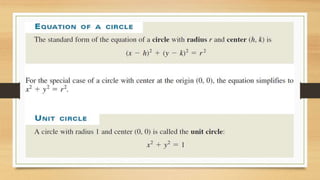
origin: 𝑥2
+ 𝑦2
= 𝑟2
.
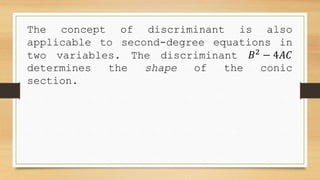
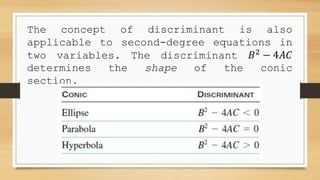
The concept of discriminant is also
applicable to second-degree equations in
two variables. The discriminant 𝐵2
− 4𝐴𝐶
determines the shape of the conic
section.
The concept of discriminant is also
applicable to second-degree equations in
two variables. The discriminant 𝐵2
− 4𝐴𝐶
determines the shape of the conic
section.
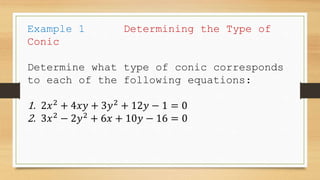
Example 1 Determining the Type of
Conic
Determine what type of conic corresponds
to each of the following equations:
1. 2𝑥2
+ 4𝑥𝑦 + 3𝑦2
+ 12𝑦 − 1 = 0
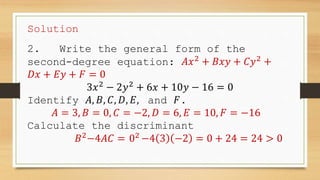
2. 3𝑥2
− 2𝑦2
+ 6𝑥 + 10𝑦 − 16 = 0
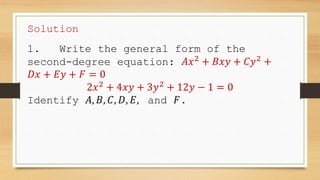
Solution
1. Write the general form of the
second-degree equation:
Solution
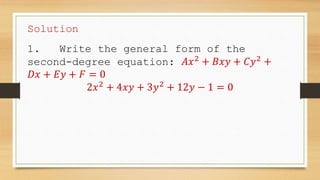
1. Write the general form of the
second-degree equation: 𝐴𝑥2
+ 𝐵𝑥𝑦 + 𝐶𝑦2
+
𝐷𝑥 + 𝐸𝑦 + 𝐹 = 0
2𝑥2
+ 4𝑥𝑦 + 3𝑦2
+ 12𝑦 − 1 = 0
Solution
1. Write the general form of the
second-degree equation: 𝐴𝑥2
+ 𝐵𝑥𝑦 + 𝐶𝑦2
+
𝐷𝑥 + 𝐸𝑦 + 𝐹 = 0
2𝑥2
+ 4𝑥𝑦 + 3𝑦2
+ 12𝑦 − 1 = 0
Identify 𝐴, 𝐵, 𝐶, 𝐷, 𝐸, and 𝐹.
Solution
1. Write the general form of the
second-degree equation: 𝐴𝑥2
+ 𝐵𝑥𝑦 + 𝐶𝑦2
+
𝐷𝑥 + 𝐸𝑦 + 𝐹 = 0
2𝑥2
+ 4𝑥𝑦 + 3𝑦2
+ 12𝑦 − 1 = 0
Identify 𝐴, 𝐵, 𝐶, 𝐷, 𝐸, and 𝐹.
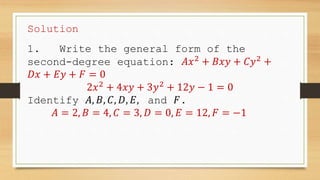
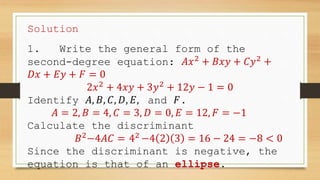
𝐴 = 2, 𝐵 = 4, 𝐶 = 3, 𝐷 = 0, 𝐸 = 12, 𝐹 = −1
Solution
1. Write the general form of the
second-degree equation: 𝐴𝑥2
+ 𝐵𝑥𝑦 + 𝐶𝑦2
+
𝐷𝑥 + 𝐸𝑦 + 𝐹 = 0
2𝑥2
+ 4𝑥𝑦 + 3𝑦2
+ 12𝑦 − 1 = 0
Identify 𝐴, 𝐵, 𝐶, 𝐷, 𝐸, and 𝐹.
𝐴 = 2, 𝐵 = 4, 𝐶 = 3, 𝐷 = 0, 𝐸 = 12, 𝐹 = −1
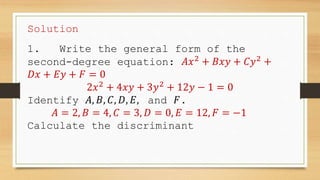
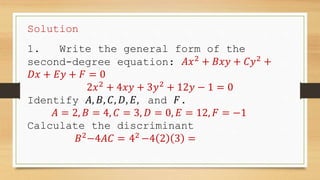
Calculate the discriminant
Solution
1. Write the general form of the
second-degree equation: 𝐴𝑥2
+ 𝐵𝑥𝑦 + 𝐶𝑦2
+
𝐷𝑥 + 𝐸𝑦 + 𝐹 = 0
2𝑥2
+ 4𝑥𝑦 + 3𝑦2
+ 12𝑦 − 1 = 0
Identify 𝐴, 𝐵, 𝐶, 𝐷, 𝐸, and 𝐹.
𝐴 = 2, 𝐵 = 4, 𝐶 = 3, 𝐷 = 0, 𝐸 = 12, 𝐹 = −1
Calculate the discriminant
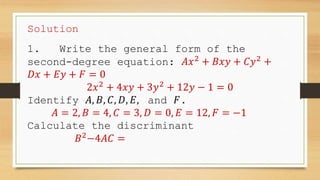
𝐵2
−4𝐴𝐶 =
Solution
1. Write the general form of the
second-degree equation: 𝐴𝑥2
+ 𝐵𝑥𝑦 + 𝐶𝑦2
+
𝐷𝑥 + 𝐸𝑦 + 𝐹 = 0
2𝑥2
+ 4𝑥𝑦 + 3𝑦2
+ 12𝑦 − 1 = 0
Identify 𝐴, 𝐵, 𝐶, 𝐷, 𝐸, and 𝐹.
𝐴 = 2, 𝐵 = 4, 𝐶 = 3, 𝐷 = 0, 𝐸 = 12, 𝐹 = −1
Calculate the discriminant
𝐵2
−4𝐴𝐶 = 42
−4 2 3 =
Solution
1. Write the general form of the
second-degree equation: 𝐴𝑥2
+ 𝐵𝑥𝑦 + 𝐶𝑦2
+
𝐷𝑥 + 𝐸𝑦 + 𝐹 = 0
2𝑥2
+ 4𝑥𝑦 + 3𝑦2
+ 12𝑦 − 1 = 0
Identify 𝐴, 𝐵, 𝐶, 𝐷, 𝐸, and 𝐹.
𝐴 = 2, 𝐵 = 4, 𝐶 = 3, 𝐷 = 0, 𝐸 = 12, 𝐹 = −1
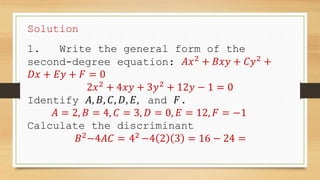
Calculate the discriminant
𝐵2
−4𝐴𝐶 = 42
−4 2 3 = 16 − 24 =
Solution
1. Write the general form of the
second-degree equation: 𝐴𝑥2
+ 𝐵𝑥𝑦 + 𝐶𝑦2
+
𝐷𝑥 + 𝐸𝑦 + 𝐹 = 0
2𝑥2
+ 4𝑥𝑦 + 3𝑦2
+ 12𝑦 − 1 = 0
Identify 𝐴, 𝐵, 𝐶, 𝐷, 𝐸, and 𝐹.
𝐴 = 2, 𝐵 = 4, 𝐶 = 3, 𝐷 = 0, 𝐸 = 12, 𝐹 = −1
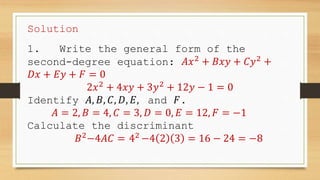
Calculate the discriminant
𝐵2
−4𝐴𝐶 = 42
−4 2 3 = 16 − 24 = −8
Solution
1. Write the general form of the
second-degree equation: 𝐴𝑥2
+ 𝐵𝑥𝑦 + 𝐶𝑦2
+
𝐷𝑥 + 𝐸𝑦 + 𝐹 = 0
2𝑥2
+ 4𝑥𝑦 + 3𝑦2
+ 12𝑦 − 1 = 0
Identify 𝐴, 𝐵, 𝐶, 𝐷, 𝐸, and 𝐹.
𝐴 = 2, 𝐵 = 4, 𝐶 = 3, 𝐷 = 0, 𝐸 = 12, 𝐹 = −1
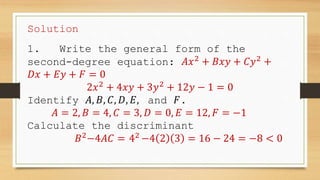
Calculate the discriminant
𝐵2
−4𝐴𝐶 = 42
−4 2 3 = 16 − 24 = −8 < 0
Solution
1. Write the general form of the
second-degree equation: 𝐴𝑥2
+ 𝐵𝑥𝑦 + 𝐶𝑦2
+
𝐷𝑥 + 𝐸𝑦 + 𝐹 = 0
2𝑥2
+ 4𝑥𝑦 + 3𝑦2
+ 12𝑦 − 1 = 0
Identify 𝐴, 𝐵, 𝐶, 𝐷, 𝐸, and 𝐹.
𝐴 = 2, 𝐵 = 4, 𝐶 = 3, 𝐷 = 0, 𝐸 = 12, 𝐹 = −1
Calculate the discriminant
𝐵2
−4𝐴𝐶 = 42
−4 2 3 = 16 − 24 = −8 < 0
Since the discriminant is negative, the
equation is that of an ellipse.
Solution
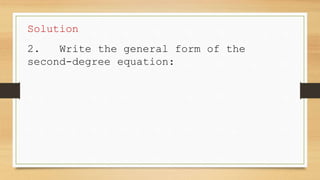
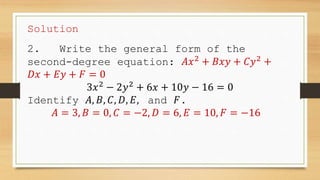
2. Write the general form of the
second-degree equation:
Solution
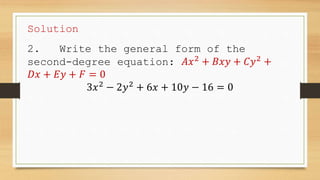
2. Write the general form of the
second-degree equation: 𝐴𝑥2
+ 𝐵𝑥𝑦 + 𝐶𝑦2
+
𝐷𝑥 + 𝐸𝑦 + 𝐹 = 0
3𝑥2
− 2𝑦2
+ 6𝑥 + 10𝑦 − 16 = 0
Solution
2. Write the general form of the
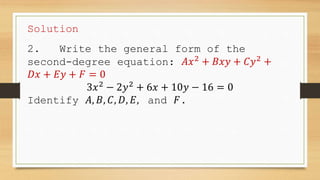
second-degree equation: 𝐴𝑥2
+ 𝐵𝑥𝑦 + 𝐶𝑦2
+
𝐷𝑥 + 𝐸𝑦 + 𝐹 = 0
3𝑥2
− 2𝑦2
+ 6𝑥 + 10𝑦 − 16 = 0
Identify 𝐴, 𝐵, 𝐶, 𝐷, 𝐸, and 𝐹.
Solution
2. Write the general form of the
second-degree equation: 𝐴𝑥2
+ 𝐵𝑥𝑦 + 𝐶𝑦2
+
𝐷𝑥 + 𝐸𝑦 + 𝐹 = 0
3𝑥2
− 2𝑦2
+ 6𝑥 + 10𝑦 − 16 = 0
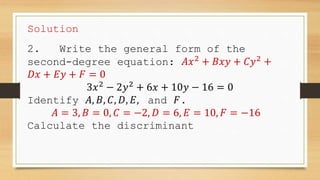
Identify 𝐴, 𝐵, 𝐶, 𝐷, 𝐸, and 𝐹.
𝐴 = 3, 𝐵 = 0, 𝐶 = −2, 𝐷 = 6, 𝐸 = 10, 𝐹 = −16
Solution
2. Write the general form of the
second-degree equation: 𝐴𝑥2
+ 𝐵𝑥𝑦 + 𝐶𝑦2
+
𝐷𝑥 + 𝐸𝑦 + 𝐹 = 0
3𝑥2
− 2𝑦2
+ 6𝑥 + 10𝑦 − 16 = 0
Identify 𝐴, 𝐵, 𝐶, 𝐷, 𝐸, and 𝐹.
𝐴 = 3, 𝐵 = 0, 𝐶 = −2, 𝐷 = 6, 𝐸 = 10, 𝐹 = −16
Calculate the discriminant
Solution
2. Write the general form of the
second-degree equation: 𝐴𝑥2
+ 𝐵𝑥𝑦 + 𝐶𝑦2
+
𝐷𝑥 + 𝐸𝑦 + 𝐹 = 0
3𝑥2
− 2𝑦2
+ 6𝑥 + 10𝑦 − 16 = 0
Identify 𝐴, 𝐵, 𝐶, 𝐷, 𝐸, and 𝐹.
𝐴 = 3, 𝐵 = 0, 𝐶 = −2, 𝐷 = 6, 𝐸 = 10, 𝐹 = −16
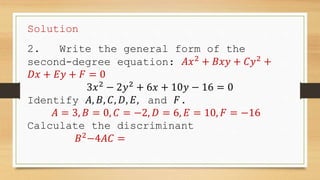
Calculate the discriminant
𝐵2
−4𝐴𝐶 =
Solution
2. Write the general form of the
second-degree equation: 𝐴𝑥2
+ 𝐵𝑥𝑦 + 𝐶𝑦2
+
𝐷𝑥 + 𝐸𝑦 + 𝐹 = 0
3𝑥2
− 2𝑦2
+ 6𝑥 + 10𝑦 − 16 = 0
Identify 𝐴, 𝐵, 𝐶, 𝐷, 𝐸, and 𝐹.
𝐴 = 3, 𝐵 = 0, 𝐶 = −2, 𝐷 = 6, 𝐸 = 10, 𝐹 = −16
Calculate the discriminant
𝐵2
−4𝐴𝐶 = 02
−4 3 −2 =
Solution
2. Write the general form of the
second-degree equation: 𝐴𝑥2
+ 𝐵𝑥𝑦 + 𝐶𝑦2
+
𝐷𝑥 + 𝐸𝑦 + 𝐹 = 0
3𝑥2
− 2𝑦2
+ 6𝑥 + 10𝑦 − 16 = 0
Identify 𝐴, 𝐵, 𝐶, 𝐷, 𝐸, and 𝐹.
𝐴 = 3, 𝐵 = 0, 𝐶 = −2, 𝐷 = 6, 𝐸 = 10, 𝐹 = −16
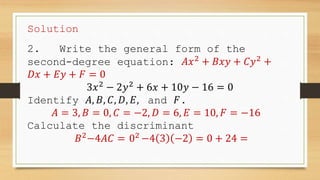
Calculate the discriminant
𝐵2
−4𝐴𝐶 = 02
−4 3 −2 = 0 + 24 =
Solution
2. Write the general form of the
second-degree equation: 𝐴𝑥2
+ 𝐵𝑥𝑦 + 𝐶𝑦2
+
𝐷𝑥 + 𝐸𝑦 + 𝐹 = 0
3𝑥2
− 2𝑦2
+ 6𝑥 + 10𝑦 − 16 = 0
Identify 𝐴, 𝐵, 𝐶, 𝐷, 𝐸, and 𝐹.
𝐴 = 3, 𝐵 = 0, 𝐶 = −2, 𝐷 = 6, 𝐸 = 10, 𝐹 = −16
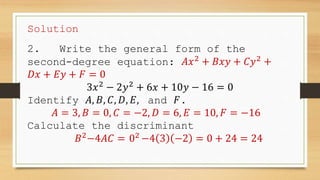
Calculate the discriminant
𝐵2
−4𝐴𝐶 = 02
−4 3 −2 = 0 + 24 = 24
Solution
2. Write the general form of the
second-degree equation: 𝐴𝑥2
+ 𝐵𝑥𝑦 + 𝐶𝑦2
+
𝐷𝑥 + 𝐸𝑦 + 𝐹 = 0
3𝑥2
− 2𝑦2
+ 6𝑥 + 10𝑦 − 16 = 0
Identify 𝐴, 𝐵, 𝐶, 𝐷, 𝐸, and 𝐹.
𝐴 = 3, 𝐵 = 0, 𝐶 = −2, 𝐷 = 6, 𝐸 = 10, 𝐹 = −16
Calculate the discriminant
𝐵2
−4𝐴𝐶 = 02
−4 3 −2 = 0 + 24 = 24 > 0
Solution
2. Write the general form of the
second-degree equation: 𝐴𝑥2
+ 𝐵𝑥𝑦 + 𝐶𝑦2
+
𝐷𝑥 + 𝐸𝑦 + 𝐹 = 0
3𝑥2
− 2𝑦2
+ 6𝑥 + 10𝑦 − 16 = 0
Identify 𝐴, 𝐵, 𝐶, 𝐷, 𝐸, and 𝐹.
𝐴 = 3, 𝐵 = 0, 𝐶 = −2, 𝐷 = 6, 𝐸 = 10, 𝐹 = −16
Calculate the discriminant
𝐵2
−4𝐴𝐶 = 02
−4 3 −2 = 0 + 24 = 24 > 0
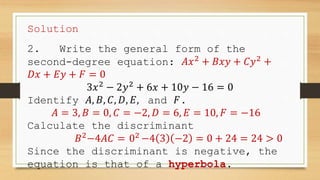
Since the discriminant is negative, the
equation is that of a hyperbola.
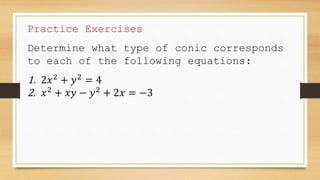
Practice Exercises
Determine what type of conic corresponds
to each of the following equations:
1. 2𝑥2
+ 𝑦2
= 4
2. 𝑥2
+ 𝑥𝑦 − 𝑦2
+ 2𝑥 = −3
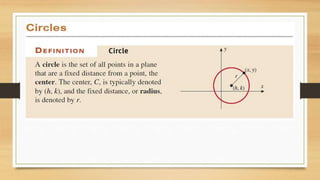
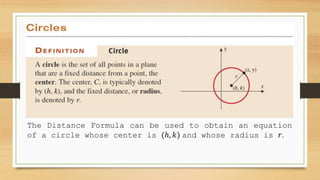
The Distance Formula can be used to obtain an equation
of a circle whose center is (ℎ, 𝑘) and whose radius is 𝑟.
The Distance Formula can be used to obtain an equation
of a circle whose center is (ℎ, 𝑘) and whose radius is 𝑟.
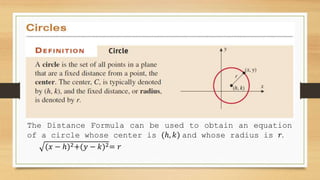
(𝑥 − ℎ)2+(𝑦 − 𝑘)2= 𝑟
The Distance Formula can be used to obtain an equation
of a circle whose center is (ℎ, 𝑘) and whose radius is 𝑟.
(𝑥 − ℎ)2+(𝑦 − 𝑘)2= 𝑟
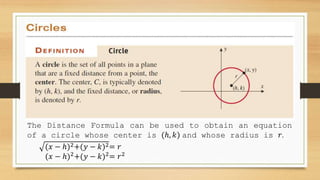
(𝑥 − ℎ)2+(𝑦 − 𝑘)2= 𝑟2
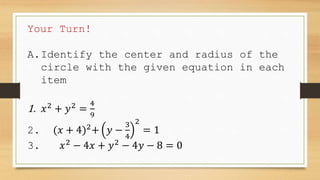
Your Turn!
A.Identify the center and radius of the
circle with the given equation in each
item
1. 𝑥2
+ 𝑦2
=
4
9
2. (𝑥 + 4)2
+ 𝑦 −
3
4
2
= 1
3. 𝑥2
− 4𝑥 + 𝑦2
− 4𝑦 − 8 = 0
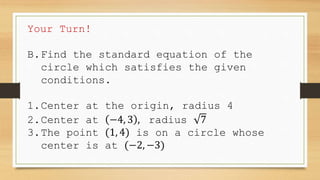
Your Turn!
B.Find the standard equation of the
circle which satisfies the given
conditions.
1.Center at the origin, radius 4
2.Center at −4, 3 , radius 7
3.The point (1, 4) is on a circle whose
center is at (−2, −3)
Every accomplishment
STARTS with the Decision
to TRY.
Thank you!

Introduction to Conic Sections and Circles.pptx

  • 1.
    Introduction to Conic Sectionsand Circles Quarter 1  Week 1
  • 2.
    Learning Outcomes Upon completionof the lessons, you should be able to:
  • 3.
    Learning Outcomes Upon completionof the lessons, you should be able to: 1. illustrate the different types of conic sections: parabola, ellipse, circle, hyperbola, and degenerate cases; (STEM_PC11AG-Ia-1)
  • 4.
    Learning Outcomes Upon completionof the lessons, you should be able to: 1. illustrate the different types of conic sections: parabola, ellipse, circle, hyperbola, and degenerate cases; (STEM_PC11AG-Ia-1) 2. define a circle; (STEM_PC11AG-Ia-2)
  • 5.
    Learning Outcomes Upon completionof the lessons, you should be able to: 1. illustrate the different types of conic sections: parabola, ellipse, circle, hyperbola, and degenerate cases; (STEM_PC11AG-Ia-1) 2. define a circle; (STEM_PC11AG-Ia-2) 3. determine the standard form of equation of a circle. (STEM_PC11AG-Ia- 3)
  • 6.
    Definition Conic sections arecurves that result from the intersection of a plane and a double cone.
  • 7.
    Definition Conic sections arecurves that result from the intersection of a plane and a double cone. The four conic sections are
  • 8.
    Definition Conic sections arecurves that result from the intersection of a plane and a double cone. The four conic sections are a circle,
  • 9.
    Definition Conic sections arecurves that result from the intersection of a plane and a double cone. The four conic sections are a circle, an ellipse,
  • 10.
    Definition Conic sections arecurves that result from the intersection of a plane and a double cone. The four conic sections are a circle, an ellipse, a parabola,
  • 11.
    Definition Conic sections arecurves that result from the intersection of a plane and a double cone. The four conic sections are a circle, an ellipse, a parabola, and a hyperbola.
  • 12.
    Definition Conic sections arecurves that result from the intersection of a plane and a double cone. The four conic sections are a circle, an ellipse, a parabola, and a hyperbola. Conics is an abbreviation for conic sections.
  • 14.
    Circle – whenthe plane is horizontal
  • 15.
    Ellipse – whenthe plane intersects only one cone to form a bounded curve
  • 16.
    Parabola – whenthe plane intersects only one cone to form an unbounded curve
  • 17.
    • Hyperbola –when the plane (not necessarily vertical) intercepts both cones to form two unbounded curves (each called a branch of the hyperbola)
  • 18.
    The general formof the second-degree equation in two variables, 𝑥 and 𝑦, is given by
  • 19.
    The general formof the second-degree equation in two variables, 𝑥 and 𝑦, is given by 𝑨𝒙𝟐 + 𝑩𝒙𝒚 + 𝑪𝒚𝟐 + 𝑫𝒙 + 𝑬𝒚 + 𝑭 = 𝟎
  • 20.
    The general formof the second-degree equation in two variables, 𝑥 and 𝑦, is given by 𝑨𝒙𝟐 + 𝑩𝒙𝒚 + 𝑪𝒚𝟐 + 𝑫𝒙 + 𝑬𝒚 + 𝑭 = 𝟎 If we let 𝐴 = 1, 𝐵 = 0, 𝐶 = 1, 𝐷 = 0, 𝐸 = 0, and 𝐹 = −𝑟2 , this general equation reduces to the equation of a circle centered at the origin: 𝑥2 + 𝑦2 = 𝑟2 .
  • 21.
    The concept ofdiscriminant is also applicable to second-degree equations in two variables. The discriminant 𝐵2 − 4𝐴𝐶 determines the shape of the conic section.
  • 22.
    The concept ofdiscriminant is also applicable to second-degree equations in two variables. The discriminant 𝐵2 − 4𝐴𝐶 determines the shape of the conic section.
  • 23.
    Example 1 Determiningthe Type of Conic Determine what type of conic corresponds to each of the following equations: 1. 2𝑥2 + 4𝑥𝑦 + 3𝑦2 + 12𝑦 − 1 = 0 2. 3𝑥2 − 2𝑦2 + 6𝑥 + 10𝑦 − 16 = 0
  • 24.
    Solution 1. Write thegeneral form of the second-degree equation:
  • 25.
    Solution 1. Write thegeneral form of the second-degree equation: 𝐴𝑥2 + 𝐵𝑥𝑦 + 𝐶𝑦2 + 𝐷𝑥 + 𝐸𝑦 + 𝐹 = 0 2𝑥2 + 4𝑥𝑦 + 3𝑦2 + 12𝑦 − 1 = 0
  • 26.
    Solution 1. Write thegeneral form of the second-degree equation: 𝐴𝑥2 + 𝐵𝑥𝑦 + 𝐶𝑦2 + 𝐷𝑥 + 𝐸𝑦 + 𝐹 = 0 2𝑥2 + 4𝑥𝑦 + 3𝑦2 + 12𝑦 − 1 = 0 Identify 𝐴, 𝐵, 𝐶, 𝐷, 𝐸, and 𝐹.
  • 27.
    Solution 1. Write thegeneral form of the second-degree equation: 𝐴𝑥2 + 𝐵𝑥𝑦 + 𝐶𝑦2 + 𝐷𝑥 + 𝐸𝑦 + 𝐹 = 0 2𝑥2 + 4𝑥𝑦 + 3𝑦2 + 12𝑦 − 1 = 0 Identify 𝐴, 𝐵, 𝐶, 𝐷, 𝐸, and 𝐹. 𝐴 = 2, 𝐵 = 4, 𝐶 = 3, 𝐷 = 0, 𝐸 = 12, 𝐹 = −1
  • 28.
    Solution 1. Write thegeneral form of the second-degree equation: 𝐴𝑥2 + 𝐵𝑥𝑦 + 𝐶𝑦2 + 𝐷𝑥 + 𝐸𝑦 + 𝐹 = 0 2𝑥2 + 4𝑥𝑦 + 3𝑦2 + 12𝑦 − 1 = 0 Identify 𝐴, 𝐵, 𝐶, 𝐷, 𝐸, and 𝐹. 𝐴 = 2, 𝐵 = 4, 𝐶 = 3, 𝐷 = 0, 𝐸 = 12, 𝐹 = −1 Calculate the discriminant
  • 29.
    Solution 1. Write thegeneral form of the second-degree equation: 𝐴𝑥2 + 𝐵𝑥𝑦 + 𝐶𝑦2 + 𝐷𝑥 + 𝐸𝑦 + 𝐹 = 0 2𝑥2 + 4𝑥𝑦 + 3𝑦2 + 12𝑦 − 1 = 0 Identify 𝐴, 𝐵, 𝐶, 𝐷, 𝐸, and 𝐹. 𝐴 = 2, 𝐵 = 4, 𝐶 = 3, 𝐷 = 0, 𝐸 = 12, 𝐹 = −1 Calculate the discriminant 𝐵2 −4𝐴𝐶 =
  • 30.
    Solution 1. Write thegeneral form of the second-degree equation: 𝐴𝑥2 + 𝐵𝑥𝑦 + 𝐶𝑦2 + 𝐷𝑥 + 𝐸𝑦 + 𝐹 = 0 2𝑥2 + 4𝑥𝑦 + 3𝑦2 + 12𝑦 − 1 = 0 Identify 𝐴, 𝐵, 𝐶, 𝐷, 𝐸, and 𝐹. 𝐴 = 2, 𝐵 = 4, 𝐶 = 3, 𝐷 = 0, 𝐸 = 12, 𝐹 = −1 Calculate the discriminant 𝐵2 −4𝐴𝐶 = 42 −4 2 3 =
  • 31.
    Solution 1. Write thegeneral form of the second-degree equation: 𝐴𝑥2 + 𝐵𝑥𝑦 + 𝐶𝑦2 + 𝐷𝑥 + 𝐸𝑦 + 𝐹 = 0 2𝑥2 + 4𝑥𝑦 + 3𝑦2 + 12𝑦 − 1 = 0 Identify 𝐴, 𝐵, 𝐶, 𝐷, 𝐸, and 𝐹. 𝐴 = 2, 𝐵 = 4, 𝐶 = 3, 𝐷 = 0, 𝐸 = 12, 𝐹 = −1 Calculate the discriminant 𝐵2 −4𝐴𝐶 = 42 −4 2 3 = 16 − 24 =
  • 32.
    Solution 1. Write thegeneral form of the second-degree equation: 𝐴𝑥2 + 𝐵𝑥𝑦 + 𝐶𝑦2 + 𝐷𝑥 + 𝐸𝑦 + 𝐹 = 0 2𝑥2 + 4𝑥𝑦 + 3𝑦2 + 12𝑦 − 1 = 0 Identify 𝐴, 𝐵, 𝐶, 𝐷, 𝐸, and 𝐹. 𝐴 = 2, 𝐵 = 4, 𝐶 = 3, 𝐷 = 0, 𝐸 = 12, 𝐹 = −1 Calculate the discriminant 𝐵2 −4𝐴𝐶 = 42 −4 2 3 = 16 − 24 = −8
  • 33.
    Solution 1. Write thegeneral form of the second-degree equation: 𝐴𝑥2 + 𝐵𝑥𝑦 + 𝐶𝑦2 + 𝐷𝑥 + 𝐸𝑦 + 𝐹 = 0 2𝑥2 + 4𝑥𝑦 + 3𝑦2 + 12𝑦 − 1 = 0 Identify 𝐴, 𝐵, 𝐶, 𝐷, 𝐸, and 𝐹. 𝐴 = 2, 𝐵 = 4, 𝐶 = 3, 𝐷 = 0, 𝐸 = 12, 𝐹 = −1 Calculate the discriminant 𝐵2 −4𝐴𝐶 = 42 −4 2 3 = 16 − 24 = −8 < 0
  • 34.
    Solution 1. Write thegeneral form of the second-degree equation: 𝐴𝑥2 + 𝐵𝑥𝑦 + 𝐶𝑦2 + 𝐷𝑥 + 𝐸𝑦 + 𝐹 = 0 2𝑥2 + 4𝑥𝑦 + 3𝑦2 + 12𝑦 − 1 = 0 Identify 𝐴, 𝐵, 𝐶, 𝐷, 𝐸, and 𝐹. 𝐴 = 2, 𝐵 = 4, 𝐶 = 3, 𝐷 = 0, 𝐸 = 12, 𝐹 = −1 Calculate the discriminant 𝐵2 −4𝐴𝐶 = 42 −4 2 3 = 16 − 24 = −8 < 0 Since the discriminant is negative, the equation is that of an ellipse.
  • 35.
    Solution 2. Write thegeneral form of the second-degree equation:
  • 36.
    Solution 2. Write thegeneral form of the second-degree equation: 𝐴𝑥2 + 𝐵𝑥𝑦 + 𝐶𝑦2 + 𝐷𝑥 + 𝐸𝑦 + 𝐹 = 0 3𝑥2 − 2𝑦2 + 6𝑥 + 10𝑦 − 16 = 0
  • 37.
    Solution 2. Write thegeneral form of the second-degree equation: 𝐴𝑥2 + 𝐵𝑥𝑦 + 𝐶𝑦2 + 𝐷𝑥 + 𝐸𝑦 + 𝐹 = 0 3𝑥2 − 2𝑦2 + 6𝑥 + 10𝑦 − 16 = 0 Identify 𝐴, 𝐵, 𝐶, 𝐷, 𝐸, and 𝐹.
  • 38.
    Solution 2. Write thegeneral form of the second-degree equation: 𝐴𝑥2 + 𝐵𝑥𝑦 + 𝐶𝑦2 + 𝐷𝑥 + 𝐸𝑦 + 𝐹 = 0 3𝑥2 − 2𝑦2 + 6𝑥 + 10𝑦 − 16 = 0 Identify 𝐴, 𝐵, 𝐶, 𝐷, 𝐸, and 𝐹. 𝐴 = 3, 𝐵 = 0, 𝐶 = −2, 𝐷 = 6, 𝐸 = 10, 𝐹 = −16
  • 39.
    Solution 2. Write thegeneral form of the second-degree equation: 𝐴𝑥2 + 𝐵𝑥𝑦 + 𝐶𝑦2 + 𝐷𝑥 + 𝐸𝑦 + 𝐹 = 0 3𝑥2 − 2𝑦2 + 6𝑥 + 10𝑦 − 16 = 0 Identify 𝐴, 𝐵, 𝐶, 𝐷, 𝐸, and 𝐹. 𝐴 = 3, 𝐵 = 0, 𝐶 = −2, 𝐷 = 6, 𝐸 = 10, 𝐹 = −16 Calculate the discriminant
  • 40.
    Solution 2. Write thegeneral form of the second-degree equation: 𝐴𝑥2 + 𝐵𝑥𝑦 + 𝐶𝑦2 + 𝐷𝑥 + 𝐸𝑦 + 𝐹 = 0 3𝑥2 − 2𝑦2 + 6𝑥 + 10𝑦 − 16 = 0 Identify 𝐴, 𝐵, 𝐶, 𝐷, 𝐸, and 𝐹. 𝐴 = 3, 𝐵 = 0, 𝐶 = −2, 𝐷 = 6, 𝐸 = 10, 𝐹 = −16 Calculate the discriminant 𝐵2 −4𝐴𝐶 =
  • 41.
    Solution 2. Write thegeneral form of the second-degree equation: 𝐴𝑥2 + 𝐵𝑥𝑦 + 𝐶𝑦2 + 𝐷𝑥 + 𝐸𝑦 + 𝐹 = 0 3𝑥2 − 2𝑦2 + 6𝑥 + 10𝑦 − 16 = 0 Identify 𝐴, 𝐵, 𝐶, 𝐷, 𝐸, and 𝐹. 𝐴 = 3, 𝐵 = 0, 𝐶 = −2, 𝐷 = 6, 𝐸 = 10, 𝐹 = −16 Calculate the discriminant 𝐵2 −4𝐴𝐶 = 02 −4 3 −2 =
  • 42.
    Solution 2. Write thegeneral form of the second-degree equation: 𝐴𝑥2 + 𝐵𝑥𝑦 + 𝐶𝑦2 + 𝐷𝑥 + 𝐸𝑦 + 𝐹 = 0 3𝑥2 − 2𝑦2 + 6𝑥 + 10𝑦 − 16 = 0 Identify 𝐴, 𝐵, 𝐶, 𝐷, 𝐸, and 𝐹. 𝐴 = 3, 𝐵 = 0, 𝐶 = −2, 𝐷 = 6, 𝐸 = 10, 𝐹 = −16 Calculate the discriminant 𝐵2 −4𝐴𝐶 = 02 −4 3 −2 = 0 + 24 =
  • 43.
    Solution 2. Write thegeneral form of the second-degree equation: 𝐴𝑥2 + 𝐵𝑥𝑦 + 𝐶𝑦2 + 𝐷𝑥 + 𝐸𝑦 + 𝐹 = 0 3𝑥2 − 2𝑦2 + 6𝑥 + 10𝑦 − 16 = 0 Identify 𝐴, 𝐵, 𝐶, 𝐷, 𝐸, and 𝐹. 𝐴 = 3, 𝐵 = 0, 𝐶 = −2, 𝐷 = 6, 𝐸 = 10, 𝐹 = −16 Calculate the discriminant 𝐵2 −4𝐴𝐶 = 02 −4 3 −2 = 0 + 24 = 24
  • 44.
    Solution 2. Write thegeneral form of the second-degree equation: 𝐴𝑥2 + 𝐵𝑥𝑦 + 𝐶𝑦2 + 𝐷𝑥 + 𝐸𝑦 + 𝐹 = 0 3𝑥2 − 2𝑦2 + 6𝑥 + 10𝑦 − 16 = 0 Identify 𝐴, 𝐵, 𝐶, 𝐷, 𝐸, and 𝐹. 𝐴 = 3, 𝐵 = 0, 𝐶 = −2, 𝐷 = 6, 𝐸 = 10, 𝐹 = −16 Calculate the discriminant 𝐵2 −4𝐴𝐶 = 02 −4 3 −2 = 0 + 24 = 24 > 0
  • 45.
    Solution 2. Write thegeneral form of the second-degree equation: 𝐴𝑥2 + 𝐵𝑥𝑦 + 𝐶𝑦2 + 𝐷𝑥 + 𝐸𝑦 + 𝐹 = 0 3𝑥2 − 2𝑦2 + 6𝑥 + 10𝑦 − 16 = 0 Identify 𝐴, 𝐵, 𝐶, 𝐷, 𝐸, and 𝐹. 𝐴 = 3, 𝐵 = 0, 𝐶 = −2, 𝐷 = 6, 𝐸 = 10, 𝐹 = −16 Calculate the discriminant 𝐵2 −4𝐴𝐶 = 02 −4 3 −2 = 0 + 24 = 24 > 0 Since the discriminant is negative, the equation is that of a hyperbola.
  • 46.
    Practice Exercises Determine whattype of conic corresponds to each of the following equations: 1. 2𝑥2 + 𝑦2 = 4 2. 𝑥2 + 𝑥𝑦 − 𝑦2 + 2𝑥 = −3
  • 48.
    The Distance Formulacan be used to obtain an equation of a circle whose center is (ℎ, 𝑘) and whose radius is 𝑟.
  • 49.
    The Distance Formulacan be used to obtain an equation of a circle whose center is (ℎ, 𝑘) and whose radius is 𝑟. (𝑥 − ℎ)2+(𝑦 − 𝑘)2= 𝑟
  • 50.
    The Distance Formulacan be used to obtain an equation of a circle whose center is (ℎ, 𝑘) and whose radius is 𝑟. (𝑥 − ℎ)2+(𝑦 − 𝑘)2= 𝑟 (𝑥 − ℎ)2+(𝑦 − 𝑘)2= 𝑟2
  • 52.
    Your Turn! A.Identify thecenter and radius of the circle with the given equation in each item 1. 𝑥2 + 𝑦2 = 4 9 2. (𝑥 + 4)2 + 𝑦 − 3 4 2 = 1 3. 𝑥2 − 4𝑥 + 𝑦2 − 4𝑦 − 8 = 0
  • 53.
    Your Turn! B.Find thestandard equation of the circle which satisfies the given conditions. 1.Center at the origin, radius 4 2.Center at −4, 3 , radius 7 3.The point (1, 4) is on a circle whose center is at (−2, −3)
  • 54.
  • 55.