CourseNo.:CE-3202
Credit:0.75
CourseTitle:Openchannelflowsessional
DHAKAUNIVERSITY OF ENGINEERING & TECHNOLOGY, GAZIPUR
WELCOME
Presentation
on
Determination of state of flow and
critical depth in an open channel
To
Presented
to:
Dr. Mohammad Alauddin
Professor
Dept. of CE
DUET
Ms. Rokshana Pervin
Asst.-Professor
Dept. of CE
DUET
GROUP NO. 01
1. MD MEHEDI HASAN
2. MD MOMIN ALI
3. MD RABEUL AWAL
4. MEHEDI HASAN SHAMIM
5. HELAL SARKER
6. M M ALAMGIR HOSSAIN
7. FAYSAL AHAMED
8. MORSHEDUL ALAM
9. EKRAMUL TALUKDER
10. S.M. SHAHEDUR RAHMAN
161065
161067
161068
161069
161071
161072
161073
161074
161075
161076
PRESENTED BY
 Background
 Objectives
 Theory
 Experimental setup
 Procedure
 Data sheet
 References
CONTENT
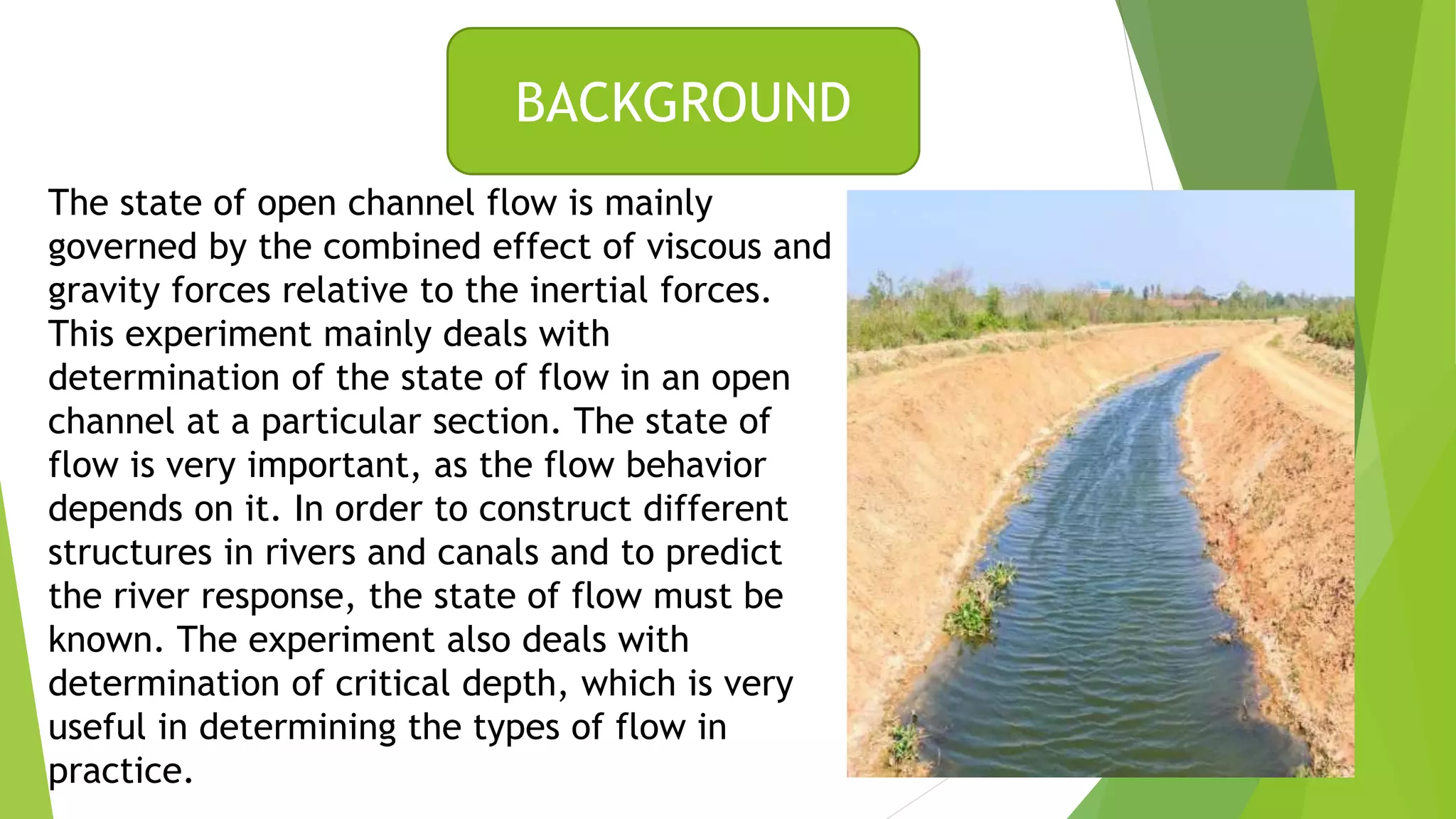
The state of open channel flow is mainly
governed by the combined effect of viscous and
gravity forces relative to the inertial forces.
This experiment mainly deals with
determination of the state of flow in an open
channel at a particular section. The state of
flow is very important, as the flow behavior
depends on it. In order to construct different
structures in rivers and canals and to predict
the river response, the state of flow must be
known. The experiment also deals with
determination of critical depth, which is very
useful in determining the types of flow in
practice.
BACKGROUND
1) To measure water depth both upstream and
downstream of a weir.
2) To determine the Reynolds number (Re) and the
Froude number (Fr).
3) To determine the state of flow.
4) To determine critical depth (yc).
5) To observe the subcritical and the supercritical flows.
OBJECTIVES
Depending on the effect of viscosity relative to inertia,
the flow may be laminar, turbulent or transitional. The
effect of viscosity relative to the inertia is expressed by
the Reynolds number, given by
Re =
𝑉𝑅
𝑣
THEORY
V = The mean velocity of flow,
R = The hydraulic radius =A/P
A =The wetted cross-sectional area,
P = The wetted perimeter and
 = The kinematic viscosity of water.
When,
Re <500 the flow is laminar.
500  Re 12,500 the flow is transitional.
Re > 12,500 the flow is turbulent.
When the flow is dominated by the gravity, then the
type of flow can be identified by a dimensionless
number, known as Froude Number, given by
Fr =
𝑉
𝑔𝐷
V = the mean velocity of flow,
D = the hydraulic depth (= A/T),
A = the cross-sectional area,
T = the top width and
g =The acceleration due to
gravity
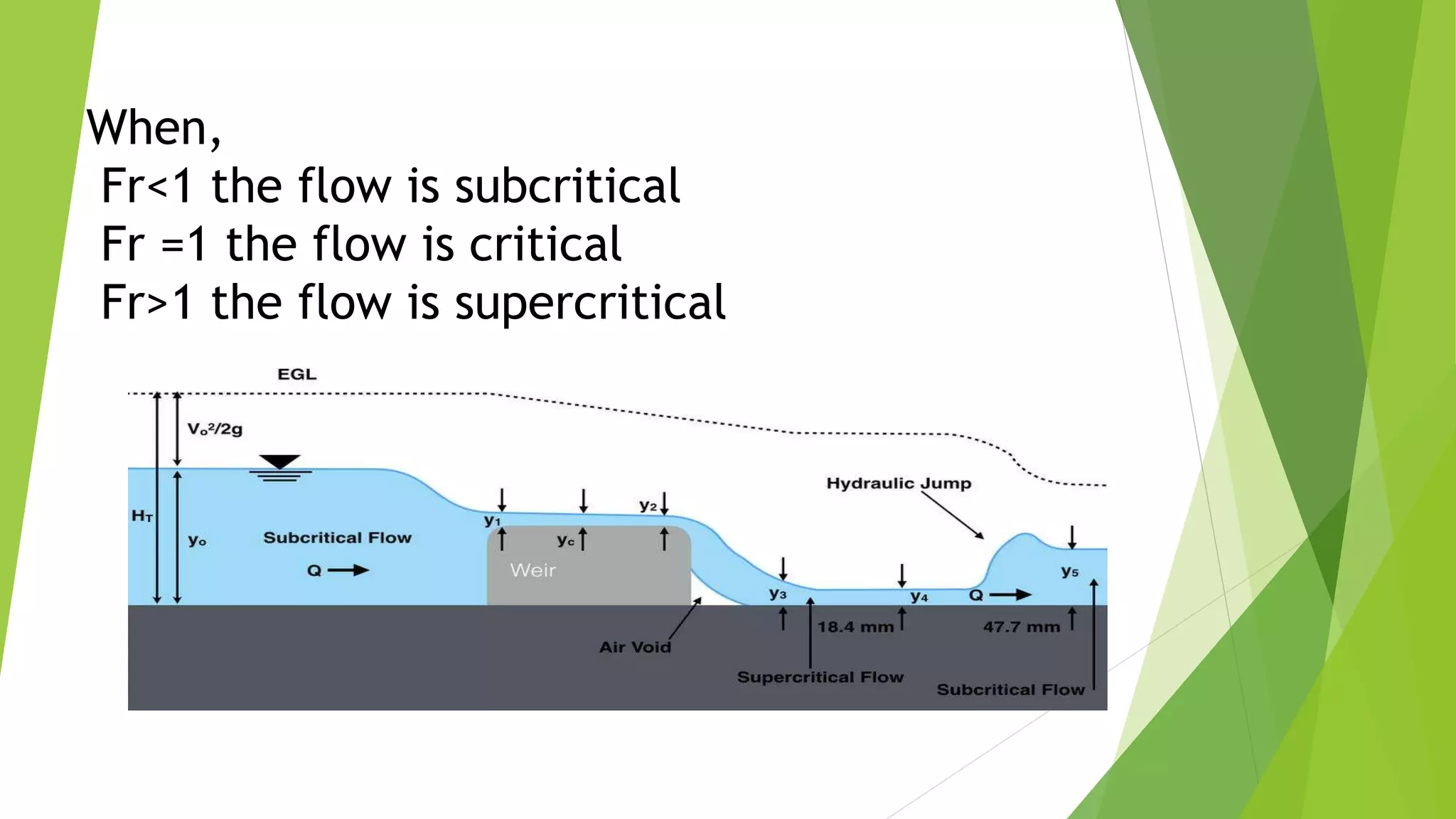
When,
Fr<1 the flow is subcritical
Fr =1 the flow is critical
Fr>1 the flow is supercritical
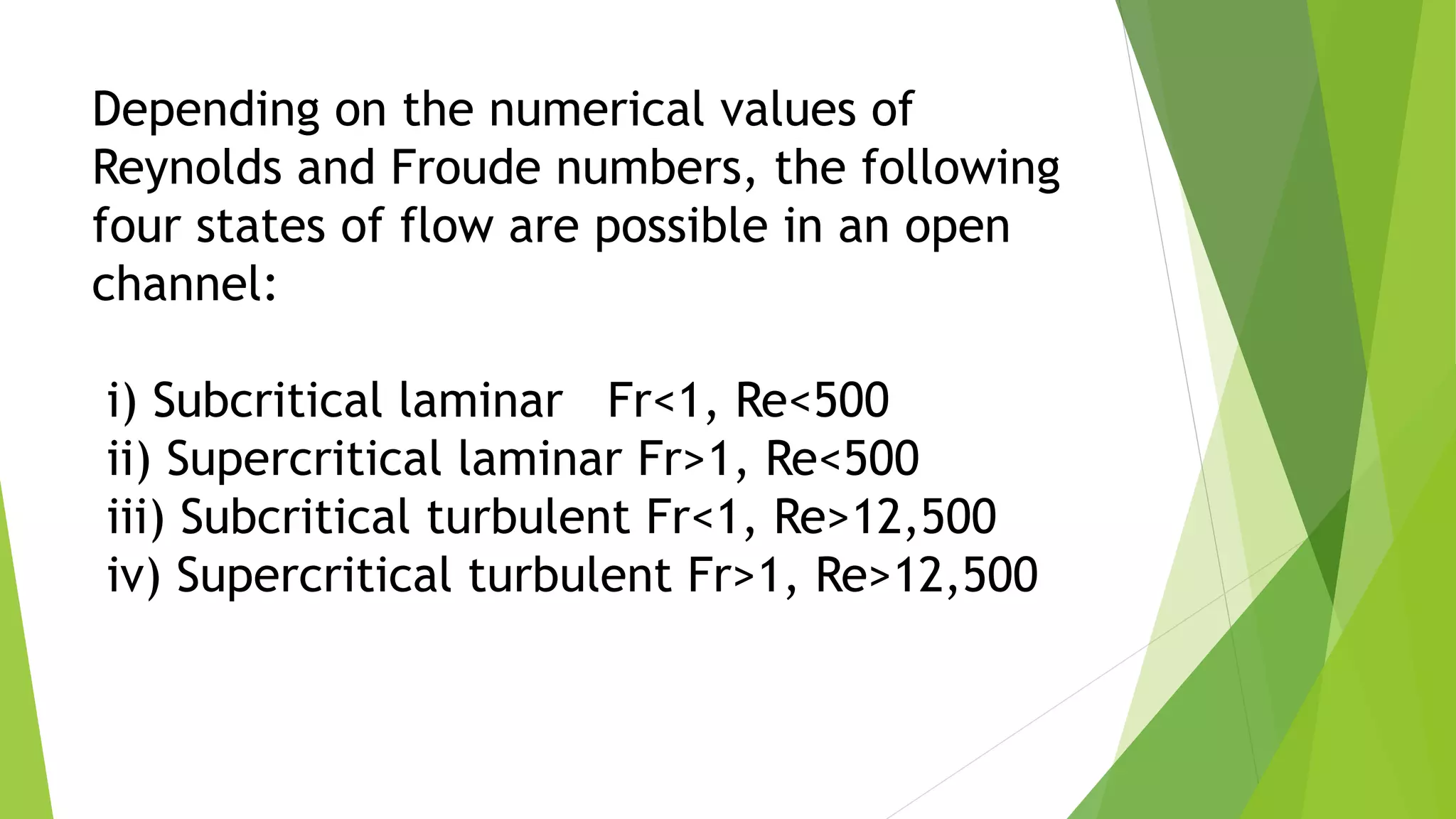
Depending on the numerical values of
Reynolds and Froude numbers, the following
four states of flow are possible in an open
channel:
i) Subcritical laminar Fr<1, Re<500
ii) Supercritical laminar Fr>1, Re<500
iii) Subcritical turbulent Fr<1, Re>12,500
iv) Supercritical turbulent Fr>1, Re>12,500
DETERMINATION OF STATE OF FLOW WITHOUT
ANY MEASUREMENT
Critical depth
Flow in an open channel is critical when the Froude
number of the flow is equal to unity. Critical flow in a
channel depends on the discharge and the geometry of
channel section. For a rectangular section, the critical
depth is given by
yc=
3 𝑄2
𝑔𝐵2
Where,
yc = The critical depth,
Q = The discharge and
B = The width of the channel.
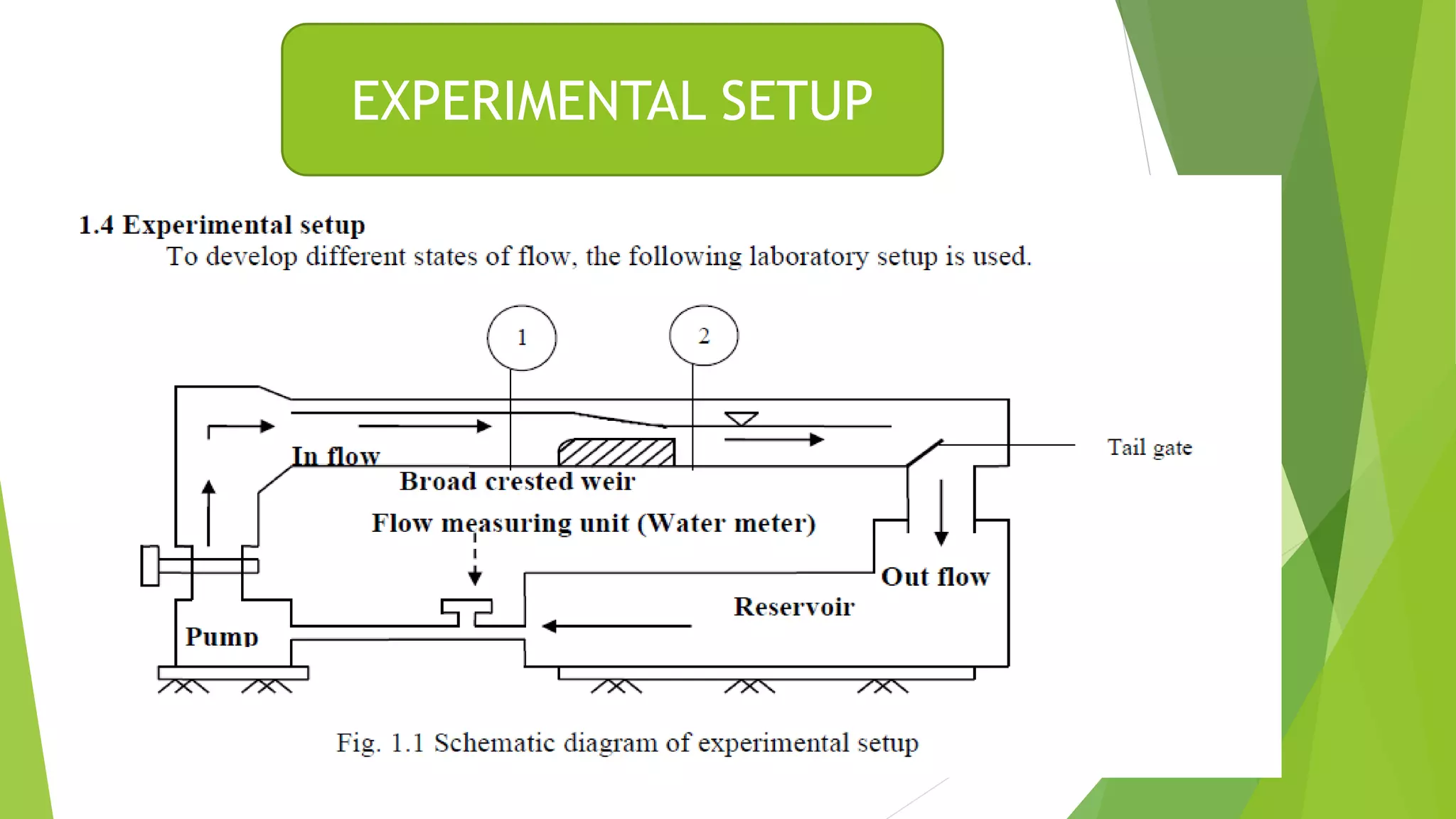
EXPERIMENTAL SETUP
i) The depth of flow is measured at sections 1 and 2 by
a point gage.
ii) The reading of discharge is taken.
iii) The velocity at both the sections is calculated.
iv) Re and Fr for the both sections are calculated by
using the equations of Re and Fr. It helps us to
determine the state of flow.
v) The critical depth yc is calculated by using the
equation of critical depth.
PROCEDURE
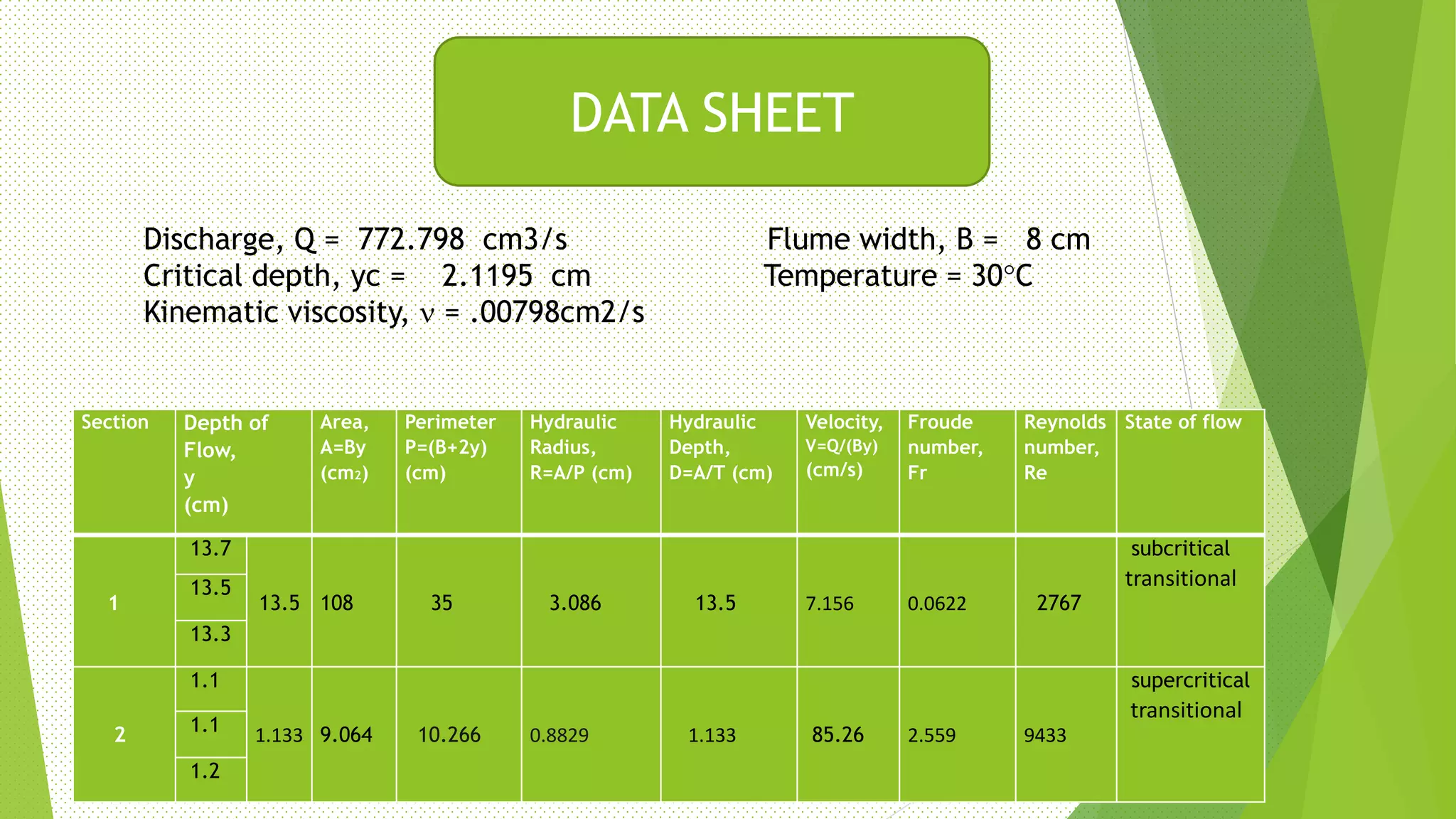
Discharge, Q = 772.798 cm3/s Flume width, B = 8 cm
Critical depth, yc = 2.1195 cm Temperature = 30C
Kinematic viscosity,  = .00798cm2/s
DATA SHEET
Section Depth of
Flow,
y
(cm)
Area,
A=By
(cm2)
Perimeter
P=(B+2y)
(cm)
Hydraulic
Radius,
R=A/P (cm)
Hydraulic
Depth,
D=A/T (cm)
Velocity,
V=Q/(By)
(cm/s)
Froude
number,
Fr
Reynolds
number,
Re
State of flow
1
13.7
13.5 108 35 3.086 13.5 7.156 0.0622 2767
subcritical
transitional13.5
13.3
2
1.1
1.133 9.064 10.266 0.8829 1.133 85.26 2.559 9433
supercritical
transitional
1.1
1.2
• www.google.com
• www.wikipedia.com
• www.britannica.com
• www.engineersedge.com
REFERENCES
ANYQUERY
Open channel flow

Open channel flow

  • 1.
  • 2.
    WELCOME Presentation on Determination of stateof flow and critical depth in an open channel To
  • 3.
    Presented to: Dr. Mohammad Alauddin Professor Dept.of CE DUET Ms. Rokshana Pervin Asst.-Professor Dept. of CE DUET
  • 4.
    GROUP NO. 01 1.MD MEHEDI HASAN 2. MD MOMIN ALI 3. MD RABEUL AWAL 4. MEHEDI HASAN SHAMIM 5. HELAL SARKER 6. M M ALAMGIR HOSSAIN 7. FAYSAL AHAMED 8. MORSHEDUL ALAM 9. EKRAMUL TALUKDER 10. S.M. SHAHEDUR RAHMAN 161065 161067 161068 161069 161071 161072 161073 161074 161075 161076 PRESENTED BY
  • 5.
     Background  Objectives Theory  Experimental setup  Procedure  Data sheet  References CONTENT
  • 6.
    The state ofopen channel flow is mainly governed by the combined effect of viscous and gravity forces relative to the inertial forces. This experiment mainly deals with determination of the state of flow in an open channel at a particular section. The state of flow is very important, as the flow behavior depends on it. In order to construct different structures in rivers and canals and to predict the river response, the state of flow must be known. The experiment also deals with determination of critical depth, which is very useful in determining the types of flow in practice. BACKGROUND
  • 7.
    1) To measurewater depth both upstream and downstream of a weir. 2) To determine the Reynolds number (Re) and the Froude number (Fr). 3) To determine the state of flow. 4) To determine critical depth (yc). 5) To observe the subcritical and the supercritical flows. OBJECTIVES
  • 8.
    Depending on theeffect of viscosity relative to inertia, the flow may be laminar, turbulent or transitional. The effect of viscosity relative to the inertia is expressed by the Reynolds number, given by Re = 𝑉𝑅 𝑣 THEORY V = The mean velocity of flow, R = The hydraulic radius =A/P A =The wetted cross-sectional area, P = The wetted perimeter and  = The kinematic viscosity of water.
  • 9.
    When, Re <500 theflow is laminar. 500  Re 12,500 the flow is transitional. Re > 12,500 the flow is turbulent.
  • 10.
    When the flowis dominated by the gravity, then the type of flow can be identified by a dimensionless number, known as Froude Number, given by Fr = 𝑉 𝑔𝐷 V = the mean velocity of flow, D = the hydraulic depth (= A/T), A = the cross-sectional area, T = the top width and g =The acceleration due to gravity
  • 11.
    When, Fr<1 the flowis subcritical Fr =1 the flow is critical Fr>1 the flow is supercritical
  • 12.
    Depending on thenumerical values of Reynolds and Froude numbers, the following four states of flow are possible in an open channel: i) Subcritical laminar Fr<1, Re<500 ii) Supercritical laminar Fr>1, Re<500 iii) Subcritical turbulent Fr<1, Re>12,500 iv) Supercritical turbulent Fr>1, Re>12,500
  • 13.
    DETERMINATION OF STATEOF FLOW WITHOUT ANY MEASUREMENT
  • 14.
    Critical depth Flow inan open channel is critical when the Froude number of the flow is equal to unity. Critical flow in a channel depends on the discharge and the geometry of channel section. For a rectangular section, the critical depth is given by yc= 3 𝑄2 𝑔𝐵2 Where, yc = The critical depth, Q = The discharge and B = The width of the channel.
  • 15.
  • 16.
    i) The depthof flow is measured at sections 1 and 2 by a point gage. ii) The reading of discharge is taken. iii) The velocity at both the sections is calculated. iv) Re and Fr for the both sections are calculated by using the equations of Re and Fr. It helps us to determine the state of flow. v) The critical depth yc is calculated by using the equation of critical depth. PROCEDURE
  • 17.
    Discharge, Q =772.798 cm3/s Flume width, B = 8 cm Critical depth, yc = 2.1195 cm Temperature = 30C Kinematic viscosity,  = .00798cm2/s DATA SHEET Section Depth of Flow, y (cm) Area, A=By (cm2) Perimeter P=(B+2y) (cm) Hydraulic Radius, R=A/P (cm) Hydraulic Depth, D=A/T (cm) Velocity, V=Q/(By) (cm/s) Froude number, Fr Reynolds number, Re State of flow 1 13.7 13.5 108 35 3.086 13.5 7.156 0.0622 2767 subcritical transitional13.5 13.3 2 1.1 1.133 9.064 10.266 0.8829 1.133 85.26 2.559 9433 supercritical transitional 1.1 1.2
  • 18.
    • www.google.com • www.wikipedia.com •www.britannica.com • www.engineersedge.com REFERENCES
  • 19.