WELCOME
TO THE
PRESENTATION
Course No. : CE-2104 Credit : 0.75
Course Title : Mechanics of solids-II (Sessional)
Topic : Welding Joint
Presented by :
Group : 01
Department of Civil Engineering
Dhaka University of Engineering & Technology, Gazipur .
Md. Mehedi Hasan - 161065
Md. Tayeb Hasan - 161066
Md. Momin Ali - 161067
Md. Rabeul Awal - 161068
Md. Mehedi Hasan Shamim - 161069
Md. Helal Sarkar - 161071
M M Alamgir Hossain - 161072
Faysal Ahmed - 161073
Md. Morshedul Alam - 161074
Md Ekramul Hasan - 161075
S.M. Shahedur Rahman - 161076
Presented to :
Department of Civil Engineering
Dhaka University of Engineering & Technology, Gazipur.
Dr. Md. Abdus Salam
Professor
Department of Civil Engineering
Mr. Shahab Uddin
Lecturer
Department of Civil Engineering
Before going into the depth of the types of welding joints it is
necessary to understand why different welding joints are
necessary. The main reason behind the various types of welding
joints is the uniqueness of each joint.
Few joints are useful for lightweight metals & few for heavy
metals. Few produce strong welds consequently they are complex
while others are cheap & produce mild welds. Every joint has its
own unique applications, pros & cons.
ABSTRACT
INTRODUCTION
★ What is Welding?
Welding is the process of joining two pieces of metal together so that
bonding takes place at the ends of joining surface.
★ What is Welding Joint?
A welding joint is a common point or edge where two or more
work pieces of plastic or metal are joined. These work pieces are
joined using different types of welding processes.
OBJECTIVES
The main objectives of this experiment was to investigate
the efficiency of spot and butt welding joint abreast of
failure mode.
There also some specific objectives:
To investigate the failure mode of the joint.
To determine the efficiency of spot & butt welding joint.
To determine the mechanical properties of a butt & spot
welding joint when subjected to tensile load.
APPARATUS
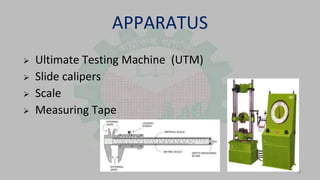
 Ultimate Testing Machine (UTM)
 Slide calipers
 Scale
 Measuring Tape
8
METHODOLOGY
 Firstly the geometrical shape of the joint was
measured.
 The sample was taken place in Universal
Testing Machine and adjust all instrument.
 The load was applied.
 The failure mode was investigated.
SAMPLE CALCULATION
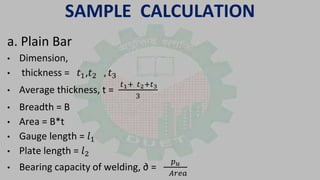
a. Plain Bar
• Dimension,
• thickness = 𝑡1,𝑡2 , 𝑡3
• Average thickness, t =
𝑡1+ 𝑡2+𝑡3
3
• Breadth = B
• Area = B*t
• Gauge length = 𝑙1
• Plate length = 𝑙2
• Bearing capacity of welding, ∂ =
𝑝 𝑢
𝐴𝑟𝑒𝑎
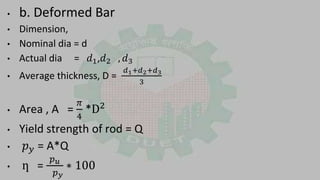
• b. Deformed Bar
• Dimension,
• Nominal dia = d
• Actual dia = 𝑑1,𝑑2 , 𝑑3
• Average thickness, D =
𝑑1+𝑑2+𝑑3
3
• Area , A =
𝜋
4
*D2
• Yield strength of rod = Q
• 𝑝 𝑦 = A*Q
• ƞ =
𝑝 𝑢
𝑝 𝑦
∗ 100
BUTT JOINT
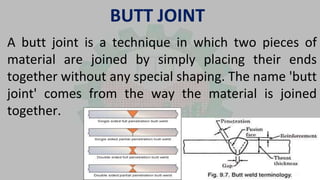
A butt joint is a technique in which two pieces of
material are joined by simply placing their ends
together without any special shaping. The name 'butt
joint' comes from the way the material is joined
together.
TYPES OF BUTT JOINTS
1. Single welded butt joint
2. Double welded butt joint
3. Open welded butt joint
4. Closed welded butt joint
1. Universally accepted method
2. Easiest welding method
3. Most common method
4. Very affordable/cheap method
ADVANTAGES OF BUTT WELDING JOINT
DISADVANTAGES OF BUTT WELDING JOINT
1. Chances of porosity in butt welds
2. Edge preparation is required while working with
thick metal pieces
APPLICATIONS OF BUTT WELDING JOINT
1. Pipes,
2. Valves,
3. Flanges,
4. Fittings, etc.
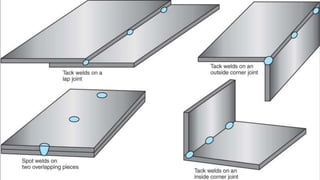
SPOT WELDING
Spot welding is one of the oldest welding processes. It is
used in a wide range of industries but notably for the
assembly of sheet steel vehicle bodies. This is a type
of resistance welding where the spot welds are made at
regular intervals on overlapping sheets of metal.
ADVANTAGES OF SPOT JOINT
Spot welding is quick and easy. There is no need to use any fluxes or
filler metal to create a join by spot welding, and there is no dangerous
open flame. Spot welding can be performed without any special skill.
Automated machines can spot weld in factories to speed up
production. The machines used in car factories produce as many as 200
spot welds in six seconds. Spot welding can be used to join many
different metals, and can join different types to each other. Sheets as
thin as 1/4 inch can be spot welded, and multiple sheets may be joined
together at the same time
DISADVANTAGES OF SPOT JOINT
The electrodes have to be able to reach both sides of
the pieces of metal that are being joined together. ...
If the current is not strong enough, hot enough or
the metal is not held together with enough force, the
spot weld may be small or weak.
APPLICATIONS OF SPOT WELDING JOINT
Spot welding is typically used when welding particular types of sheet
metal, welded wire mesh or wire mesh. Thicker stock is more difficult
to spot weld because the heat flows into the surrounding metal more
easily. Spot welding can be easily identified on many sheet metal
goods, such as metal buckets. Aluminium alloys can be spot welded,
but their much higher thermal conductivity and electrical
conductivity requires higher welding currents. This requires larger,
more powerful, and more expensive welding transformers.
THANK YOU

Mechanics of solid

  • 1.
  • 2.
    Course No. :CE-2104 Credit : 0.75 Course Title : Mechanics of solids-II (Sessional) Topic : Welding Joint
  • 3.
    Presented by : Group: 01 Department of Civil Engineering Dhaka University of Engineering & Technology, Gazipur . Md. Mehedi Hasan - 161065 Md. Tayeb Hasan - 161066 Md. Momin Ali - 161067 Md. Rabeul Awal - 161068 Md. Mehedi Hasan Shamim - 161069 Md. Helal Sarkar - 161071 M M Alamgir Hossain - 161072 Faysal Ahmed - 161073 Md. Morshedul Alam - 161074 Md Ekramul Hasan - 161075 S.M. Shahedur Rahman - 161076
  • 4.
    Presented to : Departmentof Civil Engineering Dhaka University of Engineering & Technology, Gazipur. Dr. Md. Abdus Salam Professor Department of Civil Engineering Mr. Shahab Uddin Lecturer Department of Civil Engineering
  • 5.
    Before going intothe depth of the types of welding joints it is necessary to understand why different welding joints are necessary. The main reason behind the various types of welding joints is the uniqueness of each joint. Few joints are useful for lightweight metals & few for heavy metals. Few produce strong welds consequently they are complex while others are cheap & produce mild welds. Every joint has its own unique applications, pros & cons. ABSTRACT
  • 6.
    INTRODUCTION ★ What isWelding? Welding is the process of joining two pieces of metal together so that bonding takes place at the ends of joining surface. ★ What is Welding Joint? A welding joint is a common point or edge where two or more work pieces of plastic or metal are joined. These work pieces are joined using different types of welding processes.
  • 7.
    OBJECTIVES The main objectivesof this experiment was to investigate the efficiency of spot and butt welding joint abreast of failure mode. There also some specific objectives: To investigate the failure mode of the joint. To determine the efficiency of spot & butt welding joint. To determine the mechanical properties of a butt & spot welding joint when subjected to tensile load.
  • 8.
    APPARATUS  Ultimate TestingMachine (UTM)  Slide calipers  Scale  Measuring Tape 8
  • 9.
    METHODOLOGY  Firstly thegeometrical shape of the joint was measured.  The sample was taken place in Universal Testing Machine and adjust all instrument.  The load was applied.  The failure mode was investigated.
  • 10.
    SAMPLE CALCULATION a. PlainBar • Dimension, • thickness = 𝑡1,𝑡2 , 𝑡3 • Average thickness, t = 𝑡1+ 𝑡2+𝑡3 3 • Breadth = B • Area = B*t • Gauge length = 𝑙1 • Plate length = 𝑙2 • Bearing capacity of welding, ∂ = 𝑝 𝑢 𝐴𝑟𝑒𝑎
  • 11.
    • b. DeformedBar • Dimension, • Nominal dia = d • Actual dia = 𝑑1,𝑑2 , 𝑑3 • Average thickness, D = 𝑑1+𝑑2+𝑑3 3 • Area , A = 𝜋 4 *D2 • Yield strength of rod = Q • 𝑝 𝑦 = A*Q • ƞ = 𝑝 𝑢 𝑝 𝑦 ∗ 100
  • 12.
    BUTT JOINT A buttjoint is a technique in which two pieces of material are joined by simply placing their ends together without any special shaping. The name 'butt joint' comes from the way the material is joined together.
  • 13.
    TYPES OF BUTTJOINTS 1. Single welded butt joint 2. Double welded butt joint 3. Open welded butt joint 4. Closed welded butt joint
  • 14.
    1. Universally acceptedmethod 2. Easiest welding method 3. Most common method 4. Very affordable/cheap method ADVANTAGES OF BUTT WELDING JOINT
  • 15.
    DISADVANTAGES OF BUTTWELDING JOINT 1. Chances of porosity in butt welds 2. Edge preparation is required while working with thick metal pieces
  • 16.
    APPLICATIONS OF BUTTWELDING JOINT 1. Pipes, 2. Valves, 3. Flanges, 4. Fittings, etc.
  • 17.
    SPOT WELDING Spot weldingis one of the oldest welding processes. It is used in a wide range of industries but notably for the assembly of sheet steel vehicle bodies. This is a type of resistance welding where the spot welds are made at regular intervals on overlapping sheets of metal.
  • 19.
    ADVANTAGES OF SPOTJOINT Spot welding is quick and easy. There is no need to use any fluxes or filler metal to create a join by spot welding, and there is no dangerous open flame. Spot welding can be performed without any special skill. Automated machines can spot weld in factories to speed up production. The machines used in car factories produce as many as 200 spot welds in six seconds. Spot welding can be used to join many different metals, and can join different types to each other. Sheets as thin as 1/4 inch can be spot welded, and multiple sheets may be joined together at the same time
  • 20.
    DISADVANTAGES OF SPOTJOINT The electrodes have to be able to reach both sides of the pieces of metal that are being joined together. ... If the current is not strong enough, hot enough or the metal is not held together with enough force, the spot weld may be small or weak.
  • 21.
    APPLICATIONS OF SPOTWELDING JOINT Spot welding is typically used when welding particular types of sheet metal, welded wire mesh or wire mesh. Thicker stock is more difficult to spot weld because the heat flows into the surrounding metal more easily. Spot welding can be easily identified on many sheet metal goods, such as metal buckets. Aluminium alloys can be spot welded, but their much higher thermal conductivity and electrical conductivity requires higher welding currents. This requires larger, more powerful, and more expensive welding transformers.
  • 22.