OBJECTIVES Explain the difference between IQ and EQ. Discuss the specific roles that emotions and intelligence play in Emotional intelligence. Understanding the basic principles of emotional intelligence
Anyone can become angry, that is easy. But to be angry with the right person, to the right degree, at the right time ,for the right purpose ,and in the right way ---that is not easy.
Emotions Emotions  are whole-body experiences, combining feelings,thoughts,and bodily sensations. Emotions are reaction to an object,i,e.they are object specific.
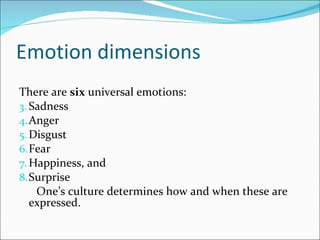
Emotion dimensions There are  six  universal emotions: Sadness Anger Disgust Fear Happiness, and Surprise One’s culture determines how and when these are expressed.
What is Intelligence? Intelligence is the ability to learn and understand, It is the ability to cope with a new situation. IQ AND EQ IQ defines how smart you are, EQ defines how well you use what smarts you have.
IQ gets you hired, while EQ gets you promoted.
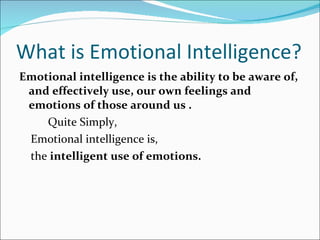
What is Emotional Intelligence? Emotional intelligence is the ability to be aware of, and effectively use, our own feelings and emotions of those around us . Quite Simply, Emotional intelligence is,  the  intelligent use of emotions.
The Five Essentials of EI According to Daniel Goleman these essential skills greatly enhance, or hurt, our quality of life. Self awareness:  knowing what you are feeling when you feel it. Managing your emotions: knowing what to do with your feelings .
Motivating yourself:  Channeling your feelings in the right direction without acting impulsively. Empathy:  feeling for others and accepting their feelings, too. Handling relationships: having good interpersonal skills so others feel good about you.
People who are Emotionally Literate Are, Aware of their bodily response to events or people. Able to discriminate between one type of response and another. Able to identify various physiological responses with appropriate emotional labels . Able to choose the most effective ways of acting and are not controlled by their emotions.
Able to recognize and limit the effects of past distress and its restimulation in everyday life. Can accept and value their positive and negative feelings. Take responsibility for their feelings. They do not blame others for making them feel the way they do.
Managing Emotions We have a number of healthy options for managing our emotions ,we can, Express them verbally and/or with full physical motion such as crying. Control them by no longer identifying with them ,by  repressing  or  suppressing  them.  Release them  cathartically  in a non-destructive manner and in an appropriate place.
Transform them into constructive action, artistic creation, or self realization.
What Emotions Can Do for Us? Our emotions ,when functioning well can, Help us find out what we want and what is right for us. Tell us something needs changing in us ,in others and in the world. Help communicate our priorities and needs to others. Help us empathize with others.
Warn us of danger. Motivate us to grow. Helps us clarify our own values and guides us.

Session 15 emotional intelligence ( SMS )

  • 1.
  • 2.
    OBJECTIVES Explain thedifference between IQ and EQ. Discuss the specific roles that emotions and intelligence play in Emotional intelligence. Understanding the basic principles of emotional intelligence
  • 3.
    Anyone can becomeangry, that is easy. But to be angry with the right person, to the right degree, at the right time ,for the right purpose ,and in the right way ---that is not easy.
  • 4.
    Emotions Emotions are whole-body experiences, combining feelings,thoughts,and bodily sensations. Emotions are reaction to an object,i,e.they are object specific.
  • 5.
    Emotion dimensions Thereare six universal emotions: Sadness Anger Disgust Fear Happiness, and Surprise One’s culture determines how and when these are expressed.
  • 6.
    What is Intelligence?Intelligence is the ability to learn and understand, It is the ability to cope with a new situation. IQ AND EQ IQ defines how smart you are, EQ defines how well you use what smarts you have.
  • 7.
    IQ gets youhired, while EQ gets you promoted.
  • 8.
    What is EmotionalIntelligence? Emotional intelligence is the ability to be aware of, and effectively use, our own feelings and emotions of those around us . Quite Simply, Emotional intelligence is, the intelligent use of emotions.
  • 9.
    The Five Essentialsof EI According to Daniel Goleman these essential skills greatly enhance, or hurt, our quality of life. Self awareness: knowing what you are feeling when you feel it. Managing your emotions: knowing what to do with your feelings .
  • 10.
    Motivating yourself: Channeling your feelings in the right direction without acting impulsively. Empathy: feeling for others and accepting their feelings, too. Handling relationships: having good interpersonal skills so others feel good about you.
  • 11.
    People who areEmotionally Literate Are, Aware of their bodily response to events or people. Able to discriminate between one type of response and another. Able to identify various physiological responses with appropriate emotional labels . Able to choose the most effective ways of acting and are not controlled by their emotions.
  • 12.
    Able to recognizeand limit the effects of past distress and its restimulation in everyday life. Can accept and value their positive and negative feelings. Take responsibility for their feelings. They do not blame others for making them feel the way they do.
  • 13.
    Managing Emotions Wehave a number of healthy options for managing our emotions ,we can, Express them verbally and/or with full physical motion such as crying. Control them by no longer identifying with them ,by repressing or suppressing them. Release them cathartically in a non-destructive manner and in an appropriate place.
  • 14.
    Transform them intoconstructive action, artistic creation, or self realization.
  • 15.
    What Emotions CanDo for Us? Our emotions ,when functioning well can, Help us find out what we want and what is right for us. Tell us something needs changing in us ,in others and in the world. Help communicate our priorities and needs to others. Help us empathize with others.
  • 16.
    Warn us ofdanger. Motivate us to grow. Helps us clarify our own values and guides us.