The document elaborates on the significance of emotional intelligence (EQ) in leadership and organizational success, highlighting that high EQ leaders can add significantly more value to their organizations compared to average leaders. It outlines the business case for EQ, presents various EQ skills and leadership styles, and describes methods for developing emotional intelligence through structured programs. Furthermore, it emphasizes the impact of EQ on team dynamics, conflict resolution, and overall performance outcomes.
In this document
Powered by AI
Overview of EQ and its significance in leadership and organizational success.
Demonstrated benefits of high EQ in leadership roles, with financial impacts and retention statistics.
Examples of EQ applications in various professions and their impact on performance.
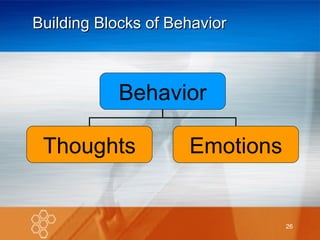
Concepts of EQ, including emotional awareness, thoughts, and behavior and how emotions affect decision making.
Four steps of EQ, covering emotional identification, impact understanding, and management.
Detailed explanations of 15 EQ skills integral for personal and professional development.
Analysis of different leadership styles connected to EQ, their effectiveness, and required skills.
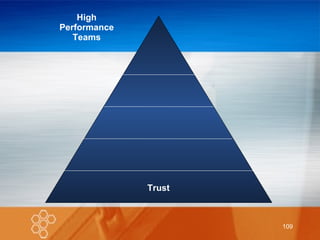
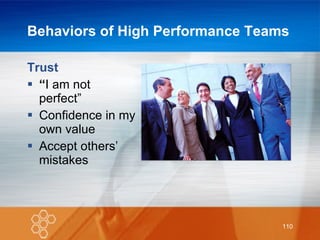
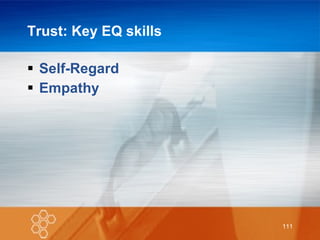
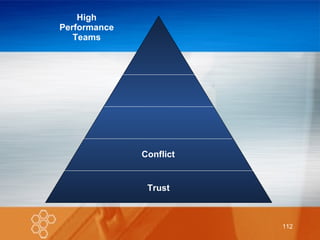
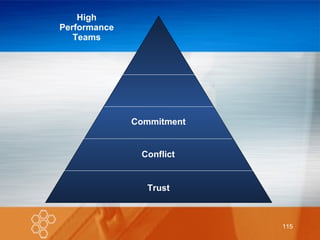
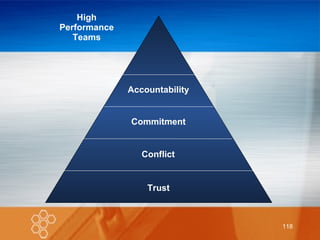
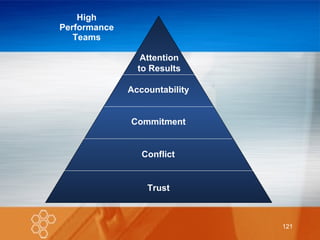
Role of EQ in high-performance teams, emphasizing trust, conflict resolution, and commitment.
Closing remarks and invitation for questions with contact information provided.
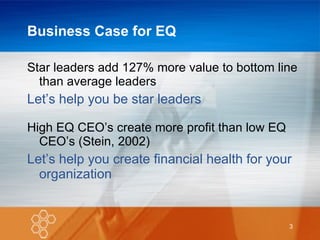
Business Case forEQ Star leaders add 127% more value to bottom line than average leaders Let’s help you be star leaders High EQ CEO’s create more profit than low EQ CEO’s (Stein, 2002) Let’s help you create financial health for your organization
4.
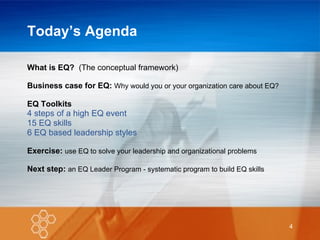
Today’s Agenda Whatis EQ? (The conceptual framework) Business case for EQ: Why would you or your organization care about EQ? EQ Toolkits 4 steps of a high EQ event 15 EQ skills 6 EQ based leadership styles Exercise: use EQ to solve your leadership and organizational problems Next step: an EQ Leader Program - systematic program to build EQ skills
5.
Introductions Basics NameTime with organization Current job What led you to participate in our EQ program? One of your work/career dreams
Companies Use EQMerrill Lynch American Express Financial Services McDonnell Douglas CIBA Canada Life Metropolitan Life Commercial Financial Services Canadian Imperial Bank of Commerce Wrigley
9.
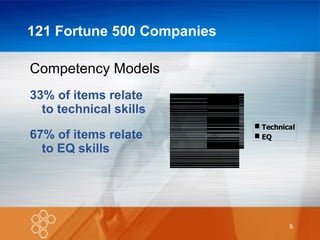
121 Fortune 500Companies Competency Models 33% of items relate to technical skills 67% of items relate to EQ skills
10.
Star Vs. AverageLeaders Stars superior in . . . One intellectual skill – big picture Six emotional skills
11.
Bottom Line BestVs. Average Leaders Top performers add 127% to the bottom line
12.
The Air ForceRecruiter Project Recruiter turnover = 50% per year. It cost $ 30 000 to replace each recruiter who left.
13.
Recruiter Competency ModelStar Performer Analysis Successful recruiters were strong in five skills: Emotional Self-Awareness, Assertiveness, Empathy, Problem Solving, and Happiness
14.
What the AirForce did Screened new recruiters for the 5 skills Trained incumbents in the 5 skills
15.
In one year…Retention rate went from 50% to 96% Saved $2.7 million
16.
Star Dentist EQSkills Emotional Self-Awareness Assertiveness Self-Actualization Reality Testing
17.
Productivity Computer Programmers:+300 % Manufacturing Superintendents Lost time accidents down 50% Formal grievances down from 15 to 3 per year All production goals surpassed
Peter Salovey, Ph.D. Chair of Psychology, Yale University Major EQ Researcher and Theorist I view emotions as organizing processes that enable individuals to think and behave adaptively. This perspective can be contrasted with a more traditional one that sees affect as a disorganized interruption of mental activity that must be minimized and controlled.” “
29.
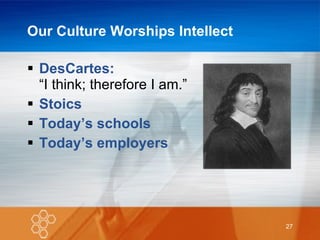
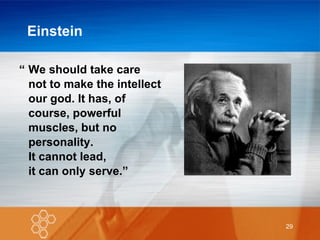
Einstein We shouldtake care not to make the intellect our god. It has, of course, powerful muscles, but no personality. It cannot lead, it can only serve.” “
30.
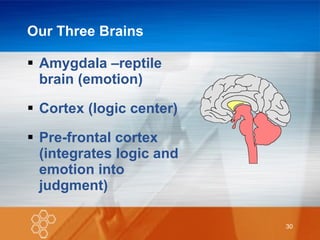
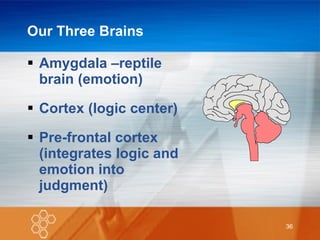
Our Three BrainsAmygdala –reptile brain (emotion) Cortex (logic center) Pre-frontal cortex (integrates logic and emotion into judgment)
31.
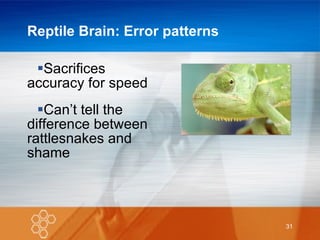
Reptile Brain: Errorpatterns Sacrifices accuracy for speed Can’t tell the difference between rattlesnakes and shame
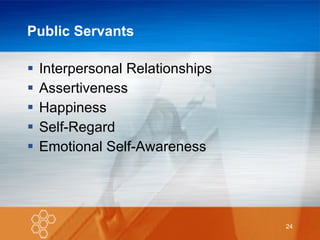
EQ: A Collectionof Skills Recognize what others want and need Sense what you want and need Dovetail our wants/needs with others’ Stay calm under pressure Act so others like to be around us
40.
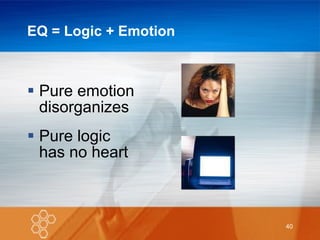
EQ = Logic+ Emotion Pure emotion disorganizes Pure logic has no heart
41.
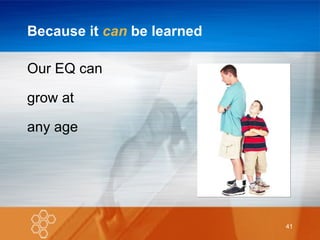
Our EQ can grow at any age Because it can be learned
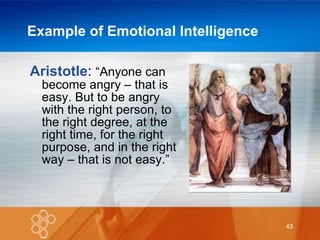
Example of EmotionalIntelligence Aristotle : “Anyone can become angry – that is easy. But to be angry with the right person, to the right degree, at the right time, for the right purpose, and in the right way – that is not easy.”
Four Steps ofEQ Notice/identify emotion Impact: emotion prioritizes thought
47.
Four Steps ofEQ Notice/identify emotion Impact: emotion prioritizes thought Understanding source
48.
Four Steps ofEQ Notice/identify emotion Impact: emotion prioritizes thought Understanding source Management
49.
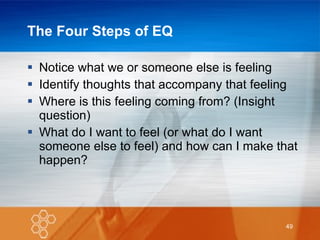
The Four Stepsof EQ Notice what we or someone else is feeling Identify thoughts that accompany that feeling Where is this feeling coming from? (Insight question) What do I want to feel (or what do I want someone else to feel) and how can I make that happen?
50.
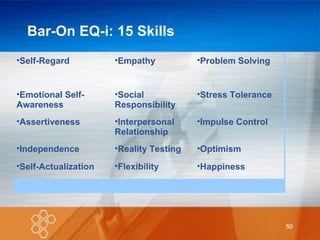
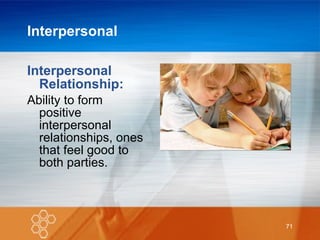
Bar-On EQ-i: 15Skills Self-Regard Empathy Problem Solving Emotional Self-Awareness Social Responsibility Stress Tolerance Assertiveness Interpersonal Relationship Impulse Control Independence Reality Testing Optimism Self-Actualization Flexibility Happiness
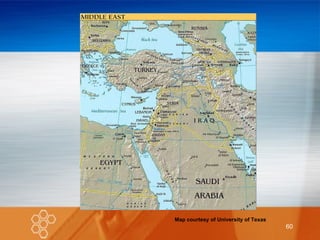
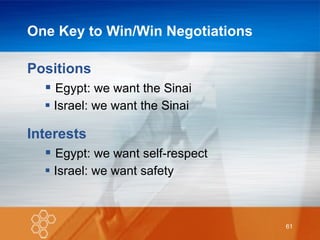
One Key toWin/Win Negotiations Positions Egypt: we want the Sinai Israel: we want the Sinai Interests Egypt: we want self-respect Israel: we want safety
62.
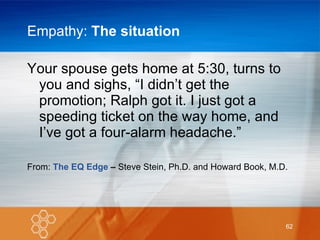
Empathy: Thesituation Your spouse gets home at 5:30, turns to you and sighs, “I didn’t get the promotion; Ralph got it. I just got a speeding ticket on the way home, and I’ve got a four-alarm headache.” From: The EQ Edge – Steve Stein, Ph.D. and Howard Book, M.D.
63.
Empathic ? Didn’tget the promotion! We’ve been banking on it. We’ve been counting on the increased income. What went wrong?” “
64.
Empathic ? Don’tworry; you’re smart. I’ve got confidence in you. Another opportunity will show.” “
65.
Empathic ? Youshould have seen this coming. Ralph is a fine guy; he’s a hotshot, a glad-hander and he does have more experience.” “
66.
Empathic ? Oh,what a day you’ve had. You must wonder if it can get any worse.” “
67.
Empathic ? Geez. . . You must feel like nothing’s going your way.” “
68.
Empathic ? Boy,you must feel like crap. Come here and I’ll give you a back rub.” “
69.
Empathic ? Oh,dear, it sounds awful, but others have it worse. Remember Philly? He lost his job last month, and his wife walked out four days later.” “
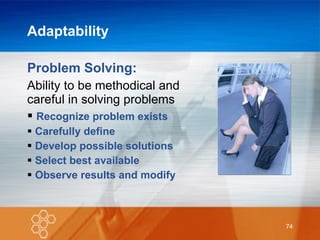
Adaptability Problem Solving:Ability to be methodical and careful in solving problems Recognize problem exists Carefully define Develop possible solutions Select best available Observe results and modify
75.
Judgment is .. . the process of recalling our past experiences to guide current decision making. . . .
76.
Richard Fairbank “Finding a visionary strategy . . . as a leader is a very intuitive thing. There are many things a leader can’t predict using data. How do you know what you will need to have in three years? Yet you’ve got to start development now or you won’t have it when you need it. Our company hires brilliant data analysts; we have one of the biggest Oracle databases in the world. But at the end of the day, I find that all the data does is push us farther on the frontier where it’s uncertain all over again.” ( Primal Leadership , p. 42)
77.
Adaptability Reality Testing:Ability to keep our emotions from overly influencing interpretations of events Testing the stories (theories) we make up about others
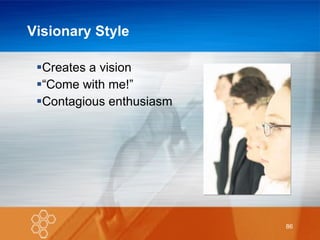
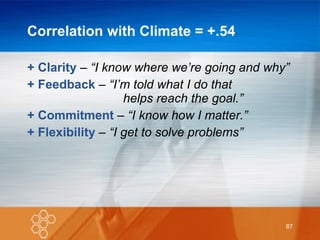
Correlation with Climate= +.54 + Clarity – “I know where we’re going and why” + Feedback – “I’m told what I do that helps reach the goal.” + Commitment – “I know how I matter.” + Flexibility – “I get to solve problems”
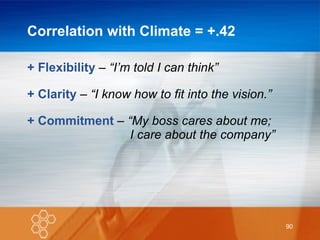
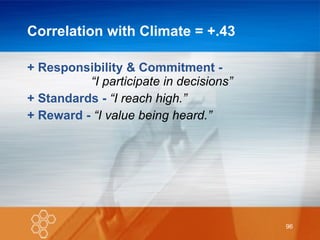
Correlation with Climate= +.42 + Flexibility – “I’m told I can think” + Clarity – “I know how to fit into the vision.” + Commitment – “My boss cares about me; I care about the company”
91.
EQ Skills Neededby Coach Leaders Emotional Self-Awareness Empathy Social Responsibility
Correlation with Climate= +.46 + Flexibility - “ I’m trusted to think.” + Rewards - “ My boss notices when I succeed.” + Commitment - “I match my boss’ commitment to me.”
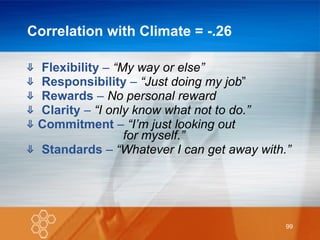
Correlation with Climate= -.26 ⇓ Flexibility – “My way or else” ⇓ Responsibility – “Just doing my job ” ⇓ Rewards – No personal reward ⇓ Clarity – “I only know what not to do.” ⇓ Commitment – “I’m just looking out for myself.” ⇓ Standards – “Whatever I can get away with.”
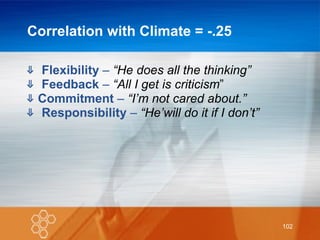
Correlation with Climate= -.25 ⇓ Flexibility – “He does all the thinking” ⇓ Feedback – “All I get is criticism ” ⇓ Commitment – “I’m not cared about.” ⇓ Responsibility – “He’will do it if I don’t”
103.
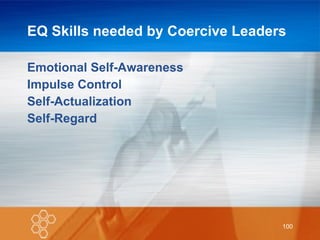
EQ Skills Neededby Pacesetters Self-Regard Self-Actualization Notice - all about self, nothing about others
104.
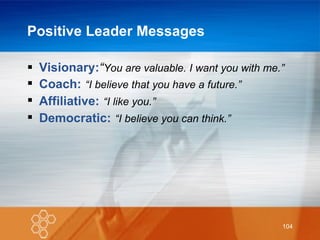
Positive Leader MessagesVisionary: “ You are valuable. I want you with me.” Coach: “I believe that you have a future.” Affiliative: “I like you.” Democratic: “I believe you can think.”
105.
EQ Tools Foursteps of an emotionally intelligent event 15 EQ skills measured by EQ-i Six leadership styles
106.
Outcomes of TraditionalDesign Will you change any emotional habits today? Binder on the shelf Half life of behavior change = 3 – 6 weeks Waste $5.6-16.8 billion
107.
EQ Leader ProgramSteps Conceptual overview (today) EQ Assessment EQ-i interview Feedback Computer report Custom report Feedback interview Ten step planning process for skill development Review with supervisor You and coach execute plan
Behaviors of HighPerformance Teams Commitment Shared mission, vision, strategies and tactics Requires conflict Maturity = not always having to get our own way
117.
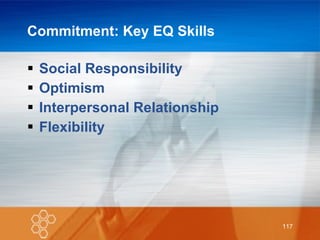
Commitment: Key EQSkills Social Responsibility Optimism Interpersonal Relationship Flexibility
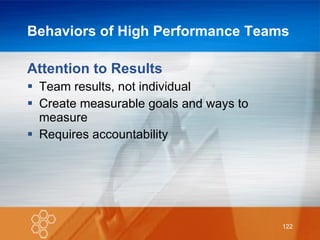
Behaviors of HighPerformance Teams Attention to Results Team results, not individual Create measurable goals and ways to measure Requires accountability