Epidermal Growth Factor(EGF)
Presented By - Jayanta Saha
Msc
Entry No-2015CHS1003
•Contents:
Two important type of cell
Epidermal Growth Factor
EGF Pathway & Transduction Process
MAPK signaling pathway in tumor cell with RAS mutation
Treatment Technique
Epidermal Growth Factor
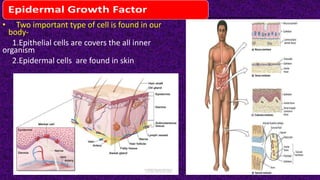
• Two important type of cell is found in our
body-
1.Epithelial cells are covers the all inner
organism
2.Epidermal cells are found in skin
Epidermal Growth Factor
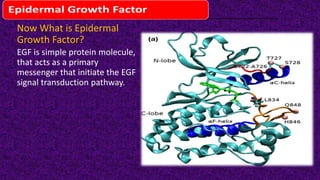
Now What is Epidermal
Growth Factor?
EGF is simple protein molecule,
that acts as a primary
messenger that initiate the EGF
signal transduction pathway.
Epidermal Growth Factor
• EGF Pathway:
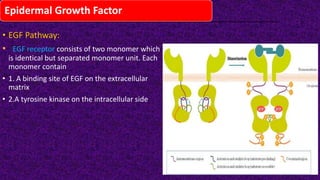
• EGF receptor consists of two monomer which
is identical but separated monomer unit. Each
monomer contain
• 1. A binding site of EGF on the extracellular
matrix
• 2.A tyrosine kinase on the intracellular side
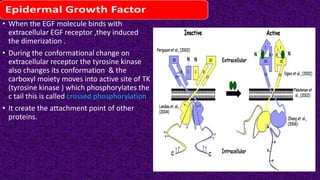
• When the EGF molecule binds with
extracellular EGF receptor ,they induced
the dimerization .
• During the conformational change on
extracellular receptor the tyrosine kinase
also changes its conformation & the
carboxyl moiety moves into active site of TK
(tyrosine kinase ) which phosphorylates the
c tail this is called crossed phosphorylation
• It create the attachment point of other
proteins.
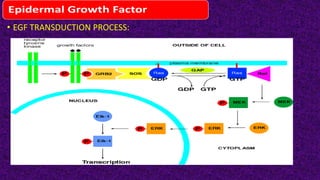
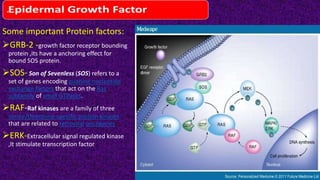
• EGF TRANSDUCTION PROCESS:
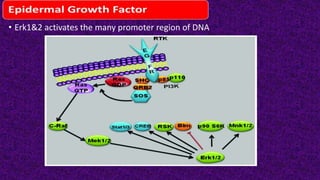
• Erk1&2 activates the many promoter region of DNA
.
Some important Protein factors:
GRB-2 -growth factor receptor bounding
protein ,its have a anchoring effect for
bound SOS protein.
SOS- Son of Sevenless (SOS) refers to a
set of genes encoding guanine nucleotide
exchange factors that act on the Ras
subfamily of small GTPases.
RAF-Raf kinases are a family of three
serine/threonine-specific protein kinases
that are related to retroviral oncogenes
ERK-Extracellular signal regulated kinase
,It stimulate transcription factor
.• Function Of EGFR:
1. Cell growth
2. Cell Proliferation
3. Angiogenesis
4. Signaling many Protein Synthesis, like Cyclins, CDKs
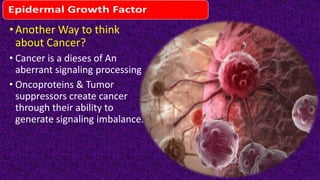
• Another Way to think
about Cancer?
• Cancer is a dieses of An
aberrant signaling processing
• Oncoproteins & Tumor
suppressors create cancer
through their ability to
generate signaling imbalance.
• RAS mutation
• All Ras protein family members belong to a class of protein called small GTPase, and are
involved in transmitting signals within cells.
• It is 'switched on' by incoming signals, it subsequently switches on other proteins like Ref,
Mek, Erk etc. ,which ultimately turn on genes involved in cell growth, differentiation and
survival. As a result, mutations in ras genes can lead to the production of permanently
activated Ras proteins. This can cause unintended and overactive signaling inside the cell,
even in the absence of incoming signals. Because these signals result in cell growth and
division, overactive Ras signaling can ultimately lead to cancer.
• The 3 Ras genes in humans (H-ras, K-ras, and N-ras) are the most common oncogenes in
human cancer; mutations that permanently activate Ras are found in 20% to 25% of all
human tumors and up to 90% in certain types of cancer (e.g., pancreatic cancer).
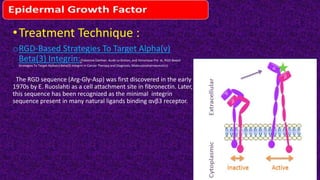
•Treatment Technique :
oRGD-Based Strategies To Target Alpha(v)
Beta(3) Integrin:(Fabienne Danhier, Aude Le Breton, and Veronique Pre ́ t , RGD-Based
Strategies To Target Alpha(v) Beta(3) Integrin in Cancer Therapy and Diagnosis, Molecularpharmaceutics)
The RGD sequence (Arg-Gly-Asp) was first discovered in the early
1970s by E. Ruoslahti as a cell attachment site in fibronectin. Later,
this sequence has been recognized as the minimal integrin
sequence present in many natural ligtnds binding αvβ3 receptor.
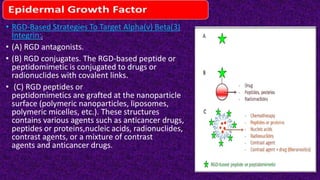
• RGD-Based Strategies To Target Alpha(v) Beta(3)
Integrin:(
• (A) RGD antagonists.
• (B) RGD conjugates. The RGD-based peptide or
peptidomimetic is conjugated to drugs or
radionuclides with covalent links.
• (C) RGD peptides or
peptidomimetics are grafted at the nanoparticle
surface (polymeric nanoparticles, liposomes,
polymeric micelles, etc.). These structures
contains various agents such as anticancer drugs,
peptides or proteins,nucleic acids, radionuclides,
contrast agents, or a mixture of contrast
agents and anticancer drugs.
Chemical structures.
(A) The original RGD
sequence.
(B) Cyclic RGD peptide
antagonist (c(RGDf[N-
Me]V) or cilengitide.
(C) Cyclic peptide
c(RGDfK).
(D) ACDCRGDCFCG (RGD4C).
(E) Example of RGD
peptidomimetic-containing
the RGD sequence (S-
247).28
(F)Example of RGD
peptidomimetic
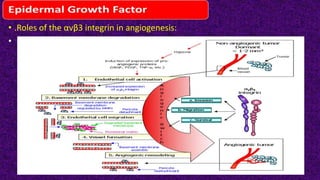
• .Roles of he αvβ3 in egrin in angiogenesis:
•
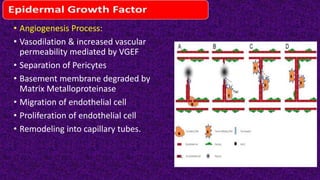
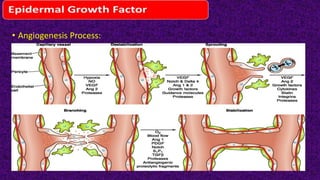
• Angiogenesis Process:
• Vasodilation & increased vascular
permeability mediated by VGEF
• Separation of Pericytes
• Basement membrane degraded by
Matrix Metalloproteinase
• Migration of endothelial cell
• Proliferation of endothelial cell
• Remodeling into capillary tubes.
• Angiogenesis Process:
•Treatment Technique :
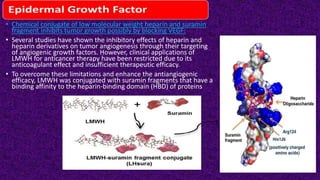
 Chemical conjugate of low molecular weight heparin and suramin fragment
inhibits tumor growth possibly by blocking VEGF: (Jooho Park, Ji-young Kim, Seung Rim Hwang, Foyez
Mahmud, and Youngro Byun .Mol. Pharmaceutics)
 Angiogenesis is a fundamental process for tumor growth
 Among angiogenic growth factors, vascular endothelial growth factor (VEGF)
plays a key role
 One of the unique characteristics of VEGF is that it contains a heparin-
binding domain (HBD)
• Chemical conjugate of low molecular weight heparin and suramin
fragment inhibits tumor growth possibly by blocking VEGF:
• Several studies have shown the inhibitory effects of heparin and
heparin derivatives on tumor angiogenesis through their targeting
of angiogenic growth factors. However, clinical applications of
LMWH for anticancer therapy have been restricted due to its
anticoagulant effect and insufficient therapeutic efficacy.
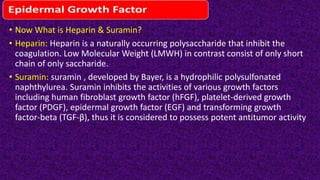
• To overcome these limitations and enhance the antiangiogenic
efficacy, LMWH was conjugated with suramin fragments that have a
binding affinity to the heparin-binding domain (HBD) of proteins
• Now What is Heparin & Suramin?
• Heparin: Heparin is a naturally occurring polysaccharide that inhibit the
coagulation. Low Molecular Weight (LMWH) in contrast consist of only short
chain of only saccharide.
• Suramin: suramin , developed by Bayer, is a hydrophilic polysulfonated
naphthylurea. Suramin inhibits the activities of various growth factors
including human fibroblast growth factor (hFGF), platelet-derived growth
factor (PDGF), epidermal growth factor (EGF) and transforming growth
factor-beta (TGF-β), hus i is considered o possess po en tn i umor tc ivi y
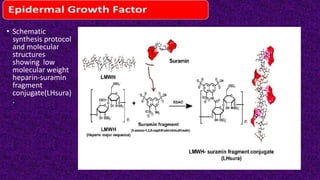
• Schematic
synthesis protocol
and molecular
structures
showing low
molecular weight
heparin-suramin
fragment
conjugate(LHsura)
.
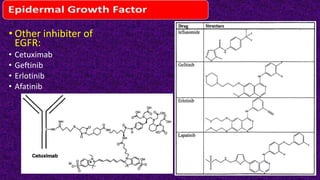
• Other inhibiter of
EGFR:
• Cetuximab
• Geftinib
• Erlotinib
• Afatinib
Epidermal growth factor(egf)

Epidermal growth factor(egf)

  • 1.
    Epidermal Growth Factor(EGF) PresentedBy - Jayanta Saha Msc Entry No-2015CHS1003
  • 2.
    •Contents: Two important typeof cell Epidermal Growth Factor EGF Pathway & Transduction Process MAPK signaling pathway in tumor cell with RAS mutation Treatment Technique
  • 3.
    Epidermal Growth Factor •Two important type of cell is found in our body- 1.Epithelial cells are covers the all inner organism 2.Epidermal cells are found in skin
  • 4.
    Epidermal Growth Factor NowWhat is Epidermal Growth Factor? EGF is simple protein molecule, that acts as a primary messenger that initiate the EGF signal transduction pathway.
  • 5.
    Epidermal Growth Factor •EGF Pathway: • EGF receptor consists of two monomer which is identical but separated monomer unit. Each monomer contain • 1. A binding site of EGF on the extracellular matrix • 2.A tyrosine kinase on the intracellular side
  • 6.
    • When theEGF molecule binds with extracellular EGF receptor ,they induced the dimerization . • During the conformational change on extracellular receptor the tyrosine kinase also changes its conformation & the carboxyl moiety moves into active site of TK (tyrosine kinase ) which phosphorylates the c tail this is called crossed phosphorylation • It create the attachment point of other proteins.
  • 7.
  • 8.
    • Erk1&2 activatesthe many promoter region of DNA
  • 9.
    . Some important Proteinfactors: GRB-2 -growth factor receptor bounding protein ,its have a anchoring effect for bound SOS protein. SOS- Son of Sevenless (SOS) refers to a set of genes encoding guanine nucleotide exchange factors that act on the Ras subfamily of small GTPases. RAF-Raf kinases are a family of three serine/threonine-specific protein kinases that are related to retroviral oncogenes ERK-Extracellular signal regulated kinase ,It stimulate transcription factor
  • 10.
    .• Function OfEGFR: 1. Cell growth 2. Cell Proliferation 3. Angiogenesis 4. Signaling many Protein Synthesis, like Cyclins, CDKs
  • 11.
    • Another Wayto think about Cancer? • Cancer is a dieses of An aberrant signaling processing • Oncoproteins & Tumor suppressors create cancer through their ability to generate signaling imbalance.
  • 12.
    • RAS mutation •All Ras protein family members belong to a class of protein called small GTPase, and are involved in transmitting signals within cells. • It is 'switched on' by incoming signals, it subsequently switches on other proteins like Ref, Mek, Erk etc. ,which ultimately turn on genes involved in cell growth, differentiation and survival. As a result, mutations in ras genes can lead to the production of permanently activated Ras proteins. This can cause unintended and overactive signaling inside the cell, even in the absence of incoming signals. Because these signals result in cell growth and division, overactive Ras signaling can ultimately lead to cancer. • The 3 Ras genes in humans (H-ras, K-ras, and N-ras) are the most common oncogenes in human cancer; mutations that permanently activate Ras are found in 20% to 25% of all human tumors and up to 90% in certain types of cancer (e.g., pancreatic cancer).
  • 13.
    •Treatment Technique : oRGD-BasedStrategies To Target Alpha(v) Beta(3) Integrin:(Fabienne Danhier, Aude Le Breton, and Veronique Pre ́ t , RGD-Based Strategies To Target Alpha(v) Beta(3) Integrin in Cancer Therapy and Diagnosis, Molecularpharmaceutics) The RGD sequence (Arg-Gly-Asp) was first discovered in the early 1970s by E. Ruoslahti as a cell attachment site in fibronectin. Later, this sequence has been recognized as the minimal integrin sequence present in many natural ligtnds binding αvβ3 receptor.
  • 14.
    • RGD-Based StrategiesTo Target Alpha(v) Beta(3) Integrin:( • (A) RGD antagonists. • (B) RGD conjugates. The RGD-based peptide or peptidomimetic is conjugated to drugs or radionuclides with covalent links. • (C) RGD peptides or peptidomimetics are grafted at the nanoparticle surface (polymeric nanoparticles, liposomes, polymeric micelles, etc.). These structures contains various agents such as anticancer drugs, peptides or proteins,nucleic acids, radionuclides, contrast agents, or a mixture of contrast agents and anticancer drugs.
  • 15.
    Chemical structures. (A) Theoriginal RGD sequence. (B) Cyclic RGD peptide antagonist (c(RGDf[N- Me]V) or cilengitide. (C) Cyclic peptide c(RGDfK). (D) ACDCRGDCFCG (RGD4C). (E) Example of RGD peptidomimetic-containing the RGD sequence (S- 247).28 (F)Example of RGD peptidomimetic
  • 16.
    • .Roles ofhe αvβ3 in egrin in angiogenesis: •
  • 17.
    • Angiogenesis Process: •Vasodilation & increased vascular permeability mediated by VGEF • Separation of Pericytes • Basement membrane degraded by Matrix Metalloproteinase • Migration of endothelial cell • Proliferation of endothelial cell • Remodeling into capillary tubes.
  • 18.
  • 19.
    •Treatment Technique : Chemical conjugate of low molecular weight heparin and suramin fragment inhibits tumor growth possibly by blocking VEGF: (Jooho Park, Ji-young Kim, Seung Rim Hwang, Foyez Mahmud, and Youngro Byun .Mol. Pharmaceutics)  Angiogenesis is a fundamental process for tumor growth  Among angiogenic growth factors, vascular endothelial growth factor (VEGF) plays a key role  One of the unique characteristics of VEGF is that it contains a heparin- binding domain (HBD)
  • 20.
    • Chemical conjugateof low molecular weight heparin and suramin fragment inhibits tumor growth possibly by blocking VEGF: • Several studies have shown the inhibitory effects of heparin and heparin derivatives on tumor angiogenesis through their targeting of angiogenic growth factors. However, clinical applications of LMWH for anticancer therapy have been restricted due to its anticoagulant effect and insufficient therapeutic efficacy. • To overcome these limitations and enhance the antiangiogenic efficacy, LMWH was conjugated with suramin fragments that have a binding affinity to the heparin-binding domain (HBD) of proteins
  • 21.
    • Now Whatis Heparin & Suramin? • Heparin: Heparin is a naturally occurring polysaccharide that inhibit the coagulation. Low Molecular Weight (LMWH) in contrast consist of only short chain of only saccharide. • Suramin: suramin , developed by Bayer, is a hydrophilic polysulfonated naphthylurea. Suramin inhibits the activities of various growth factors including human fibroblast growth factor (hFGF), platelet-derived growth factor (PDGF), epidermal growth factor (EGF) and transforming growth factor-beta (TGF-β), hus i is considered o possess po en tn i umor tc ivi y
  • 22.
    • Schematic synthesis protocol andmolecular structures showing low molecular weight heparin-suramin fragment conjugate(LHsura) .
  • 23.
    • Other inhibiterof EGFR: • Cetuximab • Geftinib • Erlotinib • Afatinib