PLANNING CYCLE
Dr J. R. Bandi
Dr Amrut Swami
•Planning is a process of identifying a course of action
systematically in an organized manner to achieve
objectives by utilizing the available resources skilfully in a
cost effective way.
•Purpose-
1) To match the limited resources with many problems
2) Eliminate unnecessary expenditure
3) Develop best course of action
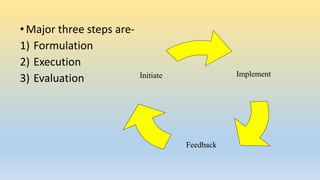
•Major three steps are-
1) Formulation
2) Execution
3) Evaluation Implement
Feedback
Initiate
• National development planning :
Continuous, systematic, coordinated planning for
the investment of the resources (MMM) of a country in
programmes aimed at achieving the most rapid
economic and social development possible.
Sectoral plans-
Agriculture, Education, Health & Family Planning,
Industry, Transport & Communication, Housing, Power ,
Social Welfare etc…
Planning Commission NITI Ayog.
• Do not think of planning as a
straight-through process.
Planning
Analysis Design Construct Implement Feedback
1) Health Needs And Demands
• Deficiencies in health that call for preventive, curative, control
or eradication measures.
• Experts - Health needs
• People - Demands.
2) Resources
MMM
3) Objectives,
Targets & Goals
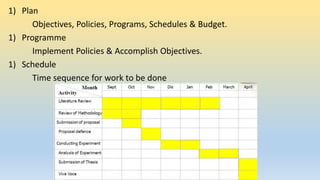
1) Plan
Objectives, Policies, Programs, Schedules & Budget.
1) Programme
Implement Policies & Accomplish Objectives.
1) Schedule
Time sequence for work to be done
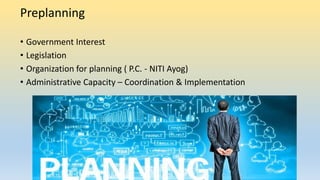
Preplanning
• Government Interest
• Legislation
• Organization for planning ( P.C. - NITI Ayog)
• Administrative Capacity – Coordination & Implementation
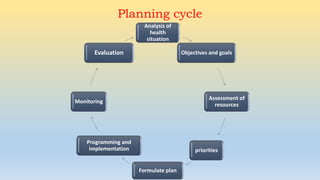
Planning cycle
Analysis of
health
situation
Objectives and goals
Assessment of
resources
priorities
Formulate plan
Programming and
implementation
Monitoring
Evaluation
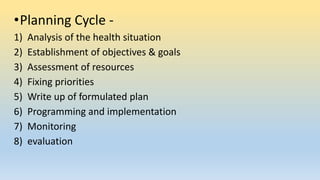
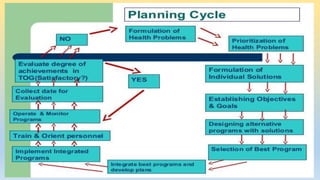
•Planning Cycle -
1) Analysis of the health situation
2) Establishment of objectives & goals
3) Assessment of resources
4) Fixing priorities
5) Write up of formulated plan
6) Programming and implementation
7) Monitoring
8) evaluation
15
1. Analysis of the health situation
a) Population statistics
b) Statistics of morbidity and mortality
c) Manpower (HR)
d) Existing medical care facilities
e) Geographical distribution and epidemiology
f) Training facilities available
g) Attitudes and beliefs
16
2. Establishment of objectives and goals
a) Should be established at all levels
b) It should be set by a person having authority.
c) The goal should be realistic.
d) It should be specific.
e) Acceptability
f) Easily measurable
17
3. Assessment of resources
a) Manpower
b) Money
c) Materials
d) Skills and knowledge
e) Technical needs
4) Fixing priorities
Disease/ situational categorization in three points
1) Importance of disease (based on mortality, morbidity, suffering, cost of
treatment and loss of productivity):
3 marks if high importance, 2 if moderate, 1 if low importance.
2) Effectiveness of Interventions:
3 marks if interventions known to be very effective, 2 if moderately
effective, 1 if low or non effective
3) Cost of interventions:
3 marks if cost is low, 2 if moderate cost and 1 if cost is high
(Intervention could be a treatment or preventive modality).
• Also political & community interests and pressures.
5. Write formulated plans
a) Must be complete in all respect to execute the project
b) Detailed detecting input and output
c) Contained working guidance for execution
d) Evaluation should be built in
6. Programming and implantation
a) Assign and fix responsibilities
b) Define roles and tasks
c) Selection, training, motivation and supervision
d) Organization and communication
e) Efficiency of health institutions
7. Monitoring
• Continuous process of observing, recording and reporting on
the activities of the organization or project
• Keeping track of activities
• Identifying deviations- taking correct actions.
8. Evaluation
• Measures the degree to which objectives and
targets are fulfilled and the quality of results
obtained
• Monitoring- day to day / ongoing operations
• Evaluation- Final outcome & factors associated.
• Output achieved
• Reallocation of priorities with changing health
needs.
Planning cycle
Planning cycle
Planning cycle

Planning cycle

  • 2.
    PLANNING CYCLE Dr J.R. Bandi Dr Amrut Swami
  • 3.
    •Planning is aprocess of identifying a course of action systematically in an organized manner to achieve objectives by utilizing the available resources skilfully in a cost effective way. •Purpose- 1) To match the limited resources with many problems 2) Eliminate unnecessary expenditure 3) Develop best course of action
  • 4.
    •Major three stepsare- 1) Formulation 2) Execution 3) Evaluation Implement Feedback Initiate
  • 5.
    • National developmentplanning : Continuous, systematic, coordinated planning for the investment of the resources (MMM) of a country in programmes aimed at achieving the most rapid economic and social development possible. Sectoral plans- Agriculture, Education, Health & Family Planning, Industry, Transport & Communication, Housing, Power , Social Welfare etc…
  • 6.
  • 8.
    • Do notthink of planning as a straight-through process. Planning Analysis Design Construct Implement Feedback
  • 9.
    1) Health NeedsAnd Demands • Deficiencies in health that call for preventive, curative, control or eradication measures. • Experts - Health needs • People - Demands. 2) Resources MMM 3) Objectives, Targets & Goals
  • 10.
    1) Plan Objectives, Policies,Programs, Schedules & Budget. 1) Programme Implement Policies & Accomplish Objectives. 1) Schedule Time sequence for work to be done
  • 11.
    Preplanning • Government Interest •Legislation • Organization for planning ( P.C. - NITI Ayog) • Administrative Capacity – Coordination & Implementation
  • 12.
    Planning cycle Analysis of health situation Objectivesand goals Assessment of resources priorities Formulate plan Programming and implementation Monitoring Evaluation
  • 13.
    •Planning Cycle - 1)Analysis of the health situation 2) Establishment of objectives & goals 3) Assessment of resources 4) Fixing priorities 5) Write up of formulated plan 6) Programming and implementation 7) Monitoring 8) evaluation
  • 15.
    15 1. Analysis ofthe health situation a) Population statistics b) Statistics of morbidity and mortality c) Manpower (HR) d) Existing medical care facilities e) Geographical distribution and epidemiology f) Training facilities available g) Attitudes and beliefs
  • 16.
    16 2. Establishment ofobjectives and goals a) Should be established at all levels b) It should be set by a person having authority. c) The goal should be realistic. d) It should be specific. e) Acceptability f) Easily measurable
  • 17.
    17 3. Assessment ofresources a) Manpower b) Money c) Materials d) Skills and knowledge e) Technical needs
  • 18.
    4) Fixing priorities Disease/situational categorization in three points 1) Importance of disease (based on mortality, morbidity, suffering, cost of treatment and loss of productivity): 3 marks if high importance, 2 if moderate, 1 if low importance. 2) Effectiveness of Interventions: 3 marks if interventions known to be very effective, 2 if moderately effective, 1 if low or non effective 3) Cost of interventions: 3 marks if cost is low, 2 if moderate cost and 1 if cost is high (Intervention could be a treatment or preventive modality). • Also political & community interests and pressures.
  • 19.
    5. Write formulatedplans a) Must be complete in all respect to execute the project b) Detailed detecting input and output c) Contained working guidance for execution d) Evaluation should be built in
  • 20.
    6. Programming andimplantation a) Assign and fix responsibilities b) Define roles and tasks c) Selection, training, motivation and supervision d) Organization and communication e) Efficiency of health institutions
  • 21.
    7. Monitoring • Continuousprocess of observing, recording and reporting on the activities of the organization or project • Keeping track of activities • Identifying deviations- taking correct actions.
  • 22.
    8. Evaluation • Measuresthe degree to which objectives and targets are fulfilled and the quality of results obtained • Monitoring- day to day / ongoing operations • Evaluation- Final outcome & factors associated. • Output achieved • Reallocation of priorities with changing health needs.