


By
Dr. Yahia Ahmed Maher
Assistant professor of Microbiology
Biodegradationof Griseofulvinby Bacillussubtilis
isolatedfromexpiredpharmaceuticalsraw materials
Qura University-Faculty of Dentistry Umm Al  
Aim of the Work
2 Purification of the biodegradation enzymes.
3 Identification of the biodegradation products.
Study the biodegradation process of
pharmaceutical raw materials.1
• The pharmaceutical industry products are
present in everyday life, for a long time the
production of chemicals and pharmaceuticals
as well as their usage and application caused
heavy pollution of the environment and
serious health effects (Sheldon, 2007).
Introduction
• Biodegradation is a very important process in
the transformation of organic pollutants as
pharmaceuticals by bacterial growth as energy
source during metabolically processes that
helps to maintain ecosystem and human
health (Yu and Wu, 2012).
Introduction
• Some microorganisms may cause drug
contaminant and unable to replicate but could
remain viable and cause lowering of the
quantity of the therapeutic agent in the dosage
form and decrease in its bioavailability or
released a toxic product into environment such
as phenol and acids (United States
Pharmacopoeia 2004).
Introduction
• Griseofulvin is antifungal produced by growth
of certain strains of Penicillium griseofulvum
and used against dermatophytic infection,
young actively metabolized cells and inactive
against Actinomyces, Nocardia, and other
bacteria (United States Pharmacopoeia 2004).
Introduction
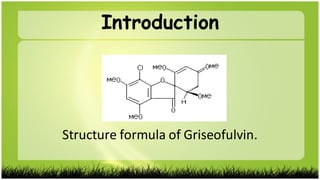
Structure formula of Griseofulvin.
Introduction
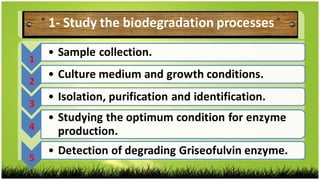
1  
• Sample collection.
2  
• Culture medium and growth conditions.
3  
• Isolation, purification and identification.
4  
• Studying the optimum condition for enzyme
production.
5  
• Detection of degrading Griseofulvin enzyme.
1- Study the biodegradation processes
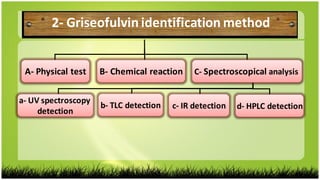
2- Griseofulvin identification method
A- Physical test B- Chemical reaction C- Spectroscopical analysis
a- UV spectroscopy
detection
c- IR detectionb- TLC detection d- HPLC detection
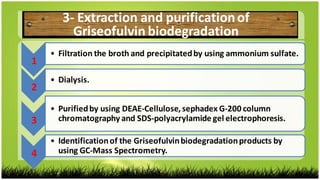
1  
• Filtration the broth and precipitatedby using ammonium sulfate.
2  
• Dialysis.
3  
• Purifiedby using DEAE-Cellulose, sephadex G-200 column
chromatography and SDS-polyacrylamide gel electrophoresis.
4  
• Identificationof the Griseofulvinbiodegradationproducts by
using GC-Mass Spectrometry.
3- Extraction and purificationof
Griseofulvin biodegradation
Sample collection
• Eleven bacterial isolates from six expired
pharmaceutical raw materials on Tryptic Soy Agar
(TSA) and Nutrient Agar (NA) medium from total
different seventy-eight samples of expired
pharmaceutical raw materials which collected
from the storage room of Memphis Company for
pharmaceutical and chemical industry.
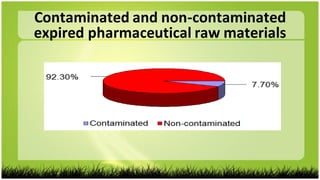
Contaminated and non-contaminated
expired pharmaceutical raw materials
Microphotograph of Bacillus subtilis
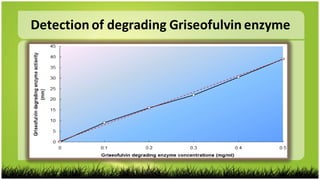
Detection of degrading Griseofulvin enzyme
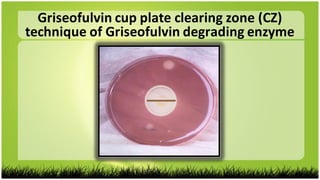
Griseofulvin cup plate clearing zone (CZ)
technique of Griseofulvin degrading enzyme
2- Griseofulvin identification method
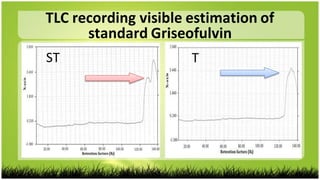
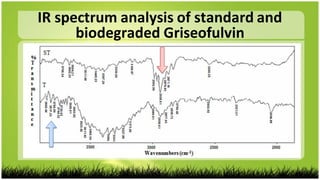
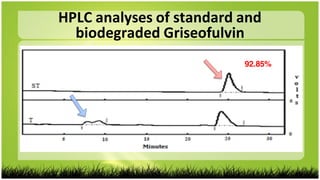
• The physical, chemical and UV spectroscopy don’t
detect any degradation for Griseofulvin while it is
detected by TLC, IR and HPLC.
TLC recording visible estimation of
standard Griseofulvin
ST T
IR spectrum analysis of standard and
biodegraded Griseofulvin
HPLC analyses of standard and
biodegraded Griseofulvin
92.85%
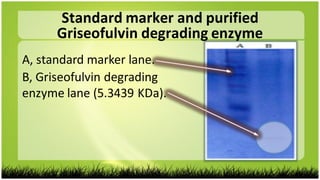
Standard marker and purified
Griseofulvin degrading enzyme
A, standard marker lane.
B, Griseofulvin degrading
enzyme lane (5.3439 KDa).
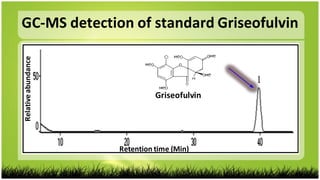
Relativeabundance
Retention time (Min)
GC-MS detection of standard Griseofulvin
Griseofulvin
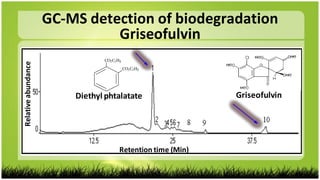
Relativeabundance
Retention time (Min)
GC-MS detection of biodegradation
Griseofulvin
Diethyl phtalatate
CO2C2H5
CO2C2H5
Griseofulvin
Conclusion
The biodegradation processes require present adapted isolate
to synthesize appropriate enzyme.
The biodegradation products were extracted and identified by
GC-Mass Spectrometry.
Remediation of the pharmaceutical raw materials wastes by
using biodegradation technique.
Biodegradation of Griseofulvin by Bacillus subtilis isolated from expired pharmaceuticals raw materials

Biodegradation of Griseofulvin by Bacillus subtilis isolated from expired pharmaceuticals raw materials

  • 1.
    By Dr. Yahia AhmedMaher Assistant professor of Microbiology Biodegradationof Griseofulvinby Bacillussubtilis isolatedfromexpiredpharmaceuticalsraw materials Qura University-Faculty of Dentistry Umm Al  
  • 3.
    Aim of theWork 2 Purification of the biodegradation enzymes. 3 Identification of the biodegradation products. Study the biodegradation process of pharmaceutical raw materials.1
  • 5.
    • The pharmaceuticalindustry products are present in everyday life, for a long time the production of chemicals and pharmaceuticals as well as their usage and application caused heavy pollution of the environment and serious health effects (Sheldon, 2007). Introduction
  • 6.
    • Biodegradation isa very important process in the transformation of organic pollutants as pharmaceuticals by bacterial growth as energy source during metabolically processes that helps to maintain ecosystem and human health (Yu and Wu, 2012). Introduction
  • 7.
    • Some microorganismsmay cause drug contaminant and unable to replicate but could remain viable and cause lowering of the quantity of the therapeutic agent in the dosage form and decrease in its bioavailability or released a toxic product into environment such as phenol and acids (United States Pharmacopoeia 2004). Introduction
  • 8.
    • Griseofulvin isantifungal produced by growth of certain strains of Penicillium griseofulvum and used against dermatophytic infection, young actively metabolized cells and inactive against Actinomyces, Nocardia, and other bacteria (United States Pharmacopoeia 2004). Introduction
  • 9.
    Structure formula ofGriseofulvin. Introduction
  • 11.
    1   • Samplecollection. 2   • Culture medium and growth conditions. 3   • Isolation, purification and identification. 4   • Studying the optimum condition for enzyme production. 5   • Detection of degrading Griseofulvin enzyme. 1- Study the biodegradation processes
  • 12.
    2- Griseofulvin identificationmethod A- Physical test B- Chemical reaction C- Spectroscopical analysis a- UV spectroscopy detection c- IR detectionb- TLC detection d- HPLC detection
  • 13.
    1   • Filtrationthe broth and precipitatedby using ammonium sulfate. 2   • Dialysis. 3   • Purifiedby using DEAE-Cellulose, sephadex G-200 column chromatography and SDS-polyacrylamide gel electrophoresis. 4   • Identificationof the Griseofulvinbiodegradationproducts by using GC-Mass Spectrometry. 3- Extraction and purificationof Griseofulvin biodegradation
  • 15.
    Sample collection • Elevenbacterial isolates from six expired pharmaceutical raw materials on Tryptic Soy Agar (TSA) and Nutrient Agar (NA) medium from total different seventy-eight samples of expired pharmaceutical raw materials which collected from the storage room of Memphis Company for pharmaceutical and chemical industry.
  • 16.
    Contaminated and non-contaminated expiredpharmaceutical raw materials
  • 17.
  • 18.
    Detection of degradingGriseofulvin enzyme
  • 19.
    Griseofulvin cup plateclearing zone (CZ) technique of Griseofulvin degrading enzyme
  • 20.
    2- Griseofulvin identificationmethod • The physical, chemical and UV spectroscopy don’t detect any degradation for Griseofulvin while it is detected by TLC, IR and HPLC.
  • 21.
    TLC recording visibleestimation of standard Griseofulvin ST T
  • 22.
    IR spectrum analysisof standard and biodegraded Griseofulvin
  • 23.
    HPLC analyses ofstandard and biodegraded Griseofulvin 92.85%
  • 24.
    Standard marker andpurified Griseofulvin degrading enzyme A, standard marker lane. B, Griseofulvin degrading enzyme lane (5.3439 KDa).
  • 25.
    Relativeabundance Retention time (Min) GC-MSdetection of standard Griseofulvin Griseofulvin
  • 26.
    Relativeabundance Retention time (Min) GC-MSdetection of biodegradation Griseofulvin Diethyl phtalatate CO2C2H5 CO2C2H5 Griseofulvin
  • 27.
    Conclusion The biodegradation processesrequire present adapted isolate to synthesize appropriate enzyme. The biodegradation products were extracted and identified by GC-Mass Spectrometry. Remediation of the pharmaceutical raw materials wastes by using biodegradation technique.