EPIDEMIOLOGY
y- Dr. Armaan Singh
1
1. INTRODUCTION TO EPIDEMIOLOGY
tilahunigatu@yahoo.com 2
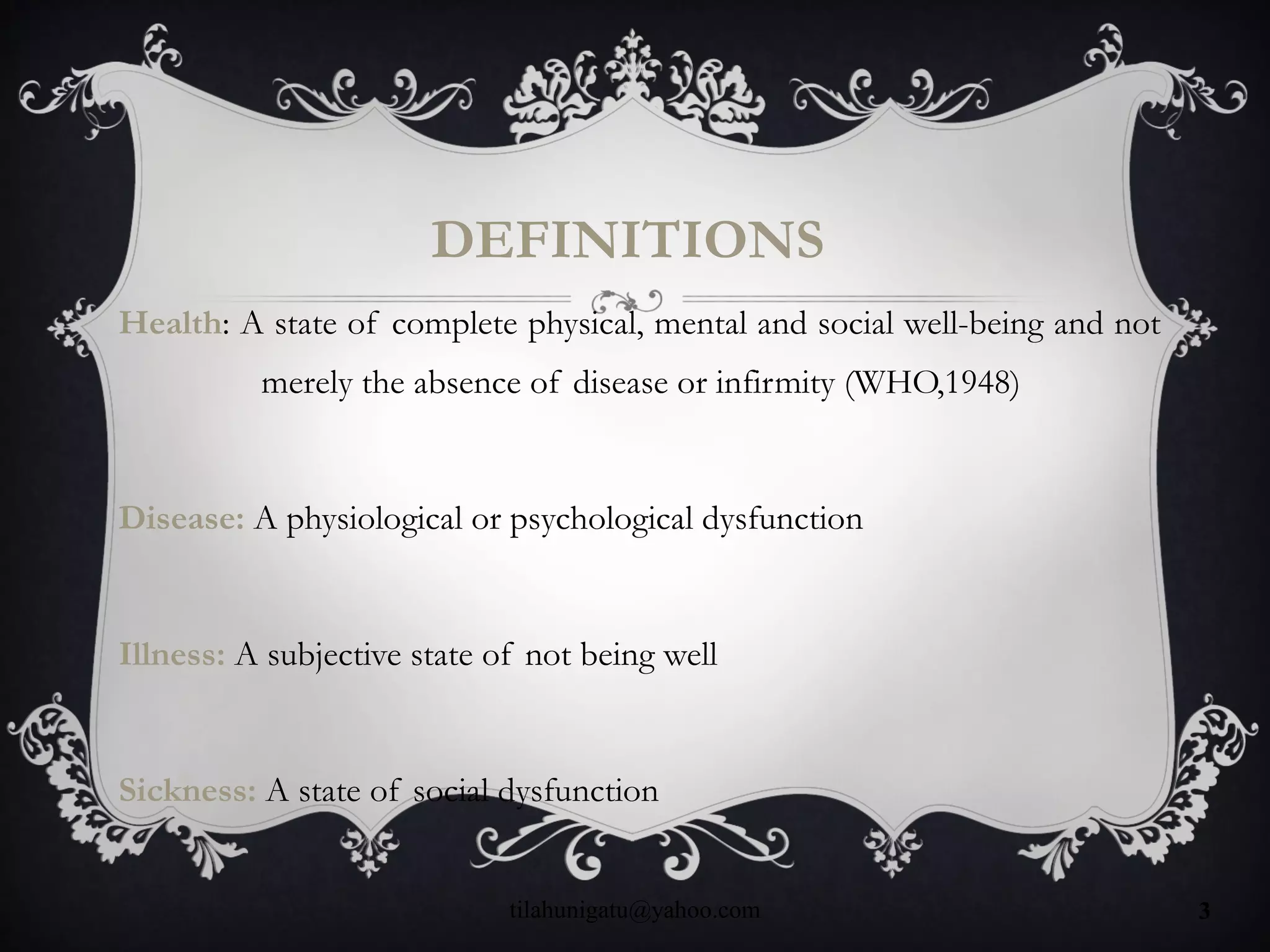
DEFINITIONS
Health: A state of complete physical, mental and social well-being and not
merely the absence of disease or infirmity (WHO,1948)
Disease: A physiological or psychological dysfunction
Illness: A subjective state of not being well
Sickness: A state of social dysfunction
tilahunigatu@yahoo.com 3
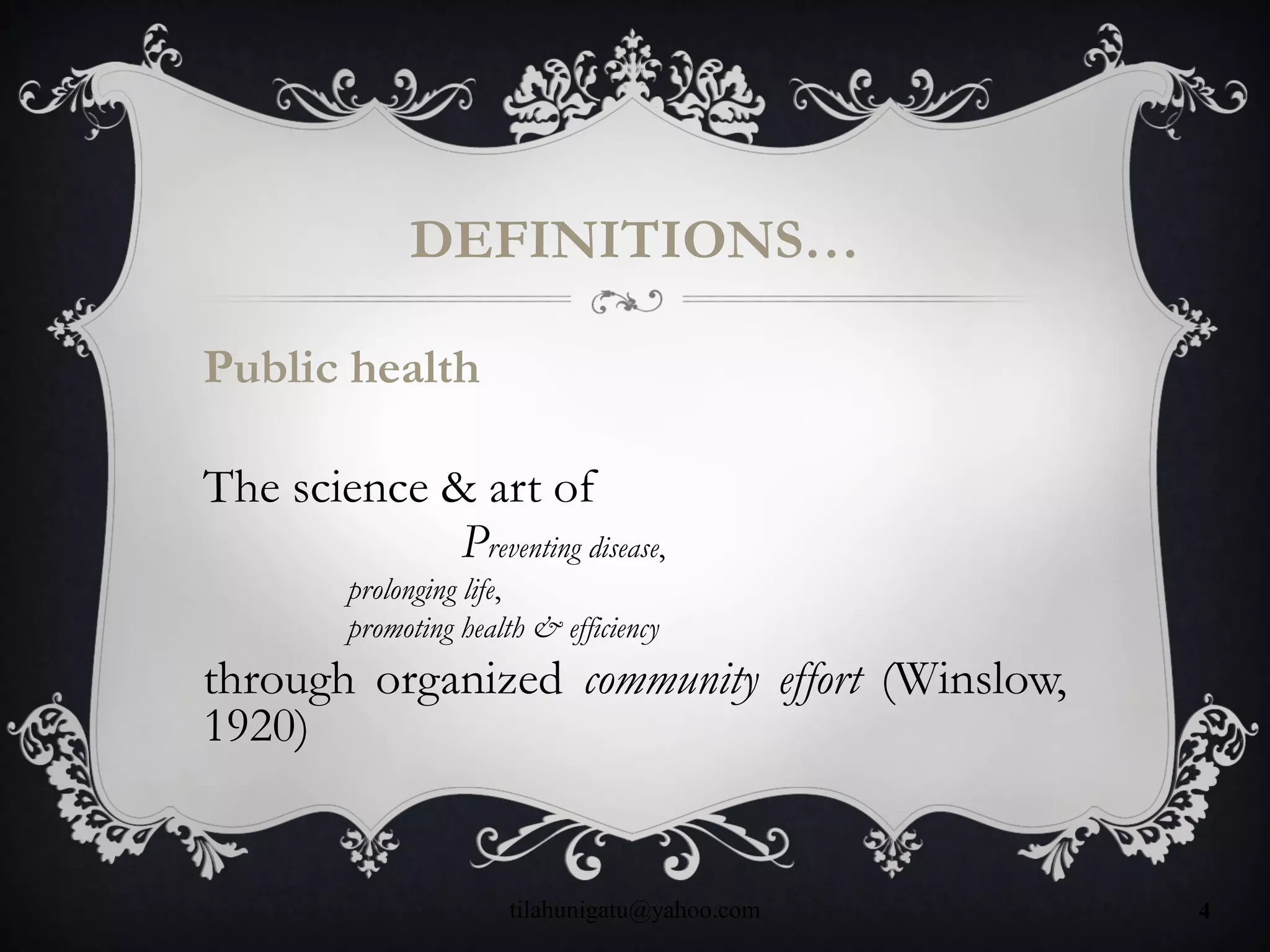
DEFINITIONS…
Public health
The science & art of
Preventing disease,
prolonging life,
promoting health & efficiency
through organized community effort (Winslow,
1920)
tilahunigatu@yahoo.com 4
DEFINITIONS…
Epidemiology
It is the study of frequency, distribution, and determinants of diseases and
other health-related conditions in a human population
and
the application of this study to the prevention of disease and
promotion of health
tilahunigatu@yahoo.com 5
COMPONENTS OF THE
DEFINITION
1.Study: Systematic collection, analysis and interpretation of
data
Epidemiology involves collection, analysis and interpretation of
health related data
Epidemiology is a science
tilahunigatu@yahoo.com 6
COMPONENTS…
2. Frequency: the number of times an event occurs
Epidemiology studies the number of times a disease
occurs
It answers the question How many?
Epidemiology is a quantitative science
tilahunigatu@yahoo.com 7
COMPONENTS…
3. Distribution: Distribution of an event by person, place and time
Epidemiology studies distribution of diseases
It answers the question who, where and when?
Epidemiology describes health events
tilahunigatu@yahoo.com 8
COMPONENTS…
4. Determinants: Factors the presence/absence of which affect the
occurrence and level of an event
Epidemiology studies what determines health events
It answers the question how and why?
Epidemiology analyzes health events
tilahunigatu@yahoo.com 9
COMPONENTS…
5. Diseases & other health related events
Epidemiology is not only the study of diseases
The focus of Epidemiology are not only patients
It studies all health related conditions
Epidemiology is a broader science
tilahunigatu@yahoo.com 10
COMPONENTS…
6. Human population
Epidemiology diagnoses and treats communities/populations
Clinical medicine diagnoses and treats patients
Epidemiology is a basic science of public health
tilahunigatu@yahoo.com 11
COMPONENTS…
7. Application
Epidemiological studies have direct and practical
applications for prevention of diseases & promotion
of health
Epidemiology is a science and practice
Epidemiology is an applied science
tilahunigatu@yahoo.com 12
HISTORY OF EPIDEMIOLOGY
Seven land marks in the history of Epidemiology
1. Hippocrates (460BC): Environment & human
behaviors affects health
2. John Graunt (1662): Quantified births, deaths and
diseases
3. Lind (1747): Scurvy could be treated with fresh fruit
tilahunigatu@yahoo.com 13
HISTORY…
. William Farr (1839): Established application of vital
statistics for the evaluation of health problems
. John Snow (1854): tested a hypothesis on the origin of
epidemic of cholera
. Alexander Louis (1872): Systematized application of
numerical thinking (quantitative reasoning)
tilahunigatu@yahoo.com 14
HISTORY…
. Bradford Hill (1937): Suggested criteria for
establishing causation
pidemiological thought emerged in 460 BC
pidemiology flourished as a discipline in 1940stilahunigatu@yahoo.com 15
SCOPE OF EPIDEMIOLOGY
Originally, Epidemiology was concerned with investigation &
management of epidemics of communicable diseases
Lately, Epidemiology was extended to endemic communicable
diseases and non-communicable infectious diseases
Recently, Epidemiology can be applied to all diseases and
other health related events
tilahunigatu@yahoo.com 16
PURPOSE/USE OF
EPIDEMIOLOGY
The ultimate purpose of Epidemiology is prevention of diseases and promotion of
health
How?
1. Elucidation of natural history of diseases
2.Description of health status of population
3. Establishing determinants of diseases
4. Evaluation of intervention effectiveness
tilahunigatu@yahoo.com 17
TYPES OF EPIDEMIOLOGY
Two major categories of Epidemiology
1.Descriptive Epidemiology
Defines frequency and distribution of diseases
and other health related events
Answers the four major questions: how many,
who, where, and when?
tilahunigatu@yahoo.com 18
TYPES…
2. Analytic Epidemiology
Analyses determinants of health problems
Answers two other major questions: how? and why?
Generally, Epidemiology answers six major questions:
how many, who, where, when, how and why?
tilahunigatu@yahoo.com 19
BASIC EPIDEMIOLOGICAL
ASSUMPTIONS
1.Human diseases doesn’t occur at random or by
chance
2. Human diseases have causal and preventive factors
tilahunigatu@yahoo.com 20
BASIC FEATURES OF
EPIDEMIOLOGY
1. Studies are conducted on human population
2. It examines patterns of events in people
3. Can establish cause-effect relationship without the
knowledge of biological mechanism
4. It covers a wide range of conditions
5. It is an advancing science
tilahunigatu@yahoo.com 21
2. COMMUNICABLE DISEASE
EPIDEMIOLOGY
tilahunigatu@yahoo.com 22
DISEASE CAUSATION
The cause of a disease
An event, a condition or a characteristic that
comes before the disease and without which the
disease wouldn’t occur
tilahunigatu@yahoo.com 23
THEORIES OF DISEASE
CAUSALITY
What causes a disease?
Ninetieth century theories
1. Contagion theory
2. Supernatural theory
3. Personal behavior theory
4. Miasma theory
tilahunigatu@yahoo.com 24
THEORIES…
Twentieth century theories
1. Germ theory
2. Lifestyle theory
3. Environmental theory
4. Multi-causal theory
tilahunigatu@yahoo.com 25
NECESSARY VS SUFFICIENT
tilahunigatu@yahoo.com 26
Necessary: the disease will not occur without the
presence of the factor
Example: Mycobacterium TB for TB
Sufficient: the presence of the factor always result
in disease
Example: Rabies virus for rabies
ETIOLOGY OF A DISEASE
The sum of all factors contribution to the
occurrence of a disease
Agent factors +Host factors +Environmental factors
= Etiology of a disease
tilahunigatu@yahoo.com 27
DISEASE MODELS
How do diseases develop?
Three best known models
1.Epidemiological triangle
The interaction of an agent and host in an appropriate
environment results in disease
tilahunigatu@yahoo.com 28
DISEASE MODELS…
2. Web of causation
Complex interaction of factors results in disease
3. Wheel model
The hub (host) having a genetic make up as its core, surrounded by
an environment schematically divided in to biological, physical and
social
tilahunigatu@yahoo.com 29
NATURAL HISTORY OF DISEASE
The progression of disease process in an individual overtime in the
absence of intervention
Four stages in the natural history of a disease
1.Stage of susceptibility
Presence of factors
No disease
tilahunigatu@yahoo.com 30
NATURAL HISTORY…
. Stage of sub-clinical disease
resence of pathogenic changes (biological
onset)
tilahunigatu@yahoo.com 31
LEVELS OF DISEASE
PREVENTION
Three major levels of disease prevention
1. Primary prevention
Targeted at healthy people
Objectives are Promotion of health
Prevention of exposure andtilahunigatu@yahoo.com 32
LEVELS OF DISEASE…
2. Secondary prevention
Targeted at sick individuals
Objective is to stop or slow the progression of disease
and to prevent or limit permanent damage through
early detection & treatmenttilahunigatu@yahoo.com 33
LEVELS OF DISEASE…
3. Tertiary prevention
Targeted at people with chronic diseases &
disabilities that can’t be cured
Objective is to prevent further disability ortilahunigatu@yahoo.com 34
INFECTIOUS DISEASE
PROCESS
There are six components of the infectious disease process
constituting chain of disease transmission
1.The agent 2. Its reservoir
3. Its portal of exit 4. Its mode of transmission
5. Its portal of entry 6. Susceptible host
tilahunigatu@yahoo.com 35
THE AGENT
Possible outcomes of exposure to an infectious agent
Infection: invasion & multiplication in the host
Infectivity: the proportion of exposed who becomes
infected
Infection rate= Infected/exposed
Disease: A clinically apparent infection
tilahunigatu@yahoo.com 36
THE AGENT…
Pathogenicity:the proportion of infected who
develop clinical disease
Clinical-to-Subclinical ratio
Virulence: the proportion clinical cases
resulting in severe clinical disease
Case fatality & hospitalization ratetilahunigatu@yahoo.com 37
RESERVOIR VS CARRIER
Reservoir
An organism or habitat in which an infectious agent
normally lives, transforms, develops and/or multiplies
Carrier
A person who doesn’t have apparent clinical disease,
but is a potential source of infection to other peopletilahunigatu@yahoo.com 38
TYPES OF CARRIERS
1.Incubatory carriers: transmits the
disease during incubation period
Example: Measles, mumps
2. Convalescent carriers: transmits the
disease during convalescent periodtilahunigatu@yahoo.com 39
TYPES OF CARRIERS…
3. Asymptomatic carriers: transmitting
the disease without showing
manifestations
Example: polio, Amoebiasis
4. Chronic Carriers: transmitting thetilahunigatu@yahoo.com 40
IMPORTANCE OF CARRIERS
1. Number- carriers may outnumber cases
2. Difficulty in recognition- carriers don’t know that
they are infected
3. Mobility- carriers are mobile, cases are restricted
4. Chronicity- carriers re-introduce infection and
contribute to endemicity
tilahunigatu@yahoo.com 41
EFFECT OF CARRIERS ON
DISEASE TRANSMISSION
ce-berg effect in temperate zone
ippopotamus effect in tropical zone
tilahunigatu@yahoo.com 42
MODES OF DISEASE TRANSMISSION
1.Direct transmission
Direct contact: physical contact with body part of
infected person: Touching, kissing,biting,sex
Example: HIV
Direct projection: projection of saliva droplets
while coughing, sneezing,spitting,talking,singing etc
Example: Common cold
Transplacental: Transmission from mother to
fetus through the placenta
Example: Syphilis
tilahunigatu@yahoo.com 43
MODES OF DISEASE…
2. Indirect transmission
Vehicle-borne: transmission through inanimate objects/non-living
substances e.g HIV by needles
Air-borne: transmission by dust or droplet nuclei
tilahunigatu@yahoo.com 44
MODES OF DISEASE…
ector-borne: infectious agent is conveyed by an
arthropod to host
Biological: there is multiplication and/or development
in the vector
tilahunigatu@yahoo.com 45
IMPORTANCE OF MODE OF
TRANSMISSION
disease often has several modes of transmission
t is important to distinguish between the predominant
mode of transmission and those of secondary
importance
tilahunigatu@yahoo.com 46
HERD IMMUNITY
It is host resistance at a population level
It is defined as the resistance of a community (group)
to invasion and spread of an infectious agent, based
on immunity of high proportions of individuals in the
community.
tilahunigatu@yahoo.com 47
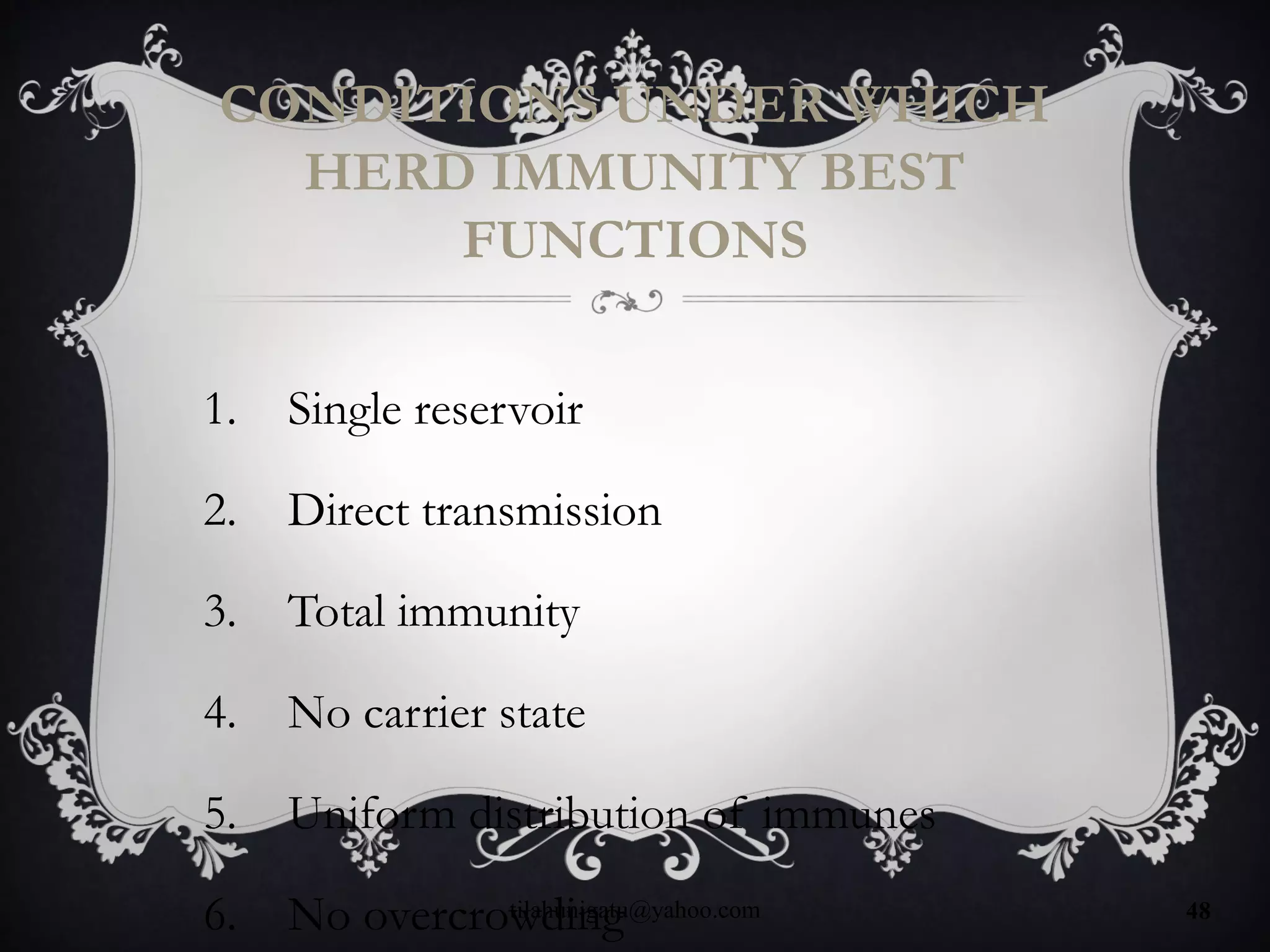
CONDITIONS UNDER WHICH
HERD IMMUNITY BEST
FUNCTIONS
1. Single reservoir
2. Direct transmission
3. Total immunity
4. No carrier state
5. Uniform distribution of immunes
6. No overcrowdingtilahunigatu@yahoo.com 48
TIME COURSE OF AN INFECTIOUS
DISEASE
re-patent period: between biological onset and first shedding
ncubation period: between biological onset and clinical onset
ommunicable period: time during which agent is being shed
tilahunigatu@yahoo.com 49
TIME COURSE OF…
Latent period: between recovery and
relapse in clinical disease
Convalescent period: between recovery and
time when shedding stops
tilahunigatu@yahoo.com 50
APPLICATION OF TIME PERIODS
re-patent period
• When should we investigate?
ncubation period
• When was time of exposure?
ommunicable period
• When should we take care of infectiousness?
tilahunigatu@yahoo.com 51
FACTORS WHICH INFLUENCE
THE DEVELOPMENT OF
DISEASE
train of the agent
ose of the agent
oute of infection
tilahunigatu@yahoo.com 52
3. MEASURES OF DISEASE
OCCURRENCE
tilahunigatu@yahoo.com 53
WHAT ARE MEASURES OF
DISEASE OCCURRENCE?
hese are measurements of the frequency/magnitude/amount
f disease
n populations
tilahunigatu@yahoo.com 54
HOW DO WE MEASURE
DISEASES?
our quantitative descriptors
umbers
atios
roportions
ates
tilahunigatu@yahoo.com 55
DESCRIPTORS
umbers: Use of actual number of events
e.g 100 cases of TB in community A
tilahunigatu@yahoo.com 56
DESCRIPTORS
roportions: a ratio in which the numerator is included
in the denominator
.g proportion of TB cases in community A is 10%
tilahunigatu@yahoo.com 57
WHICH COMMUNITY IS MORE
AFFECTED?
ommunity A has 100 cases of disease X
and
ommunity B has 1000 cases of disease X,
tilahunigatu@yahoo.com 58
WHEN WE CALL..
hen we call a measure a ratio, we mean a non-
proportional ratio
hen we call a measure a proportion, we mean a
proportional ratio that doesn’t measure an event
overtime
hen we call a rate, we mean a proportional ratio that
does measure an event in a population overtimetilahunigatu@yahoo.com 59
TYPES OF RATES
1. Crude rates: Apply to the total population in a
given area
2. Specific rates: Apply to specific subgroups in the
population (age, sex etc) or specific diseases
3. Standardized rates: used to permit comparisons of
rates in population which differ in structure (e.gtilahunigatu@yahoo.com 60
MORBIDITY RATES
Morbidity rates are rates that are used to
quantify the magnitude/frequency of
diseases
tilahunigatu@yahoo.com 61
INCIDENCE RATE
he proportion of a population that develops a disease
overtime
he risk/probability of an individual developing a
disease overtime
he rapidity with which new cases of a disease develop
overtime
tilahunigatu@yahoo.com 62
CUMULATIVE INCIDENCE
Number of new cases of a
Cumulative = disease during a specified period
Incidence Population at risk in the same
tilahunigatu@yahoo.com 63
PRACTICAL CHALLENGES IN
MEASURING INCIDENCE
RATE
1. Identification of population at risk
Population at risk constitutes all those free of the
disease and susceptible to it
2. Population is not static/it fluctuates/as a result of
births, deaths and migration
tilahunigatu@yahoo.com 64
PRACTICAL SOLUTION TO
THE CHALLENGES
1. Use the total population as a
denominator
This gives an estimate of the incidence
rate and not the actual incidence rate
2. Use person-time at risktilahunigatu@yahoo.com 65
PREVALENCE RATE
It measures the proportion of a
population with a disease during a
specified period or at a point in time
Two types
1. Point prevalence ratetilahunigatu@yahoo.com 66
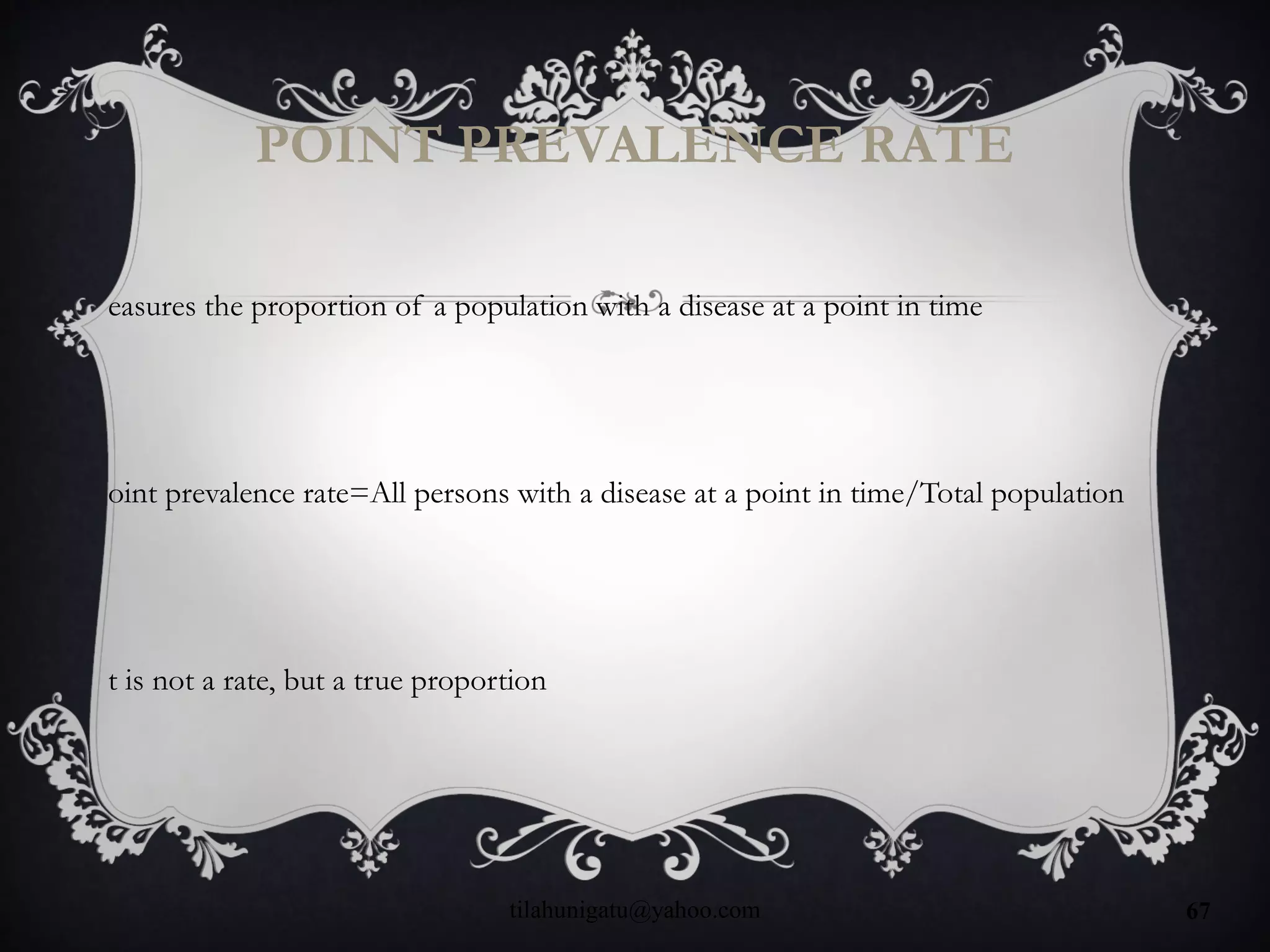
POINT PREVALENCE RATE
easures the proportion of a population with a disease at a point in time
oint prevalence rate=All persons with a disease at a point in time/Total population
t is not a rate, but a true proportion
tilahunigatu@yahoo.com 67
PERIOD PREVALENCE RATE
easures the proportion of a population with a disease in a specified
time period
eriod prevalence rate=All persons with a disease overtime
period/Average(mid-year)population in the same period
tilahunigatu@yahoo.com 68
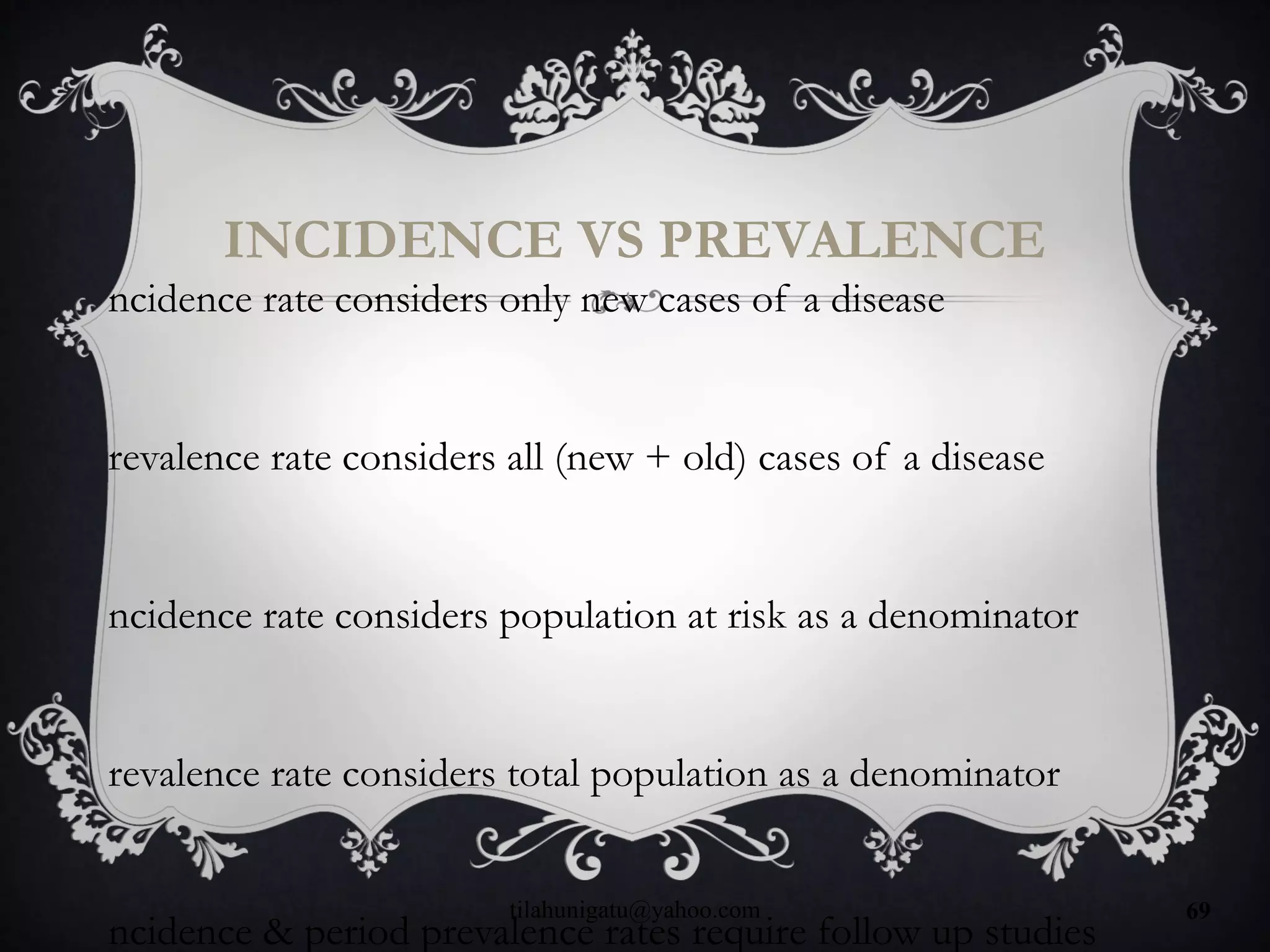
INCIDENCE VS PREVALENCE
ncidence rate considers only new cases of a disease
revalence rate considers all (new + old) cases of a disease
ncidence rate considers population at risk as a denominator
revalence rate considers total population as a denominator
ncidence & period prevalence rates require follow up studies
tilahunigatu@yahoo.com 69
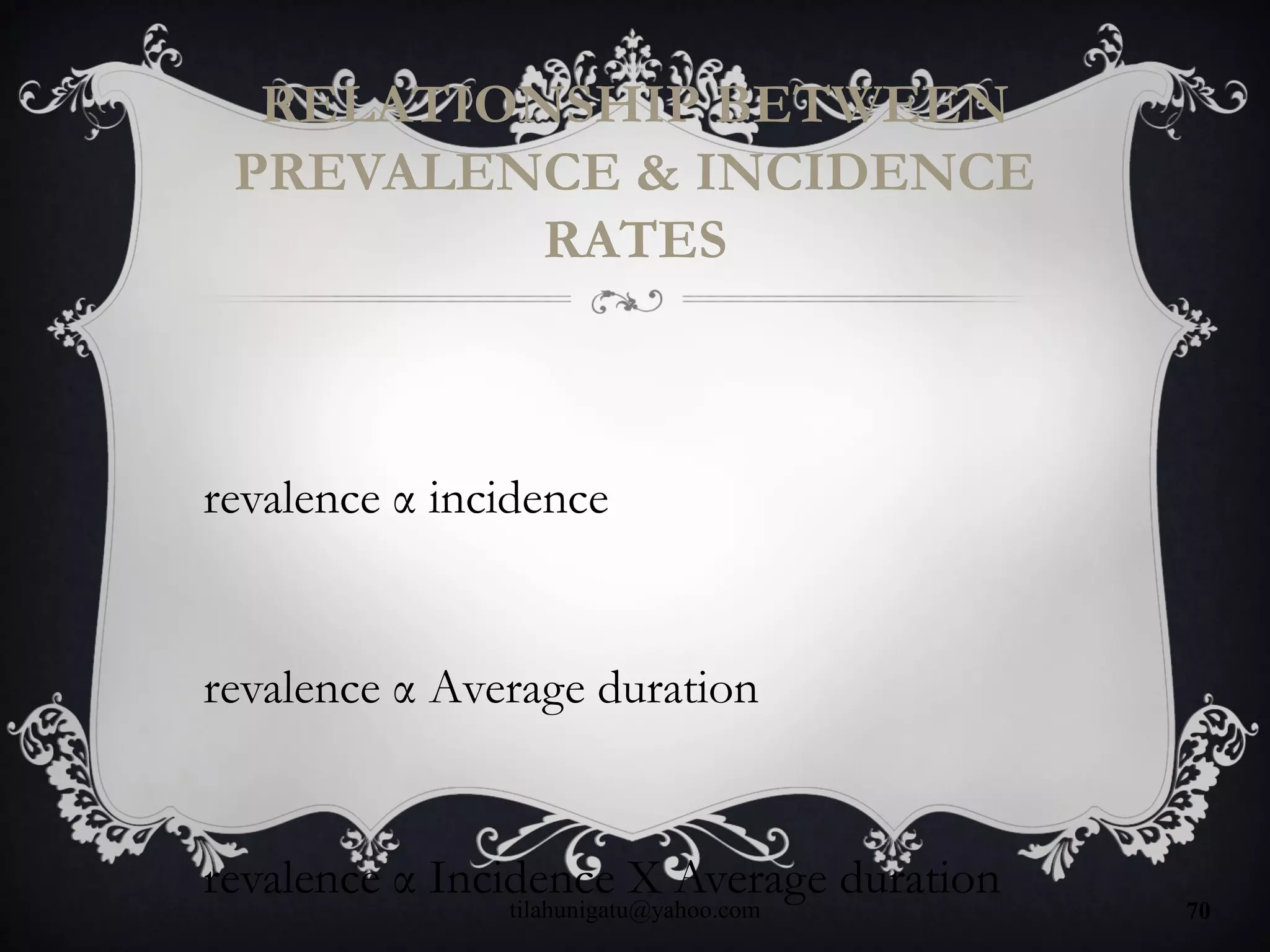
RELATIONSHIP BETWEEN
PREVALENCE & INCIDENCE
RATES
revalence α incidence
revalence α Average duration
revalence α Incidence X Average duration
tilahunigatu@yahoo.com 70
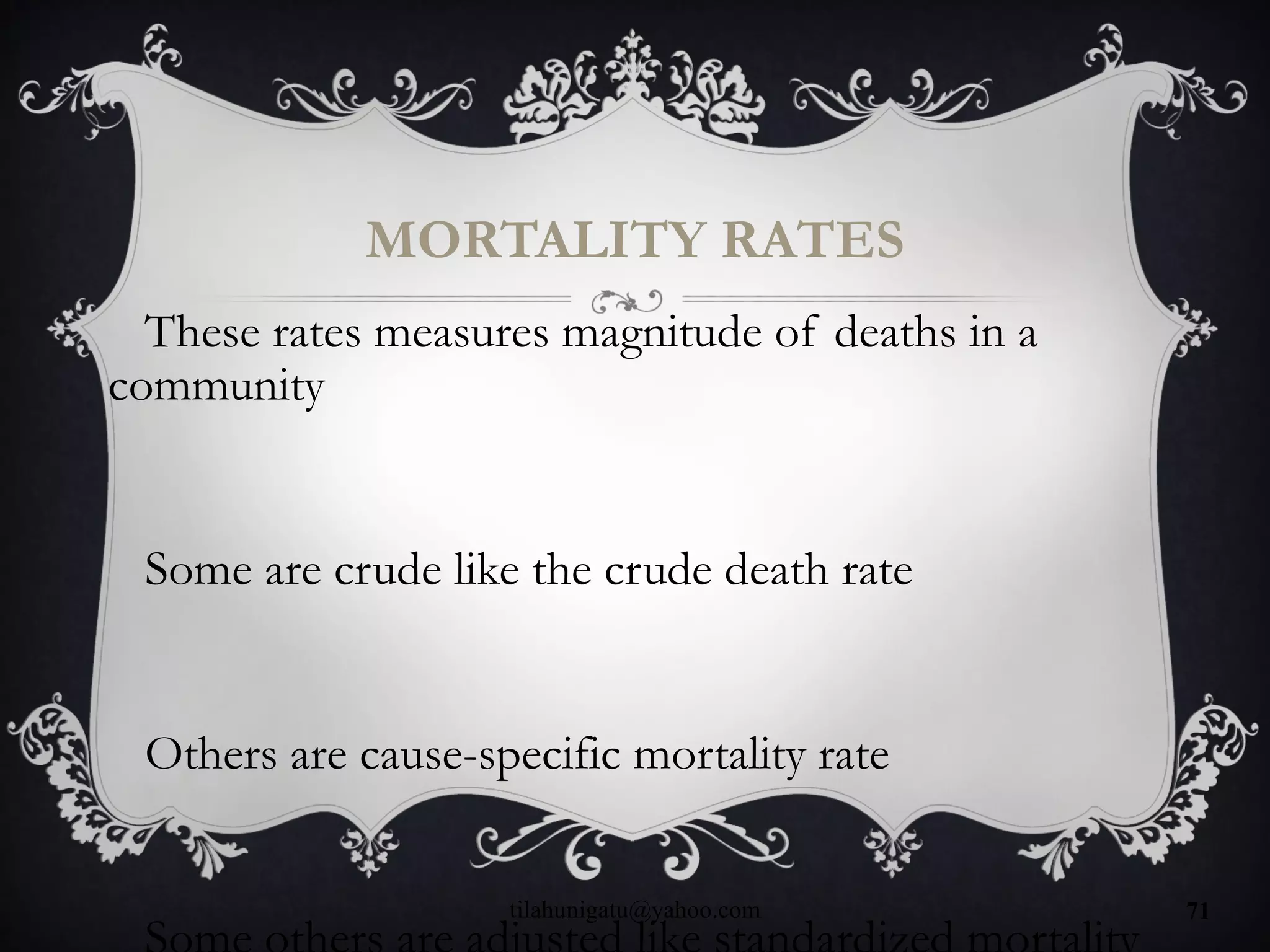
MORTALITY RATES
These rates measures magnitude of deaths in a
community
Some are crude like the crude death rate
Others are cause-specific mortality rate
tilahunigatu@yahoo.com 71
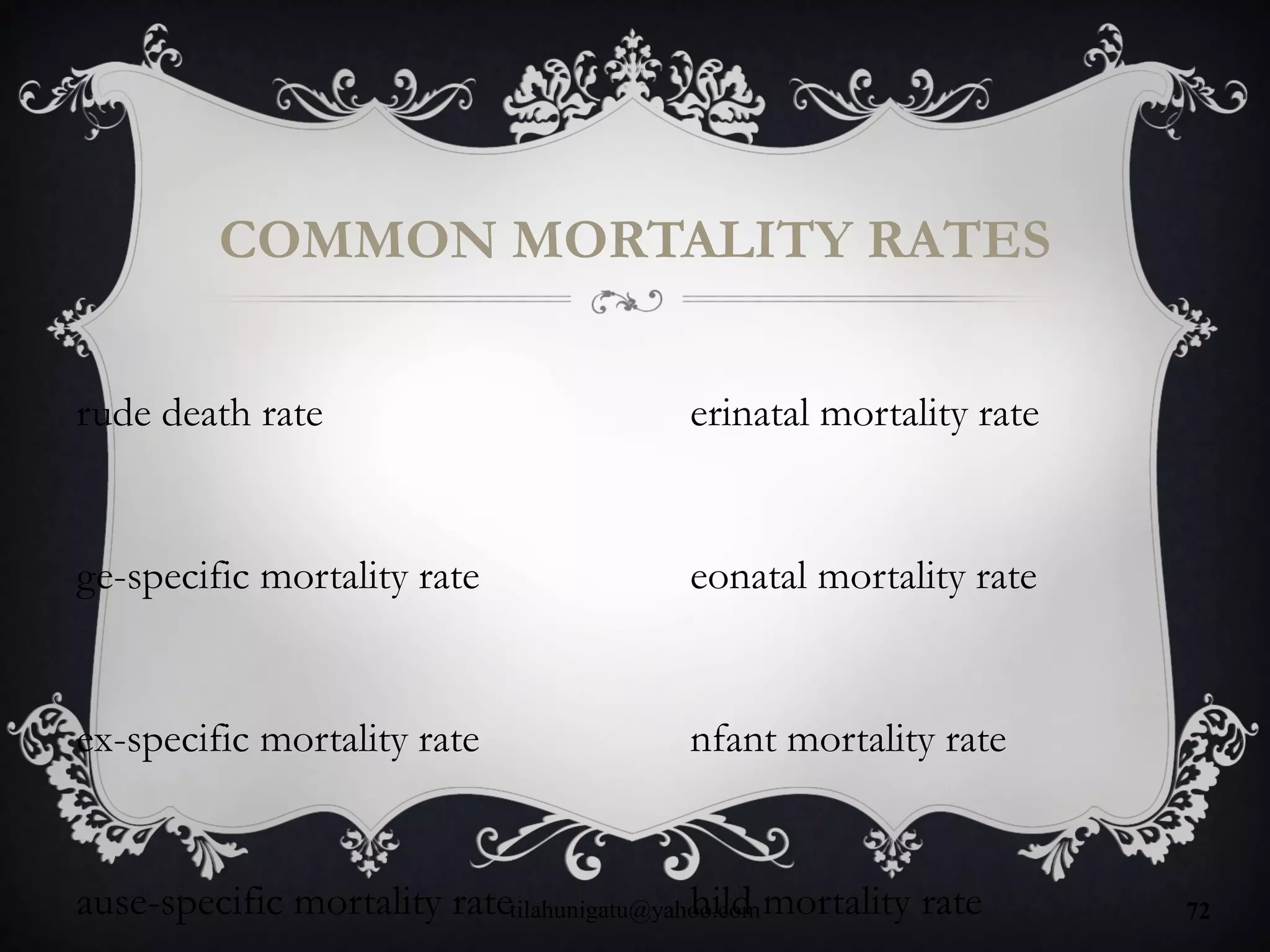
rude death rate
ge-specific mortality rate
ex-specific mortality rate
ause-specific mortality rate
COMMON MORTALITY RATES
tilahunigatu@yahoo.com 72
erinatal mortality rate
eonatal mortality rate
nfant mortality rate
hild mortality rate
4. MEASURES OF ASSOCIATION
tilahunigatu@yahoo.com 73
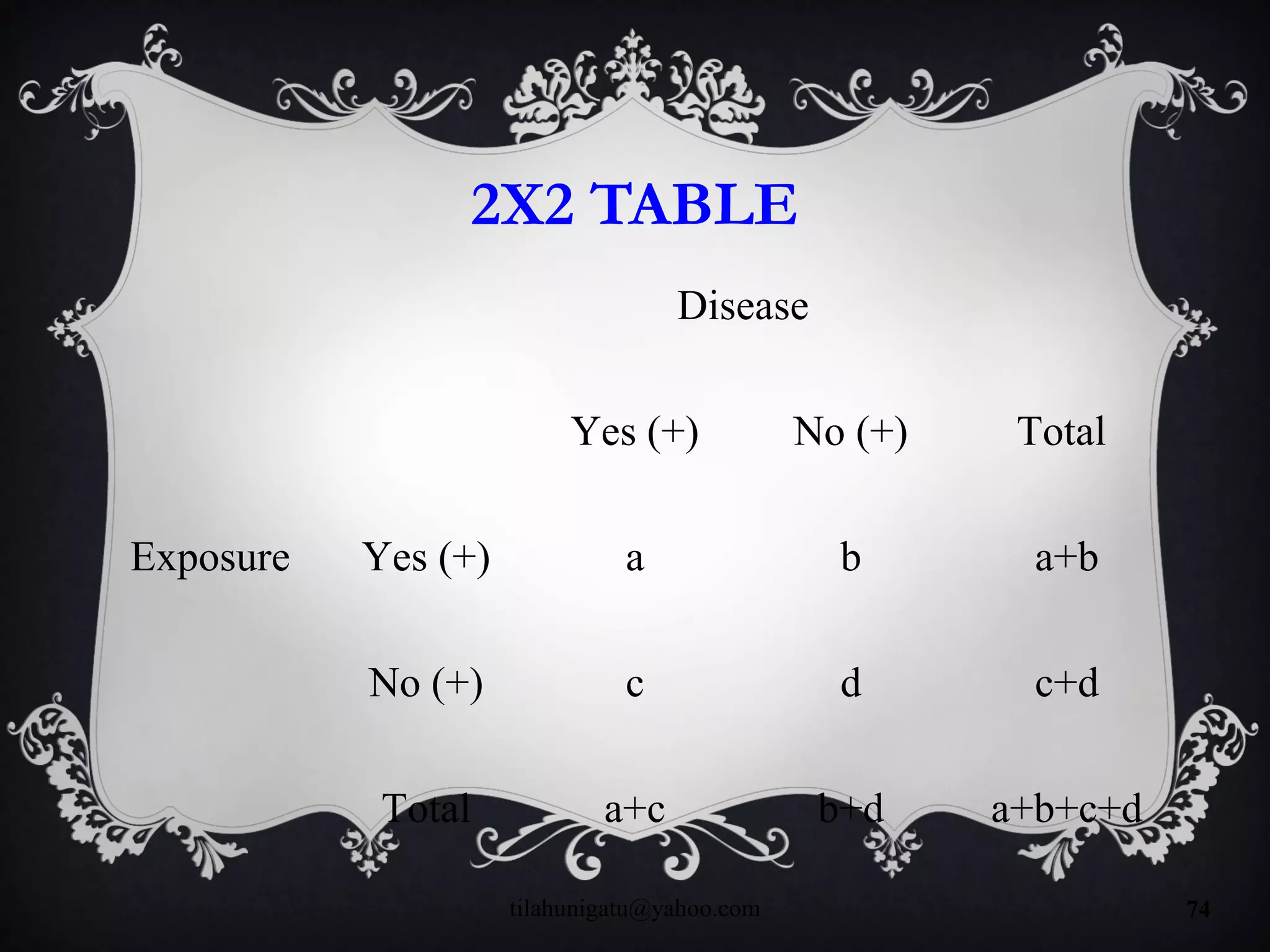
2X2 TABLE
Disease
Yes (+) No (+) Total
Exposure Yes (+) a b a+b
No (+) c d c+d
Total a+c b+d a+b+c+d
tilahunigatu@yahoo.com 74
CELLS
= Exposed, and diseased
= Exposed, Not diseased
= Not exposed, diseased
tilahunigatu@yahoo.com 75
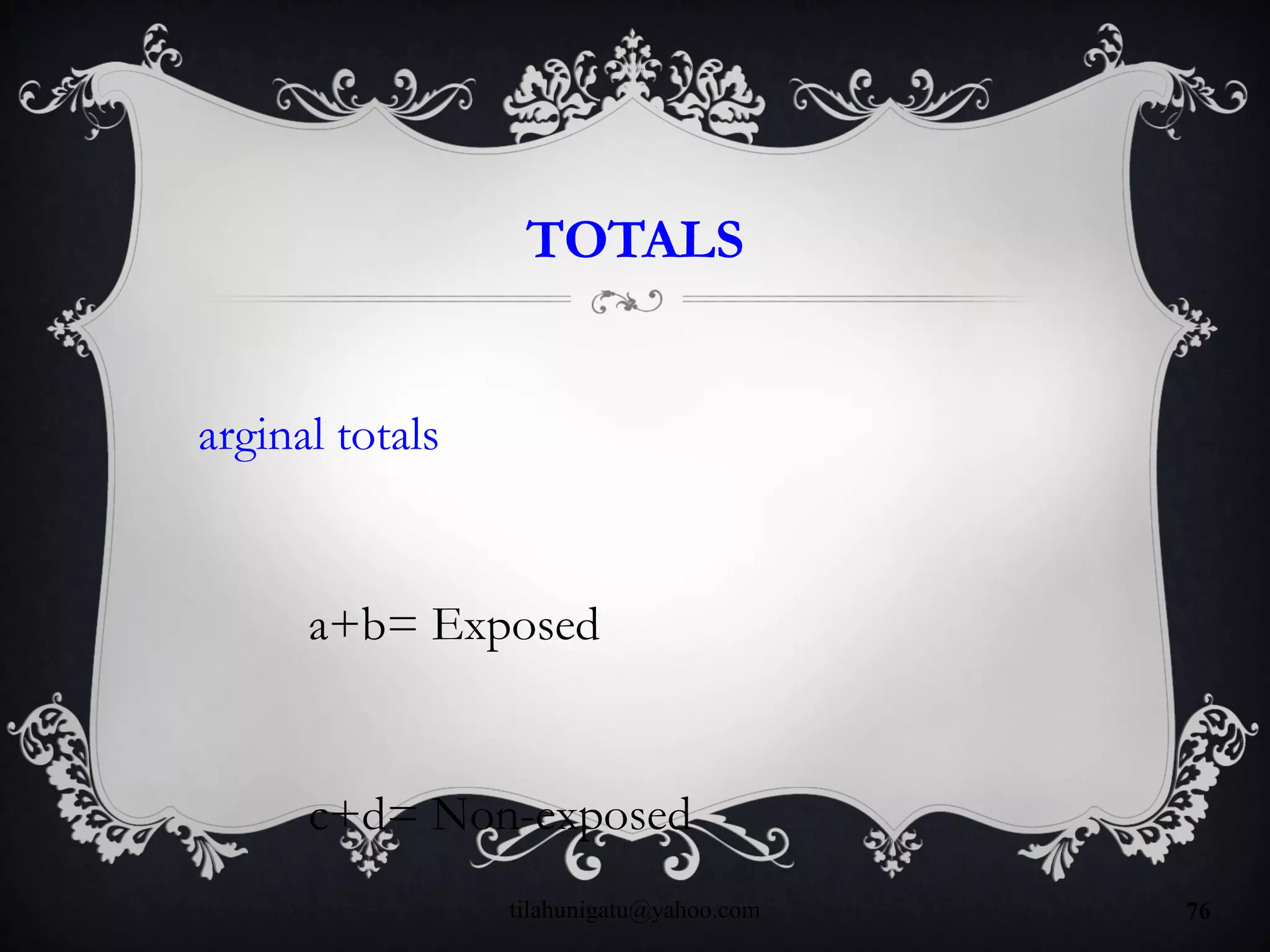
TOTALS
arginal totals
a+b= Exposed
c+d= Non-exposed
tilahunigatu@yahoo.com 76
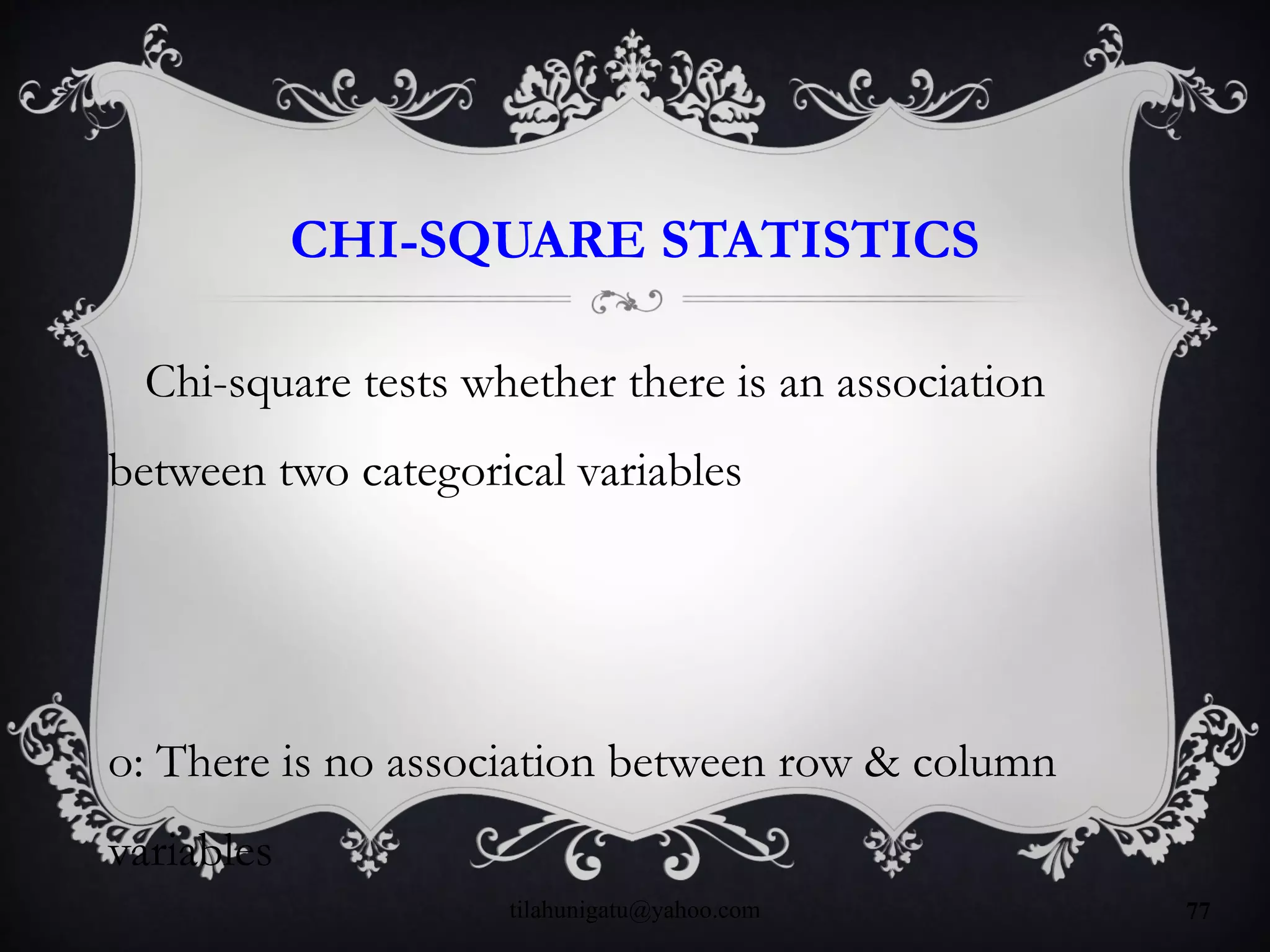
CHI-SQUARE STATISTICS
Chi-square tests whether there is an association
between two categorical variables
o: There is no association between row & column
variables
tilahunigatu@yahoo.com 77
CHI-SQUARE…
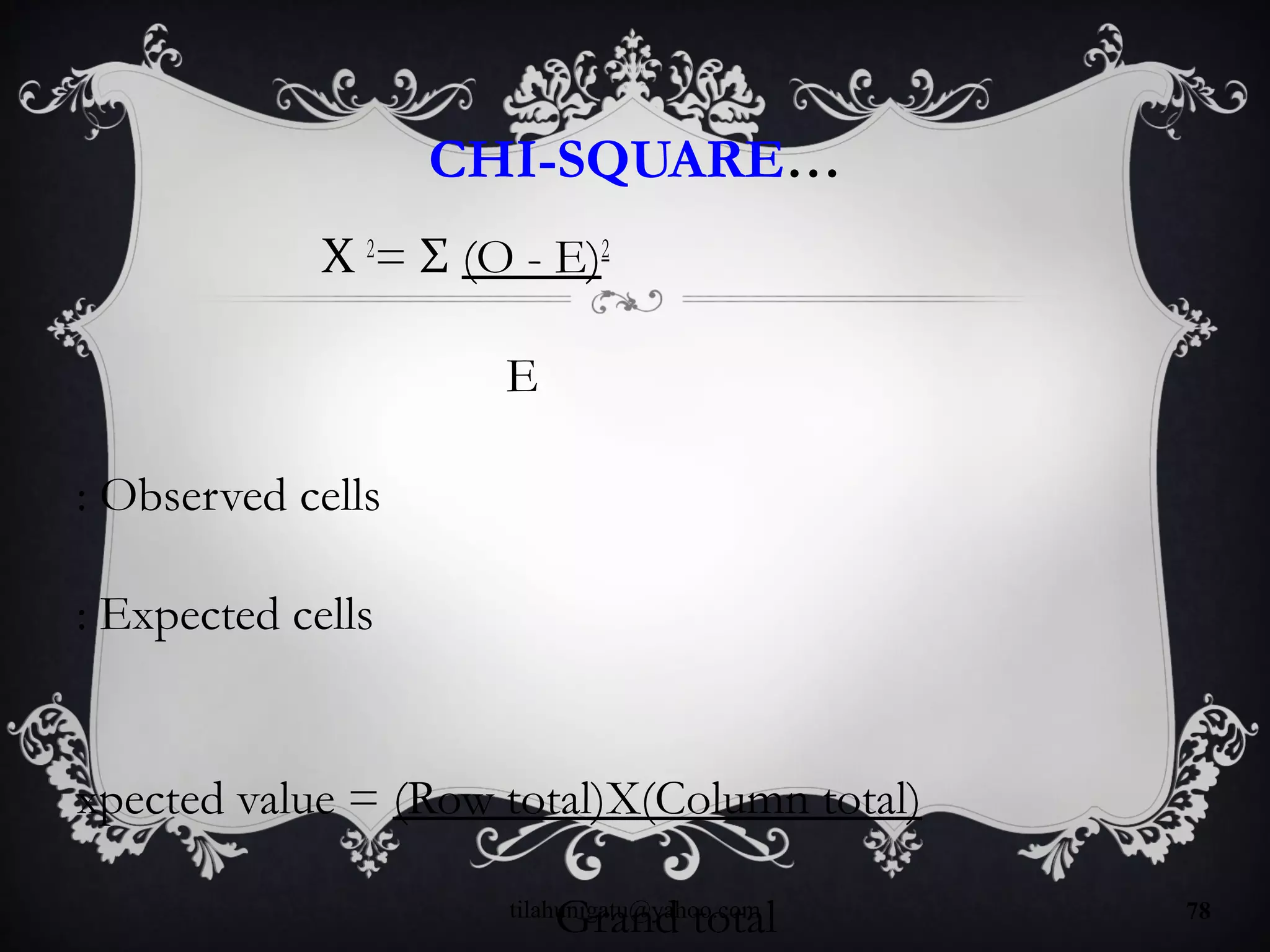
Χ 2
= Σ (O - E)2
E
: Observed cells
: Expected cells
xpected value = (Row total)X(Column total)
Grand totaltilahunigatu@yahoo.com 78
IMPORTANCE OF CHI-SQUARE
If the calculated chi-square value is greater
than the critical or P<0.05 we say that there
is association
tilahunigatu@yahoo.com 79
RELATIVE RISK (RR)
Expresses risk of developing a diseases in exposed group
(a + b) as compared to non-exposed group (c + d)
RR= Incidence (risk) among exposed
tilahunigatu@yahoo.com 80
INTERPRETATION OF RELATIVE
RISK
hat does a RR of 2 mean?
isk in exposed =RRX Risk in non-exposed
tilahunigatu@yahoo.com 81
STRENGTH OF ASSOCIATION
n general strength of association can be
considered as:
igh if RR>3 tilahunigatu@yahoo.com 82
ODDS RATIO (OR)
Odds ratio is the ratio of odds of exposure
among diseased to odds of exposure among
non-diseased
tilahunigatu@yahoo.com 83
ODDS RATIO…dds of exposure among exposed=a/c
dds of exposure among non-diseased=b/d
R = Odds of exposure among diseased
Odds of exposure among non-diseased
R= (a/c)/(b/d)
tilahunigatu@yahoo.com 84
ODDS RATIO…
RR can be best estimated by OR if the following
conditions are fulfilled
1. Controls are representative of general population
2. Selected cases are representative of all cases
3. The disease is rare
tilahunigatu@yahoo.com 85
ATTRIBUTABLE RISK (AR)
AR indicates how much of the risk is due to /attributable/
to the exposure
Quantifies the excess risk in the exposed that can be
attributable to the exposure by removing the risk of the
disease occurred due to other causes
AR= Risk (incidence) in exposed- Risk (incidence) in non-exposed
tilahunigatu@yahoo.com 86
INTERPRETING AR
What does attributable risk of 10 mean?
10 of the exposed cases are attributable to
the exposure
tilahunigatu@yahoo.com 87
ATTRIBUTABLE RISK
PERCENT (AR%)
Estimates the proportion of disease among
the exposed that is attributable to the
exposure
tilahunigatu@yahoo.com 88
INTERPRETATION OF AR%
hat does AR% of 10% mean?
0% of the disease can be attributed to the
exposure
tilahunigatu@yahoo.com 89
POPULATION ATTRIBUTABLE
RISK (PAR)
Estimates the rate of disease in total
population that is attributable to the
exposure
tilahunigatu@yahoo.com 90
POPULATION ATTRIBUTABLE
RISK PERCENT (PAR%)
Estimates the proportion of disease in the study
population that is attributable to exposure and thus could
be eliminated if the exposure were eliminated
AR%= Risk in population – Risk in unexposed
tilahunigatu@yahoo.com 91
POSSIBLE OUTCOMES IN
STUDYING THE
RELATIONSHIP BETWEEN
EXPOSURE & DISEASE
1. No association
RR=1
AR=0
2. Positive association
RR>1
AR>0
3. Negative association
RR<1 (fraction)
AR<0 (Negative)
tilahunigatu@yahoo.com 92
RISK VS PREVENTIVE
FACTORS
A risk factor is any factor positively
associated with a disease (RR>1)
It is associated with an increased
occurrence of a disease
A preventive factor is any factor
negatively associated with a disease (RR<1)
tilahunigatu@yahoo.com 93
5. EVALUATION OF EVIDENCE
(JUDGMENT OF CAUSALITY)
tilahunigatu@yahoo.com 94
ASSOCIATION VS CAUSATION
The existence of an association doesn’t
itself constitute a proof of causation
An observed association could be a fact or
tilahunigatu@yahoo.com 95
POSSIBLE EXPLANATIONS
FOR OBSERVED ASSOCIATION
1. Chance
2. Bias
3. Confounding
4. Reverse causation
5. Reciprocal causation
6. Cause-effect relationshiptilahunigatu@yahoo.com 96
ACCURACY OF
MEASUREMENT
Accuracy = Validity + Precision
Validity is the extent to which a measured value
actually reflects truth
tilahunigatu@yahoo.com 97
TYPES OF VALIDITY
nternal validity:
Is the degree to which a measured value is
true within the sample
tilahunigatu@yahoo.com 98
PRECISION
Precision is the extent to which random
error alters the measurement of effects
Threats to validity of study:
tilahunigatu@yahoo.com 99
JUDGMENT OF CAUSALITY
Judgment of causality has two steps
1. Check whether the observed association
between exposure and disease is Valid (Rule out
chance, bias and confounding)
2. Check whether the observed association is
tilahunigatu@yahoo.com 100
ROLE OF CHANCE
The role of chance as an alternative
explanation for an association emerges
from sampling variability
Evaluation of the role of chance is
mainly the domain of statistics and
tilahunigatu@yahoo.com 101
1. TEST OF STATISTICAL
SIGNIFICANCE
-value quantifies the degree to which chance accounts
for observed association
-value is the probability of obtaining a result at least as
extreme as the observed by chance alone
<0.05 indicates statistical significance for medical
research tilahunigatu@yahoo.com 102
TEST OF STATISTICAL…
very small difference may be significant if
you have large sample
large difference may not achieve statistical
tilahunigatu@yahoo.com 103
2. ESTIMATION OF
CONFIDENCE INTERVAL
Confidence interval represents the range
within which true magnitude of effect lies
within a certain degree of assurance
tilahunigatu@yahoo.com 104
ROLE OF BIAS
Bias is any systematic error in the design, conduct or
analysis of an epidemiologic study that results in an
incorrect estimate of association between exposure
and disease
Unlike chance bias can’t be statistically evaluated
There are two major types of bias
1. Selection bias
2. Information bias
tilahunigatu@yahoo.com 105
SELECTION BIASAny systematic error that arises in the process of
identifying the study population
It affects the representativeness of the study
It occurs when there is a difference between sample
and population with respect to a variable
Examples of selection bias:
1. Diagnostic bias
2. Volunteer bias
tilahunigatu@yahoo.com 106
INFORMATION/OBSERVATIO
N/BIAS
Any systematic error in the measurement
of information on exposure or disease
Examples of information bias:
1. Interviewer bias/observer bias
2. Recall bias / Response bias
3. Social desirability bias
4. Placebo effect
tilahunigatu@yahoo.com 107
WAYS TO MINIMIZE BIAS
1. Choose study design carefully
2. Choose objective rather than subjective
outcomes
3. Blind interviewers whenever possible
4. Use close ended questions whenever possible
5. Collect data on variables you don’t expect totilahunigatu@yahoo.com 108
ROLE OF CONFOUNDING
Confounding refers to the mixing of the
effect of an extraneous variable with the
effect of the exposure and disease of
interest
Characteristics of a confounding
tilahunigatu@yahoo.com 109
EFFECT OF CONFOUNDING
otally or partially account for the apparent effect
ask an underlying true association
tilahunigatu@yahoo.com 110
CONTROL OF CONFOUNDING
VARIABLES
uring designing stage:
• Randomization
• Restriction
• Matching
uring analysis stage
• Standardization
• Stratification/pooling
• Multivariate analysis
tilahunigatu@yahoo.com 111
CRITERIA TO ASSES THE
STRENGTH OF EVIDENCE
FOR CAUSE AND EFFECT
RELATIONSHIP
Observational studies have many biases
and confounding. Experimental studies if
properly done can show cause-effect
relationship. But they are not usually feasible
due to ethical issues
In the absence of an experimental trail, the
following criteria (Bradford Hill criteria) are
used to asses the strength of evidence for a
tilahunigatu@yahoo.com 112
CRITERIA TO ASSES THE
STRENGTH…
1. Strength of association: The stronger the association the more likely it is causal
2. Consistency of association: The more consistent, the more likely it is causal
3. Specificity of association: If single exposure
linked to single disease more likely
4. Temporal relationship: The exposure must come
before the diseasetilahunigatu@yahoo.com 113
CRITERIA TO ASSES THE
STRENGTH…
. Dose-response relationship: risk of
disease increase with increasing exposure
with factor
. Biological plausibility: Knowledge of
association coherent with biology and
descriptive epidemiology of the disease
tilahunigatu@yahoo.com 114
6. EPIDEMIOLOGIC STUDY
DESIGNS
tilahunigatu@yahoo.com 115
STUDY DESIGN
Study design is the arrangement of conditions for
the collection and analysis of data to provide the most
accurate answer to a question in the most economical
way.
tilahunigatu@yahoo.com 116
TYPES OF EPIDEMIOLOGIC
STUDY DESIGNS
I. Based on objective/focus/research
question
1. Descriptive studies
• Describe: who, when, where & how many
tilahunigatu@yahoo.com 117
TYPES…
II. Based on the role of the investigator
1. Observational studies
• The investigator observes nature
• No intervention
2. Intervention/Experimental studies
• Investigator intervenes
• He has a control over the situation
tilahunigatu@yahoo.com 118
TYPES…
II. Based on timing
. One-time (one-spot) studies
• Conducted at a point in time
• An individual is observed at oncetilahunigatu@yahoo.com 119
TYPES…
IV. Based on direction of follow-up/data
collection
1. Prospective
• Conducted forward in time
2. Retrospective
• Conducted backward in time
tilahunigatu@yahoo.com 120
TYPES…
V. Based on type of data they generate
1. Qualitative studies
• Generate contextual data
• Also called exploratory studies
2. Quantitative studies
tilahunigatu@yahoo.com 121
TYPES…
VI. Based on study setting
1. Community-based studies
• Conducted in communities
2. Institution-based studies
• Conducted in communities
3. Laboratory-based studiestilahunigatu@yahoo.com 122
TYPES…
VII. Standard classification
1. Cross-sectional studies
2. Case-control studies
3. Cohort studies
4. Experimental studiestilahunigatu@yahoo.com 123
CROSS-SECTIONAL STUDIES
In this study design information about the status of an
individual with respect to presence/absence of exposure
and diseased is assessed at a point in time.
Cross-sectional studies are useful to generate a
hypothesis rather that to test ittilahunigatu@yahoo.com 124
CROSS-SECTIONAL…
omparison groups are formed after data
collection
he object of comparison are prevalence of
exposure or disease
tilahunigatu@yahoo.com 125
CROSS-SECTIONAL…
dvantages of cross-sectional studies
ess time consuming
tilahunigatu@yahoo.com 126
CROSS-SECTIONAL…
imitations of cross-sectional studies
ntecedent-consequence uncertainty
tilahunigatu@yahoo.com 127
CROSS-SECTIONAL…
Types of cross-sectional studies
1. Single cross-sectional studies
• Determine single proportion/mean in a
single population at a single point in time
2. Comparative cross-sectional studies
• Determine two proportions/means in two
populations at a single point in time
3. Time-series cross-sectional studies
tilahunigatu@yahoo.com 128
CROSS-SECTIONAL…
n general, cross-sectional studies are
• Simplest to conduct
• Commonest to find
• Least useful to establish causation
tilahunigatu@yahoo.com 129
CASE-CONTROL STUDIES
ubjects are selected with respect to the
presence (cases) or absence (controls) of
disease, and then inquiries are made about
past exposure
e compare diseased (cases) and non-diseased
(controls) to find out the level of exposure
tilahunigatu@yahoo.com 130
CASE-CONTROL…
Steps in conducting case-control studies
I. Define who is a case
• Establish strict diagnostic criteria
• All who fulfil the criteria will be “case population
• Those who don’t fulfil will be “control population”
II. Select a sample of cases from case population
• This sample must be representative of the case population
tilahunigatu@yahoo.com 131
CASE-CONTROL…
Sources of cases
1. Hospitals (Health institution)
• Cost-less
• Bias-more
2. Population (Community)
• Cost-moretilahunigatu@yahoo.com 132
CASE-CONTROL…
III. Select controls from a control population
• Should be representative of control population
• Should be similar to cases except outcome
• Should be selected by the same method as cases
Sources of controls
1. Hospital (Health institution) controls
• Readily available
• Low recall bias
• More cooperative
tilahunigatu@yahoo.com 133
CASE-CONTROL…
owever, hospital controls are
• Less representative
• More confounding
. Population (community) controls
• More representative
• Less confounding
• Costly and time consuming
• More recall bias
• Less cooperative
tilahunigatu@yahoo.com 134
CASE-CONTROL…
V. Measure the level of exposure in cases &
controls
• Review or interview for exposure status
• Use same method for case and controls
tilahunigatu@yahoo.com 135
CASE-CONTROL…
Types of case-control studies
I. Based on case identification
1. Retrospective case-control
• Uses prevalent cases
• Increased sample size
• Difficult to establish temporal sequence
• Useful for rare outcomes
tilahunigatu@yahoo.com 136
CASE-CONTROL…
. Prospective case-control
• Uses incident cases
• Establish temporal sequence
• Recall is not a serious problem
• Records are easily obtainable
tilahunigatu@yahoo.com 137
CASE-CONTROL…
II. Based on matching
Matching: Relating cases and controls with
respect to certain variable
1. Matched case-control studies
2. Unmatched case-control studiestilahunigatu@yahoo.com 138
CASE-CONTROL…
dvantages of case-control studies
ptimal for evaluation of rare diseases
tilahunigatu@yahoo.com 139
CASE-CONTROL…
imitations of case-control studies
nefficient for evaluation of rare exposure
tilahunigatu@yahoo.com 140
COHORT STUDIES
 Subjects are selected by exposure and
followed to see development of disease
 Two types of cohort studies
1. Prospective (classical)tilahunigatu@yahoo.com 141
COHORT…
. Retrospective (Historical)
oth exposure and disease has occurred
before the beginning of the study
tilahunigatu@yahoo.com 142
COHORT…
Steps in conducting cohort studies
1. Define exposure
2. Select exposed group
3. Select non-exposed group
4. Follow and collect data on outcome
5. Compare outcome b/n exposed & non-
exposed
tilahunigatu@yahoo.com 143
COHORT…
dvantages of cohort studies
aluable when exposure is rare
tilahunigatu@yahoo.com 144
COHORT…
imitations of cohort studies
nefficient for evaluation of rare disease
tilahunigatu@yahoo.com 145
EXPERIMENTAL STUDIES
ndividuals are allocated in to treatment and
control groups by the investigator
f properly done, experimental studies can
tilahunigatu@yahoo.com 146
EXPERIMENTAL…
Experimental studies can be
1. Therapeutic trials
• Conducted on patients
• To determine the effect of treatment on
disease
2. Preventive trials
• Conducted on healthy people
• To determine the effect of prevention on
risk tilahunigatu@yahoo.com 147
EXPERIMENTAL…
Three different ways of classifying
intervention studies
I. Based on population studies
• Clinical trial: on patients in clinical settings
• Field trial: on healthy people in the field
• Community trial: on the community as a
whole
II. Based on design
tilahunigatu@yahoo.com 148
EXPERIMENTAL…
III. Based on objective
• Phase I: to determine toxic effect
• Phase II: to determine toxic effect
• Phase III: to determine applicability
Challenges in intervention studies
 Ethical issuestilahunigatu@yahoo.com 149
EXPERIMENTAL…
easibility issues
• Getting adequate subjects
• Achieving satisfactory compliance
ost issues
• Experimental studies are expensive
tilahunigatu@yahoo.com 150
EXPERIMENTAL…
he quality of “Gold standard” in
experimental studies can be achieved
through
• Randomization
• Blinding tilahunigatu@yahoo.com 151
EXPERIMENTAL…
andomization: random allocation of study
subjects in to treatment & control groups
Advantage: Avoids bias & confounding
tilahunigatu@yahoo.com 152
EXPERIMENTAL…
Single blinding: study subjects don’t
know to which group they belong
Double blinding: Care givers also don’t
know to which group study subjects belong
tilahunigatu@yahoo.com 153
EXPERIMENTAL…
lacebo: an inert material indistinguishable
from active treatment
lacebo effect: tendency to report favourable
tilahunigatu@yahoo.com 154
7. SCREENING
tilahunigatu@yahoo.com 155
SCREENING
Screening refers to the presumptive
identification of a disease/defect by
application of tests, examinations or other
procedures in apparently healthy people.
tilahunigatu@yahoo.com 156
AIMS OF SCREENING
PROGRAM
hanging disease progression efficiently
ltering natural course of disease
rotecting society from contagious disease
tilahunigatu@yahoo.com 157
CRITERIA FOR SELECTING
DISEASES FOR SCREENING
everity- The disease should be serious
reatment- Early treatment should be more beneficial
tilahunigatu@yahoo.com 158
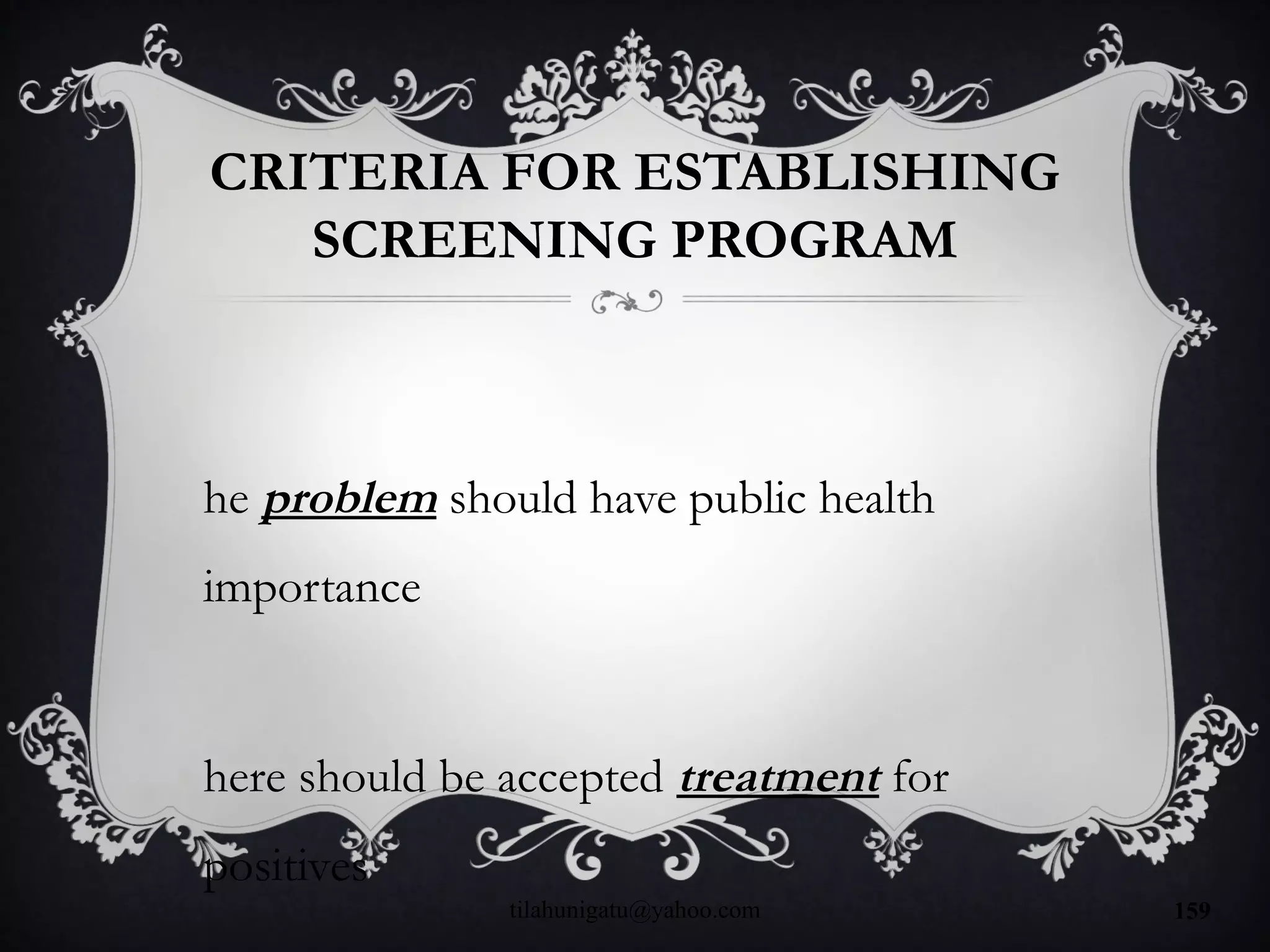
CRITERIA FOR ESTABLISHING
SCREENING PROGRAM
he problem should have public health
importance
here should be accepted treatment for
positives
tilahunigatu@yahoo.com 159
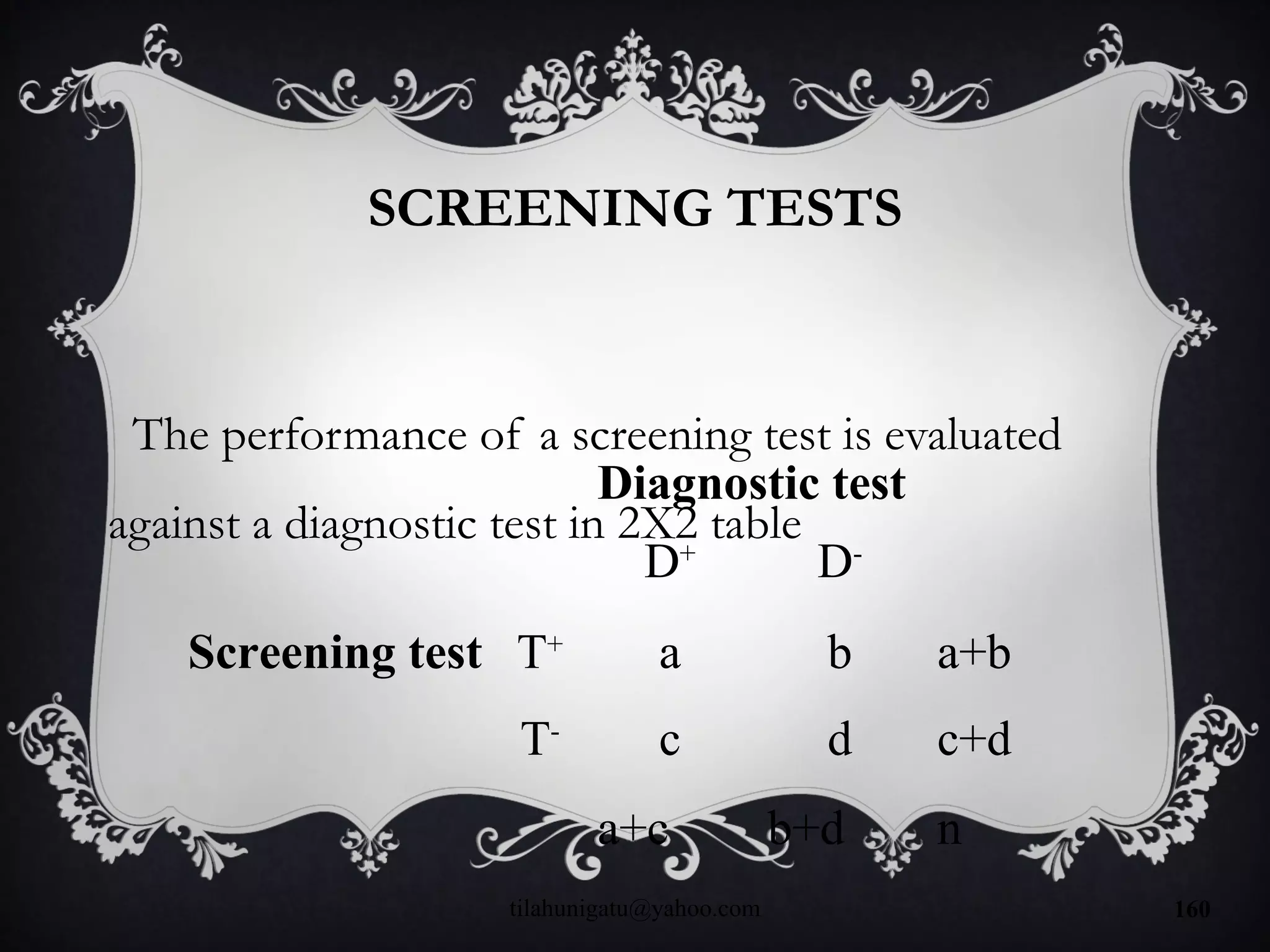
SCREENING TESTS
The performance of a screening test is evaluated
against a diagnostic test in 2X2 table
Diagnostic test
D+
D-
Screening test T+
a b a+b
T-
c d c+d
a+c b+d n
tilahunigatu@yahoo.com 160
DEFINITIONS OF CELLS
rue positives (a): Diseased identified by test as diseased
alse positives (b): Disease free falsely labelled as disease
alse negatives (c): Diseased falsely labelled as disease free
tilahunigatu@yahoo.com 161
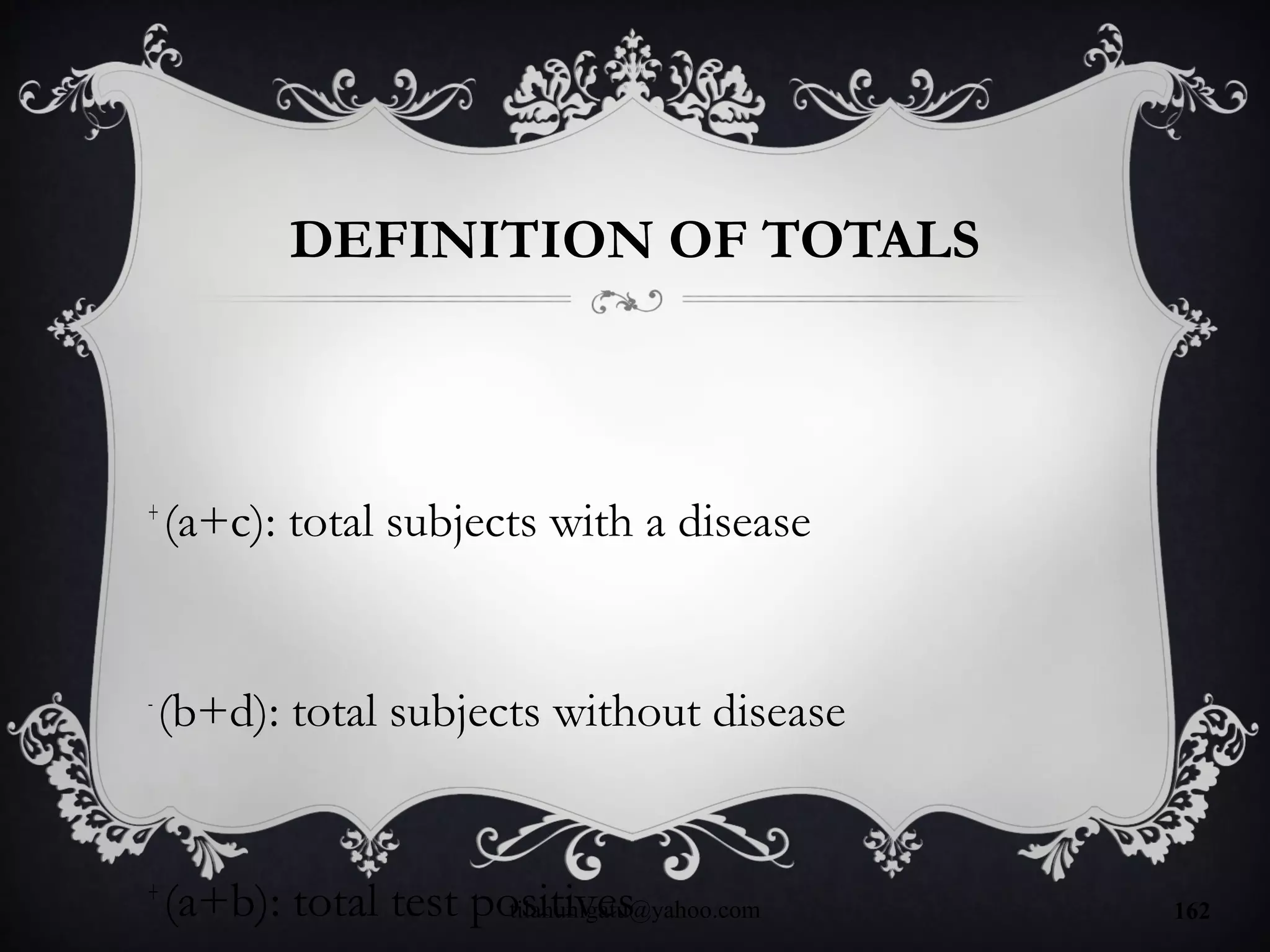
DEFINITION OF TOTALS
+
(a+c): total subjects with a disease
-
(b+d): total subjects without disease
+
(a+b): total test positivestilahunigatu@yahoo.com 162
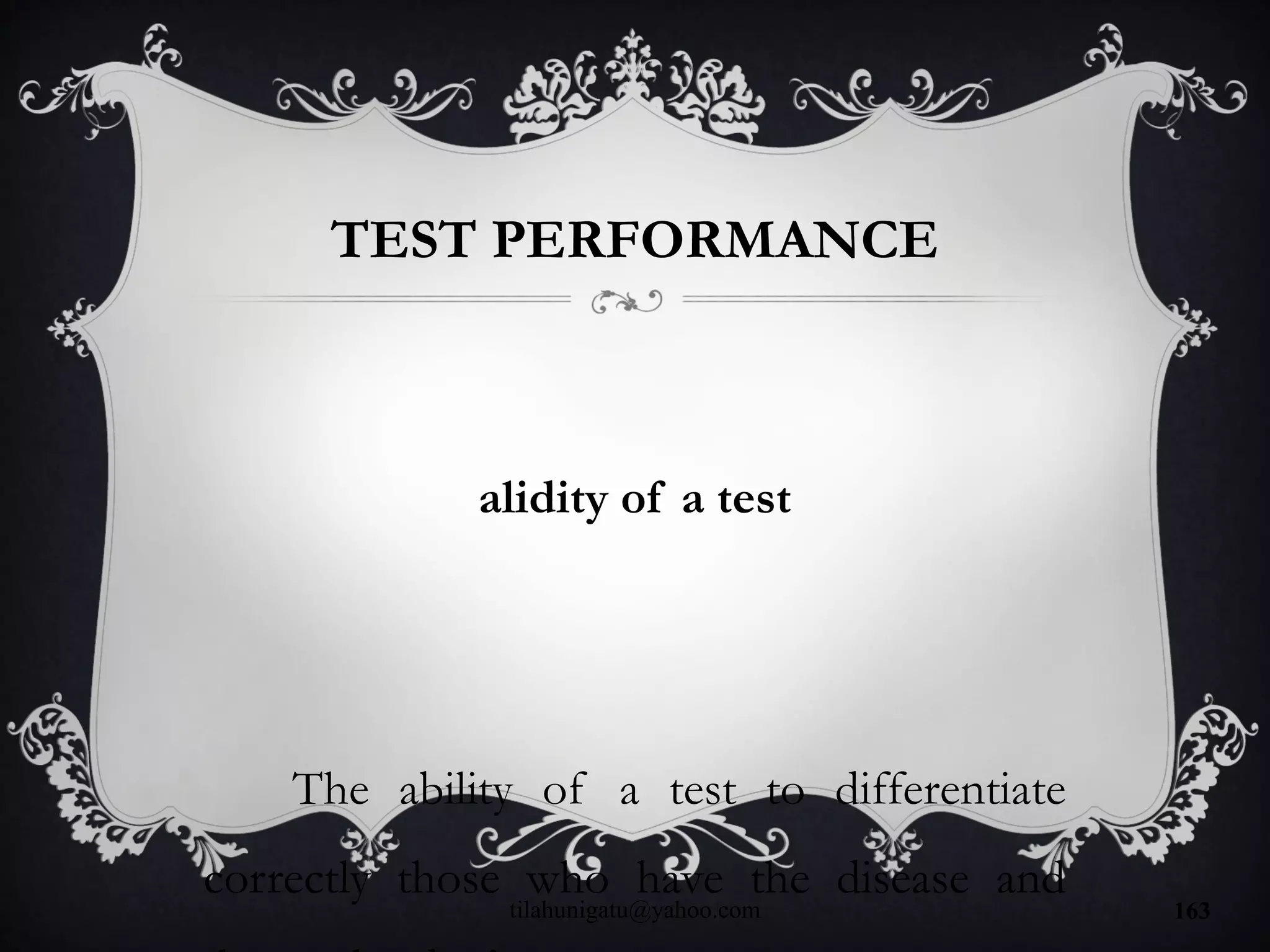
TEST PERFORMANCE
alidity of a test
The ability of a test to differentiate
correctly those who have the disease and
tilahunigatu@yahoo.com 163
TEST PERFORMANCE
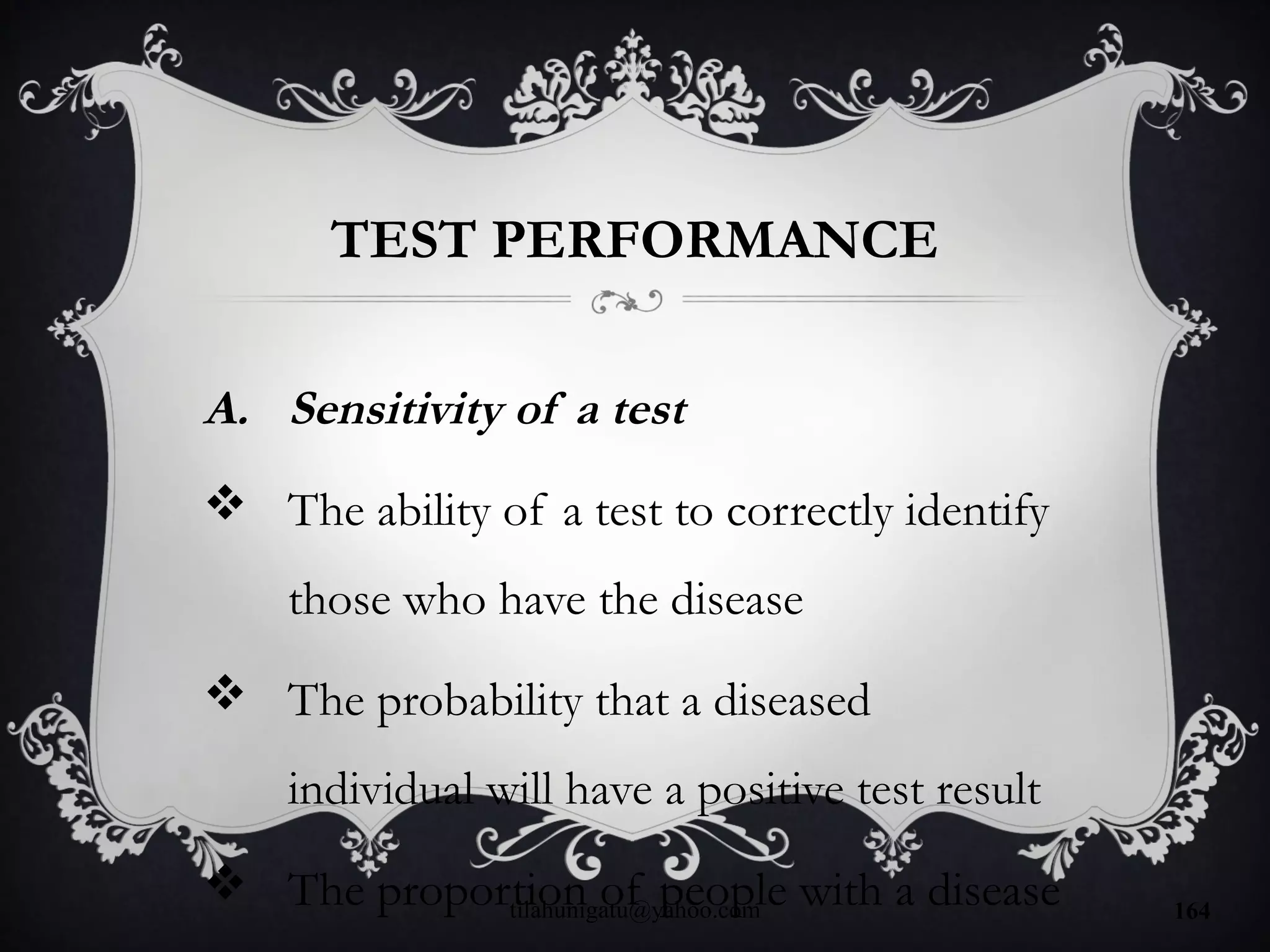
A. Sensitivity of a test
 The ability of a test to correctly identify
those who have the disease
 The probability that a diseased
individual will have a positive test result
 The proportion of people with a diseasetilahunigatu@yahoo.com 164
TEST PERFORMANCE
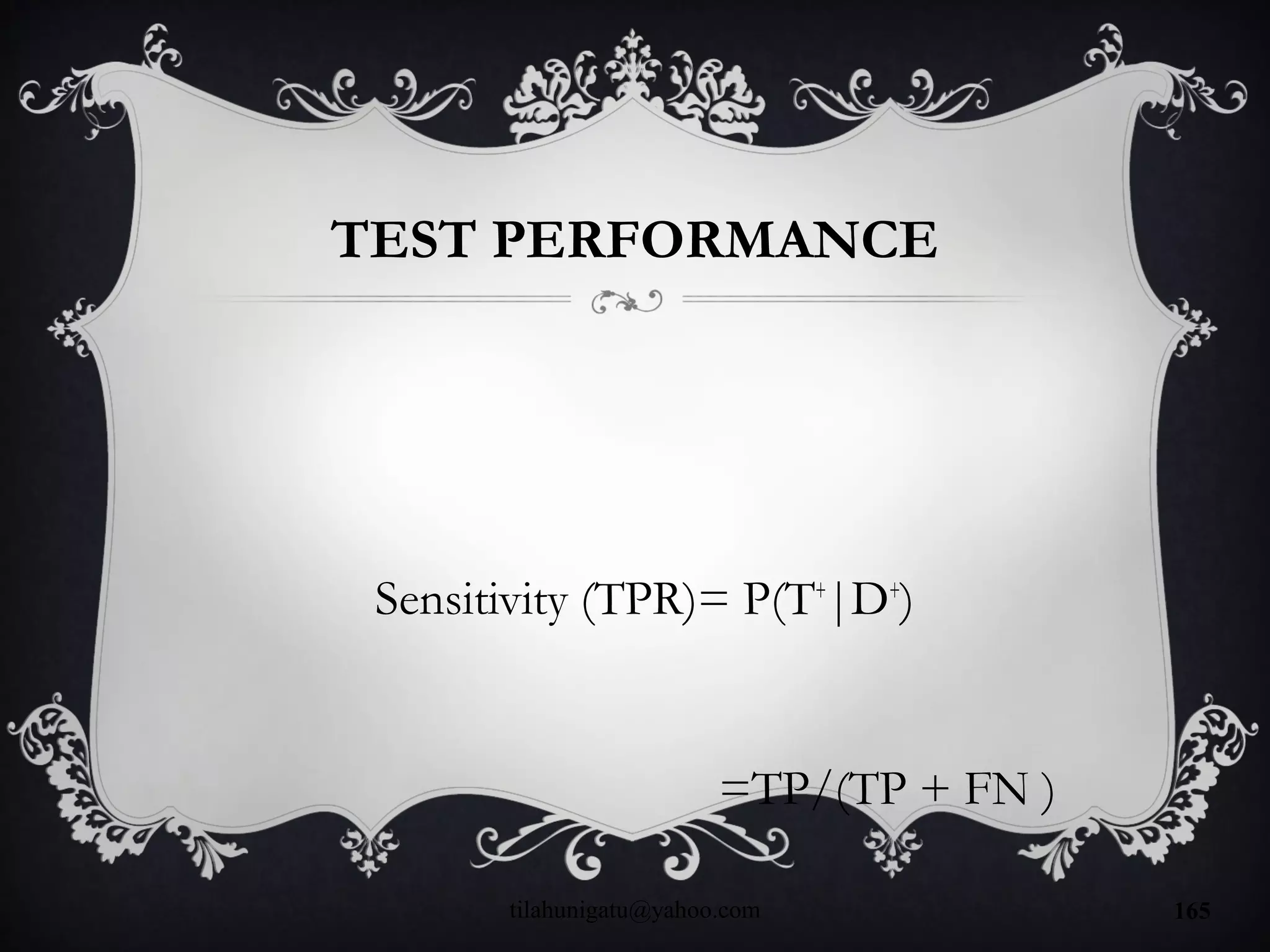
Sensitivity (TPR)= P(T+
|D+
)
=TP/(TP + FN )
tilahunigatu@yahoo.com 165
TEST PERFORMANCE
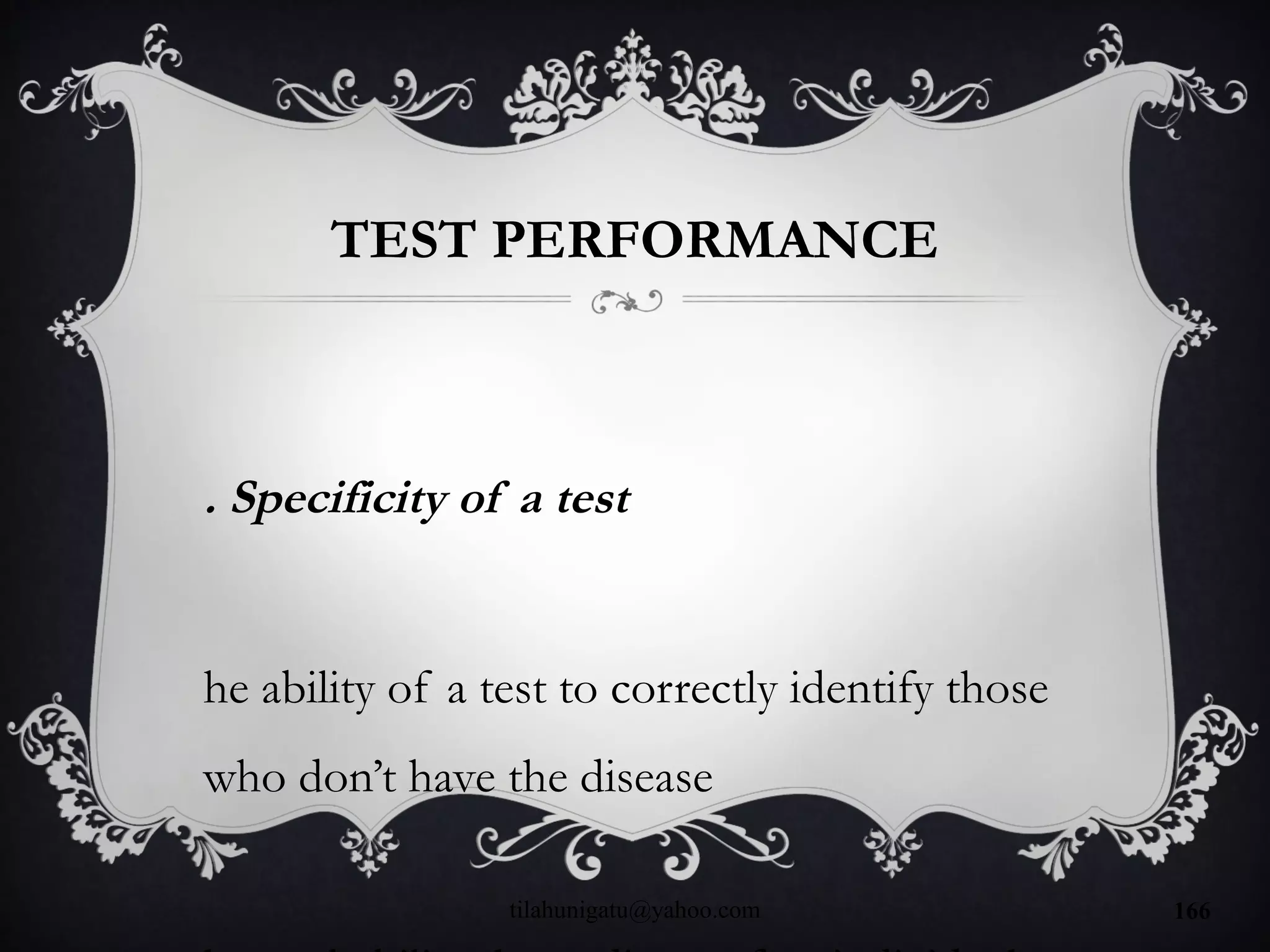
. Specificity of a test
he ability of a test to correctly identify those
who don’t have the disease
tilahunigatu@yahoo.com 166
TEST PERFORMANCE
Specificity (TNR)= P(T-
|D-
)
=TN/(TN +
FP )
tilahunigatu@yahoo.com 167
TEST PERFORMANCE
redictive value of a test
The ability of a test to predict the presence
or absence of disease
tilahunigatu@yahoo.com 168
TEST PERFORMANCE
A. Predictive value positive (PVP)
√ The ability of a test to predict the
presence of disease among who test
positive
√ The probability that a person with a
positive test result has a disease
√ The proportion of diseased individuals
in a population with a positive test result
√ Prior/post-test probability
PVP=P(D+
| T+
)tilahunigatu@yahoo.com 169
TEST PERFORMANCE
A. Predictive value negative (PVN)
 The ability of a test to predict the
absence of disease among who test
negative
 The probability that a person with a
negative test result is disease-free
 The proportion of disease-free
individuals in a population with a
negative test result
 Prior/post-test probabilitytilahunigatu@yahoo.com 170
TEST PERFORMANCE
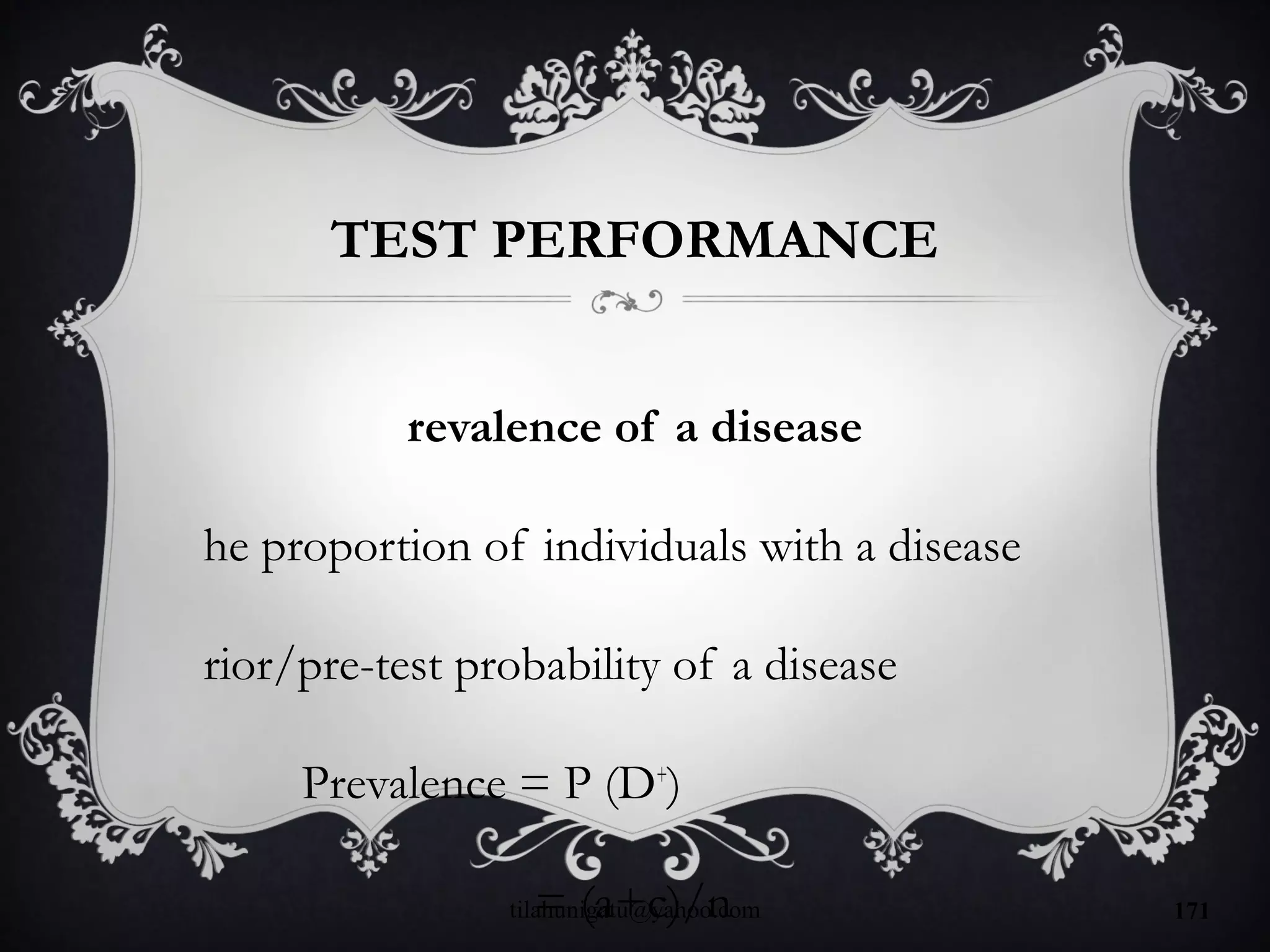
revalence of a disease
he proportion of individuals with a disease
rior/pre-test probability of a disease
Prevalence = P (D+
)
= (a+c)/ntilahunigatu@yahoo.com 171
MULTIPLE TESTING
arallel testing:
• Tests are given concurrently
• At least one positive indicates disease
• Results in
• Greater sensitivity
• Increased PVN
• Decreased specificity
tilahunigatu@yahoo.com 172
MULTIPLE TESTING
erial testing:
• Tests are administered sequentially
• All positive indicates disease
• Results in
• Lower sensitivity
• Increased specificity
• Increased PVP
tilahunigatu@yahoo.com 173
RELIABILITY OF A TEST
bility of a test to give consistent results up
on repeated measurements
wo major factors affect reliability
• Method variation
tilahunigatu@yahoo.com 174
RELIABILITY OF A TEST
eliability can be classified as:
• Internal reliability
• Internal consistency reliability
• External reliability
• Alternate test reliability
• Test-retest reliability
tilahunigatu@yahoo.com 175
EVALUATION OF A
SCREENING PROGRAM
Evaluation of a screening program
involves consideration of two issues
1. Feasibility: Determined by acceptability
of the screening program
tilahunigatu@yahoo.com 176
IN GENERAL
n general, a screening test should be
• Reliable & valid
• Sensitive & specific
• Simple & acceptable
• Effective & efficient
tilahunigatu@yahoo.com 177
THANK YOU!
tilahunigatu@yahoo.com 178

Epidemiology

  • 1.
  • 2.
    1. INTRODUCTION TOEPIDEMIOLOGY tilahunigatu@yahoo.com 2
  • 3.
    DEFINITIONS Health: A stateof complete physical, mental and social well-being and not merely the absence of disease or infirmity (WHO,1948) Disease: A physiological or psychological dysfunction Illness: A subjective state of not being well Sickness: A state of social dysfunction tilahunigatu@yahoo.com 3
  • 4.
    DEFINITIONS… Public health The science& art of Preventing disease, prolonging life, promoting health & efficiency through organized community effort (Winslow, 1920) tilahunigatu@yahoo.com 4
  • 5.
    DEFINITIONS… Epidemiology It is thestudy of frequency, distribution, and determinants of diseases and other health-related conditions in a human population and the application of this study to the prevention of disease and promotion of health tilahunigatu@yahoo.com 5
  • 6.
    COMPONENTS OF THE DEFINITION 1.Study:Systematic collection, analysis and interpretation of data Epidemiology involves collection, analysis and interpretation of health related data Epidemiology is a science tilahunigatu@yahoo.com 6
  • 7.
    COMPONENTS… 2. Frequency: thenumber of times an event occurs Epidemiology studies the number of times a disease occurs It answers the question How many? Epidemiology is a quantitative science tilahunigatu@yahoo.com 7
  • 8.
    COMPONENTS… 3. Distribution: Distributionof an event by person, place and time Epidemiology studies distribution of diseases It answers the question who, where and when? Epidemiology describes health events tilahunigatu@yahoo.com 8
  • 9.
    COMPONENTS… 4. Determinants: Factorsthe presence/absence of which affect the occurrence and level of an event Epidemiology studies what determines health events It answers the question how and why? Epidemiology analyzes health events tilahunigatu@yahoo.com 9
  • 10.
    COMPONENTS… 5. Diseases &other health related events Epidemiology is not only the study of diseases The focus of Epidemiology are not only patients It studies all health related conditions Epidemiology is a broader science tilahunigatu@yahoo.com 10
  • 11.
    COMPONENTS… 6. Human population Epidemiologydiagnoses and treats communities/populations Clinical medicine diagnoses and treats patients Epidemiology is a basic science of public health tilahunigatu@yahoo.com 11
  • 12.
    COMPONENTS… 7. Application Epidemiological studieshave direct and practical applications for prevention of diseases & promotion of health Epidemiology is a science and practice Epidemiology is an applied science tilahunigatu@yahoo.com 12
  • 13.
    HISTORY OF EPIDEMIOLOGY Sevenland marks in the history of Epidemiology 1. Hippocrates (460BC): Environment & human behaviors affects health 2. John Graunt (1662): Quantified births, deaths and diseases 3. Lind (1747): Scurvy could be treated with fresh fruit tilahunigatu@yahoo.com 13
  • 14.
    HISTORY… . William Farr(1839): Established application of vital statistics for the evaluation of health problems . John Snow (1854): tested a hypothesis on the origin of epidemic of cholera . Alexander Louis (1872): Systematized application of numerical thinking (quantitative reasoning) tilahunigatu@yahoo.com 14
  • 15.
    HISTORY… . Bradford Hill(1937): Suggested criteria for establishing causation pidemiological thought emerged in 460 BC pidemiology flourished as a discipline in 1940stilahunigatu@yahoo.com 15
  • 16.
    SCOPE OF EPIDEMIOLOGY Originally,Epidemiology was concerned with investigation & management of epidemics of communicable diseases Lately, Epidemiology was extended to endemic communicable diseases and non-communicable infectious diseases Recently, Epidemiology can be applied to all diseases and other health related events tilahunigatu@yahoo.com 16
  • 17.
    PURPOSE/USE OF EPIDEMIOLOGY The ultimatepurpose of Epidemiology is prevention of diseases and promotion of health How? 1. Elucidation of natural history of diseases 2.Description of health status of population 3. Establishing determinants of diseases 4. Evaluation of intervention effectiveness tilahunigatu@yahoo.com 17
  • 18.
    TYPES OF EPIDEMIOLOGY Twomajor categories of Epidemiology 1.Descriptive Epidemiology Defines frequency and distribution of diseases and other health related events Answers the four major questions: how many, who, where, and when? tilahunigatu@yahoo.com 18
  • 19.
    TYPES… 2. Analytic Epidemiology Analysesdeterminants of health problems Answers two other major questions: how? and why? Generally, Epidemiology answers six major questions: how many, who, where, when, how and why? tilahunigatu@yahoo.com 19
  • 20.
    BASIC EPIDEMIOLOGICAL ASSUMPTIONS 1.Human diseasesdoesn’t occur at random or by chance 2. Human diseases have causal and preventive factors tilahunigatu@yahoo.com 20
  • 21.
    BASIC FEATURES OF EPIDEMIOLOGY 1.Studies are conducted on human population 2. It examines patterns of events in people 3. Can establish cause-effect relationship without the knowledge of biological mechanism 4. It covers a wide range of conditions 5. It is an advancing science tilahunigatu@yahoo.com 21
  • 22.
  • 23.
    DISEASE CAUSATION The causeof a disease An event, a condition or a characteristic that comes before the disease and without which the disease wouldn’t occur tilahunigatu@yahoo.com 23
  • 24.
    THEORIES OF DISEASE CAUSALITY Whatcauses a disease? Ninetieth century theories 1. Contagion theory 2. Supernatural theory 3. Personal behavior theory 4. Miasma theory tilahunigatu@yahoo.com 24
  • 25.
    THEORIES… Twentieth century theories 1.Germ theory 2. Lifestyle theory 3. Environmental theory 4. Multi-causal theory tilahunigatu@yahoo.com 25
  • 26.
    NECESSARY VS SUFFICIENT tilahunigatu@yahoo.com26 Necessary: the disease will not occur without the presence of the factor Example: Mycobacterium TB for TB Sufficient: the presence of the factor always result in disease Example: Rabies virus for rabies
  • 27.
    ETIOLOGY OF ADISEASE The sum of all factors contribution to the occurrence of a disease Agent factors +Host factors +Environmental factors = Etiology of a disease tilahunigatu@yahoo.com 27
  • 28.
    DISEASE MODELS How dodiseases develop? Three best known models 1.Epidemiological triangle The interaction of an agent and host in an appropriate environment results in disease tilahunigatu@yahoo.com 28
  • 29.
    DISEASE MODELS… 2. Webof causation Complex interaction of factors results in disease 3. Wheel model The hub (host) having a genetic make up as its core, surrounded by an environment schematically divided in to biological, physical and social tilahunigatu@yahoo.com 29
  • 30.
    NATURAL HISTORY OFDISEASE The progression of disease process in an individual overtime in the absence of intervention Four stages in the natural history of a disease 1.Stage of susceptibility Presence of factors No disease tilahunigatu@yahoo.com 30
  • 31.
    NATURAL HISTORY… . Stageof sub-clinical disease resence of pathogenic changes (biological onset) tilahunigatu@yahoo.com 31
  • 32.
    LEVELS OF DISEASE PREVENTION Threemajor levels of disease prevention 1. Primary prevention Targeted at healthy people Objectives are Promotion of health Prevention of exposure andtilahunigatu@yahoo.com 32
  • 33.
    LEVELS OF DISEASE… 2.Secondary prevention Targeted at sick individuals Objective is to stop or slow the progression of disease and to prevent or limit permanent damage through early detection & treatmenttilahunigatu@yahoo.com 33
  • 34.
    LEVELS OF DISEASE… 3.Tertiary prevention Targeted at people with chronic diseases & disabilities that can’t be cured Objective is to prevent further disability ortilahunigatu@yahoo.com 34
  • 35.
    INFECTIOUS DISEASE PROCESS There aresix components of the infectious disease process constituting chain of disease transmission 1.The agent 2. Its reservoir 3. Its portal of exit 4. Its mode of transmission 5. Its portal of entry 6. Susceptible host tilahunigatu@yahoo.com 35
  • 36.
    THE AGENT Possible outcomesof exposure to an infectious agent Infection: invasion & multiplication in the host Infectivity: the proportion of exposed who becomes infected Infection rate= Infected/exposed Disease: A clinically apparent infection tilahunigatu@yahoo.com 36
  • 37.
    THE AGENT… Pathogenicity:the proportionof infected who develop clinical disease Clinical-to-Subclinical ratio Virulence: the proportion clinical cases resulting in severe clinical disease Case fatality & hospitalization ratetilahunigatu@yahoo.com 37
  • 38.
    RESERVOIR VS CARRIER Reservoir Anorganism or habitat in which an infectious agent normally lives, transforms, develops and/or multiplies Carrier A person who doesn’t have apparent clinical disease, but is a potential source of infection to other peopletilahunigatu@yahoo.com 38
  • 39.
    TYPES OF CARRIERS 1.Incubatorycarriers: transmits the disease during incubation period Example: Measles, mumps 2. Convalescent carriers: transmits the disease during convalescent periodtilahunigatu@yahoo.com 39
  • 40.
    TYPES OF CARRIERS… 3.Asymptomatic carriers: transmitting the disease without showing manifestations Example: polio, Amoebiasis 4. Chronic Carriers: transmitting thetilahunigatu@yahoo.com 40
  • 41.
    IMPORTANCE OF CARRIERS 1.Number- carriers may outnumber cases 2. Difficulty in recognition- carriers don’t know that they are infected 3. Mobility- carriers are mobile, cases are restricted 4. Chronicity- carriers re-introduce infection and contribute to endemicity tilahunigatu@yahoo.com 41
  • 42.
    EFFECT OF CARRIERSON DISEASE TRANSMISSION ce-berg effect in temperate zone ippopotamus effect in tropical zone tilahunigatu@yahoo.com 42
  • 43.
    MODES OF DISEASETRANSMISSION 1.Direct transmission Direct contact: physical contact with body part of infected person: Touching, kissing,biting,sex Example: HIV Direct projection: projection of saliva droplets while coughing, sneezing,spitting,talking,singing etc Example: Common cold Transplacental: Transmission from mother to fetus through the placenta Example: Syphilis tilahunigatu@yahoo.com 43
  • 44.
    MODES OF DISEASE… 2.Indirect transmission Vehicle-borne: transmission through inanimate objects/non-living substances e.g HIV by needles Air-borne: transmission by dust or droplet nuclei tilahunigatu@yahoo.com 44
  • 45.
    MODES OF DISEASE… ector-borne:infectious agent is conveyed by an arthropod to host Biological: there is multiplication and/or development in the vector tilahunigatu@yahoo.com 45
  • 46.
    IMPORTANCE OF MODEOF TRANSMISSION disease often has several modes of transmission t is important to distinguish between the predominant mode of transmission and those of secondary importance tilahunigatu@yahoo.com 46
  • 47.
    HERD IMMUNITY It ishost resistance at a population level It is defined as the resistance of a community (group) to invasion and spread of an infectious agent, based on immunity of high proportions of individuals in the community. tilahunigatu@yahoo.com 47
  • 48.
    CONDITIONS UNDER WHICH HERDIMMUNITY BEST FUNCTIONS 1. Single reservoir 2. Direct transmission 3. Total immunity 4. No carrier state 5. Uniform distribution of immunes 6. No overcrowdingtilahunigatu@yahoo.com 48
  • 49.
    TIME COURSE OFAN INFECTIOUS DISEASE re-patent period: between biological onset and first shedding ncubation period: between biological onset and clinical onset ommunicable period: time during which agent is being shed tilahunigatu@yahoo.com 49
  • 50.
    TIME COURSE OF… Latentperiod: between recovery and relapse in clinical disease Convalescent period: between recovery and time when shedding stops tilahunigatu@yahoo.com 50
  • 51.
    APPLICATION OF TIMEPERIODS re-patent period • When should we investigate? ncubation period • When was time of exposure? ommunicable period • When should we take care of infectiousness? tilahunigatu@yahoo.com 51
  • 52.
    FACTORS WHICH INFLUENCE THEDEVELOPMENT OF DISEASE train of the agent ose of the agent oute of infection tilahunigatu@yahoo.com 52
  • 53.
    3. MEASURES OFDISEASE OCCURRENCE tilahunigatu@yahoo.com 53
  • 54.
    WHAT ARE MEASURESOF DISEASE OCCURRENCE? hese are measurements of the frequency/magnitude/amount f disease n populations tilahunigatu@yahoo.com 54
  • 55.
    HOW DO WEMEASURE DISEASES? our quantitative descriptors umbers atios roportions ates tilahunigatu@yahoo.com 55
  • 56.
    DESCRIPTORS umbers: Use ofactual number of events e.g 100 cases of TB in community A tilahunigatu@yahoo.com 56
  • 57.
    DESCRIPTORS roportions: a ratioin which the numerator is included in the denominator .g proportion of TB cases in community A is 10% tilahunigatu@yahoo.com 57
  • 58.
    WHICH COMMUNITY ISMORE AFFECTED? ommunity A has 100 cases of disease X and ommunity B has 1000 cases of disease X, tilahunigatu@yahoo.com 58
  • 59.
    WHEN WE CALL.. henwe call a measure a ratio, we mean a non- proportional ratio hen we call a measure a proportion, we mean a proportional ratio that doesn’t measure an event overtime hen we call a rate, we mean a proportional ratio that does measure an event in a population overtimetilahunigatu@yahoo.com 59
  • 60.
    TYPES OF RATES 1.Crude rates: Apply to the total population in a given area 2. Specific rates: Apply to specific subgroups in the population (age, sex etc) or specific diseases 3. Standardized rates: used to permit comparisons of rates in population which differ in structure (e.gtilahunigatu@yahoo.com 60
  • 61.
    MORBIDITY RATES Morbidity ratesare rates that are used to quantify the magnitude/frequency of diseases tilahunigatu@yahoo.com 61
  • 62.
    INCIDENCE RATE he proportionof a population that develops a disease overtime he risk/probability of an individual developing a disease overtime he rapidity with which new cases of a disease develop overtime tilahunigatu@yahoo.com 62
  • 63.
    CUMULATIVE INCIDENCE Number ofnew cases of a Cumulative = disease during a specified period Incidence Population at risk in the same tilahunigatu@yahoo.com 63
  • 64.
    PRACTICAL CHALLENGES IN MEASURINGINCIDENCE RATE 1. Identification of population at risk Population at risk constitutes all those free of the disease and susceptible to it 2. Population is not static/it fluctuates/as a result of births, deaths and migration tilahunigatu@yahoo.com 64
  • 65.
    PRACTICAL SOLUTION TO THECHALLENGES 1. Use the total population as a denominator This gives an estimate of the incidence rate and not the actual incidence rate 2. Use person-time at risktilahunigatu@yahoo.com 65
  • 66.
    PREVALENCE RATE It measuresthe proportion of a population with a disease during a specified period or at a point in time Two types 1. Point prevalence ratetilahunigatu@yahoo.com 66
  • 67.
    POINT PREVALENCE RATE easuresthe proportion of a population with a disease at a point in time oint prevalence rate=All persons with a disease at a point in time/Total population t is not a rate, but a true proportion tilahunigatu@yahoo.com 67
  • 68.
    PERIOD PREVALENCE RATE easuresthe proportion of a population with a disease in a specified time period eriod prevalence rate=All persons with a disease overtime period/Average(mid-year)population in the same period tilahunigatu@yahoo.com 68
  • 69.
    INCIDENCE VS PREVALENCE ncidencerate considers only new cases of a disease revalence rate considers all (new + old) cases of a disease ncidence rate considers population at risk as a denominator revalence rate considers total population as a denominator ncidence & period prevalence rates require follow up studies tilahunigatu@yahoo.com 69
  • 70.
    RELATIONSHIP BETWEEN PREVALENCE &INCIDENCE RATES revalence α incidence revalence α Average duration revalence α Incidence X Average duration tilahunigatu@yahoo.com 70
  • 71.
    MORTALITY RATES These ratesmeasures magnitude of deaths in a community Some are crude like the crude death rate Others are cause-specific mortality rate tilahunigatu@yahoo.com 71
  • 72.
    rude death rate ge-specificmortality rate ex-specific mortality rate ause-specific mortality rate COMMON MORTALITY RATES tilahunigatu@yahoo.com 72 erinatal mortality rate eonatal mortality rate nfant mortality rate hild mortality rate
  • 73.
    4. MEASURES OFASSOCIATION tilahunigatu@yahoo.com 73
  • 74.
    2X2 TABLE Disease Yes (+)No (+) Total Exposure Yes (+) a b a+b No (+) c d c+d Total a+c b+d a+b+c+d tilahunigatu@yahoo.com 74
  • 75.
    CELLS = Exposed, anddiseased = Exposed, Not diseased = Not exposed, diseased tilahunigatu@yahoo.com 75
  • 76.
    TOTALS arginal totals a+b= Exposed c+d=Non-exposed tilahunigatu@yahoo.com 76
  • 77.
    CHI-SQUARE STATISTICS Chi-square testswhether there is an association between two categorical variables o: There is no association between row & column variables tilahunigatu@yahoo.com 77
  • 78.
    CHI-SQUARE… Χ 2 = Σ(O - E)2 E : Observed cells : Expected cells xpected value = (Row total)X(Column total) Grand totaltilahunigatu@yahoo.com 78
  • 79.
    IMPORTANCE OF CHI-SQUARE Ifthe calculated chi-square value is greater than the critical or P<0.05 we say that there is association tilahunigatu@yahoo.com 79
  • 80.
    RELATIVE RISK (RR) Expressesrisk of developing a diseases in exposed group (a + b) as compared to non-exposed group (c + d) RR= Incidence (risk) among exposed tilahunigatu@yahoo.com 80
  • 81.
    INTERPRETATION OF RELATIVE RISK hatdoes a RR of 2 mean? isk in exposed =RRX Risk in non-exposed tilahunigatu@yahoo.com 81
  • 82.
    STRENGTH OF ASSOCIATION ngeneral strength of association can be considered as: igh if RR>3 tilahunigatu@yahoo.com 82
  • 83.
    ODDS RATIO (OR) Oddsratio is the ratio of odds of exposure among diseased to odds of exposure among non-diseased tilahunigatu@yahoo.com 83
  • 84.
    ODDS RATIO…dds ofexposure among exposed=a/c dds of exposure among non-diseased=b/d R = Odds of exposure among diseased Odds of exposure among non-diseased R= (a/c)/(b/d) tilahunigatu@yahoo.com 84
  • 85.
    ODDS RATIO… RR canbe best estimated by OR if the following conditions are fulfilled 1. Controls are representative of general population 2. Selected cases are representative of all cases 3. The disease is rare tilahunigatu@yahoo.com 85
  • 86.
    ATTRIBUTABLE RISK (AR) ARindicates how much of the risk is due to /attributable/ to the exposure Quantifies the excess risk in the exposed that can be attributable to the exposure by removing the risk of the disease occurred due to other causes AR= Risk (incidence) in exposed- Risk (incidence) in non-exposed tilahunigatu@yahoo.com 86
  • 87.
    INTERPRETING AR What doesattributable risk of 10 mean? 10 of the exposed cases are attributable to the exposure tilahunigatu@yahoo.com 87
  • 88.
    ATTRIBUTABLE RISK PERCENT (AR%) Estimatesthe proportion of disease among the exposed that is attributable to the exposure tilahunigatu@yahoo.com 88
  • 89.
    INTERPRETATION OF AR% hatdoes AR% of 10% mean? 0% of the disease can be attributed to the exposure tilahunigatu@yahoo.com 89
  • 90.
    POPULATION ATTRIBUTABLE RISK (PAR) Estimatesthe rate of disease in total population that is attributable to the exposure tilahunigatu@yahoo.com 90
  • 91.
    POPULATION ATTRIBUTABLE RISK PERCENT(PAR%) Estimates the proportion of disease in the study population that is attributable to exposure and thus could be eliminated if the exposure were eliminated AR%= Risk in population – Risk in unexposed tilahunigatu@yahoo.com 91
  • 92.
    POSSIBLE OUTCOMES IN STUDYINGTHE RELATIONSHIP BETWEEN EXPOSURE & DISEASE 1. No association RR=1 AR=0 2. Positive association RR>1 AR>0 3. Negative association RR<1 (fraction) AR<0 (Negative) tilahunigatu@yahoo.com 92
  • 93.
    RISK VS PREVENTIVE FACTORS Arisk factor is any factor positively associated with a disease (RR>1) It is associated with an increased occurrence of a disease A preventive factor is any factor negatively associated with a disease (RR<1) tilahunigatu@yahoo.com 93
  • 94.
    5. EVALUATION OFEVIDENCE (JUDGMENT OF CAUSALITY) tilahunigatu@yahoo.com 94
  • 95.
    ASSOCIATION VS CAUSATION Theexistence of an association doesn’t itself constitute a proof of causation An observed association could be a fact or tilahunigatu@yahoo.com 95
  • 96.
    POSSIBLE EXPLANATIONS FOR OBSERVEDASSOCIATION 1. Chance 2. Bias 3. Confounding 4. Reverse causation 5. Reciprocal causation 6. Cause-effect relationshiptilahunigatu@yahoo.com 96
  • 97.
    ACCURACY OF MEASUREMENT Accuracy =Validity + Precision Validity is the extent to which a measured value actually reflects truth tilahunigatu@yahoo.com 97
  • 98.
    TYPES OF VALIDITY nternalvalidity: Is the degree to which a measured value is true within the sample tilahunigatu@yahoo.com 98
  • 99.
    PRECISION Precision is theextent to which random error alters the measurement of effects Threats to validity of study: tilahunigatu@yahoo.com 99
  • 100.
    JUDGMENT OF CAUSALITY Judgmentof causality has two steps 1. Check whether the observed association between exposure and disease is Valid (Rule out chance, bias and confounding) 2. Check whether the observed association is tilahunigatu@yahoo.com 100
  • 101.
    ROLE OF CHANCE Therole of chance as an alternative explanation for an association emerges from sampling variability Evaluation of the role of chance is mainly the domain of statistics and tilahunigatu@yahoo.com 101
  • 102.
    1. TEST OFSTATISTICAL SIGNIFICANCE -value quantifies the degree to which chance accounts for observed association -value is the probability of obtaining a result at least as extreme as the observed by chance alone <0.05 indicates statistical significance for medical research tilahunigatu@yahoo.com 102
  • 103.
    TEST OF STATISTICAL… verysmall difference may be significant if you have large sample large difference may not achieve statistical tilahunigatu@yahoo.com 103
  • 104.
    2. ESTIMATION OF CONFIDENCEINTERVAL Confidence interval represents the range within which true magnitude of effect lies within a certain degree of assurance tilahunigatu@yahoo.com 104
  • 105.
    ROLE OF BIAS Biasis any systematic error in the design, conduct or analysis of an epidemiologic study that results in an incorrect estimate of association between exposure and disease Unlike chance bias can’t be statistically evaluated There are two major types of bias 1. Selection bias 2. Information bias tilahunigatu@yahoo.com 105
  • 106.
    SELECTION BIASAny systematicerror that arises in the process of identifying the study population It affects the representativeness of the study It occurs when there is a difference between sample and population with respect to a variable Examples of selection bias: 1. Diagnostic bias 2. Volunteer bias tilahunigatu@yahoo.com 106
  • 107.
    INFORMATION/OBSERVATIO N/BIAS Any systematic errorin the measurement of information on exposure or disease Examples of information bias: 1. Interviewer bias/observer bias 2. Recall bias / Response bias 3. Social desirability bias 4. Placebo effect tilahunigatu@yahoo.com 107
  • 108.
    WAYS TO MINIMIZEBIAS 1. Choose study design carefully 2. Choose objective rather than subjective outcomes 3. Blind interviewers whenever possible 4. Use close ended questions whenever possible 5. Collect data on variables you don’t expect totilahunigatu@yahoo.com 108
  • 109.
    ROLE OF CONFOUNDING Confoundingrefers to the mixing of the effect of an extraneous variable with the effect of the exposure and disease of interest Characteristics of a confounding tilahunigatu@yahoo.com 109
  • 110.
    EFFECT OF CONFOUNDING otallyor partially account for the apparent effect ask an underlying true association tilahunigatu@yahoo.com 110
  • 111.
    CONTROL OF CONFOUNDING VARIABLES uringdesigning stage: • Randomization • Restriction • Matching uring analysis stage • Standardization • Stratification/pooling • Multivariate analysis tilahunigatu@yahoo.com 111
  • 112.
    CRITERIA TO ASSESTHE STRENGTH OF EVIDENCE FOR CAUSE AND EFFECT RELATIONSHIP Observational studies have many biases and confounding. Experimental studies if properly done can show cause-effect relationship. But they are not usually feasible due to ethical issues In the absence of an experimental trail, the following criteria (Bradford Hill criteria) are used to asses the strength of evidence for a tilahunigatu@yahoo.com 112
  • 113.
    CRITERIA TO ASSESTHE STRENGTH… 1. Strength of association: The stronger the association the more likely it is causal 2. Consistency of association: The more consistent, the more likely it is causal 3. Specificity of association: If single exposure linked to single disease more likely 4. Temporal relationship: The exposure must come before the diseasetilahunigatu@yahoo.com 113
  • 114.
    CRITERIA TO ASSESTHE STRENGTH… . Dose-response relationship: risk of disease increase with increasing exposure with factor . Biological plausibility: Knowledge of association coherent with biology and descriptive epidemiology of the disease tilahunigatu@yahoo.com 114
  • 115.
  • 116.
    STUDY DESIGN Study designis the arrangement of conditions for the collection and analysis of data to provide the most accurate answer to a question in the most economical way. tilahunigatu@yahoo.com 116
  • 117.
    TYPES OF EPIDEMIOLOGIC STUDYDESIGNS I. Based on objective/focus/research question 1. Descriptive studies • Describe: who, when, where & how many tilahunigatu@yahoo.com 117
  • 118.
    TYPES… II. Based onthe role of the investigator 1. Observational studies • The investigator observes nature • No intervention 2. Intervention/Experimental studies • Investigator intervenes • He has a control over the situation tilahunigatu@yahoo.com 118
  • 119.
    TYPES… II. Based ontiming . One-time (one-spot) studies • Conducted at a point in time • An individual is observed at oncetilahunigatu@yahoo.com 119
  • 120.
    TYPES… IV. Based ondirection of follow-up/data collection 1. Prospective • Conducted forward in time 2. Retrospective • Conducted backward in time tilahunigatu@yahoo.com 120
  • 121.
    TYPES… V. Based ontype of data they generate 1. Qualitative studies • Generate contextual data • Also called exploratory studies 2. Quantitative studies tilahunigatu@yahoo.com 121
  • 122.
    TYPES… VI. Based onstudy setting 1. Community-based studies • Conducted in communities 2. Institution-based studies • Conducted in communities 3. Laboratory-based studiestilahunigatu@yahoo.com 122
  • 123.
    TYPES… VII. Standard classification 1.Cross-sectional studies 2. Case-control studies 3. Cohort studies 4. Experimental studiestilahunigatu@yahoo.com 123
  • 124.
    CROSS-SECTIONAL STUDIES In thisstudy design information about the status of an individual with respect to presence/absence of exposure and diseased is assessed at a point in time. Cross-sectional studies are useful to generate a hypothesis rather that to test ittilahunigatu@yahoo.com 124
  • 125.
    CROSS-SECTIONAL… omparison groups areformed after data collection he object of comparison are prevalence of exposure or disease tilahunigatu@yahoo.com 125
  • 126.
    CROSS-SECTIONAL… dvantages of cross-sectionalstudies ess time consuming tilahunigatu@yahoo.com 126
  • 127.
    CROSS-SECTIONAL… imitations of cross-sectionalstudies ntecedent-consequence uncertainty tilahunigatu@yahoo.com 127
  • 128.
    CROSS-SECTIONAL… Types of cross-sectionalstudies 1. Single cross-sectional studies • Determine single proportion/mean in a single population at a single point in time 2. Comparative cross-sectional studies • Determine two proportions/means in two populations at a single point in time 3. Time-series cross-sectional studies tilahunigatu@yahoo.com 128
  • 129.
    CROSS-SECTIONAL… n general, cross-sectionalstudies are • Simplest to conduct • Commonest to find • Least useful to establish causation tilahunigatu@yahoo.com 129
  • 130.
    CASE-CONTROL STUDIES ubjects areselected with respect to the presence (cases) or absence (controls) of disease, and then inquiries are made about past exposure e compare diseased (cases) and non-diseased (controls) to find out the level of exposure tilahunigatu@yahoo.com 130
  • 131.
    CASE-CONTROL… Steps in conductingcase-control studies I. Define who is a case • Establish strict diagnostic criteria • All who fulfil the criteria will be “case population • Those who don’t fulfil will be “control population” II. Select a sample of cases from case population • This sample must be representative of the case population tilahunigatu@yahoo.com 131
  • 132.
    CASE-CONTROL… Sources of cases 1.Hospitals (Health institution) • Cost-less • Bias-more 2. Population (Community) • Cost-moretilahunigatu@yahoo.com 132
  • 133.
    CASE-CONTROL… III. Select controlsfrom a control population • Should be representative of control population • Should be similar to cases except outcome • Should be selected by the same method as cases Sources of controls 1. Hospital (Health institution) controls • Readily available • Low recall bias • More cooperative tilahunigatu@yahoo.com 133
  • 134.
    CASE-CONTROL… owever, hospital controlsare • Less representative • More confounding . Population (community) controls • More representative • Less confounding • Costly and time consuming • More recall bias • Less cooperative tilahunigatu@yahoo.com 134
  • 135.
    CASE-CONTROL… V. Measure thelevel of exposure in cases & controls • Review or interview for exposure status • Use same method for case and controls tilahunigatu@yahoo.com 135
  • 136.
    CASE-CONTROL… Types of case-controlstudies I. Based on case identification 1. Retrospective case-control • Uses prevalent cases • Increased sample size • Difficult to establish temporal sequence • Useful for rare outcomes tilahunigatu@yahoo.com 136
  • 137.
    CASE-CONTROL… . Prospective case-control •Uses incident cases • Establish temporal sequence • Recall is not a serious problem • Records are easily obtainable tilahunigatu@yahoo.com 137
  • 138.
    CASE-CONTROL… II. Based onmatching Matching: Relating cases and controls with respect to certain variable 1. Matched case-control studies 2. Unmatched case-control studiestilahunigatu@yahoo.com 138
  • 139.
    CASE-CONTROL… dvantages of case-controlstudies ptimal for evaluation of rare diseases tilahunigatu@yahoo.com 139
  • 140.
    CASE-CONTROL… imitations of case-controlstudies nefficient for evaluation of rare exposure tilahunigatu@yahoo.com 140
  • 141.
    COHORT STUDIES  Subjectsare selected by exposure and followed to see development of disease  Two types of cohort studies 1. Prospective (classical)tilahunigatu@yahoo.com 141
  • 142.
    COHORT… . Retrospective (Historical) othexposure and disease has occurred before the beginning of the study tilahunigatu@yahoo.com 142
  • 143.
    COHORT… Steps in conductingcohort studies 1. Define exposure 2. Select exposed group 3. Select non-exposed group 4. Follow and collect data on outcome 5. Compare outcome b/n exposed & non- exposed tilahunigatu@yahoo.com 143
  • 144.
    COHORT… dvantages of cohortstudies aluable when exposure is rare tilahunigatu@yahoo.com 144
  • 145.
    COHORT… imitations of cohortstudies nefficient for evaluation of rare disease tilahunigatu@yahoo.com 145
  • 146.
    EXPERIMENTAL STUDIES ndividuals areallocated in to treatment and control groups by the investigator f properly done, experimental studies can tilahunigatu@yahoo.com 146
  • 147.
    EXPERIMENTAL… Experimental studies canbe 1. Therapeutic trials • Conducted on patients • To determine the effect of treatment on disease 2. Preventive trials • Conducted on healthy people • To determine the effect of prevention on risk tilahunigatu@yahoo.com 147
  • 148.
    EXPERIMENTAL… Three different waysof classifying intervention studies I. Based on population studies • Clinical trial: on patients in clinical settings • Field trial: on healthy people in the field • Community trial: on the community as a whole II. Based on design tilahunigatu@yahoo.com 148
  • 149.
    EXPERIMENTAL… III. Based onobjective • Phase I: to determine toxic effect • Phase II: to determine toxic effect • Phase III: to determine applicability Challenges in intervention studies  Ethical issuestilahunigatu@yahoo.com 149
  • 150.
    EXPERIMENTAL… easibility issues • Gettingadequate subjects • Achieving satisfactory compliance ost issues • Experimental studies are expensive tilahunigatu@yahoo.com 150
  • 151.
    EXPERIMENTAL… he quality of“Gold standard” in experimental studies can be achieved through • Randomization • Blinding tilahunigatu@yahoo.com 151
  • 152.
    EXPERIMENTAL… andomization: random allocationof study subjects in to treatment & control groups Advantage: Avoids bias & confounding tilahunigatu@yahoo.com 152
  • 153.
    EXPERIMENTAL… Single blinding: studysubjects don’t know to which group they belong Double blinding: Care givers also don’t know to which group study subjects belong tilahunigatu@yahoo.com 153
  • 154.
    EXPERIMENTAL… lacebo: an inertmaterial indistinguishable from active treatment lacebo effect: tendency to report favourable tilahunigatu@yahoo.com 154
  • 155.
  • 156.
    SCREENING Screening refers tothe presumptive identification of a disease/defect by application of tests, examinations or other procedures in apparently healthy people. tilahunigatu@yahoo.com 156
  • 157.
    AIMS OF SCREENING PROGRAM hangingdisease progression efficiently ltering natural course of disease rotecting society from contagious disease tilahunigatu@yahoo.com 157
  • 158.
    CRITERIA FOR SELECTING DISEASESFOR SCREENING everity- The disease should be serious reatment- Early treatment should be more beneficial tilahunigatu@yahoo.com 158
  • 159.
    CRITERIA FOR ESTABLISHING SCREENINGPROGRAM he problem should have public health importance here should be accepted treatment for positives tilahunigatu@yahoo.com 159
  • 160.
    SCREENING TESTS The performanceof a screening test is evaluated against a diagnostic test in 2X2 table Diagnostic test D+ D- Screening test T+ a b a+b T- c d c+d a+c b+d n tilahunigatu@yahoo.com 160
  • 161.
    DEFINITIONS OF CELLS ruepositives (a): Diseased identified by test as diseased alse positives (b): Disease free falsely labelled as disease alse negatives (c): Diseased falsely labelled as disease free tilahunigatu@yahoo.com 161
  • 162.
    DEFINITION OF TOTALS + (a+c):total subjects with a disease - (b+d): total subjects without disease + (a+b): total test positivestilahunigatu@yahoo.com 162
  • 163.
    TEST PERFORMANCE alidity ofa test The ability of a test to differentiate correctly those who have the disease and tilahunigatu@yahoo.com 163
  • 164.
    TEST PERFORMANCE A. Sensitivityof a test  The ability of a test to correctly identify those who have the disease  The probability that a diseased individual will have a positive test result  The proportion of people with a diseasetilahunigatu@yahoo.com 164
  • 165.
    TEST PERFORMANCE Sensitivity (TPR)=P(T+ |D+ ) =TP/(TP + FN ) tilahunigatu@yahoo.com 165
  • 166.
    TEST PERFORMANCE . Specificityof a test he ability of a test to correctly identify those who don’t have the disease tilahunigatu@yahoo.com 166
  • 167.
    TEST PERFORMANCE Specificity (TNR)=P(T- |D- ) =TN/(TN + FP ) tilahunigatu@yahoo.com 167
  • 168.
    TEST PERFORMANCE redictive valueof a test The ability of a test to predict the presence or absence of disease tilahunigatu@yahoo.com 168
  • 169.
    TEST PERFORMANCE A. Predictivevalue positive (PVP) √ The ability of a test to predict the presence of disease among who test positive √ The probability that a person with a positive test result has a disease √ The proportion of diseased individuals in a population with a positive test result √ Prior/post-test probability PVP=P(D+ | T+ )tilahunigatu@yahoo.com 169
  • 170.
    TEST PERFORMANCE A. Predictivevalue negative (PVN)  The ability of a test to predict the absence of disease among who test negative  The probability that a person with a negative test result is disease-free  The proportion of disease-free individuals in a population with a negative test result  Prior/post-test probabilitytilahunigatu@yahoo.com 170
  • 171.
    TEST PERFORMANCE revalence ofa disease he proportion of individuals with a disease rior/pre-test probability of a disease Prevalence = P (D+ ) = (a+c)/ntilahunigatu@yahoo.com 171
  • 172.
    MULTIPLE TESTING arallel testing: •Tests are given concurrently • At least one positive indicates disease • Results in • Greater sensitivity • Increased PVN • Decreased specificity tilahunigatu@yahoo.com 172
  • 173.
    MULTIPLE TESTING erial testing: •Tests are administered sequentially • All positive indicates disease • Results in • Lower sensitivity • Increased specificity • Increased PVP tilahunigatu@yahoo.com 173
  • 174.
    RELIABILITY OF ATEST bility of a test to give consistent results up on repeated measurements wo major factors affect reliability • Method variation tilahunigatu@yahoo.com 174
  • 175.
    RELIABILITY OF ATEST eliability can be classified as: • Internal reliability • Internal consistency reliability • External reliability • Alternate test reliability • Test-retest reliability tilahunigatu@yahoo.com 175
  • 176.
    EVALUATION OF A SCREENINGPROGRAM Evaluation of a screening program involves consideration of two issues 1. Feasibility: Determined by acceptability of the screening program tilahunigatu@yahoo.com 176
  • 177.
    IN GENERAL n general,a screening test should be • Reliable & valid • Sensitive & specific • Simple & acceptable • Effective & efficient tilahunigatu@yahoo.com 177
  • 178.