INTRODUCTION OF
EPIDEMIOLOGY
Pradhuman Yadav
B.v.Sc & a.h
ONE WORLD ONE
HEALTH
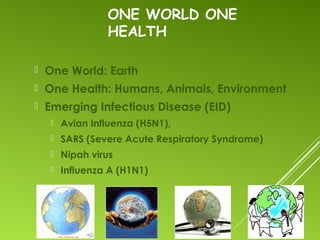
 One World: Earth
 One Health: Humans, Animals, Environment
 Emerging Infectious Disease (EID)
 Avian Influenza (H5N1),
 SARS (Severe Acute Respiratory Syndrome)
 Nipah virus
 Influenza A (H1N1)
EMERGING INFECTIOUS DISEASES
 infectious diseases with an increasing in
patient report over the past 20 years
 infectious diseases with an increasing
possibility in the near future
 AIDS, Avian Influenza, and drug resistant
tuberculosis
 Antimicrobial resistant organisms
RE-EMERGING INFECTIOUS DISEASES
 infectious diseases that used to create
outbreak in the past and subsided for a nu
mber of years but are occurred again
 tuberculosis, hemorrhage fever and malaria
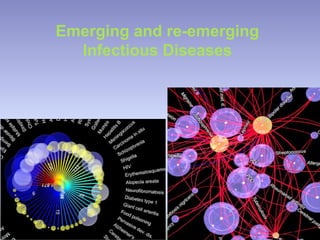
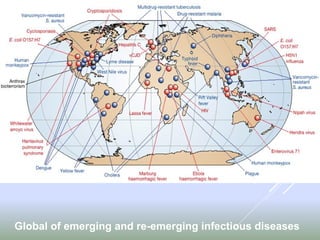
Emerging and re-emerging
Infectious Diseases
Global of emerging and re-emerging infectious diseases
FACTORS OF EID
 Humans (Africa, Asia and Latin America)
 Wildlife (Forest encroachment)
 Climate change
 Pathogens
 Spread of pathogen (air or insect)
 Virus (mutation)
EPIDEMIOLOGY
 Epi = on, upon
 Demos = people
 Logos = knowledge
HISTORICAL OF
EPIDEMIOLOGY
 Hippocrates (400 BC)
 John Graunt (1662)
 John Snow (1854)
 Out break of cholera occurred in a small area
of central London (Golden Square)
WHAT IS EPIDEMIOLOGY?
 The study of the distribution and
determinants of health-related states or
events in specified populations and the a
pplication of this study to the control of h
ealth problems (CDC)
WHAT IS EPIDEMIOLOGY?
 focused on the health and disease status
of a population
 the study of how disease is distributed in
populations and the factors that influence
or determine this distribution
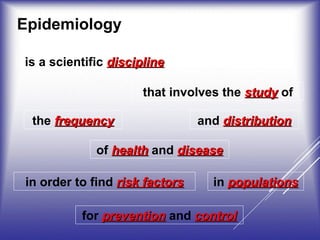
Epidemiology
is a scientific disciplinediscipline
that involves the studystudy of
the frequencyfrequency and distributiondistribution
of healthhealth and diseasedisease
in populationspopulationsin order to find risk factorsrisk factors
for preventionprevention and controlcontrol
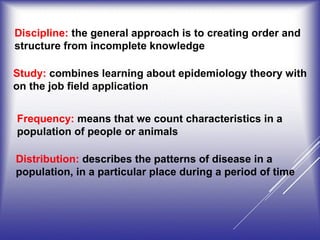
Discipline: the general approach is to creating order and
structure from incomplete knowledge
Study: combines learning about epidemiology theory with
on the job field application
Frequency: means that we count characteristics in a
population of people or animals
Distribution: describes the patterns of disease in a
population, in a particular place during a period of time
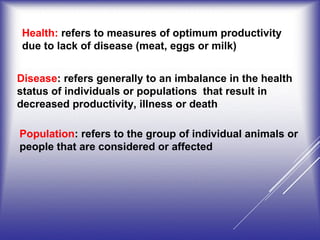
Health: refers to measures of optimum productivity
due to lack of disease (meat, eggs or milk)
Disease: refers generally to an imbalance in the health
status of individuals or populations that result in
decreased productivity, illness or death
Population: refers to the group of individual animals or
people that are considered or affected
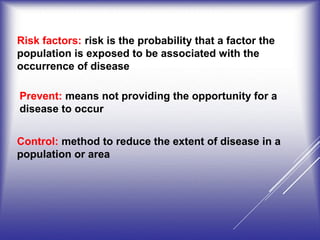
Prevent: means not providing the opportunity for a
disease to occur
Control: method to reduce the extent of disease in a
population or area
Risk factors: risk is the probability that a factor the
population is exposed to be associated with the
occurrence of disease
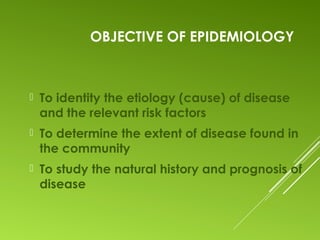
OBJECTIVE OF EPIDEMIOLOGY
 To identity the etiology (cause) of disease
and the relevant risk factors
 To determine the extent of disease found in
the community
 To study the natural history and prognosis of
disease
OBJECTIVE OF EPIDEMIOLOGY
 To evaluate both existing and newly
developed preventive and therapeutic
measure and modes of health care
delivery
 To provide the foundation for developing
public policy relating to environmental
problems
Use of Epidemiology
• Describe the distribution of disease
• Describe the natural history of disease
• Identify factors that increase/decrease risk
• Predict trends
• Consider mechanisms of transmissions
• Test efficacy & evaluate interventions
• Identify health needs
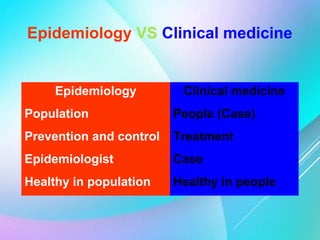
Epidemiology Clinical medicine
Population People (Case)
Prevention and control Treatment
Epidemiologist Case
Healthy in population Healthy in people
Epidemiology VS Clinical medicine
FIELD EPIDEMIOLOGY
 Field Epidemiology is the front linefront line
 There is health emergency or an immediate
need to understand the health status of a
population
 Emerging Infectious Disease (EID): no
information, very limited
FIELD EPIDEMIOLOGY
 Attempts to gather and organize data to
bring order and meaning to it
 Can be applied to disease outbreaks,
situation assessments and policy evaluation.
 Relies on a systematic approach to gather
and organize data in a way that will support
a better understanding of a disease situation
GOAL OF
VETERINARY FIELD EPIDEMIOLOGY
 Prevention and control disease agents
 Health of animals, humans and environment
 Concepts and methods of epidemiology
 Practical and information
EPIDEMIOLOGY APPROACH
 Try and understand what factors may be
increasing or reducing the risk of disease
 Promoting and protecting the health of
animal and human populations
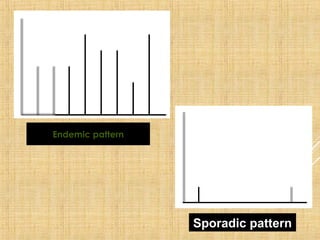
ENDEMIC
 the constant occurrence of a disease that
commonly presentscommonly presents in a particular place with
stability in the level of infection
 Sporadic: An irregular occurrence of a disease
that commonly presents in a particular place
Endemic pattern
Sporadic pattern
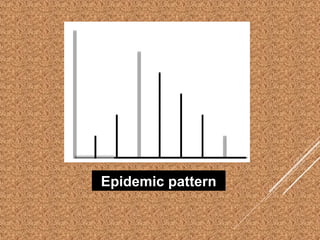
EPIDEMIC
 the occurrence of a disease that the level of
infection exceeds that normal expectancy
in a specific region, spreads rapidly and
usually lasts for a limited period of time
 Pandemic: widespread epidemic that affects a
large part of population in many countries
 Epizootic: epidemic that involves animal host
population
Epidemic pattern
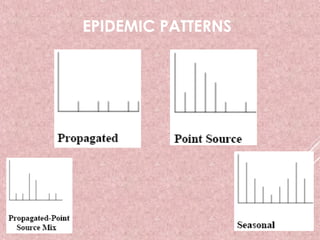
EPIDEMIC PATTERNS
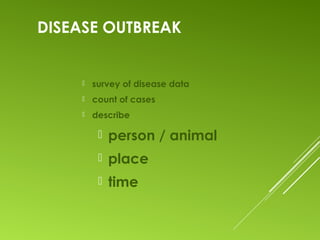
DISEASE OUTBREAK
 survey of disease data
 count of cases
 describe
 person / animal
 place
 time
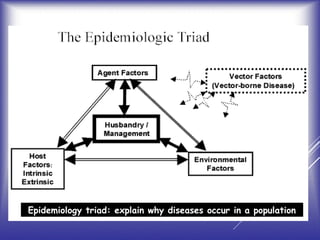
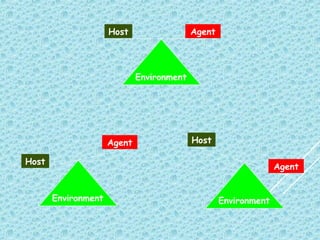
Epidemiology triad: explain why diseases occur in a population
Environment
Host Agent
Environment
Host
Agent
Environment
Host
Agent
Environment
Host Agent
Environment
Host Agent
AGENTS
 Biological
 Viruses Bacteria Parasites or prions
 Chemical
 Toxins
 Man-made (Dioxins and melamine)
 Inorganic/organic: zearalenone
 Physical
 Foreign bodies
 Trauma
 Radiation
AGENT FACTORS
 Dose
 Environmental hardiness
 Virulence (microbial)
 Infectivity (microbial)
 Toxicity (poisons)
HOST
 Natural host:
 agent has adapted itself and co-exists in
balance in the host
 Atypical host:
 agent is not normally encountered
HOST
 Demography
 Age, Sex, Species, Breed
 Production type / level, Density
 Biology
 Genetics, behavior
 Management
 Intensive (housing) / extensive (free roaming)
 Nutrition
 Hygiene
 Husbandry
 Vaccination / medication
HOST
 Marketing
 Profitability related to prices (economics)
 Distance from market
 Herd immunity
 Innate (genetic capability)
 Acquired through vaccination or deliberate
exposure
 Proportion of total population that is resistant to a
disease agent
 Susceptibility
 Lack of resistance to the disease agent
HOST FACTORS
 Innate resistance (e.g. gastric barrier,
mucocilliary transport mechanism)
 Previous exposure
 Passive immune status (neonates)
 Vaccination status and response
 Age
 Gender
HOST FACTORS
 Behavior (e.g. mutual grooming, dominance, pica)
 Production status (e.g., lactating vs. non-lactating)
 Reproductive status (e.g., pregnant vs. non-
pregnant, sterile vs. intact)
 Genetics
ENVIRONMENT
1) Natural environment
 Geography
 Climate
 Season
 pH
 Ammonia concentration
 Water activity
 Ultraviolet light
 Organic matter
2) Human aspects
 Animal management systems
 Marketing systems and economics
 Government policies
ENVIRONMENTAL
FACTORS
 Animal stocking density
 Animal movement between groups
 Housing (e.g. ventilation, sanitation)
 Environmental conditions (e.g. temperature,
humidity, wind velocity, precipitation)
 Nutrition (protein, energy and macromineral and
micromineral adequacy)
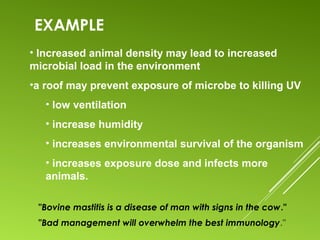
EXAMPLE
"Bovine mastitis is a disease of man with signs in the cow."
"Bad management will overwhelm the best immunology."
• Increased animal density may lead to increased
microbial load in the environment
•a roof may prevent exposure of microbe to killing UV
• low ventilation
• increase humidity
• increases environmental survival of the organism
• increases exposure dose and infects more
animals.
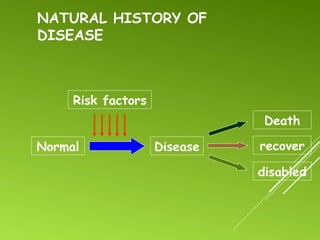
NATURAL HISTORY OF
DISEASE
Normal
Risk factors
Disease
Death
recover
disabled
NATURAL HISTORY OF DISEASE
 Stage of susceptibility
 Stage of preclinical disease
 Stage of clinical disease
 Stage of disability
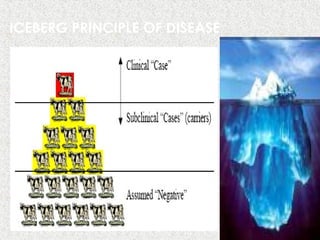
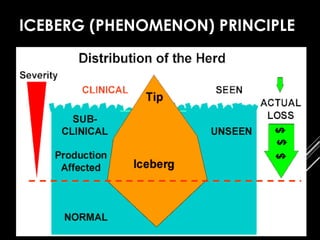
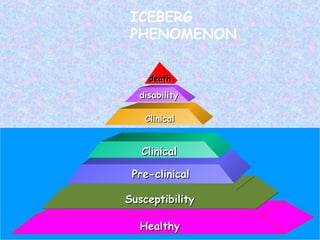
ICEBERG PRINCIPLE OF DISEASE
ICEBERG (PHENOMENON) PRINCIPLE
ICEBERG
PHENOMENON
deathdeath
disabilitydisability
ClinicalClinical
ClinicalClinical
Pre-clinicalPre-clinical
SusceptibilitySusceptibility
HealthyHealthy
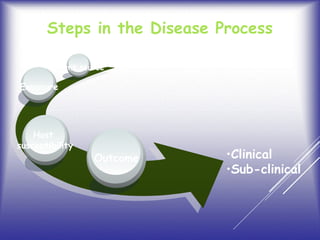
•Clinical
•Sub-clinical
Outcome
Host
susceptibility
Exposure
Agent source
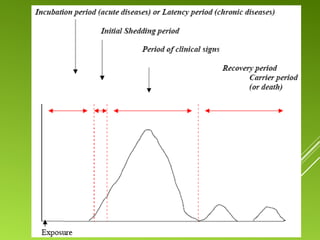
Steps in the Disease Process
CONCEPT OF
CAUSATION
 The basis for most epidemiological
investigations
 To identify causal relationships and potential
risk factors
 A framework for identifying causes of
infectious disease
KOCH’S POSTULATES
 The agent has to be present in every case of
the disease.
 The agent has to be isolated and grown in
pure culture.
 The agent has to cause disease when
inoculated into a susceptible animal and th
e agent must then be able to be recovered f
rom that animal and identified.
CAUSATION OF DISEASE
 The agent
 Is present when the disease exists
 Is absent when the disease does not exist
 The agent can be isolated in pure culture and
results in disease when it is given to exposed a
nimals
 Exposure
 Occurs before the disease occurs
CAUSATION OF DISEASE
 Consistency
 The disease is reproducible in different populations at
different times
 Strength of statistical association
 The results are not due to chance
 Dose-response
 Increase in exposure leads to increase in disease
SOURCES OF INFECTIOUS DISEASE
 Environment
 Live Animals / Dead animals
 Feed and Water
 Animal products
 Animal by-products
 Reservoir (wild animals, insects)
 Fomites (clothing, equipment, vehicles)
 Vectors (insects)
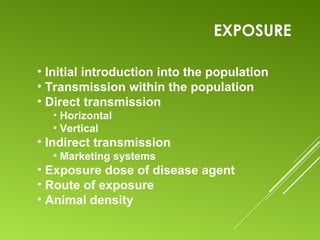
EXPOSURE
• Initial introduction into the population
• Transmission within the population
• Direct transmission
• Horizontal
• Vertical
• Indirect transmission
• Marketing systems
• Exposure dose of disease agent
• Route of exposure
• Animal density
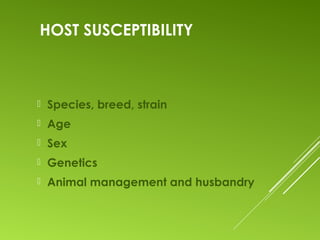
HOST SUSCEPTIBILITY
 Species, breed, strain
 Age
 Sex
 Genetics
 Animal management and husbandry
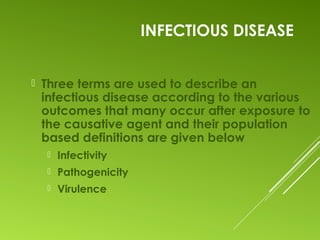
INFECTIOUS DISEASE
 Three terms are used to describe an
infectious disease according to the various
outcomes that many occur after exposure to
the causative agent and their population
based definitions are given below
 Infectivity
 Pathogenicity
 Virulence
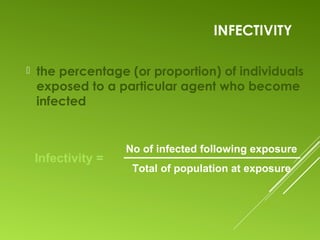
INFECTIVITY
 the percentage (or proportion) of individuals
exposed to a particular agent who become
infected
No of infected following exposure
Total of population at exposure
Infectivity =
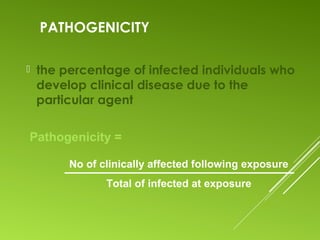
PATHOGENICITY
 the percentage of infected individuals who
develop clinical disease due to the
particular agent
No of clinically affected following exposure
Total of infected at exposure
Pathogenicity =
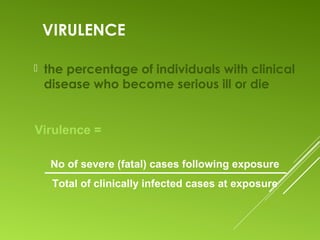
VIRULENCE
 the percentage of individuals with clinical
disease who become serious ill or die
No of severe (fatal) cases following exposure
Total of clinically infected cases at exposure
Virulence =
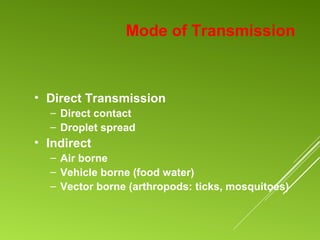
Mode of Transmission
• Direct Transmission
– Direct contact
– Droplet spread
• Indirect
– Air borne
– Vehicle borne (food water)
– Vector borne (arthropods: ticks, mosquitoes)
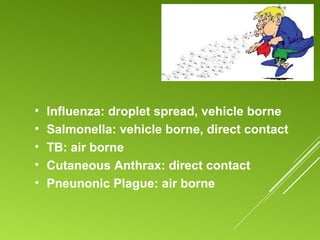
• Influenza: droplet spread, vehicle borne
• Salmonella: vehicle borne, direct contact
• TB: air borne
• Cutaneous Anthrax: direct contact
• Pneunonic Plague: air borne
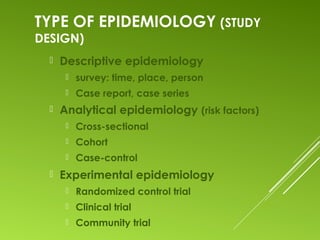
TYPE OF EPIDEMIOLOGY (STUDY
DESIGN)
 Descriptive epidemiology
 survey: time, place, person
 Case report, case series
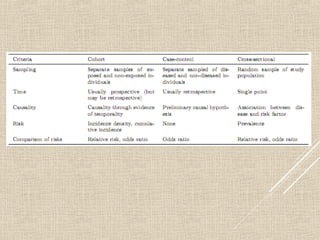
 Analytical epidemiology (risk factors)
 Cross-sectional
 Cohort
 Case-control
 Experimental epidemiology
 Randomized control trial
 Clinical trial
 Community trial
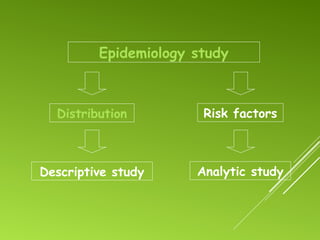
Epidemiology study
Distribution Risk factors
Analytic studyDescriptive study
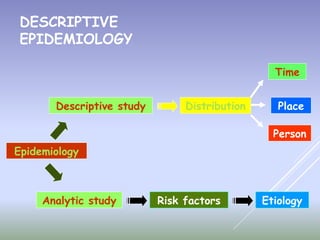
DESCRIPTIVE
EPIDEMIOLOGY
Epidemiology
Distribution
Risk factors
Time
Place
Person
Analytic study
Descriptive study
Etiology
DESCRIPTIVE EPIDEMIOLOGY
 What (How much): occurred
 Who: animals or humans
 When: time
 Where: place
DESCRIPTIVE EPIDEMIOLOGY
 Detection of individual case
 Detection of outbreaks
 Measuring the impact of disease
 Understand the nature of a disease
 Understand the way that disease spreads
and is distributed
DESCRIPTIVE EPIDEMIOLOGY
 Generate hypotheses and ideas for further
research
 Evaluation of prevention and control
measures
 Support planning activities for animal health
program
BASIC MEASURES AND TOOLS OF
DESCRIPTIVE EPIDEMIOLOGY
 Data collection
 classification / organization
 summarizing
 presentation
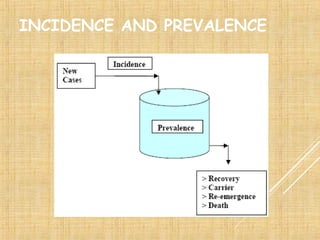
INCIDENCE
 the number of NEW cases that develop
over a certain time period.
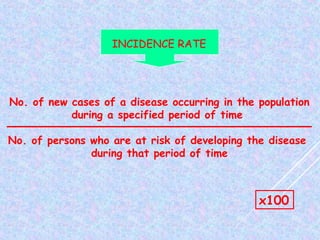
INCIDENCE RATE
No. of new cases of a disease occurring in the population
during a specified period of time
No. of persons who are at risk of developing the disease
during that period of time
x100
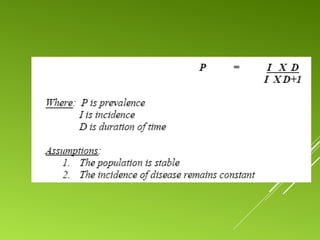
PREVALENCE
 the number of existing cases including old
and new cases that have developed at som
e point during a time period.
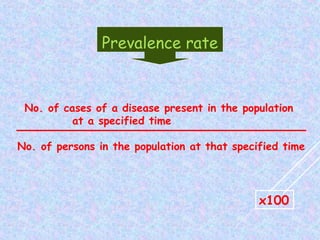
No. of cases of a disease present in the population
at a specified time
No. of persons in the population at that specified time
Prevalence rate
x100
INCIDENCE AND PREVALENCE
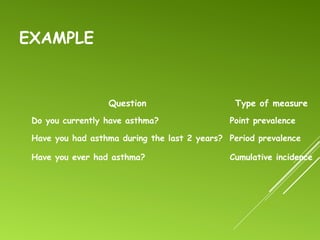
EXAMPLE
Question Type of measure
Do you currently have asthma? Point prevalence
Have you had asthma during the last 2 years? Period prevalence
Have you ever had asthma? Cumulative incidence
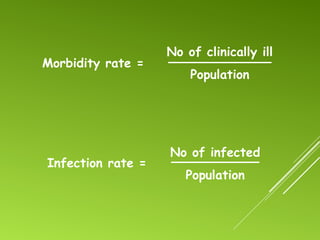
No of clinically ill
Population
Morbidity rate =
No of infected
Population
Infection rate =
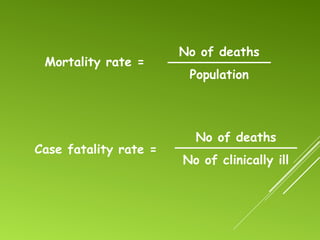
No of deaths
Population
Mortality rate =
No of deaths
No of clinically ill
Case fatality rate =
ANALYTICAL EPIDEMIOLOGY
 How: adjust policy and response
 Why: prevent and control
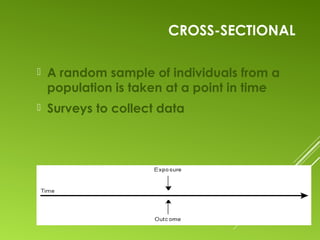
CROSS-SECTIONAL
 A random sample of individuals from a
population is taken at a point in time
 Surveys to collect data
CROSS-SECTIONAL
 Advantages:
 quick to conduct and cost is moderate
compared with other study designs.
 Disadvantages:
 cannot provide information on the incidence of
disease in a population only an estimate of
prevalence
 Difficult to investigate cause and effect
relationships
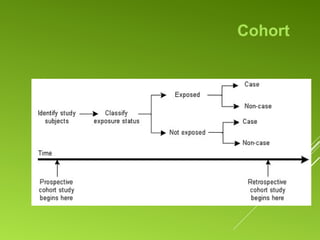
COHORT
 Comparing disease incidence over time
between groups
 Prospective cohort
 Non-disease case
 Expose and non-expose
 Retrospective cohort
 Disease case
 Evaluated for evidence of exposure to the agent
Cohort
COHORT
 Advantages:
 monitored over time for disease occurrence
 estimates of the absolute incidence of disease in
exposed and non-exposed
 Disadvantages:
 long follow-up period
 case of rare diseases large groups are necessary
 Losses to follow-up
 expensive
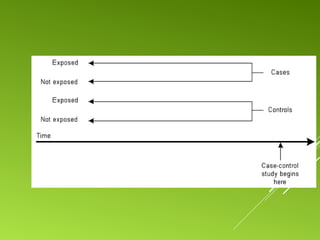
CASE-CONTROL
 Comparing the frequency of past exposure
between cases who develop the disease (or
other outcome of interest) and controls
chosen to reflect the frequency of exposure
in the underlying population at risk
CASE-
CONTROL
 Advantages:
 an efficient method for studying rare diseases
 subjects have experienced the outcome of
interest at the start of the study
 quick to run and cheaper than other study
 Disadvantages:
 Can not provide information on the disease
incidence in a population
 Reliant on the quality of past records or
recollection of study participants
 Difficult to ensure an unbiased selection of the
control group
Introduction to epidemiology

Introduction to epidemiology

  • 1.
  • 2.
    ONE WORLD ONE HEALTH One World: Earth  One Health: Humans, Animals, Environment  Emerging Infectious Disease (EID)  Avian Influenza (H5N1),  SARS (Severe Acute Respiratory Syndrome)  Nipah virus  Influenza A (H1N1)
  • 3.
    EMERGING INFECTIOUS DISEASES infectious diseases with an increasing in patient report over the past 20 years  infectious diseases with an increasing possibility in the near future  AIDS, Avian Influenza, and drug resistant tuberculosis  Antimicrobial resistant organisms
  • 4.
    RE-EMERGING INFECTIOUS DISEASES infectious diseases that used to create outbreak in the past and subsided for a nu mber of years but are occurred again  tuberculosis, hemorrhage fever and malaria
  • 5.
  • 6.
    Global of emergingand re-emerging infectious diseases
  • 7.
    FACTORS OF EID Humans (Africa, Asia and Latin America)  Wildlife (Forest encroachment)  Climate change  Pathogens  Spread of pathogen (air or insect)  Virus (mutation)
  • 9.
    EPIDEMIOLOGY  Epi =on, upon  Demos = people  Logos = knowledge
  • 10.
    HISTORICAL OF EPIDEMIOLOGY  Hippocrates(400 BC)  John Graunt (1662)  John Snow (1854)  Out break of cholera occurred in a small area of central London (Golden Square)
  • 11.
    WHAT IS EPIDEMIOLOGY? The study of the distribution and determinants of health-related states or events in specified populations and the a pplication of this study to the control of h ealth problems (CDC)
  • 12.
    WHAT IS EPIDEMIOLOGY? focused on the health and disease status of a population  the study of how disease is distributed in populations and the factors that influence or determine this distribution
  • 13.
    Epidemiology is a scientificdisciplinediscipline that involves the studystudy of the frequencyfrequency and distributiondistribution of healthhealth and diseasedisease in populationspopulationsin order to find risk factorsrisk factors for preventionprevention and controlcontrol
  • 14.
    Discipline: the generalapproach is to creating order and structure from incomplete knowledge Study: combines learning about epidemiology theory with on the job field application Frequency: means that we count characteristics in a population of people or animals Distribution: describes the patterns of disease in a population, in a particular place during a period of time
  • 15.
    Health: refers tomeasures of optimum productivity due to lack of disease (meat, eggs or milk) Disease: refers generally to an imbalance in the health status of individuals or populations that result in decreased productivity, illness or death Population: refers to the group of individual animals or people that are considered or affected
  • 16.
    Prevent: means notproviding the opportunity for a disease to occur Control: method to reduce the extent of disease in a population or area Risk factors: risk is the probability that a factor the population is exposed to be associated with the occurrence of disease
  • 17.
    OBJECTIVE OF EPIDEMIOLOGY To identity the etiology (cause) of disease and the relevant risk factors  To determine the extent of disease found in the community  To study the natural history and prognosis of disease
  • 18.
    OBJECTIVE OF EPIDEMIOLOGY To evaluate both existing and newly developed preventive and therapeutic measure and modes of health care delivery  To provide the foundation for developing public policy relating to environmental problems
  • 19.
    Use of Epidemiology •Describe the distribution of disease • Describe the natural history of disease • Identify factors that increase/decrease risk • Predict trends • Consider mechanisms of transmissions • Test efficacy & evaluate interventions • Identify health needs
  • 20.
    Epidemiology Clinical medicine PopulationPeople (Case) Prevention and control Treatment Epidemiologist Case Healthy in population Healthy in people Epidemiology VS Clinical medicine
  • 21.
    FIELD EPIDEMIOLOGY  FieldEpidemiology is the front linefront line  There is health emergency or an immediate need to understand the health status of a population  Emerging Infectious Disease (EID): no information, very limited
  • 22.
    FIELD EPIDEMIOLOGY  Attemptsto gather and organize data to bring order and meaning to it  Can be applied to disease outbreaks, situation assessments and policy evaluation.  Relies on a systematic approach to gather and organize data in a way that will support a better understanding of a disease situation
  • 23.
    GOAL OF VETERINARY FIELDEPIDEMIOLOGY  Prevention and control disease agents  Health of animals, humans and environment  Concepts and methods of epidemiology  Practical and information
  • 24.
    EPIDEMIOLOGY APPROACH  Tryand understand what factors may be increasing or reducing the risk of disease  Promoting and protecting the health of animal and human populations
  • 25.
    ENDEMIC  the constantoccurrence of a disease that commonly presentscommonly presents in a particular place with stability in the level of infection  Sporadic: An irregular occurrence of a disease that commonly presents in a particular place
  • 26.
  • 27.
    EPIDEMIC  the occurrenceof a disease that the level of infection exceeds that normal expectancy in a specific region, spreads rapidly and usually lasts for a limited period of time  Pandemic: widespread epidemic that affects a large part of population in many countries  Epizootic: epidemic that involves animal host population
  • 28.
  • 29.
  • 30.
    DISEASE OUTBREAK  surveyof disease data  count of cases  describe  person / animal  place  time
  • 31.
    Epidemiology triad: explainwhy diseases occur in a population
  • 32.
  • 33.
  • 34.
    AGENTS  Biological  VirusesBacteria Parasites or prions  Chemical  Toxins  Man-made (Dioxins and melamine)  Inorganic/organic: zearalenone  Physical  Foreign bodies  Trauma  Radiation
  • 35.
    AGENT FACTORS  Dose Environmental hardiness  Virulence (microbial)  Infectivity (microbial)  Toxicity (poisons)
  • 36.
    HOST  Natural host: agent has adapted itself and co-exists in balance in the host  Atypical host:  agent is not normally encountered
  • 37.
    HOST  Demography  Age,Sex, Species, Breed  Production type / level, Density  Biology  Genetics, behavior  Management  Intensive (housing) / extensive (free roaming)  Nutrition  Hygiene  Husbandry  Vaccination / medication
  • 38.
    HOST  Marketing  Profitabilityrelated to prices (economics)  Distance from market  Herd immunity  Innate (genetic capability)  Acquired through vaccination or deliberate exposure  Proportion of total population that is resistant to a disease agent  Susceptibility  Lack of resistance to the disease agent
  • 39.
    HOST FACTORS  Innateresistance (e.g. gastric barrier, mucocilliary transport mechanism)  Previous exposure  Passive immune status (neonates)  Vaccination status and response  Age  Gender
  • 40.
    HOST FACTORS  Behavior(e.g. mutual grooming, dominance, pica)  Production status (e.g., lactating vs. non-lactating)  Reproductive status (e.g., pregnant vs. non- pregnant, sterile vs. intact)  Genetics
  • 41.
    ENVIRONMENT 1) Natural environment Geography  Climate  Season  pH  Ammonia concentration  Water activity  Ultraviolet light  Organic matter
  • 42.
    2) Human aspects Animal management systems  Marketing systems and economics  Government policies
  • 43.
    ENVIRONMENTAL FACTORS  Animal stockingdensity  Animal movement between groups  Housing (e.g. ventilation, sanitation)  Environmental conditions (e.g. temperature, humidity, wind velocity, precipitation)  Nutrition (protein, energy and macromineral and micromineral adequacy)
  • 44.
    EXAMPLE "Bovine mastitis isa disease of man with signs in the cow." "Bad management will overwhelm the best immunology." • Increased animal density may lead to increased microbial load in the environment •a roof may prevent exposure of microbe to killing UV • low ventilation • increase humidity • increases environmental survival of the organism • increases exposure dose and infects more animals.
  • 45.
    NATURAL HISTORY OF DISEASE Normal Riskfactors Disease Death recover disabled
  • 46.
    NATURAL HISTORY OFDISEASE  Stage of susceptibility  Stage of preclinical disease  Stage of clinical disease  Stage of disability
  • 47.
  • 48.
  • 49.
  • 50.
  • 51.
    CONCEPT OF CAUSATION  Thebasis for most epidemiological investigations  To identify causal relationships and potential risk factors  A framework for identifying causes of infectious disease
  • 52.
    KOCH’S POSTULATES  Theagent has to be present in every case of the disease.  The agent has to be isolated and grown in pure culture.  The agent has to cause disease when inoculated into a susceptible animal and th e agent must then be able to be recovered f rom that animal and identified.
  • 53.
    CAUSATION OF DISEASE The agent  Is present when the disease exists  Is absent when the disease does not exist  The agent can be isolated in pure culture and results in disease when it is given to exposed a nimals  Exposure  Occurs before the disease occurs
  • 54.
    CAUSATION OF DISEASE Consistency  The disease is reproducible in different populations at different times  Strength of statistical association  The results are not due to chance  Dose-response  Increase in exposure leads to increase in disease
  • 55.
    SOURCES OF INFECTIOUSDISEASE  Environment  Live Animals / Dead animals  Feed and Water  Animal products  Animal by-products  Reservoir (wild animals, insects)  Fomites (clothing, equipment, vehicles)  Vectors (insects)
  • 56.
    EXPOSURE • Initial introductioninto the population • Transmission within the population • Direct transmission • Horizontal • Vertical • Indirect transmission • Marketing systems • Exposure dose of disease agent • Route of exposure • Animal density
  • 58.
    HOST SUSCEPTIBILITY  Species,breed, strain  Age  Sex  Genetics  Animal management and husbandry
  • 59.
    INFECTIOUS DISEASE  Threeterms are used to describe an infectious disease according to the various outcomes that many occur after exposure to the causative agent and their population based definitions are given below  Infectivity  Pathogenicity  Virulence

  • 60.
    INFECTIVITY  the percentage(or proportion) of individuals exposed to a particular agent who become infected No of infected following exposure Total of population at exposure Infectivity =
  • 61.
    PATHOGENICITY  the percentageof infected individuals who develop clinical disease due to the particular agent No of clinically affected following exposure Total of infected at exposure Pathogenicity =
  • 62.
    VIRULENCE  the percentageof individuals with clinical disease who become serious ill or die No of severe (fatal) cases following exposure Total of clinically infected cases at exposure Virulence =
  • 63.
    Mode of Transmission •Direct Transmission – Direct contact – Droplet spread • Indirect – Air borne – Vehicle borne (food water) – Vector borne (arthropods: ticks, mosquitoes)
  • 64.
    • Influenza: dropletspread, vehicle borne • Salmonella: vehicle borne, direct contact • TB: air borne • Cutaneous Anthrax: direct contact • Pneunonic Plague: air borne
  • 65.
    TYPE OF EPIDEMIOLOGY(STUDY DESIGN)  Descriptive epidemiology  survey: time, place, person  Case report, case series  Analytical epidemiology (risk factors)  Cross-sectional  Cohort  Case-control  Experimental epidemiology  Randomized control trial  Clinical trial  Community trial
  • 66.
    Epidemiology study Distribution Riskfactors Analytic studyDescriptive study
  • 67.
  • 68.
    DESCRIPTIVE EPIDEMIOLOGY  What(How much): occurred  Who: animals or humans  When: time  Where: place
  • 69.
    DESCRIPTIVE EPIDEMIOLOGY  Detectionof individual case  Detection of outbreaks  Measuring the impact of disease  Understand the nature of a disease  Understand the way that disease spreads and is distributed
  • 70.
    DESCRIPTIVE EPIDEMIOLOGY  Generatehypotheses and ideas for further research  Evaluation of prevention and control measures  Support planning activities for animal health program
  • 71.
    BASIC MEASURES ANDTOOLS OF DESCRIPTIVE EPIDEMIOLOGY  Data collection  classification / organization  summarizing  presentation
  • 72.
    INCIDENCE  the numberof NEW cases that develop over a certain time period.
  • 73.
    INCIDENCE RATE No. ofnew cases of a disease occurring in the population during a specified period of time No. of persons who are at risk of developing the disease during that period of time x100
  • 74.
    PREVALENCE  the numberof existing cases including old and new cases that have developed at som e point during a time period.
  • 75.
    No. of casesof a disease present in the population at a specified time No. of persons in the population at that specified time Prevalence rate x100
  • 76.
  • 78.
    EXAMPLE Question Type ofmeasure Do you currently have asthma? Point prevalence Have you had asthma during the last 2 years? Period prevalence Have you ever had asthma? Cumulative incidence
  • 79.
    No of clinicallyill Population Morbidity rate = No of infected Population Infection rate =
  • 80.
    No of deaths Population Mortalityrate = No of deaths No of clinically ill Case fatality rate =
  • 81.
    ANALYTICAL EPIDEMIOLOGY  How:adjust policy and response  Why: prevent and control
  • 82.
    CROSS-SECTIONAL  A randomsample of individuals from a population is taken at a point in time  Surveys to collect data
  • 83.
    CROSS-SECTIONAL  Advantages:  quickto conduct and cost is moderate compared with other study designs.  Disadvantages:  cannot provide information on the incidence of disease in a population only an estimate of prevalence  Difficult to investigate cause and effect relationships
  • 84.
    COHORT  Comparing diseaseincidence over time between groups  Prospective cohort  Non-disease case  Expose and non-expose  Retrospective cohort  Disease case  Evaluated for evidence of exposure to the agent
  • 85.
  • 86.
    COHORT  Advantages:  monitoredover time for disease occurrence  estimates of the absolute incidence of disease in exposed and non-exposed  Disadvantages:  long follow-up period  case of rare diseases large groups are necessary  Losses to follow-up  expensive
  • 87.
    CASE-CONTROL  Comparing thefrequency of past exposure between cases who develop the disease (or other outcome of interest) and controls chosen to reflect the frequency of exposure in the underlying population at risk
  • 89.
    CASE- CONTROL  Advantages:  anefficient method for studying rare diseases  subjects have experienced the outcome of interest at the start of the study  quick to run and cheaper than other study  Disadvantages:  Can not provide information on the disease incidence in a population  Reliant on the quality of past records or recollection of study participants  Difficult to ensure an unbiased selection of the control group