







Epidemiological Exercise
Dr. Animesh Gupta
Associate Professor
Dept. of Community Medicine, NMCH
1
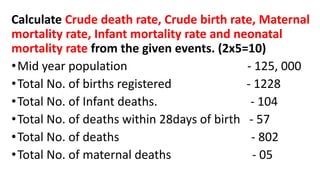
Calculate Crude death rate, Crude birth rate, Maternal
mortality rate, Infant mortality rate and neonatal
mortality rate from the given events. (2x5=10)
•Mid year population - 125, 000
•Total No. of births registered - 1228
•Total No. of Infant deaths. - 104
•Total No. of deaths within 28days of birth - 57
•Total No. of deaths - 802
•Total No. of maternal deaths - 05
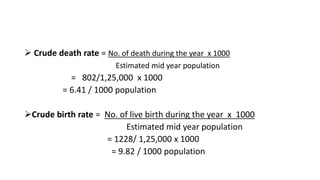
 Crude death rate = No. of death during the year x 1000
Estimated mid year population
= 802/1,25,000 x 1000
= 6.41 / 1000 population
Crude birth rate = No. of live birth during the year x 1000
Estimated mid year population
= 1228/ 1,25,000 x 1000
= 9.82 / 1000 population
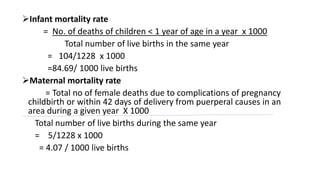
Infant mortality rate
= No. of deaths of children < 1 year of age in a year x 1000
Total number of live births in the same year
= 104/1228 x 1000
=84.69/ 1000 live births
Maternal mortality rate
= Total no of female deaths due to complications of pregnancy
childbirth or within 42 days of delivery from puerperal causes in an
area during a given year X 1000
Total number of live births during the same year
= 5/1228 x 1000
= 4.07 / 1000 live births
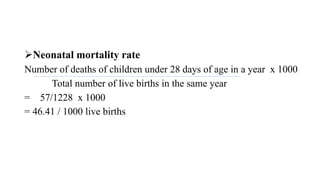
Neonatal mortality rate
Number of deaths of children under 28 days of age in a year x 1000
Total number of live births in the same year
= 57/1228 x 1000
= 46.41 / 1000 live births
2
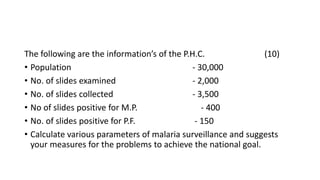
The following are the information’s of the P.H.C. (10)
• Population - 30,000
• No. of slides examined - 2,000
• No. of slides collected - 3,500
• No of slides positive for M.P. - 400
• No. of slides positive for P.F. - 150
• Calculate various parameters of malaria surveillance and suggests
your measures for the problems to achieve the national goal.
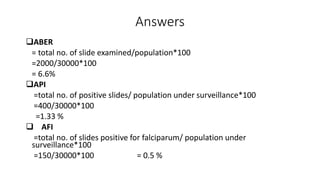
Answers
ABER
= total no. of slide examined/population*100
=2000/30000*100
= 6.6%
API
=total no. of positive slides/ population under surveillance*100
=400/30000*100
=1.33 %
 AFI
=total no. of slides positive for falciparum/ population under
surveillance*100
=150/30000*100 = 0.5 %
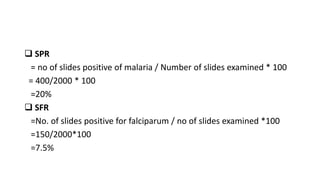
 SPR
= no of slides positive of malaria / Number of slides examined * 100
= 400/2000 * 100
=20%
 SFR
=No. of slides positive for falciparum / no of slides examined *100
=150/2000*100
=7.5%
3
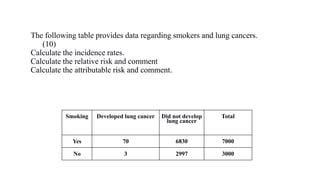
The following table provides data regarding smokers and lung cancers.
(10)
Calculate the incidence rates.
Calculate the relative risk and comment
Calculate the attributable risk and comment.
Smoking Developed lung cancer Did not develop
lung cancer
Total
Yes 70 6830 7000
No 3 2997 3000
Answers
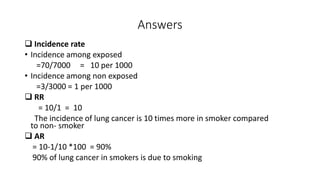
 Incidence rate
• Incidence among exposed
=70/7000 = 10 per 1000
• Incidence among non exposed
=3/3000 = 1 per 1000
 RR
= 10/1 = 10
The incidence of lung cancer is 10 times more in smoker compared
to non- smoker
 AR
= 10-1/10 *100 = 90%
90% of lung cancer in smokers is due to smoking
4
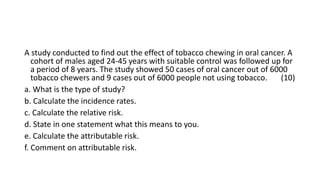
A study conducted to find out the effect of tobacco chewing in oral cancer. A
cohort of males aged 24-45 years with suitable control was followed up for
a period of 8 years. The study showed 50 cases of oral cancer out of 6000
tobacco chewers and 9 cases out of 6000 people not using tobacco. (10)
a. What is the type of study?
b. Calculate the incidence rates.
c. Calculate the relative risk.
d. State in one statement what this means to you.
e. Calculate the attributable risk.
f. Comment on attributable risk.
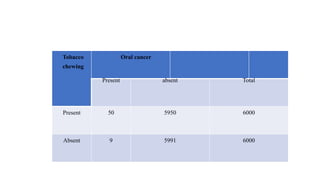
Tobacco
chewing
Oral cancer
Present absent Total
Present 50 5950 6000
Absent 9 5991 6000
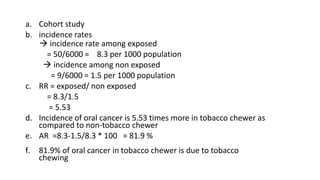
a. Cohort study
b. incidence rates
 incidence rate among exposed
= 50/6000 = 8.3 per 1000 population
 incidence among non exposed
= 9/6000 = 1.5 per 1000 population
c. RR = exposed/ non exposed
= 8.3/1.5
= 5.53
d. Incidence of oral cancer is 5.53 times more in tobacco chewer as
compared to non-tobacco chewer
e. AR =8.3-1.5/8.3 * 100 = 81.9 %
f. 81.9% of oral cancer in tobacco chewer is due to tobacco
chewing
5
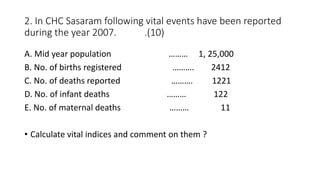
2. In CHC Sasaram following vital events have been reported
during the year 2007. .(10)
A. Mid year population ……… 1, 25,000
B. No. of births registered ………. 2412
C. No. of deaths reported ………. 1221
D. No. of infant deaths ……… 122
E. No. of maternal deaths ……… 11
• Calculate vital indices and comment on them ?
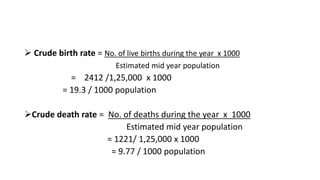
 Crude birth rate = No. of live births during the year x 1000
Estimated mid year population
= 2412 /1,25,000 x 1000
= 19.3 / 1000 population
Crude death rate = No. of deaths during the year x 1000
Estimated mid year population
= 1221/ 1,25,000 x 1000
= 9.77 / 1000 population
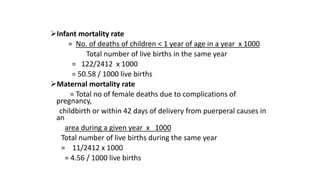
Infant mortality rate
= No. of deaths of children < 1 year of age in a year x 1000
Total number of live births in the same year
= 122/2412 x 1000
= 50.58 / 1000 live births
Maternal mortality rate
= Total no of female deaths due to complications of
pregnancy,
childbirth or within 42 days of delivery from puerperal causes in
an
area during a given year x 1000
Total number of live births during the same year
= 11/2412 x 1000
= 4.56 / 1000 live births
6
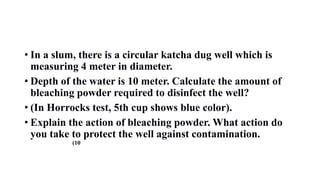
• In a slum, there is a circular katcha dug well which is
measuring 4 meter in diameter.
• Depth of the water is 10 meter. Calculate the amount of
bleaching powder required to disinfect the well?
• (In Horrocks test, 5th cup shows blue color).
• Explain the action of bleaching powder. What action do
you take to protect the well against contamination.
(10
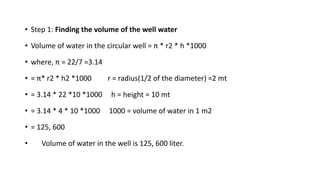
• Step 1: Finding the volume of the well water
• Volume of water in the circular well = π * r2 * h *1000
• where, π = 22/7 =3.14
• = π* r2 * h2 *1000 r = radius(1/2 of the diameter) =2 mt
• = 3.14 * 22 *10 *1000 h = height = 10 mt
• = 3.14 * 4 * 10 *1000 1000 = volume of water in 1 m2
• = 125, 600
• Volume of water in the well is 125, 600 liter.
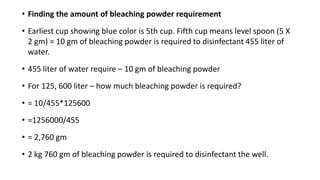
• Finding the amount of bleaching powder requirement
• Earliest cup showing blue color is 5th cup. Fifth cup means level spoon (5 X
2 gm) = 10 gm of bleaching powder is required to disinfectant 455 liter of
water.
• 455 liter of water require – 10 gm of bleaching powder
• For 125, 600 liter – how much bleaching powder is required?
• = 10/455*125600
• =1256000/455
• = 2,760 gm
• 2 kg 760 gm of bleaching powder is required to disinfectant the well.
Thank You

Epidemiological Exercise.ppsx

  • 1.
    Epidemiological Exercise Dr. AnimeshGupta Associate Professor Dept. of Community Medicine, NMCH
  • 2.
  • 3.
    Calculate Crude deathrate, Crude birth rate, Maternal mortality rate, Infant mortality rate and neonatal mortality rate from the given events. (2x5=10) •Mid year population - 125, 000 •Total No. of births registered - 1228 •Total No. of Infant deaths. - 104 •Total No. of deaths within 28days of birth - 57 •Total No. of deaths - 802 •Total No. of maternal deaths - 05
  • 4.
     Crude deathrate = No. of death during the year x 1000 Estimated mid year population = 802/1,25,000 x 1000 = 6.41 / 1000 population Crude birth rate = No. of live birth during the year x 1000 Estimated mid year population = 1228/ 1,25,000 x 1000 = 9.82 / 1000 population
  • 5.
    Infant mortality rate =No. of deaths of children < 1 year of age in a year x 1000 Total number of live births in the same year = 104/1228 x 1000 =84.69/ 1000 live births Maternal mortality rate = Total no of female deaths due to complications of pregnancy childbirth or within 42 days of delivery from puerperal causes in an area during a given year X 1000 Total number of live births during the same year = 5/1228 x 1000 = 4.07 / 1000 live births
  • 6.
    Neonatal mortality rate Numberof deaths of children under 28 days of age in a year x 1000 Total number of live births in the same year = 57/1228 x 1000 = 46.41 / 1000 live births
  • 7.
  • 8.
    The following arethe information’s of the P.H.C. (10) • Population - 30,000 • No. of slides examined - 2,000 • No. of slides collected - 3,500 • No of slides positive for M.P. - 400 • No. of slides positive for P.F. - 150 • Calculate various parameters of malaria surveillance and suggests your measures for the problems to achieve the national goal.
  • 9.
    Answers ABER = total no.of slide examined/population*100 =2000/30000*100 = 6.6% API =total no. of positive slides/ population under surveillance*100 =400/30000*100 =1.33 %  AFI =total no. of slides positive for falciparum/ population under surveillance*100 =150/30000*100 = 0.5 %
  • 10.
     SPR = noof slides positive of malaria / Number of slides examined * 100 = 400/2000 * 100 =20%  SFR =No. of slides positive for falciparum / no of slides examined *100 =150/2000*100 =7.5%
  • 11.
  • 12.
    The following tableprovides data regarding smokers and lung cancers. (10) Calculate the incidence rates. Calculate the relative risk and comment Calculate the attributable risk and comment. Smoking Developed lung cancer Did not develop lung cancer Total Yes 70 6830 7000 No 3 2997 3000
  • 13.
    Answers  Incidence rate •Incidence among exposed =70/7000 = 10 per 1000 • Incidence among non exposed =3/3000 = 1 per 1000  RR = 10/1 = 10 The incidence of lung cancer is 10 times more in smoker compared to non- smoker  AR = 10-1/10 *100 = 90% 90% of lung cancer in smokers is due to smoking
  • 14.
  • 15.
    A study conductedto find out the effect of tobacco chewing in oral cancer. A cohort of males aged 24-45 years with suitable control was followed up for a period of 8 years. The study showed 50 cases of oral cancer out of 6000 tobacco chewers and 9 cases out of 6000 people not using tobacco. (10) a. What is the type of study? b. Calculate the incidence rates. c. Calculate the relative risk. d. State in one statement what this means to you. e. Calculate the attributable risk. f. Comment on attributable risk.
  • 16.
    Tobacco chewing Oral cancer Present absentTotal Present 50 5950 6000 Absent 9 5991 6000
  • 17.
    a. Cohort study b.incidence rates  incidence rate among exposed = 50/6000 = 8.3 per 1000 population  incidence among non exposed = 9/6000 = 1.5 per 1000 population c. RR = exposed/ non exposed = 8.3/1.5 = 5.53 d. Incidence of oral cancer is 5.53 times more in tobacco chewer as compared to non-tobacco chewer e. AR =8.3-1.5/8.3 * 100 = 81.9 % f. 81.9% of oral cancer in tobacco chewer is due to tobacco chewing
  • 18.
  • 19.
    2. In CHCSasaram following vital events have been reported during the year 2007. .(10) A. Mid year population ……… 1, 25,000 B. No. of births registered ………. 2412 C. No. of deaths reported ………. 1221 D. No. of infant deaths ……… 122 E. No. of maternal deaths ……… 11 • Calculate vital indices and comment on them ?
  • 20.
     Crude birthrate = No. of live births during the year x 1000 Estimated mid year population = 2412 /1,25,000 x 1000 = 19.3 / 1000 population Crude death rate = No. of deaths during the year x 1000 Estimated mid year population = 1221/ 1,25,000 x 1000 = 9.77 / 1000 population
  • 21.
    Infant mortality rate =No. of deaths of children < 1 year of age in a year x 1000 Total number of live births in the same year = 122/2412 x 1000 = 50.58 / 1000 live births Maternal mortality rate = Total no of female deaths due to complications of pregnancy, childbirth or within 42 days of delivery from puerperal causes in an area during a given year x 1000 Total number of live births during the same year = 11/2412 x 1000 = 4.56 / 1000 live births
  • 22.
  • 23.
    • In aslum, there is a circular katcha dug well which is measuring 4 meter in diameter. • Depth of the water is 10 meter. Calculate the amount of bleaching powder required to disinfect the well? • (In Horrocks test, 5th cup shows blue color). • Explain the action of bleaching powder. What action do you take to protect the well against contamination. (10
  • 24.
    • Step 1:Finding the volume of the well water • Volume of water in the circular well = π * r2 * h *1000 • where, π = 22/7 =3.14 • = π* r2 * h2 *1000 r = radius(1/2 of the diameter) =2 mt • = 3.14 * 22 *10 *1000 h = height = 10 mt • = 3.14 * 4 * 10 *1000 1000 = volume of water in 1 m2 • = 125, 600 • Volume of water in the well is 125, 600 liter.
  • 25.
    • Finding theamount of bleaching powder requirement • Earliest cup showing blue color is 5th cup. Fifth cup means level spoon (5 X 2 gm) = 10 gm of bleaching powder is required to disinfectant 455 liter of water. • 455 liter of water require – 10 gm of bleaching powder • For 125, 600 liter – how much bleaching powder is required? • = 10/455*125600 • =1256000/455 • = 2,760 gm • 2 kg 760 gm of bleaching powder is required to disinfectant the well.
  • 26.