Epidemiological exercises:
Malaria indices
Dr. Rizwan S A
Asst. Professor (Community Medicine)
VMCH & RI, Madurai
1
Three major types
• Rates and proportions
• Measures of association
• Diagnostic test validity
2
RATE AND PROPORTIONS
3
Rate and Proportions
• Demographic indices (CBR, CDR, MYP)
• MCH indicators
• Disease related indices (AR, SAR)
• Filarial indices
• Malarial indices
• TB indices
• Fertility indices (TFR, GFR, GMFR)
4
INTRO TO MALARIA BURDEN
5
WORLD
6
7
Global disease burden in 2015
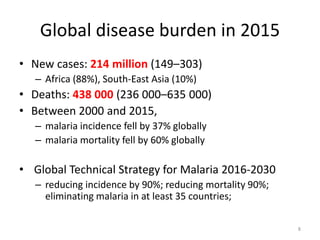
• New cases: 214 million (149–303)
– Africa (88%), South-East Asia (10%)
• Deaths: 438 000 (236 000–635 000)
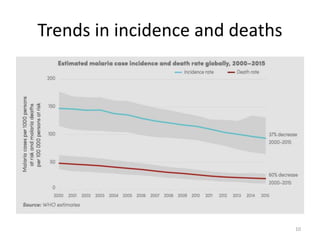
• Between 2000 and 2015,
– malaria incidence fell by 37% globally
– malaria mortality fell by 60% globally
• Global Technical Strategy for Malaria 2016-2030
– reducing incidence by 90%; reducing mortality 90%;
eliminating malaria in at least 35 countries;
8
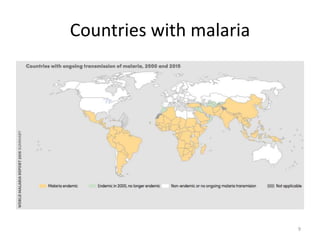
Countries with malaria
9
Trends in incidence and deaths
10
INDIA
11
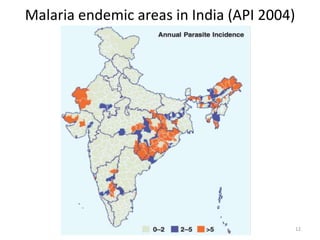
Malaria endemic areas in India (API 2004)
12
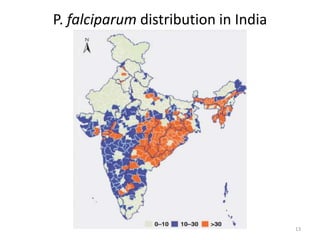
P. falciparum distribution in India
13
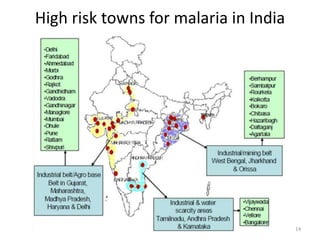
High risk towns for malaria in India
14
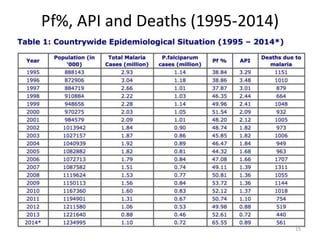
Pf%, API and Deaths (1995-2014)
15
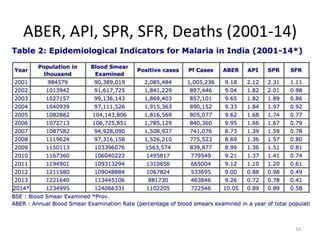
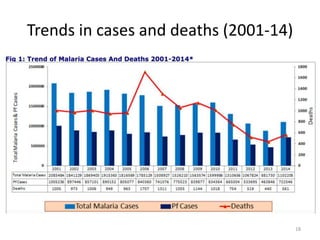
ABER, API, SPR, SFR, Deaths (2001-14)
16
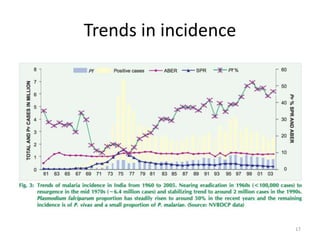
Trends in incidence
17
Trends in cases and deaths (2001-14)
18
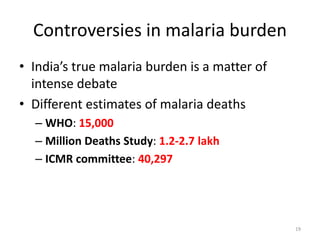
Controversies in malaria burden
• India’s true malaria burden is a matter of
intense debate
• Different estimates of malaria deaths
– WHO: 15,000
– Million Deaths Study: 1.2-2.7 lakh
– ICMR committee: 40,297
19
MALARIA INDICES
20
Learning objectives
• To assess the burden of disease in a community in
terms of morbidity and mortality wrt malaria
• To calculate indices to monitor and evaluate national
health programs wrt malaria
21
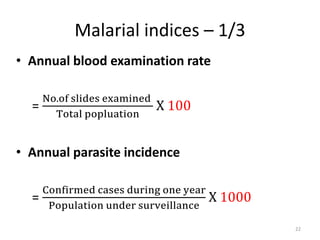
Malarial indices – 1/3
• Annual blood examination rate
=
No.of slides examined
Total popluation
X 100
• Annual parasite incidence
=
Confirmed cases during one year
Population under surveillance
X 1000
22
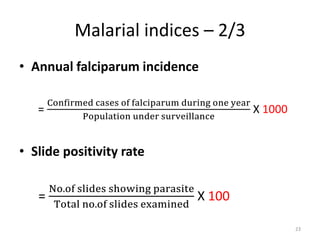
Malarial indices – 2/3
• Annual falciparum incidence
=
Confirmed cases of falciparum during one year
Population under surveillance
X 1000
• Slide positivity rate
=
No.of slides showing parasite
Total no.of slides examined
X 100
23
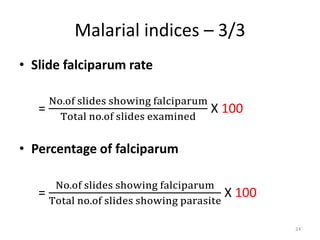
Malarial indices – 3/3
• Slide falciparum rate
=
No.of slides showing falciparum
Total no.of slides examined
X 100
• Percentage of falciparum
=
No.of slides showing falciparum
Total no.of slides showing parasite
X 100
24
Malaria control in India
25
Objective and indicators
• To achieve API <1 by 2017
• At least 80% of those suffering from malaria
get complete treatment within 24 hours
• At least 10% of the population in high-risk
areas is surveyed annually (ABER >10%)
• At least 50% reduction in mortality by 2017
(2010 baseline)
26
27
EXAMPLE PROBLEMS
28
Ex. Problem 1
1. In a Community health centre, with a population of
1,00,000, the health workers collected 3725 blood
smears from fever cases during their home visits. In
the same year, 3275 blood smears were collected from
Outpatient departments. On examination 185 slides
were positive for P. vivax and 15 slides were positive for
P. falciparum. Calculate the all-possible malarial indices.
29
Ex. Problem 1
Given:
– Population = 100000
– Blood smears collected from fever cases home visits = 3725
– Blood smears collected from Outpatient departments = 3275
– Slides positive for P. vivax = 185
– Slides positive for P. falciparum = 15
• Annual blood examination rate = (3725+3275)/100000 X 100 = 7%
• Annual parasite incidence = (185+15)/100000 X 1000 = 2 per 1000 population
• Annual falciparum incidence = 15/100000 X 1000 = 0.15 per 1000 population
• Slide positivity rate = 200/7000 X 100 = 2.8%
• Slide falciparum rate = 15/7000 X 100 = 0.2%
• Percentage of falciparum = 15/200 X 100 = 7.5%
30
Ex. Problem 2
2. Population of a PHC is 25000. A total of 200
peripheral blood smears were made. 38 of them
tested positive for P.vivax, 40 for P.Falciparum
and 10 showed both. Calculate the indices for
malaria control in the area.
31
Ex. Problem 2
• API= 88/25000*1000= 3.5 per 1000
population
• ABER= 200/25000*100= 0.8%
• SPR = 88/ 200*100= 44%
• SFR= 40/200 *100= 20%
32
Work out on your own 1
The following are the data available for Madurai
district with population 10,00,000 regarding Anti
malaria activities during the year 2010. Blood
smear examined = 80000 positive cases
detected PV = 2592, PF = 308. Calculate ABER,
API, AFI, SPR and Percentage of falciparum.
Interpret the results and mention remedial
measures.
33
Work out on your own 2
• The following are the data from a Primary Health
Centre for the year 2015
• Total population = 30,000
• Blood slides collected by active surveillance =260
• Blood slides positive for parasite in above = 80
• Blood slide collected by passive surveillance = 140
• Blood slides positive for parasite in above = 40
• Among the positive slides, falciparum was seen in 9
Calculate the malaria indices and comment on them
34

Indicators of malaria control

  • 1.
    Epidemiological exercises: Malaria indices Dr.Rizwan S A Asst. Professor (Community Medicine) VMCH & RI, Madurai 1
  • 2.
    Three major types •Rates and proportions • Measures of association • Diagnostic test validity 2
  • 3.
  • 4.
    Rate and Proportions •Demographic indices (CBR, CDR, MYP) • MCH indicators • Disease related indices (AR, SAR) • Filarial indices • Malarial indices • TB indices • Fertility indices (TFR, GFR, GMFR) 4
  • 5.
  • 6.
  • 7.
  • 8.
    Global disease burdenin 2015 • New cases: 214 million (149–303) – Africa (88%), South-East Asia (10%) • Deaths: 438 000 (236 000–635 000) • Between 2000 and 2015, – malaria incidence fell by 37% globally – malaria mortality fell by 60% globally • Global Technical Strategy for Malaria 2016-2030 – reducing incidence by 90%; reducing mortality 90%; eliminating malaria in at least 35 countries; 8
  • 9.
  • 10.
    Trends in incidenceand deaths 10
  • 11.
  • 12.
    Malaria endemic areasin India (API 2004) 12
  • 13.
  • 14.
    High risk townsfor malaria in India 14
  • 15.
    Pf%, API andDeaths (1995-2014) 15
  • 16.
    ABER, API, SPR,SFR, Deaths (2001-14) 16
  • 17.
  • 18.
    Trends in casesand deaths (2001-14) 18
  • 19.
    Controversies in malariaburden • India’s true malaria burden is a matter of intense debate • Different estimates of malaria deaths – WHO: 15,000 – Million Deaths Study: 1.2-2.7 lakh – ICMR committee: 40,297 19
  • 20.
  • 21.
    Learning objectives • Toassess the burden of disease in a community in terms of morbidity and mortality wrt malaria • To calculate indices to monitor and evaluate national health programs wrt malaria 21
  • 22.
    Malarial indices –1/3 • Annual blood examination rate = No.of slides examined Total popluation X 100 • Annual parasite incidence = Confirmed cases during one year Population under surveillance X 1000 22
  • 23.
    Malarial indices –2/3 • Annual falciparum incidence = Confirmed cases of falciparum during one year Population under surveillance X 1000 • Slide positivity rate = No.of slides showing parasite Total no.of slides examined X 100 23
  • 24.
    Malarial indices –3/3 • Slide falciparum rate = No.of slides showing falciparum Total no.of slides examined X 100 • Percentage of falciparum = No.of slides showing falciparum Total no.of slides showing parasite X 100 24
  • 25.
  • 26.
    Objective and indicators •To achieve API <1 by 2017 • At least 80% of those suffering from malaria get complete treatment within 24 hours • At least 10% of the population in high-risk areas is surveyed annually (ABER >10%) • At least 50% reduction in mortality by 2017 (2010 baseline) 26
  • 27.
  • 28.
  • 29.
    Ex. Problem 1 1.In a Community health centre, with a population of 1,00,000, the health workers collected 3725 blood smears from fever cases during their home visits. In the same year, 3275 blood smears were collected from Outpatient departments. On examination 185 slides were positive for P. vivax and 15 slides were positive for P. falciparum. Calculate the all-possible malarial indices. 29
  • 30.
    Ex. Problem 1 Given: –Population = 100000 – Blood smears collected from fever cases home visits = 3725 – Blood smears collected from Outpatient departments = 3275 – Slides positive for P. vivax = 185 – Slides positive for P. falciparum = 15 • Annual blood examination rate = (3725+3275)/100000 X 100 = 7% • Annual parasite incidence = (185+15)/100000 X 1000 = 2 per 1000 population • Annual falciparum incidence = 15/100000 X 1000 = 0.15 per 1000 population • Slide positivity rate = 200/7000 X 100 = 2.8% • Slide falciparum rate = 15/7000 X 100 = 0.2% • Percentage of falciparum = 15/200 X 100 = 7.5% 30
  • 31.
    Ex. Problem 2 2.Population of a PHC is 25000. A total of 200 peripheral blood smears were made. 38 of them tested positive for P.vivax, 40 for P.Falciparum and 10 showed both. Calculate the indices for malaria control in the area. 31
  • 32.
    Ex. Problem 2 •API= 88/25000*1000= 3.5 per 1000 population • ABER= 200/25000*100= 0.8% • SPR = 88/ 200*100= 44% • SFR= 40/200 *100= 20% 32
  • 33.
    Work out onyour own 1 The following are the data available for Madurai district with population 10,00,000 regarding Anti malaria activities during the year 2010. Blood smear examined = 80000 positive cases detected PV = 2592, PF = 308. Calculate ABER, API, AFI, SPR and Percentage of falciparum. Interpret the results and mention remedial measures. 33
  • 34.
    Work out onyour own 2 • The following are the data from a Primary Health Centre for the year 2015 • Total population = 30,000 • Blood slides collected by active surveillance =260 • Blood slides positive for parasite in above = 80 • Blood slide collected by passive surveillance = 140 • Blood slides positive for parasite in above = 40 • Among the positive slides, falciparum was seen in 9 Calculate the malaria indices and comment on them 34

Editor's Notes

  • #16 Source NVBDCP website
  • #17 Source NVBDCP website
  • #19 Source NVBDCP website