Epidemic CurvesEpidemic Curves
Jen-Hsiang Chuang, M.D., Ph.D.Jen-Hsiang Chuang, M.D., Ph.D.
Taiwan Centers for Disease ControlTaiwan Centers for Disease Control
jhchuang@cdc.gov.twjhchuang@cdc.gov.tw
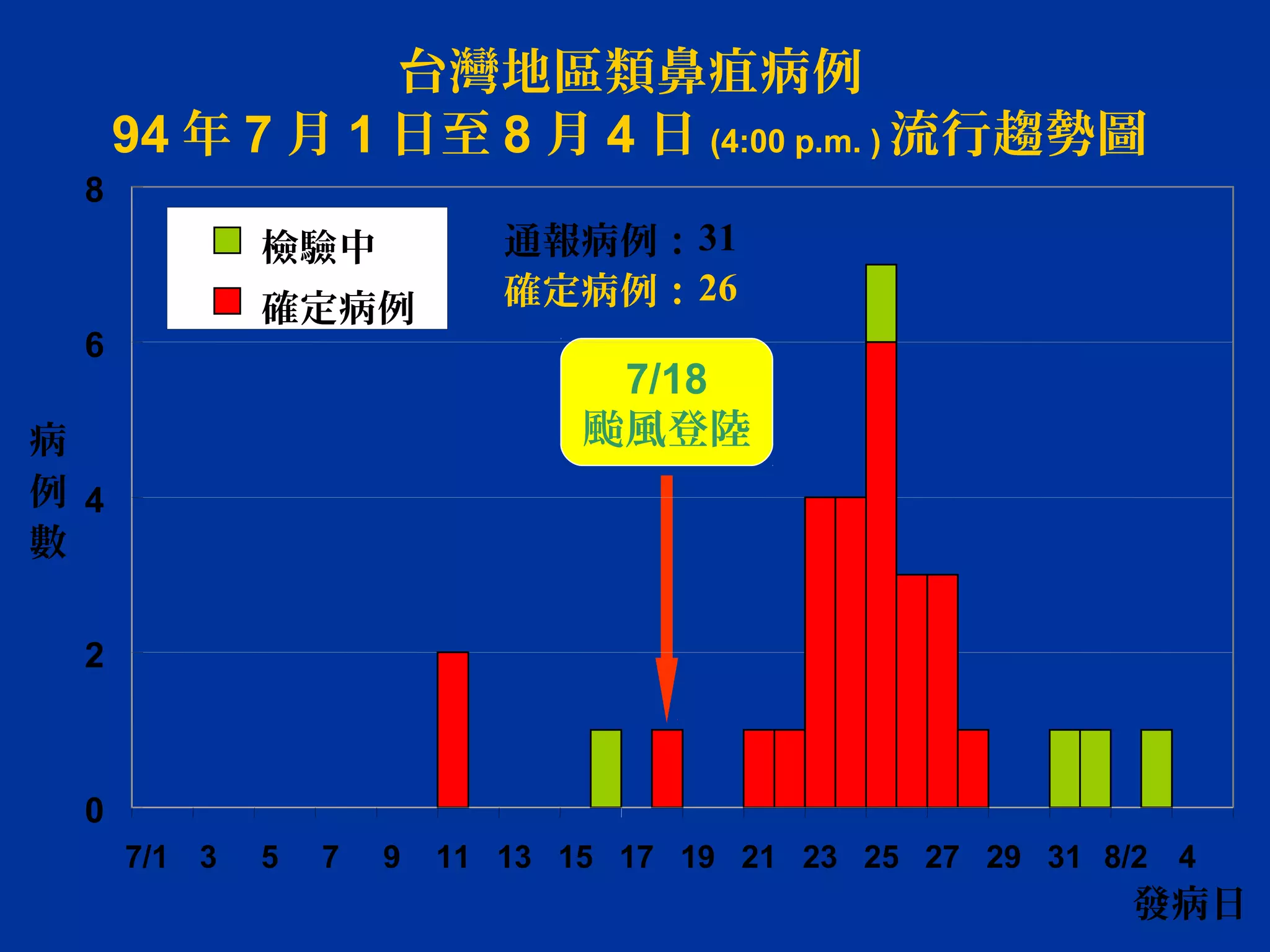
7/18
颱風登陸
台灣地區類鼻疽病例
94 年 7 月 1 日至 8 月 4 日 (4:00 p.m. ) 流行趨勢圖
0
2
4
6
8
7/1 3 5 7 9 11 13 15 17 19 21 23 25 27 29 31 8/2 4
發病日
病
例
數
檢驗中
確定病例
通報病例:31
確定病例:26
What is an Epidemic CurveWhat is an Epidemic Curve
(Epi Curve) ?(Epi Curve) ?
 An epidemic curveAn epidemic curve (( a histograma histogram )) is ais a
graphical depiction of the number of cases ofgraphical depiction of the number of cases of
illness by the date of illness onsetillness by the date of illness onset
 There should not be any space between the x-There should not be any space between the x-
axis categoriesaxis categories
How Can it Help in an Outbreak?How Can it Help in an Outbreak?
 An epi curve can provide information on theAn epi curve can provide information on the
following characteristics of an outbreak:following characteristics of an outbreak:
 Pattern of spreadPattern of spread
 MagnitudeMagnitude
 OutliersOutliers
 Time trendTime trend
 Exposure and/or disease incubation periodExposure and/or disease incubation period
Outbreak Pattern of SpreadOutbreak Pattern of Spread
 The overall shape of the epi curve can reveal theThe overall shape of the epi curve can reveal the
type of outbreaktype of outbreak
 Common sourceCommon source
 Point sourcePoint source
 PropagatedPropagated
Common Source OutbreakCommon Source Outbreak
 An outbreak due to transmission from a singleAn outbreak due to transmission from a single
environmental or human sourceenvironmental or human source
 Period of exposure may be brief or longPeriod of exposure may be brief or long
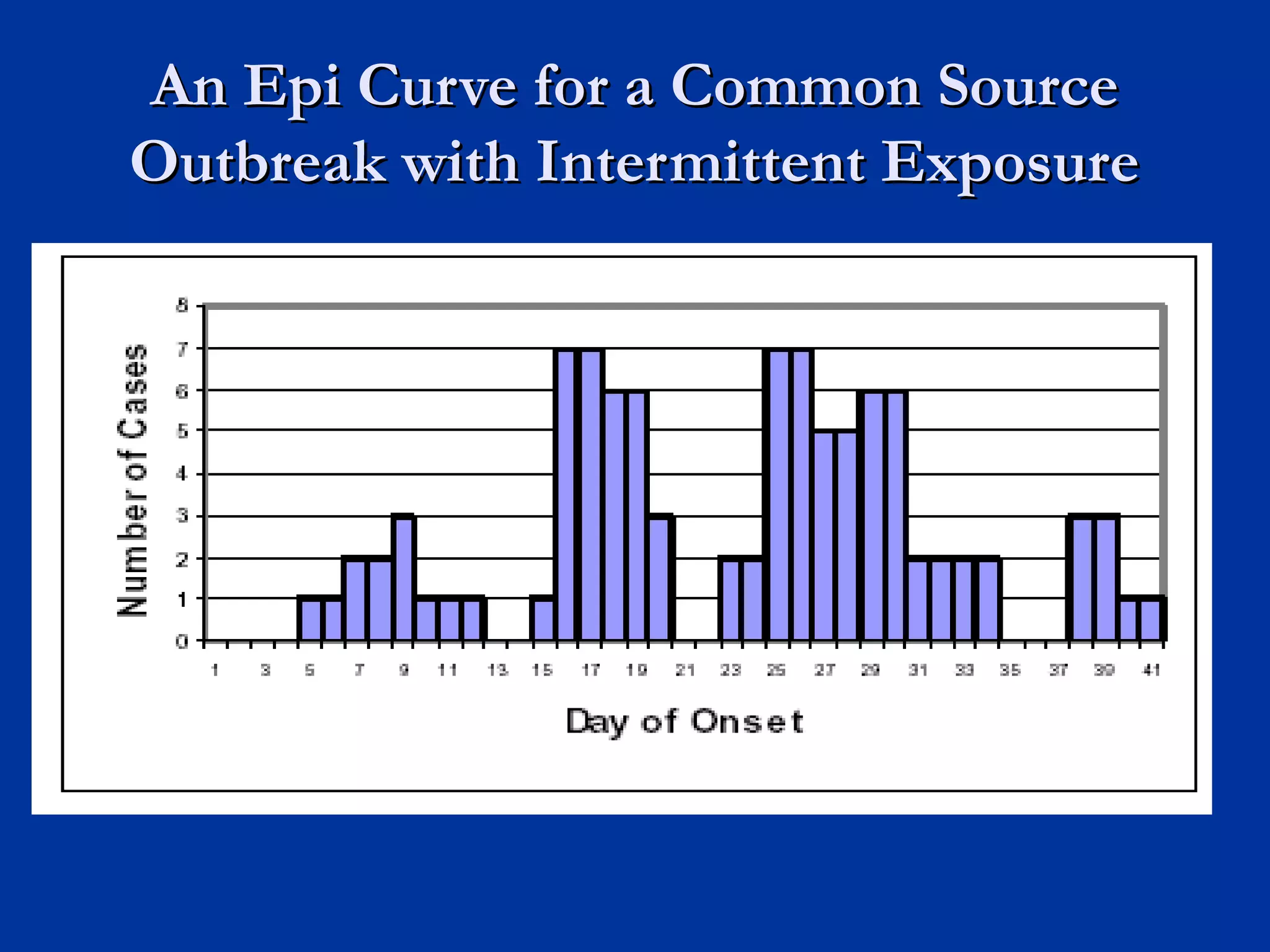
 Intermittent exposure often results in an epiIntermittent exposure often results in an epi
curve with irregular peaks that reflect the timingcurve with irregular peaks that reflect the timing
and the extent of exposureand the extent of exposure
 Continuous exposure will often cause cases toContinuous exposure will often cause cases to
rise gradually (and possibly to plateau, ratherrise gradually (and possibly to plateau, rather
than to peak)than to peak)
An Epi Curve for a Common SourceAn Epi Curve for a Common Source
Outbreak with Intermittent ExposureOutbreak with Intermittent Exposure
An Epi Curve for a Common SourceAn Epi Curve for a Common Source
Outbreak with Continuous ExposureOutbreak with Continuous Exposure
Point Source OutbreakPoint Source Outbreak
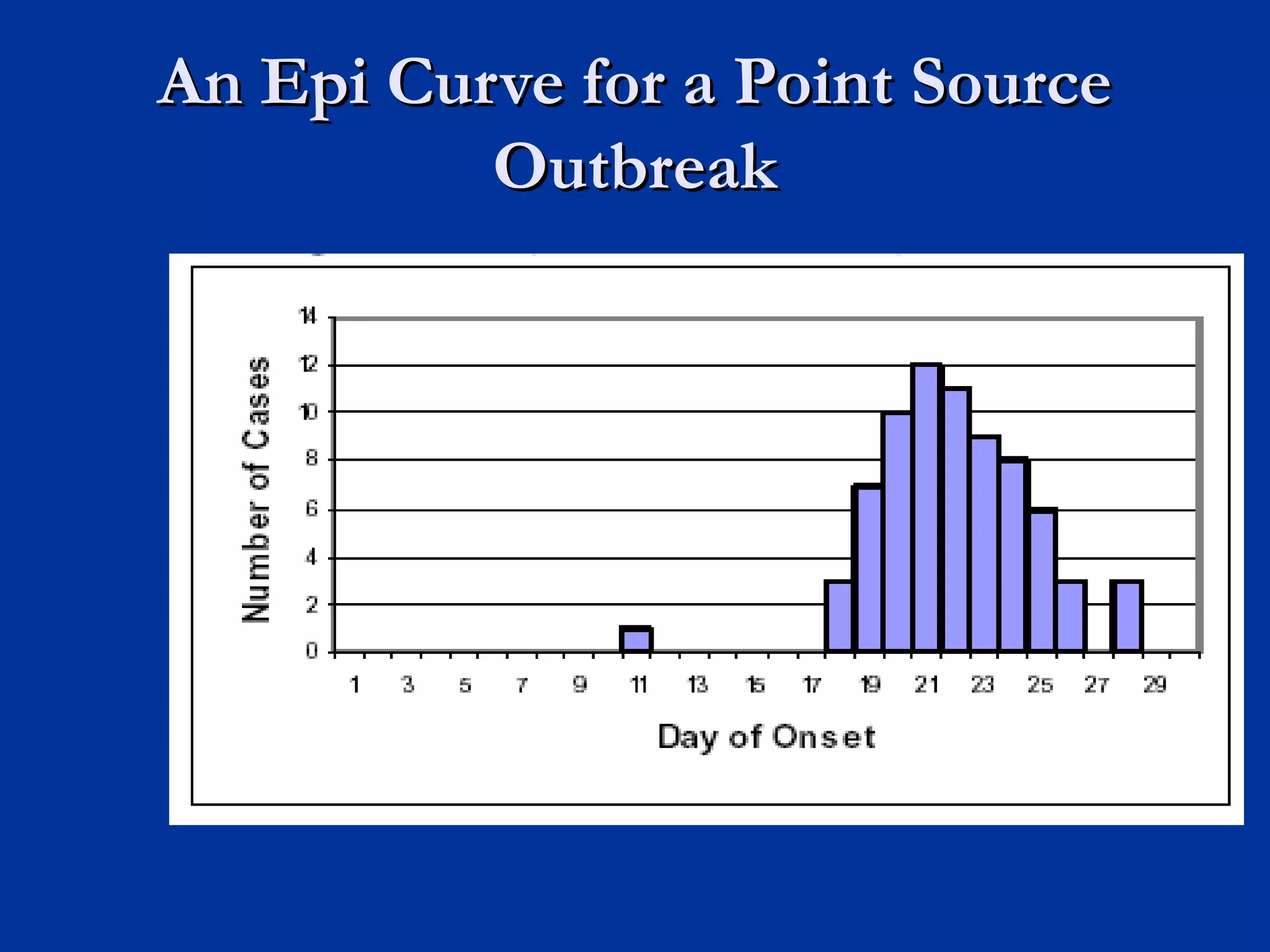
 Typically shows a sharp upward slope and aTypically shows a sharp upward slope and a
gradual downward slopegradual downward slope
 Is a common source outbreak in which theIs a common source outbreak in which the
period of exposure is brief, and all cases occurperiod of exposure is brief, and all cases occur
within one incubation periodwithin one incubation period
An Epi Curve for a Point SourceAn Epi Curve for a Point Source
OutbreakOutbreak
Propagated OutbreakPropagated Outbreak
 Is spread from person to personIs spread from person to person
 Can last longer than common source outbreaksCan last longer than common source outbreaks
 May have multiple wavesMay have multiple waves
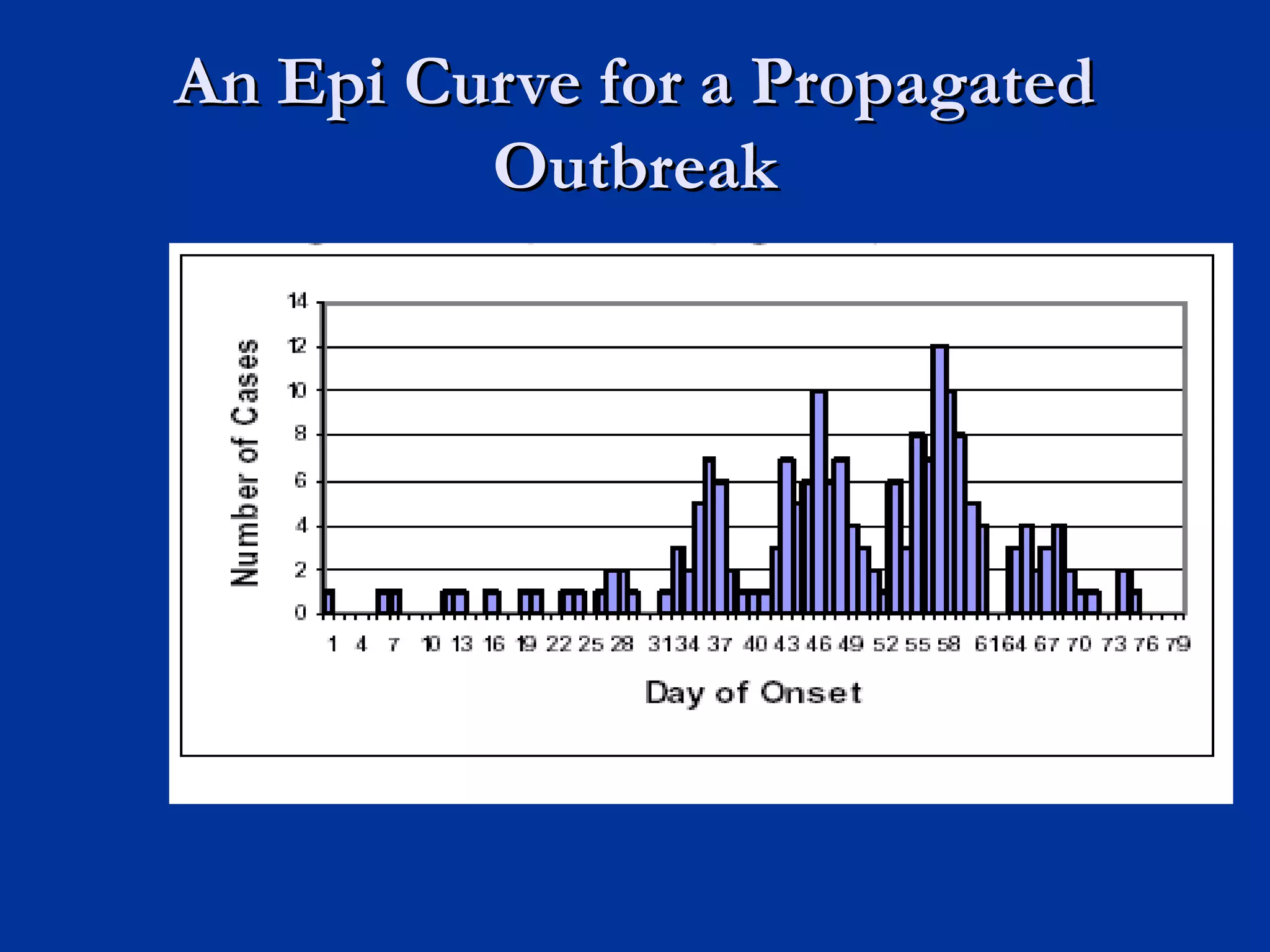
 The classic epi curve for a propagated outbreak hasThe classic epi curve for a propagated outbreak has
progressively taller peaks, an incubation period apartprogressively taller peaks, an incubation period apart
 Outbreaks may begin as a common-source oneOutbreaks may begin as a common-source one
followed by person-to-person spread (e.g., viralfollowed by person-to-person spread (e.g., viral
gastroenteritis caused by ingestion of contaminatedgastroenteritis caused by ingestion of contaminated
shrimp)shrimp)
An Epi Curve for a PropagatedAn Epi Curve for a Propagated
OutbreakOutbreak
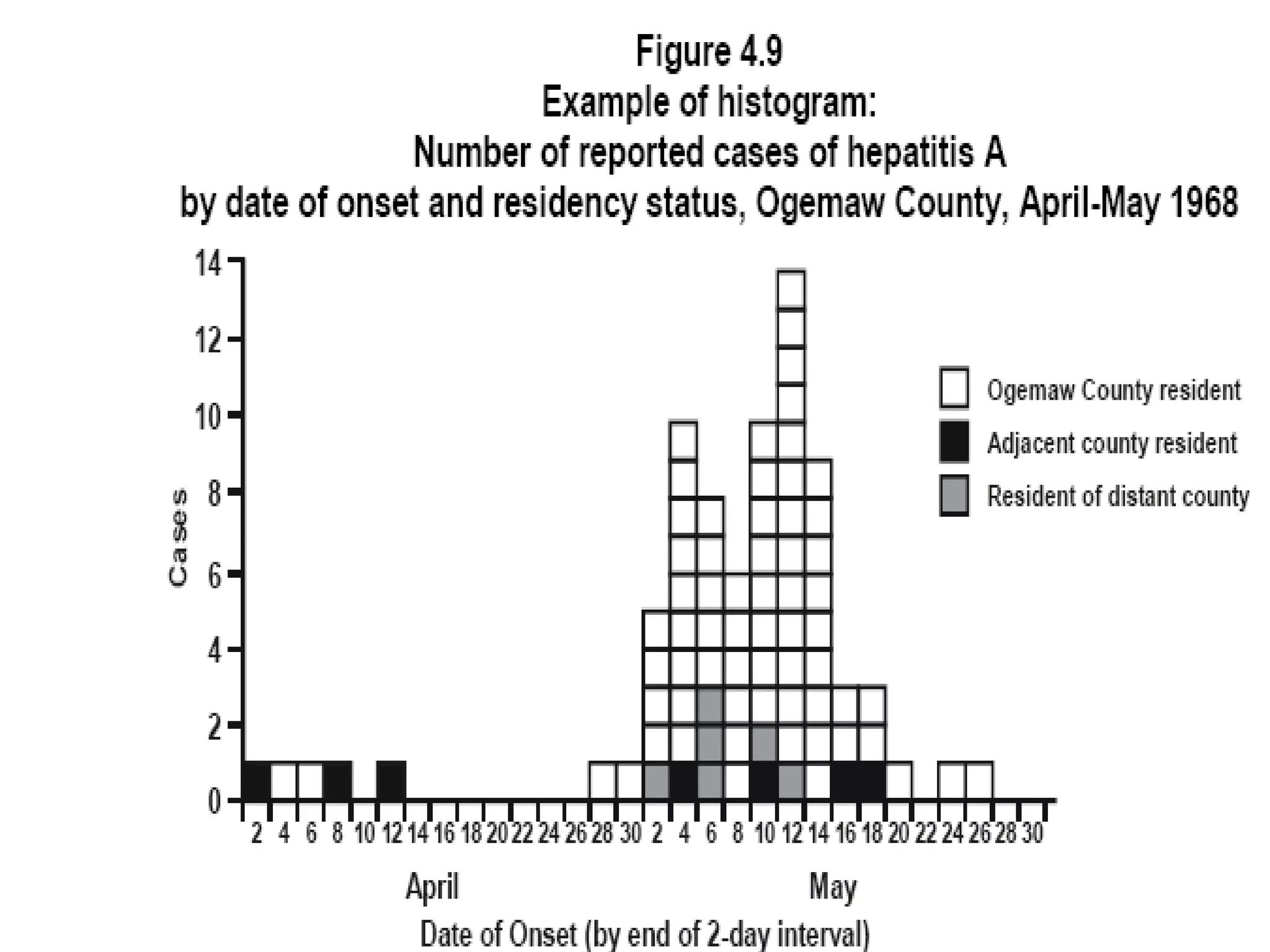
Outbreak MagnitudeOutbreak Magnitude
 Can provide a sense of the magnitude of anCan provide a sense of the magnitude of an
outbreakoutbreak
 Additional information can be obtained byAdditional information can be obtained by
stratifying the epi curvestratifying the epi curve
 Separating the sample into several subsamplesSeparating the sample into several subsamples
according to specific criteria, e.g. age, gender, &according to specific criteria, e.g. age, gender, &
geographic informationgeographic information
Outbreak Time TrendOutbreak Time Trend
 Allow information about the time trend of theAllow information about the time trend of the
outbreak to be gleanedoutbreak to be gleaned
 Consider:Consider:
 Date of illness onset for the first caseDate of illness onset for the first case
 Date when the outbreak peakedDate when the outbreak peaked
 Date of illness onset for the last caseDate of illness onset for the last case
Outbreak OutliersOutbreak Outliers
 Outliers are cases at the very beginning and endOutliers are cases at the very beginning and end
that may not appear to be relatedthat may not appear to be related
 First check to make certain they are not due to aFirst check to make certain they are not due to a
coding or data entry errorcoding or data entry error
Outbreak OutliersOutbreak Outliers
 If they are not an error, they may representIf they are not an error, they may represent
 Baseline level of illnessBaseline level of illness
 Outbreak sourceOutbreak source
 A case exposed earlier than the othersA case exposed earlier than the others
 An unrelated caseAn unrelated case
 A case exposed later than the othersA case exposed later than the others
 A case with a long incubation periodA case with a long incubation period
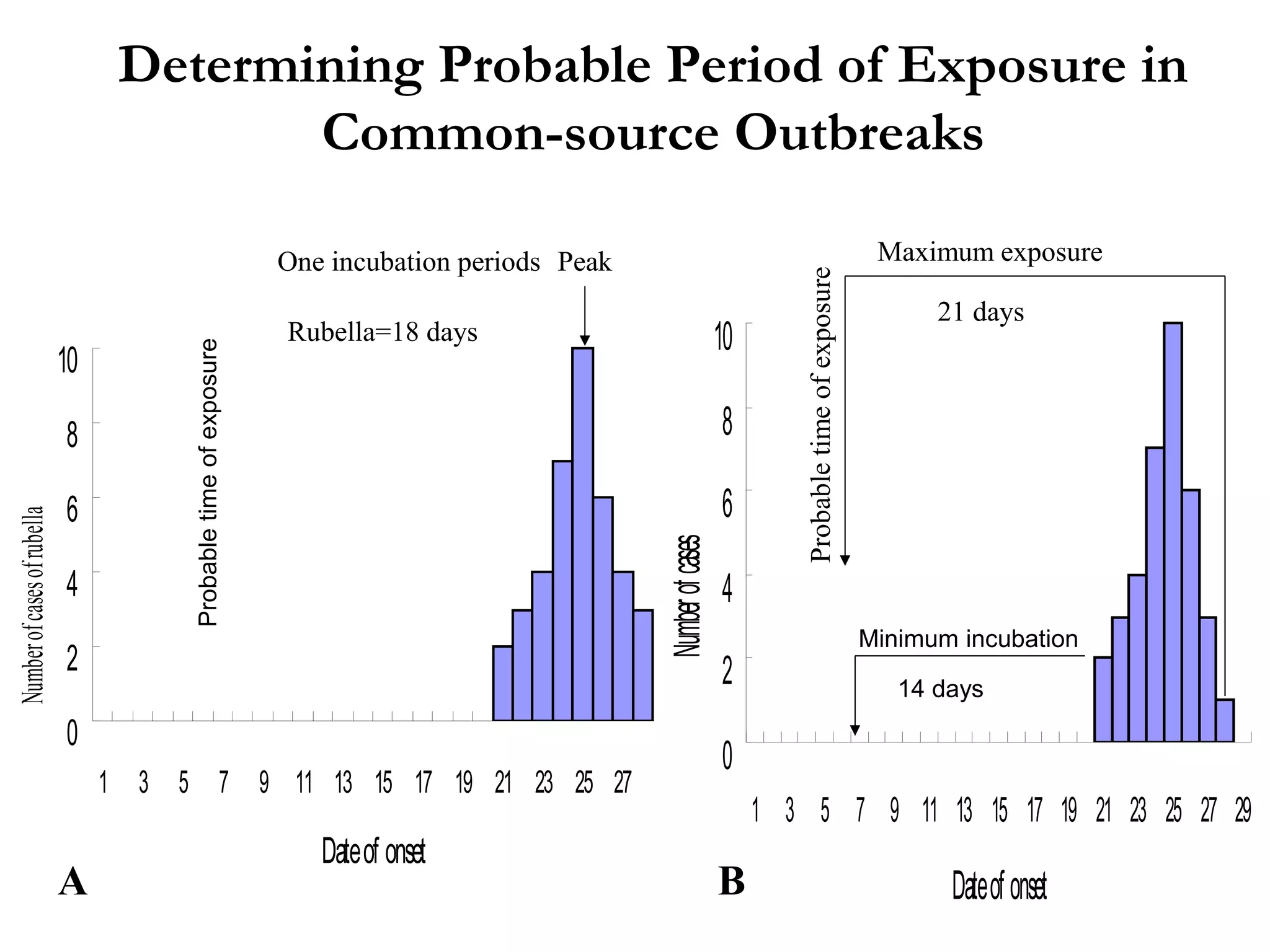
0
2
4
6
8
10
1 3 5 7 9 11 13 15 17 19 21 23 25 27
Dateof onset
Numberofcasesofrubella
PeakOne incubation periods
Rubella=18 days
Probabletimeofexposure
0
2
4
6
8
10
1 3 5 7 9 11 13 15 17 19 21 23 25 27 29
Dateof onset
Numberofcases
Minimum incubation
14 days
Maximum exposure
21 days
Probabletimeofexposure
Determining Probable Period of Exposure in
Common-source Outbreaks
A B
How do I Make an Epi Curve?How do I Make an Epi Curve?
 Plot the number of cases of disease reportedPlot the number of cases of disease reported
during an outbreak on the y-axisduring an outbreak on the y-axis
 Plot the time or date of illness onset on the x-Plot the time or date of illness onset on the x-
axisaxis
How do I Make an Epi Curve?How do I Make an Epi Curve?
 Technical tipsTechnical tips
 Choice of time unit for x-axis depends upon theChoice of time unit for x-axis depends upon the
incubation periodincubation period
 Begin with a unit approximately one third or less ofBegin with a unit approximately one third or less of
the incubation periodthe incubation period
 If the incubation period is not known, graph severalIf the incubation period is not known, graph several
epi curves with different time unitsepi curves with different time units
How do I Make an Epi Curve?How do I Make an Epi Curve?
 Usually the day of illness onset is the best unitUsually the day of illness onset is the best unit
for the x-axisfor the x-axis
 If the incubation period is very short, hour of onsetIf the incubation period is very short, hour of onset
may be more appropriate (e.g.,may be more appropriate (e.g., Staphylococcus aureusStaphylococcus aureus))
 If the incubation period is very long, week or monthIf the incubation period is very long, week or month
may be more appropriate (e.g., hepatitis B or TB)may be more appropriate (e.g., hepatitis B or TB)
 Effects for changing time intervalsEffects for changing time intervals
 http://www.cdc.gov/cogh/descd/modules/MiniModules/Ehttp://www.cdc.gov/cogh/descd/modules/MiniModules/E
pidemic_Curve/page05.htmpidemic_Curve/page05.htm
How do I Make an Epi Curve?How do I Make an Epi Curve?
 Epi curves are histogramsEpi curves are histograms
 Label each axisLabel each axis
 Provide a descriptive titleProvide a descriptive title
 Include the pre-epidemic period to show theInclude the pre-epidemic period to show the
baseline number of casesbaseline number of cases
ConclusionConclusion
 Epi curves are useful in outbreaks toEpi curves are useful in outbreaks to
 Identify the pattern of spreadIdentify the pattern of spread
 Assess the magnitudeAssess the magnitude
 Evaluate time trendsEvaluate time trends
 Examine OutliersExamine Outliers
 Estimate the exposure periodEstimate the exposure period
ReferencesReferences
1.1. CDC. Epidemic CurveCDC. Epidemic Curve
 http://www.cdc.gov/cogh/descd/modules/MiniModules/http://www.cdc.gov/cogh/descd/modules/MiniModules/
Epidemic_Curve/page01.htmEpidemic_Curve/page01.htm
1.1. North Carolina Center for Public HealthNorth Carolina Center for Public Health
Preparedness. Epidemic Curves AheadPreparedness. Epidemic Curves Ahead
 http://www.sph.unc.edu/nccphp/focus/vol1/issue5/indexhttp://www.sph.unc.edu/nccphp/focus/vol1/issue5/index
.htm.htm
1.1. CDC. Principles of Epidemiology, 2nd Edition.CDC. Principles of Epidemiology, 2nd Edition.
Atlanta, GA: Public Health Practice Program Office,Atlanta, GA: Public Health Practice Program Office,
1992.1992.
 http://www.phppo.cdc.gov/PHTN/catalog/pdf-http://www.phppo.cdc.gov/PHTN/catalog/pdf-
file/Epi_Course.pdffile/Epi_Course.pdf

Epidemic Curve

  • 1.
    Epidemic CurvesEpidemic Curves Jen-HsiangChuang, M.D., Ph.D.Jen-Hsiang Chuang, M.D., Ph.D. Taiwan Centers for Disease ControlTaiwan Centers for Disease Control jhchuang@cdc.gov.twjhchuang@cdc.gov.tw
  • 2.
    7/18 颱風登陸 台灣地區類鼻疽病例 94 年 7月 1 日至 8 月 4 日 (4:00 p.m. ) 流行趨勢圖 0 2 4 6 8 7/1 3 5 7 9 11 13 15 17 19 21 23 25 27 29 31 8/2 4 發病日 病 例 數 檢驗中 確定病例 通報病例:31 確定病例:26
  • 3.
    What is anEpidemic CurveWhat is an Epidemic Curve (Epi Curve) ?(Epi Curve) ?  An epidemic curveAn epidemic curve (( a histograma histogram )) is ais a graphical depiction of the number of cases ofgraphical depiction of the number of cases of illness by the date of illness onsetillness by the date of illness onset  There should not be any space between the x-There should not be any space between the x- axis categoriesaxis categories
  • 4.
    How Can itHelp in an Outbreak?How Can it Help in an Outbreak?  An epi curve can provide information on theAn epi curve can provide information on the following characteristics of an outbreak:following characteristics of an outbreak:  Pattern of spreadPattern of spread  MagnitudeMagnitude  OutliersOutliers  Time trendTime trend  Exposure and/or disease incubation periodExposure and/or disease incubation period
  • 5.
    Outbreak Pattern ofSpreadOutbreak Pattern of Spread  The overall shape of the epi curve can reveal theThe overall shape of the epi curve can reveal the type of outbreaktype of outbreak  Common sourceCommon source  Point sourcePoint source  PropagatedPropagated
  • 6.
    Common Source OutbreakCommonSource Outbreak  An outbreak due to transmission from a singleAn outbreak due to transmission from a single environmental or human sourceenvironmental or human source  Period of exposure may be brief or longPeriod of exposure may be brief or long  Intermittent exposure often results in an epiIntermittent exposure often results in an epi curve with irregular peaks that reflect the timingcurve with irregular peaks that reflect the timing and the extent of exposureand the extent of exposure  Continuous exposure will often cause cases toContinuous exposure will often cause cases to rise gradually (and possibly to plateau, ratherrise gradually (and possibly to plateau, rather than to peak)than to peak)
  • 7.
    An Epi Curvefor a Common SourceAn Epi Curve for a Common Source Outbreak with Intermittent ExposureOutbreak with Intermittent Exposure
  • 8.
    An Epi Curvefor a Common SourceAn Epi Curve for a Common Source Outbreak with Continuous ExposureOutbreak with Continuous Exposure
  • 9.
    Point Source OutbreakPointSource Outbreak  Typically shows a sharp upward slope and aTypically shows a sharp upward slope and a gradual downward slopegradual downward slope  Is a common source outbreak in which theIs a common source outbreak in which the period of exposure is brief, and all cases occurperiod of exposure is brief, and all cases occur within one incubation periodwithin one incubation period
  • 10.
    An Epi Curvefor a Point SourceAn Epi Curve for a Point Source OutbreakOutbreak
  • 11.
    Propagated OutbreakPropagated Outbreak Is spread from person to personIs spread from person to person  Can last longer than common source outbreaksCan last longer than common source outbreaks  May have multiple wavesMay have multiple waves  The classic epi curve for a propagated outbreak hasThe classic epi curve for a propagated outbreak has progressively taller peaks, an incubation period apartprogressively taller peaks, an incubation period apart  Outbreaks may begin as a common-source oneOutbreaks may begin as a common-source one followed by person-to-person spread (e.g., viralfollowed by person-to-person spread (e.g., viral gastroenteritis caused by ingestion of contaminatedgastroenteritis caused by ingestion of contaminated shrimp)shrimp)
  • 12.
    An Epi Curvefor a PropagatedAn Epi Curve for a Propagated OutbreakOutbreak
  • 13.
    Outbreak MagnitudeOutbreak Magnitude Can provide a sense of the magnitude of anCan provide a sense of the magnitude of an outbreakoutbreak  Additional information can be obtained byAdditional information can be obtained by stratifying the epi curvestratifying the epi curve  Separating the sample into several subsamplesSeparating the sample into several subsamples according to specific criteria, e.g. age, gender, &according to specific criteria, e.g. age, gender, & geographic informationgeographic information
  • 15.
    Outbreak Time TrendOutbreakTime Trend  Allow information about the time trend of theAllow information about the time trend of the outbreak to be gleanedoutbreak to be gleaned  Consider:Consider:  Date of illness onset for the first caseDate of illness onset for the first case  Date when the outbreak peakedDate when the outbreak peaked  Date of illness onset for the last caseDate of illness onset for the last case
  • 16.
    Outbreak OutliersOutbreak Outliers Outliers are cases at the very beginning and endOutliers are cases at the very beginning and end that may not appear to be relatedthat may not appear to be related  First check to make certain they are not due to aFirst check to make certain they are not due to a coding or data entry errorcoding or data entry error
  • 17.
    Outbreak OutliersOutbreak Outliers If they are not an error, they may representIf they are not an error, they may represent  Baseline level of illnessBaseline level of illness  Outbreak sourceOutbreak source  A case exposed earlier than the othersA case exposed earlier than the others  An unrelated caseAn unrelated case  A case exposed later than the othersA case exposed later than the others  A case with a long incubation periodA case with a long incubation period
  • 18.
    0 2 4 6 8 10 1 3 57 9 11 13 15 17 19 21 23 25 27 Dateof onset Numberofcasesofrubella PeakOne incubation periods Rubella=18 days Probabletimeofexposure 0 2 4 6 8 10 1 3 5 7 9 11 13 15 17 19 21 23 25 27 29 Dateof onset Numberofcases Minimum incubation 14 days Maximum exposure 21 days Probabletimeofexposure Determining Probable Period of Exposure in Common-source Outbreaks A B
  • 19.
    How do IMake an Epi Curve?How do I Make an Epi Curve?  Plot the number of cases of disease reportedPlot the number of cases of disease reported during an outbreak on the y-axisduring an outbreak on the y-axis  Plot the time or date of illness onset on the x-Plot the time or date of illness onset on the x- axisaxis
  • 20.
    How do IMake an Epi Curve?How do I Make an Epi Curve?  Technical tipsTechnical tips  Choice of time unit for x-axis depends upon theChoice of time unit for x-axis depends upon the incubation periodincubation period  Begin with a unit approximately one third or less ofBegin with a unit approximately one third or less of the incubation periodthe incubation period  If the incubation period is not known, graph severalIf the incubation period is not known, graph several epi curves with different time unitsepi curves with different time units
  • 21.
    How do IMake an Epi Curve?How do I Make an Epi Curve?  Usually the day of illness onset is the best unitUsually the day of illness onset is the best unit for the x-axisfor the x-axis  If the incubation period is very short, hour of onsetIf the incubation period is very short, hour of onset may be more appropriate (e.g.,may be more appropriate (e.g., Staphylococcus aureusStaphylococcus aureus))  If the incubation period is very long, week or monthIf the incubation period is very long, week or month may be more appropriate (e.g., hepatitis B or TB)may be more appropriate (e.g., hepatitis B or TB)  Effects for changing time intervalsEffects for changing time intervals  http://www.cdc.gov/cogh/descd/modules/MiniModules/Ehttp://www.cdc.gov/cogh/descd/modules/MiniModules/E pidemic_Curve/page05.htmpidemic_Curve/page05.htm
  • 22.
    How do IMake an Epi Curve?How do I Make an Epi Curve?  Epi curves are histogramsEpi curves are histograms  Label each axisLabel each axis  Provide a descriptive titleProvide a descriptive title  Include the pre-epidemic period to show theInclude the pre-epidemic period to show the baseline number of casesbaseline number of cases
  • 23.
    ConclusionConclusion  Epi curvesare useful in outbreaks toEpi curves are useful in outbreaks to  Identify the pattern of spreadIdentify the pattern of spread  Assess the magnitudeAssess the magnitude  Evaluate time trendsEvaluate time trends  Examine OutliersExamine Outliers  Estimate the exposure periodEstimate the exposure period
  • 24.
    ReferencesReferences 1.1. CDC. EpidemicCurveCDC. Epidemic Curve  http://www.cdc.gov/cogh/descd/modules/MiniModules/http://www.cdc.gov/cogh/descd/modules/MiniModules/ Epidemic_Curve/page01.htmEpidemic_Curve/page01.htm 1.1. North Carolina Center for Public HealthNorth Carolina Center for Public Health Preparedness. Epidemic Curves AheadPreparedness. Epidemic Curves Ahead  http://www.sph.unc.edu/nccphp/focus/vol1/issue5/indexhttp://www.sph.unc.edu/nccphp/focus/vol1/issue5/index .htm.htm 1.1. CDC. Principles of Epidemiology, 2nd Edition.CDC. Principles of Epidemiology, 2nd Edition. Atlanta, GA: Public Health Practice Program Office,Atlanta, GA: Public Health Practice Program Office, 1992.1992.  http://www.phppo.cdc.gov/PHTN/catalog/pdf-http://www.phppo.cdc.gov/PHTN/catalog/pdf- file/Epi_Course.pdffile/Epi_Course.pdf

Editor's Notes

  • #4 With infectious diseases, once cases in an outbreak have been counted, the tally is used to help solve the investigation by creating an epidemic curve, or epi curve. To begin, an epi curve is defined as a graphical depiction of the number of outbreak cases by date of illness onset.
  • #5 It is useful because it can provide information on the outbreak’s (1): Pattern of spread Magnitude Outliers Time trend Exposure and/or disease incubation period Each of these aspects of an epi curve will be discussed in detail.  
  • #6 The overall shape of the curve can reveal the type of outbreak (common source, point source or propagated).
  • #7 A common source outbreak is one in which people are exposed continuously or intermittently to a common harmful source. The period of exposure may be brief or long. An intermittent exposure in a common source outbreak often results in an epi curve with irregular peaks that reflect the timing and extent of the exposure (2). The following figure represents an example of a common source outbreak with intermittent exposure.
  • #8 This graph shows an example of an epi curve for a common source outbreak with an intermittent exposure. The irregular peaks represent the timing and extent of the exposure.
  • #9 This graph shows an example of an epi curve for a common source outbreak with continuous exposure. In this type of outbreak, the duration of exposure is relatively long and usually has a plateau, rather than a peak.
  • #10 An epi curve with a sharp upward slope and a gradual downward slope typically describes a point source outbreak. A point source outbreak is a common source outbreak in which the exposure period is relatively brief, and all cases occur within one incubation period. The next graph is an example of a point source epidemic curve.  
  • #11 This graph is an example of an epi curve for a point source outbreak. A point source outbreak is a type of common source outbreak in which all of the cases are exposed within one incubation period. Note how the graph shows a steep upslope and a comparatively gradual downslope.
  • #12 A propagated outbreak is one that is spread from person to person, as seen in the next figure. Because of this, propagated epidemics can last longer than common source epidemics, and may lead to multiple waves of infection if secondary and tertiary cases occur. The classic propagated epi curve has a series of progressively taller peaks, each an incubation period apart, but in reality the epi curve may look somewhat different (2).  
  • #13 This graph shows an example of an epi curve for a propagated outbreak. This type of outbreak occurs when there is person-to-person spread. The classic epi curve from a propagated outbreak shows successively taller peaks, distanced one incubation period apart. However, in reality, the epi curve for this type of outbreak may not fit this exact pattern.
  • #14 An epidemic curve can provide a sense of the magnitude of the outbreak as well. For example, there were 73 cases reported in the point source outbreak shown in a prior slide (slide # 11), this is a fairly large outbreak for certain diseases in a small geographical area! Additional information about the magnitude of the outbreak within subpopulations can be obtained by stratifying (separate sample into several subsamples) the epi curve by characteristics such as gender, age, clinical symptoms or geographic location.
  • #16 Again, using the same point source outbreak (figure in slide # 11) as an example, the epi curve allows us to glean some useful information about the time trend involved. Illness onset for the first case was on day 11 and cases continued for the rest of the month. The outbreak peaked on day 21 and then began to decline. No new cases were reported after day 28. Unless there was secondary spread, based on the curve, this outbreak appears to be over.
  • #17 Cases at the very beginning or end that may not appear to be related to the outbreak are referred to as “outliers.” The first thing that should be done when considering outliers is to make sure they are not mistakes due to miscoding or data entry error.
  • #18 Assuming they are not errors, important information can be deducted from outliers. For example, an early case may not be part of the outbreak; it may just represent the baseline level of illness. However, it may also represent the source of the outbreak, such as an infected food handler, or a case that was exposed earlier than the others. Also, a late case may not be part of the outbreak. Alternatively, a late case may represent an individual who had a long incubation period, who was exposed later than the other cases or who was a secondary case (2).  
  • #20 The structure of an epi curve is straight forward. Simply plot the number of cases of disease reported during an outbreak on the y-axis (the vertical line) and the time/date of illness onset on the x-axis (the horizontal line).
  • #21 One of the trickier aspects of creating an epi curve is choosing the unit of time for the x-axis. This choice is usually based on the incubation period of the illness and the time interval of the outbreak. In general, a time unit that is approximately a quarter of the incubation period is usually a good place to start. For example, the mean incubation period for influenza is 36 hours. Therefore, for an outbreak of influenza lasting for several days, an epi curve with nine hour intervals on the x-axis may be a good interval to begin with. If the incubation period of the illness (or the illness itself) is not known, several epi curves with different time intervals on the x-axis should be examined to see which one best represents the data. For example, suppose that while investigating an outbreak of a foodborne illness in a restaurant, it becomes obvious when comparing different epi curves that using one day on the x-axis instead of a week is a better choice because it distributes the cases more evenly and highlights the potential index.  
  • #22 For most diseases, date of onset is appropriate for the x-axis, but for illnesses with very short incubation periods (for example, Staphylococcus aureus food poisoning) hours of onset may be preferable. Likewise, for diseases with long incubation periods, such as tuberculosis, the best time interval may be days, weeks, or months (6).
  • #23 Epi curves are a type of histogram, so there should not be any space between the x-axis categories. A simple but important point to remember is to label the axes correctly and to include a descriptive title with each epi curve. The epi curve, with its title and axes should provide enough information to be completely self explanatory.The pre-epidemic period should always be included on the graph to illustrate the baseline number of cases.    
  • #24 Epi curves are useful for helping identify the pattern of spread, magnitude, time trends, and exposure period for an outbreak. Because they are so useful, be sure to make an epi curve (or more than one) to help put pieces of the puzzle together during your next outbreak investigation or during routine review of surveillance data.