Dr. Animesh Gupta
MD,FDM,FAGE
Associate professor
Dept. of Community medicine, NMCH, Sasaram
▪Group of diseases characterized by:
▪An abnormal growth of cells
▪Ability to invade adjacent tissues and even distant organs
▪The eventual death of affected patient if the tumor has
progressed beyond that stage when it can be successfully
removed
▪Cancer can occur at any site or tissue of the body and may
involve any type of cells.
24/29/2020Cancer- Introduction, Control & Screening Dr. Animesh Gupta
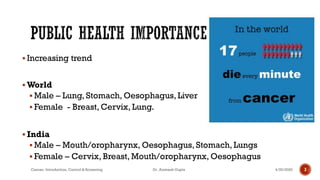
▪ Increasing trend
▪ World
▪ Male – Lung, Stomach, Oesophagus, Liver
▪ Female - Breast, Cervix, Lung.
▪ India
▪ Male – Mouth/oropharynx, Oesophagus, Stomach, Lungs
▪ Female – Cervix, Breast, Mouth/oropharynx, Oesophagus
34/29/2020Cancer- Introduction, Control & Screening Dr. Animesh Gupta
▪Sarcomas
▪arise from mesodermal cells constituting the various
connective tissues [e.g. fibrous tissue, fat and bone].
▪Carcinomas
▪arise from epithelial cells lining the internal surfaces of
various organs [e.g. mouth, oesophagus, intestine, uterus]
and from the skin epithelium.
▪Lymphomas, Myelomas, Leukaemias
▪arise from the cells of bone marrow and immune system.
44/29/2020Cancer- Introduction, Control & Screening Dr. Animesh Gupta
▪Primary tumour” denotes cancer in the organ of origin,
▪Secondary tumour” denotes cancer that has spread to
regional lymph nodes and distant organs.
▪Benign – non cancerous and do not spread
▪Malignant – cancerous and spread to other tissue/ organ
via bloodstream or lymphatic
4/29/2020Cancer- Introduction, Control & Screening Dr. Animesh Gupta 5
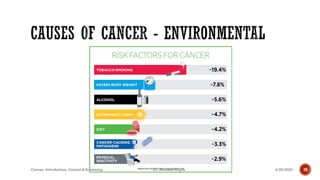
Environmental
▪ Tobacco
▪ Alcohol
▪ Dietary Factors
▪ Occupational exposures
▪ Viruses
▪ Parasites
▪ Customs, habits, Lifestyles
▪ Others – sunlight, pollution, drugs
Genetic
▪ Retinoblastoma in Children
▪ Leukemia in Mongols
4/29/2020Cancer- Introduction, Control & Screening Dr. Animesh Gupta 6
▪ Tobacco – cancers of lung, larynx, mouth, pharynx, oesophagus,
bladder, pancreas and probably kidney.
▪ Alcohol – excessive intake of alcoholic beverages is associated with
oesophageal and liver cancer.
▪ Dietary Factors – smoked fish related to stomach cancer, beef
consumption to bowel cancer, and high fat diet to breast cancer.
▪ Food additives & contaminants have fallen under suspicion as
causative agents.
▪ Occupational Exposure – exposure to benzene, arsenic, asbestos etc.
74/29/2020Cancer- Introduction, Control & Screening Dr. Animesh Gupta
▪ Viruses –
▪ Hepatitis B and C virus related to hepatocellular carcinoma
▪ Kaposi’s sarcoma related to HIV infection
▪ EBV related to Burkitt’s lymphoma
▪ Parasites
▪ Schistosomiasis related to bladder cancer
▪ Customs, habits, life styles
▪ tobacco & betel chewing with oral cancers, smoking with lung
cancers.
▪ Others
▪ Sunlight, radiation, air and water pollution, medications, pesticides.
84/29/2020Cancer- Introduction, Control & Screening Dr. Animesh Gupta
▪Genetic factors have long been suspected.
▪Retinoblastoma occurs in children of the same parents.
Mongols are more likely to develop leukaemia than
normal children.
▪There is a complex interrelationship between hereditary
susceptibility & environmental carcinogenic stimuli in the
causation of a number of cancers
4/29/2020Cancer- Introduction, Control & Screening Dr. Animesh Gupta 9
104/29/2020Cancer- Introduction, Control & Screening Dr. Animesh Gupta
4/29/2020Cancer- Introduction, Control & Screening Dr. Animesh Gupta
11
▪Consists of series of measures based on
✓present medical knowledge
✓in the fields of prevention, detection, diagnosis, treatment,
after care and rehabilitation
✓aimed at reducing significantly the no. of new cases,
increasing the no. of cures and reducing the invalidism due to
cancer
4/29/2020Cancer- Introduction, Control & Screening Dr. Animesh Gupta 12
Primary Prevention
▪ Control of tobacco & alcohol
consumption
▪ Personal Hygiene
▪ Radiation
▪ Occupational Exposures
▪ Immunization
▪ Foods & drugs
▪ Air pollution
▪ Treatment of precancerous lesion
▪ Legislation
▪ Cancer Education
Secondary Prevention
▪ Cancer Registration
▪ Hospital based registries
▪ Population based registries
▪ Early detection of cases
▪ Treatment
4/29/2020
Cancer- Introduction, Control & Screening Dr. Animesh Gupta
13
▪Treatment of precancerous lesion
▪Leukoplakia, Erythroplakia
▪Intestinal polyposis
▪Cervical tears, genital warts
▪Legislation
▪COTPA
▪The Air (Prevention & Control of Pollution) Act
4/29/2020Cancer- Introduction, Control & Screening Dr. Animesh Gupta 14
▪Cancer education
▪It is directed at high risk groups.
▪The aim of cancer education is to motivate people to seek
early diagnosis & early treatment.
▪Cancer organizations remind the public of early warning
signs [danger signals] of cancer
4/29/2020Cancer- Introduction, Control & Screening Dr. Animesh Gupta 15
▪ A lump or a hard area in breast
▪ A change in wart or mole
▪ A persistent change in bowel habits
▪ A persistent cough or hoarseness
▪ Excessive loss during menstrual periods or loss of blood
outside usual dates.
▪ Blood loss from any natural orifice
▪ A swelling that does not get better
▪ Unexplained loss of weight
4/29/2020Cancer- Introduction, Control & Screening Dr. Animesh Gupta 16
▪ C – Change in Bowel or Bladder habit
▪ A – A sore that does not heal
▪ U – Unusual bleeding or discharge
▪ T – Thickening or lump in the breast or elsewhere
▪ I – Indigestion or difficulty in swallowing
▪ O – Obvious change in wart or mole
▪ N – Nagging cough or hoarseness
▪ S – Significant weight loss (more than 10%)
Source: American Cancer Society
4/29/2020Cancer- Introduction, Control & Screening Dr. Animesh Gupta 17
Early detection of cases
▪ Cancer screening is the main weapon
for early detection of cases at a pre-
invasive or pre-malignant stage.
▪ It has to be conducted on a large
scale.
▪ It requires mobilization of all
available resources and development
of a cancer infrastructure starting at
the level of primary health care,
ending with complex cancer centers
or institutions at the state or national
levels.
Treatment
▪ Treatment facilities should be
available to all cancer patents.
▪ Certain forms of cancer are
amenable to surgical removal, while
some respond to radiation or
chemotherapy or both.
▪ For those who are beyond the curable
stage, goal must be to provide pain
relief.
4/29/2020Cancer- Introduction, Control & Screening Dr. Animesh Gupta 18
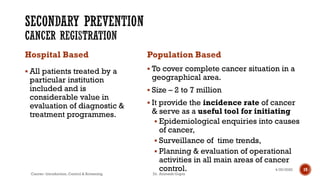
Hospital Based
▪ All patients treated by a
particular institution
included and is
considerable value in
evaluation of diagnostic &
treatment programmes.
Population Based
▪ To cover complete cancer situation in a
geographical area.
▪ Size – 2 to 7 million
▪ It provide the incidence rate of cancer
& serve as a useful tool for initiating
▪ Epidemiological enquiries into causes
of cancer,
▪ Surveillance of time trends,
▪ Planning & evaluation of operational
activities in all main areas of cancer
control. 194/29/2020
Cancer- Introduction, Control & Screening Dr. Animesh Gupta
4/29/2020Cancer- Introduction, Control & Screening Dr. Animesh Gupta
20
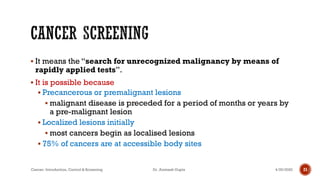
▪ It means the “search for unrecognized malignancy by means of
rapidly applied tests”.
▪ It is possible because
▪ Precancerous or premalignant lesions
▪ malignant disease is preceded for a period of months or years by
a pre-malignant lesion
▪ Localized lesions initially
▪ most cancers begin as localised lesions
▪ 75% of cancers are at accessible body sites
4/29/2020Cancer- Introduction, Control & Screening Dr. Animesh Gupta 21
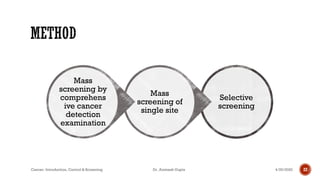
Selective
screening
Mass
screening of
single site
Mass
screening by
comprehens
ive cancer
detection
examination
4/29/2020Cancer- Introduction, Control & Screening Dr. Animesh Gupta 22
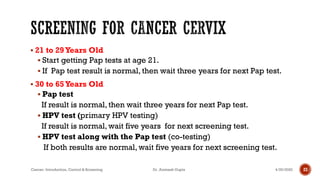
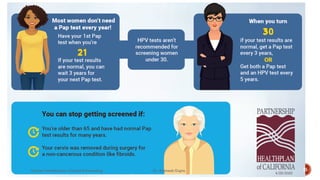
▪ 21 to 29Years Old
▪ Start getting Pap tests at age 21.
▪ If Pap test result is normal, then wait three years for next Pap test.
▪ 30 to 65Years Old
▪ Pap test
If result is normal, then wait three years for next Pap test.
▪ HPV test (primary HPV testing)
If result is normal, wait five years for next screening test.
▪ HPV test along with the Pap test (co-testing)
If both results are normal, wait five years for next screening test.
4/29/2020Cancer- Introduction, Control & Screening Dr. Animesh Gupta 23
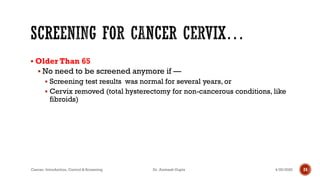
▪ Older Than 65
▪ No need to be screened anymore if —
▪ Screening test results was normal for several years, or
▪ Cervix removed (total hysterectomy for non-cancerous conditions, like
fibroids)
4/29/2020Cancer- Introduction, Control & Screening Dr. Animesh Gupta 24
4/29/2020
Cancer- Introduction, Control & Screening Dr. Animesh Gupta 25
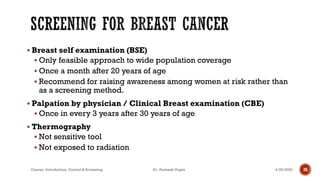
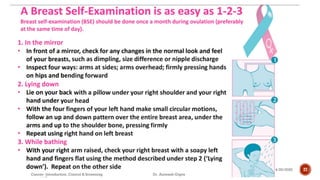
▪ Breast self examination (BSE)
▪ Only feasible approach to wide population coverage
▪ Once a month after 20 years of age
▪ Recommend for raising awareness among women at risk rather than
as a screening method.
▪ Palpation by physician / Clinical Breast examination (CBE)
▪ Once in every 3 years after 30 years of age
▪ Thermography
▪ Not sensitive tool
▪ Not exposed to radiation
4/29/2020Cancer- Introduction, Control & Screening Dr. Animesh Gupta 26
4/29/2020
Cancer- Introduction, Control & Screening Dr. Animesh Gupta
27
4/29/2020
Cancer- Introduction, Control & Screening Dr. Animesh Gupta
28
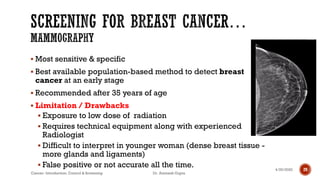
▪ Most sensitive & specific
▪ Best available population-based method to detect breast
cancer at an early stage
▪ Recommended after 35 years of age
▪ Limitation / Drawbacks
▪ Exposure to low dose of radiation
▪ Requires technical equipment along with experienced
Radiologist
▪ Difficult to interpret in younger woman (dense breast tissue -
more glands and ligaments)
▪ False positive or not accurate all the time. 4/29/2020
Cancer- Introduction, Control & Screening Dr. Animesh Gupta
29
▪Chest radiograph
▪Sputum cytology
▪Low-dose Spiral CT Scan (LDCT scan)
▪Series of very detailed pictures of areas inside the Lung
▪Indications
▪ Aged 55 to 74 years and in fairly good health, and
▪ Currently smoke or have quit within the past 15 years, and
▪ Have at least a 30-pack-year smoking history, and
4/29/2020Cancer- Introduction, Control & Screening Dr. Animesh Gupta 30
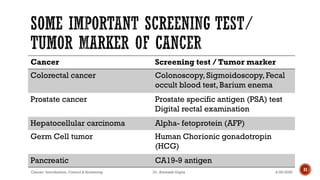
Cancer Screening test / Tumor marker
Colorectal cancer Colonoscopy, Sigmoidoscopy, Fecal
occult blood test, Barium enema
Prostate cancer Prostate specific antigen (PSA) test
Digital rectal examination
Hepatocellular carcinoma Alpha- fetoprotein (AFP)
Germ Cell tumor Human Chorionic gonadotropin
(HCG)
Pancreatic CA19-9 antigen
4/29/2020Cancer- Introduction, Control & Screening Dr. Animesh Gupta
31
4/29/2020Cancer- Introduction, Control & Screening Dr. Animesh Gupta 32
ThankYou
4/29/2020Cancer- Introduction, Control & Screening Dr. Animesh Gupta
33

Cancer - Introduction, Control & Screening

  • 1.
    Dr. Animesh Gupta MD,FDM,FAGE Associateprofessor Dept. of Community medicine, NMCH, Sasaram
  • 2.
    ▪Group of diseasescharacterized by: ▪An abnormal growth of cells ▪Ability to invade adjacent tissues and even distant organs ▪The eventual death of affected patient if the tumor has progressed beyond that stage when it can be successfully removed ▪Cancer can occur at any site or tissue of the body and may involve any type of cells. 24/29/2020Cancer- Introduction, Control & Screening Dr. Animesh Gupta
  • 3.
    ▪ Increasing trend ▪World ▪ Male – Lung, Stomach, Oesophagus, Liver ▪ Female - Breast, Cervix, Lung. ▪ India ▪ Male – Mouth/oropharynx, Oesophagus, Stomach, Lungs ▪ Female – Cervix, Breast, Mouth/oropharynx, Oesophagus 34/29/2020Cancer- Introduction, Control & Screening Dr. Animesh Gupta
  • 4.
    ▪Sarcomas ▪arise from mesodermalcells constituting the various connective tissues [e.g. fibrous tissue, fat and bone]. ▪Carcinomas ▪arise from epithelial cells lining the internal surfaces of various organs [e.g. mouth, oesophagus, intestine, uterus] and from the skin epithelium. ▪Lymphomas, Myelomas, Leukaemias ▪arise from the cells of bone marrow and immune system. 44/29/2020Cancer- Introduction, Control & Screening Dr. Animesh Gupta
  • 5.
    ▪Primary tumour” denotescancer in the organ of origin, ▪Secondary tumour” denotes cancer that has spread to regional lymph nodes and distant organs. ▪Benign – non cancerous and do not spread ▪Malignant – cancerous and spread to other tissue/ organ via bloodstream or lymphatic 4/29/2020Cancer- Introduction, Control & Screening Dr. Animesh Gupta 5
  • 6.
    Environmental ▪ Tobacco ▪ Alcohol ▪Dietary Factors ▪ Occupational exposures ▪ Viruses ▪ Parasites ▪ Customs, habits, Lifestyles ▪ Others – sunlight, pollution, drugs Genetic ▪ Retinoblastoma in Children ▪ Leukemia in Mongols 4/29/2020Cancer- Introduction, Control & Screening Dr. Animesh Gupta 6
  • 7.
    ▪ Tobacco –cancers of lung, larynx, mouth, pharynx, oesophagus, bladder, pancreas and probably kidney. ▪ Alcohol – excessive intake of alcoholic beverages is associated with oesophageal and liver cancer. ▪ Dietary Factors – smoked fish related to stomach cancer, beef consumption to bowel cancer, and high fat diet to breast cancer. ▪ Food additives & contaminants have fallen under suspicion as causative agents. ▪ Occupational Exposure – exposure to benzene, arsenic, asbestos etc. 74/29/2020Cancer- Introduction, Control & Screening Dr. Animesh Gupta
  • 8.
    ▪ Viruses – ▪Hepatitis B and C virus related to hepatocellular carcinoma ▪ Kaposi’s sarcoma related to HIV infection ▪ EBV related to Burkitt’s lymphoma ▪ Parasites ▪ Schistosomiasis related to bladder cancer ▪ Customs, habits, life styles ▪ tobacco & betel chewing with oral cancers, smoking with lung cancers. ▪ Others ▪ Sunlight, radiation, air and water pollution, medications, pesticides. 84/29/2020Cancer- Introduction, Control & Screening Dr. Animesh Gupta
  • 9.
    ▪Genetic factors havelong been suspected. ▪Retinoblastoma occurs in children of the same parents. Mongols are more likely to develop leukaemia than normal children. ▪There is a complex interrelationship between hereditary susceptibility & environmental carcinogenic stimuli in the causation of a number of cancers 4/29/2020Cancer- Introduction, Control & Screening Dr. Animesh Gupta 9
  • 10.
    104/29/2020Cancer- Introduction, Control& Screening Dr. Animesh Gupta
  • 11.
    4/29/2020Cancer- Introduction, Control& Screening Dr. Animesh Gupta 11
  • 12.
    ▪Consists of seriesof measures based on ✓present medical knowledge ✓in the fields of prevention, detection, diagnosis, treatment, after care and rehabilitation ✓aimed at reducing significantly the no. of new cases, increasing the no. of cures and reducing the invalidism due to cancer 4/29/2020Cancer- Introduction, Control & Screening Dr. Animesh Gupta 12
  • 13.
    Primary Prevention ▪ Controlof tobacco & alcohol consumption ▪ Personal Hygiene ▪ Radiation ▪ Occupational Exposures ▪ Immunization ▪ Foods & drugs ▪ Air pollution ▪ Treatment of precancerous lesion ▪ Legislation ▪ Cancer Education Secondary Prevention ▪ Cancer Registration ▪ Hospital based registries ▪ Population based registries ▪ Early detection of cases ▪ Treatment 4/29/2020 Cancer- Introduction, Control & Screening Dr. Animesh Gupta 13
  • 14.
    ▪Treatment of precancerouslesion ▪Leukoplakia, Erythroplakia ▪Intestinal polyposis ▪Cervical tears, genital warts ▪Legislation ▪COTPA ▪The Air (Prevention & Control of Pollution) Act 4/29/2020Cancer- Introduction, Control & Screening Dr. Animesh Gupta 14
  • 15.
    ▪Cancer education ▪It isdirected at high risk groups. ▪The aim of cancer education is to motivate people to seek early diagnosis & early treatment. ▪Cancer organizations remind the public of early warning signs [danger signals] of cancer 4/29/2020Cancer- Introduction, Control & Screening Dr. Animesh Gupta 15
  • 16.
    ▪ A lumpor a hard area in breast ▪ A change in wart or mole ▪ A persistent change in bowel habits ▪ A persistent cough or hoarseness ▪ Excessive loss during menstrual periods or loss of blood outside usual dates. ▪ Blood loss from any natural orifice ▪ A swelling that does not get better ▪ Unexplained loss of weight 4/29/2020Cancer- Introduction, Control & Screening Dr. Animesh Gupta 16
  • 17.
    ▪ C –Change in Bowel or Bladder habit ▪ A – A sore that does not heal ▪ U – Unusual bleeding or discharge ▪ T – Thickening or lump in the breast or elsewhere ▪ I – Indigestion or difficulty in swallowing ▪ O – Obvious change in wart or mole ▪ N – Nagging cough or hoarseness ▪ S – Significant weight loss (more than 10%) Source: American Cancer Society 4/29/2020Cancer- Introduction, Control & Screening Dr. Animesh Gupta 17
  • 18.
    Early detection ofcases ▪ Cancer screening is the main weapon for early detection of cases at a pre- invasive or pre-malignant stage. ▪ It has to be conducted on a large scale. ▪ It requires mobilization of all available resources and development of a cancer infrastructure starting at the level of primary health care, ending with complex cancer centers or institutions at the state or national levels. Treatment ▪ Treatment facilities should be available to all cancer patents. ▪ Certain forms of cancer are amenable to surgical removal, while some respond to radiation or chemotherapy or both. ▪ For those who are beyond the curable stage, goal must be to provide pain relief. 4/29/2020Cancer- Introduction, Control & Screening Dr. Animesh Gupta 18
  • 19.
    Hospital Based ▪ Allpatients treated by a particular institution included and is considerable value in evaluation of diagnostic & treatment programmes. Population Based ▪ To cover complete cancer situation in a geographical area. ▪ Size – 2 to 7 million ▪ It provide the incidence rate of cancer & serve as a useful tool for initiating ▪ Epidemiological enquiries into causes of cancer, ▪ Surveillance of time trends, ▪ Planning & evaluation of operational activities in all main areas of cancer control. 194/29/2020 Cancer- Introduction, Control & Screening Dr. Animesh Gupta
  • 20.
    4/29/2020Cancer- Introduction, Control& Screening Dr. Animesh Gupta 20
  • 21.
    ▪ It meansthe “search for unrecognized malignancy by means of rapidly applied tests”. ▪ It is possible because ▪ Precancerous or premalignant lesions ▪ malignant disease is preceded for a period of months or years by a pre-malignant lesion ▪ Localized lesions initially ▪ most cancers begin as localised lesions ▪ 75% of cancers are at accessible body sites 4/29/2020Cancer- Introduction, Control & Screening Dr. Animesh Gupta 21
  • 22.
    Selective screening Mass screening of single site Mass screeningby comprehens ive cancer detection examination 4/29/2020Cancer- Introduction, Control & Screening Dr. Animesh Gupta 22
  • 23.
    ▪ 21 to29Years Old ▪ Start getting Pap tests at age 21. ▪ If Pap test result is normal, then wait three years for next Pap test. ▪ 30 to 65Years Old ▪ Pap test If result is normal, then wait three years for next Pap test. ▪ HPV test (primary HPV testing) If result is normal, wait five years for next screening test. ▪ HPV test along with the Pap test (co-testing) If both results are normal, wait five years for next screening test. 4/29/2020Cancer- Introduction, Control & Screening Dr. Animesh Gupta 23
  • 24.
    ▪ Older Than65 ▪ No need to be screened anymore if — ▪ Screening test results was normal for several years, or ▪ Cervix removed (total hysterectomy for non-cancerous conditions, like fibroids) 4/29/2020Cancer- Introduction, Control & Screening Dr. Animesh Gupta 24
  • 25.
    4/29/2020 Cancer- Introduction, Control& Screening Dr. Animesh Gupta 25
  • 26.
    ▪ Breast selfexamination (BSE) ▪ Only feasible approach to wide population coverage ▪ Once a month after 20 years of age ▪ Recommend for raising awareness among women at risk rather than as a screening method. ▪ Palpation by physician / Clinical Breast examination (CBE) ▪ Once in every 3 years after 30 years of age ▪ Thermography ▪ Not sensitive tool ▪ Not exposed to radiation 4/29/2020Cancer- Introduction, Control & Screening Dr. Animesh Gupta 26
  • 27.
    4/29/2020 Cancer- Introduction, Control& Screening Dr. Animesh Gupta 27
  • 28.
    4/29/2020 Cancer- Introduction, Control& Screening Dr. Animesh Gupta 28
  • 29.
    ▪ Most sensitive& specific ▪ Best available population-based method to detect breast cancer at an early stage ▪ Recommended after 35 years of age ▪ Limitation / Drawbacks ▪ Exposure to low dose of radiation ▪ Requires technical equipment along with experienced Radiologist ▪ Difficult to interpret in younger woman (dense breast tissue - more glands and ligaments) ▪ False positive or not accurate all the time. 4/29/2020 Cancer- Introduction, Control & Screening Dr. Animesh Gupta 29
  • 30.
    ▪Chest radiograph ▪Sputum cytology ▪Low-doseSpiral CT Scan (LDCT scan) ▪Series of very detailed pictures of areas inside the Lung ▪Indications ▪ Aged 55 to 74 years and in fairly good health, and ▪ Currently smoke or have quit within the past 15 years, and ▪ Have at least a 30-pack-year smoking history, and 4/29/2020Cancer- Introduction, Control & Screening Dr. Animesh Gupta 30
  • 31.
    Cancer Screening test/ Tumor marker Colorectal cancer Colonoscopy, Sigmoidoscopy, Fecal occult blood test, Barium enema Prostate cancer Prostate specific antigen (PSA) test Digital rectal examination Hepatocellular carcinoma Alpha- fetoprotein (AFP) Germ Cell tumor Human Chorionic gonadotropin (HCG) Pancreatic CA19-9 antigen 4/29/2020Cancer- Introduction, Control & Screening Dr. Animesh Gupta 31
  • 32.
    4/29/2020Cancer- Introduction, Control& Screening Dr. Animesh Gupta 32
  • 33.
    ThankYou 4/29/2020Cancer- Introduction, Control& Screening Dr. Animesh Gupta 33