Dr. Animesh Gupta
MD,FDM,FAGE
Associate Professor, Dept. of Community Medicine, NMCH, Sasaram (Bihar)
4/25/2020Case Control Study Dr Animesh Gupta
1
At the end of the class, the students should know
▪ Different types of epidemiological methods
▪ Salient features of case control study
▪ Steps for conducting case control study
▪ Matching
▪ Odds ratio
▪ Bias in case control study
▪ Advantages & disadvantages in case control study
4/25/2020Case Control Study Dr Animesh Gupta 2
OBSERVATIONAL STUDIES
DESCRIPTIVE STUDY ANALYTICAL STUDIES
✓ TIME
✓ PLACE
✓ PERSON
➢ ECOLOGICAL STUDY
➢ CROSS SECTIONAL STUDY
➢ CASE-CONTROL STUDY
➢ COHORT STUDY
EXPEREMENTAL STUDIES
➢ RANDOMIZED CONTROLLED TRIAL (RCT)
➢FIELD TRIAL
➢COMMUNITY TRIAL 4/25/2020Case Control Study Dr Animesh Gupta 3
▪Makes careful measurement of patterns of exposure and
disease in population
▪Comparison group
▪The object is not to formulate but to test the hypothesis.
▪To evaluate an association between exposure and disease.
4/25/2020Case Control Study Dr Animesh Gupta 4
▪The observational epidemiologic study of persons with the
disease (or other outcome variable) of interest and a
suitable control (comparison/ reference) group of persons
without the disease. (- John M Last)
▪It is an observational study in which subjects are sampled
based upon presence or absence of disease and then their
prior exposure status is determined.
4/25/2020Case Control Study Dr Animesh Gupta 5
▪ Also knowns as “retrospective study”
▪ From effect to cause
▪ The case control method has three distinct features:
▪ Both exposure and out come have occurred before the start of
the study.
▪ The study proceeds backwards from effect to cause.
▪ It uses a control or comparison group to support or refute
an inference.
4/25/2020Case Control Study Dr Animesh Gupta 6
4/25/2020Case Control Study Dr Animesh Gupta 7
1. Selection of cases and controls
2. Matching
3. Measurement of exposure
4. Analysis & interpretation
4/25/2020Case Control Study Dr Animesh Gupta 8
▪Study begins with cases, i.e. the patients in whom the disease
has already occurred.
▪Cases were enquired for all the details of their exposure to the
suspected cause.
▪Definition of case:
▪ Diagnostic criteria : Clear cut diagnostic criteria of the disease
and its stage.
▪ Eligibility criteria : It is always advisable to take the incident
cases,since the prevalent cases might have changed their
exposure status due to medical advice etc.
4/25/2020Case Control Study Dr Animesh Gupta 9
▪Sources of Cases
▪ Hospitals
▪ Single hospital or a network of hospitals, admitted during a specified
period of time.
▪ The entire case series or a random sample of it is selected for study.
▪ General population
▪ Defined geographic area during a specified period of time
▪ Can be taken data through a survey, a disease registry or hospital
network.
▪ The cases should be fairly representative of all cases in the
community. 4/25/2020Case Control Study Dr Animesh Gupta 10
▪ Controls must be free from disease
▪ Must be similar to the cases as far as possible except for the
absence of disease.
▪ Sources:
▪ Hospital control
✓Different illness other than the study disease
▪ Relatives
✓Except genetic condition study
▪ Neighborhood
✓Same locality/ working in same area/factory
▪ General population
✓Defined geographic areas
4/25/2020Case Control Study Dr Animesh Gupta 11
▪Select controls from various diagnostic groups, so no
particular risk factors will be over represented
▪Select controls from patients with acute conditions, so
earlier exposures could not have been influenced by the
condition
▪Do not select patients who have multiple concurrent
conditions.
▪Do not select patients with diagnoses known to be related
to the risk factor of interest
4/25/2020Case Control Study Dr Animesh Gupta 12
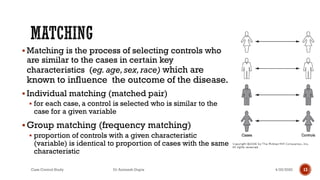
▪ Matching is the process of selecting controls who
are similar to the cases in certain key
characteristics (eg.age,sex,race) which are
known to influence the outcome of the disease.
▪ Individual matching (matched pair)
▪ for each case, a control is selected who is similar to the
case for a given variable
▪Group matching (frequency matching)
▪ proportion of controls with a given characteristic
(variable) is identical to proportion of cases with the same
characteristic
4/25/2020Case Control Study Dr Animesh Gupta 13
▪Defined as one which is associated both with exposure and
disease and is distributed unequally in study and control
groups.
▪Alcohol & Oesophageal cancer study – smoking is a
confounding factor.
4/25/2020Case Control Study Dr Animesh Gupta 14
To find out
▪Exposure rate among cases and controls to suspected
factor.
▪Estimation of disease risk associated with exposure (Odds
ratio).
4/25/2020Case Control Study Dr Animesh Gupta 15
Cases Controls
Risk factor + a b
Risk factor -- c d
4/25/2020Case Control Study Dr Animesh Gupta 16
▪Among cases = a/a+c
▪Among controls = b/b+d
4/25/2020Case Control Study Dr Animesh Gupta 17
▪Odds = is the ratio of the probability that an event will
happen to the probability that it will not happen
▪Odds ratio / cross product ratio
= ad/bc
▪It interprets that odds of cases being exposed are so many
times higher compared to the odds of controls being
exposed.
4/25/2020Case Control Study Dr Animesh Gupta 18
▪Based on 3 assumption that
▪Disease being investigated must be relatively rare.
In fact majority of the chronic disease have a low incidence in
the general population.
▪The cases must be representative of those with the disease.
▪The controls must be representative of those without the
disease.
4/25/2020Case Control Study Dr Animesh Gupta 19
It is systematic error in the determination of the association
between the exposure and the disease.
▪Bias due to confounding factor
▪Memory or recall bias
▪Selection bias
▪Interviewer’s / Observer bias
▪Berkesonian bias ( Dr Joseph Berkeson)
▪ Different rates of admission to the hospital with different
disease.
4/25/2020Case Control Study Dr Animesh Gupta 20
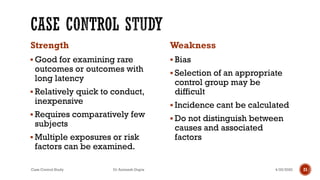
Strength
▪ Good for examining rare
outcomes or outcomes with
long latency
▪ Relatively quick to conduct,
inexpensive
▪ Requires comparatively few
subjects
▪ Multiple exposures or risk
factors can be examined.
Weakness
▪ Bias
▪ Selection of an appropriate
control group may be
difficult
▪ Incidence cant be calculated
▪ Do not distinguish between
causes and associated
factors
4/25/2020Case Control Study Dr Animesh Gupta 21
▪It is usually conducted before a Cohort or Experimental
Study to identify the possible etiology of the disease.
▪ It costs relatively less and can be conducted in a shorter time
▪For a given disease, a case control study can investigate
multiple exposures (when the real exposure is not known)
▪Case control study is preferred when the disease is rare
because investigator can intentionally search for the cases.
4/25/2020Case Control Study Dr Animesh Gupta 22
Thank You
4/25/2020Case Control Study Dr Animesh Gupta
23

Case Control Study

  • 1.
    Dr. Animesh Gupta MD,FDM,FAGE AssociateProfessor, Dept. of Community Medicine, NMCH, Sasaram (Bihar) 4/25/2020Case Control Study Dr Animesh Gupta 1
  • 2.
    At the endof the class, the students should know ▪ Different types of epidemiological methods ▪ Salient features of case control study ▪ Steps for conducting case control study ▪ Matching ▪ Odds ratio ▪ Bias in case control study ▪ Advantages & disadvantages in case control study 4/25/2020Case Control Study Dr Animesh Gupta 2
  • 3.
    OBSERVATIONAL STUDIES DESCRIPTIVE STUDYANALYTICAL STUDIES ✓ TIME ✓ PLACE ✓ PERSON ➢ ECOLOGICAL STUDY ➢ CROSS SECTIONAL STUDY ➢ CASE-CONTROL STUDY ➢ COHORT STUDY EXPEREMENTAL STUDIES ➢ RANDOMIZED CONTROLLED TRIAL (RCT) ➢FIELD TRIAL ➢COMMUNITY TRIAL 4/25/2020Case Control Study Dr Animesh Gupta 3
  • 4.
    ▪Makes careful measurementof patterns of exposure and disease in population ▪Comparison group ▪The object is not to formulate but to test the hypothesis. ▪To evaluate an association between exposure and disease. 4/25/2020Case Control Study Dr Animesh Gupta 4
  • 5.
    ▪The observational epidemiologicstudy of persons with the disease (or other outcome variable) of interest and a suitable control (comparison/ reference) group of persons without the disease. (- John M Last) ▪It is an observational study in which subjects are sampled based upon presence or absence of disease and then their prior exposure status is determined. 4/25/2020Case Control Study Dr Animesh Gupta 5
  • 6.
    ▪ Also knownsas “retrospective study” ▪ From effect to cause ▪ The case control method has three distinct features: ▪ Both exposure and out come have occurred before the start of the study. ▪ The study proceeds backwards from effect to cause. ▪ It uses a control or comparison group to support or refute an inference. 4/25/2020Case Control Study Dr Animesh Gupta 6
  • 7.
    4/25/2020Case Control StudyDr Animesh Gupta 7
  • 8.
    1. Selection ofcases and controls 2. Matching 3. Measurement of exposure 4. Analysis & interpretation 4/25/2020Case Control Study Dr Animesh Gupta 8
  • 9.
    ▪Study begins withcases, i.e. the patients in whom the disease has already occurred. ▪Cases were enquired for all the details of their exposure to the suspected cause. ▪Definition of case: ▪ Diagnostic criteria : Clear cut diagnostic criteria of the disease and its stage. ▪ Eligibility criteria : It is always advisable to take the incident cases,since the prevalent cases might have changed their exposure status due to medical advice etc. 4/25/2020Case Control Study Dr Animesh Gupta 9
  • 10.
    ▪Sources of Cases ▪Hospitals ▪ Single hospital or a network of hospitals, admitted during a specified period of time. ▪ The entire case series or a random sample of it is selected for study. ▪ General population ▪ Defined geographic area during a specified period of time ▪ Can be taken data through a survey, a disease registry or hospital network. ▪ The cases should be fairly representative of all cases in the community. 4/25/2020Case Control Study Dr Animesh Gupta 10
  • 11.
    ▪ Controls mustbe free from disease ▪ Must be similar to the cases as far as possible except for the absence of disease. ▪ Sources: ▪ Hospital control ✓Different illness other than the study disease ▪ Relatives ✓Except genetic condition study ▪ Neighborhood ✓Same locality/ working in same area/factory ▪ General population ✓Defined geographic areas 4/25/2020Case Control Study Dr Animesh Gupta 11
  • 12.
    ▪Select controls fromvarious diagnostic groups, so no particular risk factors will be over represented ▪Select controls from patients with acute conditions, so earlier exposures could not have been influenced by the condition ▪Do not select patients who have multiple concurrent conditions. ▪Do not select patients with diagnoses known to be related to the risk factor of interest 4/25/2020Case Control Study Dr Animesh Gupta 12
  • 13.
    ▪ Matching isthe process of selecting controls who are similar to the cases in certain key characteristics (eg.age,sex,race) which are known to influence the outcome of the disease. ▪ Individual matching (matched pair) ▪ for each case, a control is selected who is similar to the case for a given variable ▪Group matching (frequency matching) ▪ proportion of controls with a given characteristic (variable) is identical to proportion of cases with the same characteristic 4/25/2020Case Control Study Dr Animesh Gupta 13
  • 14.
    ▪Defined as onewhich is associated both with exposure and disease and is distributed unequally in study and control groups. ▪Alcohol & Oesophageal cancer study – smoking is a confounding factor. 4/25/2020Case Control Study Dr Animesh Gupta 14
  • 15.
    To find out ▪Exposurerate among cases and controls to suspected factor. ▪Estimation of disease risk associated with exposure (Odds ratio). 4/25/2020Case Control Study Dr Animesh Gupta 15
  • 16.
    Cases Controls Risk factor+ a b Risk factor -- c d 4/25/2020Case Control Study Dr Animesh Gupta 16
  • 17.
    ▪Among cases =a/a+c ▪Among controls = b/b+d 4/25/2020Case Control Study Dr Animesh Gupta 17
  • 18.
    ▪Odds = isthe ratio of the probability that an event will happen to the probability that it will not happen ▪Odds ratio / cross product ratio = ad/bc ▪It interprets that odds of cases being exposed are so many times higher compared to the odds of controls being exposed. 4/25/2020Case Control Study Dr Animesh Gupta 18
  • 19.
    ▪Based on 3assumption that ▪Disease being investigated must be relatively rare. In fact majority of the chronic disease have a low incidence in the general population. ▪The cases must be representative of those with the disease. ▪The controls must be representative of those without the disease. 4/25/2020Case Control Study Dr Animesh Gupta 19
  • 20.
    It is systematicerror in the determination of the association between the exposure and the disease. ▪Bias due to confounding factor ▪Memory or recall bias ▪Selection bias ▪Interviewer’s / Observer bias ▪Berkesonian bias ( Dr Joseph Berkeson) ▪ Different rates of admission to the hospital with different disease. 4/25/2020Case Control Study Dr Animesh Gupta 20
  • 21.
    Strength ▪ Good forexamining rare outcomes or outcomes with long latency ▪ Relatively quick to conduct, inexpensive ▪ Requires comparatively few subjects ▪ Multiple exposures or risk factors can be examined. Weakness ▪ Bias ▪ Selection of an appropriate control group may be difficult ▪ Incidence cant be calculated ▪ Do not distinguish between causes and associated factors 4/25/2020Case Control Study Dr Animesh Gupta 21
  • 22.
    ▪It is usuallyconducted before a Cohort or Experimental Study to identify the possible etiology of the disease. ▪ It costs relatively less and can be conducted in a shorter time ▪For a given disease, a case control study can investigate multiple exposures (when the real exposure is not known) ▪Case control study is preferred when the disease is rare because investigator can intentionally search for the cases. 4/25/2020Case Control Study Dr Animesh Gupta 22
  • 23.
    Thank You 4/25/2020Case ControlStudy Dr Animesh Gupta 23