Dr. Animesh Gupta
MBBS, MD, FAGE
Assistant Professor
Dept. of Community Medicine, SIMS & RC
ļ‚§ WHO and UNICEF recognized the need to strengthen child-health
activities in the country and decided to launch IMCI.
ļ‚§ IMNCI strategy is one of the main interventions under RCH-
II/NRHM, that focuses on Preventive, Promotive and Curative
aspects of program.
ļ‚§ IMNCI is an integrated approach to child health that focuses on the
well-being of the whole child.
ļ‚§ IMNCI aims to reduce death, illness and disability, and to promote
improved growth and development among children under five years
of age.
7/13/2017 2
ļ‚§ Inclusion of 0-7 days age group (as against 1 week to 5 years in
IMCI) to address the neonatal mortality challenge.
ļ‚§ The total duration of training was reduced from 11 days to 8 days
out of which, half of the training time was earmarked for the
management of the young infants, 0 to 2 months.
ļ‚§ Incorporating National guideline on Malaria, Anemia, Vitamin A
supplementation and Immunization schedule.
ļ‚§ Home-based care of newborns and young infants was included.
7/13/2017 3
ļ‚§ Integrated approach is child centred
ļ‚§ Five conditions : Pneumonia (ARI), Diarrhoea, Measles, Malaria and
Malnutrition are major cause of Death.
ļ‚§ Children likely to be suffering from more than one condition.
ļ‚§ Making a single diagnosis may be difficult.
ļ‚§ Such children often need combined therapy for successful treatment.
7/13/2017 4
ļ‚§Reducing infant mortality
ļ‚§Reducing the incidence and seriousness of illnesses and
health problems
ļ‚§Improving growth and development during the first five
years of a child's life
7/13/2017 5
7/13/2017 6
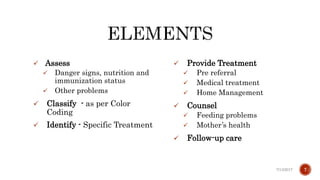
 Assess
 Danger signs, nutrition and
immunization status
 Other problems
 Classify - as per Color
Coding
 Identify - Specific Treatment
 Provide Treatment
 Pre referral
 Medical treatment
 Home Management
 Counsel
 Feeding problems
 Mother’s health
 Follow-up care
7/13/2017 7
ļ‚§ Only a limited number of carefully-selected clinical signs are
considered, based on their sensitivity and specificity, to detect the
disease.
ļ‚§ A combination of these signs helps in arriving at the child's
classification, rather than a diagnosis.
ļ‚§ Classification(s) also indicates the severity of the condition.
7/13/2017 8
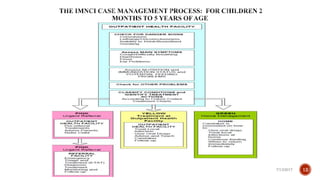
PINK : suggests hospital referral or admission
(Child needs urgent referral)
YELLOW : indicates initiation of treatment
(Child needs specific medical treatment and
advise)
GREEN : calls for home treatment
(Child needs no medicine, advise home care)
7/13/2017 9
7/13/2017 10
7/13/2017 11
7/13/2017 12
7/13/2017 13
ļ‚§ Care of Newborns and Young Infants (infants under 2 months):
ļ‚§ Keeping the child warm.
ļ‚§ Cord, skin and eye care.
ļ‚§ Recognition of illness in newborn , management and/or referral.
ļ‚§ Immunization.
7/13/2017 14
ļ‚§ Home visits in the postnatal period:
ļ‚§ Home visits by health workers (ANMs, AWWs, ASHAs ).
ļ‚§ Three home visits are to be provided to every newborn:
ļ‚§ 1st on the day of birth (day 1) & next 2 visit on day 3 & 7.
ļ‚§ For low birth weight babies, 3 more visits: on Day 14, 21 and 28.
ļ‚§ Care of mothers during the post-partum period.
7/13/2017 15
ļ‚§ Management of diarrhoea, acute respiratory infections
(pneumonia), malaria, measles, acute ear infection, malnutrition
and anaemia.
ļ‚§ Recognition of illness / at risk conditions and management/referral
ļ‚§ Prevention and management of Iron and Vitamin A deficiency.
ļ‚§ Feeding Counselling for all children below 2 years
ļ‚§ Feeding Counselling for malnourished children between 2 to 5
years.
ļ‚§ Immunization.
7/13/2017 16
7/13/2017 17
1. Operational Guidelines for Implementation of Integrated Management of
Neonatal and Childhood Illness
2. Integrated management of childhood illness. Available from: URL:
http://www.unicef.org/health/23958_imci.html
3. Kishore J. National Health Programs of India, 11th edition. New Delhi: Century;
2014
4. Student’s Handbook for IMNCI. Integrated Management of Neonatal and
Childhood Illness. Ministry of Health and Family Welfare , Government of India;
2003
5. K Park, Textbook of Preventive and Social Medicine, 23rd edition. Bhanot
Publisher, 2015
7/13/2017 18
7/13/2017 19

IMNCI

  • 1.
    Dr. Animesh Gupta MBBS,MD, FAGE Assistant Professor Dept. of Community Medicine, SIMS & RC
  • 2.
    ļ‚§ WHO andUNICEF recognized the need to strengthen child-health activities in the country and decided to launch IMCI. ļ‚§ IMNCI strategy is one of the main interventions under RCH- II/NRHM, that focuses on Preventive, Promotive and Curative aspects of program. ļ‚§ IMNCI is an integrated approach to child health that focuses on the well-being of the whole child. ļ‚§ IMNCI aims to reduce death, illness and disability, and to promote improved growth and development among children under five years of age. 7/13/2017 2
  • 3.
    ļ‚§ Inclusion of0-7 days age group (as against 1 week to 5 years in IMCI) to address the neonatal mortality challenge. ļ‚§ The total duration of training was reduced from 11 days to 8 days out of which, half of the training time was earmarked for the management of the young infants, 0 to 2 months. ļ‚§ Incorporating National guideline on Malaria, Anemia, Vitamin A supplementation and Immunization schedule. ļ‚§ Home-based care of newborns and young infants was included. 7/13/2017 3
  • 4.
    ļ‚§ Integrated approachis child centred ļ‚§ Five conditions : Pneumonia (ARI), Diarrhoea, Measles, Malaria and Malnutrition are major cause of Death. ļ‚§ Children likely to be suffering from more than one condition. ļ‚§ Making a single diagnosis may be difficult. ļ‚§ Such children often need combined therapy for successful treatment. 7/13/2017 4
  • 5.
    ļ‚§Reducing infant mortality ļ‚§Reducingthe incidence and seriousness of illnesses and health problems ļ‚§Improving growth and development during the first five years of a child's life 7/13/2017 5
  • 6.
  • 7.
     Assess  Dangersigns, nutrition and immunization status  Other problems  Classify - as per Color Coding  Identify - Specific Treatment  Provide Treatment  Pre referral  Medical treatment  Home Management  Counsel  Feeding problems  Mother’s health  Follow-up care 7/13/2017 7
  • 8.
    ļ‚§ Only alimited number of carefully-selected clinical signs are considered, based on their sensitivity and specificity, to detect the disease. ļ‚§ A combination of these signs helps in arriving at the child's classification, rather than a diagnosis. ļ‚§ Classification(s) also indicates the severity of the condition. 7/13/2017 8
  • 9.
    PINK : suggestshospital referral or admission (Child needs urgent referral) YELLOW : indicates initiation of treatment (Child needs specific medical treatment and advise) GREEN : calls for home treatment (Child needs no medicine, advise home care) 7/13/2017 9
  • 10.
  • 11.
  • 12.
  • 13.
  • 14.
    ļ‚§ Care ofNewborns and Young Infants (infants under 2 months): ļ‚§ Keeping the child warm. ļ‚§ Cord, skin and eye care. ļ‚§ Recognition of illness in newborn , management and/or referral. ļ‚§ Immunization. 7/13/2017 14
  • 15.
    ļ‚§ Home visitsin the postnatal period: ļ‚§ Home visits by health workers (ANMs, AWWs, ASHAs ). ļ‚§ Three home visits are to be provided to every newborn: ļ‚§ 1st on the day of birth (day 1) & next 2 visit on day 3 & 7. ļ‚§ For low birth weight babies, 3 more visits: on Day 14, 21 and 28. ļ‚§ Care of mothers during the post-partum period. 7/13/2017 15
  • 16.
    ļ‚§ Management ofdiarrhoea, acute respiratory infections (pneumonia), malaria, measles, acute ear infection, malnutrition and anaemia. ļ‚§ Recognition of illness / at risk conditions and management/referral ļ‚§ Prevention and management of Iron and Vitamin A deficiency. ļ‚§ Feeding Counselling for all children below 2 years ļ‚§ Feeding Counselling for malnourished children between 2 to 5 years. ļ‚§ Immunization. 7/13/2017 16
  • 17.
  • 18.
    1. Operational Guidelinesfor Implementation of Integrated Management of Neonatal and Childhood Illness 2. Integrated management of childhood illness. Available from: URL: http://www.unicef.org/health/23958_imci.html 3. Kishore J. National Health Programs of India, 11th edition. New Delhi: Century; 2014 4. Student’s Handbook for IMNCI. Integrated Management of Neonatal and Childhood Illness. Ministry of Health and Family Welfare , Government of India; 2003 5. K Park, Textbook of Preventive and Social Medicine, 23rd edition. Bhanot Publisher, 2015 7/13/2017 18
  • 19.