GOOD
AFTERNOON
EVALUATION OF A
NATIONAL HEALTH
PROGRAMME
Dr. Rahulputra Gajbhiye
Jr II
Seminar
 Introduction
 What is Evaluation? … Definition of evaluation
 Types of evaluation
 Principles of evaluation
 The evaluation process
 National Health programmes
 Evaluation of RNTCP
 References
INTRODUCTION
Health services have become more complex
There has been a growing concern about their
functioning both in the developed and developing
nations
Questions are raised about the quality of medical care,
utilization and coverage of health services, benefits to
community health and improvement in the health status
of the recipients of care
An evaluation study addresses itself to above issues
So, program evaluation is an essential organizational
practice in public health
However, it is not practiced consistently across program
areas, nor is it sufficiently well-integrated into the day-to-
day management of most programs
Thus, a framework for understanding program
evaluation and facilitating integration of evaluation
throughout the public health system is needed
The mandate to fulfil society’s interests and
assure healthy conditions and quality services
puts public health in frequent and compelling
contact with the legal system.
Public health system employ law as a tool to
achieve its goal. Thus these laws play a unique
role in ensuring the population’s health.
The purposes of this seminar is to:
summarize the essential elements of program
evaluation;
provide a framework for conducting effective program
evaluations;
clarify the steps in program evaluation;
review standards for effective program evaluation; and
address misconceptions regarding the purposes and
methods of program evaluation
What is Evaluation ?
And
Definition of evaluation
“Research seeks to prove,
evaluation seeks to improve…”
M.Q. Patton
• Evaluation has its origin from the Latin word “Valupure”
which means the value of a particular thing, idea or
action
• Evaluation means finding out the value of something.
• Evaluation, thus, helps us to understand the worth,
quality, significance amount, degree or condition of any
intervention desired to tackle a social problem
• Evaluation simply refers to the procedures of fact finding
Its began in the field of education
Strengthened during the 1960’s emphasis on social
programs and determining their effect on society
Further strengthened during the 1990’s emphasis on
outcomes measurement and quality improvement
“The systematic investigation of the worth, merit, or
significance of an ‘object’ ”
Michael Scriven
Evaluation has been defined as
“ The systematic and scientific process determining the
extent to which an action or set of actions were successful
in the achievement of pre-determined objectives. It involves
measurement of adequacy, effectiveness and efficiency of
health services”
-WHO
Evaluation is defined as the collection and analysis of
information to determine program performance
i.e. ‘ finding out value of something”
- J Kishor
 To gain insight about a program and its
operations – to see where we are going and where
we are coming from, and to find out what works
and what doesn’t
 To improve practice – to modify or adapt practice
to enhance the success of activities
 To assess effects – to see how well we are
meeting objectives and goals, how the program
benefits the community, and to provide evidence of
effectiveness
 To build capacity - increase funding, enhance
skills, strengthen accountability
• Direct service
interventions
• Community mobilization
efforts
• Research initiatives
• Surveillance systems
• Policy development
activities
• Outbreak investigations
• Laboratory diagnostics
• Communication
campaigns
• Infrastructure-building
projects
• Training and educational
services
• Advocacy works
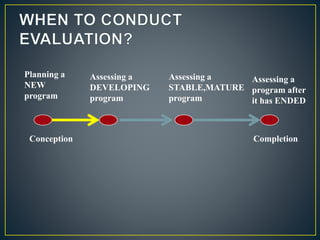
Planning a
NEW
program
Assessing a
DEVELOPING
program
Assessing a
STABLE,MATURE
program
Assessing a
program after
it has ENDED
Conception Completion
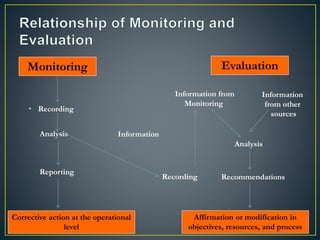
Monitoring
• Recording
Analysis
Reporting
Corrective action at the operational
level
Information
Recording
Information from
Monitoring
Information
from other
sources
Analysis
Recommendations
Evaluation
Affirmation or modification in
objectives, resources, and process
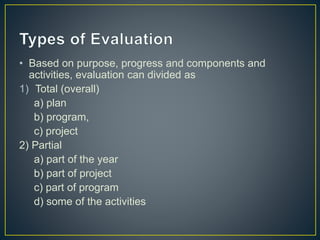
• Based on purpose, progress and components and
activities, evaluation can divided as
1) Total (overall)
a) plan
b) program,
c) project
2) Partial
a) part of the year
b) part of project
c) part of program
d) some of the activities
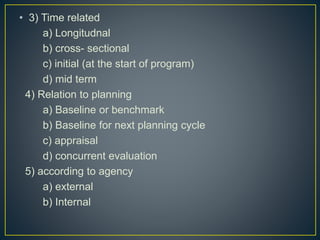
• 3) Time related
a) Longitudnal
b) cross- sectional
c) initial (at the start of program)
d) mid term
4) Relation to planning
a) Baseline or benchmark
b) Baseline for next planning cycle
c) appraisal
d) concurrent evaluation
5) according to agency
a) external
b) Internal
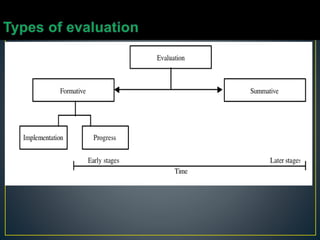
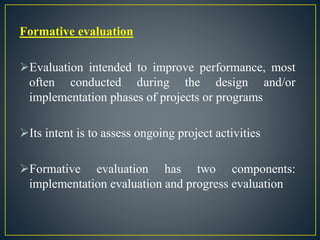
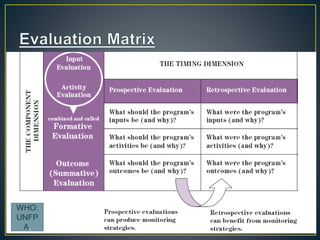
Formative evaluation
Evaluation intended to improve performance, most
often conducted during the design and/or
implementation phases of projects or programs
Its intent is to assess ongoing project activities
Formative evaluation has two components:
implementation evaluation and progress evaluation
Implementation(Process) evaluation:
The purpose of implementation evaluation is to assess
whether the project is being conducted as per planned
Progress evaluation:
To assess progress in meeting the goals of the program
and the project. It involves collecting information to learn
whether or not the benchmarks of participant progress
were met and to point out unexpected developments
Summative(Outcome/Impact) evaluation
 An evaluation conducted at the end of an
intervention to determine the extent to which anticipated
outcomes were produced such as improved survival or
reduced disability
The traditional outcome components are the 5 D’s of ill
health, viz. disease, discomfort, dissatisfaction, disability
and death
• A way of living , thinking
• That is adopted volunterily
• Upon the basis of Knowledge attitudes and
• Respossible decisions
• By individuals and couples
• in order to promotes the health and welfair
• Of the family groups and thus
• Contributes effectively to the
• social development of country
Participatory evaluation
 Evaluation which provides the active involvement
of those with a stake in the program, (providers,
partners, beneficiaries, and any other interested parties)
in designing, carrying out and interpreting an evaluation
360 degree Evaluation (evaluation by planner &
implementers)
An evaluation by those who are entrusted with the
design and delivery of a project
WHO:
UNFP
A,
Relevance:
Relates to the appropriateness of the services, whether
it is needed at all
For example, vaccination against small pox is now
irrelevant because the disease no longer exists
Adequacy:
Implies that sufficient attention has been paid to
certain previously determined courses of action, such
as the various issues to be considered during broad
programming
For example, the staff allocated to a certain program
may be described as inadequate if sufficient attention
was not paid to the quantum of workload and targets
to be achieved
Accessibility:
Proportion of the given population that can be
expected to use a specified facility, service, etc.
The barriers of accessibility may be
physical(distance, travel, time); economic(travel cost,
fee charged); or social and cultural(caste or
language)
• Acceptability:
• The services provided may be accessible but not
acceptable
• eg.male sterilisation,
• rectal cancer screening
Efficiency:
 Expression of the relationships between the results
obtained from a health program/activity and the efforts
expended in terms of human, financial and other
resources, health processes and technology, and time
(number of immunizations provided in an year as
compared with an accepted norm)
 Cost-benefit analysis will be useful for this purpose
 To find out if optimal utilization of available resources is
being made
Effectiveness:
Expression of the desired effect of a program,
service, institution or support activity in reducing a
health problem or improving an unsatisfactory
health situation
Measures the degree of attainment of the
predetermined objectives & targets of the program,
service/institution
Impact:
Expression of the overall effect of a program,
service/institution on health and related socio-
economic development
Aimed at identifying any necessary change in the
direction of health programs so as to increase their
contribution to overall health and socioeconomic
development
Sustainability:
Meeting needs without compromising the ability of
future generations to meet their needs (project will
continue after donors intervention)
To improve health programs and the services for
delivering them
To guide the allocation of resources in current and
future programs
Should be used constructively & not for the
justification of past actions/merely to identify their
inadequacies
Decision-oriented tool and to link closely with
decision making, whether at the operational/the
policy level
The very process of carrying out an evaluation often
induces a better understanding of the activities being
evaluated, and a more constructive approach to their
implementation and to any further action required
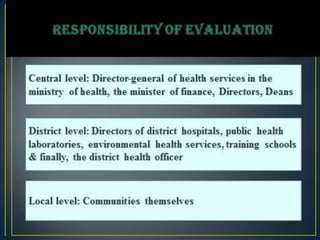
Responsibility for evaluation will lie on individuals
and groups responsibility for development and
application of marginal process at various policy and
operational levels eg. Local, district and central.
 Evaluation can be done by,
1. The planner themselves
2. Ad hoc research group
3. Those responsible for health devlopment
4.Those responsible for implementation
5. Community itself.
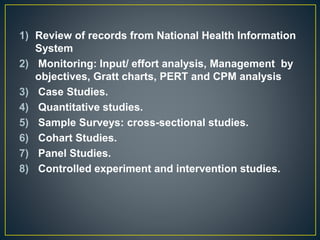
1) Review of records from National Health Information
System
2) Monitoring: Input/ effort analysis, Management by
objectives, Gratt charts, PERT and CPM analysis
3) Case Studies.
4) Quantitative studies.
5) Sample Surveys: cross-sectional studies.
6) Cohart Studies.
7) Panel Studies.
8) Controlled experiment and intervention studies.
History timeline
Of
National programmes
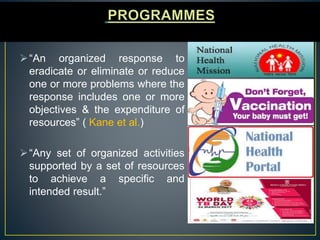
“An organized response to
eradicate or eliminate or reduce
one or more problems where the
response includes one or more
objectives & the expenditure of
resources” ( Kane et al.)
“Any set of organized activities
supported by a set of resources
to achieve a specific and
intended result.”
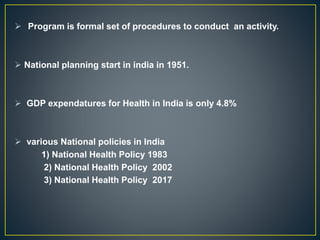
 Program is formal set of procedures to conduct an activity.
 National planning start in india in 1951.
 GDP expendatures for Health in India is only 4.8%
 various National policies in India
1) National Health Policy 1983
2) National Health Policy 2002
3) National Health Policy 2017
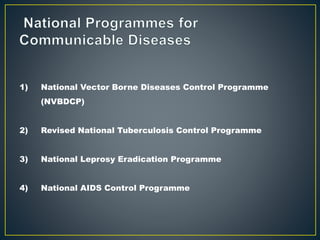
1) National Vector Borne Diseases Control Programme
(NVBDCP)
2) Revised National Tuberculosis Control Programme
3) National Leprosy Eradication Programme
4) National AIDS Control Programme
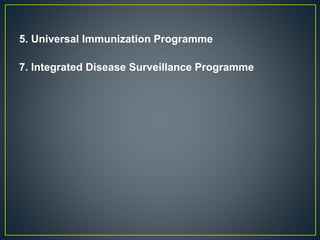
5. Universal Immunization Programme
7. Integrated Disease Surveillance Programme
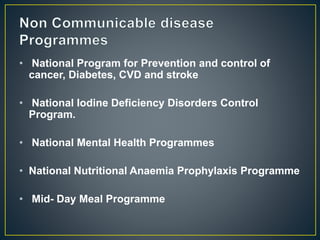
• National Program for Prevention and control of
cancer, Diabetes, CVD and stroke
• National Iodine Deficiency Disorders Control
Program.
• National Mental Health Programmes
• National Nutritional Anaemia Prophylaxis Programme
• Mid- Day Meal Programme
Process & outcome evaluation
Impact evaluation
Evaluation by funding agencies
Being done at different levels:
Evaluation at review meetings at district & state levels
a) Internal evaluation
• Those conducted by states
• Those by CTD (central TB division)
b) External evaluation
(Joint Monitoring Mission at a frequency of 3 years)
• Performance indicators are monitored & evaluated
at:
The sub-district level through monthly meetings at
district level.
District level through quarterly meetings at state
level with DTOs.
State level by the center every 6 months Quarterly
reports are regularly published on the website
(tbcindia.org)
 Each state select 2-districts based on performance (one
good & one bad performing district)
 Evaluation done by another district DTO & RNTCP
consultant (4 days)
 STO is a member of the team
 Report & recommendations sent to central TB division &
STO
 Corrective actions taken checked at next quarterly review
 One state each month, standardized forms used for data
collection & reporting
 Purposive sampling of 2-districts
 5 DMCs(designated microscopy centers): one at the DTC,
4 randomly selected, additionally one DMC (medical
college/NGO/Private/tribal/urban slum)
 Visit all the DOT centers in the DMC area & 3 more in the
district with unique characteristics
 Visit 5 NSP(new sputum positive) cases (randomly
selected) in each of the 5 DMCs
Visit 2 pts. (not NSP) from the DOT centers at DTC &
TU level
Visit at least 3 pediatric patients
Review state level issues
Repeat community based survey in a rural area , by
TRC(training and research center).
Two ARTI ( Acute respiratory tract infection) survey
completed disease prevalence surveys at 5 sentinel
sites
Drug Resistance Surveillance
• External funding for the RNTCP
World bank: >60% of RNTCP fund.
USAID:(united states agency for international
development) Haryana
GFATM:(global fund to fight AIDS,TB,malaria)
 AP, Chhattisgarh, Jharkand, Uttarakhand, Orissa &
parts of Bihar and UP
DFID;(Department for international development) For
drugs through GDF/WHO (almost half of the drug
requirement of RNTCP supplied by DFID)
 J kishor text book of National health programmes of india ,11 th
edition , century publication, Publication year 2014,page 652-657.
 P.V.Sathe book of epidemiology and management for health care
for all 3rd edn chapter 16 planning ,monitoring and evaluation
 R. Deter, R.Beagelhole “ oxford textbook of Public Health” 5th
edition, oxford university press, Publication year 2011, page no.540-
560.
 K.Park’s text book of preventive and social medicine ,24nd edn,
Bhalani publication, Publication year 2017,page 824-825
 Tb 2017, http://www.tbcindia.nic.in/( assesed on date 21/04/2017)
 Framwork for programme evaluation. https://www.cdc.gov
(accessed on date 21/04/2017)
 RNTCP, Communicable National Health programmes in
India http://mohfw.gov.in/ (accessed on date 21/04/2017)
National health program evaluation

National health program evaluation

  • 1.
  • 2.
    EVALUATION OF A NATIONALHEALTH PROGRAMME Dr. Rahulputra Gajbhiye Jr II Seminar
  • 3.
     Introduction  Whatis Evaluation? … Definition of evaluation  Types of evaluation  Principles of evaluation  The evaluation process  National Health programmes  Evaluation of RNTCP  References
  • 4.
  • 5.
    Health services havebecome more complex There has been a growing concern about their functioning both in the developed and developing nations Questions are raised about the quality of medical care, utilization and coverage of health services, benefits to community health and improvement in the health status of the recipients of care
  • 6.
    An evaluation studyaddresses itself to above issues So, program evaluation is an essential organizational practice in public health However, it is not practiced consistently across program areas, nor is it sufficiently well-integrated into the day-to- day management of most programs Thus, a framework for understanding program evaluation and facilitating integration of evaluation throughout the public health system is needed
  • 7.
    The mandate tofulfil society’s interests and assure healthy conditions and quality services puts public health in frequent and compelling contact with the legal system. Public health system employ law as a tool to achieve its goal. Thus these laws play a unique role in ensuring the population’s health.
  • 8.
    The purposes ofthis seminar is to: summarize the essential elements of program evaluation; provide a framework for conducting effective program evaluations; clarify the steps in program evaluation; review standards for effective program evaluation; and address misconceptions regarding the purposes and methods of program evaluation
  • 9.
    What is Evaluation? And Definition of evaluation
  • 10.
    “Research seeks toprove, evaluation seeks to improve…” M.Q. Patton
  • 11.
    • Evaluation hasits origin from the Latin word “Valupure” which means the value of a particular thing, idea or action • Evaluation means finding out the value of something. • Evaluation, thus, helps us to understand the worth, quality, significance amount, degree or condition of any intervention desired to tackle a social problem • Evaluation simply refers to the procedures of fact finding
  • 12.
    Its began inthe field of education Strengthened during the 1960’s emphasis on social programs and determining their effect on society Further strengthened during the 1990’s emphasis on outcomes measurement and quality improvement
  • 13.
    “The systematic investigationof the worth, merit, or significance of an ‘object’ ” Michael Scriven Evaluation has been defined as “ The systematic and scientific process determining the extent to which an action or set of actions were successful in the achievement of pre-determined objectives. It involves measurement of adequacy, effectiveness and efficiency of health services” -WHO
  • 14.
    Evaluation is definedas the collection and analysis of information to determine program performance i.e. ‘ finding out value of something” - J Kishor
  • 15.
     To gaininsight about a program and its operations – to see where we are going and where we are coming from, and to find out what works and what doesn’t  To improve practice – to modify or adapt practice to enhance the success of activities  To assess effects – to see how well we are meeting objectives and goals, how the program benefits the community, and to provide evidence of effectiveness
  • 16.
     To buildcapacity - increase funding, enhance skills, strengthen accountability
  • 17.
    • Direct service interventions •Community mobilization efforts • Research initiatives • Surveillance systems • Policy development activities • Outbreak investigations • Laboratory diagnostics • Communication campaigns • Infrastructure-building projects • Training and educational services • Advocacy works
  • 18.
    Planning a NEW program Assessing a DEVELOPING program Assessinga STABLE,MATURE program Assessing a program after it has ENDED Conception Completion
  • 19.
    Monitoring • Recording Analysis Reporting Corrective actionat the operational level Information Recording Information from Monitoring Information from other sources Analysis Recommendations Evaluation Affirmation or modification in objectives, resources, and process
  • 21.
    • Based onpurpose, progress and components and activities, evaluation can divided as 1) Total (overall) a) plan b) program, c) project 2) Partial a) part of the year b) part of project c) part of program d) some of the activities
  • 22.
    • 3) Timerelated a) Longitudnal b) cross- sectional c) initial (at the start of program) d) mid term 4) Relation to planning a) Baseline or benchmark b) Baseline for next planning cycle c) appraisal d) concurrent evaluation 5) according to agency a) external b) Internal
  • 24.
    Formative evaluation Evaluation intendedto improve performance, most often conducted during the design and/or implementation phases of projects or programs Its intent is to assess ongoing project activities Formative evaluation has two components: implementation evaluation and progress evaluation
  • 25.
    Implementation(Process) evaluation: The purposeof implementation evaluation is to assess whether the project is being conducted as per planned Progress evaluation: To assess progress in meeting the goals of the program and the project. It involves collecting information to learn whether or not the benchmarks of participant progress were met and to point out unexpected developments
  • 26.
    Summative(Outcome/Impact) evaluation  Anevaluation conducted at the end of an intervention to determine the extent to which anticipated outcomes were produced such as improved survival or reduced disability The traditional outcome components are the 5 D’s of ill health, viz. disease, discomfort, dissatisfaction, disability and death
  • 27.
    • A wayof living , thinking • That is adopted volunterily • Upon the basis of Knowledge attitudes and • Respossible decisions • By individuals and couples • in order to promotes the health and welfair • Of the family groups and thus • Contributes effectively to the • social development of country
  • 28.
    Participatory evaluation  Evaluationwhich provides the active involvement of those with a stake in the program, (providers, partners, beneficiaries, and any other interested parties) in designing, carrying out and interpreting an evaluation 360 degree Evaluation (evaluation by planner & implementers) An evaluation by those who are entrusted with the design and delivery of a project
  • 29.
  • 32.
    Relevance: Relates to theappropriateness of the services, whether it is needed at all For example, vaccination against small pox is now irrelevant because the disease no longer exists
  • 33.
    Adequacy: Implies that sufficientattention has been paid to certain previously determined courses of action, such as the various issues to be considered during broad programming For example, the staff allocated to a certain program may be described as inadequate if sufficient attention was not paid to the quantum of workload and targets to be achieved
  • 34.
    Accessibility: Proportion of thegiven population that can be expected to use a specified facility, service, etc. The barriers of accessibility may be physical(distance, travel, time); economic(travel cost, fee charged); or social and cultural(caste or language)
  • 35.
    • Acceptability: • Theservices provided may be accessible but not acceptable • eg.male sterilisation, • rectal cancer screening
  • 36.
    Efficiency:  Expression ofthe relationships between the results obtained from a health program/activity and the efforts expended in terms of human, financial and other resources, health processes and technology, and time (number of immunizations provided in an year as compared with an accepted norm)  Cost-benefit analysis will be useful for this purpose  To find out if optimal utilization of available resources is being made
  • 37.
    Effectiveness: Expression of thedesired effect of a program, service, institution or support activity in reducing a health problem or improving an unsatisfactory health situation Measures the degree of attainment of the predetermined objectives & targets of the program, service/institution
  • 38.
    Impact: Expression of theoverall effect of a program, service/institution on health and related socio- economic development Aimed at identifying any necessary change in the direction of health programs so as to increase their contribution to overall health and socioeconomic development
  • 39.
    Sustainability: Meeting needs withoutcompromising the ability of future generations to meet their needs (project will continue after donors intervention)
  • 42.
    To improve healthprograms and the services for delivering them To guide the allocation of resources in current and future programs Should be used constructively & not for the justification of past actions/merely to identify their inadequacies
  • 43.
    Decision-oriented tool andto link closely with decision making, whether at the operational/the policy level The very process of carrying out an evaluation often induces a better understanding of the activities being evaluated, and a more constructive approach to their implementation and to any further action required
  • 45.
    Responsibility for evaluationwill lie on individuals and groups responsibility for development and application of marginal process at various policy and operational levels eg. Local, district and central.  Evaluation can be done by, 1. The planner themselves 2. Ad hoc research group 3. Those responsible for health devlopment
  • 46.
    4.Those responsible forimplementation 5. Community itself.
  • 49.
    1) Review ofrecords from National Health Information System 2) Monitoring: Input/ effort analysis, Management by objectives, Gratt charts, PERT and CPM analysis 3) Case Studies. 4) Quantitative studies. 5) Sample Surveys: cross-sectional studies. 6) Cohart Studies. 7) Panel Studies. 8) Controlled experiment and intervention studies.
  • 50.
  • 51.
    “An organized responseto eradicate or eliminate or reduce one or more problems where the response includes one or more objectives & the expenditure of resources” ( Kane et al.) “Any set of organized activities supported by a set of resources to achieve a specific and intended result.”
  • 52.
     Program isformal set of procedures to conduct an activity.  National planning start in india in 1951.  GDP expendatures for Health in India is only 4.8%  various National policies in India 1) National Health Policy 1983 2) National Health Policy 2002 3) National Health Policy 2017
  • 54.
    1) National VectorBorne Diseases Control Programme (NVBDCP) 2) Revised National Tuberculosis Control Programme 3) National Leprosy Eradication Programme 4) National AIDS Control Programme
  • 55.
    5. Universal ImmunizationProgramme 7. Integrated Disease Surveillance Programme
  • 56.
    • National Programfor Prevention and control of cancer, Diabetes, CVD and stroke • National Iodine Deficiency Disorders Control Program. • National Mental Health Programmes • National Nutritional Anaemia Prophylaxis Programme • Mid- Day Meal Programme
  • 58.
    Process & outcomeevaluation Impact evaluation Evaluation by funding agencies
  • 59.
    Being done atdifferent levels: Evaluation at review meetings at district & state levels a) Internal evaluation • Those conducted by states • Those by CTD (central TB division) b) External evaluation (Joint Monitoring Mission at a frequency of 3 years)
  • 60.
    • Performance indicatorsare monitored & evaluated at: The sub-district level through monthly meetings at district level. District level through quarterly meetings at state level with DTOs. State level by the center every 6 months Quarterly reports are regularly published on the website (tbcindia.org)
  • 61.
     Each stateselect 2-districts based on performance (one good & one bad performing district)  Evaluation done by another district DTO & RNTCP consultant (4 days)  STO is a member of the team  Report & recommendations sent to central TB division & STO  Corrective actions taken checked at next quarterly review
  • 62.
     One stateeach month, standardized forms used for data collection & reporting  Purposive sampling of 2-districts  5 DMCs(designated microscopy centers): one at the DTC, 4 randomly selected, additionally one DMC (medical college/NGO/Private/tribal/urban slum)  Visit all the DOT centers in the DMC area & 3 more in the district with unique characteristics  Visit 5 NSP(new sputum positive) cases (randomly selected) in each of the 5 DMCs
  • 63.
    Visit 2 pts.(not NSP) from the DOT centers at DTC & TU level Visit at least 3 pediatric patients Review state level issues
  • 64.
    Repeat community basedsurvey in a rural area , by TRC(training and research center). Two ARTI ( Acute respiratory tract infection) survey completed disease prevalence surveys at 5 sentinel sites Drug Resistance Surveillance
  • 65.
    • External fundingfor the RNTCP World bank: >60% of RNTCP fund. USAID:(united states agency for international development) Haryana GFATM:(global fund to fight AIDS,TB,malaria)  AP, Chhattisgarh, Jharkand, Uttarakhand, Orissa & parts of Bihar and UP DFID;(Department for international development) For drugs through GDF/WHO (almost half of the drug requirement of RNTCP supplied by DFID)
  • 66.
     J kishortext book of National health programmes of india ,11 th edition , century publication, Publication year 2014,page 652-657.  P.V.Sathe book of epidemiology and management for health care for all 3rd edn chapter 16 planning ,monitoring and evaluation  R. Deter, R.Beagelhole “ oxford textbook of Public Health” 5th edition, oxford university press, Publication year 2011, page no.540- 560.  K.Park’s text book of preventive and social medicine ,24nd edn, Bhalani publication, Publication year 2017,page 824-825  Tb 2017, http://www.tbcindia.nic.in/( assesed on date 21/04/2017)  Framwork for programme evaluation. https://www.cdc.gov (accessed on date 21/04/2017)
  • 67.
     RNTCP, CommunicableNational Health programmes in India http://mohfw.gov.in/ (accessed on date 21/04/2017)

Editor's Notes

  • #52  (e.g. to identify, prevent, and ameliorate risks to health in the population)