Epidemiology
Classically speaking
 Epi = upon (among)
 Demos = people
 Ology = science
 Epidemiology = the science which deals with what
falls upon people…..
A Modern Definition
 “The study of the distribution and
determinants of health-related states in
specified populations, and the application of
this study to control health problems."
(Last J)
Search for knowledge Apply in health service
Objectives of Epidemiology
1. To describe the distribution and magnitude of health
and disease problems in the population.
2. To identify the etiological factors – risk factors in the
population.
3. To provide the data essential to planning,
implementation and evaluation of services for
prevention, control and treatment of disease and to
setting up of priorities for these services.
The ultimate aim of epidemiology is
 to eliminate or reduce health problem or
its consequences
and
 to promote health and well-being of
society as a whole.
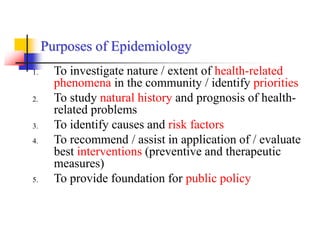
Purposes of Epidemiology
1. To investigate nature / extent of health-related
phenomena in the community / identify priorities
2. To study natural history and prognosis of health-
related problems
3. To identify causes and risk factors
4. To recommend / assist in application of / evaluate
best interventions (preventive and therapeutic
measures)
5. To provide foundation for public policy
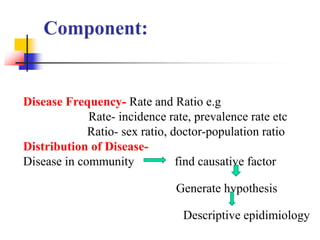
Component:
Disease Frequency- Rate and Ratio e.g
Rate- incidence rate, prevalence rate etc
Ratio- sex ratio, doctor-population ratio
Distribution of Disease-
Disease in community find causative factor
Generate hypothesis
Descriptive epidimiology
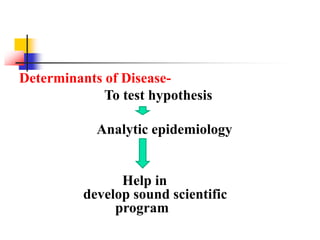
Determinants of Disease-
To test hypothesis
Analytic epidemiology
Help in
develop sound scientific
program
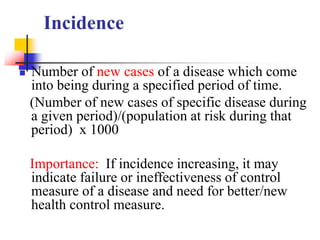
Incidence
 Number of new cases of a disease which come
into being during a specified period of time.
(Number of new cases of specific disease during
a given period)/(population at risk during that
period) x 1000
Importance: If incidence increasing, it may
indicate failure or ineffectiveness of control
measure of a disease and need for better/new
health control measure.
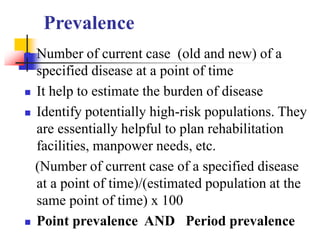
Prevalence
 Number of current case (old and new) of a
specified disease at a point of time
 It help to estimate the burden of disease
 Identify potentially high-risk populations. They
are essentially helpful to plan rehabilitation
facilities, manpower needs, etc.
(Number of current case of a specified disease
at a point of time)/(estimated population at the
same point of time) x 100
 Point prevalence AND Period prevalence
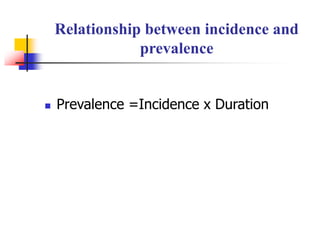
Relationship between incidence and
prevalence
 Prevalence =Incidence x Duration
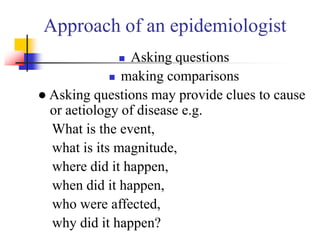
Approach of an epidemiologist
 Asking questions
 making comparisons
● Asking questions may provide clues to cause
or aetiology of disease e.g.
What is the event,
what is its magnitude,
where did it happen,
when did it happen,
who were affected,
why did it happen?
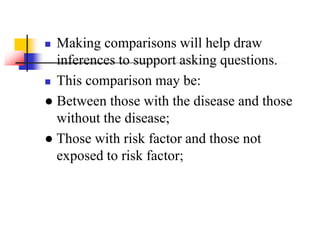
 Making comparisons will help draw
inferences to support asking questions.
 This comparison may be:
● Between those with the disease and those
without the disease;
● Those with risk factor and those not
exposed to risk factor;
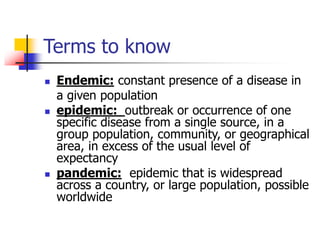
Terms to know
 Endemic: constant presence of a disease in
a given population
 epidemic: outbreak or occurrence of one
specific disease from a single source, in a
group population, community, or geographical
area, in excess of the usual level of
expectancy
 pandemic: epidemic that is widespread
across a country, or large population, possible
worldwide
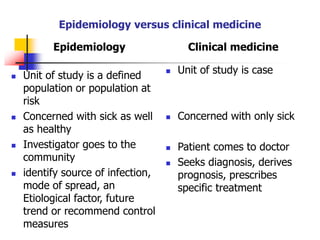
Epidemiology versus clinical medicine
Epidemiology
 Unit of study is a defined
population or population at
risk
 Concerned with sick as well
as healthy
 Investigator goes to the
community
 identify source of infection,
mode of spread, an
Etiological factor, future
trend or recommend control
measures
Clinical medicine
 Unit of study is case
 Concerned with only sick
 Patient comes to doctor
 Seeks diagnosis, derives
prognosis, prescribes
specific treatment
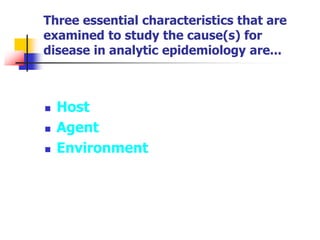
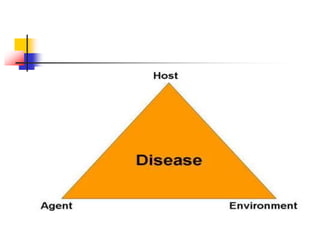
 Host
 Agent
 Environment
Three essential characteristics that are
examined to study the cause(s) for
disease in analytic epidemiology are...
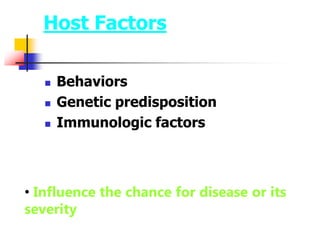
Host Factors
 Behaviors
 Genetic predisposition
 Immunologic factors
• Influence the chance for disease or its
severity
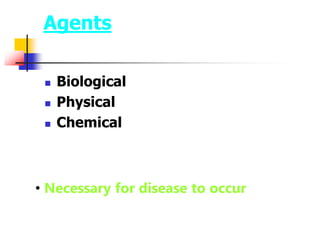
Agents
 Biological
 Physical
 Chemical
• Necessary for disease to occur
Environment
 External conditions
• Contribute to the disease process
Epidemics arise when host, agent, and
environmental factors are not in balance
 Due to new agent
 Due to change in existing agent (infectivity,
pathogenicity, virulence)
 Due to change in number of susceptibles in the
population
 Due to environmental changes that affect
transmission of the agent or growth of the
agent
EPIDEMIOLOGICAL METHODS
.
The methods he employs can be classified as:
1. Observational studies
a. Descriptive studies
b. Analytical studies
– Case control studies
– Cohort studies
2. Experimental/interventional studies
– Randomized control studies
– Field trials
– Community trials
Descriptive observations pertain to the
“who, what, where and when of health-
related state occurrence”. However,
analytical observations deal more with the
‘how’ of a health-related event occur.
Randomized control trial (often used for
new medicine or drug testing), field trial
(conducted on those at a high risk of
conducting a disease), and community
trial (research on social originating
diseases)
Descriptive Studies
Steps in conducting a descriptive study.
Descriptive studies form the first step in any
process of investigation.
These studies are concerned with observing the
distribution of disease in populations.
1. Defining the population.
2. Defining disease under study.
3. Describing the disease.
4. Measurement of disease
5. Compare
6. Formulate hypothesis-
Defining the population. Defined population
may be the whole population or a
representative sample.
 It can also be specially selected group such
as age and sex groups, occupational groups,
hospital patients, school children, small
community, etc.
2. Defining disease under study.
3. Describing the disease.
Disease is examined by the epidemiologist
by asking three questions:
● When is the disease occurring—time
distribution?
● Where is it occurring—place distribution?
● Who is getting the disease—person
distribution?
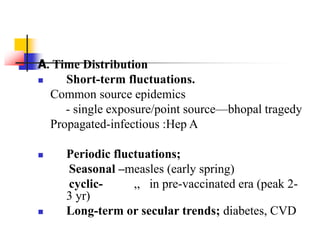
A. Time Distribution
 Short-term fluctuations.
Common source epidemics
- single exposure/point source—bhopal tragedy
Propagated-infectious :Hep A
 Periodic fluctuations;
Seasonal –measles (early spring)
cyclic- ,, in pre-vaccinated era (peak 2-
3 yr)
 Long-term or secular trends; diabetes, CVD
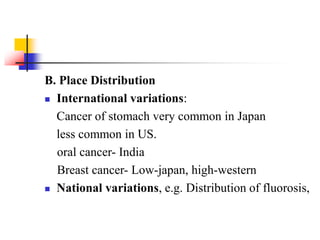
B. Place Distribution
 International variations:
Cancer of stomach very common in Japan
less common in US.
oral cancer- India
Breast cancer- Low-japan, high-western
 National variations, e.g. Distribution of fluorosis,
 Rural-urban differences, e.g.
CVD, Mental illness more common in urban
areas.
Skin diseases, worm infestations more common in
rural areas.
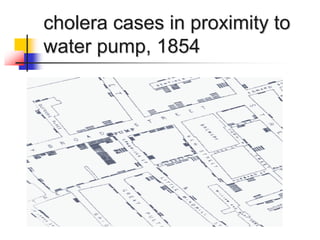
 Local distributions, e.g. Spot maps- John Snow
in London to incriminate water supply as cause of
cholera transmission in London.
cholera cases in proximity to
water pump, 1854
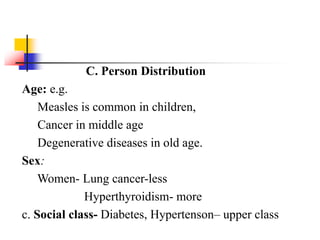
C. Person Distribution
Age: e.g.
Measles is common in children,
Cancer in middle age
Degenerative diseases in old age.
Sex:
Women- Lung cancer-less
Hyperthyroidism- more
c. Social class- Diabetes, Hypertenson– upper class
4. Measurement of disease- Mortality/ Morbidity
5. Compare- Between different population, subgroups
6. Formulate hypothesis. On basis of all data
epidemiologist form hypothesis.
Cross-sectional studies
 Cross-sectional study is also called prevalence study.
 Cross-sectional study is the simplest form of
observational study.
 It is based on single examination of cross-section of
population at one point of time.
 If the sampling methodology is accurate, results can be
projected to the entire population.
 They are more useful for chronic illnesses, e.g.
hypertension.
 Cross-sectional studies save on time and resources, but
provide very little information about natural history of
disease and incidence of illness.
Case- control studies
 It start from effect and then proceed to cause
 Both exposure and outcome have occurred
before start of the study
 The study proceeds backwards from effect to
cause
 Select subjects based on their disease status.
A group of individuals that are disease positive
(the "case" group) is compared with a group of
disease negative individuals (the "control"
group).
 The control group should ideally come from the
same population that gave rise to the cases.
Basic steps in a case-control study
 1. Selection of cases and controls
 2. Matching
 3. Measurement of exposure
 4. Analysis and interpretation.
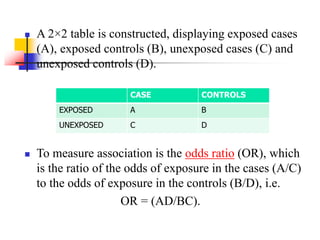
 A 2×2 table is constructed, displaying exposed cases
(A), exposed controls (B), unexposed cases (C) and
unexposed controls (D).
 To measure association is the odds ratio (OR), which
is the ratio of the odds of exposure in the cases (A/C)
to the odds of exposure in the controls (B/D), i.e.
OR = (AD/BC).
CASE CONTROLS
EXPOSED A B
UNEXPOSED C D
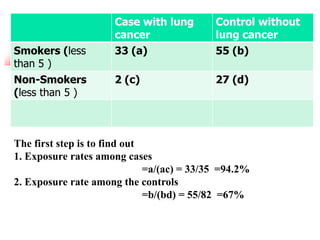
Case with lung
cancer
Control without
lung cancer
Smokers (less
than 5 )
33 (a) 55 (b)
Non-Smokers
(less than 5 )
2 (c) 27 (d)
The first step is to find out
1. Exposure rates among cases
=a/(ac) = 33/35 =94.2%
2. Exposure rate among the controls
=b/(bd) = 55/82 =67%
 If the exposure rate among the cases is more
than the controls.
 We must see if the exposure rate among the
cases is significantly more than the controls.
This is done by using the chi-square test
 It is significant if p is less than 0.05.
Odds ratio
 It is a measure of strength of association between the
risk factor and outcome.
 The derivation of the odds ratio is based on three
assumptions:
● The disease being investigated is relatively rare
● The cases must be representative of those with the disease
● The controls must be representative of those without the
disease.
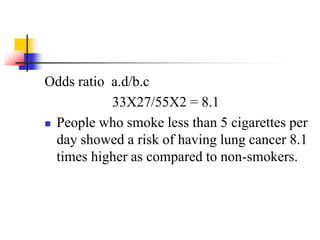
Odds ratio a.d/b.c
33X27/55X2 = 8.1
 People who smoke less than 5 cigarettes per
day showed a risk of having lung cancer 8.1
times higher as compared to non-smokers.
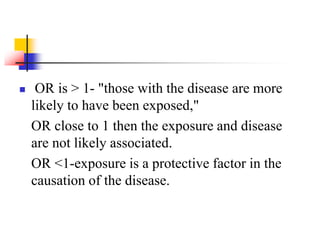
 OR is > 1- "those with the disease are more
likely to have been exposed,"
OR close to 1 then the exposure and disease
are not likely associated.
OR <1-exposure is a protective factor in the
causation of the disease.
 Case control studies are usually faster and
more cost effective
 Sensitive to bias (selection bias).
 The main challenge is to identify the
appropriate control group;
 The distribution of exposure among the
control group should be representative of
the distribution in the population that gave
rise to the cases.
Cohort Study
 It look at cause and proceed to effect
 study before the disease is manifest and proceed to
study over a period of time for the disease to occur.
 Cohort means a group of people sharing a common
experience.
 Cohort studies are often prospective studies, they
can be retrospective also, or a combination of both
prospective and retrospective components can be
brought in.
 Steps in a cohort study:
1. Selection of study subjects
2. Obtaining data on exposur
3. Selection of comparison groups
4. Follow-up
5. Analysis.
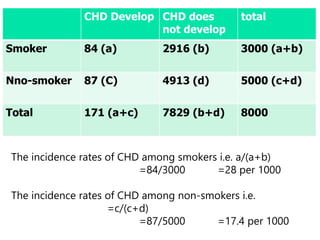
CHD Develop CHD does
not develop
total
Smoker 84 (a) 2916 (b) 3000 (a+b)
Nno-smoker 87 (C) 4913 (d) 5000 (c+d)
Total 171 (a+c) 7829 (b+d) 8000
The incidence rates of CHD among smokers i.e. a/(a+b)
=84/3000 =28 per 1000
The incidence rates of CHD among non-smokers i.e.
=c/(c+d)
=87/5000 =17.4 per 1000
 Then, we must determine if the
incidence rate among the smokers is
significantly more than among the non-
smokers by using the chi-square test.
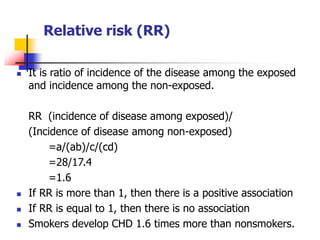
Relative risk (RR)
 It is ratio of incidence of the disease among the exposed
and incidence among the non-exposed.
RR (incidence of disease among exposed)/
(Incidence of disease among non-exposed)
=a/(ab)/c/(cd)
=28/17.4
=1.6
 If RR is more than 1, then there is a positive association
 If RR is equal to 1, then there is no association
 Smokers develop CHD 1.6 times more than nonsmokers.
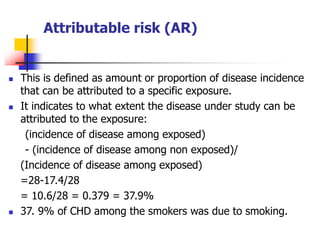
Attributable risk (AR)
 This is defined as amount or proportion of disease incidence
that can be attributed to a specific exposure.
 It indicates to what extent the disease under study can be
attributed to the exposure:
(incidence of disease among exposed)
- (incidence of disease among non exposed)/
(Incidence of disease among exposed)
=28-17.4/28
= 10.6/28 = 0.379 = 37.9%
 37. 9% of CHD among the smokers was due to smoking.
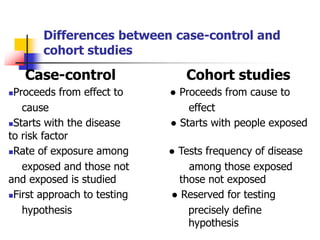
Differences between case-control and
cohort studies
Case-control Cohort studies
Proceeds from effect to ● Proceeds from cause to
cause effect
Starts with the disease ● Starts with people exposed
to risk factor
Rate of exposure among ● Tests frequency of disease
exposed and those not among those exposed
and exposed is studied those not exposed
First approach to testing ● Reserved for testing
hypothesis precisely define
hypothesis
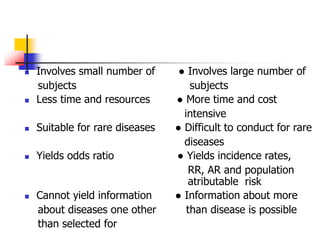
 Involves small number of ● Involves large number of
subjects subjects
 Less time and resources ● More time and cost
intensive
 Suitable for rare diseases ● Difficult to conduct for rare
diseases
 Yields odds ratio ● Yields incidence rates,
RR, AR and population
atributable risk
 Cannot yield information ● Information about more
about diseases one other than disease is possible
than selected for
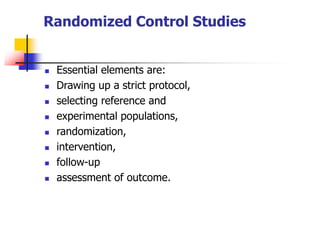
Randomized Control Studies
 Essential elements are:
 Drawing up a strict protocol,
 selecting reference and
 experimental populations,
 randomization,
 intervention,
 follow-up
 assessment of outcome.
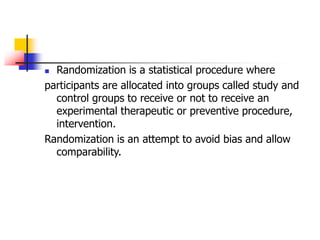
 Randomization is a statistical procedure where
participants are allocated into groups called study and
control groups to receive or not to receive an
experimental therapeutic or preventive procedure,
intervention.
Randomization is an attempt to avoid bias and allow
comparability.
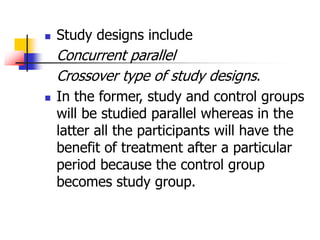
 Study designs include
Concurrent parallel
Crossover type of study designs.
 In the former, study and control groups
will be studied parallel whereas in the
latter all the participants will have the
benefit of treatment after a particular
period because the control group
becomes study group.
Types of randomized control studies are:
Clinical trials, e.g. drug trials
Preventive trials, e.g. trials of vaccines
Risk factor trials, e.g. trials of risk factors of
cardiovascular disease, e.g. tobacco use, physical
activity, diet, etc.
Cessation experiments, e.g. smoking cessation
experiments for studying lung cancer.
What is bias?
 Bias is systematic error that comes in.
 Bias on the part of participants if they know
they belong to study group—participant bias
 bias because of observer if he knows that he
is dealing with study group—observer bias
 bias because of investigator investigator bias,
if he knows he is dealing with study group.
In order to prevent this, a technique called
blinding is adopted.
Concept of blinding
 Single blind trial means participant will
not know whether he belongs to study
group or control group.
 In double blind studies, both the
participant and the observer will not be
aware.
 In triple blind study, the participant,
observer as well as the investigator will
not be aware

epidemiology with part 2 (complete) 2.ppt

  • 1.
  • 2.
    Classically speaking  Epi= upon (among)  Demos = people  Ology = science  Epidemiology = the science which deals with what falls upon people…..
  • 3.
    A Modern Definition “The study of the distribution and determinants of health-related states in specified populations, and the application of this study to control health problems." (Last J) Search for knowledge Apply in health service
  • 4.
    Objectives of Epidemiology 1.To describe the distribution and magnitude of health and disease problems in the population. 2. To identify the etiological factors – risk factors in the population. 3. To provide the data essential to planning, implementation and evaluation of services for prevention, control and treatment of disease and to setting up of priorities for these services.
  • 5.
    The ultimate aimof epidemiology is  to eliminate or reduce health problem or its consequences and  to promote health and well-being of society as a whole.
  • 6.
    Purposes of Epidemiology 1.To investigate nature / extent of health-related phenomena in the community / identify priorities 2. To study natural history and prognosis of health- related problems 3. To identify causes and risk factors 4. To recommend / assist in application of / evaluate best interventions (preventive and therapeutic measures) 5. To provide foundation for public policy
  • 7.
    Component: Disease Frequency- Rateand Ratio e.g Rate- incidence rate, prevalence rate etc Ratio- sex ratio, doctor-population ratio Distribution of Disease- Disease in community find causative factor Generate hypothesis Descriptive epidimiology
  • 8.
    Determinants of Disease- Totest hypothesis Analytic epidemiology Help in develop sound scientific program
  • 9.
    Incidence  Number ofnew cases of a disease which come into being during a specified period of time. (Number of new cases of specific disease during a given period)/(population at risk during that period) x 1000 Importance: If incidence increasing, it may indicate failure or ineffectiveness of control measure of a disease and need for better/new health control measure.
  • 10.
    Prevalence  Number ofcurrent case (old and new) of a specified disease at a point of time  It help to estimate the burden of disease  Identify potentially high-risk populations. They are essentially helpful to plan rehabilitation facilities, manpower needs, etc. (Number of current case of a specified disease at a point of time)/(estimated population at the same point of time) x 100  Point prevalence AND Period prevalence
  • 11.
    Relationship between incidenceand prevalence  Prevalence =Incidence x Duration
  • 12.
    Approach of anepidemiologist  Asking questions  making comparisons ● Asking questions may provide clues to cause or aetiology of disease e.g. What is the event, what is its magnitude, where did it happen, when did it happen, who were affected, why did it happen?
  • 13.
     Making comparisonswill help draw inferences to support asking questions.  This comparison may be: ● Between those with the disease and those without the disease; ● Those with risk factor and those not exposed to risk factor;
  • 14.
    Terms to know Endemic: constant presence of a disease in a given population  epidemic: outbreak or occurrence of one specific disease from a single source, in a group population, community, or geographical area, in excess of the usual level of expectancy  pandemic: epidemic that is widespread across a country, or large population, possible worldwide
  • 16.
    Epidemiology versus clinicalmedicine Epidemiology  Unit of study is a defined population or population at risk  Concerned with sick as well as healthy  Investigator goes to the community  identify source of infection, mode of spread, an Etiological factor, future trend or recommend control measures Clinical medicine  Unit of study is case  Concerned with only sick  Patient comes to doctor  Seeks diagnosis, derives prognosis, prescribes specific treatment
  • 17.
     Host  Agent Environment Three essential characteristics that are examined to study the cause(s) for disease in analytic epidemiology are...
  • 19.
    Host Factors  Behaviors Genetic predisposition  Immunologic factors • Influence the chance for disease or its severity
  • 20.
    Agents  Biological  Physical Chemical • Necessary for disease to occur
  • 21.
    Environment  External conditions •Contribute to the disease process
  • 22.
    Epidemics arise whenhost, agent, and environmental factors are not in balance  Due to new agent  Due to change in existing agent (infectivity, pathogenicity, virulence)  Due to change in number of susceptibles in the population  Due to environmental changes that affect transmission of the agent or growth of the agent
  • 23.
    EPIDEMIOLOGICAL METHODS . The methodshe employs can be classified as: 1. Observational studies a. Descriptive studies b. Analytical studies – Case control studies – Cohort studies 2. Experimental/interventional studies – Randomized control studies – Field trials – Community trials
  • 24.
    Descriptive observations pertainto the “who, what, where and when of health- related state occurrence”. However, analytical observations deal more with the ‘how’ of a health-related event occur. Randomized control trial (often used for new medicine or drug testing), field trial (conducted on those at a high risk of conducting a disease), and community trial (research on social originating diseases)
  • 25.
    Descriptive Studies Steps inconducting a descriptive study. Descriptive studies form the first step in any process of investigation. These studies are concerned with observing the distribution of disease in populations. 1. Defining the population. 2. Defining disease under study. 3. Describing the disease. 4. Measurement of disease 5. Compare 6. Formulate hypothesis-
  • 26.
    Defining the population.Defined population may be the whole population or a representative sample.  It can also be specially selected group such as age and sex groups, occupational groups, hospital patients, school children, small community, etc.
  • 27.
    2. Defining diseaseunder study. 3. Describing the disease. Disease is examined by the epidemiologist by asking three questions: ● When is the disease occurring—time distribution? ● Where is it occurring—place distribution? ● Who is getting the disease—person distribution?
  • 28.
    A. Time Distribution Short-term fluctuations. Common source epidemics - single exposure/point source—bhopal tragedy Propagated-infectious :Hep A  Periodic fluctuations; Seasonal –measles (early spring) cyclic- ,, in pre-vaccinated era (peak 2- 3 yr)  Long-term or secular trends; diabetes, CVD
  • 29.
    B. Place Distribution International variations: Cancer of stomach very common in Japan less common in US. oral cancer- India Breast cancer- Low-japan, high-western  National variations, e.g. Distribution of fluorosis,
  • 30.
     Rural-urban differences,e.g. CVD, Mental illness more common in urban areas. Skin diseases, worm infestations more common in rural areas.  Local distributions, e.g. Spot maps- John Snow in London to incriminate water supply as cause of cholera transmission in London.
  • 31.
    cholera cases inproximity to water pump, 1854
  • 33.
    C. Person Distribution Age:e.g. Measles is common in children, Cancer in middle age Degenerative diseases in old age. Sex: Women- Lung cancer-less Hyperthyroidism- more c. Social class- Diabetes, Hypertenson– upper class
  • 34.
    4. Measurement ofdisease- Mortality/ Morbidity 5. Compare- Between different population, subgroups 6. Formulate hypothesis. On basis of all data epidemiologist form hypothesis.
  • 35.
    Cross-sectional studies  Cross-sectionalstudy is also called prevalence study.  Cross-sectional study is the simplest form of observational study.  It is based on single examination of cross-section of population at one point of time.  If the sampling methodology is accurate, results can be projected to the entire population.  They are more useful for chronic illnesses, e.g. hypertension.  Cross-sectional studies save on time and resources, but provide very little information about natural history of disease and incidence of illness.
  • 36.
    Case- control studies It start from effect and then proceed to cause  Both exposure and outcome have occurred before start of the study  The study proceeds backwards from effect to cause
  • 37.
     Select subjectsbased on their disease status. A group of individuals that are disease positive (the "case" group) is compared with a group of disease negative individuals (the "control" group).  The control group should ideally come from the same population that gave rise to the cases.
  • 38.
    Basic steps ina case-control study  1. Selection of cases and controls  2. Matching  3. Measurement of exposure  4. Analysis and interpretation.
  • 39.
     A 2×2table is constructed, displaying exposed cases (A), exposed controls (B), unexposed cases (C) and unexposed controls (D).  To measure association is the odds ratio (OR), which is the ratio of the odds of exposure in the cases (A/C) to the odds of exposure in the controls (B/D), i.e. OR = (AD/BC). CASE CONTROLS EXPOSED A B UNEXPOSED C D
  • 40.
    Case with lung cancer Controlwithout lung cancer Smokers (less than 5 ) 33 (a) 55 (b) Non-Smokers (less than 5 ) 2 (c) 27 (d) The first step is to find out 1. Exposure rates among cases =a/(ac) = 33/35 =94.2% 2. Exposure rate among the controls =b/(bd) = 55/82 =67%
  • 41.
     If theexposure rate among the cases is more than the controls.  We must see if the exposure rate among the cases is significantly more than the controls. This is done by using the chi-square test  It is significant if p is less than 0.05.
  • 42.
    Odds ratio  Itis a measure of strength of association between the risk factor and outcome.  The derivation of the odds ratio is based on three assumptions: ● The disease being investigated is relatively rare ● The cases must be representative of those with the disease ● The controls must be representative of those without the disease.
  • 43.
    Odds ratio a.d/b.c 33X27/55X2= 8.1  People who smoke less than 5 cigarettes per day showed a risk of having lung cancer 8.1 times higher as compared to non-smokers.
  • 44.
     OR is> 1- "those with the disease are more likely to have been exposed," OR close to 1 then the exposure and disease are not likely associated. OR <1-exposure is a protective factor in the causation of the disease.
  • 45.
     Case controlstudies are usually faster and more cost effective  Sensitive to bias (selection bias).  The main challenge is to identify the appropriate control group;  The distribution of exposure among the control group should be representative of the distribution in the population that gave rise to the cases.
  • 46.
    Cohort Study  Itlook at cause and proceed to effect  study before the disease is manifest and proceed to study over a period of time for the disease to occur.  Cohort means a group of people sharing a common experience.  Cohort studies are often prospective studies, they can be retrospective also, or a combination of both prospective and retrospective components can be brought in.
  • 47.
     Steps ina cohort study: 1. Selection of study subjects 2. Obtaining data on exposur 3. Selection of comparison groups 4. Follow-up 5. Analysis.
  • 48.
    CHD Develop CHDdoes not develop total Smoker 84 (a) 2916 (b) 3000 (a+b) Nno-smoker 87 (C) 4913 (d) 5000 (c+d) Total 171 (a+c) 7829 (b+d) 8000 The incidence rates of CHD among smokers i.e. a/(a+b) =84/3000 =28 per 1000 The incidence rates of CHD among non-smokers i.e. =c/(c+d) =87/5000 =17.4 per 1000
  • 49.
     Then, wemust determine if the incidence rate among the smokers is significantly more than among the non- smokers by using the chi-square test.
  • 50.
    Relative risk (RR) It is ratio of incidence of the disease among the exposed and incidence among the non-exposed. RR (incidence of disease among exposed)/ (Incidence of disease among non-exposed) =a/(ab)/c/(cd) =28/17.4 =1.6  If RR is more than 1, then there is a positive association  If RR is equal to 1, then there is no association  Smokers develop CHD 1.6 times more than nonsmokers.
  • 51.
    Attributable risk (AR) This is defined as amount or proportion of disease incidence that can be attributed to a specific exposure.  It indicates to what extent the disease under study can be attributed to the exposure: (incidence of disease among exposed) - (incidence of disease among non exposed)/ (Incidence of disease among exposed) =28-17.4/28 = 10.6/28 = 0.379 = 37.9%  37. 9% of CHD among the smokers was due to smoking.
  • 52.
    Differences between case-controland cohort studies Case-control Cohort studies Proceeds from effect to ● Proceeds from cause to cause effect Starts with the disease ● Starts with people exposed to risk factor Rate of exposure among ● Tests frequency of disease exposed and those not among those exposed and exposed is studied those not exposed First approach to testing ● Reserved for testing hypothesis precisely define hypothesis
  • 53.
     Involves smallnumber of ● Involves large number of subjects subjects  Less time and resources ● More time and cost intensive  Suitable for rare diseases ● Difficult to conduct for rare diseases  Yields odds ratio ● Yields incidence rates, RR, AR and population atributable risk  Cannot yield information ● Information about more about diseases one other than disease is possible than selected for
  • 54.
    Randomized Control Studies Essential elements are:  Drawing up a strict protocol,  selecting reference and  experimental populations,  randomization,  intervention,  follow-up  assessment of outcome.
  • 55.
     Randomization isa statistical procedure where participants are allocated into groups called study and control groups to receive or not to receive an experimental therapeutic or preventive procedure, intervention. Randomization is an attempt to avoid bias and allow comparability.
  • 56.
     Study designsinclude Concurrent parallel Crossover type of study designs.  In the former, study and control groups will be studied parallel whereas in the latter all the participants will have the benefit of treatment after a particular period because the control group becomes study group.
  • 57.
    Types of randomizedcontrol studies are: Clinical trials, e.g. drug trials Preventive trials, e.g. trials of vaccines Risk factor trials, e.g. trials of risk factors of cardiovascular disease, e.g. tobacco use, physical activity, diet, etc. Cessation experiments, e.g. smoking cessation experiments for studying lung cancer.
  • 58.
    What is bias? Bias is systematic error that comes in.  Bias on the part of participants if they know they belong to study group—participant bias  bias because of observer if he knows that he is dealing with study group—observer bias  bias because of investigator investigator bias, if he knows he is dealing with study group. In order to prevent this, a technique called blinding is adopted.
  • 59.
    Concept of blinding Single blind trial means participant will not know whether he belongs to study group or control group.  In double blind studies, both the participant and the observer will not be aware.  In triple blind study, the participant, observer as well as the investigator will not be aware