Epidemiological	exercises
Dr	Jayaramachandran	S
Asst.	Prof
Dept.	of	Community	Medicine
MGMC	&	RI
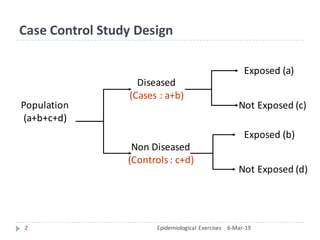
Population	
(a+b+c+d)
Diseased	
(Cases	:	a+b)
Non	Diseased	
(Controls	:	c+d)
Exposed	(a)
Not	Exposed	(c)
Exposed	(b)
Not	Exposed	(d)
Case	Control	Study	Design
6-Mar-19Epidemiological	Exercises2
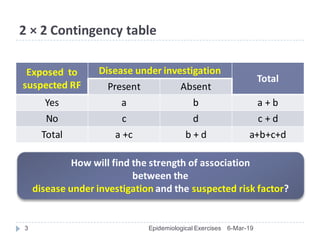
2	× 2	Contingency	table	
6-Mar-19Epidemiological Exercises3
Exposed		to	
suspected	RF
Disease under	investigation
Total
Present	 Absent	
Yes a b a	+	b
No	 c d c +	d
Total	 a	+c b	+	d a+b+c+d
How	will	find	the	strength	of	association	
between	the	
disease	under	investigation	and	the	suspected	risk	factor?
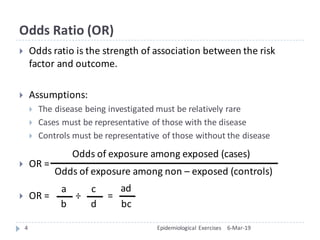
Odds	Ratio	(OR)
} Odds	ratio	is	the	strength	of	association	between	the	risk	
factor	and	outcome.	
} Assumptions:	
} The	disease	being	investigated	must	be	relatively	rare
} Cases	must	be	representative	of	those	with	the	disease
} Controls	must	be	representative	of	those	without	the	disease	
} OR	=	
} OR	=											÷ =	
6-Mar-19Epidemiological	Exercises4
Odds	of	exposure	among	exposed	(cases)	
Odds	of	exposure	among	non	– exposed	(controls)	
a
b
c
d
ad
bc
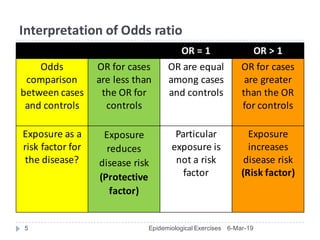
Interpretation	of	Odds	ratio
OR	=	1 OR	>	1
Odds	
comparison	
between	cases	
and	controls
OR	for	cases	
are	less	than	
the	OR	for	
controls
OR	are	equal	
among	cases	
and	controls
OR	for	cases	
are	greater	
than	the	OR	
for	controls
Exposure	as	a	
risk	factor	for	
the	disease?
Exposure	
reduces	
disease	risk	
(Protective
factor)
Particular	
exposure	is	
not	a	risk	
factor
Exposure	
increases	
disease	risk
(Risk	factor)
6-Mar-19Epidemiological Exercises5
Problem	1
6-Mar-19Epidemiological Exercises6
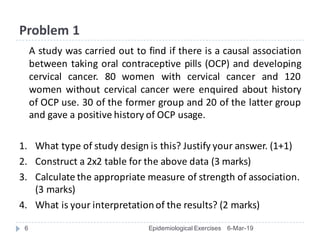
A study was carried out to find if there is a causal association
between taking oral contraceptive pills (OCP) and developing
cervical cancer. 80 women with cervical cancer and 120
women without cervical cancer were enquired about history
of OCP use. 30 of the former group and 20 of the latter group
and gave a positive history of OCP usage.
1. What	type	of	study	design	is	this?	Justify	your	answer.	(1+1)
2. Construct	a	2x2	table	for	the	above	data	(3	marks)
3. Calculate	the	appropriate	measure	of	strength	of	association.	
(3	marks)
4. What	is	your	interpretation	of	the	results?	(2	marks)
Problem	1
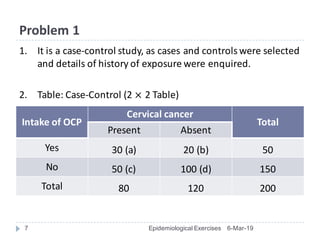
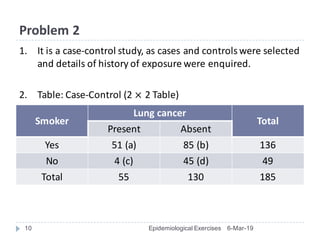
1. It	is	a	case-control	study,	as	cases	and	controls	were	selected	
and	details	of	history	of	exposure	were	enquired.
2. Table:	Case-Control	(2	✕ 2	Table)
6-Mar-19Epidemiological Exercises7
Intake of	OCP
Cervical	cancer	
Total
Present	 Absent	
Yes	 30	(a) 20	(b) 50
No 50	(c) 100	(d) 150
Total	 80 120 200
Problem	1
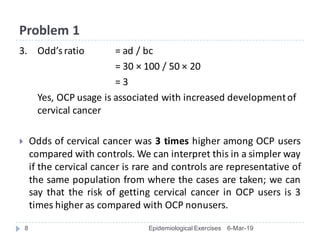
3. Odd’s	ratio	 =	ad	/	bc
=	30	× 100	/	50	× 20	
=	3
Yes,	OCP	usage	is	associated	with	increased	development	of	
cervical	cancer
} Odds of cervical cancer was 3 times higher among OCP users
compared with controls. We can interpret this in a simpler way
if the cervical cancer is rare and controls are representative of
the same population from where the cases are taken; we can
say that the risk of getting cervical cancer in OCP users is 3
times higher as compared with OCP nonusers.
6-Mar-19Epidemiological Exercises8
Problem	2
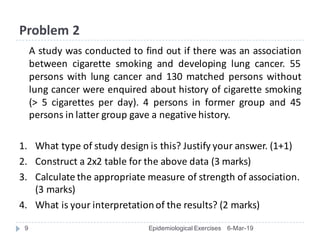
A study was conducted to find out if there was an association
between cigarette smoking and developing lung cancer. 55
persons with lung cancer and 130 matched persons without
lung cancer were enquired about history of cigarette smoking
(> 5 cigarettes per day). 4 persons in former group and 45
persons in latter group gave a negative history.
1. What	type	of	study	design	is	this?	Justify	your	answer.	(1+1)
2. Construct	a	2x2	table	for	the	above	data	(3	marks)
3. Calculate	the	appropriate	measure	of	strength	of	association.	
(3	marks)
4. What	is	your	interpretation	of	the	results?	(2	marks)
6-Mar-19Epidemiological Exercises9
Problem	2
1. It	is	a	case-control	study,	as	cases	and	controls	were	selected	
and	details	of	history	of	exposure	were	enquired.
2. Table:	Case-Control	(2	✕ 2	Table)
6-Mar-19Epidemiological Exercises10
Smoker	
Lung	cancer	
Total
Present	 Absent	
Yes	 51	(a) 85	(b) 136
No 4	(c) 45	(d) 49
Total	 55 130 185
Problem	2
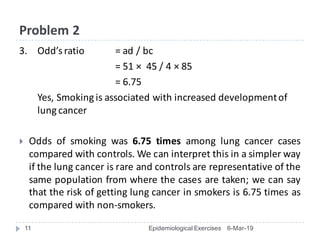
3. Odd’s	ratio	 =	ad	/	bc
=	51	× 45	/	4	× 85
=	6.75
Yes,	Smoking	is	associated	with	increased	development	of	
lung	cancer
} Odds of smoking was 6.75 times among lung cancer cases
compared with controls. We can interpret this in a simpler way
if the lung cancer is rare and controls are representative of the
same population from where the cases are taken; we can say
that the risk of getting lung cancer in smokers is 6.75 times as
compared with non-smokers.
6-Mar-19Epidemiological Exercises11
Problem	3
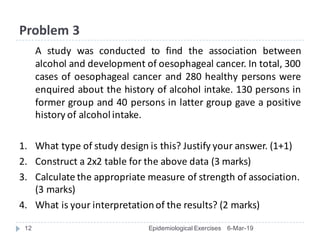
A study was conducted to find the association between
alcohol and development of oesophageal cancer. In total, 300
cases of oesophageal cancer and 280 healthy persons were
enquired about the history of alcohol intake. 130 persons in
former group and 40 persons in latter group gave a positive
history of alcoholintake.
1. What	type	of	study	design	is	this?	Justify	your	answer.	(1+1)
2. Construct	a	2x2	table	for	the	above	data	(3	marks)
3. Calculate	the	appropriate	measure	of	strength	of	association.	
(3	marks)
4. What	is	your	interpretation	of	the	results?	(2	marks)
6-Mar-1912 Epidemiological Exercises
Problem	3
6-Mar-19Epidemiological Exercises13
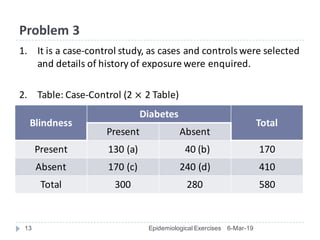
1. It	is	a	case-control	study,	as	cases	and	controls	were	selected	
and	details	of	history	of	exposure	were	enquired.
2. Table:	Case-Control	(2	✕ 2	Table)
Blindness	
Diabetes	
Total	
Present	 Absent	
Present	 130	(a) 40	(b) 170
Absent	 170	(c) 240	(d) 410
Total	 300 280 580
Problem	3
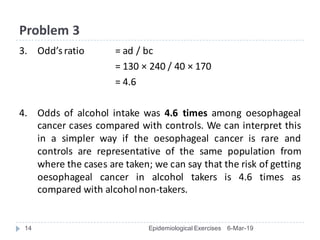
3. Odd’s	ratio	 =	ad	/	bc
=	130	× 240	/	40	× 170
=	4.6
4. Odds of alcohol intake was 4.6 times among oesophageal
cancer cases compared with controls. We can interpret this
in a simpler way if the oesophageal cancer is rare and
controls are representative of the same population from
where the cases are taken; we can say that the risk of getting
oesophageal cancer in alcohol takers is 4.6 times as
compared with alcoholnon-takers.
6-Mar-19Epidemiological Exercises14

Epidemiological Exercises on case control studies