Chapter 21
Deserts
Chapter 21
Outline
• Deserts: extents and basics.
• Desert types
-Subtropical, rain shadows, cont. interiors, coastal, polar.
• Desert Processes
-Weathering, soils, desert varnish
-Erosion by water and wind
-Deposition and transport
• Desert Landscapes
-Cliffs & mesas
-Pediments and bajadas
-Dunes, their types and controls
• Desertification
Chapter 21
Chapter 21
Deserts
• Deserts cover
• Primary control on deserts?
• Characterized by…
• Extreme
• Specialized
• Unique
Chapter 21
What Is a Desert?
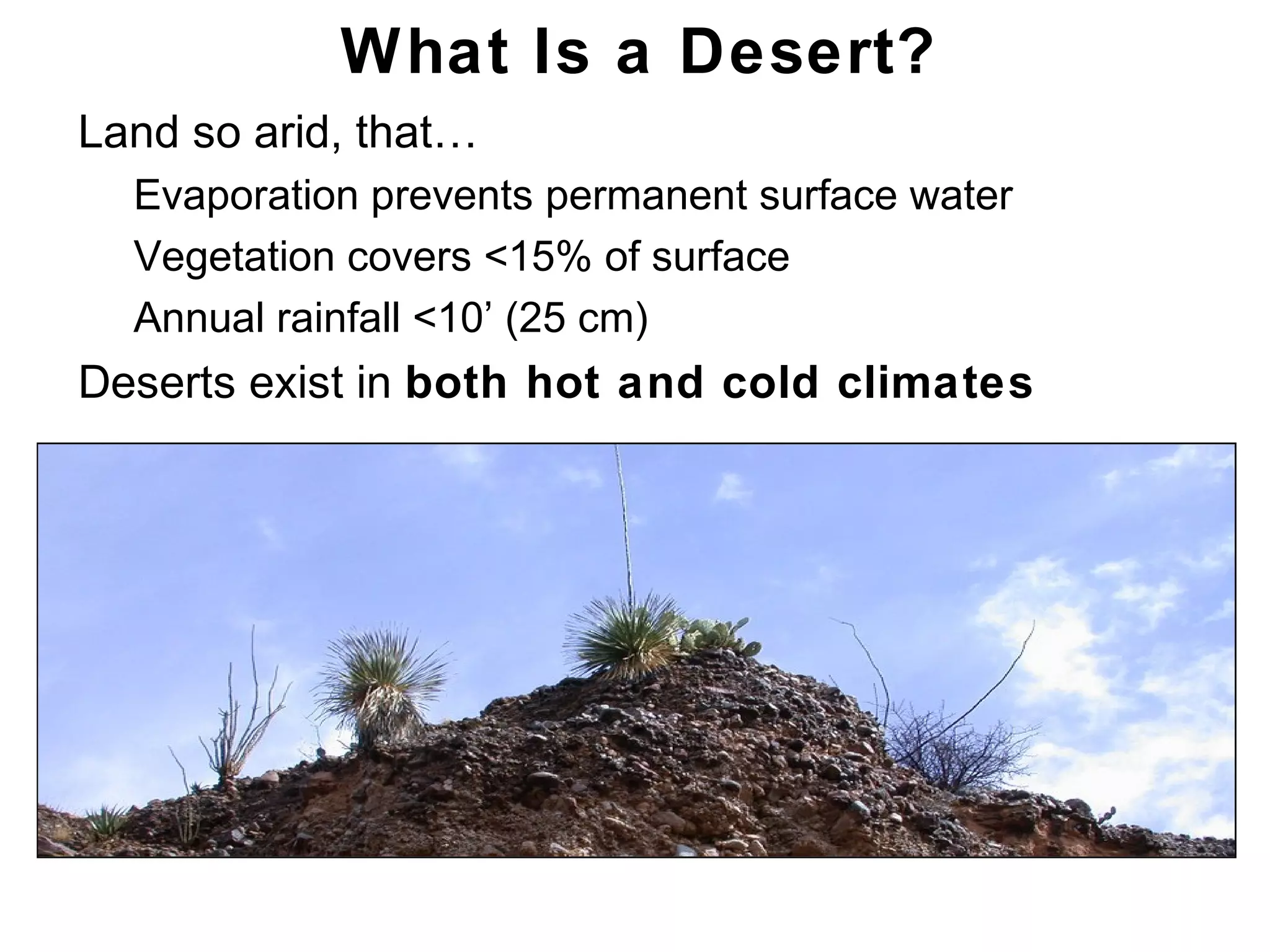
• Land so arid, that…
• Evaporation prevents permanent surface water
• Vegetation covers <15% of surface
• Annual rainfall <10’ (25 cm)
• Deserts exist in both hot and cold climates
Chapter 21
Hot vs. Cold Deserts
• Cold deserts:
• High latitudes
• High elevations
• Near cold oceans currents
• Hot deserts:
• Low latitudes
• Low elevations
• Far from oceans
Chapter 21
Desert Features
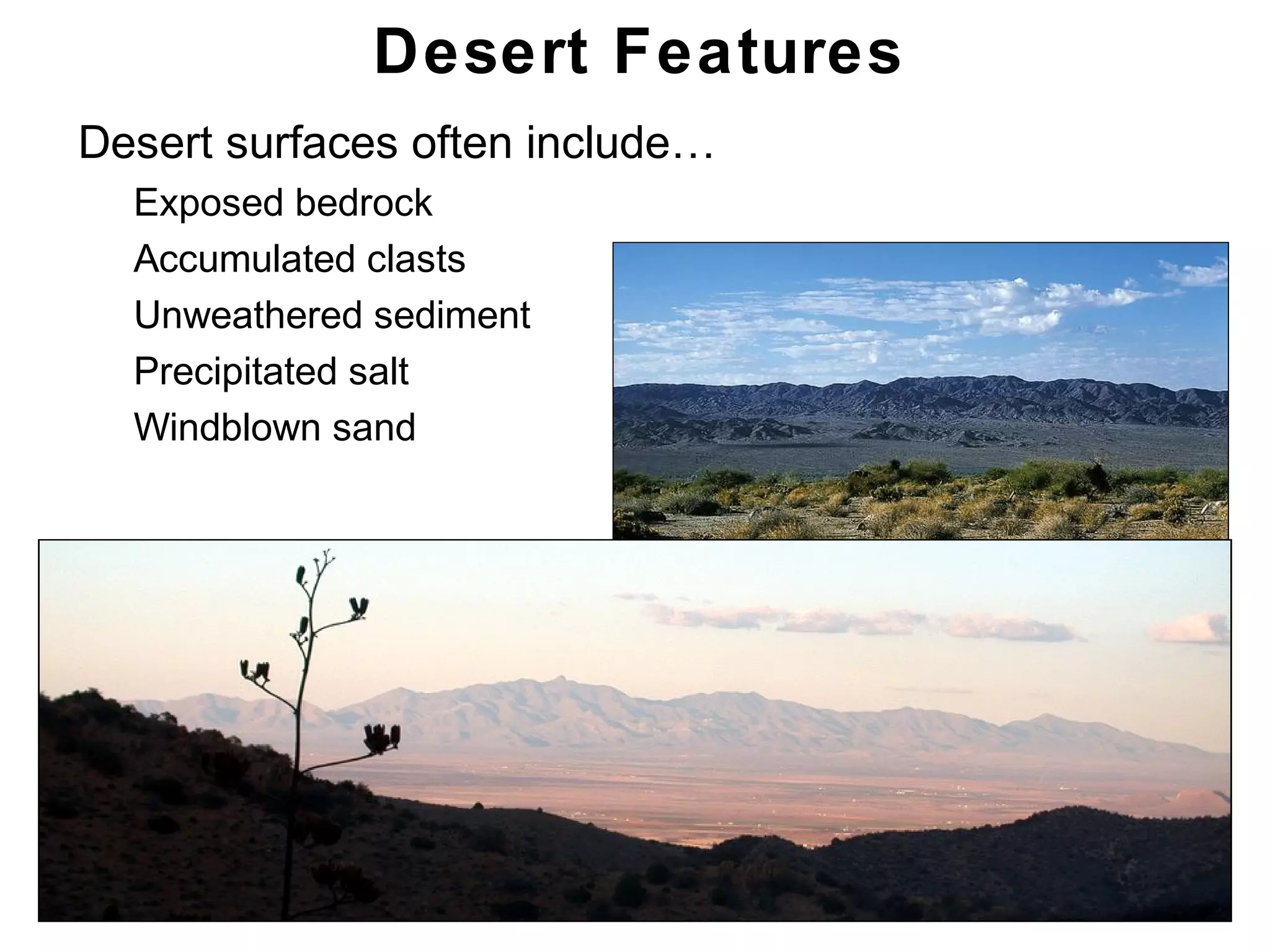
• Desert surfaces often include…
• Exposed bedrock
• Accumulated clasts
• Unweathered sediment
• Precipitated salt
• Windblown sand
Chapter 21
Outline
• Deserts: extents and basics.
• Desert types
-Subtropical, rain shadows, cont. interiors, coastal, polar.
• Desert Processes
-Weathering, soils, desert varnish
-Erosion by water and wind
-Deposition and transport
• Desert Landscapes
-Cliffs & mesas
-Pediments and bajadas
-Dunes, their types and controls
• Desertification
Chapter 21
Chapter 21
Types of Deserts
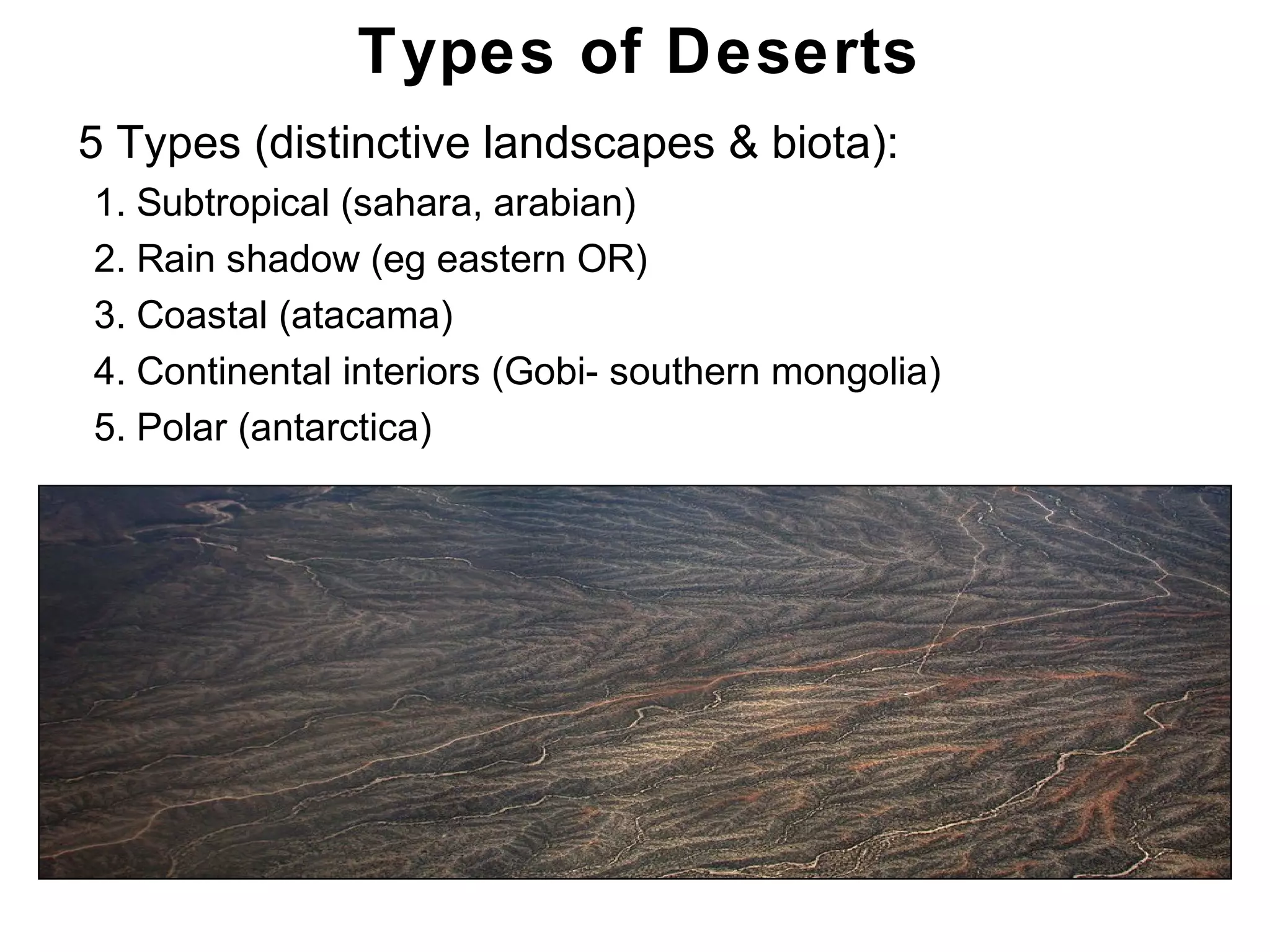
• 5 Types (distinctive landscapes & biota):
1. Subtropical (sahara, arabian)
2. Rain shadow (eg eastern OR)
3. Coastal (atacama)
4. Continental interiors (Gobi- southern mongolia)
5. Polar (antarctica)
Chapter 21
Subtropical Deserts
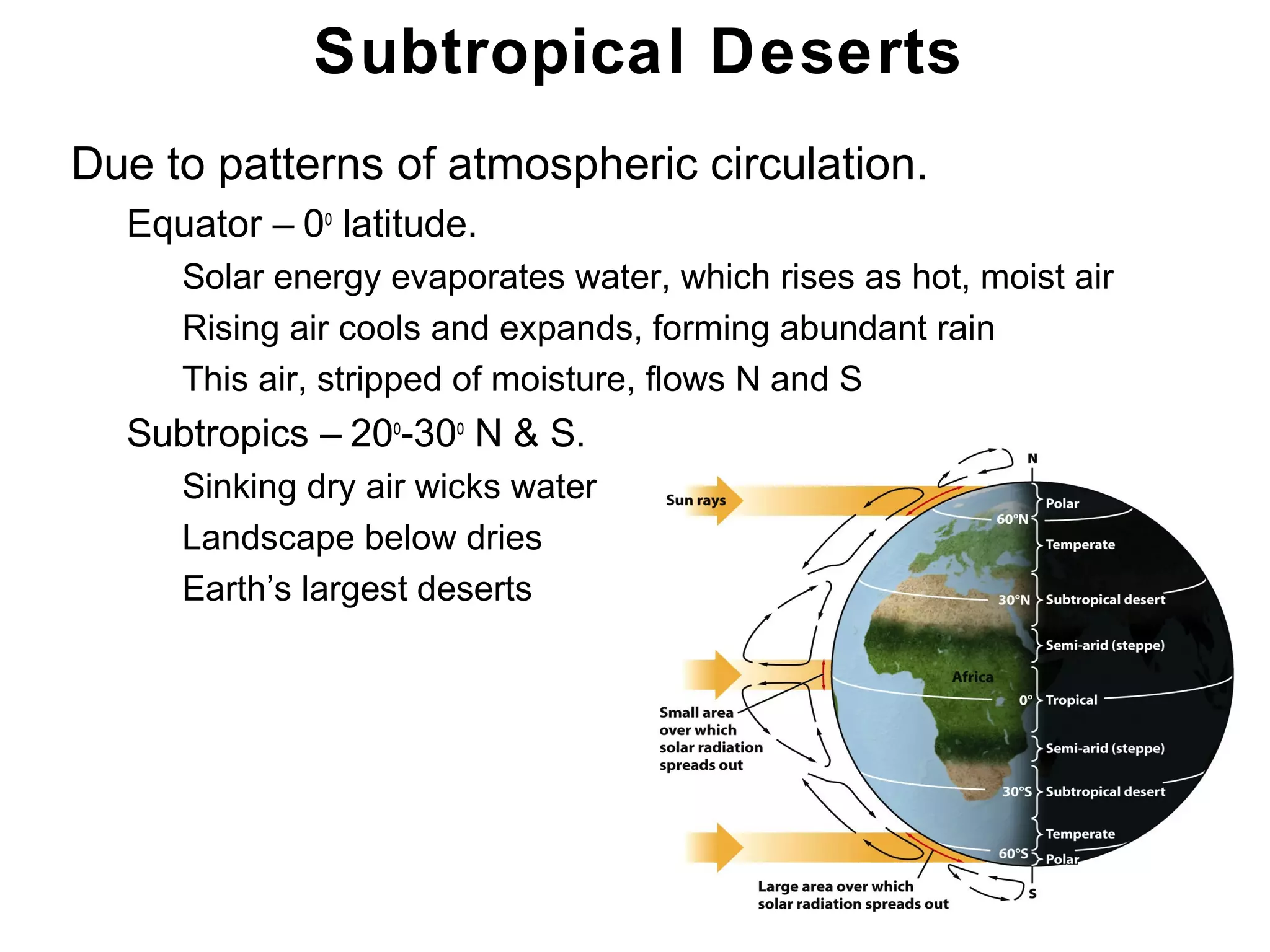
• Due to patterns of atmospheric circulation.
• Equator – 0o
latitude.
• Solar energy evaporates water, which rises as hot, moist air
• Rising air cools and expands, forming abundant rain
• This air, stripped of moisture, flows N and S
• Subtropics – 20o
-30o
N & S.
• Sinking dry air wicks water
• Landscape below dries
• Earth’s largest deserts
Chapter 21
• At 20-30o
N & S latitude across time (as plates move)
• African deserts bracket equator
• North: sahara and arabian
• Rainforest straddling equator
• South: namib and Kalahari
Subtropical Deserts
Chapter 21
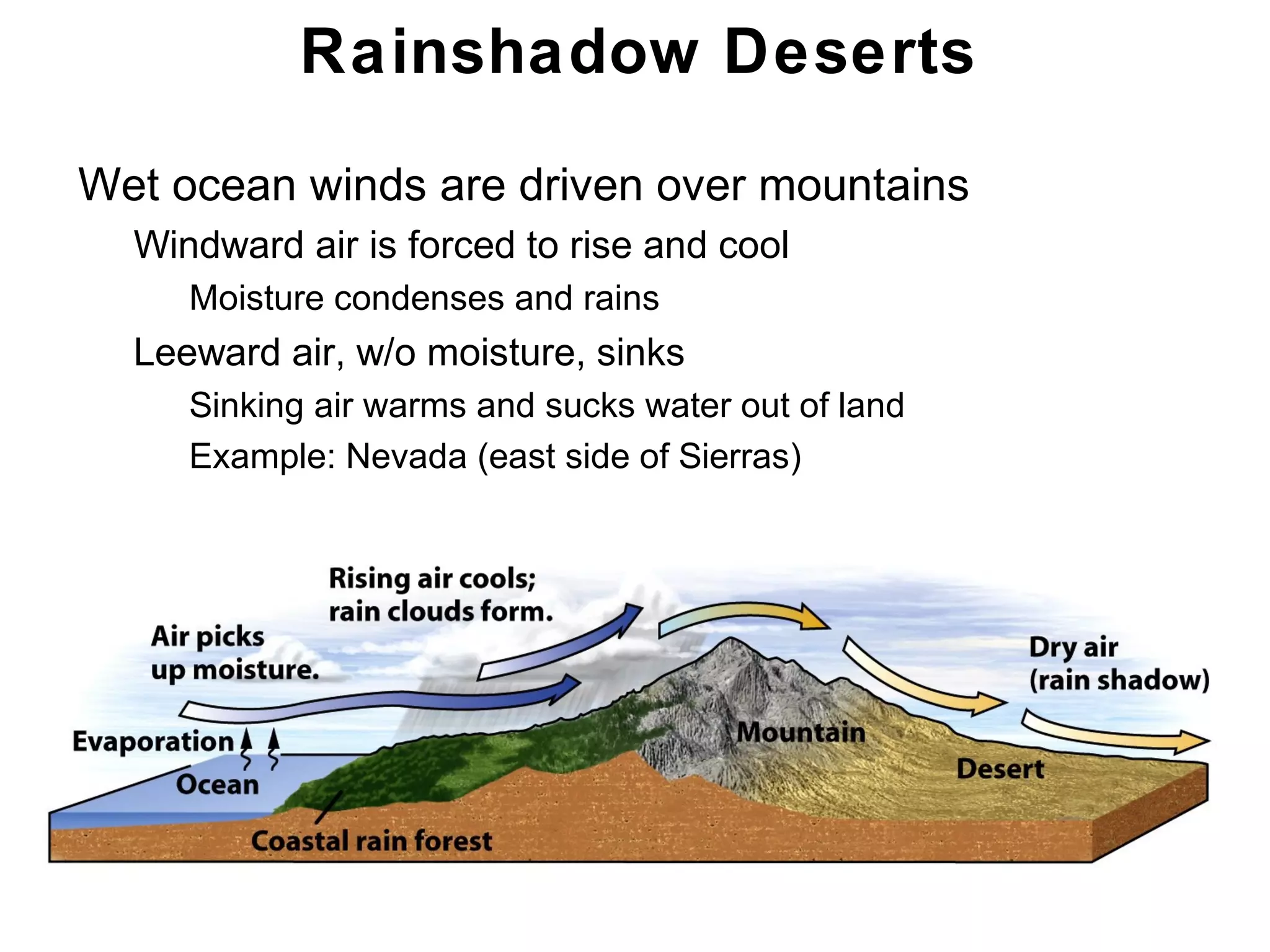
Rainshadow Deserts
• Wet ocean winds are driven over mountains
• Windward air is forced to rise and cool
• Moisture condenses and rains
• Leeward air, w/o moisture, sinks
• Sinking air warms and sucks water out of land
• Example: Nevada (east side of Sierras)
Chapter 21
Coastal Deserts
• Cool air over cold ocean water holds little moisture
• Air absorbs moisture when it interacts with land
• Atacama desert (Peru) -> driest place on earth
Chapter 21
Interior Deserts
• Air looses moisture crossing continents
• Land far from ocean moisture can be arid
• Example: gobi desert in Mongolia
Chapter 21
Polar Deserts
• Above 66º N & S latitude there is a little moisture vapor
• Air circulation carries
• It is so cold, air can’t
Chapter 21
Outline
• Deserts: extents and basics.
• Desert types
-Subtropical, rain shadows, cont. interiors, coastal, polar.
• Desert Processes
-Weathering, soils, desert varnish
-Erosion by water and wind
-Deposition and transport
• Desert Landscapes
-Cliffs & mesas
-Pediments and bajadas
-Dunes, their types and controls
• Desertification
Chapter 21
Chapter 21
Desert Processes
• Deserts are characterized by:
• Erosion by water and wind
• Weathering.
• Soil formation.
• Deposition.
• These processes result in unique landscapes
Chapter 21
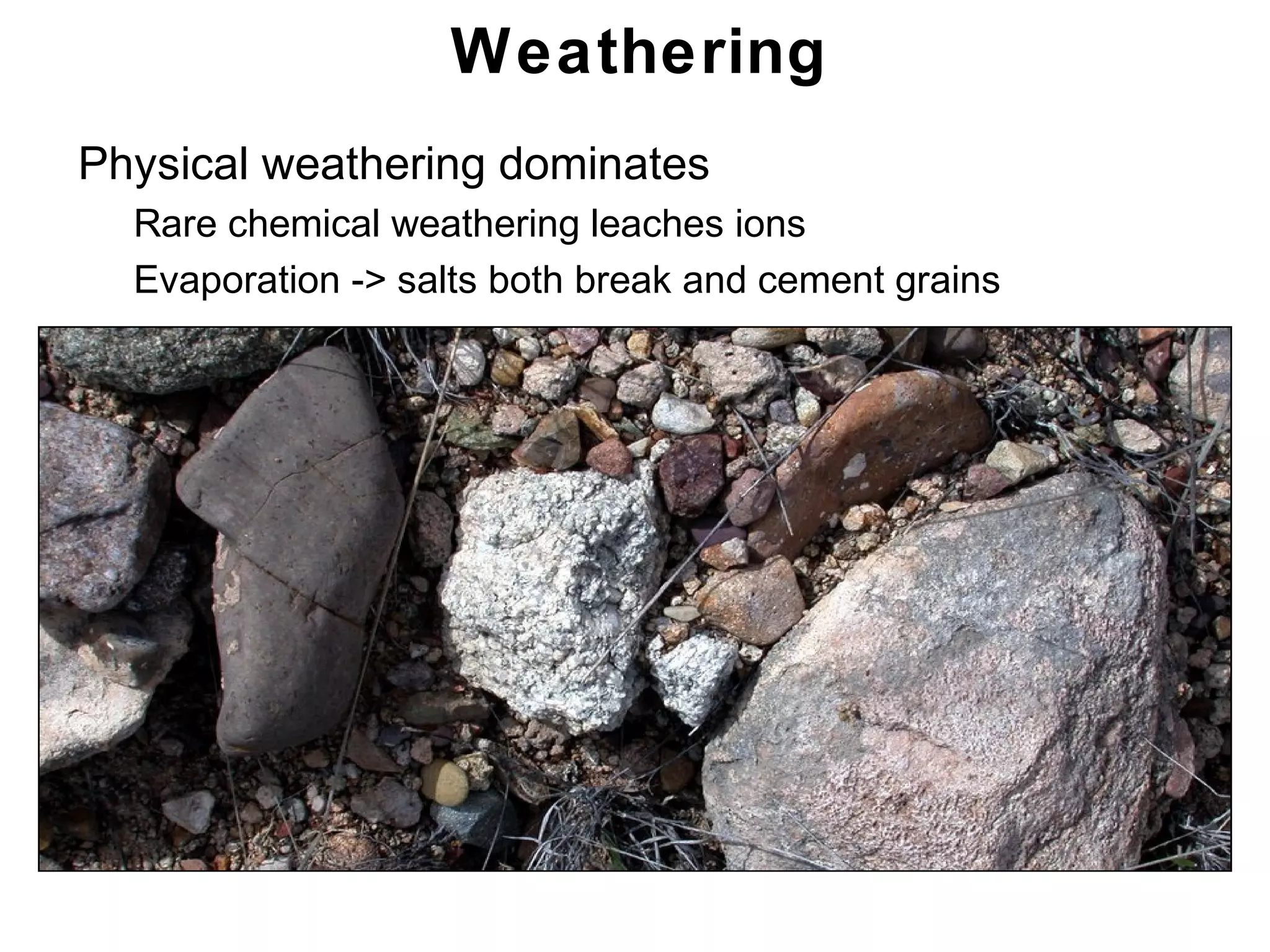
Weathering
• Physical weathering dominates
• Rare chemical weathering leaches ions
• Evaporation -> salts both break and cement grains
Chapter 21
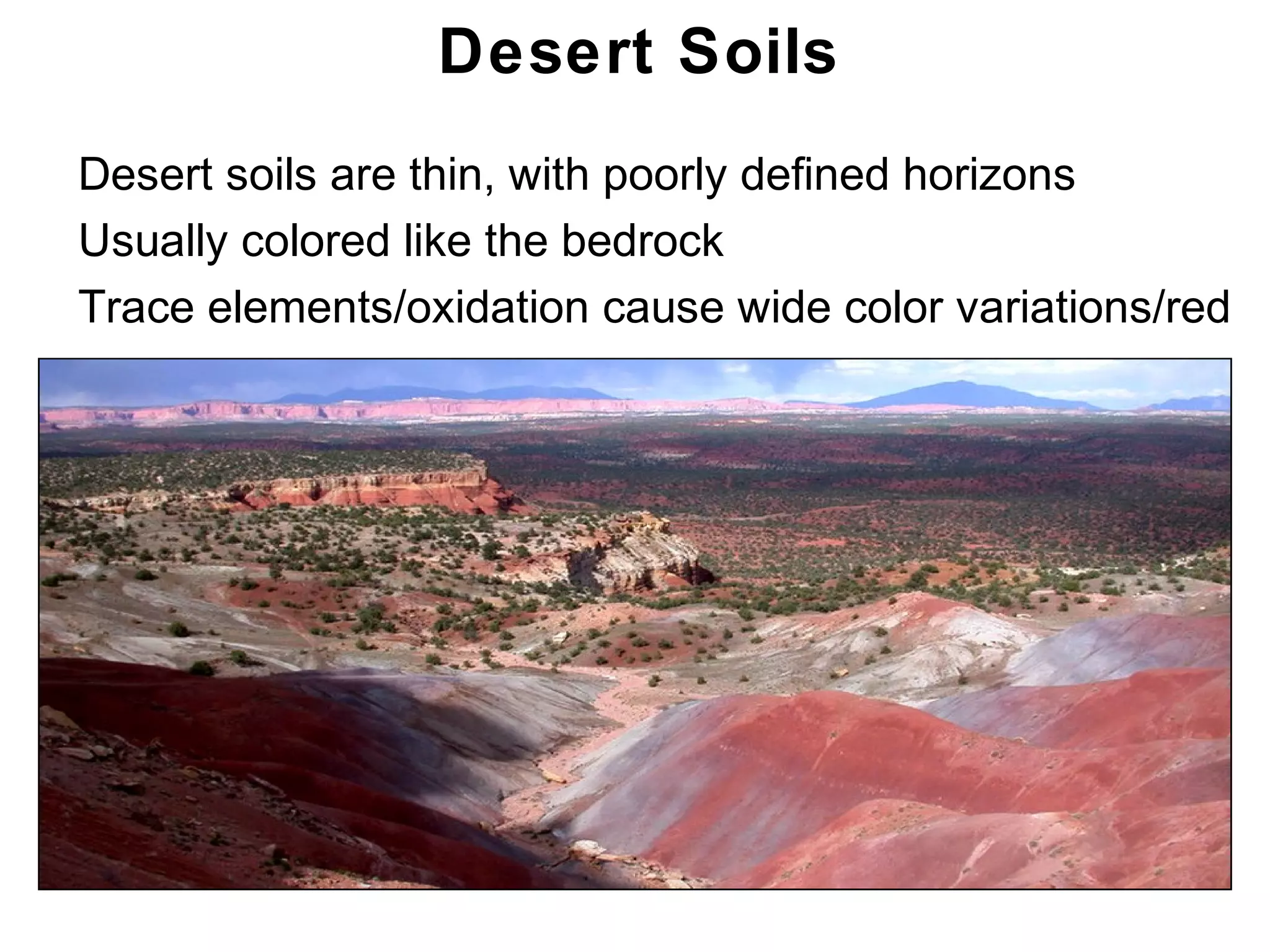
Desert Soils
• Desert soils are thin, with poorly defined horizons
• Usually colored like the bedrock
• Trace elements/oxidation cause wide color variations/red
Chapter 21
Desert Varnish
• Exposed surfaces develop desert varnish.
• Dark coating of iron and manganese oxides
• Forms very slowly by bacterial activity and dust and water
• Native Americans left petroglyphs in desert varnish
Chapter 21
Water Erosion
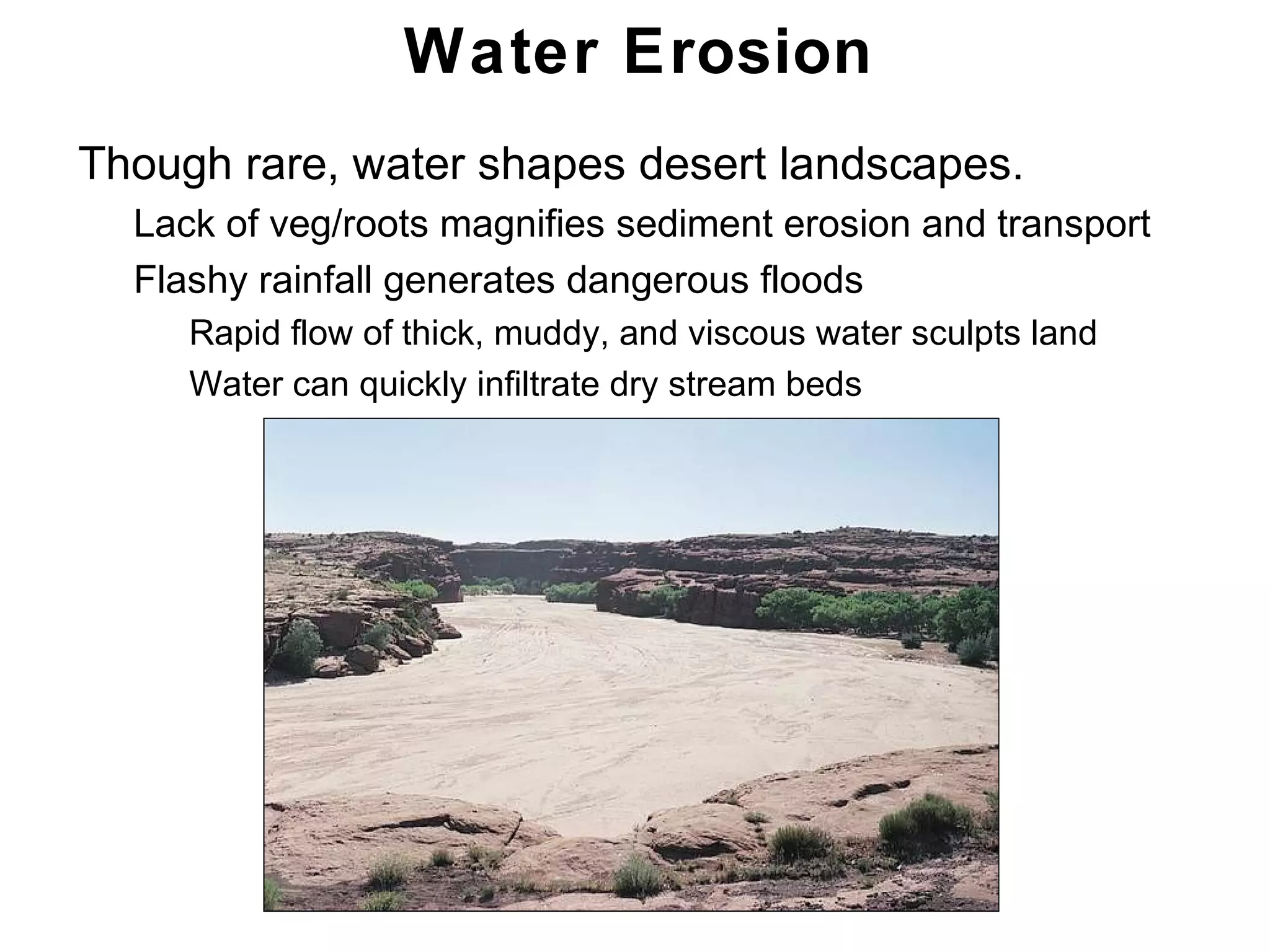
• Though rare, water shapes desert landscapes.
• Lack of veg/roots magnifies sediment erosion and transport
• Flashy rainfall generates dangerous floods
• Rapid flow of thick, muddy, and viscous water sculpts land
• Water can quickly infiltrate dry stream beds
Chapter 21
• Ground is scoured by wind
• Sand & silt-sized sediment is lifted and moved
• Surface load – grains moved along land surface
• Saltation – sand skipped, bounced by grain impact
• Suspended load – sediment carried in air
• High winds can carry dust across entire oceans
Wind Erosion and Transport
Chapter 21
• Coarse clasts can’t be lifted by wind
• Finer sediment removed; forms lag deposits (deflation)
• Creates desert pavement
-> Surface layer of stones
• Becomes resistant to erosion
Wind Erosion and Transport
Chapter 21
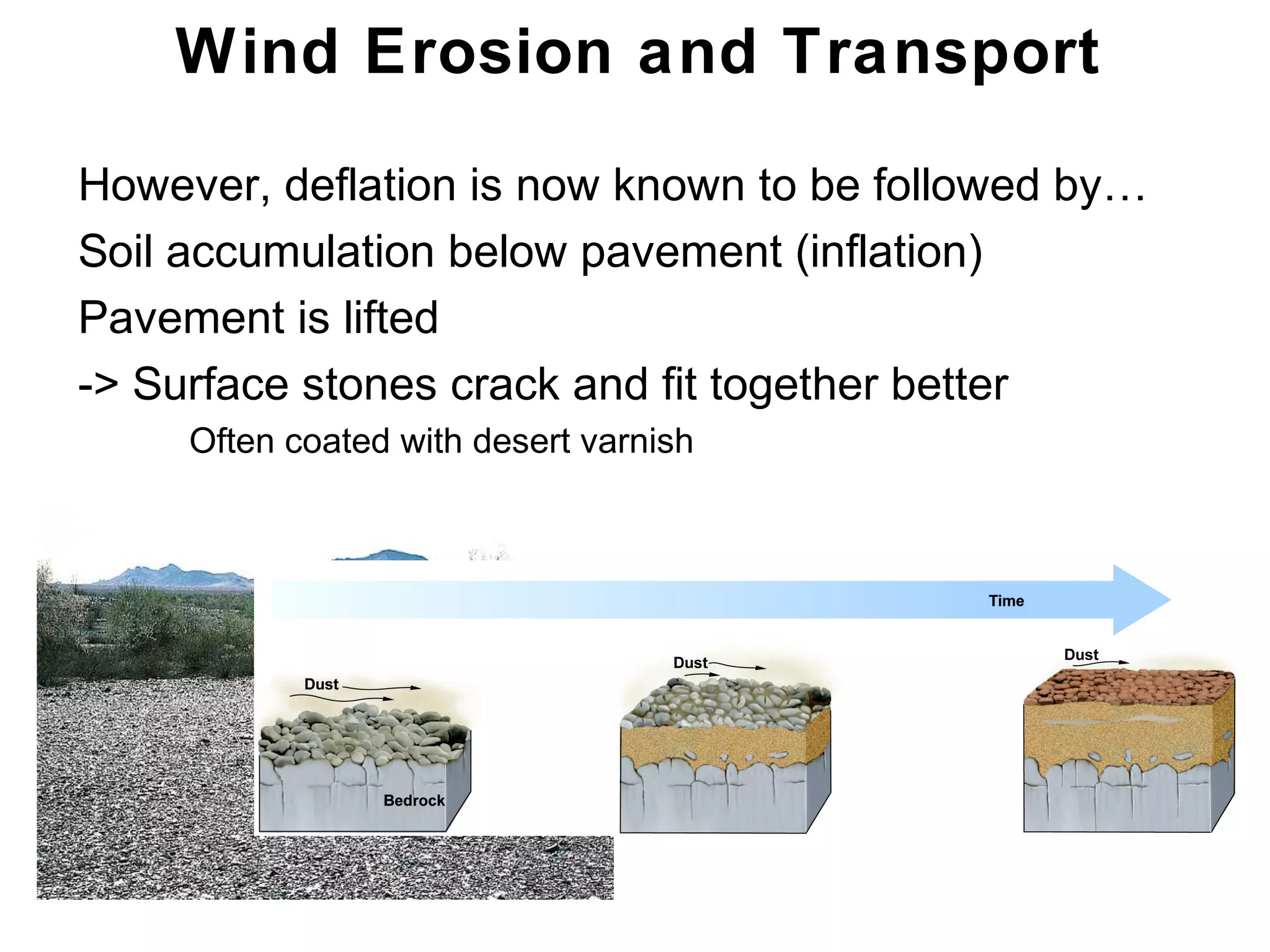
• However, deflation is now known to be followed by…
• Soil accumulation below pavement (inflation)
• Pavement is lifted
• -> Surface stones crack and fit together better
• Often coated with desert varnish
Wind Erosion and Transport
Chapter 21
• Deflation – lowering land surface via erosion
• Concentrated wind erosion creates blowouts
• Desert processes clearly operating on mars
Wind Erosion and Transport
Chapter 21
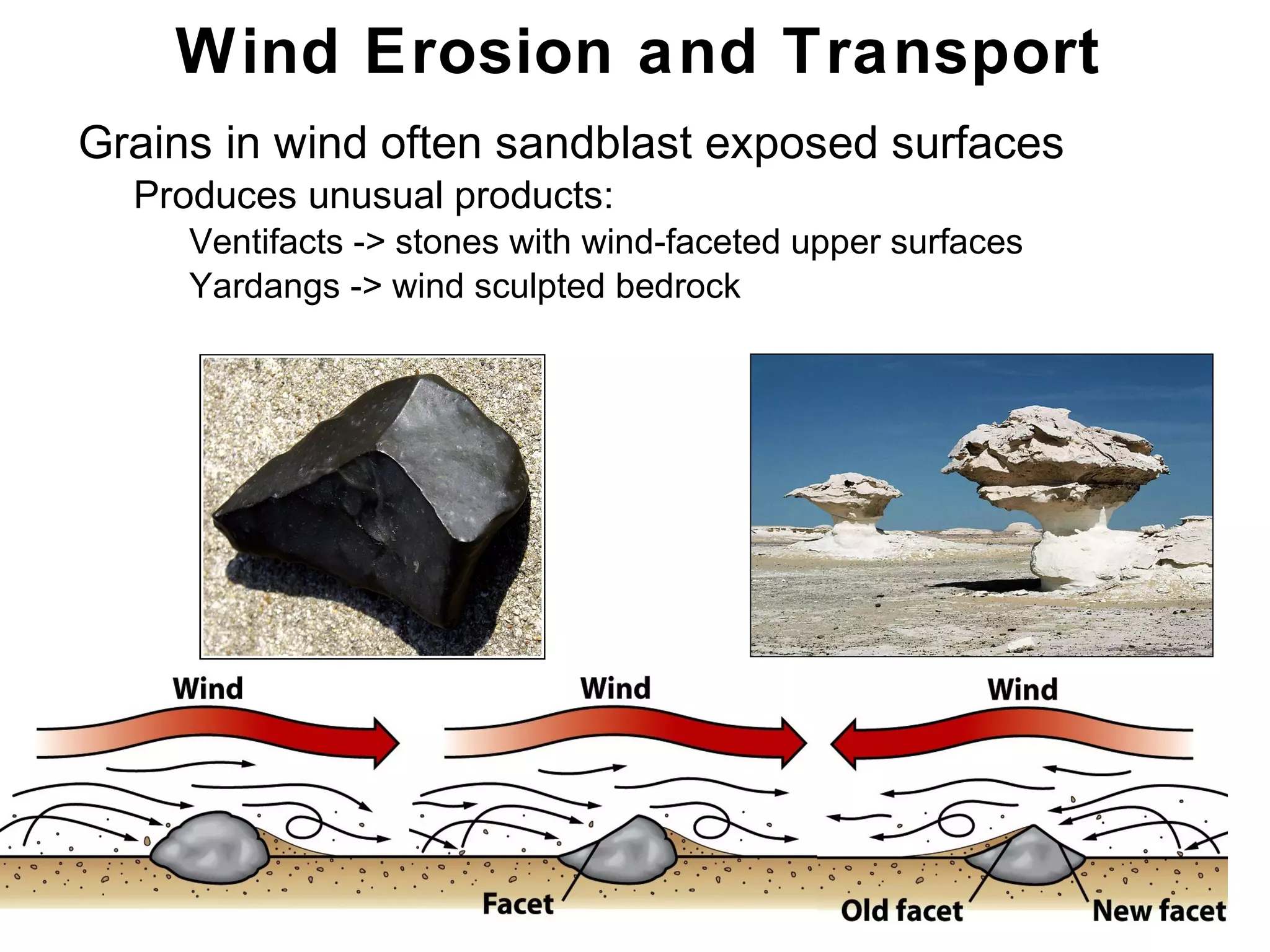
• Grains in wind often sandblast exposed surfaces
• Produces unusual products:
• Ventifacts -> stones with wind-faceted upper surfaces
• Yardangs -> wind sculpted bedrock
Wind Erosion and Transport
Chapter 21
• Desert sediments accumulate in many settings
• Erosional debris accumulates near source areas
• Talus aprons, at angle of repose, collect cliff debris
• Rock blocks have shapes determined by jointing
Desert Deposition
Chapter 21
Desert Deposition
• Playas – Desert (salt) lakes without outlet streams
• Internal drainage collects water from flash floods
• Dissolved solids crystallize out as water evaporates
• Halite, gypsum.
Salar de Uyuni, Bolivia
Chapter 21
• Wind carries 2 types of sediment load
1. Surface load – coarser sand sized particles
2. Suspended load – finer grained silt sized dust
• Sand forms dunes in deserts: dust forms loess next to (downwind
of ) deserts
Desert Processes
Chapter 21
Outline
• Deserts: extents and basics.
• Desert types
-Subtropical, rain shadows, cont. interiors, coastal, polar.
• Desert Processes
-Weathering, soils, desert varnish
-Erosion by water and wind
-Deposition and transport
• Desert Landscapes
-Cliffs & mesas
-Pediments and bajadas
-Dunes, their types and controls
• Desertification
Chapter 21
Chapter 21
• Deserts exhibit diverse landscapes
• Reflect interplay of erosional and depositional
Desert Landscapes
Chapter 21
Desert Landscapes
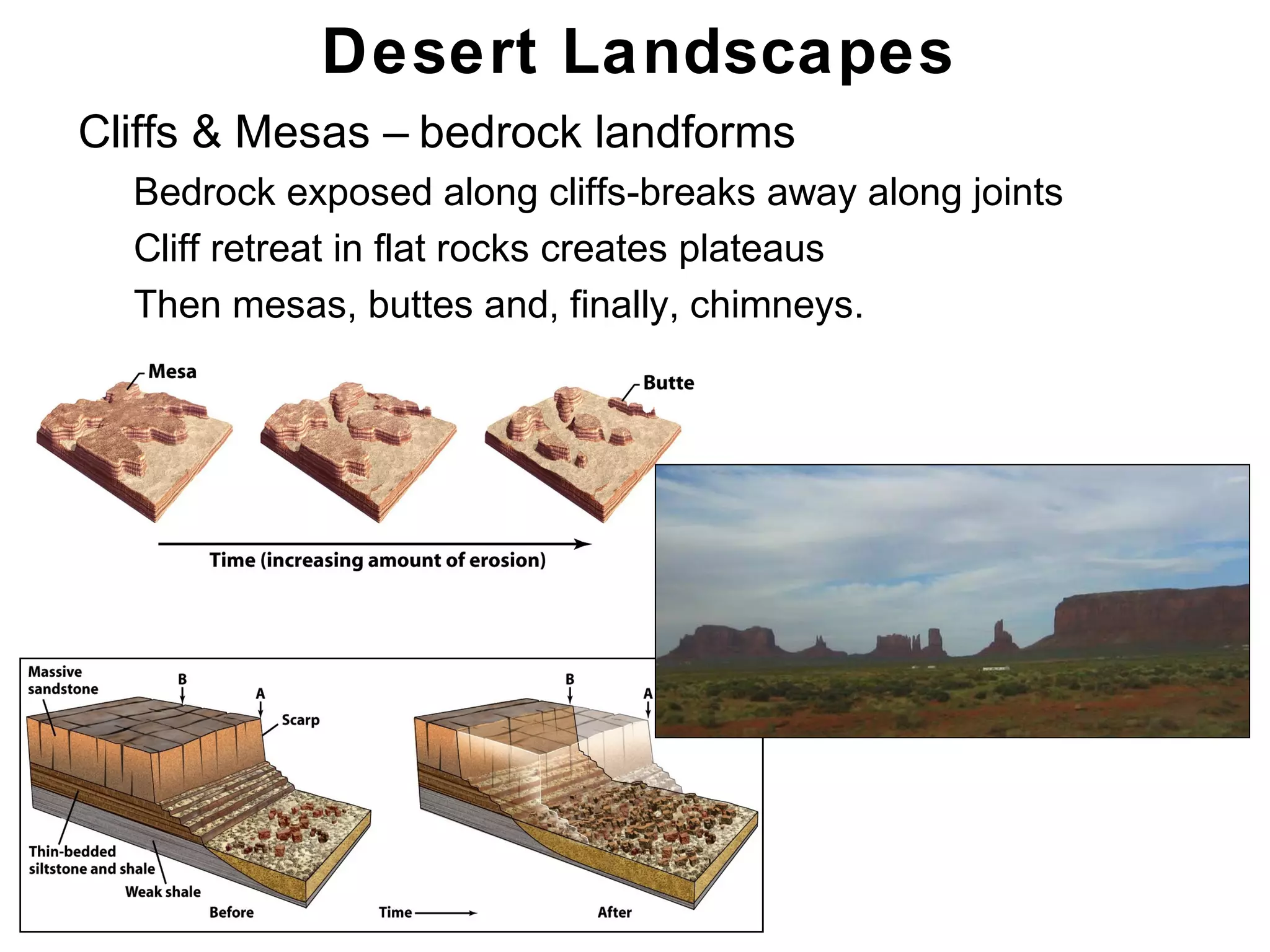
• Cliffs & Mesas – bedrock landforms
• Bedrock exposed along cliffs-breaks away along joints
• Cliff retreat in flat rocks creates plateaus
• Then mesas, buttes and, finally, chimneys.
Chapter 21
• Cliffs & Mesas –
• Resistant –
• Weak –
Desert Landscapes
Chapter 21
• Cliffs & Mesas – Structure governs landforms
• Non-horizontal bedding produces linear ridges
• Cuesta – steep joint controlled cliff, less steep dip slope
• Inselberg – eroded remnant of almost-complete cliff retreat
Desert Landscapes
Chapter 21
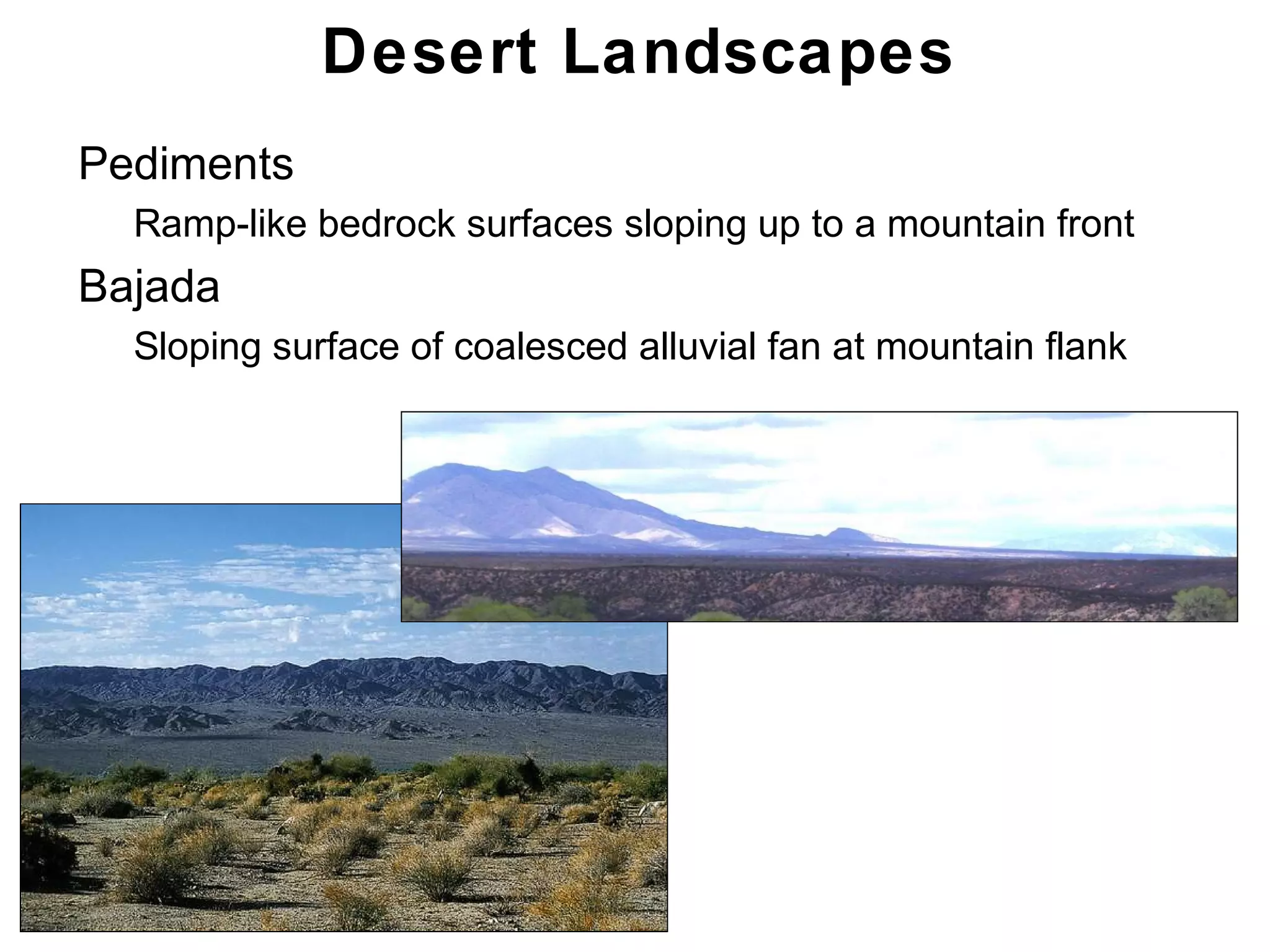
• Pediments
• Ramp-like bedrock surfaces sloping up to a mountain front
• Bajada
• Sloping surface of coalesced alluvial fan at mountain flank
Desert Landscapes
Chapter 21
• Dunes – windblown sand accumulations
• Sand carried by wind accumulates around obstacle
• Over time, a dune grows, begins to moved downwind
• Dunes generate enormous cross-beds
Desert Landscapes
Chapter 21
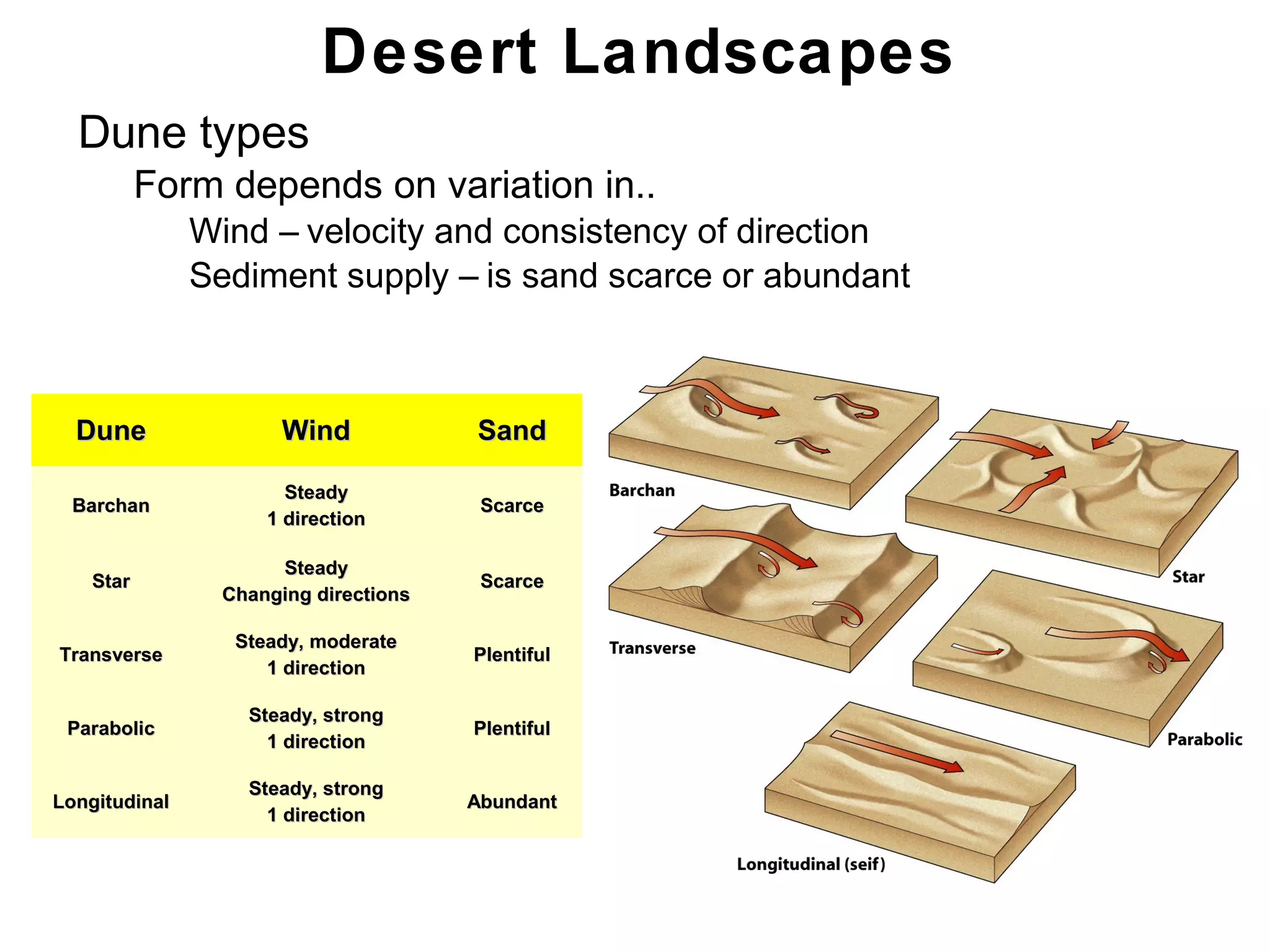
• Dune types
• Form depends on variation in..
• Wind – velocity and consistency of direction
• Sediment supply – is sand scarce or abundant
Desert Landscapes
DuneDune WindWind SandSand
BarchanBarchan
SteadySteady
1 direction1 direction
ScarceScarce
StarStar
SteadySteady
Changing directionsChanging directions
ScarceScarce
TransverseTransverse
Steady, moderateSteady, moderate
1 direction1 direction
PlentifulPlentiful
ParabolicParabolic
Steady, strongSteady, strong
1 direction1 direction
PlentifulPlentiful
LongitudinalLongitudinal
Steady, strongSteady, strong
1 direction1 direction
AbundantAbundant
Chapter 21
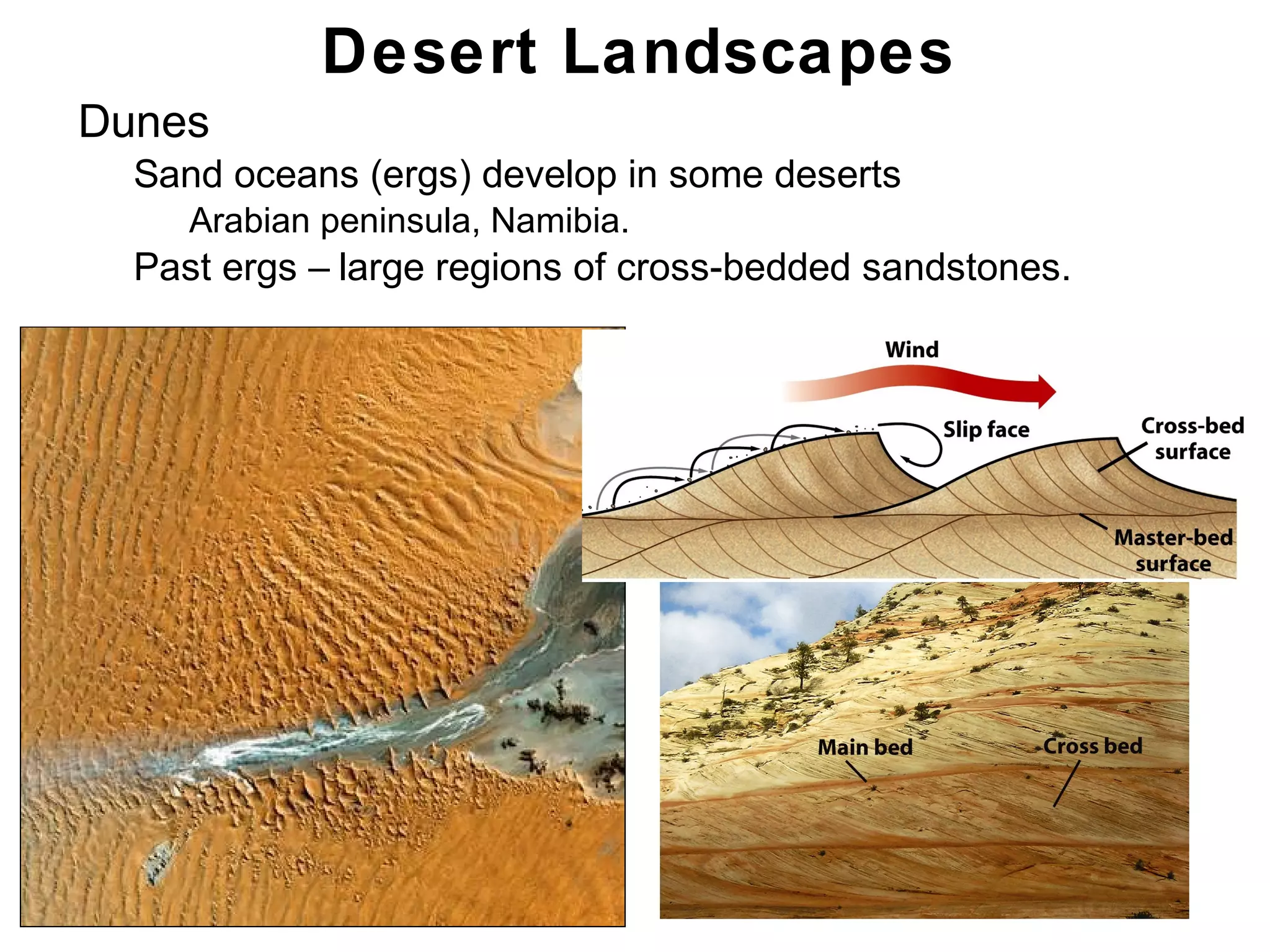
• Dunes
• Sand oceans (ergs) develop in some deserts
• Arabian peninsula, Namibia.
• Past ergs – large regions of cross-bedded sandstones.
Desert Landscapes
Chapter 21
• Desert organisms are adapted to harsh conditions
• Dessication.
• Temperature extremes.
Desert Life
Chapter 21
Outline
• Deserts: extents and basics.
• Desert types
-Subtropical, rain shadows, cont. interiors, coastal, polar.
• Desert Processes
-Weathering, soils, desert varnish
-Erosion by water and wind
-Deposition and transport
• Desert Landscapes
-Cliffs & mesas
-Pediments and bajadas
-Dunes, their types and controls
• Desertification
Chapter 21
Chapter 21
Desertification
• Desertification – aridification of nondesert areas
• Human activity expands desert areas
• Examples: aral sea and mid US
Chapter 21
Desertification
• Desertification caused by…
• Overpopulation, overgrazing
• Careless agriculture
• Diversion of water supplies
• climate change
• Leads to hardship (i.e. famine).

19 deserts forstudents

  • 1.
  • 2.
    Chapter 21 Outline • Deserts:extents and basics. • Desert types -Subtropical, rain shadows, cont. interiors, coastal, polar. • Desert Processes -Weathering, soils, desert varnish -Erosion by water and wind -Deposition and transport • Desert Landscapes -Cliffs & mesas -Pediments and bajadas -Dunes, their types and controls • Desertification Chapter 21
  • 3.
    Chapter 21 Deserts • Desertscover • Primary control on deserts? • Characterized by… • Extreme • Specialized • Unique
  • 4.
    Chapter 21 What Isa Desert? • Land so arid, that… • Evaporation prevents permanent surface water • Vegetation covers <15% of surface • Annual rainfall <10’ (25 cm) • Deserts exist in both hot and cold climates
  • 5.
    Chapter 21 Hot vs.Cold Deserts • Cold deserts: • High latitudes • High elevations • Near cold oceans currents • Hot deserts: • Low latitudes • Low elevations • Far from oceans
  • 6.
    Chapter 21 Desert Features •Desert surfaces often include… • Exposed bedrock • Accumulated clasts • Unweathered sediment • Precipitated salt • Windblown sand
  • 7.
    Chapter 21 Outline • Deserts:extents and basics. • Desert types -Subtropical, rain shadows, cont. interiors, coastal, polar. • Desert Processes -Weathering, soils, desert varnish -Erosion by water and wind -Deposition and transport • Desert Landscapes -Cliffs & mesas -Pediments and bajadas -Dunes, their types and controls • Desertification Chapter 21
  • 8.
    Chapter 21 Types ofDeserts • 5 Types (distinctive landscapes & biota): 1. Subtropical (sahara, arabian) 2. Rain shadow (eg eastern OR) 3. Coastal (atacama) 4. Continental interiors (Gobi- southern mongolia) 5. Polar (antarctica)
  • 9.
    Chapter 21 Subtropical Deserts •Due to patterns of atmospheric circulation. • Equator – 0o latitude. • Solar energy evaporates water, which rises as hot, moist air • Rising air cools and expands, forming abundant rain • This air, stripped of moisture, flows N and S • Subtropics – 20o -30o N & S. • Sinking dry air wicks water • Landscape below dries • Earth’s largest deserts
  • 10.
    Chapter 21 • At20-30o N & S latitude across time (as plates move) • African deserts bracket equator • North: sahara and arabian • Rainforest straddling equator • South: namib and Kalahari Subtropical Deserts
  • 11.
    Chapter 21 Rainshadow Deserts •Wet ocean winds are driven over mountains • Windward air is forced to rise and cool • Moisture condenses and rains • Leeward air, w/o moisture, sinks • Sinking air warms and sucks water out of land • Example: Nevada (east side of Sierras)
  • 12.
    Chapter 21 Coastal Deserts •Cool air over cold ocean water holds little moisture • Air absorbs moisture when it interacts with land • Atacama desert (Peru) -> driest place on earth
  • 13.
    Chapter 21 Interior Deserts •Air looses moisture crossing continents • Land far from ocean moisture can be arid • Example: gobi desert in Mongolia
  • 14.
    Chapter 21 Polar Deserts •Above 66º N & S latitude there is a little moisture vapor • Air circulation carries • It is so cold, air can’t
  • 15.
    Chapter 21 Outline • Deserts:extents and basics. • Desert types -Subtropical, rain shadows, cont. interiors, coastal, polar. • Desert Processes -Weathering, soils, desert varnish -Erosion by water and wind -Deposition and transport • Desert Landscapes -Cliffs & mesas -Pediments and bajadas -Dunes, their types and controls • Desertification Chapter 21
  • 16.
    Chapter 21 Desert Processes •Deserts are characterized by: • Erosion by water and wind • Weathering. • Soil formation. • Deposition. • These processes result in unique landscapes
  • 17.
    Chapter 21 Weathering • Physicalweathering dominates • Rare chemical weathering leaches ions • Evaporation -> salts both break and cement grains
  • 18.
    Chapter 21 Desert Soils •Desert soils are thin, with poorly defined horizons • Usually colored like the bedrock • Trace elements/oxidation cause wide color variations/red
  • 19.
    Chapter 21 Desert Varnish •Exposed surfaces develop desert varnish. • Dark coating of iron and manganese oxides • Forms very slowly by bacterial activity and dust and water • Native Americans left petroglyphs in desert varnish
  • 20.
    Chapter 21 Water Erosion •Though rare, water shapes desert landscapes. • Lack of veg/roots magnifies sediment erosion and transport • Flashy rainfall generates dangerous floods • Rapid flow of thick, muddy, and viscous water sculpts land • Water can quickly infiltrate dry stream beds
  • 21.
    Chapter 21 • Groundis scoured by wind • Sand & silt-sized sediment is lifted and moved • Surface load – grains moved along land surface • Saltation – sand skipped, bounced by grain impact • Suspended load – sediment carried in air • High winds can carry dust across entire oceans Wind Erosion and Transport
  • 22.
    Chapter 21 • Coarseclasts can’t be lifted by wind • Finer sediment removed; forms lag deposits (deflation) • Creates desert pavement -> Surface layer of stones • Becomes resistant to erosion Wind Erosion and Transport
  • 23.
    Chapter 21 • However,deflation is now known to be followed by… • Soil accumulation below pavement (inflation) • Pavement is lifted • -> Surface stones crack and fit together better • Often coated with desert varnish Wind Erosion and Transport
  • 24.
    Chapter 21 • Deflation– lowering land surface via erosion • Concentrated wind erosion creates blowouts • Desert processes clearly operating on mars Wind Erosion and Transport
  • 25.
    Chapter 21 • Grainsin wind often sandblast exposed surfaces • Produces unusual products: • Ventifacts -> stones with wind-faceted upper surfaces • Yardangs -> wind sculpted bedrock Wind Erosion and Transport
  • 26.
    Chapter 21 • Desertsediments accumulate in many settings • Erosional debris accumulates near source areas • Talus aprons, at angle of repose, collect cliff debris • Rock blocks have shapes determined by jointing Desert Deposition
  • 27.
    Chapter 21 Desert Deposition •Playas – Desert (salt) lakes without outlet streams • Internal drainage collects water from flash floods • Dissolved solids crystallize out as water evaporates • Halite, gypsum. Salar de Uyuni, Bolivia
  • 28.
    Chapter 21 • Windcarries 2 types of sediment load 1. Surface load – coarser sand sized particles 2. Suspended load – finer grained silt sized dust • Sand forms dunes in deserts: dust forms loess next to (downwind of ) deserts Desert Processes
  • 29.
    Chapter 21 Outline • Deserts:extents and basics. • Desert types -Subtropical, rain shadows, cont. interiors, coastal, polar. • Desert Processes -Weathering, soils, desert varnish -Erosion by water and wind -Deposition and transport • Desert Landscapes -Cliffs & mesas -Pediments and bajadas -Dunes, their types and controls • Desertification Chapter 21
  • 30.
    Chapter 21 • Desertsexhibit diverse landscapes • Reflect interplay of erosional and depositional Desert Landscapes
  • 31.
    Chapter 21 Desert Landscapes •Cliffs & Mesas – bedrock landforms • Bedrock exposed along cliffs-breaks away along joints • Cliff retreat in flat rocks creates plateaus • Then mesas, buttes and, finally, chimneys.
  • 32.
    Chapter 21 • Cliffs& Mesas – • Resistant – • Weak – Desert Landscapes
  • 33.
    Chapter 21 • Cliffs& Mesas – Structure governs landforms • Non-horizontal bedding produces linear ridges • Cuesta – steep joint controlled cliff, less steep dip slope • Inselberg – eroded remnant of almost-complete cliff retreat Desert Landscapes
  • 34.
    Chapter 21 • Pediments •Ramp-like bedrock surfaces sloping up to a mountain front • Bajada • Sloping surface of coalesced alluvial fan at mountain flank Desert Landscapes
  • 35.
    Chapter 21 • Dunes– windblown sand accumulations • Sand carried by wind accumulates around obstacle • Over time, a dune grows, begins to moved downwind • Dunes generate enormous cross-beds Desert Landscapes
  • 36.
    Chapter 21 • Dunetypes • Form depends on variation in.. • Wind – velocity and consistency of direction • Sediment supply – is sand scarce or abundant Desert Landscapes DuneDune WindWind SandSand BarchanBarchan SteadySteady 1 direction1 direction ScarceScarce StarStar SteadySteady Changing directionsChanging directions ScarceScarce TransverseTransverse Steady, moderateSteady, moderate 1 direction1 direction PlentifulPlentiful ParabolicParabolic Steady, strongSteady, strong 1 direction1 direction PlentifulPlentiful LongitudinalLongitudinal Steady, strongSteady, strong 1 direction1 direction AbundantAbundant
  • 37.
    Chapter 21 • Dunes •Sand oceans (ergs) develop in some deserts • Arabian peninsula, Namibia. • Past ergs – large regions of cross-bedded sandstones. Desert Landscapes
  • 38.
    Chapter 21 • Desertorganisms are adapted to harsh conditions • Dessication. • Temperature extremes. Desert Life
  • 39.
    Chapter 21 Outline • Deserts:extents and basics. • Desert types -Subtropical, rain shadows, cont. interiors, coastal, polar. • Desert Processes -Weathering, soils, desert varnish -Erosion by water and wind -Deposition and transport • Desert Landscapes -Cliffs & mesas -Pediments and bajadas -Dunes, their types and controls • Desertification Chapter 21
  • 40.
    Chapter 21 Desertification • Desertification– aridification of nondesert areas • Human activity expands desert areas • Examples: aral sea and mid US
  • 41.
    Chapter 21 Desertification • Desertificationcaused by… • Overpopulation, overgrazing • Careless agriculture • Diversion of water supplies • climate change • Leads to hardship (i.e. famine).