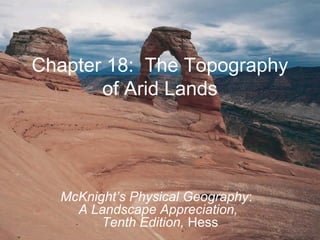
Chapter 18: The Topography
of Arid Lands
McKnight’s Physical Geography:
A Landscape Appreciation,
Tenth Edition, Hess
The Topography of Arid Lands
• A Specialized Environment
• Running Water in Waterless Regions
• Characteristic Desert Surfaces—Ergs, Regs,
and Hamadas
• The Work of Wind
• Two Characteristics of Desert Landform
Assemblages
2© 2011 Pearson Education, Inc.
A Specialized Environment
• Desert terrain stark and
abrupt
• Desert special conditions
– Weathering: mechanical
weathering dominant,
slower weathering and
angular particle formation
– Soil and regolith: soil is thin
or absent, exposing
bedrock
– Soil creep: minor due to
lack of soil and lubricating
effects of water
3© 2011 Pearson Education, Inc.
Figure 18-1
A Specialized Environment
• Desert special conditions
(cont.)
– Impermeable surfaces:
caprocks and hardpans, high
water runoff
– Sand: some deserts have sand
abundance, allows for water
input into the ground, easily
moved by rain and wind
– Rainfall: limited, most streams
are ephemeral, effective agents
of erosion, alluvium unusually
common in deserts
4© 2011 Pearson Education, Inc.
Figure 18-2
A Specialized Environment
• Desert special conditions
(cont.)
– Wind: wind action shifts
particles
– Basins of interior drainage:
most watersheds do not drain
into any ocean, water
transferred to basin or valley
with no external outlet
– Vegetation: lack of continuous
vegetative cover
5© 2011 Pearson Education, Inc.
Figure 18-4
Running Water in Waterless
Regions
• Running water most important external landform
agent
• Erosion tremendously effective with little plant cover
• Intensity of rain combined with impermeable land
surfaces create intense runoff
• Unpredictable imbalance between erosion and
deposition
6© 2011 Pearson Education, Inc.
Running Water in Waterless
Regions
• Surface water in the desert
– Exotic streams: permanent
streams that originate outside
of the arid land (i.e., Nile
River)
– Ephemeral streams:
periodically flow, result in
intense erosion,
transportation, and deposition
– Desert lakes: playas and
salinas (dry salt lake beds),
saline lakes
7© 2011 Pearson Education, Inc.
Figure 18-5
Running Water in Waterless
Regions
• Fluvial erosion in arid lands
– Occurs during small portion of
the year, flash floods
– Differential erosion: variations
in slope and shape of landform
from rock type variations
– Residual erosional surfaces:
inselbergs (i.e., bornhardts),
pediments
– Desert stream channels:
ephemeral stream beds
8© 2011 Pearson Education, Inc.
Figure 18-6
Running Water in Waterless
Regions
• Fluvial deposition in arid lands
– Talus accumulations at the
foot of steep slopes
– Piedmont: zone at the foot of
a mountain range
– Piedmont angle
– Basins of interior drainage
covered with fine particles
since flow volume and speed
are low
9© 2011 Pearson Education, Inc.
Figure 18-13
Characteristic Desert Surfaces:
Ergs, Regs, and Hamadas
• Ergs—seas of sand
– Large area covered with sand
in dune formation from wind
– Hypothesized to have
originated in a more humid
climate
– Drying of climate combined
with wind created formations
seen today
– Sahara and Arabian deserts
10© 2011 Pearson Education, Inc.
Figure 18-14
Characteristic Desert Surfaces:
Ergs, Regs, and Hamadas
• Regs—stony deserts
– Tight covering of coarse
gravel, pebbles, and/or
boulders
– Desert pavement or desert
armor
– Desert varnish: dark, shiny
coating consisting of iron and
manganese oxides
– Desert varnish is a useful
dating tool
11© 2011 Pearson Education, Inc.
Figure 18-15
Characteristic Desert Surfaces:
Ergs, Regs, and Hamadas
• Hamada—barren bedrock
– Barren surface of consolidated material
– Exposed bedrock or cemented sedimentary material
– Regs and hamadas extremely flat
12© 2011 Pearson Education, Inc.
The Work of Wind
• Wind as a sculptor is a
relatively limited effect
• Air right near surface has
zero wind
• Wind speed increases
with distance above
ground
• Effects of wind shear
• Aeolian processes
13© 2011 Pearson Education, Inc.
Figure 18-16
The Work of Wind
• Aeolian erosion
– Two effects, deflation
and abrasion
– Deflation: shifting of
loose particles via the
wind, blowouts
– Abrasion: requires tools
such as airborne sand
and dust, sculpts
landforms already in
existence, ventifacts
14© 2011 Pearson Education, Inc.
Figure 18-17
The Work of Wind
• Aeolian transportation
– Only finest particles are
carried in suspension as
dust
– Dust storms
– Larger particles moved
by saltation (curved
trajectory) and traction
(rolled or pushed)
– Creep by saltation
15© 2011 Pearson Education, Inc.
Figure 18-18
The Work of Wind
• Aeolian deposition
– Fine sand laid as thin coating,
no landform significance
– Coarser sand deposited
locally, sand plains or sand
dunes
• Desert sand dunes
– Some dune fields composed
of unanchored sand, moved
by local winds, slip face
16© 2011 Pearson Education, Inc.
Figure 18-19
The Work of Wind
• Desert sand dunes (cont.)
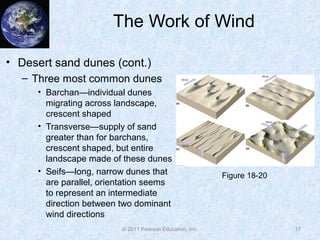
– Three most common dunes
• Barchan—individual dunes
migrating across landscape,
crescent shaped
• Transverse—supply of sand
greater than for barchans,
crescent shaped, but entire
landscape made of these dunes
• Seifs—long, narrow dunes that
are parallel, orientation seems
to represent an intermediate
direction between two dominant
wind directions
17© 2011 Pearson Education, Inc.
Figure 18-20
The Work of Wind
• Coastal dunes
– Ocean waves deposit sand
on beaches
– Prominent onshore winds
move sands inland
• Loess
– Wind deposited silt
– Lacks horizontal stratification
– Great vertical durability
– Formation not well understood
18© 2011 Pearson Education, Inc.
Figure 18-24
Two Characteristic Desert
Landform Assemblages
• Basin and range terrain
– Largely without external
drainage
– Numerous fault-block
mountain ranges
– Three principle features
• Ranges
– Surface features shaped by
weathering, mass wasting,
and fluvial processes
– Long, narrow ranges of
different elevations
19© 2011 Pearson Education, Inc.
Figure 18-27
Two Characteristic Desert
Landform Assemblages
• The piedmont zone
– Sharp break in slope that
marks change from range
to piedmont
– Underlain by erosional
pediment
– Alluvial fan: channels on
piedmont break into
distributaries, deposit new
material on old material
– Coalescing alluvial fans
– Piedmont alluvial plain, bajada
20© 2011 Pearson Education, Inc.
Figure 18-28
Two Characteristic Desert
Landform Assemblages
• The basin
– Flattish floor, very gentle slope on all sides towards a low
point
– Shallow, ill-defined drainage channels
– Salt accumulations commonplace on playa due to
evaporation of water
– Playa lakes
– Basin floor covered in fine grain material
– Death Valley is a prime example of a basin and range
terrain
21© 2011 Pearson Education, Inc.
Two Characteristic Desert
Landform Assemblages
• Death Valley
– Excellent example of
basin and range terrain
– Graben, large portion of
valley is below sea level
– Surrounding mountain
ranges
– Piedmont at foot of the
mountains is alluviated
into a complex fan structure
– Basin filled with alluvium
– Salt pans and mobile dunes
in the basin 22© 2011 Pearson Education, Inc.
Figure 18-29
Two Characteristic Desert
Landform Assemblages
• Mesa-and-scarp terrain
• Mesa—Spanish for “table,” flat
topped surface
• Scarp—short for “escarpment,”
pertains to steep cliffs
• Associated with horizontal
strata
• Variable resistance to erosion
in strata
• Plateaus and stripped plains
23© 2011 Pearson Education, Inc.
Figure 18-32
Two Characteristic Desert
Landform Assemblages
• Sapping—groundwater seeps
out of the scarp face and
erodes soluble material
• Buttes—small surface areas
and cliffs that rise above
surroundings
• Pinnacles
• Buttes, mesas, and pinnacles
typically found near a retreating
escarpment face
24© 2011 Pearson Education, Inc.
Figure 18-34
Two Characteristic Desert
Landform Assemblages
• Badlands
– Overland flows from occasional
rains develop tiny rills that
expand into ravines or gullies
– Characterized by maze of
ravines and gullies, lifeless and
nearly impassable
• Arches and natural bridges
– Arch formation
– Natural bridge formation
– Pillar formation
25© 2011 Pearson Education, Inc.
Figure 18-35
Summary
• Desert topography is abrupt and stark
• Desert terrain has ten primary characteristics that
separate it from other terrain types
• Running water is the most important land formation
mechanism is deserts
• Surface water is relatively uncommon in desert regions
but does exist in isolated lakes and streams
• Fluvial erosion and deposition result in most of the land
formations that exist in arid regions
• Ergs are vast expanses of sand in desert regions
26© 2011 Pearson Education, Inc.
Summary
• Regs are stony deserts, consisting of rocks, boulders,
and pebbles
• Hamadas are regions of barren, exposed bedrock that
is subject to mechanical weathering
• Wind acts as a sculptor of arid rock formations,
although it plays a minor role in the formation of arid
topography
• There are two primary effects of aeolian erosion
• Different sized particles interact with desert winds in
different ways
27© 2011 Pearson Education, Inc.
Summary
• There are two primary desert land formations
• The basin-and-range formation consists of a basin
surrounded by mountain ranges
• Death Valley is a classic example of a basin-and-range
desert land formation
• The mesa-and-scarp land formation is made up of a
flat-topped terrain surrounded by steep slope
• Different compositions of the rock material result in
different orientations of the land form structure
28© 2011 Pearson Education, Inc.

Ch18

  • 1.
    Chapter 18: TheTopography of Arid Lands McKnight’s Physical Geography: A Landscape Appreciation, Tenth Edition, Hess
  • 2.
    The Topography ofArid Lands • A Specialized Environment • Running Water in Waterless Regions • Characteristic Desert Surfaces—Ergs, Regs, and Hamadas • The Work of Wind • Two Characteristics of Desert Landform Assemblages 2© 2011 Pearson Education, Inc.
  • 3.
    A Specialized Environment •Desert terrain stark and abrupt • Desert special conditions – Weathering: mechanical weathering dominant, slower weathering and angular particle formation – Soil and regolith: soil is thin or absent, exposing bedrock – Soil creep: minor due to lack of soil and lubricating effects of water 3© 2011 Pearson Education, Inc. Figure 18-1
  • 4.
    A Specialized Environment •Desert special conditions (cont.) – Impermeable surfaces: caprocks and hardpans, high water runoff – Sand: some deserts have sand abundance, allows for water input into the ground, easily moved by rain and wind – Rainfall: limited, most streams are ephemeral, effective agents of erosion, alluvium unusually common in deserts 4© 2011 Pearson Education, Inc. Figure 18-2
  • 5.
    A Specialized Environment •Desert special conditions (cont.) – Wind: wind action shifts particles – Basins of interior drainage: most watersheds do not drain into any ocean, water transferred to basin or valley with no external outlet – Vegetation: lack of continuous vegetative cover 5© 2011 Pearson Education, Inc. Figure 18-4
  • 6.
    Running Water inWaterless Regions • Running water most important external landform agent • Erosion tremendously effective with little plant cover • Intensity of rain combined with impermeable land surfaces create intense runoff • Unpredictable imbalance between erosion and deposition 6© 2011 Pearson Education, Inc.
  • 7.
    Running Water inWaterless Regions • Surface water in the desert – Exotic streams: permanent streams that originate outside of the arid land (i.e., Nile River) – Ephemeral streams: periodically flow, result in intense erosion, transportation, and deposition – Desert lakes: playas and salinas (dry salt lake beds), saline lakes 7© 2011 Pearson Education, Inc. Figure 18-5
  • 8.
    Running Water inWaterless Regions • Fluvial erosion in arid lands – Occurs during small portion of the year, flash floods – Differential erosion: variations in slope and shape of landform from rock type variations – Residual erosional surfaces: inselbergs (i.e., bornhardts), pediments – Desert stream channels: ephemeral stream beds 8© 2011 Pearson Education, Inc. Figure 18-6
  • 9.
    Running Water inWaterless Regions • Fluvial deposition in arid lands – Talus accumulations at the foot of steep slopes – Piedmont: zone at the foot of a mountain range – Piedmont angle – Basins of interior drainage covered with fine particles since flow volume and speed are low 9© 2011 Pearson Education, Inc. Figure 18-13
  • 10.
    Characteristic Desert Surfaces: Ergs,Regs, and Hamadas • Ergs—seas of sand – Large area covered with sand in dune formation from wind – Hypothesized to have originated in a more humid climate – Drying of climate combined with wind created formations seen today – Sahara and Arabian deserts 10© 2011 Pearson Education, Inc. Figure 18-14
  • 11.
    Characteristic Desert Surfaces: Ergs,Regs, and Hamadas • Regs—stony deserts – Tight covering of coarse gravel, pebbles, and/or boulders – Desert pavement or desert armor – Desert varnish: dark, shiny coating consisting of iron and manganese oxides – Desert varnish is a useful dating tool 11© 2011 Pearson Education, Inc. Figure 18-15
  • 12.
    Characteristic Desert Surfaces: Ergs,Regs, and Hamadas • Hamada—barren bedrock – Barren surface of consolidated material – Exposed bedrock or cemented sedimentary material – Regs and hamadas extremely flat 12© 2011 Pearson Education, Inc.
  • 13.
    The Work ofWind • Wind as a sculptor is a relatively limited effect • Air right near surface has zero wind • Wind speed increases with distance above ground • Effects of wind shear • Aeolian processes 13© 2011 Pearson Education, Inc. Figure 18-16
  • 14.
    The Work ofWind • Aeolian erosion – Two effects, deflation and abrasion – Deflation: shifting of loose particles via the wind, blowouts – Abrasion: requires tools such as airborne sand and dust, sculpts landforms already in existence, ventifacts 14© 2011 Pearson Education, Inc. Figure 18-17
  • 15.
    The Work ofWind • Aeolian transportation – Only finest particles are carried in suspension as dust – Dust storms – Larger particles moved by saltation (curved trajectory) and traction (rolled or pushed) – Creep by saltation 15© 2011 Pearson Education, Inc. Figure 18-18
  • 16.
    The Work ofWind • Aeolian deposition – Fine sand laid as thin coating, no landform significance – Coarser sand deposited locally, sand plains or sand dunes • Desert sand dunes – Some dune fields composed of unanchored sand, moved by local winds, slip face 16© 2011 Pearson Education, Inc. Figure 18-19
  • 17.
    The Work ofWind • Desert sand dunes (cont.) – Three most common dunes • Barchan—individual dunes migrating across landscape, crescent shaped • Transverse—supply of sand greater than for barchans, crescent shaped, but entire landscape made of these dunes • Seifs—long, narrow dunes that are parallel, orientation seems to represent an intermediate direction between two dominant wind directions 17© 2011 Pearson Education, Inc. Figure 18-20
  • 18.
    The Work ofWind • Coastal dunes – Ocean waves deposit sand on beaches – Prominent onshore winds move sands inland • Loess – Wind deposited silt – Lacks horizontal stratification – Great vertical durability – Formation not well understood 18© 2011 Pearson Education, Inc. Figure 18-24
  • 19.
    Two Characteristic Desert LandformAssemblages • Basin and range terrain – Largely without external drainage – Numerous fault-block mountain ranges – Three principle features • Ranges – Surface features shaped by weathering, mass wasting, and fluvial processes – Long, narrow ranges of different elevations 19© 2011 Pearson Education, Inc. Figure 18-27
  • 20.
    Two Characteristic Desert LandformAssemblages • The piedmont zone – Sharp break in slope that marks change from range to piedmont – Underlain by erosional pediment – Alluvial fan: channels on piedmont break into distributaries, deposit new material on old material – Coalescing alluvial fans – Piedmont alluvial plain, bajada 20© 2011 Pearson Education, Inc. Figure 18-28
  • 21.
    Two Characteristic Desert LandformAssemblages • The basin – Flattish floor, very gentle slope on all sides towards a low point – Shallow, ill-defined drainage channels – Salt accumulations commonplace on playa due to evaporation of water – Playa lakes – Basin floor covered in fine grain material – Death Valley is a prime example of a basin and range terrain 21© 2011 Pearson Education, Inc.
  • 22.
    Two Characteristic Desert LandformAssemblages • Death Valley – Excellent example of basin and range terrain – Graben, large portion of valley is below sea level – Surrounding mountain ranges – Piedmont at foot of the mountains is alluviated into a complex fan structure – Basin filled with alluvium – Salt pans and mobile dunes in the basin 22© 2011 Pearson Education, Inc. Figure 18-29
  • 23.
    Two Characteristic Desert LandformAssemblages • Mesa-and-scarp terrain • Mesa—Spanish for “table,” flat topped surface • Scarp—short for “escarpment,” pertains to steep cliffs • Associated with horizontal strata • Variable resistance to erosion in strata • Plateaus and stripped plains 23© 2011 Pearson Education, Inc. Figure 18-32
  • 24.
    Two Characteristic Desert LandformAssemblages • Sapping—groundwater seeps out of the scarp face and erodes soluble material • Buttes—small surface areas and cliffs that rise above surroundings • Pinnacles • Buttes, mesas, and pinnacles typically found near a retreating escarpment face 24© 2011 Pearson Education, Inc. Figure 18-34
  • 25.
    Two Characteristic Desert LandformAssemblages • Badlands – Overland flows from occasional rains develop tiny rills that expand into ravines or gullies – Characterized by maze of ravines and gullies, lifeless and nearly impassable • Arches and natural bridges – Arch formation – Natural bridge formation – Pillar formation 25© 2011 Pearson Education, Inc. Figure 18-35
  • 26.
    Summary • Desert topographyis abrupt and stark • Desert terrain has ten primary characteristics that separate it from other terrain types • Running water is the most important land formation mechanism is deserts • Surface water is relatively uncommon in desert regions but does exist in isolated lakes and streams • Fluvial erosion and deposition result in most of the land formations that exist in arid regions • Ergs are vast expanses of sand in desert regions 26© 2011 Pearson Education, Inc.
  • 27.
    Summary • Regs arestony deserts, consisting of rocks, boulders, and pebbles • Hamadas are regions of barren, exposed bedrock that is subject to mechanical weathering • Wind acts as a sculptor of arid rock formations, although it plays a minor role in the formation of arid topography • There are two primary effects of aeolian erosion • Different sized particles interact with desert winds in different ways 27© 2011 Pearson Education, Inc.
  • 28.
    Summary • There aretwo primary desert land formations • The basin-and-range formation consists of a basin surrounded by mountain ranges • Death Valley is a classic example of a basin-and-range desert land formation • The mesa-and-scarp land formation is made up of a flat-topped terrain surrounded by steep slope • Different compositions of the rock material result in different orientations of the land form structure 28© 2011 Pearson Education, Inc.